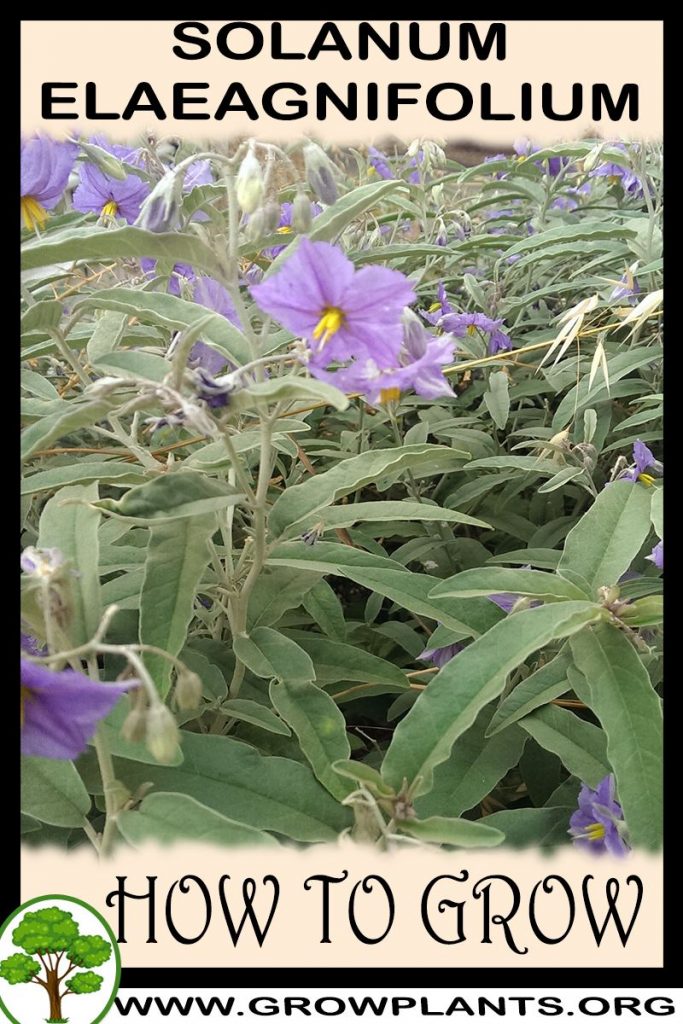
Plant Profile & Key Characteristics
Overview: A drought-tolerant, deep-rooted perennial nightshade reaching 30–80 cm (12–32 in), with silvery-grey foliage. It is grown as an ornamental but is a poisonous, aggressively spreading species.
Quick Specifications
| Specification | Attribute |
|---|---|
| Plant Type / Life Cycle | Herbaceous perennial (rhizomatous), sometimes deciduous or grown as an annual |
| Foliage Type | Evergreen to cold-deciduous |
| Mature Size | 30–80 cm (12–32 in) |
| Growth Rate | Fast to moderate |
| Root System | Deep, creeping rhizomes (spreads readily and is hard to eradicate) |
| Toxicity | Poisonous — berries and foliage contain solanine and are toxic to people and livestock; fruit is not edible |
| Hardiness | USDA zones 10b+ as a perennial; from zone 2+ as an annual |
Growth Form & Structure
- Height & Spread: Reaches 30–80 cm (12–32 in) in the ground and can be grown in a container, which also helps contain its spread.
- Growth Habit & Form: Upright, branching herb that spreads aggressively from deep rhizomes to form colonies.
- Lifespan & Maturity: A persistent perennial that regrows each season from its rootstock.
Anatomy & Physical Features
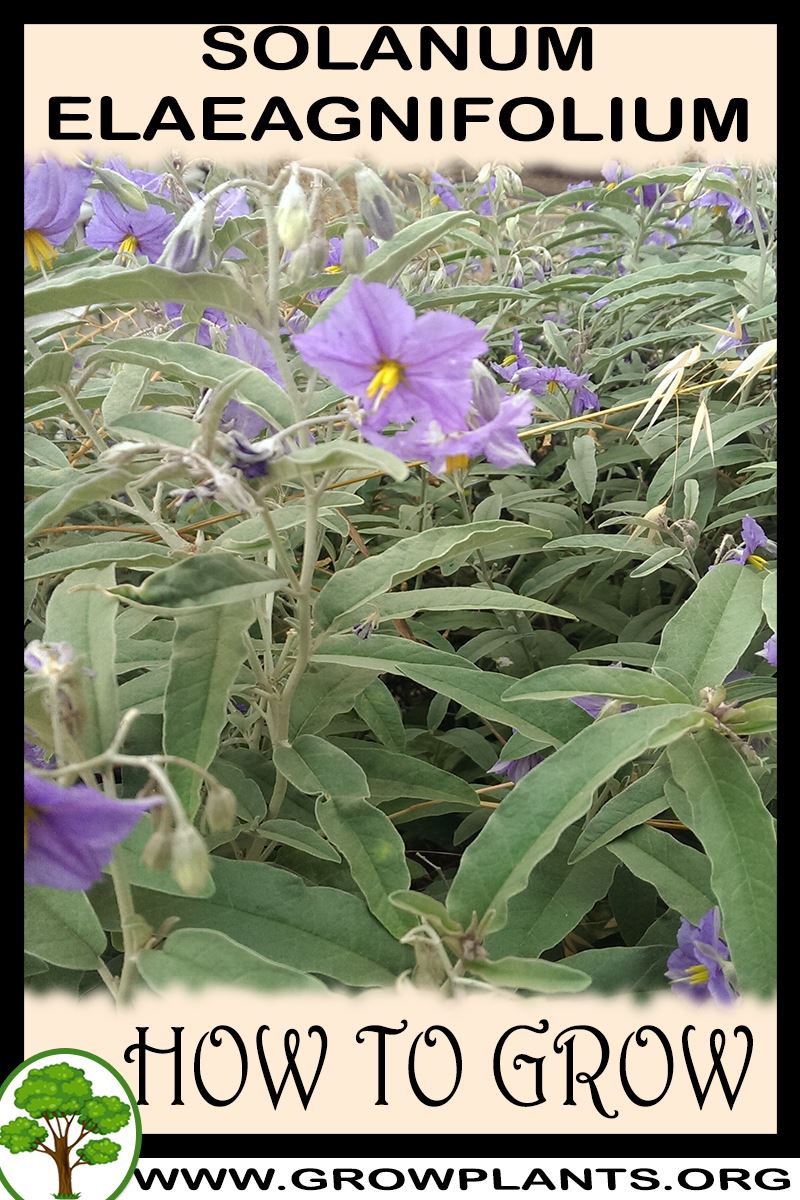
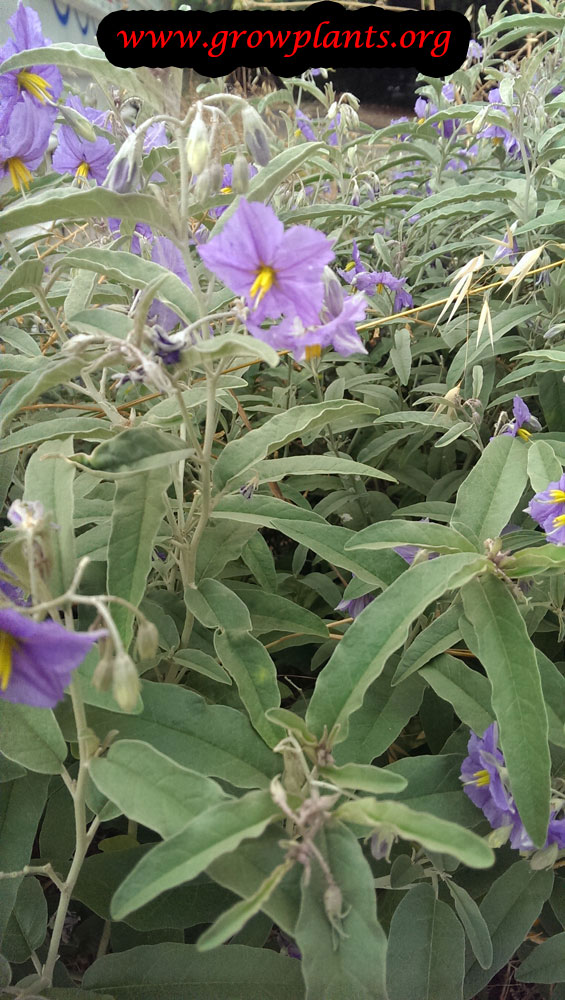
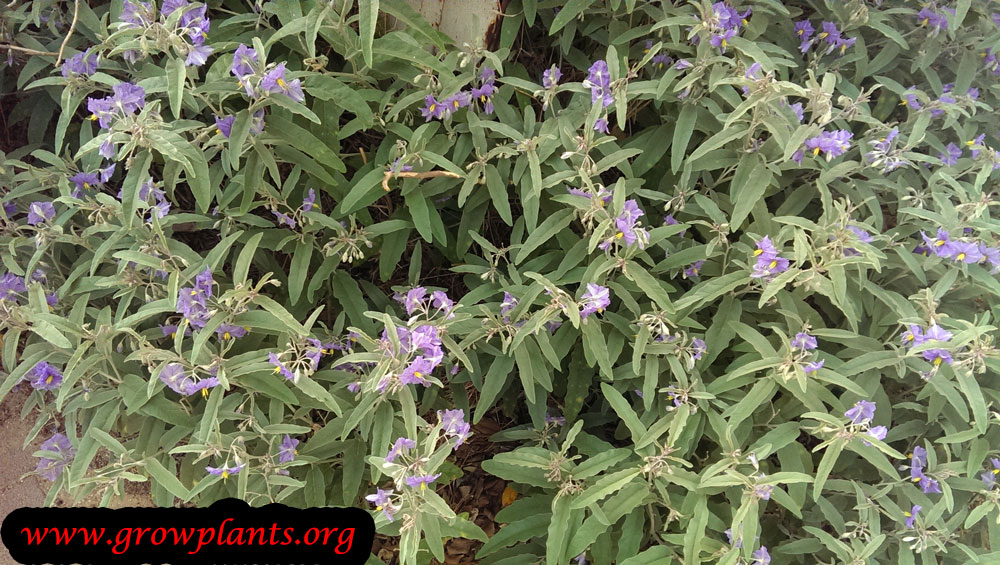
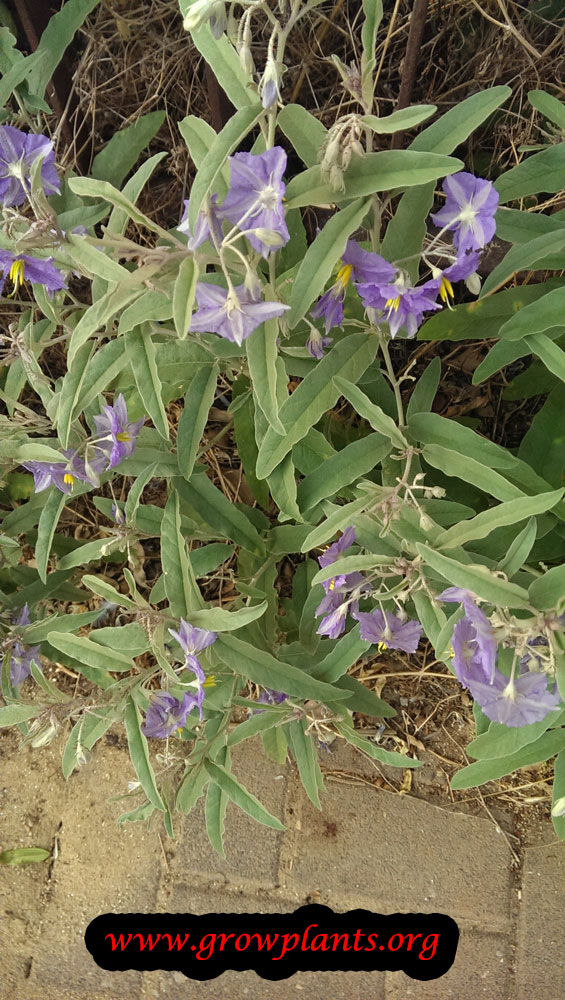
- Leaves & Foliage: Narrow, linear grey-green leaves with a silvery sheen and wavy (sinuate) margins.
Primary Uses & Landscape Value
- Functional & Ornamental Roles: Occasionally grown as a drought-tolerant ornamental, but widely regarded as an invasive noxious weed rather than a garden plant; the fruit is not edible.
Care Guide: Planting, Soil & Watering
Overview: Silverleaf nightshade is a tough, drought-tolerant perennial that grows in full sun to part shade and tolerates a wide range of soils. Once established it needs little water, so let the soil dry between waterings.
Quick Care Requirements
| Requirement | Ideal Condition |
|---|---|
| Planting Season | In spring to summer |
| Growth Rate | Moderate to fast |
| Soil Type | Adaptable and well-draining |
| Water Need | Low to moderate; drought-tolerant, let the soil dry between waterings |
Planting & Establishment
- Best Planting Season: Plant in spring to summer once the weather is warm.
- How to Plant:
- Hole Preparation: Loosen a hole a little wider than the root ball.
- Soil Amendments: Little enrichment is needed; ensure the soil drains freely.
- Planting Depth: Set the root ball level with the surrounding soil and firm gently.
- Growth Speed & Expectations: A fast grower reaching about 30–80 cm that spreads by rhizomes; it is invasive and poisonous, so contain it carefully.
Soil, Watering & Drainage Care
- Soil Mix & Drainage Needs: Very adaptable but needs free-draining soil; it thrives even in dry, poor ground.
- Watering Schedule & Technique:
- Young / Newly Planted: Water lightly while the plant establishes.
- Established: Once established it is drought-tolerant and needs only occasional deep watering.
- Seasonal Adjustments: A little more in extreme heat, very little in winter.
Climate, Light & Hardiness
Silverleaf nightshade is a tough, deep-rooted perennial of warm, sunny, dry climates - tropical, desert, subtropical, temperate and Mediterranean - growing in full sun to part shade. It is heat- and drought-hardy and, as a rhizomatous perennial, the top dies back in cold winters while the roots persist, so the site data lists it as perennial in roughly USDA zone 10b and warmer and grown from about zone 2 upward. Note it is invasive and poisonous.
Quick Climate Specifications
| Climate Zones | Tropical, desert, subtropical, temperate and Mediterranean (warm, dry-adapted) |
|---|---|
| USDA Hardiness Zones | Perennial in zone 10b+; grown from about zone 2 upward (rootstock persists where tops are frozen back) |
| Optimal Temp Range | Warm to hot conditions |
| Cold Damage Begins | Top growth is cut back by frost as temperatures fall to freezing |
| Approx. Survival Minimum | Foliage killed by frost near 0 °C (32 °F), but the deep roots survive considerable winter cold and resprout |
| Frost Tolerance | Low above ground; Moderate–High at the root (deciduous, resprouts) |
| Light Conditions | Full sun to part shade |
| Wind Tolerance | High (low, tough, deep-rooted) |
Sunlight & Light Exposure
Optimal Light Setup
Full sun suits this open-country plant best; it also tolerates part shade. Strong light and heat pose no problem.
Direct Sun Requirement
Thrives in direct, unshaded sun - it is a plant of exposed, sunny ground.
Best Exposure / Orientation
Any warm, open, sunny aspect suits it; no special shelter is needed, and its vigour means it can spread readily.
Temperature Extremes & Hardiness
USDA Hardiness & Regional Limits
The site data lists it as perennial in zone 10b and warmer and grown from about zone 2 upward. As a deep-rooted, rhizomatous perennial it behaves as a herbaceous perennial in colder zones - the top is frozen off but the roots survive and resprout, which is part of why it is such a persistent weed.
Cold Damage & Winter Protection
Frost cuts back the foliage near 0 °C (32 °F), but the extensive root system tolerates hard winter cold and regrows in spring; no protection is needed (and containment is the greater concern).
Frost Sensitivity
Only the top growth is frost-sensitive; the plant as a whole persists through winter via its roots.
Extreme Heat Tolerance
Excellent - it is at home in hot, dry, sunny climates and tolerates high temperatures and intense sun with ease.
Wind, Humidity & Microclimate
Humidity Preferences
Well adapted to dry-air climates; it does not need humidity.
Dry-Air Tolerance
High - a hallmark of the species, which thrives in arid, low-humidity conditions.
Wind Tolerance
High; its low, tough habit and deep roots shrug off wind.
Microclimate Recommendations
It needs no favourable microclimate to succeed; if grown deliberately, site it where its spread can be contained, since it is invasive and poisonous.
Growing in Pots, Balconies & Indoors
Silverleaf nightshade (Solanum elaeagnifolium) is a tough, drought-hardy perennial rather than a houseplant. It will grow in a container and can sit on a sunny patio or balcony, but be aware it is an aggressive, deeply-rooted spreader and a declared noxious weed in many regions – growing it in a sealed container (not in the open ground) actually helps keep it in check. It reaches about 30-80 cm (12-32 in).
Quick Details
- Container Size: About 10-20 L (3-5 gal) with strong drainage (general guidance; contain the roots deliberately)
- Indoor Suitability: Not a houseplant; a bright, sunny windowsill at most – and think twice about growing it at all where it is invasive
- Best Spot: Full sun to part shade
- Soil & Drainage: Undemanding but must drain freely; it tolerates lean, dry soil
- Watering in Pots: Low to moderate – it is very drought-tolerant; let the mix dry between waterings
Indoors & On the Windowsill
- Houseplant limits: The grower’s answer is no – it wants full sun and open air; indoors it only tolerates the brightest sill.
- Containment: If you grow it, keep it strictly potted with a saucer to catch seeds and runoff – never let it seed into the garden.
- Safety: All parts, especially the yellow berries, are poisonous (solanine and related alkaloids) – keep well away from children and pets.
On a Balcony or Patio
- Light & wind: Full sun and heat suit it and it shrugs off dry, windy spots; the main job is stopping it from spreading, so deadhead before berries form.
- Practicalities: Being drought-tough it is a low-maintenance pot plant, but dispose of prunings and seed carefully.
Choosing the Pot, Soil & Long-Term Care
- Pot & drainage: About a 10-20 L pot with strong drainage holes. Skip a standing-water saucer, which keeps the roots wet and invites rot. Terracotta breathes and dries faster; glazed or plastic pots hold moisture longer.
- Potting mix: Well-aerated and organic-rich – a quality potting mix, or peat/coir with perlite or vermiculite for drainage.
- Feeding: Potted plants need feeding more often than those in the ground, since frequent watering leaches nutrients away – feed through the growing season with a balanced, organic-rich fertilizer.
- Repotting: Every couple of years refresh the mix and pot on a size; for perennials, lightly prune the root ball and top growth at the same time to keep them vigorous.
Fertilizing & Feeding
A light, drought-tolerant feeder: a light balanced feeding as growth resumes plus occasional light feeding through bloom is plenty, with feeding stopped during dormancy.
Quick Fertilizing Specs
| Feeding Level | Light feeder |
|---|---|
| Main Nutrient Priority | Balanced feeding with adequate nitrogen; no high-phosphorus bloom boosters |
| Best Feeding Period | Spring through the warm flowering season |
| Organic Options | A little compost or organic matter |
| Reduce/Stop Feeding | Stop feeding during winter cold or drought dormancy |
| Micronutrients | Usually met by a complete fertilizer; correct only diagnosed issues |
| Soil pH | Tolerates a wide range, from slightly acidic to near neutral |
Feeding by Growth Stage
Spring flush of growth
Support fresh growth as the plant resumes in warm weather.
| Nutrient direction | A balanced complete fertilizer with adequate nitrogen as growth resumes; this is a tough, low-demand plant. |
|---|---|
| Timing | As growth resumes in spring or the warm season. |
| Frequency | A light feeding as growth begins. |
| Fertilizer types | A balanced complete fertilizer, A little compost or organic matter |
| Precautions | This drought-tolerant plant rarely needs much feeding, so keep it light. |
Bloom
Sustain flowering through the warm season.
| Nutrient direction | A balanced feed with adequate nitrogen sustains flowering; high-phosphorus bloom boosters are not needed. |
|---|---|
| Timing | Through the spring and summer flowering period. |
| Frequency | Occasional light feeding sustains bloom. |
| Fertilizer types | A balanced complete fertilizer |
| Precautions | Avoid overfeeding and avoid high-phosphorus bloom products, which do not improve flowering. |
Dormancy or rest
Let the plant rest through cold or dry dormancy without pushing growth.
| Nutrient direction | None – do not fertilize while the plant is dormant. |
|---|---|
| Timing | During winter cold or drought-induced dormancy. |
| Frequency | No feeding at this stage; resume only when active growth returns. |
| Fertilizer types | No feeding at this stage; do not fertilize until active growth resumes. |
| Precautions | Withhold fertilizer during dormancy; feeding an inactive plant wastes nutrients and risks salt buildup. |
Nutrient Deficiency Signs & Corrections
Older, lower leaves fade to pale green or uniform yellow and overall growth slows.
| Possible causes | low available soil nitrogen, nitrogen leaching from heavy watering or rain, thin, low-organic-matter soil |
|---|---|
| Appears first on | older, lower leaves |
| What to check | recent feeding history, soil organic matter, watering and drainage |
| Possible correction | Apply a nitrogen-containing complete fertilizer and build soil organic matter, then water evenly. |
Interveinal yellowing on older leaves while the veins themselves stay green.
| Possible causes | low soil magnesium, high potassium feeding competing with magnesium uptake, leaching in light, sandy soils |
|---|---|
| Appears first on | older, lower leaves |
| What to check | soil magnesium status, how potassium-heavy recent feeding has been, soil texture and leaching |
| Possible correction | Apply a labeled magnesium source such as Epsom salt or a dolomitic amendment and rebalance feeding. |
Leaf margins brown or scorch and growth stalls despite adequate watering.
| Possible causes | fertilizer salt buildup in the root zone, under-watering that concentrates salts, excessive or too-frequent feeding |
|---|---|
| Appears first on | leaf margins and tips |
| What to check | recent fertilizer amounts, watering consistency, drainage, especially in containers |
| Possible correction | Ease off feeding, water thoroughly to flush accumulated salts, then return to lighter feeding. |
Pruning, Training & Seasonal Maintenance
Silverleaf nightshade (Solanum elaeagnifolium) is a deep-rooted, rhizomatous perennial that spreads aggressively and is widely treated as a noxious weed; it is spiny and poisonous, and its berries are not edible. “Pruning” here is really containment: cutting or deadheading to stop it setting and scattering seed, and cutting top growth back for tidiness—while understanding that cutting alone does not kill it, because it resprouts from a deep root system and even from root fragments. Wear gloves for the spines and the toxic sap, and never rotovate around it, which multiplies it from severed roots.
Quick Pruning & Maintenance Specs
| Pruning Tolerance | High to cutting, but it resprouts vigorously from the roots |
| Primary Pruning Window | Whenever flowering starts – before seed sets – through the season |
| Typical Frequency | Repeatedly, to keep on top of seed set and spread |
| Main Objective | Stop seed production; contain spread; tidy top growth |
| Young Plant Priority | Remove before it establishes a deep root run, if unwanted |
| Mature Plant Priority | Deadhead/cut before berries ripen; contain rhizomes |
| Best Tool Type | Bypass secateurs or shears (with gloves) |
| Avoid Heavy Pruning During | — (there is no bloom crop to protect; timing is set by seed control) |
Pruning by Plant Age & Size
Newly Established
If it is unwanted, deal with a young plant before it builds its deep root system—once established, cutting the top only prompts regrowth. Where deliberately kept as a tough drought-tolerant ornamental, remove only damaged growth early on.
Young / Formative
There is no training system for this weedy perennial. The only formative decision is whether to keep it contained at all, given how readily it runs and seeds.
Mature / Established
Cut or deadhead repeatedly to prevent seed, and cut top growth back for tidiness and control—accepting that regrowth will follow from the roots. Remove and bag any berried stems rather than leaving seed to spread.
Seasonal Pruning Schedule
Flowering (Seed Prevention)
Objective: stop seed set. Remove: flowering and berrying stems before the fruit ripens. Response: repeated regrowth from the roots, which must be cut again—persistence starves the root over time.
Ongoing Containment
Objective: limit spread. Cut back runners and top growth as it advances; never cultivate the soil around it, which propagates it from root fragments.
Structural Pruning & Training
None applies. This is a spreading herbaceous perennial with no framework to build or maintain; all cutting is for seed prevention and containment rather than shape.
Special Growth to Remove
Remove flowering and berrying stems (to stop seed) and cut back the root suckers and runners that let it colonise ground. Do not compost seed-bearing or root material—bag and dispose of it—and remember that broken roots resprout.
Container & Small-Space Pruning
If grown deliberately, a container is the safest way to enjoy it, since it stops the deep roots and rhizomes escaping into beds. Cut off flowers before they seed and confine all root material to the pot; never tip spent soil with root fragments into open ground.
Tools
Bypass secateurs for individual stems, or shears for cutting a patch back to prevent seed. Wear stout gloves against the spines and toxic sap. No saw, loppers or pole pruner apply to this low herbaceous plant.
Tool Hygiene & Disease Risk
Classification: Routine for disease, but treat cuttings as hazardous material: it is poisonous, so wash hands and tools after cutting, keep the sap off skin and eyes, and dispose of prunings safely away from where seed or root fragments could establish.
Cut Placement & Technique
Cut flowering stems low, before berries form, to remove the most seed for the least regrowth. Deadhead cleanly at a node. Because the plant answers cutting with root regrowth, repeated timely cuts matter more than any single precise placement.
Heavy Pruning & Rejuvenation
Cutting the whole plant to the ground does not kill it—it resprouts from the deep root system—so there is no rejuvenation goal; repeated cutting is a suppression tactic, not a renewal one. Lasting control comes from persistence over seasons (and, where appropriate, targeted removal of the root system), not from a single hard cut.
Post-Pruning Care
After cutting, monitor for the inevitable regrowth and cut again before it flowers; keep watch for seedlings nearby. No feeding is wanted—the aim is to weaken, not encourage, the plant.
Common Pruning Mistakes
- Assuming a single cut-back kills it—it resprouts from deep roots.
- Cultivating or rotovating the soil around it and multiplying it from root fragments.
- Letting berries ripen and scatter seed.
- Handling it bare-handed, ignoring the spines and toxic sap.
When NOT to Prune
There is no bloom to protect, so timing is driven by seed control—the mistake is not pruning too early but leaving it too late, after seed has set. Do not disturb the soil around the roots at any time.
Recommended Tools (by task)
- bypass_secateurs — cut individual flowering/berrying stems before seed set.
- hedge_shears — cut a spreading patch back quickly to prevent seeding (with gloves).
Propagation Guide
Silverleaf nightshade spreads by both seed and its deep creeping roots, and any root fragment left in the soil can regrow – the trait that makes it such a persistent weed. Vegetative regeneration from root pieces is effortless; seed is slower because of a hard coat. Propagation is easy, but note this is a declared or regulated weed in many regions and is poisonous.
Quick Propagation Specs
| Best Propagation Method | Root fragments / creeping roots (vegetative) |
| Alternative Methods | Seed |
| Propagation Difficulty | Easy |
| Seed True-to-Type | Mostly uniform for this wild species |
| Vegetative True-to-Type | Yes – root fragments are clones of the parent |
| Best Propagation Season | Spring to summer (warm season) |
| Germination Temperature | Warm, roughly 20–30°C (68–86°F) |
Growing from Seed
Seed Handling & Dormancy
The seed has a hard coat and germinates erratically; gentle scarification or soaking improves and evens up emergence. Sow into warm soil in spring or summer. Because seed and root pieces both establish so readily, contain the plant carefully.
Division, Root Fragments & Creeping Roots
The plant regenerates from adventitious buds on its lateral roots, so a severed piece of root will produce a new shoot. A rooted section lifted with the warm season in mind will establish quickly. This same ability means cultivation that chops the roots simply multiplies the plant.
Bloom & Flower Guide
Quick Details
- Bloom Season: Spring to summer
- Flower Appearance: Purple or white star-shaped flowers with five petals, mostly in clusters
- Edibility: Not edible – the whole plant, including flowers and berries, is toxic. Handle as an ornamental or weed only
Detailed Blooming Overview
Silverleaf nightshade is a tough, drought-hardy plant with striking silvery-grey foliage and pretty purple or white star flowers through spring and summer. The blooms are genuinely ornamental and draw pollinators, but the plant is toxic throughout and spreads aggressively, so it is best enjoyed for its flowers while kept firmly in check.
Flower Characteristics
- Five-petaled purple or white stars with a prominent central cone of yellow anthers.
- Usually borne in small clusters above the silvery leaves.
Bloom Care & Thinning
- Managing the bloom: To limit its aggressive self-seeding, removing spent flowers before they set berries slows its spread.
- Pollination: The flowers are buzz-pollinated by bees, which vibrate the anthers to release pollen.
- Safety: Wear gloves when handling; all parts are poisonous and the berries are especially dangerous to children and livestock.
Pests, Diseases & Troubleshooting
Overview: Silverleaf nightshade (Solanum elaeagnifolium) is a tough, deep-rooted perennial weed rather than a cultivated crop, so it is extremely pest- and drought-hardy; the interest here is that it hosts and shares pests with cultivated nightshades and can act as a reservoir of their pests and viruses. It is best managed by removal, not spraying pests onto it – the pest notes below reflect the nightshade complex it carries.
Quick Troubleshooting Overview
| Issue / Pest | Main Symptom | Primary Solution |
|---|---|---|
| Colorado potato beetle | Striped beetles/grubs defoliating plants | Hand-pull the weed; host removal |
| Flea beetles | Shot-holes in the silvery leaves | Manage as a nightshade-family host |
| Aphids | Honeydew; carries potato/tomato viruses | Remove weed to cut virus reservoir |
| Nightshade specialist beetles | Chewed foliage from Leptinotarsa relatives | Monitor nearby crops |
| Foliar leaf spots | Spots on leaves in humid weather | Usually minor on this hardy weed |
| Deep taproot regrowth | Resprouts from root fragments | Persistent removal, avoid fragmenting roots |
Common Pests & Management
- Colorado potato beetle (Leptinotarsa decemlineata):
- Symptoms: Yellow-and-black striped beetles and red humped grubs chewing the foliage; this weed is a favoured wild host that can seed infestations into nearby potato and eggplant.
- Prevention & Control: Because it is a weed, the priority is removing the plant itself; near crops, hand-pick beetles and eggs and control the weed reservoir.
- Flea beetles (Epitrix spp.):
- Symptoms: Tiny shot-holes across the silvery leaves; the weed hosts the same flea beetles that damage crop nightshades.
- Prevention & Control: Manage as a host – remove silverleaf nightshade around vegetable beds to reduce beetle pressure.
- Aphids (Myzus persicae, Aphis spp.):
- Symptoms: Green/black clusters on shoots with honeydew; important because the weed is a reservoir of aphid-borne potato and tomato viruses.
- Prevention & Control: Remove the weed to cut the virus and aphid reservoir near crops; direct spraying of a weed is rarely warranted.
- False potato beetle & other chewers (Leptinotarsa juncta and relatives):
- Symptoms: Beetles and larvae grazing the foliage of this and related wild nightshades.
- Prevention & Control: Monitor and protect nearby cultivated nightshades; control the weed host.
Diseases & Fungal Issues
- Foliar leaf spots (Alternaria, Cercospora spp.):
- Symptoms: Occasional brown spots on leaves in humid conditions; generally minor on this hardy plant.
- Treatment & Management: No action usually needed; the value is noting it can harbour crop pathogens.
- Nightshade viruses (reservoir role) (PVY, CMV, TSWV):
- Symptoms: Mottling or ringspots may appear, but the weed often tolerates viruses while spreading them to crops.
- Treatment & Management: Remove the weed near susceptible crops and control the aphid and thrips vectors on the crop side.
- Root-knot nematodes (host) (Meloidogyne spp.):
- Symptoms: The deep roots can host root-knot nematodes that then threaten cultivated nightshades.
- Treatment & Management: Eliminate the weed and rotate crops away from infested ground.
Growing Difficulties & Abiotic Problems
- Aggressive regrowth from roots:
- Cause & Symptoms: The deep, spreading taproot resprouts from fragments, making it very hard to remove and a persistent weed.
- Correction Strategy: Remove young plants before seeding, avoid chopping roots (which multiplies plants), and be persistent over several seasons.
- Drought & heat hardiness:
- Cause & Symptoms: Its silvery hairs and deep roots make it thrive in dry heat where crops fail, so it dominates neglected ground.
- Correction Strategy: Maintain competitive crop or ground cover and keep beds mulched to suppress seedlings.
- Toxicity:
- Cause & Symptoms: All parts, especially the berries, contain toxic solanine-type alkaloids.
- Correction Strategy: Handle with gloves, keep away from livestock and children, and do not confuse it with edible relatives.
What Helps – Products & Tools
Because silverleaf nightshade is a weed, the main ‘tools’ are physical removal and host management rather than pest sprays. Where it grows near crops, insecticidal soap or neem and reflective mulch protect the actual crop from the aphids and beetles it harbours, and persistent hand-removal reduces the pest and virus reservoir.