

Plant Profile & Key Characteristics
Overview: A short-lived tender perennial almost always grown as an annual, forming a soft-stemmed bush or vine 0.5–3 m (1.5–10 ft) tall depending on cultivar and type. It is grown for its edible fruit, which is eaten fresh and cooked into sauce and juice.
Quick Specifications
| Specification | Attribute |
|---|---|
| Plant Type / Life Cycle | Tender perennial grown as an annual |
| Foliage Type | Herbaceous, evergreen while growing (frost-killed) |
| Mature Size | 0.5–3 m (1.5–10 ft) |
| Growth Rate | Fast to moderate |
| Root System | Taproot developing extensive fibrous roots; stems readily form adventitious roots where they touch soil |
| Toxicity | Fruit edible; the foliage and green parts contain solanine and are toxic if eaten |
| Hardiness | USDA zones 11+ as a perennial; grown as a warm-season annual from zone 2+ |
Growth Form & Structure
- Height & Spread: Reaches 0.5–3 m (1.5–10 ft) in the ground; dwarf and determinate cultivars stay much smaller and the compact ones grow well in pots and, with the right variety, even on a sunny windowsill.
- Growth Habit & Form: Soft-stemmed plant grown either as a self-topping bush (determinate) or as an indeterminate vine that keeps climbing and cropping and needs staking or caging.
- Lifespan & Maturity: Fruiting begins about 1–2.5 months after transplanting, with harvest roughly 55–160 days from sowing; the plant is spent after one season in most climates.
Anatomy & Physical Features
- Leaves & Foliage: Green, pinnately divided, aromatic leaves; plants are either the serrated regular-leaf type or the smooth, broad-lobed potato-leaf type.
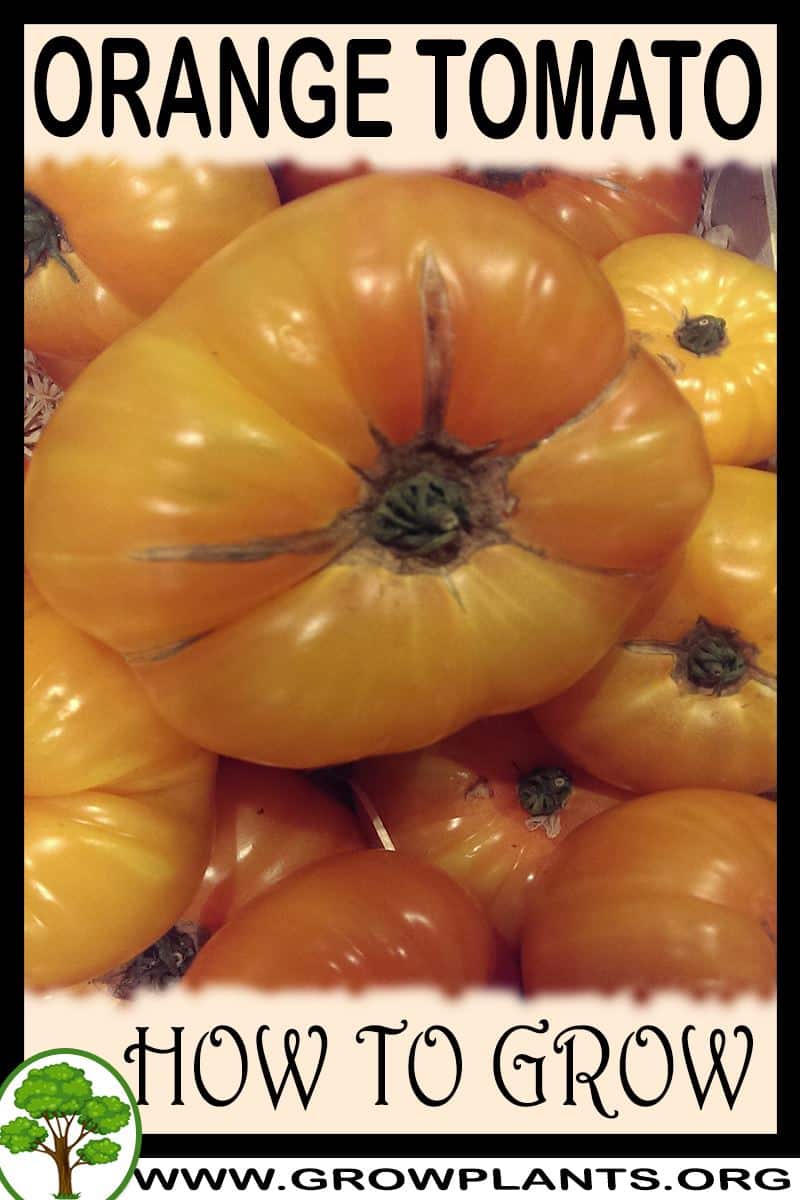
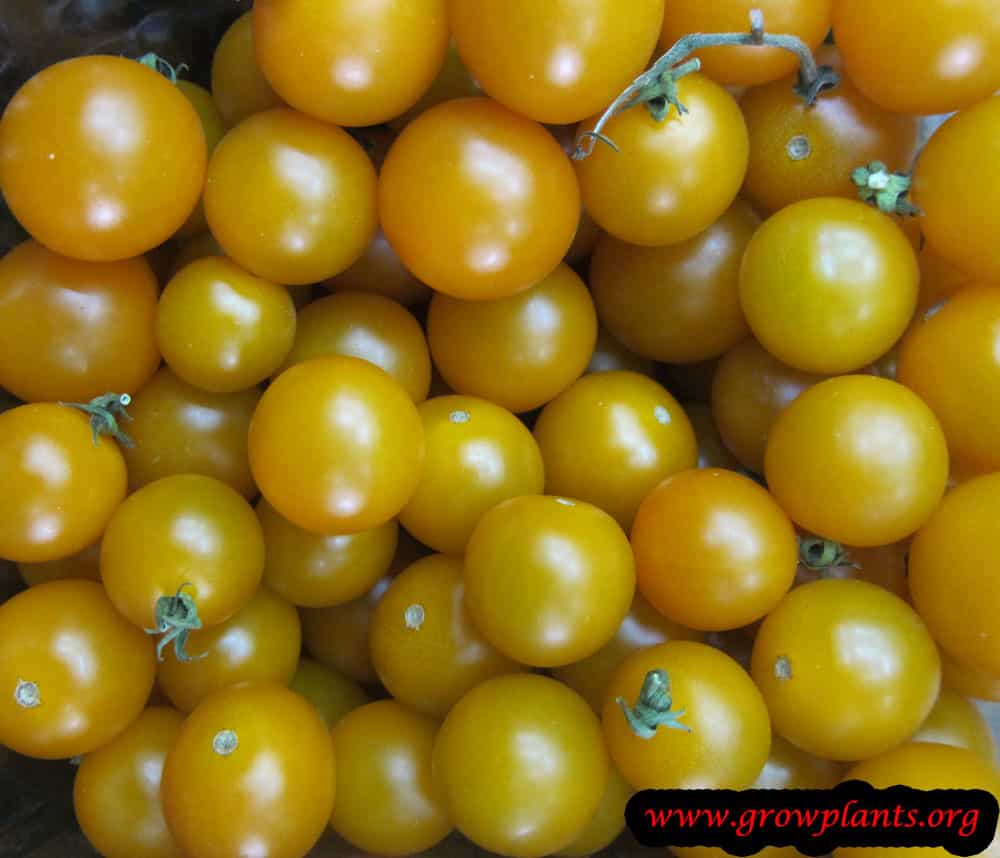
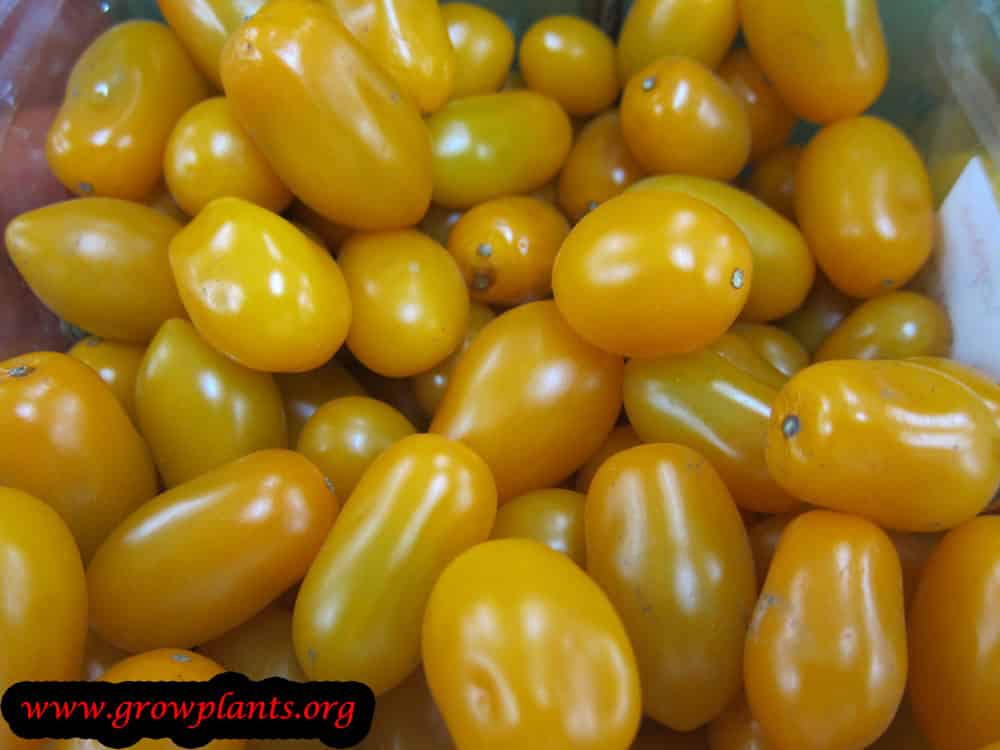
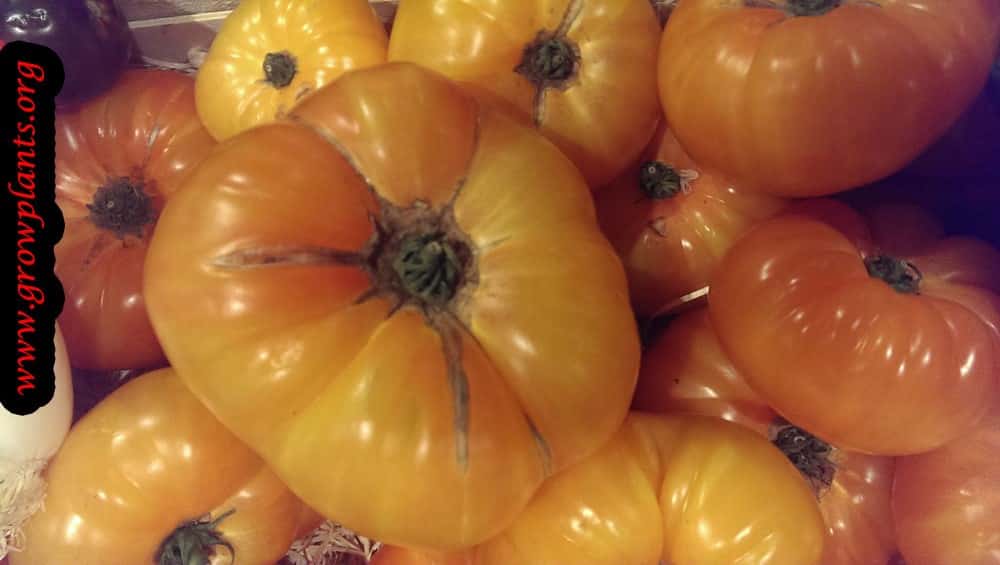
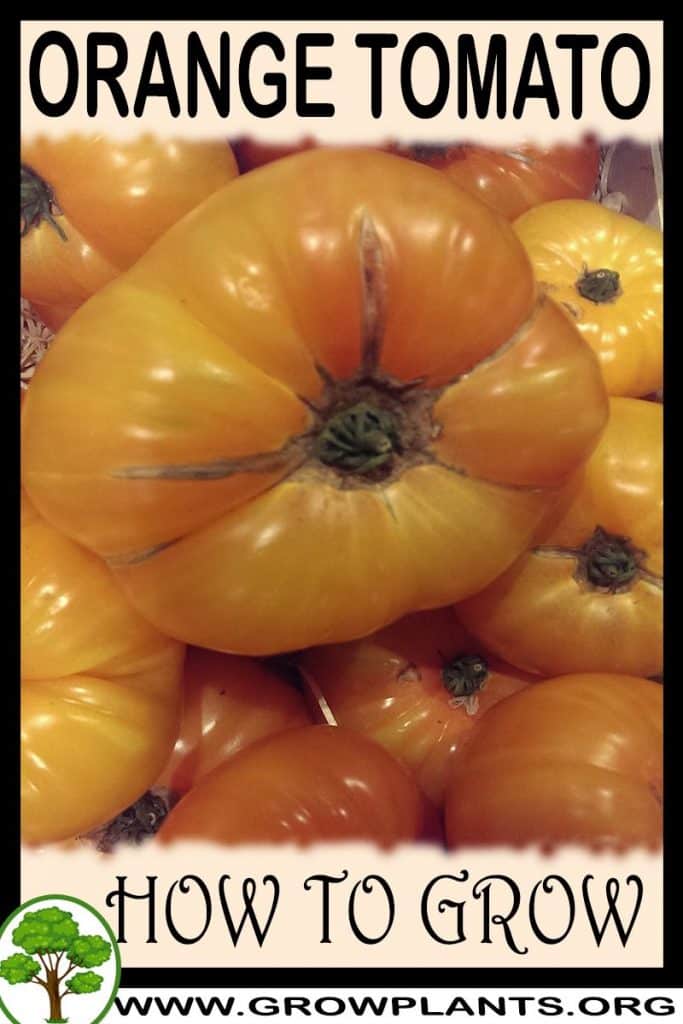
- Fruit Profile: Orange fruit, sometimes blended with red, yellow or pink and occasionally striped or spotted; round to beefsteak in form.
Primary Uses & Landscape Value
- Edible Uses: Eaten fresh in salads and cooked down into sauce, paste and juice, and preserved in many forms.
- Functional & Ornamental Roles: A staple vegetable-garden and container crop; compact bush types also suit patio pots and hanging baskets.
Care Guide: Planting, Soil & Watering
Overview: Tomatoes are warm-season plants that crop best in full sun and rich, nutrient-packed, well-draining soil. They are frost-tender and need steady moisture, so keep the soil evenly moist and feed the plant through the growing season.
Quick Care Requirements
| Requirement | Ideal Condition |
|---|---|
| Planting Season | In spring after the last frost (zones 2–10a); spring to summer in 10b–11a; spring to autumn in 11b; year-round in zone 12+ |
| Growth Rate | Moderate to fast |
| Soil Type | Rich, nutrient-packed, organic and well-draining |
| Soil pH | 6.0–6.8 (slightly acidic to neutral) |
| Water Need | Moderate to high; keep the soil evenly moist |
Planting & Establishment
- Best Planting Season: Plant out in spring once the last frost has passed and the soil has warmed; in warm, frost-free zones (10b–11a) plant from spring into summer, in zone 11b spring through autumn, and year-round from zone 12.
- How to Plant:
- Hole Preparation: Dig a hole wider and a little deeper than the root ball so the roots can spread into loose soil.
- Soil Amendments: Mix in plenty of organic matter, dead leaves and humus, then backfill with some of that enriched soil.
- Planting Depth: Tomatoes root along their stems, so you can set the plant a few centimetres deeper than it grew in the pot; firm gently and add a support or cage at planting time.
- Growth Speed & Expectations: A quick, vigorous grower reaching about 0.5–3 m depending on cultivar; feed and add organic matter if growth is slow, and provide trellising or a cage as it climbs.
Soil, Watering & Drainage Care
- Soil Mix & Drainage Needs: Give it a well-ventilated, free-draining soil rich in organic matter; in containers (about 10–30 L) use a quality potting mix, avoid a saucer that traps water, and mulch to keep the root zone evenly moist.
- Watering Schedule & Technique:
- Young / Newly Planted: Water twice on planting day, then daily for the first couple of weeks while the roots establish.
- Established: Water regularly and deeply to keep the soil consistently moist; mulch, especially in summer, to hold moisture and steady the supply.
- Seasonal Adjustments: Water more in summer heat and less in cool weather; protect the plant from winter cold, which damages or kills it in all but frost-free zones.
Climate, Light & Hardiness
Orange tomato is a warm-season crop that thrives in full sun and long, mild-to-hot growing seasons across tropical, subtropical, Mediterranean, temperate and even desert climates. It is frost-tender - commonly grown as a summer annual wherever winters freeze, yet capable of longer-term growth in essentially frost-free conditions (roughly USDA zone 11 and warmer).
Quick Climate Specifications
| Climate Zones | Tropical, subtropical, Mediterranean, temperate and desert (warm-season growing) |
|---|---|
| USDA Hardiness Zones | Perennial in zone 11+ (zone 10b with winter protection and suitable cultivars); grown as an annual from zone 2 upward |
| Optimal Temp Range | About 21–26 °C (70–79 °F); tolerable roughly 10–32 °C (50–90 °F) |
| Cold Damage Begins | Growth slows and chilling stress appears below about 10–12 °C (50–54 °F) |
| Approx. Survival Minimum | Near 0 °C (32 °F); frost is generally fatal to unprotected plants |
| Frost Tolerance | None |
| Light Conditions | Full sun (6+ hours; light afternoon shade only under extreme desert heat) |
| Wind Tolerance | Low–Moderate (tall, brittle, fruit-laden stems need support) |
Sunlight & Light Exposure
Optimal Light Setup
Grow in full sun - at least 6–8 hours of direct light daily gives the strongest growth and best fruit set. In reduced light the plant still grows but flowers and fruits noticeably less.
Direct Sun Requirement
This is a genuine full-sun crop; it will not crop well in shade, so an open, unshaded position is important for ripening.
Shade & Heat Management
In very hot, high-sun desert conditions, exposed fruit and foliage can scald; light afternoon shade or shade cloth during peak heat helps protect developing fruit.
Best Exposure / Orientation
A warm, sheltered, sun-facing spot maximizes heat and light and speeds ripening, while good air movement helps limit foliar disease.
Temperature Extremes & Hardiness
USDA Hardiness & Regional Limits
The site data lists orange tomato as perennial in hardiness zone 11 and warmer, growable in zone 10b with winter protection and the right cultivars, and grown as an annual from zone 2 upward. Hardiness here reflects winter cold survival, not heat preference - in colder zones the plant is simply grown as a warm-season annual and replaced each year.
Cold Damage & Winter Protection
Growth slows as temperatures fall below roughly 10–12 °C (50–54 °F), and in zone 10b winters an overwintering plant often suffers or dies from the cold. Where winters are mild, growers frequently keep a cultivar going by taking cuttings or overwintering stems indoors and replanting after the last frost.
Frost Sensitivity
The plant has no frost tolerance: light frost damages foliage and frost near 0 °C (32 °F) is generally fatal to unprotected plants. Transplant outdoors only after the last expected frost.
Extreme Heat Tolerance
It handles heat well up to about 32 °C (90 °F), but sustained higher temperatures can reduce flowering and fruit set and, under strong sun, cause sunscald on exposed fruit. Cold tolerance and heat performance vary by cultivar, plant age, exposure duration and conditions.
Frost-Free Growing Season
Because it is frost-tender, orange tomato needs a frost-free window long enough to mature a crop - typically on the order of 55–160 days from sowing to first harvest. In short-season regions, start seed indoors in late winter and transplant out after the last frost to make the most of the warm season.
Wind, Humidity & Microclimate
Humidity Preferences
Germinating seed and young seedlings prefer warm, humid conditions; established plants adapt to a fairly wide humidity range, with moderate humidity and good airflow being ideal.
Dry-Air Tolerance
Mature plants tolerate dry air reasonably well provided soil moisture is maintained, though very dry, hot winds can stress flowers and cause blossom drop.
Wind Tolerance
Tall, brittle, fruit-laden stems break easily in wind, so staking, caging or trellising and a sheltered site are important - especially for container plants, whose root zones also heat, cool and dry out faster and are more wind-exposed.
Rainfall & Seasonal Moisture
The crop suits a warm growing season with dry-to-moderate conditions; prolonged wet, humid weather encourages foliar and fruit diseases, so a drier ripening period improves fruit quality.
Microclimate Recommendations
A warm, sheltered microclimate - a sunny wall, raised bed or reflected heat - extends the season in cooler areas, while afternoon shade and airflow ease extreme-heat sites.
Growing in Pots, Balconies & Indoors
The orange tomato is an excellent container and balcony plant but not a true houseplant – indoors the light is too weak unless it sits on a very sunny sill. Tomatoes also do well hydroponically, though they need a larger setup than leafy crops – a Dutch bucket or NFT system with sturdy support once fruit sets. In a large, free-draining pot it crops heavily on a patio or balcony.
Quick Details
- Container Size: 10-30 L (2-6 gal), depending on the cultivar
- Indoor Suitability: Not a deep-indoor houseplant; a compact cultivar can fruit on a bright, sunny windowsill
- Best Spot: Full sun – a warm, south-facing balcony or patio is ideal (it fruits in a little less light, just less heavily)
- Soil & Drainage: Well-ventilated, organic-rich mix (potting mix, or peat/coir with perlite or vermiculite); must drain freely
- Watering in Pots: Keep the soil evenly moist – pots dry fast; let water drain away and never leave it waterlogged
Indoors & On the Windowsill
- Houseplant limits: It will not thrive deep in a room – the light is simply too weak for a fruiting plant.
- Windowsill growing: Choose a compact or dwarf cultivar and a sunny sill with direct sun; there the plant and its fruit get enough light, as the grower notes.
- Overwintering: In frost-free conditions it can be carried over as a short-lived perennial; where winters are cold, bring a potted plant under cover before the first frost.
- Safety: The ripe fruit is edible, but the leaves, stems and unripe fruit are toxic if eaten – keep the foliage out of reach of children and pets indoors.
On a Balcony or Patio
- Light & wind: Give it the sunniest spot; on an exposed balcony, stake or cage it and shelter it from wind. Walls and paving reflect heat, so pots dry quickly – check moisture daily in warm weather. A drip irrigation kit with a timer can take over that watering check automatically.
- Practicalities: A full 10-30 L pot is heavy once watered – make sure the balcony can take the weight and that drainage runoff will not be a nuisance below.
Choosing the Pot, Soil & Long-Term Care
- Pot & drainage: A 10-30 L pot with strong drainage holes; the grower advises against standing it in a saucer of water, so let it drain freely and avoid root rot. Terracotta breathes and dries faster, while glazed or plastic pots hold moisture longer.
- Potting mix: Well-ventilated and organic-rich – potting mix, or peat with perlite or vermiculite.
- Feeding: Potted plants need feeding more often than those in the ground, as nutrients wash out with each watering – a balanced feed, easing off high nitrogen once flowers and fruit set.
- As a perennial (frost-free climates): every two years refresh the mix and lightly prune the root ball and the top growth.
Growing this plant in a greenhouse
A greenhouse can give orange tomato plant frost protection, cold protection, a longer growing season and controlled production. Under warm enough conditions it can keep growing well beyond the normal outdoor season and potentially be maintained year-round - though continuous cropping is not guaranteed and depends on temperature and light.
Greenhouse at a glance
| Greenhouse suitability | Excellent - a major practical advantage |
|---|---|
| Main benefits | frost protection, cold protection, a longer growing season, controlled production |
| Season extension | potentially year-round |
| Outdoor protection advisable below | about 12°C |
| Maintain greenhouse minimum | around 12°C for active growth |
| Suitable types | heated greenhouse, polycarbonate greenhouse, lean-to |
| Heating | Heating is recommended in cold climates for continuous growth. |
Related greenhouse guides
- Greenhouses: How to Choose the Right Greenhouse
- Best Greenhouse Heaters
- Greenhouse Climate Control: Temperature, Ventilation and Humidity
- Best Lean-To Greenhouses
Fertilizing & Feeding
A moderate feeder that responds to steady, balanced nutrition through the warm growing season, leaning nitrogen-forward while it builds foliage and shifting toward potassium as fruit sets and ripens; rich, organic-matter-amended soil reduces how much supplemental feeding is needed. A fertilizer formulated for tomatoes and vegetables supports that feeding pattern through harvest.
Quick Fertilizing Specs
| Feeding Level | moderate |
|---|---|
| Main Nutrient Priority | Balanced nutrition early, shifting toward potassium at fruiting |
| Best Feeding Period | Through the active warm-season growth and fruiting period |
| Organic Options | Compost, well-rotted manure and organic matter worked into the bed at planting |
| Soil pH | Slightly acidic to near neutral |
| Reduce/Stop Feeding | Ease off as the season winds down and the plant stops setting new fruit |
| Micronutrients | A complete vegetable fertilizer usually supplies the needed micronutrients |
Feeding by Growth Stage
Establishment after transplanting
Help young transplants settle in and build roots without pushing soft, overly leafy growth.
| Nutrient direction | Gentle, balanced nutrition supported by organic matter worked into the bed. |
|---|---|
| Timing | At and shortly after transplanting into warm soil. |
| Frequency | A light feeding as plants establish is usually enough. |
| Fertilizer types | A balanced complete vegetable fertilizer, Compost or well-rotted organic matter mixed into the planting area |
| Precautions | Avoid heavy nitrogen at planting, which favors foliage ahead of early root and flower development. |
Vegetative growth
Build a strong, healthy leafy framework able to support heavy fruiting.
| Nutrient direction | Nitrogen-forward but still balanced feeding to drive steady shoot and leaf growth. |
|---|---|
| Timing | As plants grow actively before and during early flowering. |
| Frequency | Feed steadily through active growth, keeping feeding moderate. |
| Fertilizer types | A nitrogen-forward complete vegetable fertilizer, Side-dressing with compost or a balanced granular feed |
| Precautions | Ease back on nitrogen as flowering begins, or the plant may delay fruit set in favor of foliage. |
Flowering, fruit set and harvest
Support continuous flowering, fruit set and ripening over a long harvest.
| Nutrient direction | Shift toward balanced feeding with stronger potassium to support fruit development and quality. |
|---|---|
| Timing | From the onset of flowering through the main harvest period. |
| Frequency | Feed steadily through the fruiting period as the plant keeps setting and ripening fruit. |
| Fertilizer types | A balanced complete vegetable fertilizer with good potassium, A tomato- or vegetable-type feed formulated for fruiting plants |
| Precautions | Keep moisture and feeding steady, since swings can trigger fruit disorders such as blossom-end rot and cracking. |
Nutrient Deficiency Signs & Corrections
Older, lower leaves turn pale then yellow while growth slows and plants look thin.
| Possible causes | Low soil nitrogen or leaching from heavy watering, Cold or waterlogged soil limiting root uptake, Poor, low-organic-matter soil |
|---|---|
| Appears first on | Older, lower leaves |
| What to check | Recent feeding history and soil organic matter, Soil moisture and drainage, Overall plant vigor and leaf-color pattern |
| Possible correction | Apply a balanced or nitrogen-forward complete fertilizer and build up soil organic matter; correct any waterlogging. |
Edges of older leaves scorch and yellow, and fruit may ripen unevenly.
| Possible causes | Low soil potassium, High demand during heavy fruiting outpacing supply, Sandy soils prone to leaching |
|---|---|
| Appears first on | Older, lower leaves |
| What to check | Feeding program during fruiting, Soil type and past fertilization, Uniformity of fruit ripening |
| Possible correction | Use a complete fertilizer with adequate potassium during fruiting and keep feeding and watering steady. |
A dark, sunken, leathery patch develops on the blossom end of the fruit.
| Possible causes | Uneven soil moisture disrupting calcium movement into the fruit, Localized calcium shortage in rapidly growing fruit, Root damage or excess salts limiting uptake |
|---|---|
| Appears first on | Developing fruit, at the blossom end |
| What to check | Consistency of soil moisture and mulching, Soil calcium and pH, Root health and fertilizer salt load |
| Possible correction | Even out watering and mulch to stabilize moisture, correct pH and avoid excess nitrogen or salts rather than relying on foliar calcium alone. |
Interveinal yellowing on older leaves while the veins themselves stay green.
| Possible causes | Low soil magnesium, High potassium fertilization competing with magnesium uptake, Acidic or leached sandy soils |
|---|---|
| Appears first on | Older, lower leaves |
| What to check | Balance of potassium and magnesium in the feeding program, Soil pH and type, Pattern of yellowing between the veins |
| Possible correction | Correct soil pH and magnesium supply guided by a soil test, applying a labeled magnesium amendment if a shortage is confirmed. |
Pruning, Training & Seasonal Maintenance
Orange tomato plant is a soft, fast-growing herbaceous crop rather than a woody plant, so “pruning” here means managing side-shoots (suckers), keeping the stems supported, and stripping old or diseased lower leaves – it is not structural cutting and there is no dormant or renewal pruning as on a shrub. The single decision that governs everything is whether your cultivar is indeterminate (a vining type that keeps extending and is trained and suckered to one or a few leaders) or determinate (a bush type that sets most of its fruit in one flush and must NOT be suckered, because the shoots you would remove carry that crop). The orange cultivars include very large beefsteaks (Amana Orange, Kellogg’s Breakfast) and cherries, covering both habits; the big orange beefsteaks are indeterminate and benefit from being suckered to one or two leaders for full-size fruit. All of this work is done continuously through the warm growing season, weekly once flowering starts, and it directly affects airflow, disease pressure, fruit size and ripening speed.
Quick Pruning & Maintenance Specs
| Pruning Tolerance | High on indeterminate (vining) plants; Low / none on determinate (bush) plants – do not sucker those |
| Primary Pruning Window | Through active growth; weekly sucker checks once the first trusses form |
| Secondary Maintenance Window | Late season – top the plant roughly a month before first frost to push ripening |
| Typical Frequency | Weekly in peak growth (suckers enlarge fast) |
| Main Objective | Airflow and disease control, plus steering energy into fruit (indeterminate); minimal intervention (determinate) |
| Young Plant Priority | Choose leader number, start staking and tying early |
| Mature Plant Priority | Remove suckers and yellowing lower leaves; top at season end |
| Best Tool Type | Fingers for small suckers; precision snips for thicker shoots and leaves |
| Avoid Heavy Pruning During | Heat / drought stress, wet disease-spreading weather, and any time on a determinate variety |
Pruning by Plant Age & Size
Newly Established
At transplanting, remove only the lowest leaves that would touch the soil – nothing else. Tomatoes root along a buried stem, so setting the plant a little deeper (or laid on its side) builds extra roots; let it establish before you start any shoot removal.
Young / Formative
For a large orange beefsteak, build a single strong leader on a heavy stake and thin suckers early so the fruit reaches its full size. On an indeterminate plant, decide now on a single leader (largest, earliest fruit) or a two-leader system, and pinch out the suckers that form in every leaf axil while they are only 2–5 cm long. On a determinate / bush plant do the opposite – leave the side-shoots and simply cage or corral the plant, since removing them removes the crop. Get ties and support in place before the plant flops.
Mature / Established
Keep suckering an indeterminate plant weekly, strip yellowing leaves up to the lowest fruit truss to open the base to air, and remove any rotten stems or leaves. Late in the season, top the growing tips so the plant ripens what it has rather than starting fruit that will not finish.
Seasonal Pruning Schedule
Ongoing sanitary (all season): remove yellowed, spotted or rotten lower leaves and stems, and keep suckers pinched on vining plants. This is the main disease-control operation on tomatoes and the response is steadier ripening and less early blight and mould.
Peak summer canopy management: thin just enough leaf to light the fruit and move air, but do NOT over-strip – exposed fruit sunscalds badly in strong sun. Leave the upper leaves that shade the trusses.
Late season / pre-frost: stop the plant by removing growing tips (and the last flowers that cannot ripen in time) so the plant channels everything into the fruit already set.
Grown as a perennial (frost-free / overwintered): after a fruiting flush, cut back spent and leggy stems, and take those cuttings to root and carry the cultivar to the next season rather than relying on a structural cut-back.
Flowering & Fruiting Wood
Tomatoes flower and fruit on trusses produced along the current season’s growth, continuously – there is no old wood or spur system, so pruning never sacrifices “next year’s” flowers. The real trade-off is that every sucker you remove from an indeterminate plant is a potential fruiting stem: taking them out trades total quantity for earlier, larger, cleaner fruit and better airflow. On a determinate plant that logic reverses – its fruit is concentrated on those very shoots, so removing them directly cuts the harvest. Where fruit set is poor in heat, shaking or hand-pollinating the flowers helps more than any cutting.
Structural Pruning & Training
Support, not framework-building, is the point. Stake or string an indeterminate plant and tie it in as it grows; cage a determinate one. Where fruit sits shaded inside the canopy, resist cutting the covering leaves – the facts are clear that stripping them exposes fruit to sunburn; instead lean the plant to about 30–45° so light reaches the trusses. If the base of an older plant rots, lay the stem down and bury the healthy part to grow fresh roots.
Special Growth to Remove
The defining operation is removing suckers – the shoots that form in the angle between the main stem and each leaf – on indeterminate plants only. Also take off yellowed lower leaves and any rotten stems. Do NOT strip healthy upper foliage that is shading fruit, and on determinate / bush cultivars leave the side-shoots entirely. There are no woody suckers, watersprouts or runners to manage on a tomato.
Container & Small-Space Pruning
Large orange beefsteaks are heavy plants; container-grow only on a single leader with strong support, or pick a cherry type instead. For a pot or windowsill, compact determinate, dwarf and bush types are the easy choice – do not sucker them. If you grow an indeterminate type in a container, hold it to a single leader and sucker hard to keep the root-to-canopy balance manageable. When a potted plant is carried over as a perennial, cut back the top and root-prune at the every-second-year soil change rather than letting it sprawl.
Tools
Small suckers snap off cleanly with finger and thumb – the best tool of all, because it leaves the smallest wound and no shared blade. Use precision snips or light bypass secateurs for thicker suckers, leaf petioles and end-of-season topping. Loppers, saws and hedge shears have no place on a soft herbaceous plant.
Tool Hygiene & Disease Risk
High-risk. Tomatoes carry sap-borne viruses (tobacco / tomato mosaic) and bacterial diseases (canker, wilt) that spread readily on hands and blades. Work only when the foliage is dry, pinch small suckers by hand, disinfect snips between plants, and wash your hands – especially before handling if you use tobacco, which can transmit mosaic virus. Remove and bin (do not compost) any mosaic-mottled or wilting plant.
Cut Placement & Technique
Take suckers out while they are small, snapping or snipping flush at the leaf axil – a big sucker left too long becomes a thick stem and a large wound. Cut leaf petioles cleanly back to the main stem. When topping, cut just above a leaf or truss so the plant keeps a full head of foliage over the ripening fruit.
Heavy Pruning & Rejuvenation
There is no hard rejuvenation pruning on a tomato the way there is on a shrub – it is a short-lived soft plant. The only “hard” cuts are end-of-season topping to force ripening and, on an overwintered perennial plant, cutting back tired growth and restarting from cuttings. Do not attempt to renovate a tomato with a severe structural cut-back; if it is exhausted, replace it or root a cutting.
Post-Pruning Care
Keep watering even and steady after removing leaves or suckers – sudden changes in uptake trigger cracking and blossom-end rot. Watch newly exposed fruit for sunscald and re-cover with a nearby leaf if needed. Do not push nitrogen feed to “recover” the plant; high nitrogen delays flowering and fruit, so keep feed low-nitrogen. Watch cut leaf scars and the soft new growth for aphids, whitefly and disease entry.
Common Pruning Mistakes
- Suckering a determinate / bush variety – this removes the very shoots that carry its concentrated crop.
- Over-stripping leaves to “expose” fruit, which causes leathery sunscald patches in strong sun.
- Pruning or handling plants while the foliage is wet or with unwashed hands, spreading mosaic virus and bacterial disease.
- Letting suckers grow into thick stems before removing them, leaving large slow-healing wounds.
When NOT to Prune
Never sucker a determinate type at all. Avoid removing foliage during heat or drought stress, in disease-spreading wet weather, or immediately after transplanting while the plant is still establishing.
Recommended Tools (by task)
- soft_ties_stakes – essential support for a heavy, sprawling crop; stake or string indeterminate plants and cage bush types so stems and fruit stay off the ground.
- precision_snips – clean removal of thicker suckers, yellow leaves and end-of-season tips on soft stems.
- blade_disinfectant – wipe between plants to stop tomato mosaic virus and bacterial canker travelling on the blade.
Pruning Troubleshooting
| Problem | Possible Cause | What to Check | Corrective Action |
| Lots of leaf, few fruit | Too much nitrogen and/or an unsuckered vigorous vine | Feed type and leader count | Switch to low-nitrogen feed; on indeterminate plants sucker back to one or two leaders |
| Pale, leathery patches on fruit (sunscald) | Over-stripped canopy exposing fruit | Leaf cover over trusses | Stop removing shading leaves; leave upper foliage and lean the plant instead |
| Cracking / blossom-end rot after heavy leaf removal | Uneven water uptake worsened by pruning shock | Soil moisture and mulch | Mulch, water evenly, and remove less foliage at one time |
| Disease jumping plant to plant | Pruning wet, or dirty hands and blades | Timing and tool hygiene | Work dry, disinfect between plants, bin infected material |
| Flowers but no fruit set | Heat and poor pollination, not a pruning fault | Temperature and pollination | Shake or hand-pollinate; do not over-prune the flowering trusses |
Propagation Guide
Tomatoes are most often started from seed, which germinates quickly and easily, while stem cuttings (including the side shoots pinched out during pruning) and simple ground layering root readily and reproduce a chosen plant exactly. Open-pollinated orange heirlooms come mostly true from saved seed, while F1 orange hybrids do not — take cuttings to keep those exactly. Overall an easy plant to propagate by either seed or cuttings.
Quick Propagation Specs
| Best Propagation Method | Seed |
| Alternative Methods | Stem cuttings (in water or soil); ground layering of a buried stem; grafting is optional |
| Propagation Difficulty | Easy |
| Seed True-to-Type | Open-pollinated orange heirlooms come mostly true; F1 hybrids vary |
| Vegetative True-to-Type | Yes – cuttings and layers are clones of the parent |
| Best Propagation Season | Sow late winter to spring; take cuttings spring to early summer |
| Seed Germination Time | 5–16 days, sometimes longer |
| Cutting Rooting Time | 1–2 weeks (allow longer to build enough roots to transplant) |
| Germination Temperature | 21–26°C (70–79°F) as the optimum, tolerating roughly 10–32°C (50–90°F) |
| Seed Sowing Depth | 5–10 mm (0.25–0.5 in) |
Growing from Seed
Seed Handling & Viability
Seeds are small and brown-yellowish and are enclosed in a gel sac that carries germination inhibitors; scoop them out and wash (or briefly ferment) off the pulp, then dry. Stored well — store dry and in the dark, and refrigerate if keeping seed beyond a year — tomato seed stays viable for several years.
Sowing Season
Sow at the end of winter indoors, with early spring an even better time; where grown as a perennial in warm zones seed can be sown at almost any time of year depending on temperature.
Sowing Depth & Orientation
Sow 5–10 mm (0.25–0.5 in) deep into moist mix.
Germination Conditions
Keep the mix moist with high humidity and warmth — 21–26°C (70–79°F) as the optimum, tolerating roughly 10–32°C (50–90°F). Give strong light as soon as seedlings emerge.
Germination Time
Typically 5–16 days, sometimes longer.
Seedling Care
Grow on in full sun and keep above about 10°C (50°F). Young seedlings are very attractive to pests and need protection early on; prick out and space seedlings roughly 2–3 cm (about 1 in) apart before potting on.
Stem Cuttings
Cutting Type
Use soft stem cuttings or the side shoots (suckers) removed during routine pruning — healthy stems without flowers root best.
Best Timing
Spring to the beginning of summer, in warm conditions.
Cutting Preparation
Strip the lower leaves; a cutting a few nodes long is ample because tomato stems root very freely.
Rooting Setup
Root either in a glass of water, changing the water every 2 days, or in moist (preferably sterile) soil kept warm and humid.
Rooting Hormone
Unnecessary — tomato cuttings root readily on their own.
Rooting Time
Roots appear in about 1–2 weeks, though it takes a little longer to build a root system strong enough to transplant. Taking cuttings and overwintering them indoors keeps a favoured plant’s fruit quality and lets it be grown on as a perennial in cold zones.
Air & Ground Layering
Tomato stems form roots along any buried section, so a simple ground layer works well: bend a low branch over, cover part of it with soil, keep it moist until roots form, then sever and lift the rooted piece.
Grafting & Budding
Why Grafting Is Used
Grafting is not necessary for tomatoes, but it is an established option: splice-grafting a chosen variety onto a vigorous, disease-resistant rootstock can improve resistance to soil-borne diseases and boost vigour in intensive or greenhouse production. Home growers rarely need it.
Bloom & Flower Guide
Quick Details
- Bloom Season: Begins roughly 15-80 days after planting and continues through the warm season, depending on cultivar
- Time to First Bloom: Within the first season, once plants are established and temperatures warm
- Flower Appearance: Small yellow flowers borne in clusters
- Edibility: Not eaten – the flowers, like the leaves and stems, contain natural glycoalkaloids (tomatine) and are not for consumption; only the ripe fruit is edible
Detailed Blooming Overview
The tomato carries small yellow, star-shaped flowers in loose clusters. Each bloom is “perfect”, carrying both male and female parts, which is why tomatoes set fruit so readily. Flowering begins early – often 15 to 80 days from planting depending on the cultivar – and carries on through the warm season.
Flower Characteristics
- Little yellow flowers that grow in clusters.
- Each flower is self-fertile, with the anthers forming a cone around the central style.
Bloom Care & Thinning
- Pollination: Largely self-pollinating; wind and the buzz of bees help shake pollen loose. A gentle daily tap of the flower trusses, or hand-pollination indoors, improves fruit set.
- Blossom drop: Very hot or cold spells, or overly dry air, can make flowers fall before they set – steady moisture and moderate temperatures help.
Bloom Health & Protection
- Aphids and whitefly: These can gather on flowering shoots; a spray of insecticidal soap or neem oil keeps them in check.
Fruit & Uses
The ripe fruit is the edible part of orange tomato plant and is eaten both raw and cooked. Only the ripe fruit is used — the foliage and stems are not eaten.
Quick Edible Specs
| Edible Parts | Fruit |
|---|---|
| Main Use(s) | Culinary — eaten fresh in salads, cooked into dishes, and made into sauce and juice |
| Eaten Raw or Cooked | Both |
| Preparation Required | None for ripe fruit — simply wash before eating |
| Harvest Season | About 55-160 days from sowing (roughly one to two and a half months from planting out) |
| Time to First Harvest | Roughly two to five months from sowing (qualitative; see the growing notes for exact timing) |
| Storage | Best used fresh; ripe fruit keeps a few days at room temperature, and fruit picked slightly early will finish ripening indoors |
| Safety/Toxicity Caveat | Ripe fruit is a common, safe food. Like other nightshades (Solanaceae) the leaves and stems are not eaten, and unripe green fruit of ordinary red-ripening tomatoes is traditionally cooked (for example fried) rather than eaten raw in quantity. |
Fruit
The fruit is orange, sometimes combined with red, green, yellow or pink, and can be striped or spotted; the form can be round, elliptic, shapeless, beefsteak or cherry. The fruit is ready when it has taken on its full mature colour and yields slightly to gentle pressure. Pick by twisting or snipping each fruit from the cluster, leaving the green calyx attached; ripe tomatoes come away easily.
Harvesting
Fruit ripens over the season — bush (determinate) plants tend to set a concentrated flush while vining (indeterminate) plants crop for longer (see Pruning for how growth habit is managed). If pests, disease or birds are attacking the crop, pick the fruit slightly before it is fully ripe and let it finish ripening indoors.
Preparation, Uses & Safety
Ripe fruit needs no special preparation beyond washing and is eaten raw in salads or cooked into sauces, soups, juice and countless dishes. Ripe fruit is a common, safe food. Like other nightshades (Solanaceae) the leaves and stems are not eaten, and unripe green fruit of ordinary red-ripening tomatoes is traditionally cooked (for example fried) rather than eaten raw in quantity.
Pests, Diseases & Troubleshooting
Overview: The Orange tomato plant (Solanum lycopersicum) is a heavy-feeding annual that attracts a wide range of chewing and sap-sucking pests and is highly susceptible to soil-borne and foliar diseases, especially in warm, humid, crowded conditions. The best defence is cultural: crop rotation, resistant varieties, good spacing and airflow, mulching, and prompt removal of affected leaves – with organic sprays used only when monitoring shows they are needed.
Quick Troubleshooting Overview
| Issue / Pest | Main Symptom | Primary Solution |
|---|---|---|
| Tomato/tobacco hornworm | Whole leaves and stems stripped fast; dark frass pellets | Hand-pick; encourage parasitic wasps; Bt |
| Aphids & whiteflies | Sticky honeydew, sooty mould, curled shoots; virus spread | Rinse, soap/neem, reflective mulch, beneficials |
| Fruitworm / hornworm on fruit | Boreholes into green and ripening fruit | Monitor, hand-pick, Bt on young larvae |
| Early & late blight | Target-ring or greasy grey-brown leaf/fruit lesions | Rotate, space, remove leaves, copper fungicide |
| Fusarium/Verticillium wilt | One-sided yellowing and wilting; browned inner stem | Resistant (VFN) varieties, rotation, rogue plants |
| Blossom-end rot | Sunken black leathery patch on fruit base | Even watering, mulch, correct calcium/pH |
Common Pests & Management
- Tomato & tobacco hornworm (Manduca quinquemaculata / M. sexta):
- Symptoms: Large green caterpillars with a tail horn that defoliate stems overnight and gouge fruit; look for dark green-black frass pellets below the damage before you spot the well-camouflaged larva.
- Prevention & Control: Inspect and hand-pick (drop into soapy water); leave caterpillars carrying white wasp cocoons in place, as those parasitoids do free control. Encourage lacewings and wasps, and spray Bacillus thuringiensis (Bt) on young larvae if needed.
- Aphids (Macrosiphum euphorbiae, Myzus persicae):
- Symptoms: Clusters of soft green, pink or black insects on shoot tips and leaf undersides, causing curl, honeydew and sooty mould; they transmit several viruses.
- Prevention & Control: Blast off with water, encourage ladybirds, lacewings and hoverflies, use reflective/silver mulch to deter them, and spot-treat with insecticidal soap or neem oil.
- Whiteflies (Bemisia tabaci, Trialeurodes vaporariorum):
- Symptoms: Tiny white moth-like insects that fly up in clouds when disturbed; honeydew, sooty mould, yellowing and virus transmission follow.
- Prevention & Control: Hang yellow sticky traps, use reflective mulch, encourage Encarsia parasitoids, and treat undersides with insecticidal soap or neem, especially in greenhouses.
- Tomato fruitworm / corn earworm (Helicoverpa zea):
- Symptoms: Caterpillars bore neat holes into green and ripening fruit near the stem, causing internal rot and secondary spoilage.
- Prevention & Control: Monitor with pheromone traps, hand-pick, encourage Trichogramma egg parasitoids, and apply Bt or spinosad to young larvae before they enter fruit.
- Spider mites (Tetranychus urticae):
- Symptoms: Fine yellow stippling, a dusty bronzed look, and fine webbing on leaf undersides in hot, dry weather.
- Prevention & Control: Keep plants well watered and not dusty, rinse foliage, release predatory mites, and use insecticidal soap or horticultural oil for outbreaks.
- Flea beetles & Colorado potato beetle (Epitrix spp., Leptinotarsa decemlineata):
- Symptoms: Flea beetles pepper leaves with tiny shot-holes (worst on seedlings); the striped Colorado beetle and its red grubs chew foliage heavily.
- Prevention & Control: Use floating row cover on young plants, hand-pick beetles and egg clusters, rotate crops away from other nightshades, and use kaolin clay or spinosad if pressure is high.
- Root-knot nematodes (Meloidogyne spp.):
- Symptoms: Stunting, wilting and yellowing despite good care, with knotty galls swelling the roots.
- Prevention & Control: Plant nematode-resistant (N-coded) varieties, rotate with non-hosts, add organic matter, and solarise or grow marigold cover in badly infested beds.
Diseases & Fungal Issues
- Early blight (Alternaria solani):
- Symptoms: Dark brown spots with concentric target rings and a yellow halo on lower, older leaves first, working upward; can cause stem lesions and fruit rot.
- Treatment & Management: Rotate crops, mulch to stop soil splash, stake for airflow, remove affected lower leaves, and use a copper or biofungicide preventively in humid spells.
- Late blight (Phytophthora infestans):
- Symptoms: Greasy grey-green blotches on leaves with white mould underneath in cool wet weather, plus firm brown fruit rot; spreads and kills plants very fast.
- Treatment & Management: Grow resistant varieties, space and ventilate well, avoid overhead watering, remove and destroy infected plants immediately, and apply copper preventively when conditions favour it.
- Septoria leaf spot (Septoria lycopersici):
- Symptoms: Many small circular spots with dark borders and grey centres on lower leaves, causing heavy leaf drop.
- Treatment & Management: Remove infected leaves, mulch, water at the base, rotate, and use copper if it spreads.
- Fusarium & Verticillium wilt (Fusarium oxysporum, Verticillium spp.):
- Symptoms: Yellowing and wilting that often starts on one side or lower leaves; cutting the stem reveals brown streaking in the vascular tissue. Soil-borne and long-lived.
- Treatment & Management: There is no cure – choose VF-resistant varieties, rotate for several years, remove and destroy affected plants, and avoid replanting nightshades in the same soil.
- Bacterial spot & speck (Xanthomonas / Pseudomonas syringae):
- Symptoms: Small dark greasy spots, sometimes with yellow halos, on leaves and fruit, worst in warm wet weather.
- Treatment & Management: Use clean/treated seed, avoid overhead watering and handling wet plants, rotate, and apply copper preventively.
- Viruses (Tomato mosaic, Tomato spotted wilt, curly top):
- Symptoms: Mottled, distorted or fern-like leaves, ringspots, bronzing and stunted uneven growth; no recovery.
- Treatment & Management: Control aphids, thrips and whiteflies that spread them, remove infected plants, wash hands and tools (tobacco mosaic spreads by touch), and choose resistant varieties.
Growing Difficulties & Abiotic Problems
- Blossom-end rot:
- Cause & Symptoms: Uneven watering and calcium delivery (not simply low soil calcium) cause a sunken, leathery black patch on the blossom end of the fruit.
- Correction Strategy: Water evenly and deeply, mulch to buffer moisture, keep soil pH near 6.5, and avoid heavy nitrogen swings.
- Fruit cracking & catfacing:
- Cause & Symptoms: Sudden water surges after dry spells split ripening fruit; cold at flowering causes scarred, misshapen (catfaced) fruit.
- Correction Strategy: Keep moisture steady, harvest promptly, and avoid setting fruit in cold snaps.
- Blossom drop & poor set:
- Cause & Symptoms: Extreme heat or cold, excess nitrogen, or poor pollination cause flowers to drop without fruiting.
- Correction Strategy: Balance feeding, shade in extreme heat, and gently shake plants or encourage pollinators to aid pollen set.
- Sunscald:
- Cause & Symptoms: Fruit over-exposed after leaf loss develops pale, papery, sunken burned patches.
- Correction Strategy: Keep healthy leaf cover, avoid heavy pruning in strong sun, and control the diseases that defoliate plants.
- Leaf roll & nutrient issues:
- Cause & Symptoms: Upward leaf rolling from heat/moisture stress; yellowing between veins from magnesium/iron shortfalls; purpling from cold or phosphorus lock-up.
- Correction Strategy: Water consistently, feed a balanced fruiting fertiliser, correct pH, and warm the root zone in cold soils.
What Helps – Products & Tools
For the Orange tomato plant the practical kit is: Bacillus thuringiensis (Bt) and spinosad for caterpillars, insecticidal soap and neem/horticultural oil for aphids, whiteflies and mites, yellow and reflective mulches/sticky traps for flying pests, and copper or biofungicide plus resistant (VFN) varieties, crop rotation and mulch for the blight and wilt complex. Even watering, calcium/pH correction and good airflow prevent most of the non-pest problems.
Varieties & Cultivars
- Amana orange: Beefsteak type; orange with yellow, sometimes green spots; very big, can be over 1 kg. — Shop Amana orange on Amazon
- Kellog's Breakfast: Beefsteak type; orange-yellow, big, with a lot of flesh. — Shop Kellog's Breakfast on Amazon
- Sun sugar cherry: Cherry-type tomato. — Shop Sun sugar cherry on Amazon