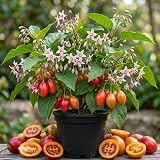


Plant Profile & Key Characteristics
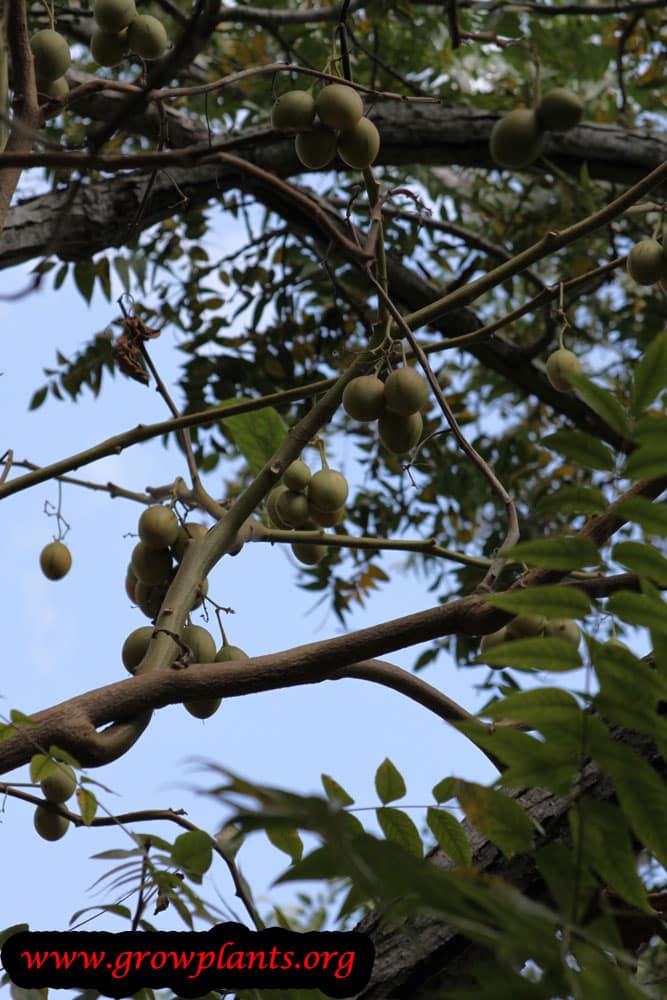
Overview: A fast-growing evergreen to semi-deciduous shrub or small tree reaching 2–5 m (6–15 ft), with a natural life of about 5–10 years. It is grown for its edible, tomato-flavoured fruit and also used ornamentally.
Quick Specifications
| Specification | Attribute |
|---|---|
| Plant Type / Life Cycle | Short-lived evergreen perennial (shrub or small tree, ~5–10 yr) |
| Foliage Type | Evergreen to semi-deciduous |
| Mature Size | 2–5 m (6–15 ft) |
| Growth Rate | Fast to moderate |
| Toxicity | Fruit edible; the leaves and other green parts are toxic nightshade tissue |
| Hardiness | USDA zones 10b+ (tropical, Mediterranean and subtropical; frost-tender) |
Growth Form & Structure
- Height & Spread: Reaches 2–5 m (6–15 ft) in the ground; can also be grown in a large container, which restrains its size, but is not suited to being an indoor houseplant.
- Growth Habit & Form: Fast-growing shrub or small single- to few-stemmed tree with a shallow, brittle framework.
- Lifespan & Maturity: Lives about 5–10 years and first bears fruit roughly 2–3 years from planting.
Anatomy & Physical Features
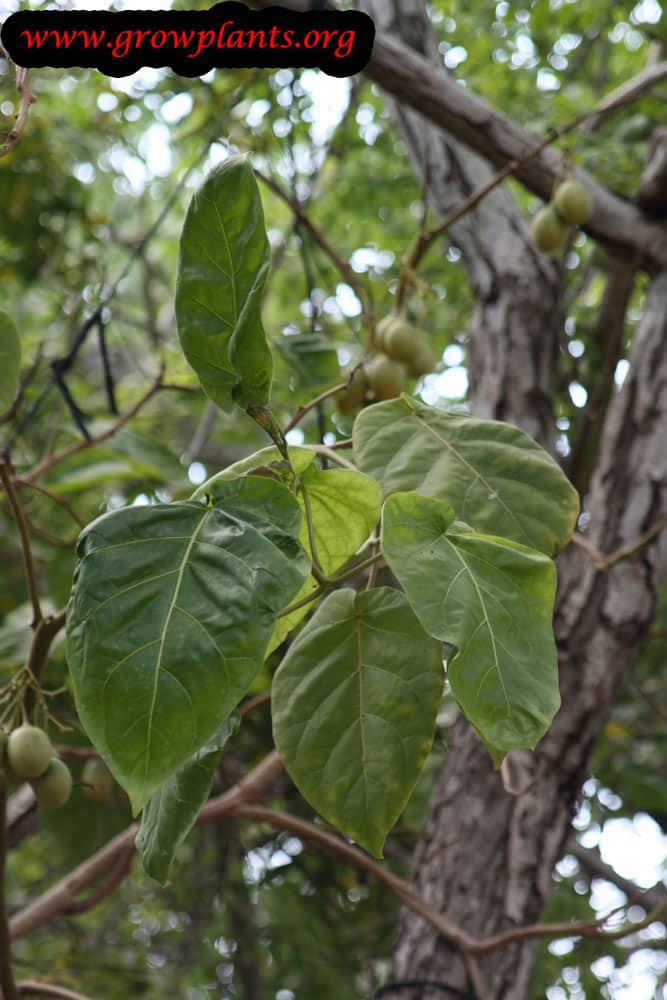
- Leaves & Foliage: Large, soft, heart-shaped green leaves with a musky scent.
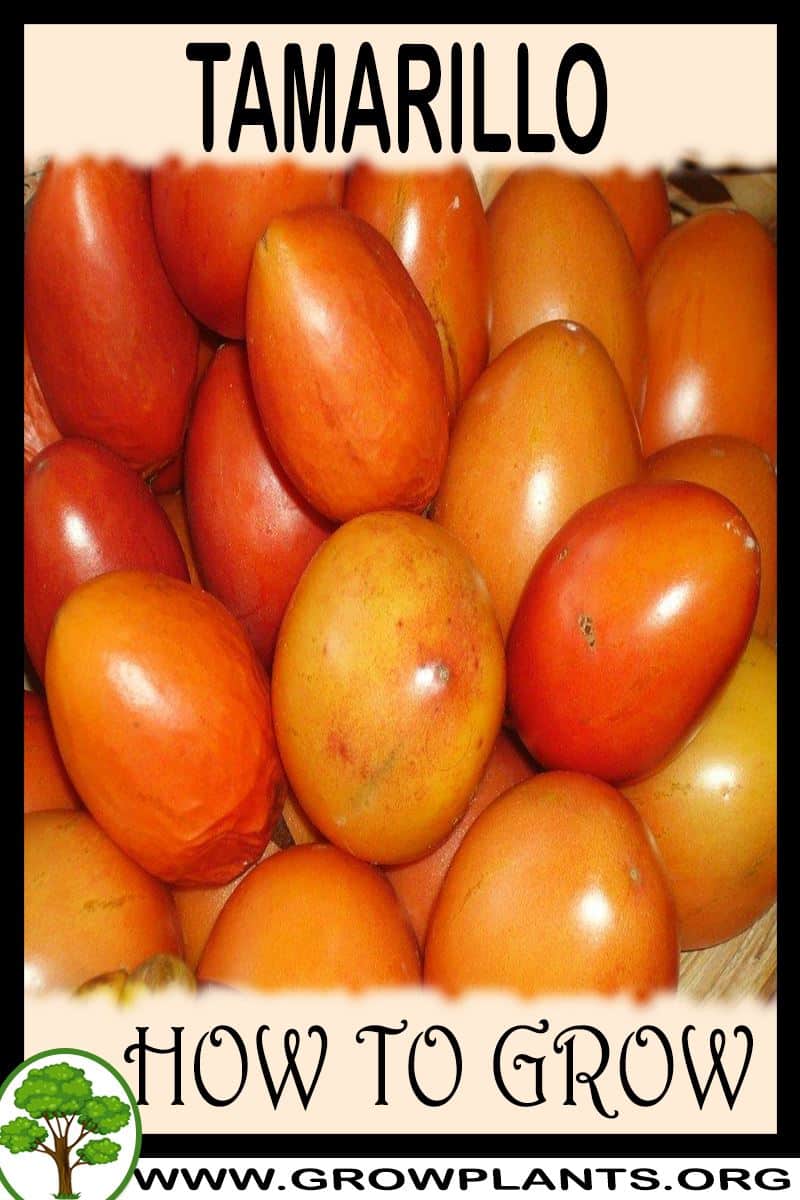
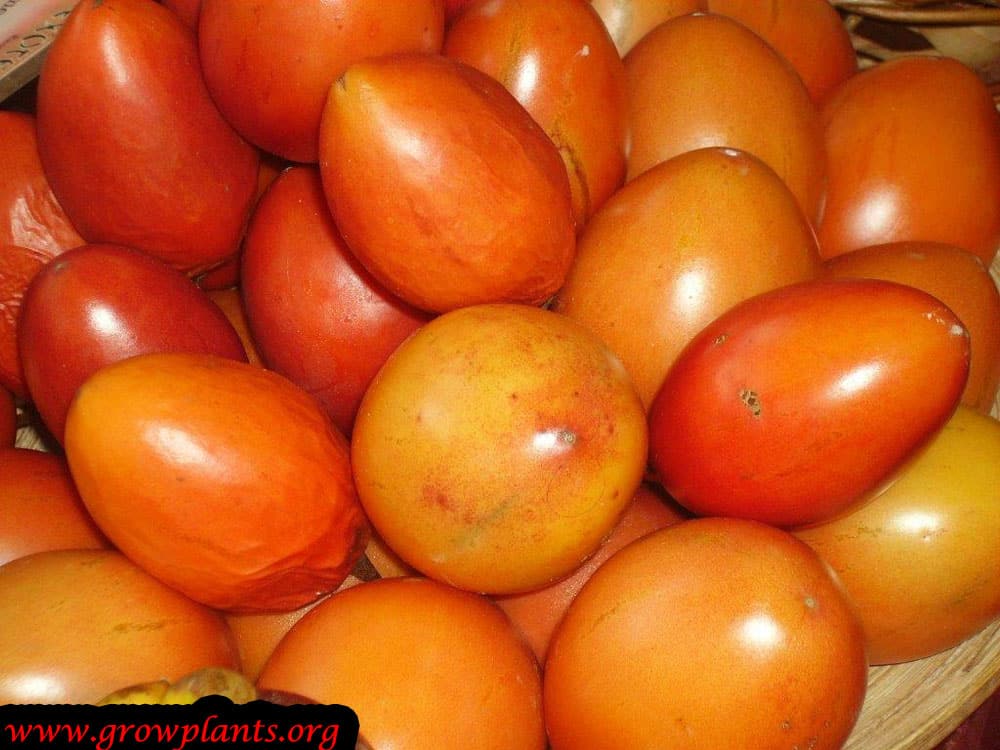
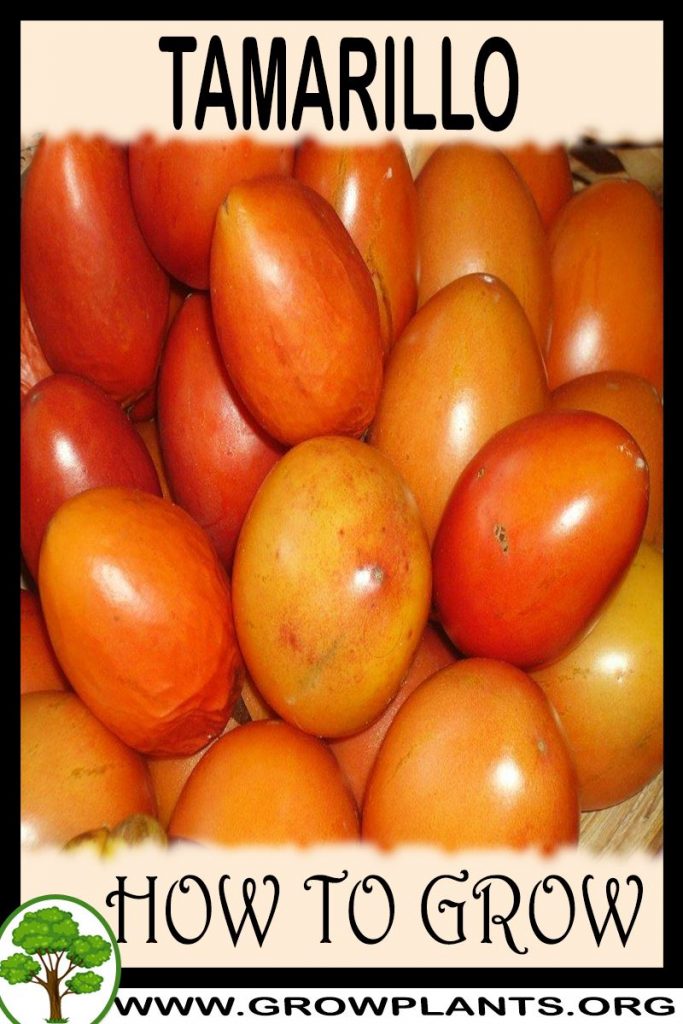
- Fruit Profile: Egg-shaped red to orange fruit 5–10 cm long, sometimes striped, with a tangy tomato-like flavour.
Primary Uses & Landscape Value
- Edible Uses: Eaten raw once fully ripe and made into juice and jams.
- Functional & Ornamental Roles: A quick-growing fruiting shrub that also serves as an attractive ornamental and large-container specimen.
Care Guide: Planting, Soil & Watering
Overview: Tamarillo is a fast-growing subtropical shrub or small tree that fruits best in full sun to part shade in rich, well-draining soil. It is frost-sensitive and likes steady moisture, so keep the soil evenly moist and shelter it from cold below about 5°C.
Quick Care Requirements
| Requirement | Ideal Condition |
|---|---|
| Planting Season | In spring to summer (frost-free, zone 10b+) |
| Growth Rate | Moderate to fast |
| Soil Type | Rich and well-draining |
| Water Need | Moderate to high; keep the soil evenly moist |
Planting & Establishment
- Best Planting Season: Plant in spring to summer once frost has passed; it needs a frost-free spot (zone 10b and warmer) and crops better with more than one tree.
- How to Plant:
- Hole Preparation: Dig a hole wider than the root ball in rich, free-draining soil.
- Soil Amendments: Mix in organic matter to feed the plant and hold moisture.
- Planting Depth: Set the root collar level with the soil surface and firm gently.
- Growth Speed & Expectations: A quick grower reaching about 2–5 m; it is short-lived (around 5–10 years), so keep it pruned to a compact small tree.
Soil, Watering & Drainage Care
- Soil Mix & Drainage Needs: Needs rich, well-draining soil; the shallow roots dislike waterlogging, so ensure water drains freely, and container plants need drainage holes.
- Watering Schedule & Technique:
- Young / Newly Planted: Keep the soil evenly moist while the plant establishes.
- Established: Water regularly and deeply so the soil stays moist but never sodden.
- Seasonal Adjustments: More in summer heat, less in winter; protect from cold, as it is very frost-sensitive.
Climate, Light & Hardiness
Tamarillo (tree tomato) is a fast-growing subtropical shrub-tree for tropical, subtropical and mild Mediterranean climates, happiest in full sun to light shade. It is notably cold-sensitive - suited to essentially frost-free areas (roughly USDA zone 10b and warmer), where the site data recommends keeping it above about 5 °C (41 °F).
Quick Climate Specifications
| Climate Zones | Tropical, subtropical and mild (frost-free) Mediterranean |
|---|---|
| USDA Hardiness Zones | Zone 10b and warmer (essentially frost-free) |
| Cold Damage Begins | Below about 5 °C (41 °F), per the site data - foliage and soft growth suffer as it approaches freezing |
| Approx. Survival Minimum | Around 0 °C (32 °F); brief light frost may only scorch foliage, but hard frost kills the plant |
| Frost Tolerance | Very Low (cold-sensitive) |
| Light Conditions | Full sun to part shade |
| Wind Tolerance | Low (brittle, shallow-rooted, top-heavy when fruiting) |
Sunlight & Light Exposure
Optimal Light Setup
Grows well in full sun to part shade; ample light supports flowering and fruiting, while a little afternoon shade is welcome in the hottest sites.
Shade & Heat Management
The large, soft leaves can scorch under intense sun and reflected heat, so light shade during peak heat protects the foliage.
Best Exposure / Orientation
A warm, sheltered, sun-facing spot out of strong wind suits its brittle, shallow-rooted frame; the site suggests planting more than one for reliable fruiting.
Temperature Extremes & Hardiness
USDA Hardiness & Regional Limits
The site data places tamarillo in zone 10b and warmer and advises keeping it above about 5 °C (41 °F). It is short-lived (about 5–10 years) and best where winters are mild and frost is rare.
Cold Damage & Winter Protection
Cold damage begins as temperatures drop toward about 5 °C (41 °F); an established plant may survive a brief dip near 0 °C (32 °F) with only foliage scorch, but sustained cold or hard frost is damaging to fatal. In marginal areas grow in a container to move under cover, or protect the plant over winter. Cold tolerance varies with plant age and exposure duration.
Frost Sensitivity
Frost-sensitive - light frost burns leaves and young growth, and hard frost can kill the whole plant. Young plants are more vulnerable than established ones.
Extreme Heat Tolerance
Tolerates subtropical warmth but not fierce, dry heat; in very hot climates it needs shelter and light shade to avoid leaf scorch and to hold its crop.
Wind, Humidity & Microclimate
Humidity Preferences
Prefers moderate to fairly high humidity in keeping with its subtropical origins.
Dry-Air Tolerance
Low to moderate - hot, dry air and wind stress the soft foliage.
Wind Tolerance
Low; the plant is brittle, shallow-rooted and top-heavy when fruiting, so it is easily wind-thrown and needs a sheltered position or staking.
Microclimate Recommendations
A warm, wind-sheltered pocket - a sunny, protected courtyard or wall - helps it through cool spells and shields the brittle canopy; container culture allows a move to frost-free shelter in winter.
Growing in Pots, Balconies & Indoors
The tamarillo (tree tomato) grows into a small tree of about 2-5 m (6-15 ft), so it is a container plant only while young – a good large pot will carry it for a few productive seasons on a sunny patio or balcony before it really wants the open ground. It is not a houseplant, but being frost-tender it is often potted so it can be moved under cover in cold climates.
Quick Details
- Container Size: A large 40 L+ (10 gal+) pot with strong drainage holes (general guidance – the grower confirms containers work; the plant outgrows pots in time)
- Indoor Suitability: Not a houseplant and ultimately too large; useful in a pot only while young or for overwintering
- Best Spot: Full sun to part shade, sheltered from wind (the shallow roots and soft wood are easily rocked)
- Soil & Drainage: Well-aerated, organic-rich mix that drains freely
- Watering in Pots: Keep evenly moist – pots dry fast; never waterlogged
Indoors & On the Windowsill
- Houseplant limits: Not an indoor plant – it grows too big and needs full sun to crop.
- Overwintering: The main reason to pot a tamarillo is portability: in cold regions move the pot into a bright, cool, frost-free spot over winter, as even a light frost damages it.
- Safety: The ripe fruit is edible, but the leaves and unripe fruit are in the nightshade family and are not – keep them from children and pets.
On a Balcony or Patio
- Light & wind: A warm, sunny, sheltered spot is best; the brittle, top-heavy stems catch the wind, so stake the plant and shelter it against walls that also give reflected warmth. Watch moisture daily in heat.
- Practicalities: A large filled pot is heavy and tall – set it in place first and secure it against gusts.
Choosing the Pot, Soil & Long-Term Care
- Pot & drainage: A large 40 L+ pot with strong drainage holes. Skip a standing-water saucer, which keeps the roots wet and invites rot. Terracotta breathes and dries faster; glazed or plastic pots hold moisture longer.
- Potting mix: Well-aerated and organic-rich – a quality potting mix, or peat/coir with perlite or vermiculite for drainage.
- Feeding: Potted plants need feeding more often than those in the ground, since frequent watering leaches nutrients away – feed through the growing season with a balanced, organic-rich fertilizer.
- Repotting: Every couple of years refresh the mix and pot on a size; for perennials, lightly prune the root ball and top growth at the same time to keep them vigorous.
Growing this plant in a greenhouse
A greenhouse can give tamarillo frost protection, cold protection, humidity control and extra warmth. In the right climate it may also be kept growing through winter, depending on how much warmth and light are provided.
Greenhouse at a glance
| Greenhouse suitability | Conditional - depends on your climate |
|---|---|
| Main benefits | frost protection, cold protection, humidity control, extra warmth |
| Season extension | earlier spring & later autumn |
| Outdoor protection advisable below | about 10°C |
| Maintain greenhouse minimum | around 15°C for active growth |
| Suitable types | heated greenhouse, polycarbonate greenhouse, lean-to |
| Heating | Heating is recommended in cold climates for continuous growth. |
Related greenhouse guides
- Greenhouses: How to Choose the Right Greenhouse
- Best Greenhouse Heaters
- Greenhouse Climate Control: Temperature, Ventilation and Humidity
- Best Lean-To Greenhouses
Fertilizing & Feeding
A moderate feeder: establish gently, favor nitrogen in the young pre-bearing years, then feed balanced with adequate potassium once the tree is bearing, feeding through the warm growing season.
Quick Fertilizing Specs
| Feeding Level | Moderate feeder |
|---|---|
| Main Nutrient Priority | Nitrogen in the young years, then balanced feeding with adequate potassium once bearing |
| Best Feeding Period | Through the warm active growing and fruiting season |
| Organic Options | Compost, aged manure, and humus |
| Reduce/Stop Feeding | Ease back as growth slows in the cool season |
| Micronutrients | A complete fruit-tree fertilizer typically supplies iron, manganese, and zinc; correct diagnosed issues |
| Soil pH | Slightly acidic to near neutral |
Feeding by Growth Stage
Newly planted
Help the newly planted tree establish roots before pushing top growth.
| Nutrient direction | A balanced complete fertilizer with organic matter to settle the young tree in. |
|---|---|
| Timing | At planting and through the first season of establishment. |
| Frequency | A light feeding at planting, supported by soil organic matter. |
| Fertilizer types | A balanced complete fertilizer, Compost and organic matter |
| Precautions | Keep feeding light while roots establish, and water evenly. |
Young, pre-bearing tree
Build a strong branch framework during the pre-bearing years.
| Nutrient direction | Lean toward nitrogen to drive vigorous shoot and canopy growth while the tree is young. |
|---|---|
| Timing | Through the active growing season of the young, pre-bearing tree. |
| Frequency | Light feedings spread through the growing season. |
| Fertilizer types | A nitrogen-forward complete fruit-tree fertilizer, Compost as a top-dressing |
| Routine trace nutrients | iron, manganese, zinc |
| Precautions | Favor steady moderate growth over forcing; overly lush growth is weak and frost-tender. |
Established, approaching bearing
Maintain a healthy, balanced framework as the tree nears fruit-bearing age.
| Nutrient direction | A balanced complete fertilizer keeps steady growth without forcing. |
|---|---|
| Timing | Through the growing season as the tree matures toward bearing. |
| Frequency | A few light feedings across the active season. |
| Fertilizer types | A balanced complete fruit-tree fertilizer, Compost and organic matter |
| Routine trace nutrients | iron, manganese, zinc |
| Precautions | Keep growth steady and protect from cold, to which this tree is very sensitive. |
Mature bearing tree
Support flowering, fruit set, and ripening on the bearing tree.
| Nutrient direction | A balanced feed with adequate potassium supports flowering and fruit filling. |
|---|---|
| Timing | Through the flowering and fruiting season of the bearing tree. |
| Frequency | Steady light feedings across the active growing and fruiting season. |
| Fertilizer types | A balanced complete fertilizer with adequate potassium |
| Routine trace nutrients | iron, manganese, zinc |
| Precautions | Water evenly through fruiting to support fruit fill and reduce drop. |
Nutrient Deficiency Signs & Corrections
Older, lower leaves fade to pale green or uniform yellow and overall growth slows.
| Possible causes | low available soil nitrogen, nitrogen leaching from heavy watering or rain, thin, low-organic-matter soil |
|---|---|
| Appears first on | older, lower leaves |
| What to check | recent feeding history, soil organic matter, watering and drainage |
| Possible correction | Apply a nitrogen-containing complete fertilizer and build soil organic matter, then water evenly. |
Interveinal yellowing appears on the youngest leaves while the fine veins stay green.
| Possible causes | high soil pH reducing iron availability, waterlogged or cold soils limiting root uptake, low available soil iron |
|---|---|
| Appears first on | the youngest, newest leaves |
| What to check | soil pH, drainage and recent waterlogging, root health |
| Possible correction | Correct pH and improve drainage, and apply a chelated iron product per its label. |
Interveinal yellowing on older leaves while the veins themselves stay green.
| Possible causes | low soil magnesium, high potassium feeding competing with magnesium uptake, leaching in light, sandy soils |
|---|---|
| Appears first on | older, lower leaves |
| What to check | soil magnesium status, how potassium-heavy recent feeding has been, soil texture and leaching |
| Possible correction | Apply a labeled magnesium source such as Epsom salt or a dolomitic amendment and rebalance feeding. |
Pruning, Training & Seasonal Maintenance
Tamarillo (Solanum betaceum), the tree tomato, is a fast, soft-wooded small tree of 2–5 m (6–15 ft) with brittle branches and shallow roots that make it prone to wind-throw. It naturally forms a single trunk topped by a head of branches, and pruning has two jobs: heading a young plant low to build a sturdy, reachable framework, and an annual winter cut to keep it compact, renew fruiting wood and stop it running up tall and top-heavy. It is frost-tender and short-lived (about 5–10 years), so keeping it low, strong and productive matters more than long-term structure.
Quick Pruning & Maintenance Specs
| Pruning Tolerance | Moderate–High (vigorous, resprouts readily; wood is brittle) |
| Primary Pruning Window | Winter / after the main harvest (frost-free spells) |
| Typical Frequency | Annual |
| Main Objective | Keep it low and branched; renew fruiting wood; reduce wind-throw |
| Young Plant Priority | Head the leader at about 1—1.5 m to force a low branching head |
| Mature Plant Priority | Shorten and thin the head; remove old fruited and weak wood |
| Best Tool Type | Bypass secateurs and loppers; a pruning saw for older trunk cuts |
| Avoid Heavy Pruning During | Frost, and just before or during heavy fruiting |
Pruning by Plant Age & Size
Newly Established
Let the young plant grow a strong single stem; remove only damaged growth. Stake it well—the shallow roots and heavy head make an unstaked young tamarillo unstable.
Young / Formative
When the leader reaches about 1–1.5 m, head it to force a low branching head of three to five main limbs. This is the single most useful cut on a tamarillo: it keeps fruit within reach, builds a stronger frame against wind, and encourages the abundant new growth that will carry the crop. Aim for well-spaced limbs rather than a congested cluster.
Mature / Established
Each winter shorten the head to keep the tree compact, thin crowded and crossing branches, and cut out old wood that has already fruited so vigorous new shoots replace it. Removing about a third to a half of the previous season’s growth keeps the tree low, productive and wind-firm without checking it.
Seasonal Pruning Schedule
Winter / Post-Harvest
Objective: renew and contain the head. Remove: old fruited wood, weak, crossing and dead branches; over-tall leaders. Do NOT remove: the strong young shoots that will bear next season. Response: a flush of new fruiting growth from lower on the framework. Fruiting impact: brings the crop lower and within reach; a hard cut delays the next crop by one flush.
Ongoing Sanitary
Objective: limit aphids and the leaf and fruit problems of a soft-leaved tree. Remove dead, infested or diseased growth as noticed.
Flowering & Fruiting Wood
Tamarillo bears on new season’s growth produced from the framework, so annual pruning that forces fresh vigorous shoots is exactly what sustains cropping. Because fruit forms on that new growth, a hard renewal cut removes the coming flush and postpones the harvest, which is why the cut is timed to winter or straight after the main crop rather than into the fruiting period. Left unpruned the tree carries fruit ever higher on brittle over-extended wood.
Structural Pruning & Training
The framework is a low headed trunk with a few strong scaffold limbs. Keep the head open and balanced, remove crossing and inward branches, and shorten over-long limbs to a strong lateral so weight stays close to the trunk—important because the wood is brittle and the roots shallow. Thinning the head improves light and fruit colour and reduces the wind-sail.
Special Growth to Remove
Remove low trunk shoots and any suckering growth from the base to keep a clean single trunk, take out old exhausted fruited wood, and shorten whippy over-vigorous shoots that unbalance the head. Grown from seed or cuttings on its own roots, so there is no graft union and no rootstock suckering to watch.
Container & Small-Space Pruning
Tamarillo grows and fruits well in a large pot precisely because it responds to heading—keep it headed low and the head tightly renewed each winter so the plant stays balanced over its root ball. Refresh the mix and root-prune lightly when repotting, and keep it staked and sheltered from wind on a patio.
Tools
New shoots and thin stems: bypass secateurs. Head limbs and older branches up to a couple of centimetres: loppers. Trunk-heading cuts and any thick old limb on a mature tree: a pruning saw. Hedge shears are wrong here—every cut is a placed, selective one. The tree is short enough that a pole pruner is rarely needed.
Tool Hygiene & Disease Risk
Classification: Increased. As a soft-wooded nightshade it is susceptible to the family viruses (mechanically spread) and to nematodes and root problems. Use clean sharp tools and wash hands and wipe blades before moving from any virus-mottled or diseased tree; healthy routine cuts do not need sterilising between each.
Cut Placement & Technique
Make heading cuts just above an outward-facing bud or strong lateral so regrowth spreads the head rather than crowds it. On larger limbs cut just outside the branch collar, and support and undercut heavy limbs before the final cut so the brittle bark does not tear. Angle cuts to shed water and leave no long stubs.
Heavy Pruning & Rejuvenation
Tamarillo tolerates hard renewal—an old leggy tree can be cut back into the main framework and will resprout vigorously—but expect to lose that season’s crop while the new head rebuilds. Spread severe reduction over a season or two on a valued tree, or, given its short life, simply raise a fresh plant from seed or cutting.
Post-Pruning Care
After opening the head, protect newly exposed limbs and fruit from sunburn, keep the shallow root zone evenly moist and mulched, and make sure the tree is firmly staked so wind does not rock the fresh regrowth. Watch new shoots for aphids; do not over-feed straight after a hard cut.
Common Pruning Mistakes
- Never heading the young plant, so it runs up tall and top-heavy on brittle wood.
- Letting fruit climb out of reach on old over-extended limbs instead of renewing wood.
- Making big cuts without staking, so wind rocks the shallow-rooted tree.
- Hard-pruning into cold weather on a frost-tender tree.
When NOT to Prune
Do not prune during frost or an imminent cold spell, nor heavily just before or during the main crop—time renewal to winter or straight after harvest. Avoid cutting a drought-stressed or newly transplanted tree.
Recommended Tools (by task)
- bypass_secateurs — new shoots and thin stems in the head.
- loppers — head limbs and branches up to a couple of centimetres.
- pruning_saw — trunk-heading cuts and thick old limbs on a mature tree.
- soft_ties_stakes — stake the shallow-rooted, top-heavy tree against wind.
Pruning Troubleshooting
| Problem | Possible Cause | What to Check | Corrective Action |
| Tall bare trunk, fruit out of reach | Young plant never headed | Height of first branching | Head into the framework in winter to force a low new head |
| Tree rocking / leaning after big cuts | Shallow roots, no support | Staking; root anchorage | Stake firmly; reduce top weight; mulch the root zone |
| Rush of leafy shoots, little fruit | Too hard a cut and/or heavy nitrogen | Severity of last prune; feeding | Prune more lightly; ease off nitrogen; let shoots mature |
| Sunburnt limbs after thinning | Head opened too much in strong sun | Exposed bark on scaffolds | Retain more shading growth; shade or paint exposed limbs |
Propagation Guide
Tamarillo grows readily from either seed or cuttings, and the choice changes the plant: seedlings make a single upright trunk on a taproot and stand up better to wind, while cutting-raised plants branch lower down, are shallower-rooted and tend to come into bearing sooner. Propagation is easy to moderate.
Quick Propagation Specs
| Best Propagation Method | Seed for a sturdy, taprooted tree; cuttings for an earlier-bearing, lower-branching plant |
| Alternative Methods | Semi-hardwood/hardwood stem cuttings; air layering |
| Propagation Difficulty | Easy to Moderate |
| Seed True-to-Type | Comes mostly true from a good strain, with some seedling variation |
| Vegetative True-to-Type | Yes – cuttings reproduce the parent exactly |
| Best Propagation Season | Spring to summer |
| Cutting Rooting Time | Typically several weeks in warm conditions |
| Germination Temperature | Warm, roughly 20–30°C (68–86°F) |
Growing from Seed
Seed Handling & Viability
Scoop seed from ripe fruit, wash off the pulp and sow it warm. Seed-raised trees develop the strong central trunk and taproot that make them the better choice on exposed or windy sites.
Germination Conditions & Time
Keep seed warm and moist; germination generally takes a few weeks. Raise seedlings under some shelter and protect them from cold, as the plant is frost-tender.
Stem Cuttings
Cutting Type & Timing
Take firm semi-hardwood or hardwood cuttings (roughly one to two centimetres thick) in spring to summer. Thicker cuttings make a plant that branches and fruits sooner but on shallower roots, so give it good support and shelter.
Rooting Setup & Time
Root in a warm, humid, free-draining medium; rooting hormone is optional. Rooting usually takes several weeks.
Air & Ground Layering
A branch can be air-layered – girdle it, wrap the wound in moist medium and pot it up once rooted – giving a true-to-type plant that is larger than a cutting from the start.
Bloom & Flower Guide
Quick Details
- Bloom Season: Spring to summer
- Flower Appearance: Fragrant pink flowers borne in clusters
- Edibility: Ornamental only – the flower is not eaten, and the leaves and green parts are toxic
Detailed Blooming Overview
The tamarillo, or tree tomato, flowers on its soft-wooded branches in spring and summer, carrying small clusters of pink, lightly scented blooms. Each cluster can set several hanging fruits, so a good bloom is the promise of the season’s crop. As a short-lived tree it flowers reliably once established.
Flower Characteristics
- Soft pink, star-shaped flowers with a central cone of stamens.
- Carried in loose clusters.
- Lightly fragrant.
Bloom Care & Thinning
- Pollination: Bees and flies visit the flowers; the plant is largely self-fertile, and a sheltered spot with pollinator activity improves fruit set.
- Supporting the bloom: Shelter from strong wind protects the brittle branches and the developing flower clusters.
Fruit & Uses
The Tamarillo, or tree tomato, is grown for its edible egg-shaped fruit, which is eaten raw and made into juice and jams. The fruit is the part used; it has a taste that is somewhat reminiscent of tomato.
Quick Edible Specs
| Edible Parts | Fruit |
|---|---|
| Main Use(s) | Culinary – eaten raw, juice, jams |
| Eaten Raw or Cooked | Both (raw and cooked into preserves) |
| Preparation Required | The skin is usually peeled or scooped; otherwise none |
| Harvest Season | Summer |
| Time to First Harvest | Two to three years from planting (see growing notes) |
| Storage | Best used fresh; also preserved as jam |
| Safety/Toxicity Caveat | Only the fruit is eaten; the skin is bitter and usually not eaten |
Fruit
The fruit is egg-shaped, about 5–10 cm long, and ripens to red or orange with a peel that may be plain or striped. Its flavour recalls tomato. Harvest when the fruit has fully coloured and is slightly soft to the touch.
Harvesting
Pick the fruit by hand in summer. Fruit fly and birds are noted as pests, so the tree may need to be covered with netting or otherwise protected as the fruit ripens.
Preparation, Uses & Safety
Tamarillos are eaten raw — typically halved and scooped, or peeled, since the skin is bitter — and made into juice and jams. Only the fruit is used.
Pests, Diseases & Troubleshooting
Overview: The tamarillo (Solanum betaceum) is a soft-wooded, shallow-rooted subtropical tree that shares many pests with its tomato relatives, plus fruit fly and aphid-borne viruses. It is short-lived and brittle, so protect it from wind and manage sap-sucking insects and root rot culturally, keeping mulch and even moisture over its surface roots.
Quick Troubleshooting Overview
| Issue / Pest | Main Symptom | Primary Solution |
|---|---|---|
| Aphids | Curled shoots, honeydew; spreads mosaic virus | Rinse, reflective mulch, soap, beneficials |
| Whiteflies & green vegetable bug | Honeydew, sooty mould; stink-bug fruit spotting | Traps, hand-pick bugs, soap/neem |
| Fruit fly | Maggots and rot inside ripening fruit | Bag fruit, traps, orchard hygiene |
| Nematodes | Stunting, wilt, galled roots | Rotate, resistant stock, organic matter |
| Powdery mildew | White coating on leaves | Airflow, sulphur or bicarbonate spray |
| Root rot | Wilt and mushy roots in wet soil | Free drainage, avoid waterlogging |
Common Pests & Management
- Aphids (Myzus persicae, Aulacorthum solani):
- Symptoms: Green or black clusters on soft shoots and undersides, causing curl and honeydew; the key vectors of tamarillo mosaic virus.
- Prevention & Control: Rinse off, use reflective mulch, encourage ladybirds and lacewings, and spot-treat with insecticidal soap or neem.
- Whiteflies (Trialeurodes vaporariorum):
- Symptoms: White insects rising in clouds when disturbed, with honeydew, sooty mould and yellowing.
- Prevention & Control: Yellow sticky traps, parasitoids, and insecticidal soap or neem on leaf undersides.
- Green vegetable bug / stink bugs (Nezara viridula):
- Symptoms: Shield-shaped bugs that pierce fruit, causing hard spots, dimpling and premature drop.
- Prevention & Control: Hand-pick adults and egg rafts in the cool of the day, keep weeds down, and encourage predatory insects.
- Fruit fly (Bactrocera / Ceratitis spp.):
- Symptoms: Small sting marks then softening and internal maggots and rot in ripening fruit.
- Prevention & Control: Bag developing fruit, hang lure/bait traps, harvest promptly, and remove and destroy fallen or infested fruit.
- Root-knot nematodes (Meloidogyne spp.):
- Symptoms: Unexplained stunting, wilting and yellowing, with knotty galls on the roots.
- Prevention & Control: Plant into clean or resistant rootstock, rotate, add organic matter, and mulch to support root health.
Diseases & Fungal Issues
- Powdery mildew (Oidium / Erysiphales):
- Symptoms: White powdery growth on leaves and shoots in warm, humid, still air, causing yellowing and leaf drop.
- Treatment & Management: Improve airflow and spacing, and spray sulphur, potassium bicarbonate or horticultural oil.
- Tamarillo mosaic & other viruses (Tamarillo mosaic virus, CMV):
- Symptoms: Mottled, distorted, mosaic-patterned leaves and reduced vigour and cropping; permanent.
- Treatment & Management: Control aphids, remove infected trees, use virus-free planting stock, and disinfect pruning tools.
- Phytophthora root & collar rot (Phytophthora spp., Pythium):
- Symptoms: Wilting, dieback and dark rotted roots and collar in wet or poorly drained soil.
- Treatment & Management: Plant on mounds with sharp drainage, avoid waterlogging, mulch (not against the trunk), and remove severely affected trees.
- Anthracnose & fruit rots (Colletotrichum spp.):
- Symptoms: Sunken dark spots on ripening fruit that rot in warm humid weather.
- Treatment & Management: Harvest promptly, remove mummified fruit, improve airflow, and use copper protectively in wet spells.
Growing Difficulties & Abiotic Problems
- Wind & storm damage:
- Cause & Symptoms: Brittle, soft wood and shallow roots make the tree prone to branch snap and windthrow.
- Correction Strategy: Stake young trees, shelter from strong wind, and prune to a sturdy open framework.
- Frost sensitivity:
- Cause & Symptoms: Foliage and stems are damaged below about 0°C and the tree can be killed by hard frost.
- Correction Strategy: Site in a warm sheltered spot, wrap or cover in cold snaps, or grow in a container to move under cover.
- Sunburn & moisture stress on surface roots:
- Cause & Symptoms: Exposed fruit scorches, and the shallow roots suffer in dry or fluctuating soil, dropping fruit and leaves.
- Correction Strategy: Mulch generously over the root zone, water evenly, and maintain some leaf cover over fruit.
What Helps – Products & Tools
For the tamarillo the useful kit is insecticidal soap and neem/horticultural oil for aphids and whiteflies, fruit-fly lure/bait traps and fruit bags, reflective mulch to deter virus-carrying aphids, sulphur or potassium bicarbonate for mildew, and copper for anthracnose and collar rot. Wind shelter, mulch and sharp drainage prevent most of its non-pest troubles.