
Plant Profile & Key Characteristics
Overview: A fast-growing herbaceous nightshade reaching 30–60 cm (12–24 in), grown as a short-lived perennial or annual for its small edible berries and also used ornamentally.
Quick Specifications
| Specification | Attribute |
|---|---|
| Plant Type / Life Cycle | Perennial grown as an annual in cold climates |
| Foliage Type | Herbaceous, evergreen while growing (frost-tender) |
| Mature Size | 30–60 cm (12–24 in) |
| Growth Rate | Fast |
| Toxicity | Fully ripe berries are edible; unripe green berries and the foliage are toxic |
| Hardiness | USDA zones 10b+ as a perennial; grown as an annual from zone 2+ |
Growth Form & Structure
- Height & Spread: Reaches 30–60 cm (12–24 in) in the ground and grows readily in a container.
- Growth Habit & Form: Fast-growing, branching, bushy herb.
- Lifespan & Maturity: Very quick to crop, bearing fruit roughly 1–3 months from planting.
Anatomy & Physical Features
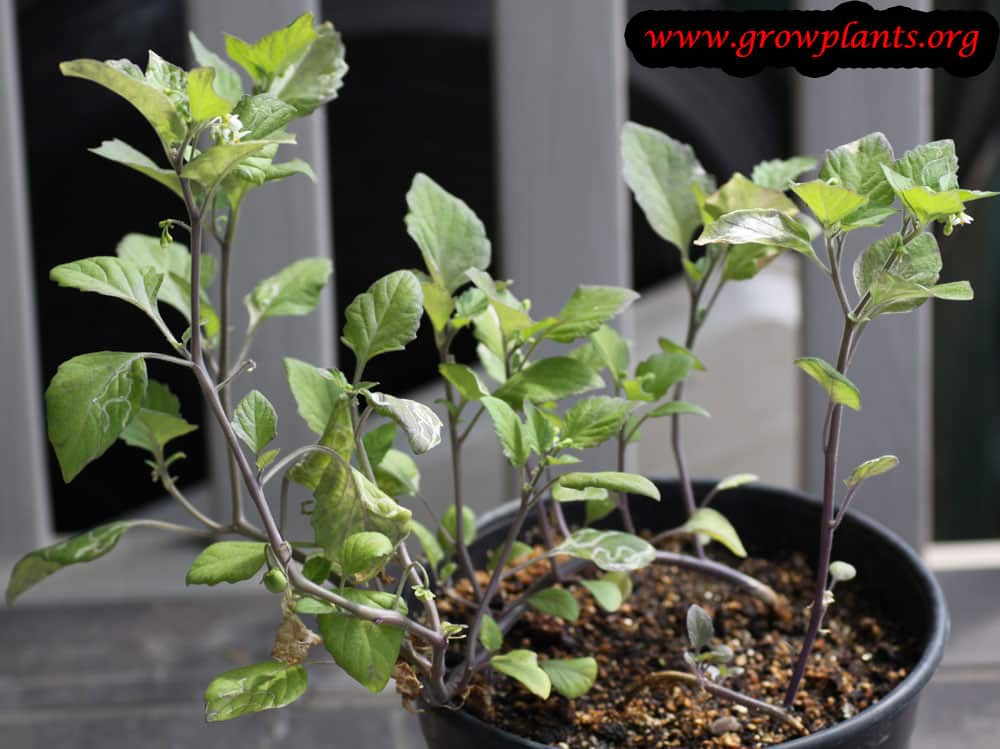
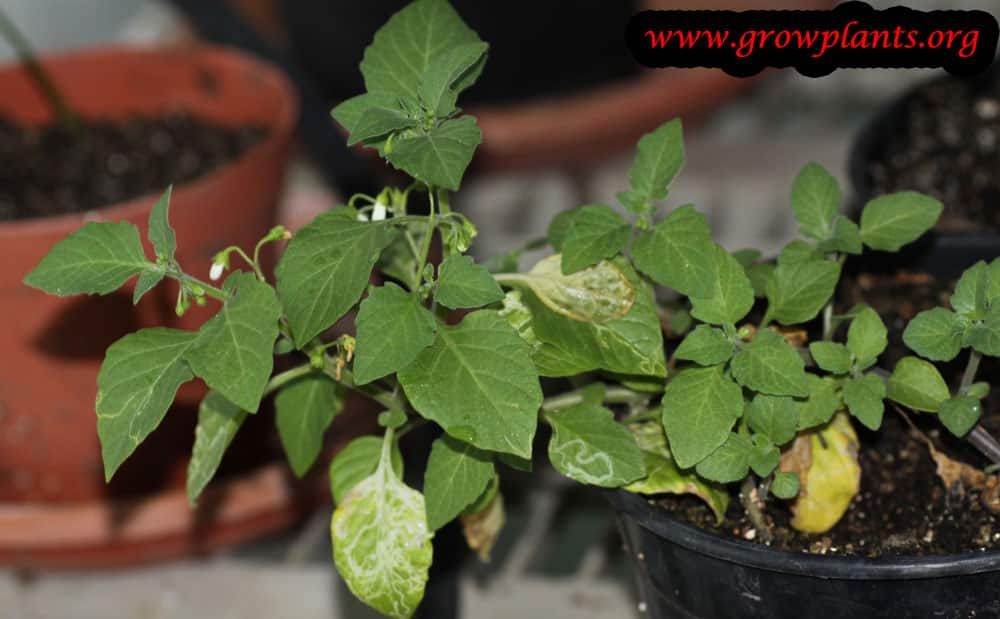
- Leaves & Foliage: Hairy green leaves 3–5 cm long, rhomboid to deltoid (diamond- to triangular-shaped).
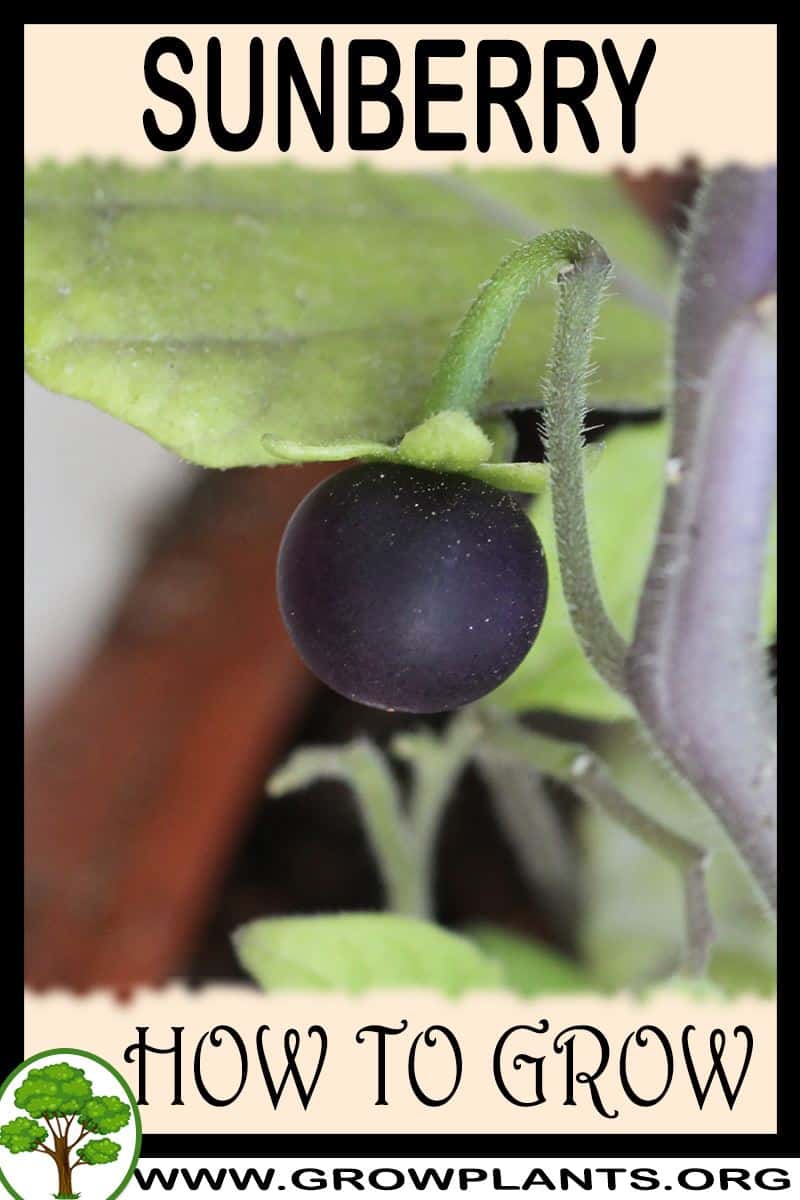
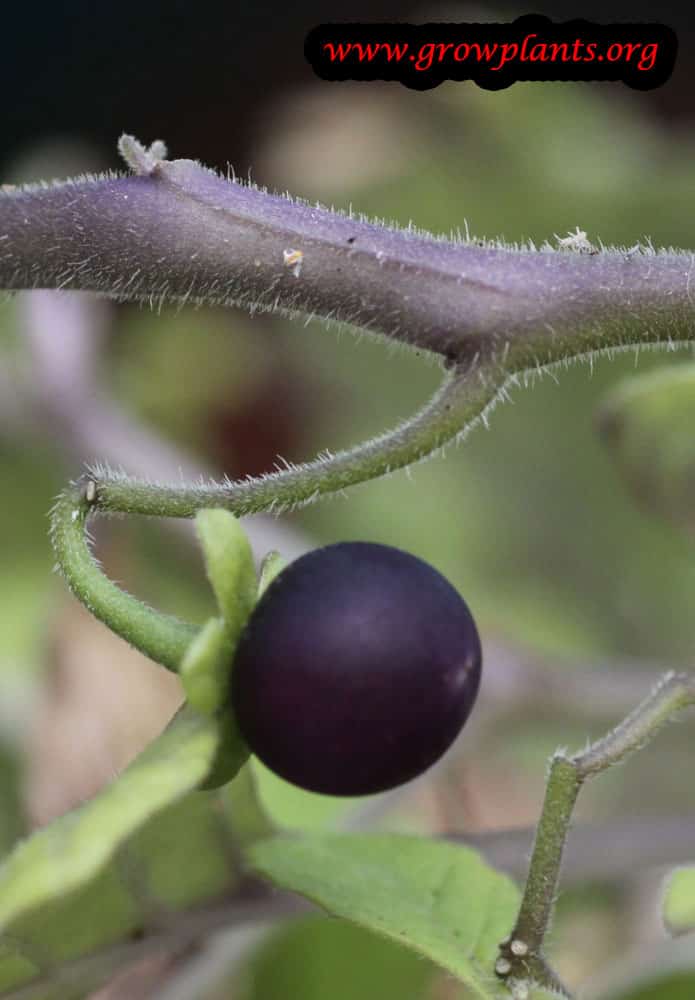
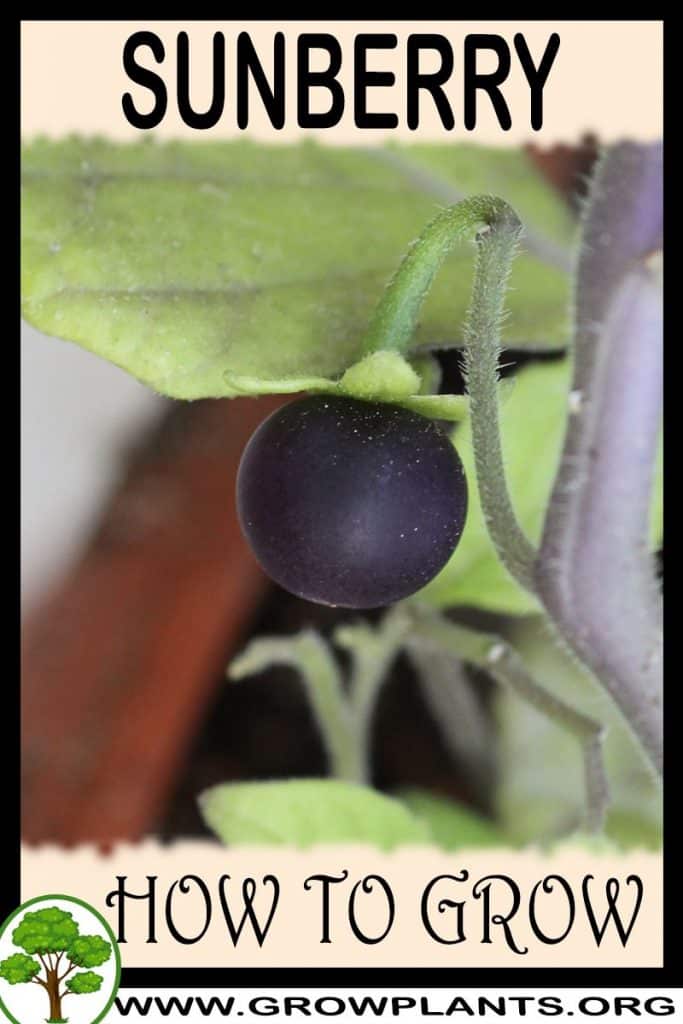
- Fruit Profile: Small dark blue-purple to black berries, mild in flavour and safe to eat only when fully ripe.
Primary Uses & Landscape Value
- Edible Uses: Fully ripe berries are eaten raw, added to salads and cooked into jams.
- Functional & Ornamental Roles: A quick berry crop for beds and containers that also has ornamental value.
Care Guide: Planting, Soil & Watering
Overview: Sunberry is a fast-growing nightshade that fruits best in full sun in rich, organic soil. It likes warmth and steady moisture, so keep the soil evenly moist through the growing season.
Quick Care Requirements
| Requirement | Ideal Condition |
|---|---|
| Planting Season | In spring after the last frost (spring to autumn in warm zones) |
| Growth Rate | Fast |
| Soil Type | Rich, organic soil with plenty of humus |
| Water Need | Moderate to high; keep the soil evenly moist |
Planting & Establishment
- Best Planting Season: Plant in spring after frost where grown as an annual (zones 2–10a); in warmer zones (10b–12) plant from spring to autumn.
- How to Plant:
- Hole Preparation: Loosen a hole slightly wider than the root ball in rich ground.
- Soil Amendments: Work in plenty of organic matter and humus to feed the plant.
- Planting Depth: Set the root ball level with the soil; layering a branch down into the soil makes the plant stronger and longer-lived.
- Growth Speed & Expectations: A fast grower reaching about 30–60 cm; it can be invasive, so site it where you can keep it in check.
Soil, Watering & Drainage Care
- Soil Mix & Drainage Needs: Give it rich, well-draining soil with organic matter; it also grows well in containers.
- Watering Schedule & Technique:
- Young / Newly Planted: Keep the soil evenly moist while establishing.
- Established: Water regularly and deeply to keep the soil moist.
- Seasonal Adjustments: More in summer heat, less in winter.
Climate, Light & Hardiness
Sunberry (wonderberry) is a fast, warm-season shrublet for Mediterranean, subtropical, temperate and tropical climates, growing in full sun to part shade. It is frost-sensitive - perennial only in essentially frost-free areas (roughly USDA zone 10b and warmer) and grown as a quick summer annual from about zone 2 upward wherever winters freeze.
Quick Climate Specifications
| Climate Zones | Mediterranean, subtropical, temperate and tropical (warm-season growing) |
|---|---|
| USDA Hardiness Zones | Perennial in zone 10b+; grown as an annual from about zone 2 upward |
| Optimal Temp Range | Warm conditions; grows fast in mild-warm weather |
| Cold Damage Begins | Soft growth checked by cool weather; decline as temperatures approach freezing |
| Approx. Survival Minimum | Near 0 °C (32 °F); frost is generally fatal to the top |
| Frost Tolerance | None (frost-sensitive) |
| Light Conditions | Full sun to part shade (bears less fruit in shade) |
| Wind Tolerance | Low–Moderate (soft-stemmed) |
Sunlight & Light Exposure
Optimal Light Setup
Full sun gives the best growth and the heaviest set of its small berries; part shade is tolerated but reduces fruiting.
Shade & Heat Management
In very hot, exposed sites the soft foliage benefits from a little afternoon shade to limit scorch.
Best Exposure / Orientation
A warm, open, sunny position drives its fast growth and quick cropping; the site notes that layering a branch into the soil makes plants stronger and longer-lived where grown as a perennial.
Temperature Extremes & Hardiness
USDA Hardiness & Regional Limits
The site data lists sunberry as perennial in zone 10b and warmer and grown as an annual from about zone 2 upward. Hardiness reflects winter cold survival, not heat preference - where winters freeze it is treated as a fast summer annual and easily regrown from seed.
Cold Damage & Winter Protection
As a perennial it continues only in frost-free areas; cool weather checks growth and frost kills the top. In cold climates simply resow each spring rather than overwinter.
Frost Sensitivity
Frost-sensitive - frost damages the soft foliage and near 0 °C (32 °F) is generally fatal to unprotected plants.
Extreme Heat Tolerance
A warm-season plant that copes with heat when kept moist; prolonged extreme heat with intense sun can stress the soft foliage, eased by light shade.
Frost-Free Growing Season
Being very quick (fruit in roughly one to three months), sunberry crops in a short warm window, so even short-season regions can grow it as a summer annual sown after the last frost.
Wind, Humidity & Microclimate
Humidity Preferences
Accepts a fairly wide range; warm, moderately humid conditions suit fast growth.
Dry-Air Tolerance
Moderate when soil moisture is maintained, though hot, dry winds stress the soft foliage.
Wind Tolerance
Low to moderate; soft stems can be knocked about, so a sheltered spot helps, especially in containers.
Rainfall & Seasonal Moisture
Suits a warm season with moderate moisture; it is vigorous and can self-seed, so watch its spread where conditions favour it.
Microclimate Recommendations
A warm, sunny, sheltered spot maximises its fast summer cropping in cooler areas.
Growing in Pots, Balconies & Indoors
Sunberry (garden huckleberry) is a warm-season crop, not a houseplant – it needs strong sun to grow and fruit well, so deep indoors it will not thrive. In a large, free-draining container it does well on a sunny patio or balcony, and a compact plant can fruit on a very bright, sunny windowsill. Expect roughly 30-60 cm (12-24 in) in good conditions.
Quick Details
- Container Size: About 10-20 L (3-5 gal) with strong drainage holes (general guidance – the grower simply notes containers work well)
- Indoor Suitability: Not a houseplant; only a bright, sunny windowsill will do, and a patio or balcony is better still
- Best Spot: Full sun; it tolerates part shade but bears fewer berries
- Soil & Drainage: Well-aerated, organic-rich mix (potting mix, or peat/coir with perlite or vermiculite); must drain freely
- Watering in Pots: Keep evenly moist – pots dry fast, so mulch the surface; never waterlogged
Indoors & On the Windowsill
- Houseplant limits: The grower’s answer is no – it wants full sun that a room’s interior cannot give, so it stays weak and shy to fruit away from a window.
- Windowsill growing: The best indoor option is the brightest, sunniest sill you have; keep the plant compact so it and its fruit get direct light.
- Overwintering: Usually grown as an annual; in mild areas a potted plant can be sheltered over winter.
- Safety: Only the ripe fruit is edible – the leaves, stems and unripe green fruit are in the nightshade family and contain solanine, so keep an indoor plant out of reach of children and pets.
On a Balcony or Patio
- Light & wind: Give it the sunniest spot. Walls and paving reflect heat and dry pots fast, so check moisture daily in summer and mulch; shelter a tall plant from wind and stake it if it gets top-heavy. A drip irrigation kit with a timer can take over that watering check automatically.
- Practicalities: A filled large pot is heavy – position it before filling, and keep drainage runoff off the balcony floor.
Choosing the Pot, Soil & Long-Term Care
- Pot & drainage: About 10-20 L (3-5 gal) with strong drainage holes (general guidance – the grower simply notes containers work well) Skip a standing-water saucer, which keeps the roots wet and invites rot. Terracotta breathes and dries faster; glazed or plastic pots hold moisture longer.
- Potting mix: Well-aerated and organic-rich – a quality potting mix, or peat/coir with perlite or vermiculite for drainage.
- Feeding: Potted plants need feeding more often than those in the ground, since frequent watering leaches nutrients away – feed through the growing season with a balanced, organic-rich fertilizer.
- Repotting: Every couple of years refresh the mix and pot on a size; for perennials, lightly prune the root ball and top growth at the same time to keep them vigorous.
Fertilizing & Feeding
A moderate feeder grown for its fruit: establish it gently, favor nitrogen while it builds leafy growth, then feed balanced with adequate potassium through flowering and fruiting.
Quick Fertilizing Specs
| Feeding Level | Moderate feeder |
|---|---|
| Main Nutrient Priority | Nitrogen while building the plant, then balanced feeding with adequate potassium at fruiting |
| Best Feeding Period | Through the warm active growing and fruiting season |
| Organic Options | Compost, aged manure, and humus |
| Reduce/Stop Feeding | Ease back as growth slows into the cool or dry season |
| Micronutrients | Usually met by a complete fertilizer and organic matter; correct only diagnosed issues |
| Soil pH | Slightly acidic to near neutral |
Feeding by Growth Stage
Establishment
Settle the young plant in and build a healthy root system before strong growth.
| Nutrient direction | A balanced complete fertilizer with generous organic matter to establish roots. |
|---|---|
| Timing | At planting and through the first weeks of establishment. |
| Frequency | A light feeding at planting, backed by organic matter in the soil. |
| Fertilizer types | A balanced complete fertilizer, Compost and well-rotted organic matter |
| Precautions | Keep early feeding light and water evenly while roots establish. |
Leafy vegetative growth
Build a vigorous leafy framework of canes and stems.
| Nutrient direction | Lean toward nitrogen to push strong vegetative growth as the plant fills out. |
|---|---|
| Timing | Through the active growing season before heavy fruiting. |
| Frequency | Regular light feedings during active leafy growth. |
| Fertilizer types | A nitrogen-forward complete fertilizer, Compost or aged manure top-dressing |
| Precautions | Provide support or trellising as the plant grows, and avoid overdoing nitrogen, which delays flowering. |
Flowering and fruiting
Support flowering, fruit set, and ripening through the harvest period.
| Nutrient direction | Return to a balanced feed with good potassium to support fruit development. |
|---|---|
| Timing | From flowering through fruit ripening. |
| Frequency | Steady light feedings while flowers and fruit are forming. |
| Fertilizer types | A balanced complete fertilizer with adequate potassium |
| Precautions | Water evenly during fruiting to support good fruit fill and reduce drop. |
Nutrient Deficiency Signs & Corrections
Older, lower leaves fade to pale green or uniform yellow and overall growth slows.
| Possible causes | low available soil nitrogen, nitrogen leaching from heavy watering or rain, thin, low-organic-matter soil |
|---|---|
| Appears first on | older, lower leaves |
| What to check | recent feeding history, soil organic matter, watering and drainage |
| Possible correction | Apply a nitrogen-containing complete fertilizer and build soil organic matter, then water evenly. |
Interveinal yellowing appears on the youngest leaves while the fine veins stay green.
| Possible causes | high soil pH reducing iron availability, waterlogged or cold soils limiting root uptake, low available soil iron |
|---|---|
| Appears first on | the youngest, newest leaves |
| What to check | soil pH, drainage and recent waterlogging, root health |
| Possible correction | Correct pH and improve drainage, and apply a chelated iron product per its label. |
Interveinal yellowing on older leaves while the veins themselves stay green.
| Possible causes | low soil magnesium, high potassium feeding competing with magnesium uptake, leaching in light, sandy soils |
|---|---|
| Appears first on | older, lower leaves |
| What to check | soil magnesium status, how potassium-heavy recent feeding has been, soil texture and leaching |
| Possible correction | Apply a labeled magnesium source such as Epsom salt or a dolomitic amendment and rebalance feeding. |
Pruning, Training & Seasonal Maintenance
Sunberry or wonderberry (Solanum retroflexum) is a fast, soft, mostly annual berry-bearing nightshade that flowers and fruits continuously on new growth almost as soon as it is established. It is not a woody plant and needs no structural pruning: the useful jobs are a light shaping pinch, removing spent and dead growth, and—because it self-seeds freely and can become weedy—cutting off spent fruiting stems before ripe berries scatter where you do not want them. Note that the unripe green berries are toxic; only fully ripe dark fruit is safe, so keep the plant away from children and pets.
Quick Pruning & Maintenance Specs
| Pruning Tolerance | Low structural need (soft herbaceous plant) |
| Primary Pruning Window | Through the season as needed; tidy in autumn/winter as it fades |
| Typical Frequency | Occasional light passes |
| Main Objective | Bushier growth, tidy spent stems, limit unwanted self-seeding |
| Young Plant Priority | Optional tip-pinch to force branching and more berries |
| Mature Plant Priority | Remove spent, leggy and dead growth; clear seeding stems if it is spreading |
| Best Tool Type | Precision snips |
| Avoid Heavy Pruning During | Peak fruiting (you lose the crop), heat spikes |
Pruning by Plant Age & Size
Newly Established
Remove only damaged growth; the plant establishes fast and needs no early cutting.
Young / Formative
An early tip-pinch on a leggy seedling forces branching and gives a bushier plant with more fruiting shoots; a naturally branched plant needs nothing. There is no framework to train.
Mature / Established
Cut back leggy, spent or exhausted stems to keep the plant productive and tidy, and remove dead growth. Because it seeds readily, snipping off spent fruiting stems before the berries drop is the main way to stop it colonising the bed.
Seasonal Pruning Schedule
Ongoing / As-Needed
Objective: keep it bushy and productive and contain self-seeding. Remove: leggy, spent and dead stems; ripe seeding heads you do not want to drop. Keep: healthy fruiting growth.
End of Season
Objective: tidy the fading plant. As it dies back in autumn or winter, cut it down and clear the debris; if you do not want volunteers next year, remove it before the last berries scatter.
Structural Pruning & Training
None is needed—this is a soft, self-branching plant with no persistent structure to build. Interventions are limited to pinching for bushiness and removing spent or unwanted growth.
Special Growth to Remove
Remove spent fruiting stems (especially to curb self-seeding) and any leggy or dead growth. There is no graft and no woody base, so no suckers or rootstock growth to manage. Where grown as a longer-lived plant in frost-free areas, deliberately layering a strong stem into soil (as the plant does naturally) roots a fresh, more vigorous replacement.
Container & Small-Space Pruning
In a pot, regular tip-pinching keeps it compact and productive, and removing spent heads keeps stray seedlings from appearing in nearby containers. Keep it to a size the pot can feed and refresh or replace it once it tires.
Tools
Precision snips or finger-and-thumb pinching handle everything on this soft plant. No secateurs, loppers, saw or shears are required.
Tool Hygiene & Disease Risk
Classification: Routine. Keep tools clean and sharp; there is no notable transmissible pruning-borne disease to warrant sterilising between cuts on healthy plants. Wash hands after handling, given the toxic unripe berries.
Cut Placement & Technique
Pinch tips with finger and thumb to force branching; cut spent stems back to a healthy node or to the base. Work with dry foliage so soft-stem wounds seal cleanly.
Post-Pruning Care
Little is needed: keep the soil evenly moist and watch fresh growth for aphids. No feeding is required after the light cutting this plant needs.
Common Pruning Mistakes
- Letting ripe berries scatter unchecked, so the plant self-seeds into a weed.
- Confusing the toxic green berries with ripe ones—only fully ripe dark fruit is edible.
- Cutting the plant hard in full fruit and needlessly losing the crop.
When NOT to Prune
Avoid heavy cutting during peak fruiting and in fierce heat. Otherwise this forgiving annual can be trimmed whenever it grows leggy.
Recommended Tools (by task)
- precision_snips — tip-pinching, removing spent stems, and cutting seeding heads before they drop.
Propagation Guide
Sunberry is fast and easy from seed – it germinates freely and self-sows readily – and it also roots quickly from cuttings or layers, which is useful for keeping it going as a perennial in mild areas. Propagation is easy.
Quick Propagation Specs
| Best Propagation Method | Seed |
| Alternative Methods | Soft stem cuttings; ground layering |
| Propagation Difficulty | Easy |
| Seed True-to-Type | Mostly uniform; the plant self-seeds freely and can become weedy |
| Vegetative True-to-Type | Yes – cuttings and layers reproduce the parent |
| Best Propagation Season | Spring (into autumn in warm zones); take cuttings in the warm season |
| Cutting Rooting Time | A few weeks under warm, humid conditions |
| Germination Temperature | Warm, roughly 18–28°C (64–82°F) |
Growing from Seed
Seed Handling & Viability
Collect seed only from fully ripe, dark berries – unripe green fruit is toxic – then squash and rinse the pulp away. Sow into warm, rich, moist soil. Be aware that self-sown seedlings can appear in numbers and the plant can be invasive.
Germination & Seedling Care
Seed germinates quickly in warmth; grow the seedlings on in full sun to part shade with steady moisture.
Stem Cuttings & Layering
Take soft cuttings in the warm season and root them in a glass of water (changed every few days) or in moist peat mix, ideally with a little rooting hormone; keep them warm and humid. Even simpler, bend a low branch over and cover it with soil – layering this way makes the plant stronger and longer-lived, and the rooted layer is separated once established.
Bloom & Flower Guide
Quick Details
- Bloom Season: Spring, summer and autumn – and potentially year-round in frost-free climates
- Flower Appearance: Small white star-shaped flowers borne in clusters
- Edibility: The flower is not eaten; the foliage and unripe green berries are toxic, and only the fully ripe berries are edible
Detailed Blooming Overview
Sunberry, or wonderberry, is a fast-growing annual-to-perennial that flowers generously through the warm season. It opens small nodding white stars in little clusters, and each sets a cluster of berries that darken as they ripen. Because it flowers and fruits almost continuously, it is rarely short of blooms.
Flower Characteristics
- Small white flowers with reflexed, star-shaped petals and a yellow central cone.
- Carried in small nodding clusters.
Bloom Care & Thinning
- Pollination: Bees and flies visit the flowers; the plant is largely self-fertile and sets fruit readily.
- Encouraging bloom: Steady moisture and warmth keep it flowering over a long season.
Fruit & Uses
Safety first: only the fully ripe berries of Sunberry are edible — the green, unripe fruit is toxic, so this plant should be grown and harvested with care and kept away from children who might eat the unripe berries. The ripe fruit is eaten raw, in salads and made into jams; no other part is used.
Quick Edible Specs
| Edible Parts | Fruit — fully ripe only |
|---|---|
| Main Use(s) | Culinary – eaten raw, salad, jams |
| Eaten Raw or Cooked | Raw when fully ripe; also cooked into jams |
| Preparation Required | Eat only fully ripe berries; discard all green/unripe fruit |
| Harvest Season | Spring, summer and autumn (year-round in the warmest zones) |
| Time to First Harvest | Roughly one to three months from planting (see growing notes) |
| Storage | Best used fresh or made into preserves |
| Safety/Toxicity Caveat | Green, unripe fruit is toxic; only the fully ripe dark berries are safe to eat, and some plants are bland in flavour |
Fruit
The small berries ripen from green to dark blue-purple or black; they must be picked only when fully ripe, as unripe green fruit is toxic. Some plants are bland in flavour. Harvest when the berries are uniformly dark, soft and come away easily — never while any green colour remains.
Harvesting
Pick the ripe berries by hand, sorting out and discarding any that are still green or firm. Birds are noted as a fruit pest. Because the plant can be invasive, avoid letting fallen fruit self-seed.
Preparation, Uses & Safety
Fully ripe berries are eaten raw, added to salads and cooked into jams. The essential safety step is to use only fully ripe fruit and to discard every green or under-ripe berry, which is toxic. Given the toxicity of the unripe fruit, this crop warrants caution, especially where children have access.
Pests, Diseases & Troubleshooting
Overview: The sunberry (Solanum retroflexum) is a fast, leafy annual nightshade grown for berries and greens; it is generally easy but attracts the usual soft-bodied nightshade pests and some foliar blights in humid weather. Manage it culturally with rotation, spacing and even watering, reserving organic sprays for real outbreaks. Note that unripe green berries are toxic – only fully ripe berries should be eaten.
Quick Troubleshooting Overview
| Issue / Pest | Main Symptom | Primary Solution |
|---|---|---|
| Aphids | Honeydew, curled tips; virus spread | Rinse, soap/neem, beneficials |
| Flea beetles | Shot-holes in leaves, worst on seedlings | Row cover, keep vigorous, kaolin |
| Whiteflies | White clouds; honeydew and sooty mould | Yellow traps, soap/neem |
| Spider mites | Stippling and webbing in dry heat | Rinse foliage, oil/soap |
| Early blight / leaf spots | Target-ring spots on lower leaves | Rotate, mulch, remove leaves, copper |
| Slugs & snails | Ragged holes overnight | Hand-pick, iron-phosphate bait |
Common Pests & Management
- Aphids (Myzus persicae, Aphis spp.):
- Symptoms: Green/black clusters on soft tips and undersides, with honeydew, curl and virus transmission.
- Prevention & Control: Rinse off, encourage ladybirds and lacewings, and spot-treat with insecticidal soap or neem.
- Flea beetles (Epitrix spp.):
- Symptoms: Tiny shot-holes peppering the leaves, most damaging on young seedlings.
- Prevention & Control: Use row cover on seedlings, keep plants growing fast, dust with kaolin clay, and rotate away from nightshades.
- Whiteflies (Trialeurodes vaporariorum, Bemisia tabaci):
- Symptoms: White insects rising in clouds when disturbed, with honeydew and sooty mould.
- Prevention & Control: Yellow sticky traps and insecticidal soap or neem on undersides.
- Spider mites (Tetranychus urticae):
- Symptoms: Fine stippling, bronzing and webbing under leaves in hot dry spells.
- Prevention & Control: Keep watered, rinse foliage, and use insecticidal soap or horticultural oil.
- Slugs & snails (Gastropoda):
- Symptoms: Ragged holes in leaves and grazed seedlings overnight, with slime trails.
- Prevention & Control: Hand-pick at night, clear debris, and use iron-phosphate bait and copper barriers.
Diseases & Fungal Issues
- Early blight & leaf spots (Alternaria solani, Septoria):
- Symptoms: Target-ring or small dark spots on lower leaves, causing yellowing and leaf drop.
- Treatment & Management: Rotate, mulch to stop soil splash, space for airflow, remove affected leaves, and use copper preventively.
- Powdery mildew (Erysiphales):
- Symptoms: White powdery patches on leaves in warm, humid, crowded conditions.
- Treatment & Management: Improve airflow and spacing, and spray sulphur or potassium bicarbonate.
- Mosaic viruses (CMV, PVY):
- Symptoms: Mottled, distorted leaves and stunting; permanent.
- Treatment & Management: Control aphids, remove infected plants, and keep the patch weed-free.
Growing Difficulties & Abiotic Problems
- Toxic unripe berries:
- Cause & Symptoms: Green, unripe berries contain solanine and can cause illness if eaten.
- Correction Strategy: Harvest only fully ripe, dark, soft berries and keep unripe fruit away from children.
- Bolting & bitterness:
- Cause & Symptoms: Heat and stress push plants to bolt and can make leaves bitter.
- Correction Strategy: Grow in cooler conditions with steady moisture and harvest young leaves regularly.
- Nutrient / moisture stress:
- Cause & Symptoms: Uneven watering or poor soil causes yellowing, poor cropping and leaf drop.
- Correction Strategy: Enrich soil with compost, feed lightly, and water evenly with mulch.
What Helps – Products & Tools
For the sunberry the useful kit is insecticidal soap and neem/horticultural oil for aphids, whiteflies and mites, row cover and kaolin clay for flea beetles, iron-phosphate bait for slugs, and copper plus rotation and mulch for the leaf-spot and blight complex. Even watering and good soil keep it healthy.