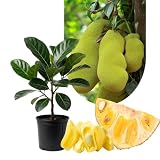
Jackfruit is not a tree you plant casually. It is a fast to medium growing evergreen that reaches 9–21 m (30–70 ft), it carries the heaviest fruit of any tree – 3–40 kg (roughly 7–88 lb), and often more, at 15–50 cm long – and it carries that fruit directly on the main trunk and the largest limbs rather than out on the twigs. Almost every practical decision you make about where to plant it, how to water it and how to prune it follows from those two facts.
What you are actually planting
The jackfruit tree (genus Artocarpus, also called jack tree) is a perennial evergreen grown for its edible fruit and seeds, and it doubles as a serious shade tree. The leaves are green and elliptic to oval, and on young or vigorous growth they can be deeply lobed – which confuses people comparing a nursery seedling with a mature tree.
Flowering is the part that surprises most gardeners. The flowers look more like small fruits than blossoms, and male and female flowers are separate. The female flowers are the larger ones, lighter green to yellow, and they usually appear before the males. Crucially, both are borne on the trunk and the big branches – a habit called cauliflory. That is why the trunk and main limbs are not just structure on a jackfruit: they are the fruiting wood, and they should not be stripped bare, scarred by a strimmer, or buried under mulch piled against them.
Climate and cold tolerance
Jackfruit grows in tropical, subtropical and Mediterranean climates, and its comfortable home is hardiness zone 11a – winters where the low stays above roughly 4.4°C (40°F). Zone 10b, with lows of about 1.7–4.4°C (35–40°F), is possible, but with two conditions attached. First, a young tree needs deliberate overwinter care until it has some bulk behind it; a mature trunk buffers cold far better than a two-year-old whip. Second, in 10b not every cultivar manages to set fruit – the single strongest argument for buying a grafted tree of a known fruiting cultivar rather than gambling on a seedling.
Humidity matters as much as heat: jackfruit expects high humidity, and a hot dry wind punishes it even where the temperature is nominally fine.
Growing jackfruit from seed
Seed is a genuinely good way to start a jackfruit – it is not a difficult germinator – but it is unforgiving on one point: jackfruit seed is short-lived. It does not dry down and wait in a packet the way a tomato seed does. Old seed simply fails, and that is the real reason behind most failed germination attempts.
- Get seed as fresh as possible and sow it as soon as possible after it leaves the fruit.
- Soak the seeds for 24 hours in room-temperature water, changing the water during that period.
- Sow 1–2 cm below the surface, in an airy, moist, well-drained medium.
- Keep humidity high and the medium consistently moist – never dry, never sodden.
- Sow in spring, in warm weather. Germination takes 3–10 weeks, so do not give up on a pot at week four.
If you need to move seed from one place to another, the trick is to let it germinate in transit: put it in moist soil inside a plastic bag, and plant it directly once it has sprouted. Jackfruit resents root disturbance, so “plant it directly” is the operative instruction – the fewer times a seedling is lifted and handled, the better it establishes.
Expect 3–5 years from seed to first flowering and fruit. Starting from a seedling or a nursery plant rather than raw seed is easier and skips the riskiest stage entirely.
Grafting, air layering and cuttings
Jackfruit can be started from a plant, from seed, from an air layer or from a cutting. Grafting is not mandatory – seedlings grow readily – but it buys two things a seedling cannot promise: better fruit, and the near-certainty that the tree will fruit at all. In zone 10b, where cultivar choice decides whether you get a crop, that certainty is worth paying for. Graft in spring. Air layering is the middle path: it clones a known tree without the skill demands of grafting.
Planting a jackfruit tree
Planting season depends on your zone: spring to summer in zone 10b (spring is better – it gives the tree a full warm season to establish before its first winter), spring to autumn in zone 11, and all year in zone 12 and above.
- Dig a hole as deep as the current root ball and 50–100% wider – use the smaller percentage for a larger tree.
- Mix organic matter, humus and dried leaves into some of the excavated soil and put it in the hole.
- Set the tree in, loosening the outside of the root ball slightly so roots break out into the new soil instead of circling.
- Backfill and firm the soil: not compacted hard, but not left fluffy either, or the tree will never be stable.
- Mulch the surface to hold moisture.
- Water it in, then water every day for the next two weeks, preferably in the morning.
- If the tree rocks at all, stake it with a bamboo cane or stick. A jackfruit that works loose in the ground in its first month rarely recovers well.
Site it away from paths, patios, glass and parked cars. This is not fussiness – a falling 40 kg fruit is a genuine hazard, and it is the most-cited difficulty of growing this species.
Soil, water and feeding
Jackfruit wants soil that is rich in nutrients, airy and well drained, kept moist, in full sun. Watering is an average to large amount – but only where drainage is good, and that qualifier is the whole story. The tree cannot be left without water, and it is also sensitive to flooding. Those two statements are not a contradiction: the roots need constant moisture and constant air, so the failure modes sit on both sides. Heavy soil that holds water is worse for a jackfruit than lighter soil watered more often.
While the tree is young, feed with a fertilizer high in nitrogen and keep adding humus and organic matter. Cover the soil with mulch or dead leaves, especially in those early years – it stabilises soil moisture, which is exactly what a plant that hates both drought and waterlogging needs.
Pruning: managing the weight of the crop
Prune from autumn into winter, and ideally straight after the fruit comes off. Two jobs matter:
- Remove weak branches. A limb that is perfectly fine carrying leaves can crack under a maturing fruit, tearing bark and structure with it on the way down. Prune while the tree is strong enough to take it, and build a frame that can hold the load.
- Thin small branches in the shaded interior, particularly where Phenacoccus solani mealybug is present. Congested, shaded growth is where sap-suckers breed.
Pests and diseases
The regular offenders are aphids and mealybugs – including Ferrisia virgata, the striped mealybug, and Phenacoccus solani. All feed on sap and excrete honeydew, which then grows sooty mould and shades the leaf surface. They favour sheltered, shaded parts of the canopy – which is why interior thinning is a pest-control measure and not only a shaping one.
Harvest, taste and uses
Jackfruit blooms in spring to summer, and the fruit season runs from the end of summer into winter. The fruit turns from green to yellow and is covered in spines; it has a strong, unpleasant smell, and handling it bare-handed is not recommended – wear gloves.
Ripe jackfruit tastes of pineapple, with people variously reading mango, Monstera deliciosa or durian into it. Eat it raw, juice it, cook it, or turn it into jam. The seeds are edible too and are usually roasted – do not throw away several kilograms of them with the rind.
Green jackfruit
Green jackfruit is simply unripe jackfruit, and it is a different ingredient rather than a lesser one. Picked young it is used for cooking, roasting and baking, where its firm, neutral flesh behaves more like a vegetable than a fruit. If one tree is producing more fruit than you can possibly eat ripe, harvesting part of the crop green is the practical answer.
Jackfruit leaves
The leaves are not edible. They have a traditional medicinal use – most of the claims concern diabetes – and are used fresh or dried, but there is very little solid information behind it. Treat that as folklore rather than guidance.
Jackfruit and durian: similar, unrelated
Jackfruit and durian are constantly compared, and the resemblance is real: both are big, spiny, strong-smelling tropical fruits, and some people find them similar in taste too. But there is no botanical connection between them. This is convergent evolution – two independent lineages arriving at a similar form, structure and smell.
For the gardener the useful comparison is practical: their growing conditions are almost identical, with one difference that decides marginal climates – jackfruit is the more cold tolerant of the two. If you are on the cool edge of the tropics and choosing between them, jackfruit is the safer bet.
Common mistakes
- Sowing old seed. Jackfruit seed does not store – fresh seed or nothing.
- Assuming a seedling will fruit. In zone 10b especially, buy grafted stock.
- Planting into heavy soil and then watering generously. That combination is flooding.
- Skipping structural pruning until the first heavy crop, then losing a main limb to it.
For the full plant profile see our Jackfruit tree growing page.
See also: fruit tree grafting · grafting tools & supplies · rooting hormone for cuttings
See also: how to graft fruit trees · grafting tools
More fruit-growing guides
- Growing fruit trees from seed
- How to prune fruit trees
- How to hand-pollinate flowers
- Why a tree flowers but won’t fruit
- How and when to fertilize
- Growing tropical fruit in cool climates
For the general techniques behind this (cuttings, division, layering, grafting), see our plant propagation methods guide.