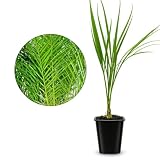
The acai palm, Euterpe oleracea, is an easy plant in the right place and an impossible one everywhere else. Nothing about its care is complicated – water it heavily, keep the soil acid, give it sun and humidity – but it is a true tropical palm rated for hardiness zone 12 and above, meaning it wants a climate where the temperature essentially never drops below about 10 °C (50 °F). That single line decides whether you can grow it at all, so it is worth being honest about before you buy seed.
What acai actually needs
Four requirements matter, and they are all connected:
- Tropical warmth all year. No cold season, no frost, no cool nights that stall growth.
- High humidity. Acai is a rainforest palm and it shows in the leaves. Dry air scorches the leaflets and browns the tips even when the soil is soaking.
- Moist, acid soil. Acidity is not a preference you can ignore. In alkaline soil, iron and several other nutrients become chemically locked up and unavailable to the roots, and the result is a pale, yellowing palm that no amount of watering will green up. If your soil is neutral or limy, work in generous organic matter and choose acidifying feeds.
- A large amount of water. Most palms hate wet feet. Acai is one of the exceptions – it comes from ground that stays wet, and constantly moist soil is what it wants rather than what it tolerates.
Light is the most flexible of the requirements: full sun to half shade. Half shade suits a young palm, which in the wild would start life beneath a canopy; full sun gives the fastest growth and the heaviest crop once it has height.
 5 Date Palm Seeds | Phoenix dactylifera Palm Tree Seeds for Planting
 CZ Grain Tropical Palm Tree Seeds Variety Pack – 50 Seeds, 10 Exotic Palm
Acai palm seed for growing your own Euterpe oleracea: As an Amazon Associate we earn from qualifying purchases.
Starting an acai palm
You can begin with a nursery plant, with seed, or vegetatively. A plant is the easiest and quickest start and the usual recommendation. Vegetative propagation is not necessary but it is easy to do, so if you have access to an established clump and can separate an offshoot with roots attached, take that route – you skip the germination stage entirely and get a known plant.
Growing acai from seed
Seed works well and is often the only way to obtain the palm outside its native range.
- Sow at any time of year in a suitably warm climate, but spring is best. Note that acai seed is a South American crop, and in South America that spring sowing window falls in October – worth remembering when a supplier quotes a season, because their spring is the northern hemisphere’s autumn.
- Sow so the seed is covered by 2-3 cm of soil above the top of the seed.
- Use moist, acid soil and give it warm weather and high humidity. Germination is a heat-and-moisture process; a cool spell simply stops it.
- Keep the soil wet – not merely damp – and never let it dry between waterings.
- Grow the seedlings on in full sun to half shade, with plenty of water.
Buy seed as fresh as you can. Like most tropical palm seed, it is not the sort of thing to keep in a drawer for a year.
Planting and ongoing care
In a genuinely tropical climate the palm can be planted at any time of the year, which is one of the conveniences of a place with no cold season. Growth is medium to fast given heat, water and fertile acid soil.
The single most common cause of a struggling acai outside the tropics is not cold at all – it is dryness. Between low humidity and irregular watering, the palm ends up with brown, ragged leaflets and stops extending. Mulch heavily, water often, and if you are in a marginal climate, group plants together to raise the humidity around them.
Pruning: dead leaves only, and why that matters
Pruning acai can be done all year round, and the rule is short: remove dead leaves only.
Resist the urge to tidy up leaves that are merely yellowing or half brown. As a leaf ages, the palm systematically withdraws its minerals back out of it and moves them into new growth. A fading leaf is not waste – it is a resource still being recovered. Cut it off while it is still partly green and you throw away nutrients the palm has already invested in, and in poor soil that shows up as slower growth and paler new fronds.
So wait until a frond is genuinely dead and dry, then take it off. This is also good hygiene, since dead material left in the crown gives pests somewhere to shelter.
Pests and the one disease risk to know
Red palm weevil
The serious pest is Rhynchophorus ferrugineus, the red palm weevil. The adult is a large rusty-red beetle, but it is the larvae that kill: they tunnel inside the trunk and crown, feeding on the tissue that produces new leaves. The damage happens entirely out of sight, and by the time the crown collapses or the newest frond pulls out easily, the palm is usually beyond saving. Inspect the crown regularly, look for weeping holes or chewing frass on the trunk, and act at the first sign rather than waiting to be sure.
Birds
Birds are the main competitor for the fruit. On a young, short palm netting is practical. On a mature one it is not, and you simply harvest promptly.
Triatomines in the fruit
One genuine hazard is specific to acai: the fruit can carry triatomine bugs, which can contaminate the pulp during harvesting and processing. This is the main reason acai is virtually never eaten raw off the palm and is instead pulped and heat-treated before use. If you are processing your own harvest, wash the fruit thoroughly, discard anything that arrives with insects on it, and cook or heat the pulp rather than consuming it raw.
Size, dwarf cultivars, pots and indoors
A standard acai palm reaches 10-20 m (30-60 ft). Dwarf cultivars stay at 4-6 m (12-20 ft), and that difference is not just about garden space – it is about whether you can pick the fruit. Harvesting acai is easy while the palm is young and within reach; once it is tall it becomes hard work, and in commercial groves it means climbing. For a home garden, a dwarf cultivar is very often the smarter choice.
As for containers and indoor growing, the honest answer is that acai is not a container palm and not a houseplant. It wants a huge amount of water, permanent humidity and eventually a great deal of room, none of which a pot in a living room supplies. The one qualified exception is a dwarf cultivar in a large container right beside a bright window, which can survive and may just grow – but treat that as an ornamental experiment, not a route to a crop.
Flowers and pollination
Acai can bloom throughout the year. The flowers are red and carried on branched sprays, with dozens of individual flowers on each branch – an impressive display on a mature palm. Pollination is done by beetles, bees, wasps and flies, so a garden that keeps a broad insect population, rather than one sprayed clean, sets more fruit.
Fruit: the wait, the harvest and the uses
Expect the first crop 5-8 years after planting. Once bearing, the palm can fruit through most of the year in a suitable climate, which is one of its great advantages over seasonal fruit trees.
The berries are small and black-purple. They are not a dessert fruit to eat by the handful – the flesh is a thin layer around a large seed – so acai is processed rather than eaten out of hand. The standard uses are juice, pulp, powder, ice cream and cooked preparations.
Two other parts of the palm are used as well:
- Heart of palm – the tender growing point at the top of the stem is edible and is a recognised product of this species. Be aware that taking it removes the stem’s only growing point, so that stem will not regrow.
- The seeds – used ornamentally and in traditional medicine, so a harvest need not be wasted after pulping.
For the full plant profile see our Acai palm growing page.