Plant Profile & Key Characteristics
Overview: Jackfruit is a large evergreen tropical to subtropical tree growing 9-21 m (36-64 ft) tall. This perennial is grown for its enormous edible fruit and seeds and also makes a useful shade tree.
Quick Specifications
| Specification | Attribute |
|---|---|
| Plant Type / Life Cycle | Perennial (evergreen tree) |
| Foliage Type | Evergreen |
| Mature Size | 9-21 m tall (36-64 ft) |
| Growth Rate | Fast to moderate |
| Root System | Deep taproot |
| Toxicity | Non-toxic / edible (fruit and seeds) |
| Hardiness | USDA zone 11a (10b+ with winter care) |
Growth Form & Structure
- Height & Spread: 9-21 m (36-64 ft) tall with a dense spreading crown in the ground; not suited to pots or indoor growing.
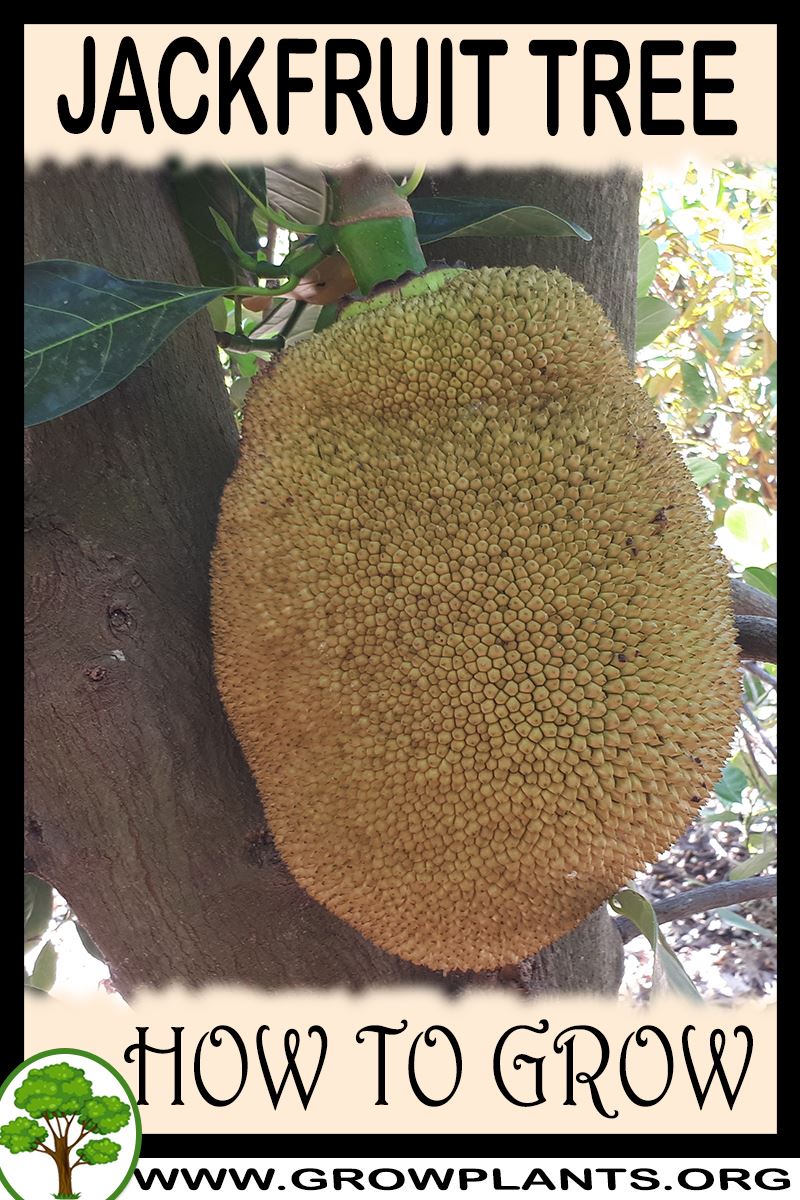
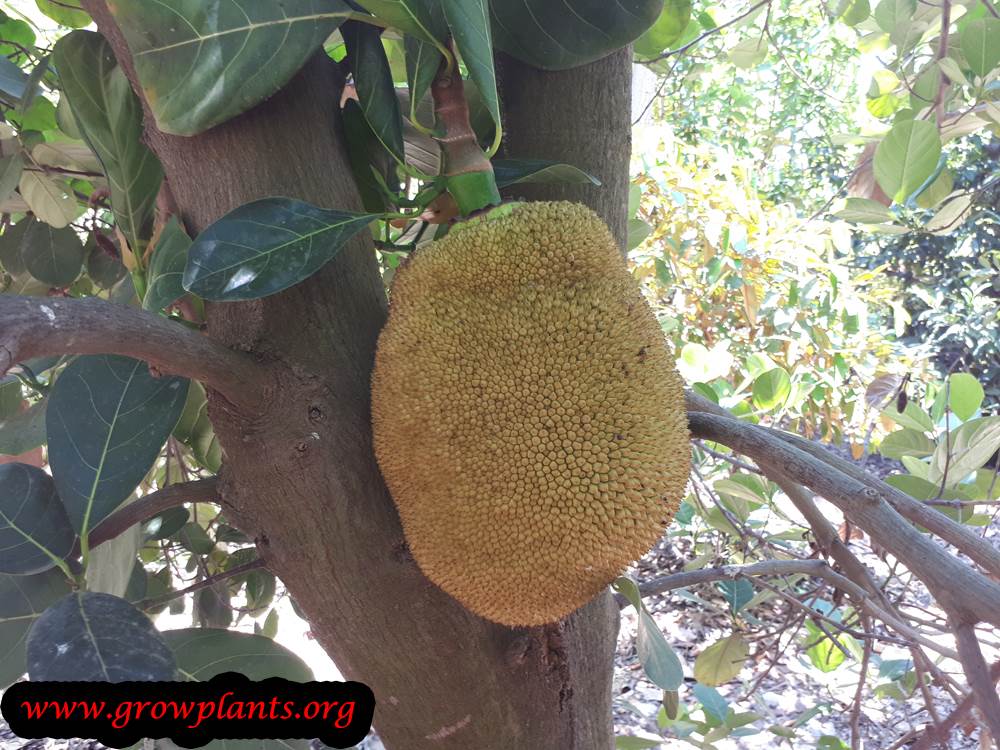
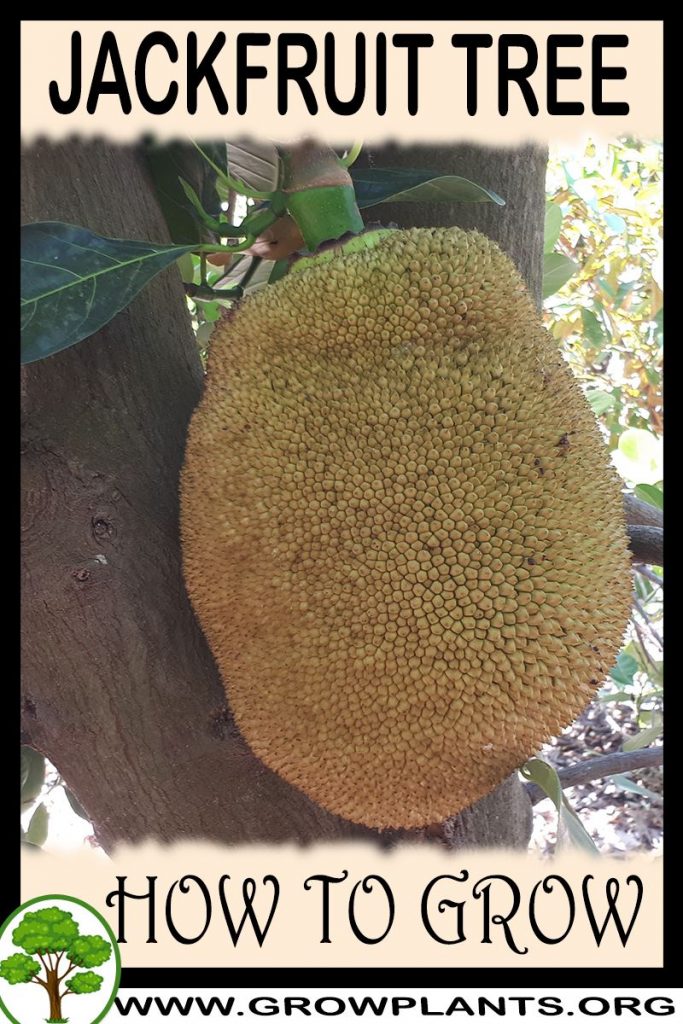
- Growth Habit & Form: Evergreen tree with a strong trunk; the huge fruits grow directly on the trunk and main branches (cauliflory).
- Lifespan & Maturity: Long-lived; grafted trees bear in about 3-4 years, seedlings 5+ years.
Anatomy & Physical Features
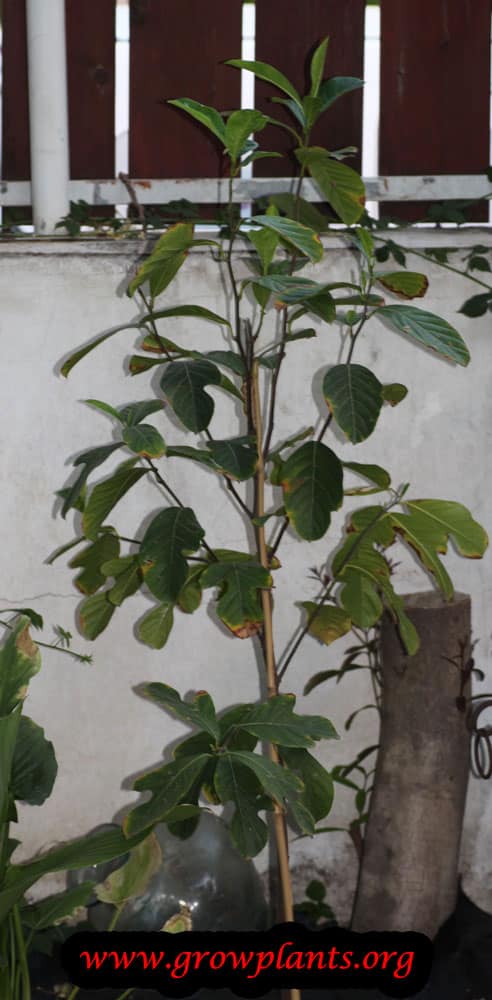
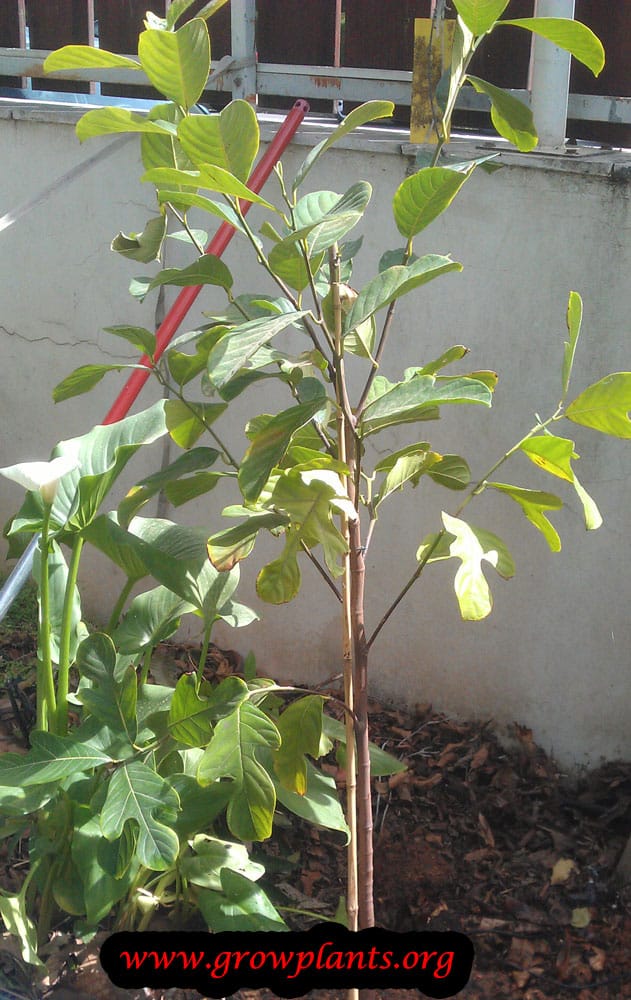
- Leaves & Foliage: Green leaves in elliptic to oval shape, sometimes deeply lobed on young growth.
- Flower Characteristics: Separate male and female flower heads that look like small fruits, borne on trunk and branches; the larger female appears first (see Bloom guide).
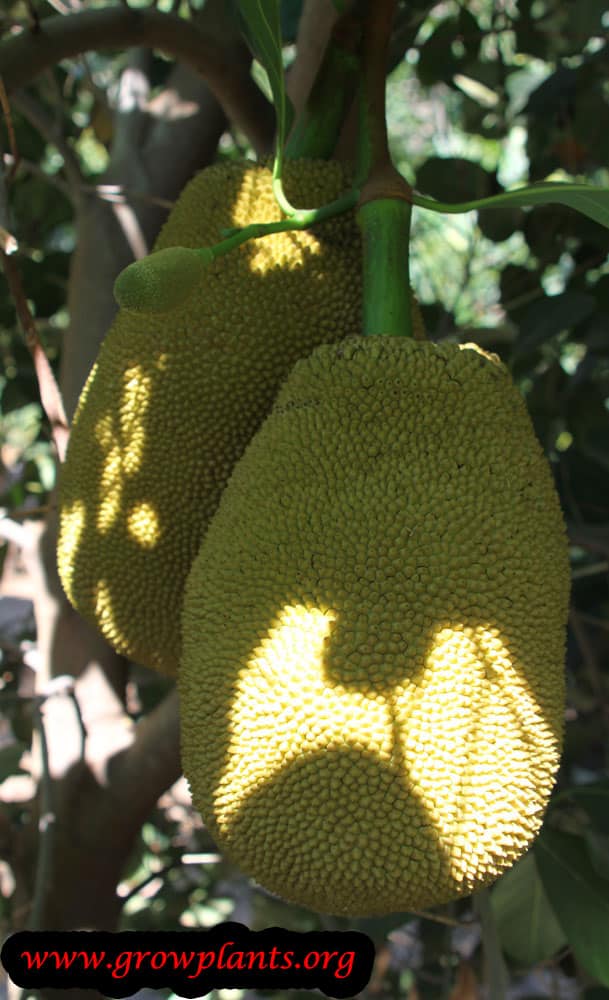
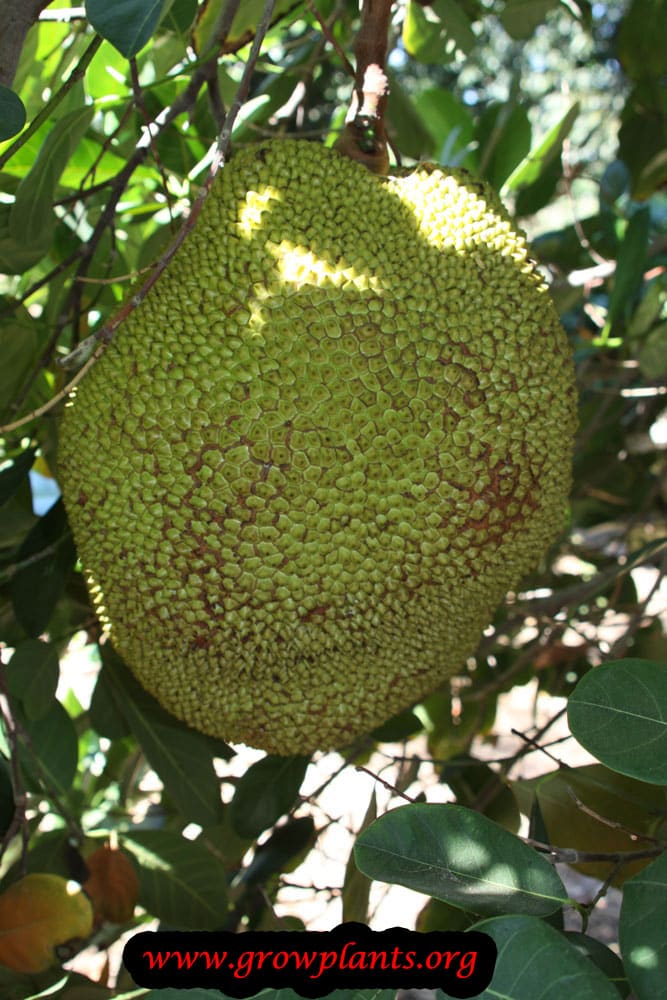
- Fruit Profile: Very large green-to-yellow spiny fruit weighing 3-40 kg; strong odour when ripe, with edible brown seeds (see Fruit guide).
Primary Uses & Landscape Value
- Edible Uses: Fruit eaten raw or cooked, juiced or made into jams; seeds edible when cooked.
- Functional & Ornamental Roles: Shade tree and productive orchard tree in warm climates.
Care Guide: Planting, Soil & Watering
Overview: Jackfruit is a fast-growing tropical to subtropical tree that needs full sun, warmth and high humidity (hardiness zone 11a, or 10b with winter protection when young). Plant it in rich, nutrient-heavy soil that stays moist yet remains airy and well-draining.
Quick Care Requirements
| Requirement | Ideal Condition |
|---|---|
| Planting Season | Spring in zone 10b; spring–autumn in zone 11; year-round in zone 12+ |
| Growth Rate | Moderate to fast |
| Soil Type | Rich, nutrient-heavy, airy and well-draining, kept moist |
| Water Need | Moderate to high with good drainage – never let it dry out |
Planting & Establishment
- Best Planting Season: In zone 10b plant in spring so early growth catches the warmth; spring to autumn in zone 11; year-round in zone 12+. Avoid cold snaps while the tree is young.
- How to Plant:
- Hole Preparation: Dig a hole as deep as the root ball and 50–100% wider – the smaller the tree, the smaller the extra margin – so roots settle into loosened soil.
- Soil Amendments: Mix organic matter, humus and dried leaves into some of the backfill; young trees also benefit from a nitrogen-rich feed and a mulch of straw or dead leaves to hold moisture.
- Planting Depth: Set the tree at its original depth, loosen the outer roots of the root ball, and firm the soil enough to keep it stable without compacting it, then mulch and water in. Stake young trees so they do not rock or fall.
- Growth Speed & Expectations: Expect fast to moderate growth in warm conditions toward a large 9–21 m tree.
Soil, Watering & Drainage Care
- Soil Mix & Drainage Needs: Use rich, airy, well-drained soil; jackfruit needs an average to large amount of water but is sensitive to floods and cannot sit in waterlogged ground, so drainage is critical.
- Watering Schedule & Technique:
- Young / Newly Planted: For the first two weeks water every day, preferably in the morning, keeping the root zone moist while the tree establishes.
- Established: Once established, water regularly and deeply – the tree cannot go without water – while making sure excess drains away.
- Seasonal Adjustments: Water more in hot, dry weather and less in cool spells; protect young trees over winter in marginal zones.
Climate, Light & Hardiness
Jackfruit grows in tropical, subtropical, and Mediterranean climates in full sun, reliably outdoors from about zone 11a, and can be pushed into zone 10b+ with dedicated overwinter care while young. Young trees need more cold protection than mature ones.
Quick Climate Specifications
| Climate Zones | Tropical, Subtropical, Mediterranean |
|---|---|
| USDA Hardiness Zones | 11a, and 10b+ with overwinter care while young |
| Approx. Survival Minimum | approximately 1.7 to 4.4°C (35–40°F) at the zone 10b–11 boundary, briefly, for an established tree |
| Frost Tolerance | Low |
| Light Conditions | Full Sun (young trees tolerate half shade but grow and fruit more slowly) |
Sunlight & Light Exposure
Optimal Light Setup
Full sun is important for the tree's overall growth and fruiting.
Direct Sun Requirement
Important for mature growth and reliable fruiting; young trees can start in half shade but will take longer to grow and bear fruit.
Best Exposure / Orientation
An open, sunny site with room for a large tree.
Temperature Extremes & Hardiness
USDA Hardiness & Regional Limits
Reliable from about zone 11a; zone 10b+ is workable with overwinter protection, especially while the tree is young.
Cold Damage & Winter Protection
Young trees are notably more cold-sensitive than mature ones; provide extra winter protection and shelter in marginal (zone 10b) climates.
Frost Sensitivity
Low frost tolerance overall, greatest risk while young.
Extreme Heat Tolerance
Good in genuinely tropical/subtropical heat.
Wind, Humidity & Microclimate
Humidity Preferences
Prefers high humidity for best fruit development.
Rainfall & Seasonal Moisture
Wants average to large, consistent water with good drainage, reflecting its humid tropical/subtropical origin.
Microclimate Recommendations
A warm, sheltered site is especially useful near the cold edge of its range, particularly for young trees.
Growing in Pots, Balconies & Indoors
Jackfruit (Artocarpus heterophyllus) is a very large tree of 9-21 m (36-64 ft) with heavy fruit. The grower confirms it is neither a houseplant nor a container plant, and its massive fruit can be dangerous when it falls – it belongs in open ground.
Quick Details
- Container Size: Only while young – a large tub; it soon needs the ground
- Indoor Suitability: Not suitable
- Best Spot: Full sun (a young tree tolerates half shade but is slower), outdoors
- Soil & Drainage: Rich, free-draining mix; it cannot go without water but hates flooding
- Watering in Pots: Average to generous – keep evenly moist, never waterlogged
Indoors & On the Windowsill
- Houseplant limits: Not a houseplant – it becomes an enormous tree needing full sun.
- Overwintering: Only young potted plants in cool climates – keep them bright, warm and frost-free before planting out.
On a Balcony or Patio
- Young plants only: A young tree can spend warm seasons in a large pot in full sun. Pots dry quickly, so water regularly; note that a mature tree’s heavy fruit makes it unsuitable near seating or walkways.
Choosing the Pot, Soil & Long-Term Care
- Pot & drainage: Use a pot with plenty of drainage holes; skip a standing water saucer to avoid root rot. Terracotta breathes and dries faster, while glazed or plastic pots hold moisture longer.
- Potting mix: A well-aerated, organic-rich mix – peat or coir blended with perlite or vermiculite for drainage.
- Feeding: Potted plants need feeding more often than those in the ground, as nutrients leach out with each watering – feed lightly through the active growing season.
- Repotting: Refresh the mix or pot up about every two years; for an established specimen, replace part of the soil and lightly prune the roots and top growth.
Fertilizing & Feeding
Jackfruit does best on rich, airy, well-drained soil with high humidity, and a young tree in particular benefits from a nitrogen-forward feeding program alongside humus and organic matter to help it size up toward its first flowers, which form directly on the trunk and older branches.
Quick Fertilizing Specs
| Feeding Level | Moderate. |
|---|---|
| young_feeding | Nitrogen-forward feeding paired with humus and organic matter, which this tree draws on heavily while young. |
| mature_feeding | Balanced feeding, shifting toward potassium to support its very large, heavy fruit. |
| Main Nutrient Priority | Nitrogen while young to build a rich, well-fed root zone, then balanced-to-potassium once the tree is bearing its large fruit. |
| Best Feeding Period | Through the main warm-season growth period; a young tree in a cooler-edge climate benefits from extra care over winter. |
| Organic Options | Rich soil built up with humus, organic matter, and a mulch or dead-leaf cover, which this tree responds to strongly, especially while young. |
| Soil pH | Prefers rich, airy, well-drained soil rather than any particular pH extreme. |
| Reduce/Stop Feeding | Ease feeding back only where cooler weather slows growth in marginal climates. |
Feeding by Growth Stage
Newly planted
Help a newly planted jackfruit tree root into rich, airy, well-drained soil, with mulch or dead leaves keeping the root zone moist while it establishes.
| Nutrient direction | Keep feeding light while the tree focuses on rooting in; the organic matter and humus worked into the planting hole carry most of the early load. |
|---|---|
| Timing | At planting, and through the first weeks of steady watering while the tree stabilizes. |
| Frequency | Skip fertilizer right at planting; introduce light feeding only once clear new growth confirms the tree has rooted in. |
| Fertilizer types | Organic matter, humus, and dried leaves mixed into the planting hole, A light, balanced fertilizer once new growth appears |
| Precautions | Keep the young tree well supported and its root zone consistently moist with mulch; avoid feeding a stressed, unrooted tree. |
Young tree, building growth
Build a strong young tree – this stage is explicitly where a nitrogen-forward feeding program alongside humus and organic matter matters most for this species.
| Nutrient direction | A nitrogen-forward feed, paired with humus and organic matter, supports the vigorous early growth this species is known for while young. |
|---|---|
| Timing | Through the growing season for the first several years before the tree begins bearing fruit on its trunk and older branches. |
| Frequency | Feed regularly through the growing season, keeping the root zone mulched between feedings. |
| Fertilizer types | A nitrogen-forward complete fertilizer through the growing season, Humus, organic matter, and a mulch or dead-leaf cover around the root zone |
| Routine trace nutrients | iron, manganese, zinc |
| Precautions | In climates at the cooler edge of this tree’s range, protect young trees over winter rather than pushing late-season growth with heavy feeding. |
Established tree approaching bearing age
Support the shift toward flowering, where distinct female and male flowers form directly on the trunk or large branches.
| Nutrient direction | Shift toward a balanced feed as the tree matures toward its first flowering and fruit set. |
|---|---|
| Timing | As the tree matures over several growing seasons toward its first bloom. |
| Frequency | Continue steady, moderate feeding through the growing season. |
| Fertilizer types | A balanced complete fertilizer through the growing season, Organic matter and mulch to maintain rich, airy soil |
| Routine trace nutrients | iron, manganese, zinc |
| Precautions | Full sun gives the best growth toward bearing age; a tree grown in partial shade will simply take longer to reach flowering and fruiting. |
Mature, fruit-bearing tree
Support the development of this tree’s very large, heavy, spiny-skinned fruit, which forms directly on the trunk and main branches.
| Nutrient direction | A balanced feed shifting toward potassium support to help size up such large fruit. |
|---|---|
| Timing | Through the growing season, with attention around flowering and while fruit is sizing up toward harvest later in the year. |
| Frequency | Feed steadily through the growing season to match the demands of this tree’s unusually large fruit. |
| Fertilizer types | A balanced-to-potassium-leaning fertilizer through the growing and fruiting season, Mulch and organic matter maintained around the root zone |
| Routine trace nutrients | iron, manganese, zinc |
| Precautions | Prune out weak branches so the tree can safely support its heavy fruit, and net or otherwise protect fruit if birds become a problem. |
Nutrient Deficiency Signs & Corrections
Pale foliage and slow branch development in a young tree that should be growing vigorously.
| Possible causes | Insufficient nitrogen for the young-tree growth stage, which this species draws on heavily, Humus or organic matter not replenished around the root zone, Root stress from waterlogged or compacted soil |
|---|---|
| Appears first on | Older leaves first, spreading to new growth if it continues. |
| What to check | Recent feeding history, Whether mulch and organic matter have been kept up around the root zone, Overall growth compared with prior seasons |
| Possible correction | Step up to a nitrogen-forward feeding paired with fresh humus or organic matter, as this species responds strongly to both while young. |
Older leaves yellowing between the veins while veins stay green, on an otherwise large, well-grown tree.
| Possible causes | Low soil magnesium, common on heavily leached soils under high rainfall, Potassium-heavy feeding that outcompetes magnesium uptake, Waterlogged soil limiting root function |
|---|---|
| Appears first on | Older, lower leaves. |
| What to check | Balance between potassium and magnesium in recent feeding, Soil drainage, Whether yellowing is confined to older leaves |
| Possible correction | Use a complete fertilizer that includes magnesium rather than a straight potassium product. |
Fruit that stays undersized or develops unevenly for this tree’s typically very large fruit.
| Possible causes | Low soil potassium unable to keep pace with such large, heavy fruit, Inconsistent soil moisture while fruit is sizing up, A tree still too young or under-fed to properly support a full fruit load |
|---|---|
| Appears first on | Developing fruit. |
| What to check | Whether feeding shifted toward potassium as fruit began developing, Soil moisture consistency, Tree age and overall vigor |
| Possible correction | Shift toward a potassium-leaning feed as fruit develops and keep soil moisture consistent. |
Pruning, Training & Seasonal Maintenance
Jackfruit is a large tropical tree that flowers and fruits directly on the trunk and major branches (cauliflory), producing some of the heaviest fruit of any cultivated tree – up to 40kg each. Pruning tolerance is moderate and structural rather than cosmetic: the central task is keeping the trunk and scaffold branches strong enough to carry that fruit load without breaking, and pest-driven sanitary removal of small shaded branches, best done in autumn/winter directly after the harvest.
Quick Pruning & Maintenance Specs
| Pruning Tolerance | Moderate |
| Primary Pruning Window | Autumn to winter, directly after the fruit harvest |
| Typical Frequency | Annual structural check; sanitary removal as pests are found |
| Main Objective | Build/maintain scaffold branches strong enough to bear very heavy fruit; protect trunk cauliflory zones |
| Young Plant Priority | Build a strong, well-angled scaffold before the tree begins fruiting |
| Mature Plant Priority | Remove weak branches before they fail under fruit weight; sanitary mealybug-affected wood removal |
| Best Tool Type | Pruning saw and loppers for structural limbs; precision snips for shaded mealybug-affected twigs |
| Avoid Heavy Pruning During | While fruit is developing/maturing on the tree – the same branches carrying weight are being assessed, not cut |
Pruning by Plant Age & Size
Newly Established
Remove only damaged growth; do not remove structural branches while the young tree is still establishing.
Young / Formative
Build an open, well-angled scaffold of main branches before the tree reaches bearing age (typically 3-5 years, longer from seed) – wide branch angles and adequate spacing matter more here than for most fruit trees because those same branches will eventually have to carry fruit weighing several kilograms each, sometimes over 30kg.
Mature / Established
Regularly assess scaffold branches for weakness once the tree is bearing – the source guidance is explicit that branches should be pruned out ‘as long as the tree [is] strong enough,’ since an overloaded weak branch can crush under the fruit. Also remove small branches growing in shaded, poorly-ventilated parts of the canopy, which are more prone to Phenacoccus solani mealybug infestation.
Seasonal Pruning Schedule
Post-Harvest (Autumn-Winter)
- Objective: structural correction and canopy cleanup right after the crop is picked
- Remove: weak or damaged scaffold branches, shaded mealybug-prone twigs
- Do not remove: healthy trunk and main-branch surface where next season’s cauliflorous flowers will form
- Expected response: stronger framework for the next fruiting cycle
- Flowering/fruiting impact: minimal, since this window falls after the current crop and before the next flowering flush
Ongoing Sanitary
- Objective: remove mealybug-infested shaded branches as soon as noticed
- Remove: small interior branches showing Phenacoccus solani or other pest activity
- Do not remove: healthy cauliflorous wood on the trunk/main limbs
- Expected response: reduces pest pressure and improves airflow to shaded interior growth
- Flowering/fruiting impact: protects surrounding healthy fruiting wood from infestation spread
Flowering & Fruiting Wood
Jackfruit is strongly cauliflorous: separate male and female flowers (female flowers larger, lighter green to yellow, typically appearing before the male) form directly on the main trunk and large branches, and the fruit that follows hangs from these same woody surfaces. Because the trunk and main scaffold ARE the fruiting wood, routine pruning must avoid stripping this bark/wood, and any necessary branch removal should target smaller, weaker, or shaded secondary growth rather than the main cauliflory-bearing trunk and limbs.
Structural Pruning & Training
The dominant structural concern is branch strength versus fruit weight – remove or shorten branches that are too thin or weakly attached to safely carry mature fruit before they fail under load. Thin small shaded interior branches to improve airflow and reduce the mealybug pressure noted in the source data.
Special Growth to Remove
Rootstock suckers (relevant since grafting is recommended in cooler hardiness zones to ensure reliable bearing) should be removed below the graft union; weak or shaded small branches prone to mealybug infestation should be thinned out of the interior canopy.
Tools
- Pruning saw and loppers for structural scaffold-branch removal
- Precision snips or bypass secateurs for small shaded, mealybug-affected twigs
- Pole pruner for reaching upper canopy on a mature tree
Tool Hygiene & Disease Risk
Increased. Phenacoccus solani mealybug and other listed pests (aphids, Ferrisia virgata) can be spread on tools and hands when removing infested material – clean tools between cuts when pruning out pest-affected branches, and prune those branches out promptly rather than leaving them in the shaded canopy.
Cut Placement & Technique
Use staged, undercut-first removal for any large limb to avoid bark tear given the fruit-bearing weight these branches carry; cut mealybug-affected small branches back to clean healthy wood, not just where damage is visible.
Heavy Pruning & Rejuvenation
Not a routine practice – the priority is targeted removal of weak or pest-affected branches rather than broad rejuvenation cuts, since the trunk and main limbs carry irreplaceable cauliflorous fruiting sites that take years to re-establish.
Post-Pruning Care
After removing a weak or fruit-damaged branch, monitor the wound and surrounding canopy for mealybug recolonization, and support any remaining heavily-laden branches (bracing or props) rather than relying on pruning alone to prevent breakage during a heavy fruit set.
Common Pruning Mistakes
Leaving obviously weak branches in place until they crush under a maturing fruit’s weight instead of removing or supporting them proactively; scraping or damaging trunk bark during routine work and destroying cauliflorous flowering sites; ignoring small shaded interior branches that become a mealybug reservoir.
When NOT to Prune
While fruit is actively developing on the branches being assessed – the fruit itself (heavy and easily bruised, with a strong odor when handled) should not be disturbed by nearby cutting; also avoid removing trunk-surface wood at any time, since that is permanent cauliflorous fruiting real estate.
Recommended Tools (by task)
- pruning_saw – removing weak scaffold branches before they fail under heavy fruit
- loppers – mid-size branch removal and thinning shaded interior growth
- pole_pruner – reaching upper canopy on a mature, large tree
- blade_disinfectant – cleaning tools between cuts when removing mealybug-infested wood
Pruning Troubleshooting
| Problem | Possible Cause | What to Check | Corrective Action |
| Branch breaks or splits under fruit weight | Weak branch attachment or undersized branch left to bear heavy fruit | Branch diameter and angle relative to fruit size/number it is carrying | Remove or thin overloaded weak branches proactively, before fruit reaches full weight; brace/support branches with a heavy set |
| Mealybug infestation recurring in the canopy | Shaded, poorly-ventilated interior branches left unpruned | Presence of Phenacoccus solani on small shaded twigs | Prune out affected shaded branches promptly and improve interior airflow |
| Reduced fruit set on the trunk | Bark/wood damage on the trunk or main limbs from over-pruning or scraping | Old wounds or scars on trunk and main-limb cauliflory zones | Stop cutting into trunk surfaces; allow cauliflorous wood to recover over seasons |
Propagation Guide
Jackfruit is most reliably started from fresh seed, though air layering and cuttings are also listed as ways to begin new plants, and grafting is preferred where dependable fruiting matters, since not every seedling is guaranteed to fruit well in marginal climates. Difficulty is moderate: germination itself is not hard, but the seed loses viability within days of removal from the fruit, so timing and fresh handling matter more than technique.
Quick Propagation Specs
| Best Propagation Method | Seed (fresh) |
| Alternative Methods | Air layering; cuttings; grafting |
| Propagation Difficulty | Moderate |
| Seed True-to-Type | Variable – seedling trees are not guaranteed to fruit as reliably as the parent, especially in marginal (zone 10b) climates |
| Vegetative True-to-Type | Yes |
| Best Propagation Season | Tropical: all year, best spring–summer; hardiness zone 10b: sow fresh seed directly in a greenhouse |
| Seed Germination Time | 1–3 weeks; seed that is less fresh takes longer to germinate |
| Germination Temperature | Warm, roughly 25–35°C (77–95°F) |
| Seed Sowing Depth | 3–5 cm (1–2 inches) |
Growing from Seed
Seed Handling & Viability
Seed must be fresh: viability declines with every day that passes, and after about five days the seed may no longer be viable. If seed cannot be sown immediately, keep it in water-soaked peat with the excess water squeezed out, bury the seed fully in the peat, wrap the peat in a plastic bag, and then wrap that in aluminum foil until sowing – direct sowing as soon as possible is still preferred.
Sowing Season
In the tropics, seed can be sown all year but does best in spring to summer. In hardiness zone 10b, because the seed must be used fresh, sow it directly in a greenhouse rather than waiting for a specific season.
Sowing Depth & Orientation
Sow about 3–5 cm (1–2 inches) deep from the top of the seed, in peat or another water-retentive, well-ventilated soil. For seedlings destined for transplant, space sowings about 50×50 cm (20×20 inches) apart, or grow individually in separate pots; seed can also be sown directly where the tree will grow.
Germination Conditions
Provide moist soil, full sun, and high humidity, with an average to generous amount of water.
Germination Time
Germination typically takes 1–3 weeks; the less fresh the seed, the longer it takes to germinate.
Seedling Care
Keep seedlings in moist, well-drained soil – they are sensitive to overwatering despite needing consistent moisture, so good drainage matters as much as regular water.
Stem Cuttings
Cuttings are listed as a way to start this tree, though jackfruit is generally considered slower and less reliable to root from cuttings than by air layering or grafting. Use healthy semi-hardwood growth, root under warm, humid, misted conditions, and expect rooting hormone to be genuinely useful (though not documented as strictly required) given this species’ reputation for uneven rooting from cuttings.
Air & Ground Layering
Air layering is listed as a standard way to start a new jackfruit tree and is a practical way to reproduce a known, reliably fruiting tree true-to-type without depending on fresh seed availability. Wound or girdle a healthy, moderately mature branch, pack the wound with moist rooting medium, wrap and keep consistently humid, and expect rooting to take a period of months before the layer can be separated and potted on.
Grafting & Budding
Why Grafting Is Used
Grafting is not strictly necessary, but the site notes it helps ensure a tree will actually bear fruit and bear it well, which matters especially in hardiness zone 10b, where not every seedling cultivar succeeds at fruiting reliably; grafted trees are also noted to come into production sooner than seedling trees.
Rootstock
Seedling jackfruit rootstock is used, grown on to a suitable size before grafting a known, reliably fruiting selection onto it.
Best Grafting Season
Warm, actively growing periods within this tree’s spring-to-summer (zone 10b) or extended (zone 11+) planting window are most favorable.
Graft Aftercare
Keep newly grafted plants in moist, well-drained, well-ventilated soil in full sun (or light shade while young), protected from overwatering, matching this tree’s general establishment needs.
Bloom & Flower Guide
Quick Details
- Bloom Season: Mainly late winter to spring, though warm tropical trees can flower over a longer period
- Flower Appearance: Tiny flowers packed onto club-shaped spikes; separate male and female heads, the female larger
- Edibility: The flower is not eaten in most kitchens; the tree is grown for its very large edible fruit
Detailed Blooming Overview
Jackfruit is cauliflorous – its flowers grow on the trunk and large branches. Male and female flower heads are separate but on the same tree; each is a dense spike of tiny flowers that already looks like a miniature fruit. The larger, paler green-yellow female heads are the ones that develop into the jackfruit.
Flower Characteristics
- Tiny flowers massed on club-shaped spikes that resemble small fruits.
- Separate male and female heads on the same tree; the female head is larger and paler green-yellow.
- Borne on the trunk and main branches.
Bloom Care & Thinning
- Pollination: Mainly flies and bees; hand-pollination can improve fruit set.
- Thinning: Remove some of the young set until the tree is strong enough to carry a full load.
Bloom Health & Protection
- In warm, wet weather Rhizopus blossom-and-fruit rot can blacken and drop the flower spikes and young fruit – improving airflow and clearing affected spikes helps limit it.
Fruit & Uses
Jackfruit is grown for its very large fruit, whose sweet arils are eaten raw or cooked, and for its edible seeds, which should be cooked before eating. Unripe fruit is also widely used as a savory, meat-like cooked ingredient.
Quick Edible Specs
| Edible Parts | Fruit (arils/flesh), seeds |
| Main Use(s) | Fresh eating, juice, cooking, jams; unripe fruit as a savory cooked dish; seeds cooked and eaten |
| Eaten Raw or Cooked | Ripe arils: raw or cooked; unripe fruit and seeds: cooked |
| Preparation Required | Ripe flesh: none (sap is sticky, avoid bare-hand contact); unripe fruit & seeds: cook |
| Harvest Season | End of summer through autumn and winter, depending on cultivar |
| Time to First Harvest | Several years after planting (see Propagation for grafted vs. seed-grown timing) |
| Storage | Fresh arils best used soon after opening the fruit; whole unopened fruit keeps longer than cut fruit |
| Safety/Toxicity Caveat | Fruit has a strong odor and sticky latex sap – avoid handling with bare hands; seeds should be cooked, not eaten raw |
Fruit
The huge, spiny green-to-yellow fruit (commonly 3–40+ kg, 15–50 cm) is ready to pick when the spines on the rind give way easily to a touch. Inside, the sweet yellow arils are eaten fresh out of hand, juiced, cooked, or made into jams. Younger, unripe fruit is commonly cooked whole as a savory dish. The fruit has a strong smell and produces sticky latex, so it is not recommended to handle it with bare hands.
Seeds, Pods & Nuts
The brown, oval seeds (about 2–5 cm) embedded in the arils are edible but should be cooked first – boiled or roasted, similar to a chestnut – rather than eaten raw.
Harvesting
Because the ripe fruit is very heavy, a fallen fruit can be dangerous, so timely harvesting matters. Ripeness is judged by the spines yielding easily to touch. Fruit may need net protection from birds while maturing.
Preparation, Uses & Safety
Ripe arils can be eaten straight from the fruit, juiced, or cooked into jams; unripe fruit is cooked and used as a meat-like savory ingredient in many cuisines. Seeds must be cooked (boiled or roasted) before eating – do not eat raw seeds. Wear gloves or oil your hands when cutting the fruit, as the sap is sticky and the odor strong.
Pests, Diseases & Troubleshooting
Overview: Jackfruit (Artocarpus heterophyllus), the largest tree-borne fruit, is prone to the family’s sap-sucking insects, fruit flies and stem borers, plus the classic Rhizopus and Phytophthora fruit rots in humid conditions. These large tropical Moraceae trees are broadly resilient but their soft new flushes, latex-rich fruit and sap draw sap-sucking insects and a handful of aggressive fruit and stem rots, especially in humid, poorly drained sites. Manage them with an orchard-hygiene mindset: open the canopy for airflow, remove and destroy mummified or rotten fruit promptly, and reserve sprays for confirmed pressure while protecting the pollinators and natural predators that keep scale and mealybug in check.
Quick Troubleshooting Overview
| Issue / Pest | Main Symptom | Primary Solution |
|---|---|---|
| Mealybugs & scale | Sticky honeydew and black sooty mould on leaves, fruit and stems | Wash off, release/encourage predators, spot-treat with horticultural oil |
| Fruit flies | Stung, prematurely dropping fruit with maggots inside | Bag developing fruit, sanitation of drops, protein-bait/pheromone traps |
| Shoot & bark borer | Wilting shoot tips, frass and gum at bore holes | Prune and burn infested shoots, keep trees vigorous |
| Rhizopus / Phytophthora fruit rot | Soft, water-soaked, mould-covered fruit and blossoms | Remove rotten fruit, improve airflow/drainage, protective copper |
| Pink disease | Pinkish crust on branches with dieback above | Cut out affected wood well below the crust, paint/treat with copper |
Common Pests & Management
- Mealybugs (Planococcus spp., Paracoccus marginatus):
- Symptoms: White cottony masses in leaf axils, on fruit stalks and under leaves; abundant sticky honeydew followed by black sooty mould and ant activity.
- Prevention & Control: Dislodge colonies with a firm water jet; conserve ladybirds and parasitic wasps and control ants that farm them; treat persistent clusters with horticultural or neem oil, covering undersides and fruit stalks, spraying in the cool of evening.
- Soft & armored scale (Coccus spp., Aulacaspis spp.):
- Symptoms: Brown, waxy or shell-like bumps along stems, midribs and fruit; honeydew and sooty mould with soft scale; general loss of vigour where heavy.
- Prevention & Control: Prune out and destroy encrusted twigs; encourage parasitoids and lady beetles; smother crawlers with horticultural oil and repeat as the young stages emerge.
- Fruit flies (Bactrocera dorsalis):
- Symptoms: Small puncture ‘stings’ on ripening fruit, oozing and softening, then internal tunnelling by cream maggots and early fruit drop.
- Prevention & Control: Bag fruit early with paper or fine mesh; collect and deep-bury or solarise all fallen and infested fruit to break the cycle; deploy protein-bait and pheromone/male-annihilation traps rather than cover sprays.
- Jackfruit spittlebug (Cosmoscarta relata):
- Symptoms: Frothy ‘spittle’ masses on tender shoots and inflorescences; nymphs suck sap causing shoot and flower drop and weak flushes.
- Prevention & Control: Hose off froth masses and prune heavily infested flushes; maintain balanced (not excessive nitrogen) feeding; spot-treat serious outbreaks with neem or a soft contact insecticide.
- Shoot & bark borer (Diaphania caesalis):
- Symptoms: Wilting, dying shoot tips, tunnels in young shoots and fruit, and frass/gum extruding from bark bore holes.
- Prevention & Control: Prune and burn borer-infested shoots and fruit; probe holes and keep trees vigorous with steady water and feeding; sanitation is the main tool as internal larvae resist sprays.
- Ambrosia & bark beetles (Xyleborus spp.):
- Symptoms: Pinhead entry holes weeping sap with fine sawdust ‘toothpicks’, staining of galleries and dieback, usually attacking stressed or injured wood.
- Prevention & Control: Keep trees unstressed and avoid mechanical wounds; remove and destroy dead and dying limbs that breed beetles; there is no reliable cure once tunnelling, so prevention through tree health is key.
Diseases & Fungal Issues
- Rhizopus fruit rot (Rhizopus artocarpi):
- Symptoms: A fast, soft brown rot of male flowers and developing fruit, quickly covered in grey-black whiskery mould, especially in wet, still, humid weather.
- Treatment & Management: Remove and destroy affected male spikes and fruit before the mould spreads; open the canopy for airflow, avoid overhead wetting of fruit, and apply a protective copper or approved fungicide during prolonged wet spells.
- Phytophthora fruit & blossom rot (Phytophthora palmivora):
- Symptoms: Water-soaked, darkening lesions on blossoms and fruit, dropping of young fruit, and sometimes bleeding stem cankers in waterlogged soils.
- Treatment & Management: Improve drainage and avoid soil splash onto low fruit; mulch, remove infected fruit, and apply phosphonate or copper-based protectants; never let trees sit in saturated ground.
- Pink disease (Erythricium salmonicolor):
- Symptoms: A silky pink to whitish fungal crust encircling branches, with cracking bark and wilting/dieback of the growth beyond the infection.
- Treatment & Management: Prune out affected branches well below the crust and burn them; thin the canopy to reduce humidity, and paint or spray cut areas with a copper fungicide (e.g. Bordeaux).
- Anthracnose (Colletotrichum gloeosporioides):
- Symptoms: Dark sunken spots on leaves, twigs and fruit that enlarge and merge in wet weather, causing leaf blight and post-harvest fruit rot.
- Treatment & Management: Rake up and destroy fallen leaves and fruit, prune for airflow, and apply copper or an approved fungicide preventively during extended rain; handle fruit gently to avoid entry wounds.
Growing Difficulties & Abiotic Problems
- Root rot & waterlogging:
- Cause & Symptoms: Yellowing, thinning canopy and dieback where trees sit in heavy, poorly drained or over-irrigated soil; roots blacken and the tree declines.
- Correction Strategy: Plant on mounds or well-drained sites, water deeply but let the topsoil breathe between irrigations, and mulch to steady soil moisture without saturating the root zone.
- Fruit cracking & sunburn:
- Cause & Symptoms: Split, corky or sun-scorched patches on fruit and tender bark, worst after erratic watering or sudden exposure of shaded fruit.
- Correction Strategy: Keep soil moisture even, avoid heavy watering after dry spells, and retain enough canopy to shade fruit and trunks from harsh afternoon sun.
- Micronutrient deficiency:
- Cause & Symptoms: Interveinal yellowing of new leaves and poor fruit set, typically boron, zinc or iron shortage on alkaline or leached tropical soils.
- Correction Strategy: Confirm with a leaf/soil test, correct soil pH toward slightly acid, and apply a balanced feed with the missing micronutrient (foliar zinc/boron or iron chelate) as indicated.
- Cold & wind damage:
- Cause & Symptoms: Leaf browning, flush death and latex bleeding after cold snaps or exposure, most serious on young trees.
- Correction Strategy: Site trees in warm, sheltered spots, protect young plants during cold events, and prune damaged wood only once new growth shows where the live tissue is.
What Helps – Products & Tools
For this crop the mainstays are cultural: canopy pruning for airflow, strict removal of rotten and fallen fruit, and fruit bagging. Where sprays are justified, lean on horticultural/neem oil and insecticidal soap for mealybug, scale and spittlebug; protein-bait and pheromone traps for fruit flies; and copper-based fungicides (including Bordeaux paste on pruning cuts) for the fruit rots, pink disease and anthracnose. Spray oils in the cool evening to protect pollinators.