
Plant Profile & Key Characteristics
Overview: A large tropical evergreen tree reaching 10-30 m (33-100 ft), grown for its large, spiny, strongly-scented edible fruit. Evergreen but semi-deciduous below about 10C, and strictly a warm-tropical species.
Quick Specifications
| Specification | Attribute |
|---|---|
| Plant Type / Life Cycle | Perennial (tree) |
| Foliage Type | Evergreen (deciduous below ~10C) |
| Mature Size | 10-30 m tall (33-100 ft) |
| Growth Rate | Moderate |
| Toxicity | Non-toxic / fruit widely eaten |
| Hardiness | USDA zone 12b+ (tropical only) |
Growth Form & Structure
- Height & Spread: A tall forest tree of 10-30 m (33-100 ft); not suited to container growing.
- Growth Habit & Form: Upright single-trunked tree with a broad crown; can shed limbs in strong winds.
- Lifespan & Maturity: Long-lived tree; takes about 5-10 years to begin bearing fruit.
Anatomy & Physical Features
- Trunk & Bark: Stout single trunk carrying a large spreading canopy.
- Flower Characteristics: Large, edible white flowers borne in clusters, bee-pollinated.
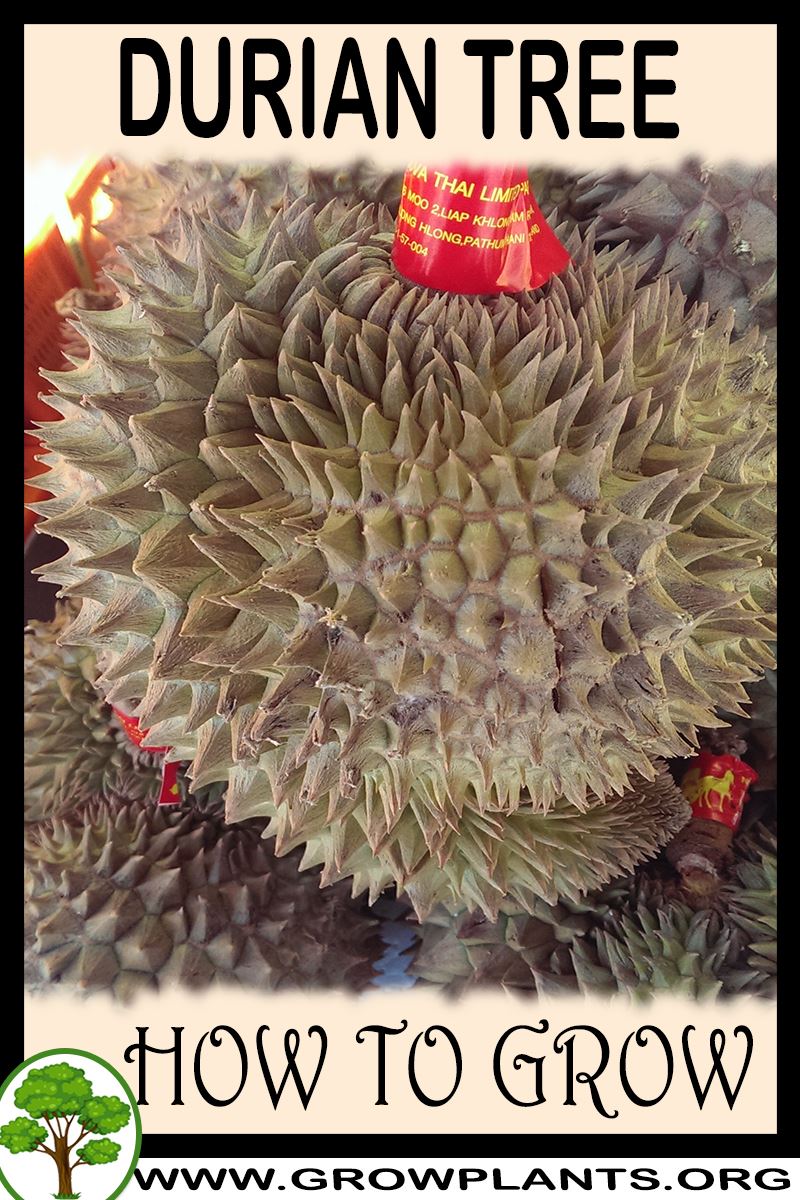
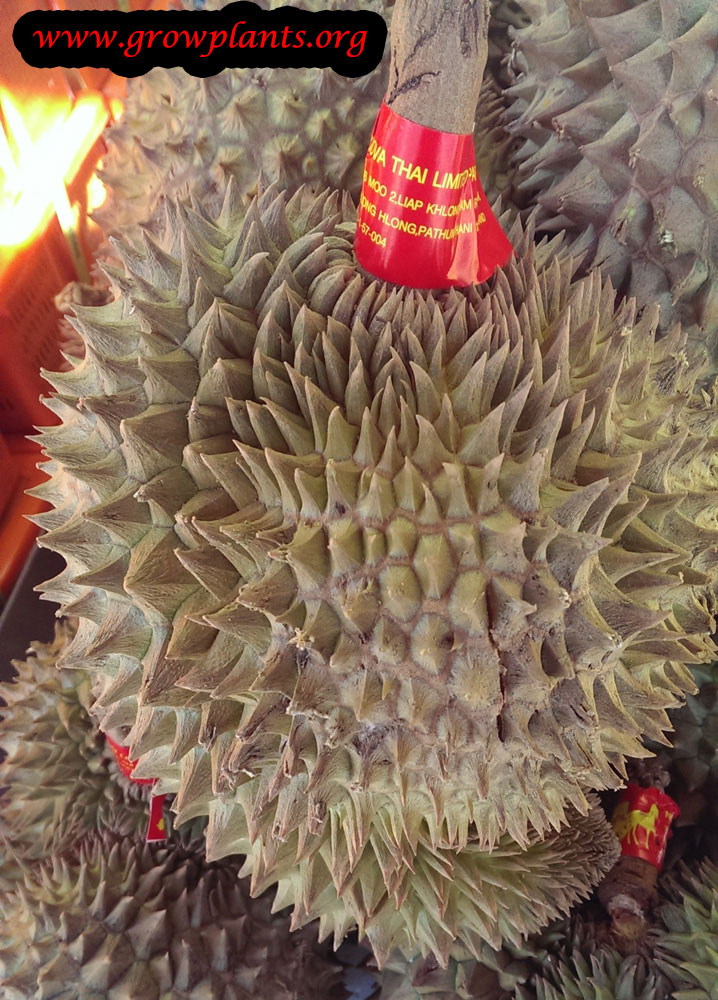
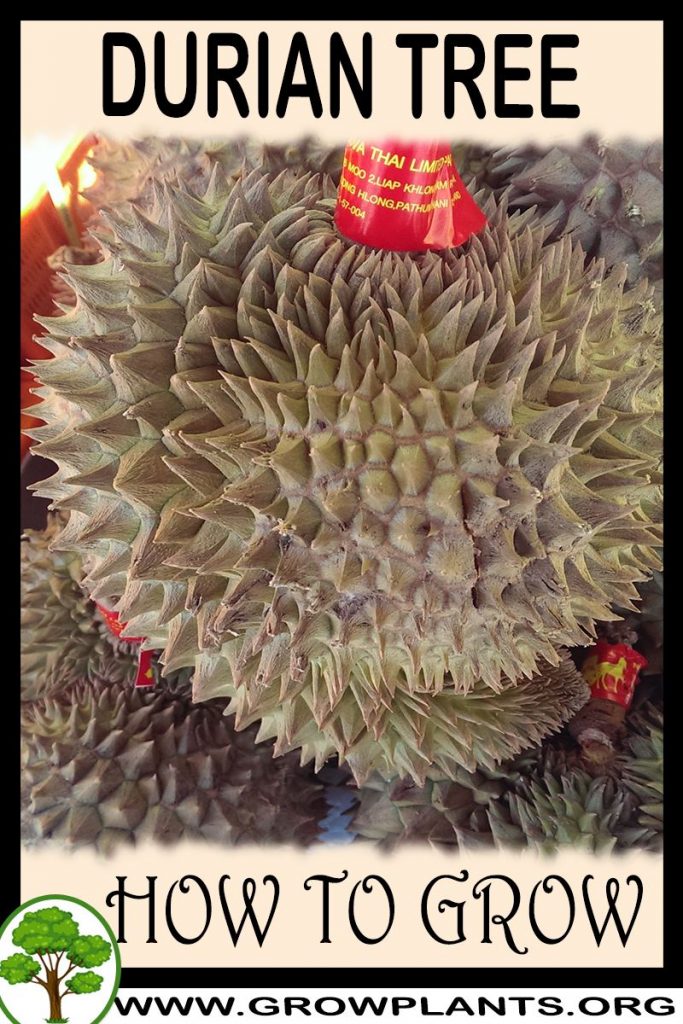
- Fruit Profile: Very large fruit 10-30 cm and 0.5-3+ kg, with a spiny yellowish-brown husk and creamy yellow flesh famed for its rich flavour and pungent smell.
Primary Uses & Landscape Value
- Edible Uses: Flesh eaten fresh, juiced or dried; the flowers are also edible.
- Functional & Ornamental Roles: Grown primarily as a tropical fruit and shade tree.
Care Guide: Planting, Soil & Watering
Overview: Durian (Durio zibethinus) is a large tropical tree (hardiness zone 12b+) needing hot, humid conditions, full sun and deep, rich, well-draining soil. It is a thirsty tree that wants abundant, consistent moisture but must never sit waterlogged, and it suffers below about 10°C.
Quick Care Requirements
| Requirement | Ideal Condition |
|---|---|
| Planting Season | Year-round in warm, humid tropics (zone 12b+) |
| Growth Rate | Moderate |
| Soil Type | Deep, rich, well-draining soil |
| Water Need | High — keep the soil consistently moist but never waterlogged |
Planting & Establishment
- Best Planting Season: In a suitably hot, humid tropical climate it can be planted year-round; avoid any cool spell, as the tree is very cold-sensitive.
- How to Plant:
- Hole Preparation: Dig a generous hole, wider than the root ball, and loosen the surrounding soil to give the roots a deep, easy run.
- Soil Amendments: Enrich with plenty of organic matter and ensure sharp drainage, since the roots will not tolerate standing water.
- Planting Depth: Set the root collar level with the surrounding soil; don’t bury the trunk base.
- Growth Speed & Expectations: Moderate; it grows steadily into a very large tree over many years before it matures.
Soil, Watering & Drainage Care
- Soil Mix & Drainage Needs: Deep, fertile, free-draining soil with high humidity around the tree is ideal; good drainage is essential to prevent root rot despite the heavy watering.
- Watering Schedule & Technique:
- Young / Newly Planted: Water frequently to keep the soil consistently moist as the young tree establishes.
- Established: Water deeply and regularly, especially during heat and dry spells — this is a high-water tree.
- Seasonal Adjustments: Maintain steady moisture in warm weather; ease off only if conditions turn cool.
Climate, Light & Hardiness
Durian is a large, strictly tropical evergreen tree, hardy only from USDA zone 12b and warmer – one of the most cold-tender trees in cultivation. It needs full sun, consistently warm conditions above about 10°C (50°F), and high humidity, and it becomes deciduous if temperatures drop below that threshold.
Quick Climate Specifications
| Climate Zones | tropical climates |
|---|---|
| USDA Hardiness Zones | 12b+ |
| Optimal Temp Range | consistently warm, humid tropical conditions, generally well above 10°C (50°F) year-round |
| Cold Damage Begins | the tree sheds its leaves and becomes deciduous once temperatures fall below about 10°C (50°F) |
| Approx. Survival Minimum | no cold tolerance to speak of beyond brief mild chilling; sustained cold well below 10°C (50°F) threatens the tree's survival |
| Frost Tolerance | None |
| Light Conditions | Full Sun |
| Wind Tolerance | Low |
Sunlight & Light Exposure
Optimal Light Setup
Full sun is needed for healthy growth and fruiting.
Direct Sun Requirement
Direct sun is genuinely required.
Shade & Heat Management
Thrives in hot, humid tropical heat provided it gets a big amount of water; no shading is needed in its natural climate range.
Best Exposure/Orientation
An open, sunny tropical site, though see the wind note below – avoid highly wind-exposed positions.
Temperature Extremes & Hardiness
USDA Hardiness & Regional Limits
Reliable only in zone 12b and warmer – essentially equatorial and near-equatorial lowland tropics; this is among the most cold-tender plants in the entire dataset.
Cold Damage & Winter Protection
The tree sheds foliage and becomes deciduous once temperatures fall below about 10°C (50°F), so it needs to be kept above that threshold to stay evergreen and healthy; there is no practical winter protection that makes it viable outside true tropical climates.
Frost Sensitivity
Extremely frost sensitive; frost is not survivable.
Extreme Heat Tolerance
Excellent, provided humidity and water are both high – it's a lowland tropical species.
Wind, Humidity & Microclimate
Humidity Preferences
High; a core requirement alongside warmth and well-drained soil.
Dry-Air Tolerance
Poor; needs a big amount of water and humid air.
Wind Tolerance
Low; the site data notes the tree can fall in strong winds, and its heavy fruit is also hazardous when it drops, so a wind-sheltered site is important.
Rainfall & Seasonal Moisture
Adapted to consistently high tropical rainfall; not suited to climates with a pronounced dry season.
Microclimate Recommendations
A warm, humid, wind-sheltered tropical microclimate is essential; this is not a marginal-zone or protected-culture candidate the way many subtropical fruit trees are.
Growing in Pots, Balconies & Indoors
The durian (Durio zibethinus) is ultimately a full-size tree (10-30 m (30-100 ft)), so a pot suits it only while young – the grower confirms it is not a houseplant, and he does not recommend growing it in containers. Kept in a large tub on a sunny patio or balcony it grows happily for a few years before it needs the open ground or ever-bigger pots.
Quick Details
- Container Size: Only while young – see below
- Indoor Suitability: Not a houseplant – too large and too light-hungry for indoors
- Best Spot: Full sun – the sunniest, warmest patio or balcony you have
- Soil & Drainage: Aerated, organic-rich mix that drains freely
- Watering in Pots: A generous amount of water – potted trees dry fast, so check often
Indoors & On the Windowsill
- Houseplant limits: Not an indoor plant – it grows into a sizeable tree and needs far more light than a room can give; a bright window is no substitute for open sun.
- Overwintering: Being cold-tender, a young potted specimen can be moved somewhere sheltered and frost-free over a cold winter – a key reason to keep it in a pot in cooler climates.
On a Balcony or Patio
- Light & wind: Give it the sunniest spot; stake a young tree against wind, and remember walls and paving reflect heat so pots dry quickly – check moisture daily in hot spells. A drip irrigation kit with a timer can take over that watering check automatically.
- Weight & drainage: A filled tub is heavy – use a stable, wide container and make sure a balcony can take the load and drain the run-off.
Choosing the Pot, Soil & Long-Term Care
- Pot & drainage: A short-term option at best – the grower does not recommend long-term pot culture. If you try it, use the largest tub you can and expect to plant out early.
- Potting mix: A well-aerated, organic mix – peat or coir with perlite (and a little vermiculite) – giving roots both moisture and air.
- Feeding: Potted plants need feeding more often than those in the ground, since watering leaches nutrients from the mix – a balanced feed through the growing season keeps them productive.
- Holding its size: To keep a tree small in a pot for longer, root- and top-prune every year or two (a bonsai-style approach) and refresh part of the mix.
Growing this plant in a greenhouse
A greenhouse can give durian frost protection, cold protection, humidity control and extra warmth.
Greenhouse at a glance
| Greenhouse suitability | Conditional - depends on your climate |
|---|---|
| Main benefits | frost protection, cold protection, humidity control, extra warmth |
| Season extension | earlier spring & later autumn |
| Outdoor protection advisable below | about 10°C |
| Maintain greenhouse minimum | around 15°C for active growth |
| Suitable types | heated greenhouse, polycarbonate greenhouse |
| Heating | Heating is recommended in cold climates for continuous growth. |
Related greenhouse guides
- Greenhouses: How to Choose the Right Greenhouse
- Best Greenhouse Heaters
- Greenhouse Climate Control: Temperature, Ventilation and Humidity
- Polycarbonate Greenhouses: What to Look for Before Buying
Fertilizing & Feeding
A moderate feeder: this large tropical tree responds to nitrogen-forward feeding while young, shifting to balanced, potassium- and boron-aware feeding once it carries its heavy, spiny fruit.
Quick Fertilizing Specs
| Feeding Level | Moderate feeder |
|---|---|
| Main Nutrient Priority | Nitrogen-forward while young, shifting to balanced and potassium-supported feeding to support heavy fruit development |
| Best Feeding Period | Warm, humid active growing season |
| Organic Options | Compost, humus, and other organic matter worked into the root zone |
| Reduce/Stop Feeding | Ease off feeding for young trees during any cooler or drier spell that slows growth |
| Micronutrients | Correct only diagnosed deficiencies; a complete fruit-tree fertilizer usually supplies routine trace needs |
| Soil pH | Prefers humid conditions and well-drained soil |
Feeding by Growth Stage
Newly planted / establishment
Help the young tree establish a strong root system in warm, humid, well-drained soil.
| Nutrient direction | Minimal feeding is usually enough while roots establish; organic matter and steady humidity do most of the early work. |
|---|---|
| Timing | The first months after planting, during the warm growing season. |
| Frequency | Feeding is rarely needed until fresh new growth shows the roots have taken hold. |
| Fertilizer types | A diluted, balanced complete fertilizer once new growth appears, Compost or other organic matter worked around the root zone |
| Precautions | Avoid feeding right at planting; concentrated fertilizer can injure fresh roots, and staking helps protect a young tree from wind until it is established. |
Young tree – active vegetative growth
Build a strong canopy and root system before the tree begins bearing its large fruit.
| Nutrient direction | A nitrogen-forward complete fertilizer supports vigorous leafy growth and structural development. |
|---|---|
| Timing | Through the warm growing season while the tree is young and not yet bearing. |
| Frequency | Regular light feedings through the growing season, tapering off if growth slows. |
| Fertilizer types | A nitrogen-forward complete fertilizer formulated for young fruit trees, Compost or other organic matter maintained around the root zone |
| Routine trace nutrients | iron, manganese, zinc |
| Precautions | Keep fertilizer away from the trunk and build canopy structure gradually so the tree can better withstand strong winds. |
Established, pre-bearing
Maintain steady, balanced growth as the tree matures toward its first crop of fruit.
| Nutrient direction | A balanced complete fertilizer supports continued structural growth without pushing excess soft foliage. |
|---|---|
| Timing | Through the warm growing season in the years before the tree first sets fruit. |
| Frequency | Periodic balanced feedings spaced through the active growing season. |
| Fertilizer types | A balanced complete fertilizer, Organic matter or compost worked into the root zone |
| Routine trace nutrients | iron, manganese, zinc |
| Precautions | Avoid heavy nitrogen pushes late in the season, which can delay the tree’s shift toward bearing. |
Mature, fruit-bearing
Support flowering, fruit set, and development of the tree’s large, heavy fruit.
| Nutrient direction | A balanced fertilizer with adequate potassium supports fruit development and fruit quality; a diagnosed boron shortfall can also limit fruit set in tropical fruit trees. |
|---|---|
| Timing | Through the growing season, timed around bloom and fruit development. |
| Frequency | Periodic feedings through the growing season, tapering off as fruit nears harvest. |
| Fertilizer types | A balanced fruit-tree fertilizer with adequate potassium, Compost or other organic matter renewed around the root zone |
| Routine trace nutrients | iron, manganese, zinc |
| Precautions | Avoid excess nitrogen while fruit is developing, which favors leafy growth over fruit set; keep fertilizer away from the trunk. |
Nutrient Deficiency Signs & Corrections
Older leaves fade to pale green or yellow and overall canopy growth slows.
| Possible causes | low available soil nitrogen, heavy tropical rainfall leaching nutrients from the root zone, thin, low-organic-matter soil |
|---|---|
| Appears first on | older, lower leaves |
| What to check | recent feeding history, soil organic matter, drainage and rainfall pattern |
| Possible correction | Apply a nitrogen-forward complete fertilizer suited to the tree’s stage and build soil organic matter. |
New leaves emerge pale yellow with distinct dark green veins (interveinal chlorosis).
| Possible causes | high or alkaline soil pH limiting iron uptake, waterlogged or poorly aerated roots, recent root disturbance or transplant stress |
|---|---|
| Appears first on | newest leaves at branch tips |
| What to check | soil pH and drainage, recent watering and root health, whether new growth or old growth is affected first |
| Possible correction | Improve drainage and aeration, and apply a chelated iron product per its label if soil is alkaline. |
Older leaf margins scorch or turn brown while the leaf center stays green, and fruit quality can suffer.
| Possible causes | low soil potassium relative to the demands of heavy fruiting, leaching in sandy, well-drained soils, competing uptake from heavy nitrogen feeding |
|---|---|
| Appears first on | older leaves, starting at the margins |
| What to check | recent fertilizer balance, soil texture and leaching potential, fruit load relative to tree size |
| Possible correction | Shift toward a fertilizer with a stronger potassium component and correct any leaching or drainage issue. |
Poor fruit set, malformed or lopsided fruit, and dieback of young shoot tips despite otherwise adequate feeding.
| Possible causes | low soil boron availability, drought or dry conditions during flowering that reduce uptake, sandy soils prone to boron leaching |
|---|---|
| Appears first on | flowers, developing fruit, and young shoot tips |
| What to check | soil test for boron status, watering consistency around bloom time, soil texture and leaching history |
| Possible correction | Apply a labeled boron product only per its instructions, since the margin between deficiency and toxicity is narrow. |
Pruning, Training & Seasonal Maintenance
Durian is a very large, long-lived tropical tree (10–30 m) pruned mainly ‘for design’ – light structural shaping rather than a demanding annual regime – since this plant’s own data shows pruning tolerated broadly through the year rather than tied to a narrow dormant season, unsurprising in its non-seasonal tropical climate. The most important pruning consideration specific to this species is safety: durian is cauliflorous, meaning flowers and the large, heavy, spine-covered fruit form directly on the trunk and older major limbs rather than at branch tips, and that fruit is explicitly recorded as dangerous when it falls – so canopy and limb management near paths, seating areas or structures matters more here than for most fruit trees.
Quick Pruning & Maintenance Specs
| Pruning Tolerance | Moderate (light shaping tolerated broadly; avoid removing major older limbs, where flowers/fruit form) |
| Primary Pruning Window | Flexible/year-round per this plant’s data (non-seasonal tropical climate); avoid cutting limbs currently flowering or fruiting |
| Main Objective | Structural shape and size management on a very large tree; canopy-raising and clearance for fruit-drop safety |
| Young Plant Priority | Establish a sound, well-spaced scaffold while limbs are small and easy to correct |
| Mature Plant Priority | Remove dead/beetle-damaged wood; manage limb spacing/height; keep fruit-drop zones clear |
| Best Tool Type | Pruning saw and pole pruner given the tree’s ultimate size; loppers while young |
| Avoid Heavy Pruning During | Active flowering/fruit development, since flowers and fruit sit on the trunk and older limbs |
Pruning by Plant Age & Size
Newly Established
Minimal – remove only damaged growth; correct any weak or crossing scaffold limbs early while cuts are small.
Young / Formative
Light structural training to establish a well-spaced framework of major limbs, since these same limbs will carry cauliflorous flowers and heavy fruit for the tree’s life; avoid removing large amounts of this framework later.
Mature / Established
Focus shifts to safety and access: raise the lower canopy over paths and structures, remove dead or beetle-affected wood, and manage overall height/spread on a tree that can reach 30 m.
Flowering & Fruiting Wood
Durian is cauliflorous – flowers, and later the very large, heavy fruit, form directly on the trunk and older major branches rather than on new terminal shoots. Because of this, removing established older wood, rather than young tips, is what actually costs future flowering and fruiting sites, so structural pruning should favor thinning younger, non-bearing growth and keep major fruit-bearing limbs intact wherever safely possible.
Structural Pruning & Training
Given the tree’s eventual large size and heavy fruit load, well-spaced main scaffold limbs established while young reduce the risk of limb failure later. Thin crowded young growth so major limbs aren’t competing for light and weakening each other.
Special Growth to Remove
- Dead or bark-beetle-damaged wood (Scolytinae is this plant’s recorded pest) – remove and monitor, since beetle galleries can spread through weakened wood.
- Low limbs or fruit clusters directly over paths, seating, or structures – thin or keep that area clear, given this species’ own recorded fruit-fall hazard.
Tools
Pruning saw for structural cuts at trunk-and-major-limb scale; pole pruner for reaching upper canopy on a mature tree up to 30 m; loppers for smaller framework cuts on a young tree.
Tool Hygiene & Disease Risk
Increased – durian is documented to be affected by Phytophthora limb/trunk canker in humid tropical conditions, which can spread through infected material and tools; disinfect blades after cutting any visibly diseased or beetle-damaged wood before moving to healthy limbs.
Cut Placement & Technique
Use standard collar cuts and stage the removal of any large limb (undercut first) to avoid tearing bark on this heavy wood; avoid flush cuts.
Heavy Pruning & Rejuvenation
Not a species with documented tolerance for hard rejuvenation cutback in the available data; given its cauliflorous fruiting habit on older wood, treat major limb removal conservatively and spread any large size-reduction work over multiple seasons rather than cutting hard all at once.
Post-Pruning Care
Monitor cut sites on this tropical, humid-climate tree for fungal issues; no extra feeding after a cut; keep the fruit-drop zone clear while the tree recovers and resumes cropping.
Common Pruning Mistakes
- Allowing weak, crowded scaffold limbs to persist when young – a real liability once they’re carrying mature fruit loads.
- Neglecting to keep pathways and structures clear of the fruit-drop zone.
- Removing major older limbs and losing established cauliflorous fruiting wood.
When NOT to Prune
Avoid removing major limbs while they are actively flowering or carrying developing fruit. Avoid pruning in strong-wind conditions, given this species’ own recorded vulnerability to wind-related limb/fruit fall.
Recommended Tools (by task)
| Task | Tool Category | Why |
| Major structural limb work | pruning_saw | Needed for trunk/major-limb scale cuts |
| Upper-canopy access on a tall mature tree | pole_pruner | Reaches canopy on a tree up to 30 m |
| Young-tree framework cuts | loppers | Handles smaller scaffold limbs while training |
| After cutting beetle-damaged or diseased wood | blade_disinfectant | Limits spread of Phytophthora canker between cuts |
Pruning Troubleshooting
| Problem | Possible Cause | What to Check | Corrective Action |
| Dieback near old cuts | Possible Phytophthora canker in humid conditions | Cut sites and surrounding bark for canker/staining | Disinfect tools, remove affected wood, improve air circulation |
| Beetle galleries in cut wood | Scolytinae bark beetle (this species’ recorded pest) | Dead/weak wood for boring damage | Remove and dispose of infested wood promptly |
| Fruit falling over paths or structures | Low or overhanging fruiting limb near a trafficked area | Canopy position relative to walkways | Raise/clear canopy over that zone; restrict access during heavy fruit-drop periods |
Propagation Guide
The source states vegetative reproduction is not necessary, so seed is a workable and simple way to grow a durian tree. That said, named durian cultivars are almost always propagated by grafting or budding onto seedling rootstock in wider horticultural practice, since seedling trees vary greatly in fruit size, taste and aroma and can take considerably longer to begin bearing – this is noted here cautiously alongside the source’s own answer. Difficulty is Easy from seed, but Difficult to Specialist for producing a true-to-type, named-cultivar grafted tree.
Quick Propagation Specs
| Best Propagation Method | Seed (per the source, sufficient for basic growing) |
| Alternative Methods | Grafting or budding (used in general practice to preserve named cultivars, though not covered in the source) |
| Propagation Difficulty | Easy (seed); Difficult to Specialist (grafting for named cultivars) |
| Seed True-to-Type | No – seedling fruit size, taste and aroma vary considerably from the parent |
| Vegetative True-to-Type | Yes |
| Best Propagation Season | All year, matching the source’s stated planting season for suitable (tropical, zone 12b+) climates |
Growing from Seed
Seed Handling & Viability
Not detailed by the source. Durian seed is short-lived and loses viability quickly if dried or stored, so it is best sown fresh, soon after being removed from the fruit.
Sowing Season
All year in climates suited to this species, matching the source’s stated planting season.
Germination Conditions
Warm, humid, well-drained conditions, consistent with the source’s stated preference for humidity, good drainage and full sun; germination is relatively quick for a large tropical seed, though timing can vary.
Seedling Care
Keep warm (the source notes a preference for above 10°C/50°F) and humid, with well-drained soil, protecting young seedlings while they establish.
Grafting & Budding
Why Grafting Is Used
While the source states grafting is not necessary to grow the tree, it is the standard method in wider durian cultivation for guaranteeing a specific named cultivar’s fruit size, taste and aroma, and for bringing a tree into bearing sooner than an unpredictable seedling.
Rootstock
Seedling durian rootstock.
Scion Selection
Scion wood selected from a known, named cultivar with the desired fruit characteristics.
Bloom & Edible Flower Guide
Quick Details
- Bloom Season: Can flower at any time of year in a suitable tropical climate
- Time to First Bloom: Grafted trees usually begin flowering after several years; seedlings take longer
- Flower Appearance: Large creamy-white flowers hanging in clusters directly from the branches and trunk
- Edibility: Edible – the flowers are cooked and eaten as a vegetable in parts of Southeast Asia
Detailed Blooming Overview
Durian (Durio zibethinus) carries large, creamy-white flowers in clusters straight off the older wood of the branches and trunk. The blooms open in the evening and are night-scented, timed for their main visitors. In a warm tropical setting the tree can flower at almost any time of year. Beyond their role in setting fruit, the flowers themselves are gathered and cooked as a vegetable in several Southeast Asian cuisines.
Flower Characteristics
- Large white flowers borne in clusters on the branches and trunk.
- Open at night and heavily scented to draw their pollinators.
Bloom Care & Thinning
- Pollination: Primarily pollinated by bats, which visit the night-opening flowers; bees also work the blooms.
Fruit & Uses
Durian is grown above all for its large, spiny-shelled fruit, whose custardy flesh is eaten raw, juiced or dried, and is notorious for its powerful smell. The tree’s large white flowers are also edible and used as a cooked vegetable in some regional cuisines, though this is a minor use next to the fruit.
Quick Edible Specs
| Edible Parts | Fruit (flesh); flowers (regional/minor use) |
|---|---|
| Main Use(s) | Fruit: culinary – fresh eating, juice, drying. Flowers: culinary, cooked, in some regional cuisines |
| Eaten Raw or Cooked | Fruit flesh: raw (also juiced or dried). Flowers: cooked |
| Preparation Required | Fruit: peel/open the spiny shell to reach the flesh. Flowers: cooking, as for a vegetable |
| Harvest Season | Can fruit and flower across much of the year in suitable tropical climates |
| Time to First Harvest | A long wait from planting to first fruit, longer than many other fruit trees (see Propagation) |
| Storage | Fresh flesh is perishable and strong-smelling once opened; drying is the main way to preserve a harvest |
| Safety/Toxicity Caveat | No toxicity concerns for the ripe flesh; the shell is spiny and heavy and can cause injury if it falls, so harvesting and standing under mature trees calls for care |
Fruit
The large fruit (roughly 10-30cm, often half a kilogram or more) has a yellowish-brown, spiny shell protecting yellow flesh inside. Once the shell is carefully opened, the flesh is eaten raw, prized (and notorious) for its rich texture and very strong smell; larger harvests are also juiced or dried. Opening the fruit takes some care to avoid the odour spreading and to handle the spines safely.
Flowers & Flower Buds
The tree’s large white flowers, which grow in clusters, are also edible and are used as a cooked vegetable in some Southeast Asian cuisines. This is a secondary use next to the fruit and worth noting mainly where the tree is grown at scale.
Harvesting
Fruit and flowers can appear across much of the year in favourable tropical conditions rather than in one tight season. The heavy, spiny fruit is dangerous when it drops on its own, so timed picking (rather than letting fruit fall) is safer, and protecting the crop from borers is worthwhile.
Preparation, Uses & Safety
Fruit needs no cooking – the ripe flesh is eaten straight from the opened shell, or processed into juice or dried fruit. Flowers, where used, are cooked as a vegetable rather than eaten raw. The main practical hazards are handling the spiny shell and the risk from falling fruit, not toxicity.
Pests, Diseases & Troubleshooting
Overview: Durian is a large tropical fruit tree whose most damaging problem by far is Phytophthora – patch canker on the trunk plus root, foliar and fruit rot – followed by fruit and seed borers that ruin the crop and a range of sap-suckers. Because the tree is big and long-lived, management is built on orchard sanitation, drainage, trunk and canopy hygiene, and protecting developing fruit, with targeted products only where cultural measures fall short.
Quick Troubleshooting Overview
| Issue / Pest | Main Symptom | Primary Solution |
|---|---|---|
| Phytophthora patch canker | Dark, oozing trunk lesions; dieback; root/fruit rot | Drainage, trunk hygiene, phosphonate/copper |
| Durian fruit/seed borer | Bored, frass-filled fruit; larvae in seeds & pulp | Bagging, sanitation, remove fallen fruit |
| Fruit flies | Stung, rotting fallen fruit with maggots | Bagging, traps, collect & destroy drops |
| Mealybugs & scale | White/brown clusters on fruit stalks & leaves; sooty mould | Prune, oil sprays, control ants |
| Spider mites | Bronzed, stippled leaves in dry heat | Hose foliage, horticultural oil/predatory mites |
| Anthracnose | Brown leaf blight & sunken fruit spots | Airflow, sanitation, copper fungicide |
Common Pests & Management
- Durian fruit & seed borer (Mudaria magniplaga / Conogethes punctiferalis):
- Symptoms: Caterpillars bore into developing and ripening fruit, tunnelling through the rind, pulp and seeds and pushing out frass at the entry holes; damaged fruit rots, drops early and is unmarketable. The yellow peach moth (Conogethes) and the durian seed/fruit borer (Mudaria) are the key culprits.
- Prevention & Control: Bag fruit early with cloth/paper sleeves, remove and destroy all bored and fallen fruit to break the life cycle, and keep the orchard floor clean. Encourage parasitic wasps and birds; use pheromone monitoring where available and apply an approved biorational insecticide only at the vulnerable young-fruit stage, following label and pre-harvest intervals.
- Fruit flies (Bactrocera spp.):
- Symptoms: Females sting soft, ripening fruit to lay eggs; maggots feed inside, causing rot, oozing and premature fruit fall. Most damaging as fruit approaches maturity.
- Prevention & Control: Bag fruit, deploy methyl-eugenol/protein-bait traps, and collect and destroy fallen fruit daily so maggots cannot complete development in the soil. Harvest promptly at maturity.
- Mealybugs (Pseudococcidae):
- Symptoms: White cottony colonies on fruit stalks, in the fruit spines and on leaf undersides; they suck sap, foul the fruit with honeydew and sooty mould, and are tended by ants that spread them.
- Prevention & Control: Prune to open the canopy, wash and oil-spray infested fruit clusters, and control the ants that farm and protect the mealybugs. Conserve ladybird and lacewing predators; use horticultural oil for heavy build-up.
- Scale insects (Coccidae & Diaspididae):
- Symptoms: Fixed brown or white bumps on twigs, leaf veins and fruit; soft scales produce honeydew and sooty mould, armoured scales cause spotting and twig dieback.
- Prevention & Control: Prune out heavily encrusted wood, apply thorough horticultural-oil sprays timed to the crawler stage, and support natural enemies by avoiding broad-spectrum insecticides.
- Spider mites (Tetranychidae):
- Symptoms: Fine stippling and a bronzed, dull cast to leaves in hot, dry, dusty conditions, with webbing on undersides and some leaf drop that stresses fruiting trees.
- Prevention & Control: Maintain tree vigour and moisture, hose or rain-wash dusty foliage, and rely on predatory mites; spot-treat serious outbreaks with horticultural oil.
- Bark-eating / stem borers (Cerambycidae & bark caterpillars):
- Symptoms: Frass and sawdust at bark tunnels and branch crotches, ringed or weakened limbs, and entry holes in the trunk; can girdle and kill branches and open wounds for Phytophthora.
- Prevention & Control: Keep trees vigorous, inspect and probe tunnels, physically remove grubs, and paint/seal wounds; maintain clean bark and remove dead wood that harbours borers.
Diseases & Fungal Issues
- Phytophthora patch canker & root/fruit rot (Phytophthora palmivora):
- Symptoms: The signature durian disease: dark, water-soaked, often oozing lesions (reddish-brown gum) on the trunk and main branches; root rot causing decline and yellowing; and firm brown rot of fruit in the field or in storage. Worst in wet, poorly drained soils and splashing rain.
- Treatment & Management: Prioritise drainage and mounded planting, keep the trunk base clear and dry, avoid mechanical wounds, and prune to improve airflow. Scrape and treat cankers, remove and destroy rotten fruit and infected material, and use phosphonate (trunk injection/spray) or copper as directed. Mulch and balanced nutrition (avoid excess nitrogen) reduce susceptibility.
- Anthracnose (Colletotrichum gloeosporioides):
- Symptoms: Brown leaf blight starting at tips and margins, defoliation under humid conditions, and sunken dark spots on fruit that expand in storage.
- Treatment & Management: Open the canopy for airflow, remove fallen leaves and mummified fruit, and avoid overhead wetting; apply copper or an appropriate fungicide during prolonged wet spells and treat fruit hygienically after harvest.
- Pink disease (Erythricium salmonicolor):
- Symptoms: A smooth pinkish fungal crust on branches, with bark cracking, wilting and dieback of the limb beyond the infection, in very humid conditions.
- Treatment & Management: Prune out and destroy affected branches well below the infection, improve canopy ventilation, and paint cuts; a copper or lime-based paste on the lesion helps in bad seasons.
- Algal leaf spot (Cephaleuros virescens):
- Symptoms: Raised orange-brown to greyish velvety spots on leaves and sometimes twigs in warm, humid, stagnant conditions; usually minor but weakening on stressed trees.
- Treatment & Management: Improve air movement and light with pruning, reduce leaf wetness, and keep trees vigorous; copper sprays help where infection is heavy.
Growing Difficulties & Abiotic Problems
- Flower & fruit drop:
- Cause & Symptoms: Heavy shedding of flowers and young fruit from water stress, erratic irrigation, poor pollination, nutrient imbalance or sudden weather swings – a major yield problem in durian.
- Correction Strategy: Provide steady moisture through flowering and fruit-set, feed a balanced program (adequate potassium and boron), assist pollination where natural pollinators are scarce, and shelter from strong wind.
- Fruit splitting & sunburn:
- Cause & Symptoms: Cracked rind and pale scalded patches on exposed fruit and bark from irregular watering after dry spells and intense direct sun on fruit or trunk.
- Correction Strategy: Keep soil moisture even (mulch heavily), avoid sudden heavy irrigation on dry trees, and maintain enough canopy to shade fruit and trunk; whitewash exposed trunks in very sunny sites.
- Nutrient deficiencies:
- Cause & Symptoms: General yellowing, small leaves, marginal scorch or poor fruiting from deficiencies (nitrogen, potassium, magnesium, boron, zinc) common on leached tropical soils.
- Correction Strategy: Base feeding on soil/leaf analysis, apply balanced fertiliser with micronutrients, and maintain organic mulch to hold nutrients and moisture; correct pH so nutrients stay available.
What Helps – Products & Tools
Durian management leans on cultural tools plus targeted materials: good drainage and trunk hygiene against Phytophthora, fruit bagging and fruit-fly/pheromone traps to protect the crop, horticultural oil for scale, mealybug and mites, and copper or phosphonate fungicides for Phytophthora, anthracnose and pink disease. Sanitation – removing fallen and rotten fruit and diseased wood – is the single most valuable practice.
Frequently Asked Questions
Can you grow durian in a pot or container?
Durian is not recommended for long-term container growing, since it ultimately becomes a full-size tree. A young potted specimen can be kept happily in a large tub on a sunny patio or balcony for a few years before it needs open ground or ever-bigger pots, but it is not suited to being an indoor plant, as it grows into a sizeable tree and needs far more light than a room can give.
How much water does a durian tree need?
Durian is a thirsty, high-water tree that wants abundant, consistent moisture but must never sit waterlogged. Water frequently to keep the soil consistently moist as the young tree establishes, and once established, water deeply and regularly, especially during heat and dry spells; ease off only if conditions turn cool.
Can durian survive cold weather or be grown outside the tropics?
No. Durian is one of the most cold-tender trees in cultivation and is hardy only from USDA zone 12b and warmer. It needs consistently warm conditions above about 10°C (50°F); once temperatures fall below that it sheds its leaves and becomes deciduous, and sustained cold well below 10°C (50°F) threatens the tree’s survival. It is extremely frost sensitive, and frost is not survivable.
How long does it take for a durian tree to start bearing fruit?
Durian is slow to bear: it is a long-lived tree that takes about 5-10 years to begin bearing fruit, a longer wait from planting to first harvest than many other fruit trees. Grafted trees usually begin flowering after several years, while seedling trees take even longer.
What is the most serious disease affecting durian trees?
Durian’s most damaging problem by far is Phytophthora patch canker, causing dark, oozing trunk lesions plus root, foliar and fruit rot, and it is worst in wet, poorly drained soils and splashing rain. Management should prioritise drainage and mounded planting, keep the trunk base clear and dry, avoid mechanical wounds, and prune to improve airflow; scrape and treat cankers, remove and destroy rotten fruit and infected material, and use phosphonate (trunk injection/spray) or copper as directed.
Is durian fruit dangerous when it falls from the tree?
Yes. Durian fruit is very large (10-30 cm and 0.5-3+ kg) with a spiny husk, and because the tree is cauliflorous, flowers and fruit form directly on the trunk and older major limbs rather than at branch tips. The heavy, spiny fruit is dangerous when it drops on its own, so timed picking rather than letting fruit fall is safer, and keeping paths, seating areas or structures clear of the fruit-drop zone matters.