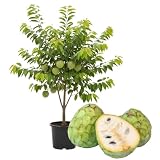
Custard apple, Annona reticulata, is not a difficult tree to grow. It is a difficult tree to get fruit from, and almost every complaint about it traces back to one thing: pollination. Get that right and the rest of the tree’s care is routine – rich soil, mulch, regular water, sun, a feed a few times a year. Get it wrong and you will have a healthy, well-shaped tree that flowers freely and sets almost nothing.
Why a custard apple flowers heavily and fruits lightly
The flowers are green-yellowish and, crucially, they are protogynous. Each flower opens in a female phase first, receptive to pollen, and only later turns male and releases its own pollen. Male and female phases happen on the same tree, but at different times.
That timing gap is the whole problem. When a flower is receptive, the tree around it is usually not shedding pollen yet; by the time it is shedding, that flower has closed its female phase. A lone tree therefore spends much of the season with pollen and receptive flowers that never meet – the low fruit set caused by the difference in blooming hours between the male and female phases. There are three practical answers, and they work well together.
1. Plant more than one tree
Two or more trees standing near each other increase the chance of pollination substantially, because they are unlikely to run their phases on precisely the same clock. One tree’s pollen arrives while a neighbour still has receptive flowers. This is the simplest fix and the reason the advice to plant a pair comes up again and again.
2. Hand pollinate
Hand pollination is the reliable method, and it is why growers deliberately keep the tree small. You cannot hand pollinate flowers you cannot reach. Collect pollen from flowers in their male phase and transfer it to flowers that are in their female phase, and you take chance out of the equation entirely.
3. Graft two cultivars, or two Annona species, onto one tree
If you only have room for one tree, grafting more than one cultivar – or even a different Annona species – onto the same trunk gives you the pollination benefit of two trees in a single footprint. When you do grow two cultivars or species together, let their branches grow into each other rather than keeping them separate; the intermingled canopy raises the amount of fruit.
Seed, cutting, air layer or grafted tree?
All four routes work: a nursery plant, cuttings, air layering, or seed. Custard apple is not hard to grow from seed, but seed is a lottery, and a grafted tree is strongly recommended for anyone who wants fruit rather than just a tree. What grafting buys you:
- Known flavour. A seedling may produce fruit that is disappointing, and you will not know for years.
- Fewer seeds and larger fruit, which are cultivar traits, not something you can feed into a seedling.
- Fewer years to the first crop.
- A longer harvest season.
- The option of several cultivars on one trunk, which solves the pollination problem as described above.
A sensible middle path is to raise seedlings and graft them once established; if a seedling bears small or poorly flavoured fruit, graft it over rather than starting again.
How to sow custard apple seed
- Sow in spring, in warm weather.
- Dig a small hole and set the seed so it is covered by about 2 cm (1 inch) of soil.
- Cover it and keep the soil moist at all times – germination stalls if it dries out.
- Give full sun, or half shade in a hot climate.
- Grow the seedlings on in a tropical, subtropical or Mediterranean climate with no frost.
One point worth stating plainly, because it is asked often: custard apple seeds are not edible. Eat the flesh, keep the seeds for sowing or discard them.
Buying a custard apple tree: what to check
You can buy custard apple from most plant nurseries. Since you are committing several years to it, inspect before you pay:
- Confirm it is grafted, and that the graft union is visible, clean and well healed.
- Check the trunk for holes – the sign of borers, and the reason to walk away from an otherwise handsome tree.
- Look the plant over for pests and disease on stems and under the leaves.
- Inspect the soil in the pot for ant nests or other insects, which travel home with you.
- Look for distorted leaves, which can be an early indication of disease.
- If buying seed rather than a plant, check the seed is clean and free of pests.
Climate and planting season
Custard apple grows in tropical, subtropical and Mediterranean climates, in hardiness zone 10 and above – no frost, with winter lows of around -1 °C (30 °F) at the coldest. It is an evergreen, but in cold weather it behaves as a deciduous tree and drops its leaves; that is a stress response, not its normal habit.
Planting season follows the zone:
- Zone 10a – spring.
- Zone 10b – spring to summer.
- Zone 11a – spring to autumn.
- Zone 11b and warmer – all year.
Full sun gives the best growth and crop; the tree will accept half shade but performs less well there.
How to plant
- Dig a hole about 50% larger than the root ball.
- Add organic matter, dead leaves and humus to the hole, return some soil and mix them together.
- Set the tree in and backfill, firming lightly but firmly enough that it will not fall over.
- Stake it if it needs support. If the tree is unstable because it is top-heavy, consider pruning it back – reducing the canopy lets the roots establish instead of fighting to hold up growth they cannot yet anchor.
- Water it twice on the first day, then every day for two weeks.
- Mulch the surface once planted.
Water, feeding and mulch
Custard apple takes an average amount of water, applied regularly. Consistency counts more than volume: erratic watering stresses developing fruit, while permanently soggy soil is not what the tree wants either.
Feed four times a year. While the tree is young, weight the feed towards nitrogen, which drives the leafy growth and framework you want before fruiting begins. Keep adding humus and organic matter to the soil, and keep the ground covered with mulch – it holds moisture, moderates soil temperature and feeds the soil as it breaks down.
Pruning: build a dense, low canopy
Prune once a year in winter, or after the fruit has been picked.
The approach is unusual for a fruit tree. Rather than opening the centre out, you cut the outer branches and encourage the remaining branches to grow into each other at high density. A dense, compact canopy keeps flowers within reach for hand pollination, and where two cultivars or species share a tree, the intergrown branches put pollen and receptive flowers close together – which is precisely what this species needs.
One detail to know: if you strip leaves off by hand at the base of a branch, a new shoot may grow from that spot. That is useful when you want branching in a particular place and a nuisance when you do not, so pull leaves deliberately rather than absent-mindedly.
Size: keep it small on purpose
Custard apple reaches 2-6 m (6-20 ft) and can go taller if left alone, but the recommendation is to keep it small. Growth is medium to fast – faster in a tropical climate or with generous feeding – so it will outgrow your reach in a few seasons. A small tree is one you can hand pollinate, inspect and harvest, and with this species that is worth more than extra size.
Pests and diseases
Custard apple attracts a fairly long list of sap-feeding insects: aphids, scales, mealybugs, leafhoppers, whiteflies and mites, plus borers.
- Sap feeders weaken new growth and coat the leaves in honeydew, which then grows sooty mould. Watch for ants: they farm aphids, scales and mealybugs and protect them from predators, so controlling the ants is part of controlling the insects.
- Mites are easy to miss – look for fine stippling and dull, bronzed leaves in hot dry weather.
- Borers are the serious one, tunnelling inside the wood where sprays cannot reach. Holes in the trunk are the warning sign, which is why you check for them before buying.
The dense canopy this tree is pruned into makes regular inspection more important, not less – problems hide in it.
Harvest and uses
A custard apple normally begins bearing 3 to 4 years after planting, sometimes from year two on a good grafted tree. It blooms in spring to summer and the fruit follows from summer into autumn.
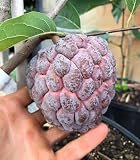
The fruit has a distinctive patterned skin, marked with scale-like segments that are sometimes flush with the surface and sometimes stand out from it, in brown or reddish tones – hence the alternative name Red Annona. Pick as the fruit softens and use it quickly; ripe annonas do not keep.
Uses: eaten raw above all, and otherwise juice, fruit shakes, jam and cakes – the last of which is the practical answer to a tree that ripens a large amount of soft fruit in a short window.
For the full plant profile see our Custard apple tree growing page.
See also: fruit tree grafting · grafting tools & supplies · rooting hormone for cuttings
See also: fruit tree grafting · grafting tools
More fruit-growing guides
- Growing fruit trees from seed
- How to prune fruit trees
- How to hand-pollinate flowers
- Why a tree flowers but won’t fruit
- How and when to fertilize
- Growing tropical fruit in cool climates
For the general techniques behind this (cuttings, division, layering, grafting), see our plant propagation methods guide.