Plant Profile & Key Characteristics
Overview: Cattleya is an evergreen perennial epiphytic orchid, generally 20-60 cm (8-24 in) tall, grown for its large, spectacular, often fragrant flowers. It is cultivated as an ornamental and houseplant in warm, bright conditions and mounted or potted in bark rather than soil.
Quick Specifications
| Specification | Attribute |
|---|---|
| Plant Type / Life Cycle | Perennial (epiphytic orchid) |
| Foliage Type | Evergreen |
| Mature Size | 20-60 cm tall (8-24 in) |
| Growth Rate | Slow |
| Root System | Epiphytic aerial roots, thick and covered in white velamen. |
| Toxicity | Non-toxic. |
| Hardiness | USDA zones 11+ |
Growth Form & Structure
- Height & Spread: 20-60 cm (8-24 in); grown in transparent pots or mounted, kept only slightly larger than the root ball.
- Growth Habit & Form: Sympodial orchid producing new fleshy pseudobulbs each year, each bearing thick leaves.
- Lifespan & Maturity: Slow-growing, long-lived perennial; roots and pseudobulbs advance about once a year.
Anatomy & Physical Features
- Leaves & Foliage: Green, thick, fleshy oval leaves growing from pseudobulbs; evergreen.
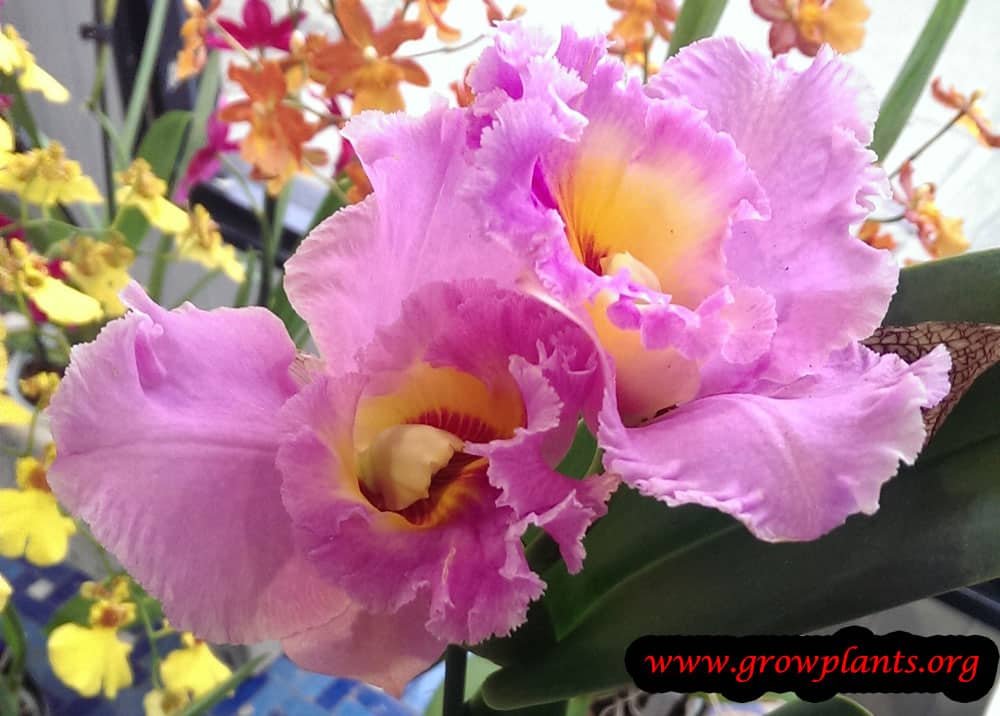
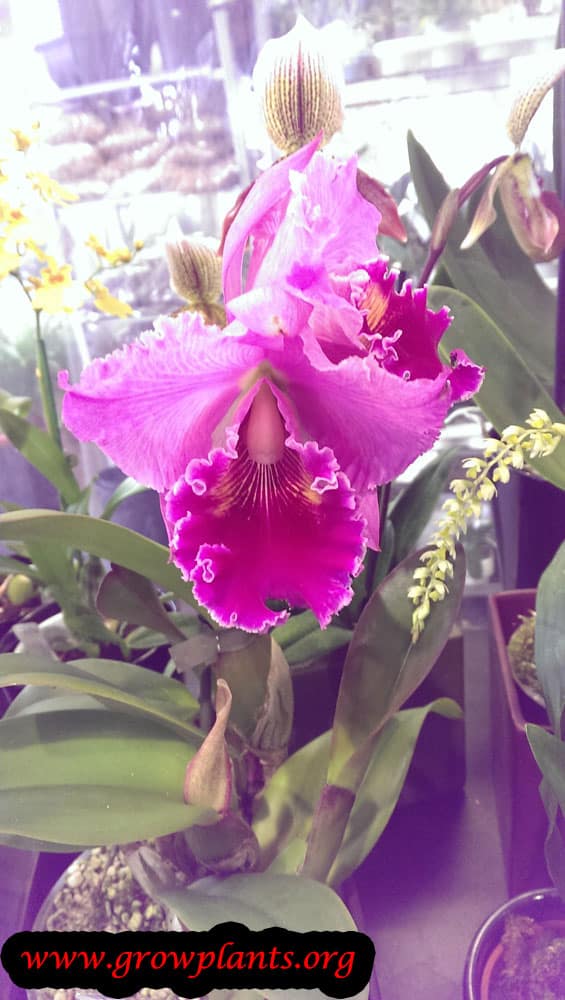
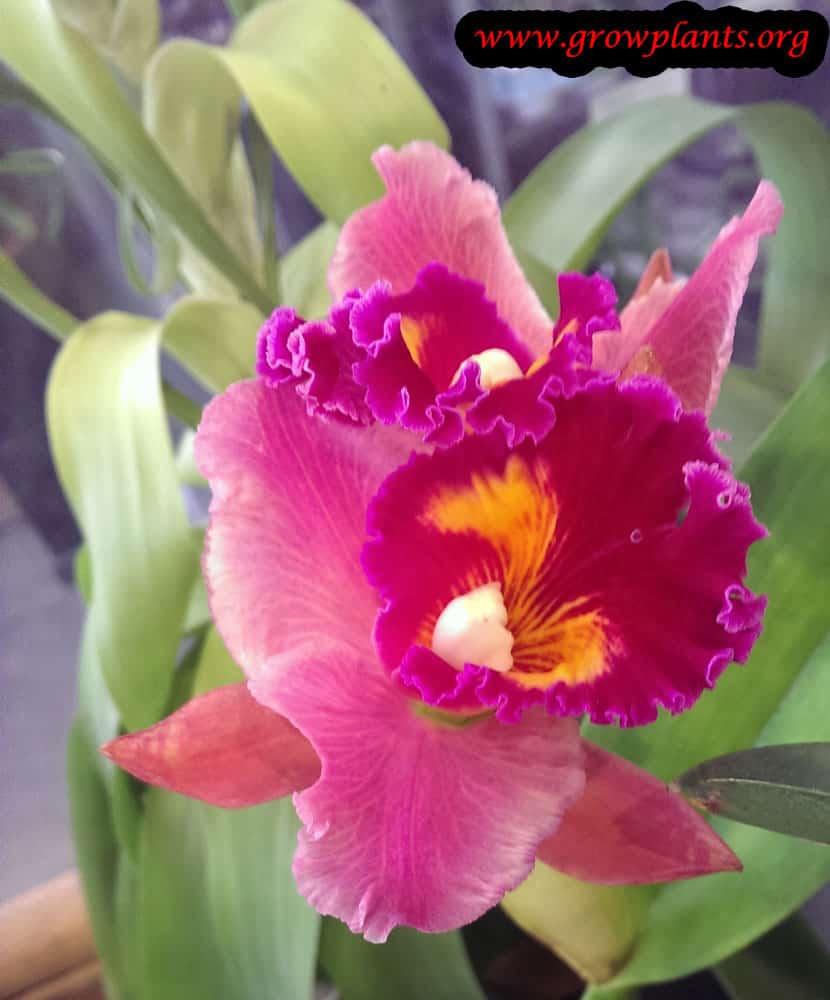
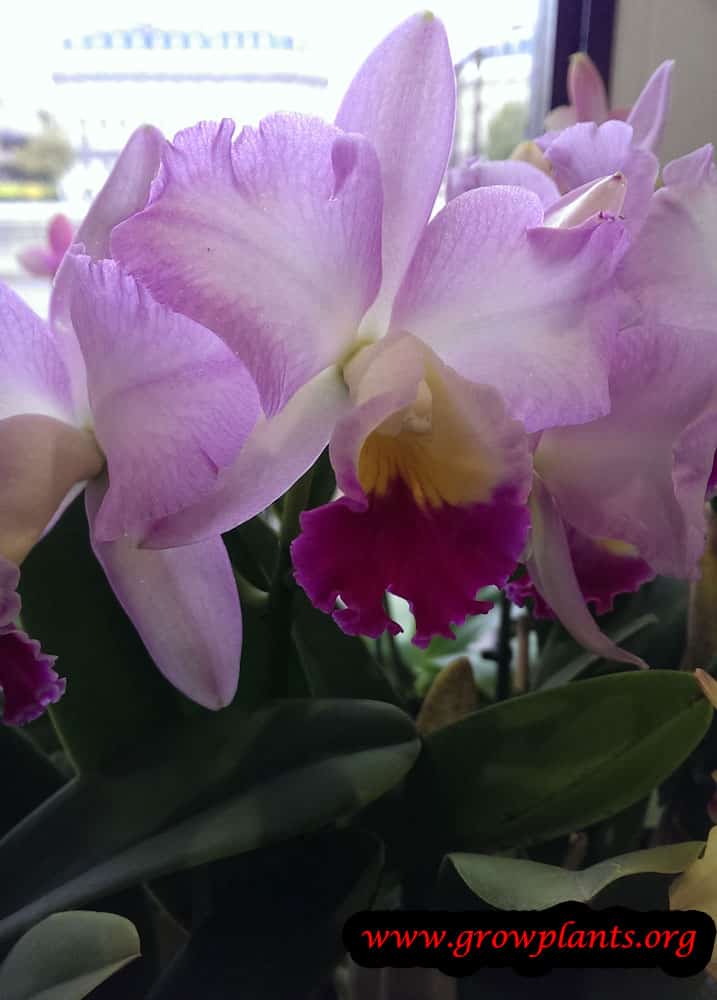
- Flower Characteristics: Large, showy, often fragrant flowers in a very wide colour range (purple, red, pink, white, orange, yellow and more), frequently striped or spotted; blooms can last up to three months.
Primary Uses & Landscape Value
- Functional & Ornamental Roles: Premier ornamental and houseplant orchid grown for cut and display flowers in warm climates and indoors.
Care Guide: Planting, Soil & Watering
Overview: Cattleya is an epiphytic orchid for warm, frost-free conditions (hardiness zone 11+) or as a houseplant, wanting bright, filtered light rather than deep shade. It grows in a chunky, fast-draining bark mix – never garden soil – and likes to dry out between waterings.
Quick Care Requirements
| Requirement | Ideal Condition |
|---|---|
| Planting Season | Any time of year; best repotted just as new roots begin to grow |
| Growth Rate | Slow |
| Soil Type | Open, epiphytic bark or bark-chip mix (not soil) |
| Water Need | Moderate – water thoroughly, then let the mix approach dryness before watering again |
Planting & Establishment
- Best Planting Season: Pot or repot at any time of year, ideally when fresh roots are starting so it re-establishes quickly.
- How to Plant:
- Soil Amendments: Use a coarse orchid bark or bark-chip mix; adding a little charcoal or perlite keeps it open and airy.
- Planting Depth: Seat the plant so the base of the pseudobulbs sits at the surface and new roots can spread over the mix; do not bury them.
- Growth Speed & Expectations: A slow grower, typically 20-60 cm (12-24 in), adding roughly one new pseudobulb per growth cycle.
Soil, Watering & Drainage Care
- Soil Mix & Drainage Needs: Grow in a transparent pot of open bark mix for airflow and drainage; refresh the medium yearly before it breaks down and turns acidic, trimming dead roots as you repot.
- Watering Schedule & Technique:
- Young / Newly Planted: After potting, water lightly and let roots re-establish before resuming the normal soak-and-dry routine.
- Established: Water thoroughly with clean, room-temperature water (rainwater is ideal), then let the mix nearly dry before watering again.
- Seasonal Adjustments: More often in warm, active growth; ease off while cool and resting.
Climate, Light & Hardiness
Cattleya orchids thrive in Mediterranean, subtropical, or tropical warmth and benefit from a day-to-night temperature drop to flower well. They want half-shade with strong overall light and have essentially no frost tolerance, so outdoor culture is limited to warm, frost-free climates.
Quick Climate Specifications
| Factor | Detail |
|---|---|
| Climate Zones | Mediterranean, subtropical, or tropical; also grown as a houseplant |
| USDA Hardiness Zones | 11+ |
| Optimal Temp Range | Approximately 22–30°C (71–85°F) by day, 13–16°C (55–60°F) at night |
| Frost Tolerance | None |
| Light Conditions | Half shade with strong overall light |
| Wind Tolerance | Low |
Sunlight & Light Exposure
Optimal Light Setup
Bright, filtered light or half-shade with strong ambient brightness gives the best growth and flowering, without harsh midday sun scorching the leaves.
Shade & Heat Management
Light shading during the hottest part of the day, combined with the natural night-time temperature drop, keeps plants comfortable and supports flowering.
Best Exposure/Orientation
An east-facing window, bright greenhouse bench, or lightly shaded outdoor spot in warm climates all work well; a roughly 15°C (27°F) day-to-night difference with shorter days helps trigger blooming.
Temperature Extremes & Hardiness
USDA Hardiness & Regional Limits
Site data places Cattleya in hardiness zone 11 and warmer, so a consistently warm, essentially frost-free climate is required for year-round outdoor growth; elsewhere it is best grown as a houseplant or in a greenhouse.
Cold Damage & Winter Protection
No specific cold-damage threshold is given, but night temperatures dropping much below the preferred 13–16°C (55–60°F) range call for protection, and plants should be moved under cover before any frost risk.
Frost Sensitivity
Frost sensitive with no established survival minimum in the source data; treat frost exposure as damaging to fatal.
Extreme Heat Tolerance
Reasonably good during the day, tolerating up to around 30°C (85°F), but plants depend on cooler nights and should not be kept in continuously hot conditions without a day-night swing.
Wind, Humidity & Microclimate
Humidity Preferences
The site notes a preference for moist growing conditions rather than a specific humidity figure; steady ambient humidity supports healthy root and flower development.
Dry-Air Tolerance
Moderate; sustained dry air, especially indoors, should be offset with misting or a humidity tray.
Wind Tolerance
Low to moderate; the open, well-drained pot Cattleya needs benefits from gentle airflow but not strong or drying wind.
Rainfall & Seasonal Moisture
Prefers consistently humid conditions with regular moisture rather than a pronounced dry season.
Microclimate Recommendations
A warm, moderately bright spot that cools noticeably at night – a greenhouse, covered patio, or bright room away from heating vents – supports both healthy growth and reliable blooming.
Growing in Pots, Balconies & Indoors
Cattleya is a compact epiphytic orchid and a genuine houseplant – the grower confirms it grows well indoors and in pots. It wants bright, filtered light (half shade), so a spot near a bright window is perfect; it also does beautifully in a container on a sheltered patio in warm weather.
Quick Details
- Container Size: 20-60 cm (12-24 in) tall – fits a compact orchid pot
- Indoor Suitability: A good houseplant in bright, indirect light
- Best Spot: Bright filtered light / half shade – a bright window indoors, or dappled shade outside
- Soil & Drainage: Open orchid bark mix (never ordinary soil); must drain freely
- Watering in Pots: Water thoroughly, then let the bark mix dry out before watering again – pots and open bark dry fast
Indoors & On the Windowsill
- A real houseplant: Cattleya is happy indoors year round in bright, indirect light. Give it the brightest window you can without harsh midday sun scorching the leaves.
- Windowsill growing: An east- or lightly-shaded south window suits it well; its compact size keeps it easy on a sill or shelf. Average humidity is fine, and a little extra moisture helps.
- Overwintering: In cold climates keep it indoors over winter – it is not frost-hardy – and it happily lives indoors permanently.
On a Balcony or Patio
- Light & shelter: Outdoors in warm weather give it bright dappled shade, not full sun. Walls and railings reflect heat and open bark dries quickly, so check moisture often and keep it out of drying wind.
- Bring it in: Move it back indoors before nights turn cold; it is a warmth-loving orchid.
Choosing the Pot, Soil & Long-Term Care
- Pot & drainage: Use a pot with plenty of holes (a slotted orchid pot is ideal); a clear plastic pot lets you watch the roots and moisture. Never leave it standing in a saucer of water – stagnant wet at the base rots the roots.
- Potting mix: Not ordinary potting soil – grow in an open, fast-draining orchid medium of bark chips or coconut husk; a few pieces of cork or charcoal add extra air around the roots.
- Feeding: Bark mixes hold few nutrients and pots leach fast, so feed with a dilute orchid fertiliser through the growing season.
- Repotting: Bark breaks down over about two years – refresh the medium and pot up then, or sooner once the roots fill the container.
Fertilizing & Feeding
The classic light-feeding epiphyte: dilute fertilizer through active pseudobulb growth is enough, tapering as the growth matures and pausing during the rest after bloom.
Quick Fertilizing Specs
| Feeding Level | Light feeder, fed dilute rather than often |
|---|---|
| Main Nutrient Priority | Nitrogen-leaning while a new pseudobulb develops, balanced as it matures toward flowering |
| Best Feeding Period | Through active pseudobulb and leaf growth ahead of bloom |
| Organic Options | A well-diluted mild organic liquid feed can supplement or occasionally replace synthetic fertilizer |
| Reduce/Stop Feeding | Taper as the pseudobulb finishes sizing and pause through the rest that follows flowering |
| Micronutrients | Usually covered by a complete orchid fertilizer; add extras only for a diagnosed deficiency |
| Soil pH | Grown in bark or cork media that trend slightly acidic and more so with age |
Feeding by Growth Stage
New pseudobulb growth
Support the newest pseudobulb and leaf as they develop.
| Nutrient direction | A dilute, nitrogen-leaning complete orchid fertilizer suits this leafy growth phase. |
|---|---|
| Timing | While the newest pseudobulb is actively enlarging. |
| Frequency | Light, dilute feeding through this active phase. |
| Fertilizer types | A dilute, nitrogen-leaning complete orchid fertilizer, An occasional diluted organic liquid feed |
| Routine trace nutrients | iron, manganese |
| Precautions | Keep dilutions light; the fine roots and bark medium have little buffering against fertilizer salts. |
Maturation into bloom
Carry the pseudobulb from full size through flower spike formation and the bloom itself.
| Nutrient direction | A balanced, dilute feed suits this stage better than continued heavy nitrogen. |
|---|---|
| Timing | As the pseudobulb nears full size, through flowering. |
| Frequency | Continue light, dilute feeding through bloom. |
| Fertilizer types | A balanced, dilute complete orchid fertilizer |
| Routine trace nutrients | iron, manganese |
| Precautions | Ease back on nitrogen now; it favors soft growth over good flowering and raises rot risk. |
Rest after bloom
Allow a quiet spell after flowering before the next pseudobulb starts.
| Nutrient direction | No feeding is needed until a new growth begins. |
|---|---|
| Timing | After the flowers fade, before a new growth appears. |
| Frequency | No feeding during this rest. |
| Fertilizer types | No feeding at this stage; hold off fertilizing until a new growth begins. |
| Precautions | Do not fertilize while growth is paused; unused salts just build up in the medium. |
Nutrient Deficiency Signs & Corrections
Older leaves fade toward pale yellow-green and the newest growth comes in smaller than before.
| Possible causes | too little nitrogen in recent feedings, an extended stretch without feeding, quick nutrient loss through a very open bark mix |
|---|---|
| Appears first on | older leaves |
| What to check | feeding history and strength, drainage rate of the current medium, new growth size versus earlier seasons |
| Possible correction | Resume light, dilute, nitrogen-leaning feeding while the plant is actively growing. |
Interveinal yellowing develops on older leaves while the veins stay green.
| Possible causes | low magnesium in the fertilizer being used, a stretch of high-potassium bloom feeding, leaching through a fast-draining bark medium |
|---|---|
| Appears first on | older leaves |
| What to check | balance of recent fertilizer, use of bloom-booster type products, medium age and drainage |
| Possible correction | Apply a labeled magnesium source such as Epsom salt at a light rate and return to balanced feeding. |
Root tips blacken and leaf tips scorch even with regular watering.
| Possible causes | fertilizer salts accumulating in the bark medium, hard or mineral-rich water adding to the load, not enough plain-water flushing between feedings |
|---|---|
| Appears first on | root tips and leaf margins |
| What to check | water source and mineral content, frequency of plain-water flushing, recent fertilizer strength |
| Possible correction | Flush the medium well with plain water, favor rain or distilled water, and keep feeding dilute going forward. |
Pruning, Training & Seasonal Maintenance
Cattleya tolerates only light grooming, never structural pruning – the plant’s entire growth is stored in its pseudobulbs, and cutting a live one removes that season’s growth permanently. The main objective is sanitation: removing spent flower spikes and yellowed leaf/sheath tissue so it cannot rot into the crown. Because Cattleya blooms in succession from whichever pseudobulb has just matured (flowering most heavily in autumn/winter but capable of blooming any time), the safe window is simply as-soon-as each individual spike finishes, not one fixed calendar date. Pruning itself does not trigger or improve next season’s flowers – that depends on a new pseudobulb maturing – but poor sanitation can invite rot that costs the plant a lead.
Quick Pruning & Maintenance Specs
| Pruning Tolerance | Low – grooming/sanitation only |
| Primary Pruning Window | Immediately after each flower spike finishes |
| Secondary Maintenance Window | Any time, for dead leaves/roots and old sheaths |
| Typical Frequency | A few small cuts per pseudobulb, per bloom cycle |
| Main Objective | Prevent rot; occasional clump division |
| Young Plant Priority | Let roots and first pseudobulbs establish undisturbed |
| Mature Plant Priority | Manage backbulb reserve; divide only when overcrowded |
| Best Tool Type | Sterile precision snips or single-edge blade |
| Avoid Heavy Pruning During | While a spike is still green/budding, or during active root flush |
Pruning by Plant Age & Size
Newly Established
Remove only damaged or rotted tissue present at purchase/shipping; otherwise leave the plant alone until roots anchor into the mix.
Young / Formative
No structural training applies – Cattleya does not take a trained framework. The only formative task is tidying papery sheath debris as each new pseudobulb matures, to prevent it trapping moisture against the stem.
Mature / Established
Track backbulb count along the rhizome. Once a clump has six or more pseudobulbs and is crowding its pot, divide at repotting time, keeping at least three pseudobulbs (including one active lead) per division for reliable re-establishment.
Seasonal Pruning Schedule
Post-Flowering
Objective: remove spent tissue before it decays into the crown. Remove: the flower spike, cut back to a couple of centimeters above the pseudobulb it emerged from, plus any fully yellowed lower leaves. Do not remove: green pseudobulbs, healthy leaves, or firm (even leafless) backbulbs – these are the plant’s stored reserve and future propagation material. Expected response: the plant redirects energy into its next developing pseudobulb. Flowering impact: none directly on the next bloom, but leaving spike stubs to rot is a common route to Botrytis and crown rot that can cost a lead.
Ongoing Sanitary
Remove dead roots whenever repotting and strip fully yellow bottom leaves as they occur.
Structural Pruning & Training
Essentially none – there is no branch or leader to select. The only structural act is rhizome division of an overcrowded clump, cut cleanly between (not through) a pseudobulb node with a sterile blade to improve airflow and re-energize vigor.
Special Growth to Remove
Dry papery sheaths left wrapping the pseudobulb base (can trap moisture and harbor scale/rot); shriveled, blackened backbulbs that are clearly no longer viable.
Container & Small-Space Pruning
Cattleya is inherently a snug-pot plant – the facts for this plant specifically warn against oversizing the pot. Repot only when pseudobulbs reach the rim; never pot up in advance "for growth room", since excess unused mix around the roots stays wet and promotes rot.
Tools
Precision snips or a clean single-edge blade for spikes and leaf tissue; the same sterile blade for rhizome division cuts.
Tool Hygiene & Disease Risk
High-risk. Orchid viruses such as Cymbidium Mosaic Virus and Odontoglossum Ringspot Virus are transmitted mechanically by cutting tools and show no visible symptoms in early stages, so tools should be sterilized (flame, alcohol, or a single-use blade) between individual plants, not just between different orchid species.
Cut Placement & Technique
Cut the flower spike cleanly a few centimeters above where it emerges from the pseudobulb (roughly 2 cm), not flush against it. Remove old leaves at their base near the sheath. Make rhizome division cuts between pseudobulbs at a natural node, never through the middle of one.
Heavy Pruning & Rejuvenation
Not tolerated in the hard-prune sense – there is no canopy or wood to cut back. "Rejuvenation" instead means dividing an overcrowded, tired clump to restart vigorous new leads from fresh backbulbs, not cutting the plant down.
Post-Pruning Care
After spike removal keep water out of the crown to prevent the cut from rotting inward. After division, let cut surfaces callus for a few hours before potting into fresh bark mix, and hold off on fertilizer until new roots are visibly active.
Common Pruning Mistakes
Cutting into a live green pseudobulb; leaving a spike stub to decay into the crown; over-potting after division; reusing an unsterilized blade across multiple orchids and spreading virus.
When NOT to Prune
While a spike is still green or budded (removing it forfeits that bloom); during the active new-growth/root-flush phase unless the tissue being removed is clearly dead.
Recommended Tools (by task)
- precision_snips – the only cuts this plant needs (spent spike, yellow leaf) are small and soft; nothing here is woody.
- blade_disinfectant – mandatory given the real, extension-documented risk of mechanical virus transmission between orchids sharing a cutting tool.
Propagation Guide
Cattleya is propagated almost entirely by division of its pseudobulb clumps, since seed germination requires sterile laboratory (flask) culture and is not practical for home growers. Vegetative propagation is preferred and, for named hybrids and cultivars, necessary to keep the exact flower form and color true; division itself is fairly straightforward, but the plant is slow to re-establish and re-bloom afterward.
Quick Propagation Specs
| Best Propagation Method | Division of the pseudobulb clump |
| Alternative Methods | Backbulb propagation (potting up older, leafless pseudobulbs) |
| Propagation Difficulty | Moderate by division; Specialist by seed |
| Seed True-to-Type | Hybrid offspring vary – most cultivated Cattleya are hybrids, so seedlings will not match the parent |
| Vegetative True-to-Type | Yes |
| Best Propagation Season | As new growth and roots begin, typically once flowering has finished |
| Time Until Division Establishes | Often a year or more before a new division flowers again |
Growing from Seed
Cattleya seed is dust-fine and, like almost all orchids, will not germinate reliably outside sterile flask (in-vitro) culture with the correct nutrient medium; this is a specialist/lab technique rather than a home method, matching the site’s own note that starting from seed is very difficult. Because most garden Cattleya are hybrids, seedlings raised this way would also be genetically variable rather than true to the parent.
Division, Offsets, Pups & Suckers
Divide the pseudobulb clump when repotting, at the start of a new root/growth flush rather than right after flowering finishes. Cut through the connecting rhizome with a sterile blade so each division keeps at least three to four pseudobulbs, including at least one live “eye” or growing point – smaller divisions survive but take longer to reach flowering size. Older, leafless back pseudobulbs (“backbulbs”) can be removed and potted separately in fresh, well-drained bark mix; they root more slowly and may take a year or more to push a new growth, but this is a useful way to multiply a valued plant without weakening the main clump. Keep new divisions on the drier side with light misting until fresh roots are established, then resume normal watering.
Bloom & Flower Guide
Quick Details
- Bloom Season: Can flower at any time, but most often in autumn and winter
- Flower Appearance: Large, showy flowers in almost any colour — often multi-coloured, with stripes, spots or irregular patterning
- Edibility: Ornamental only — grown purely for the flowers
Detailed Blooming Overview
Cattleya is the classic “corsage” orchid, and the flowers are the whole point: large, sculptural and richly coloured, and long-lasting — a single bloom can hold for up to three months. Flowering is often triggered by a swing between day and night temperatures (around 15°C cooler at night) together with shortening days, so cooler nights in autumn frequently bring the plant into bud.
Flower Characteristics
- Colours span purple, red, blue, brown, pink, white, orange, yellow, near-black and green.
- Frequently multi-coloured — striped, spotted or irregularly marked.
- Exceptionally long-lasting, up to about three months per bloom.
Bloom Care & Thinning
- Triggering bloom: give cooler nights and a genuine day-to-night temperature difference, with shorter day length, to encourage budding.
- After flowering: once blooms fade, trim the spent spike and let the plant build the next pseudobulb.
Bloom Health & Protection
- Botrytis petal blight: small dark spots on the flowers in cool, damp, still air. Better airflow, lower humidity around the blooms and prompt removal of spotted flowers help; a suitable fungicide if it persists.
- Aphids and mites on buds: these can distort opening flowers — a rinse or insecticidal soap early keeps them in check.
Pests, Diseases & Troubleshooting
Cattleya orchids are epiphytes whose problems come mainly from the pests and rots of container culture rather than the plant itself. Boisduval scale is their signature insect, and soft/black rots move fast in stagnant, over-wet conditions; incurable viruses spread on dirty tools. Good airflow, careful watering, sterile cutting and quarantine of new plants prevent almost every serious problem.
Quick Troubleshooting Overview
| Issue / Pest | Main Symptom | Primary Solution |
|---|---|---|
| Boisduval scale | Yellow speckling, white/yellow scale crusts on pseudobulbs and sheaths | Peel old sheaths, scrub off, horticultural oil, isolate |
| Mealybugs | White cottony masses in leaf axils and on roots | Alcohol swab, horticultural oil, check roots |
| Black rot | Soft blackish watery spreading lesions on leaves/pseudobulbs | Cut into clean tissue, improve airflow, copper/phosphonate |
| Bacterial soft/brown rot | Sunken, wet, foul-smelling collapsing spots | Excise, dry out, reduce humidity, bactericide |
| Virus (CymMV/ORSV) | Colour-break, mosaic, necrotic streaks; permanent | No cure; destroy or isolate; sterilise tools between plants |
| Thrips | Silvered, distorted flowers and buds; bud drop | Sticky traps, sanitation, insecticidal soap/spinosad |
Common Pests & Management
- Boisduval scale (Diaspis boisduvalii):
- Symptoms: The classic Cattleya pest: circular yellowish-white armored scales and cottony male masses hide under old leaf sheaths, on pseudobulbs and along leaf midribs, causing yellow speckling and, when heavy, general decline; it spreads unseen beneath dried sheaths.
- Prevention & Control: Strip off and discard old dry sheaths where scale shelters; scrub pseudobulbs and leaves with a soft toothbrush and mild soapy water; apply horticultural oil to smother scale and crawlers, repeating every couple of weeks; isolate infested plants and inspect neighbours, as it spreads readily in a collection.
- Mealybugs (Pseudococcus / Planococcus spp.):
- Symptoms: White cottony insects clustered in leaf axils, under sheaths, in new growth and on the roots, sucking sap, stunting growth and leaving honeydew and sooty mould.
- Prevention & Control: Dab clusters with an alcohol swab; rinse and treat with horticultural oil or insecticidal soap, repeating to catch hatchlings; unpot and inspect roots for root mealybug, drenching or repotting into fresh medium if found; quarantine new acquisitions.
- Spider mites and false spider mites (Tenuipalpus / Brevipalpus spp.):
- Symptoms: Fine silvery stippling and a pitted, sunken sheen on the upper leaf surface, sometimes with faint webbing; false spider mites cause characteristic sunken necrotic patches, worst in warm dry air.
- Prevention & Control: Raise humidity and improve airflow; wipe and rinse leaves regularly, including undersides; treat with horticultural oil or a miticide labelled for orchids, repeating; introduce predatory mites in a greenhouse.
- Thrips (Frankliniella / Dichromothrips spp.):
- Symptoms: Tiny slender insects that rasp buds and flowers, causing silvered streaks, brown flecking, distorted or discoloured blooms and bud drop; they also spread on new plants.
- Prevention & Control: Use blue or yellow sticky traps to monitor; remove spent flowers and weeds that harbour them; treat with insecticidal soap or spinosad, targeting buds, and quarantine incoming plants that are in bud or bloom.
- Snails and slugs (Deroceras / Zonitoides spp.):
- Symptoms: Chewed root tips, notched new growth and grazed flower buds, with slime trails; small bush snails in the medium attack roots unseen.
- Prevention & Control: Hand-pick at night; trap under boards or with bait stations; drench or repot to remove medium-dwelling snails; iron-phosphate bait around benches; keep the growing area clean.
Diseases & Fungal Issues
- Black rot (Phytophthora cactorum):
- Symptoms: Soft, watery, blackish-brown spreading lesions on leaves, new growths and pseudobulbs, often starting at the base and racing through the plant in warm, wet, stagnant conditions; can kill quickly.
- Treatment & Management: Act fast: cut well into clean green tissue with a sterile blade and discard the rotted parts; dust or drench cuts with copper or a phosphonate fungicide; dramatically improve air movement, reduce watering and stop water sitting in crowns and sheaths; isolate the plant.
- Bacterial soft and brown rot (Erwinia / Pectobacterium spp.):
- Symptoms: Water-soaked, sunken spots that turn brown-black, soften and often smell foul, collapsing leaves rapidly, especially where water sits in warm humid still air.
- Treatment & Management: Excise infected tissue with a sterile tool into clean tissue and let it dry; move the plant to bright, airy, drier conditions and water at the roots only; apply a copper bactericide; keep foliage dry, particularly overnight.
- Fusarium wilt / root rot (Fusarium oxysporum):
- Symptoms: Progressive yellowing and shrivelling of pseudobulbs with a tell-tale purplish ring visible when a rhizome is cut; roots rot and the plant slowly declines.
- Treatment & Management: Remove and destroy affected rhizome sections, cutting back to clean tissue with sterile tools; repot into fresh, open, well-drained medium; avoid overwatering and stale mix; drench with an appropriate fungicide if valuable.
- Orchid viruses (CymMV & ORSV) (Cymbidium mosaic virus / Odontoglossum ringspot virus):
- Symptoms: Colour-break and streaking in flowers, mosaic mottling, and necrotic streaks or rings on leaves; symptoms may be subtle, but infection is systemic and permanent.
- Treatment & Management: There is no cure. Destroy or permanently isolate confirmed plants; the key control is prevention-sterilise cutting tools between every plant (flame or fresh blades), avoid sap contact, and control sucking insects; test suspect plants where a collection is at stake.
- Botrytis petal blight (Botrytis cinerea):
- Symptoms: Small brown or pinkish spots that spread on flower petals in cool, damp, still conditions, ruining blooms.
- Treatment & Management: Improve airflow and lower humidity around flowers; remove spotted and spent blooms; avoid wetting flowers; do not crowd plants in bloom.
Growing Difficulties & Abiotic Problems
- Overwatering and crown/root rot:
- Cause & Symptoms: Cattleyas are epiphytes that need their thick roots to dry and breathe; constantly wet, dense or broken-down medium suffocates roots and invites rot, causing shrivelled pseudobulbs and dead roots even while the top looks moist.
- Correction Strategy: Water thoroughly then let the medium approach dryness; use a coarse, open, free-draining mix and repot every couple of years before it decomposes; ensure pots drain freely and never let water sit in the crown or new growth.
- Leaf sunburn:
- Cause & Symptoms: Cattleyas want bright light but scorch in direct midday sun, showing bleached white-to-black dead patches on the exposed leaf surface.
- Correction Strategy: Give bright, filtered light; increase exposure gradually after winter or a move; shade during the hottest hours and ensure airflow to cool leaves.
- Salt and mineral tip burn:
- Cause & Symptoms: Fertiliser salts and hard water accumulate in the medium, burning root tips and browning leaf tips.
- Correction Strategy: Water with low-mineral water where possible; flush the medium periodically with plain water to leach salts; fertilise weakly and regularly (‘weakly, weekly’) rather than heavily.
- Failure to grow or bloom:
- Cause & Symptoms: Too little light, stale medium or erratic watering leave plants soft, dark green and reluctant to flower.
- Correction Strategy: Provide adequate bright light and a proper seasonal temperature drop; keep the medium fresh and roots healthy; feed appropriately through the growing season.
What Helps — Products & Tools
Cattleya care is precise and cultural: sterile blades, fresh open medium, good airflow and disciplined watering. Horticultural oil and insecticidal soap (plus alcohol swabs) handle Boisduval scale, mealybugs and mites; blue/yellow sticky traps and spinosad address thrips. Copper and phosphonate fungicides treat black and bacterial rots; there is no cure for orchid viruses-prevention by tool sterilisation is everything.