Plant Profile & Key Characteristics
Overview: An epiphytic evergreen hybrid orchid growing 20-60 cm tall, cultivated as an ornamental cut-flower orchid. It is grown mounted or in open, airy media rather than dense soil.
Quick Specifications
| Specification | Attribute |
|---|---|
| Plant Type / Life Cycle | Perennial (evergreen) |
| Foliage Type | Evergreen |
| Mature Size | 20-60 cm (8-24 in) |
| Growth Rate | Slow to Moderate |
| Root System | Aerial roots (epiphytic) |
| Toxicity | Generally non-toxic (orchid) |
| Hardiness | USDA zone 12+ |
Growth Form & Structure
- Height & Spread: 20-60 cm (8-24 in); best grown mounted or in open bark/basket media, and can be a bright-window houseplant.
- Growth Habit & Form: Monopodial epiphytic orchid with fleshy leaves on an upright stem.
- Lifespan & Maturity: Long-lived; slow-to-medium growth.
Anatomy & Physical Features
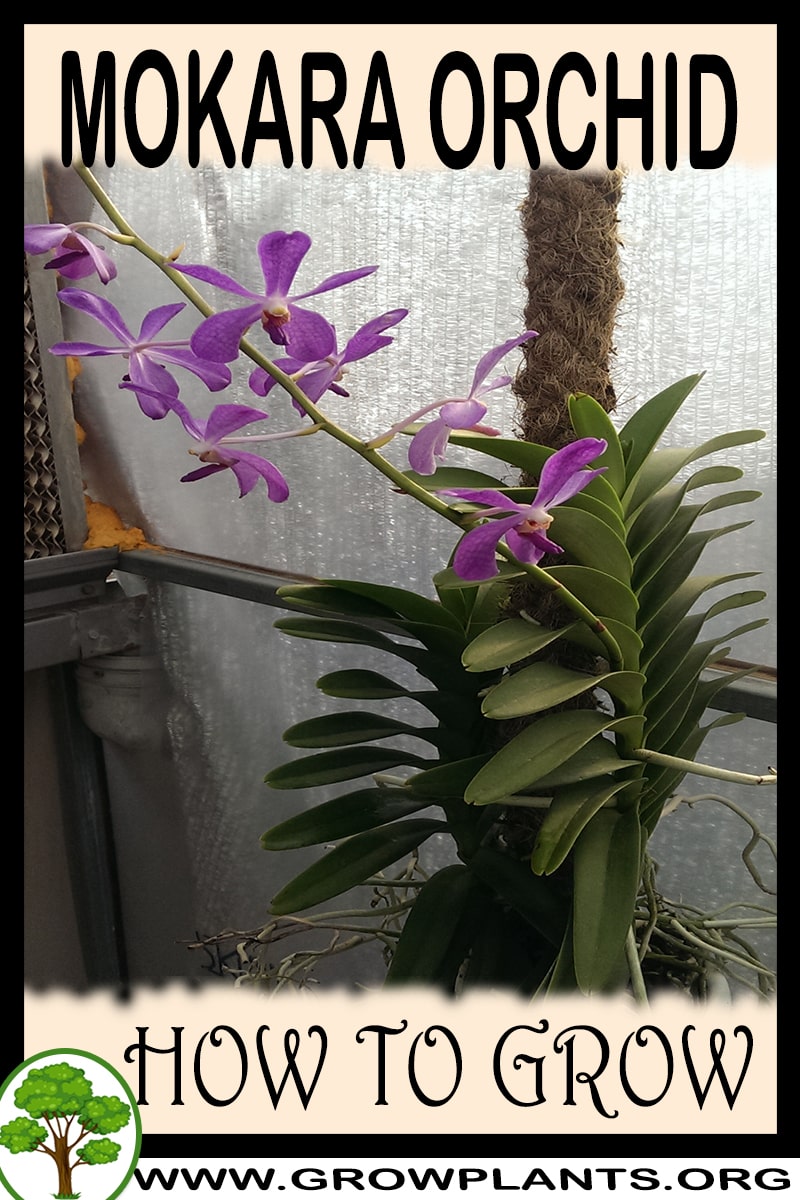
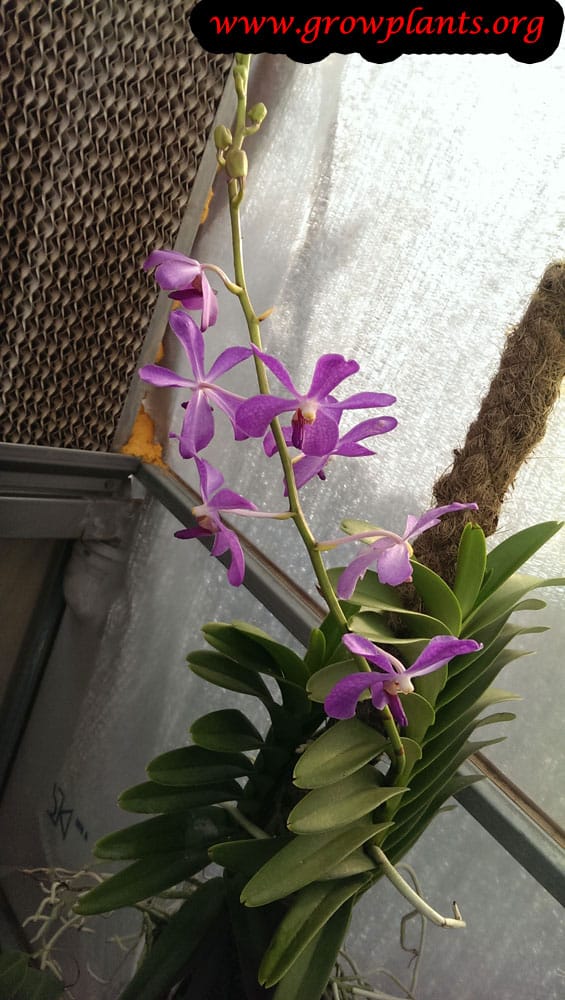
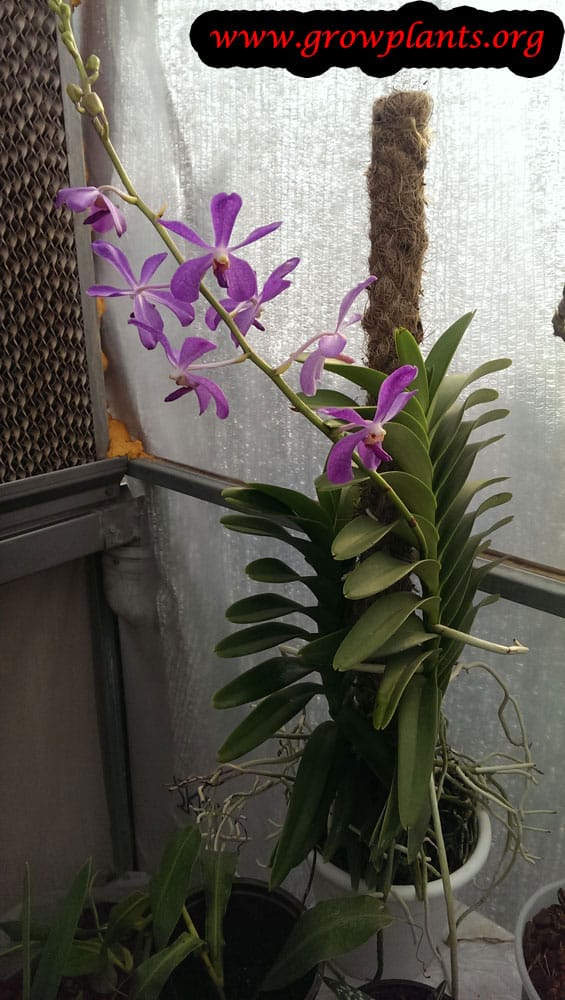
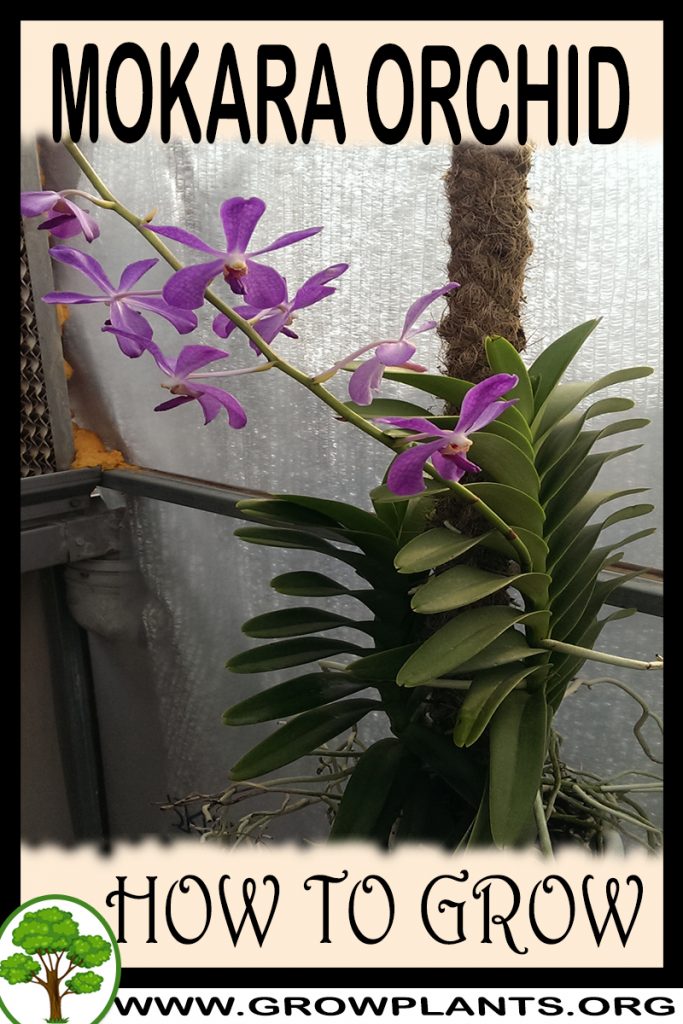
- Leaves & Foliage: Green, fleshy oval leaves arranged along the stem.
- Flower Characteristics: Five-petalled, ovate-to-elliptic flowers, often spotted, in purple, red, pink, white, orange or yellow – a prized cut flower.
Primary Uses & Landscape Value
- Functional & Ornamental Roles: Ornamental cut-flower orchid; specimen or houseplant in bright, humid conditions.
Care Guide: Planting, Soil & Watering
Overview: The Mokara is an epiphytic orchid that thrives in warm, very humid conditions (around 80% humidity, ideally about 15°C or warmer) in bright light. It is not grown in ordinary soil but mounted on bark or in a coarse, free-draining bark or wood-chip medium that is kept constantly moist yet drains freely.
Quick Care Requirements
| Requirement | Ideal Condition |
|---|---|
| Planting Season | All year, in warm conditions |
| Growth Rate | Slow to Moderate |
| Soil Type | Coarse bark / wood chips, or mounted – no garden soil |
| Water Need | High plus high humidity; never fully dry, must drain freely |
Planting & Establishment
- Best Planting Season: It can be potted or mounted at any time of year as long as conditions stay warm.
- How to Plant / Pot:
- Container: Use a transparent pot with plenty of drainage holes so you can watch the roots, or mount the plant on a slab of bark.
- Growing Medium: Grow in coarse bark, wood chips, cork or coconut husk – never ordinary soil; a little Styrofoam at the base improves drainage and airflow.
- Positioning & Roots: Keep the crown exposed and trim dead roots when repotting; refresh part of the medium each year before it breaks down and turns acidic.
- Growth Speed & Expectations: Slow to moderate; steady growth in stable warmth, light and humidity.
Soil, Watering & Drainage Care
- Soil Mix & Drainage Needs: Not grown in garden soil – use an open, fast-draining medium of coarse bark or wood chips, or mount on bark; excellent drainage and airflow are vital to prevent root rot.
- Watering Schedule & Technique:
- Young / Newly Planted: After potting or mounting, keep the roots consistently moist with clean, room-temperature water (rainwater is ideal) and high humidity while the plant settles.
- Established: Water often enough that the medium never dries out completely, always letting it drain freely; mist or fog to hold humidity near 80%.
- Seasonal Adjustments: Water more in heat and dry air; ease off a little in cool spells, but never let the plant dry out fully.
Climate, Light & Hardiness
Mokara orchid is a warmth-loving Vanda-alliance hybrid suited to tropical and subtropical climates or a bright indoor spot, needing consistently high humidity to thrive. Light needs vary by cultivar between full sun and half shade, and the plant has essentially no frost tolerance.
Quick Climate Specifications
| Factor | Detail |
|---|---|
| Climate Zones | Tropical or subtropical; also grown as a houseplant |
| USDA Hardiness Zones | 12+ |
| Optimal Temp Range | Around 15°C (60°F) or warmer by day |
| Approx. Survival Minimum | Around 11°C (52°F) briefly – site notes up to 35°C (95°F) is also survivable but neither extreme is recommended for regular growing conditions |
| Frost Tolerance | None |
| Light Conditions | Full sun to half shade, depending on cultivar |
| Wind Tolerance | Low |
Sunlight & Light Exposure
Optimal Light Setup
Light needs vary by cultivar – some varieties want full sun while others burn in it and prefer half shade, so it is worth matching light exposure to the specific plant's response.
Shade & Heat Management
Where grown in fuller sun, adequate humidity (via spray or fogger, as the site notes) and airflow help offset heat stress on the roots and foliage.
Best Exposure/Orientation
Indoors, position it in a spot with a lot of light on the window; outdoors, choose exposure appropriate to the cultivar's sun tolerance.
Temperature Extremes & Hardiness
USDA Hardiness & Regional Limits
Site data places Mokara in hardiness zone 12 and warmer, so a consistently warm, essentially frost-free tropical climate is needed for outdoor growth year-round; elsewhere it is best kept as a houseplant or in a greenhouse.
Cold Damage & Winter Protection
Growth and flowering suffer well before the lower survival threshold is reached; protect the plant once temperatures fall much below the roughly 15°C (60°F) daytime baseline.
Frost Sensitivity
Frost sensitive; the site notes a brief survival minimum around 11°C (52°F), a stress threshold rather than a comfortable growing temperature, and true frost should be avoided entirely.
Extreme Heat Tolerance
The site notes it can survive up to around 35°C (95°F), but this is described as not recommended for sustained conditions; consistent humidity and drainage checks help the plant cope with heat.
Wind, Humidity & Microclimate
Humidity Preferences
Very high humidity is important, with the site recommending around 80%, achievable with spray misting or a fogger system where natural humidity is insufficient.
Dry-Air Tolerance
Low; like other Vanda-alliance orchids, it is often grown with exposed or minimally potted roots, making ambient humidity especially important.
Wind Tolerance
Low to moderate; gentle air movement benefits the roots, but strong or persistently drying wind is stressful.
Rainfall & Seasonal Moisture
Adapted to a humid, regularly moist environment rather than a long dry season.
Microclimate Recommendations
A warm, very humid spot with light matched to the cultivar and gentle airflow – a bright greenhouse, humid patio, or sunny window with supplemental humidity – suits Mokara orchid well outside a naturally tropical climate.
Growing in Pots, Balconies & Indoors
Mokara is a sun-loving Vanda-type orchid. The grower says it can be kept indoors only with a lot of light on a window – it will not thrive in a shaded room. Like its Vanda parents it grows best with roots open to the air, mounted or in a coarse, very free-draining pot with high humidity.
Quick Details
- Container Size: 20-60 cm (12-24 in)
- Indoor Suitability: Only on a very bright, sunny windowsill with lots of light
- Best Spot: Full sun to half shade – as bright as possible
- Soil & Drainage: Best mounted on bark/synthetic; if potted, special orchid mix or big wood-chip/coconut, in a clear pot
- Watering in Pots: Average to plenty of water with high humidity – mist or fog, and make sure it drains well
Indoors & On the Windowsill
- Windowsill only: The grower says indoors works only with a lot of light on a window; deeper into a room it will not have enough light.
- Humidity: It wants humidity around the roots – mist regularly or use a fogger, and keep good air movement.
- Overwintering: Tender – keep it in the brightest indoor spot over winter in cold climates.
On a Balcony or Patio
- Light & humidity: Outdoors give it bright light and warmth; baskets and bare roots dry fast, so mist and water often, especially near warm walls.
- Bring it in: Protect it from cold nights.
Choosing the Pot, Soil & Long-Term Care
- Mount or clear pot: The grower prefers it grown bare on bark or a synthetic mount; if potted, use a clear pot so you can check the roots – their health tells you when to repot.
- Medium: A special orchid soil, or big wood chips or coconut; make plenty of holes in the pot, because good drainage is essential.
- Feeding: Feed little and often with a dilute orchid fertiliser through the growing season.
- Refreshing the mix: The grower switches part of the medium each year, or replaces it all every two years.
Grower’s Container Tip
- Grow it airy and watch the roots: Best grown bare on bark or something synthetic; when potted, always use a transparent pot so you can watch the root system, judge its health, and see when it needs switching – with plenty of drainage holes and coarse bark/coconut medium.
Fertilizing & Feeding
A moderate feeder among orchids: this vandaceous, full-sun-tolerant hybrid grows and flowers vigorously with frequent watering and misting, so it benefits from more regular light feeding than shadier orchid types, kept weak enough not to burn its exposed roots.
Quick Fertilizing Specs
| Feeding Level | Moderate feeder for an orchid |
|---|---|
| Main Nutrient Priority | A weak, balanced fertilizer applied often enough to keep pace with vigorous growth and frequent watering |
| Best Feeding Period | Through the warmer months whenever new growth or flower spikes are actively developing |
| Organic Options | A diluted organic liquid feed made for container or epiphytic plants |
| Micronutrients | Usually supplied by a complete, weak fertilizer formulated for orchids or container plants |
| Soil pH | Grown in a well-drained bark, chip, or similar open medium rather than soil |
| Reduce/Stop Feeding | Ease off feeding in cooler climates when growth slows for the season |
Feeding by Growth Stage
Active growth
Support new leaf and root growth on this fast-growing, full-sun-tolerant orchid.
| Nutrient direction | A weak, balanced fertilizer suited to epiphytic, bark-grown plants, applied a bit more often than for shadier orchid types. |
|---|---|
| Timing | Through the warm growing months whenever new growth is visible. |
| Frequency | Regular light feeding keeps pace with this vigorous grower’s frequent watering needs. |
| Fertilizer types | A weak, balanced fertilizer diluted for container-grown orchids, A fertilizer suited to bark or bark-chip mixes |
| Routine trace nutrients | iron, manganese |
| Precautions | Keep fertilizer weak despite feeding more often – frequent watering flushes nutrients quickly but overly strong fertilizer can still build up salt on exposed roots. |
Repeat cut-flower bloom
Support this orchid’s long-lasting cut-flower bloom spikes, which can appear across most of the growing season.
| Nutrient direction | Continue the same weak, balanced fertilizer through each bloom; avoid switching to a high-phosphorus bloom product. |
|---|---|
| Timing | Whenever new bloom spikes are forming, mostly through the warmer months. |
| Frequency | Maintain the same regular light feeding through flowering. |
| Fertilizer types | The same weak, balanced fertilizer used during active growth, Avoid high-phosphorus bloom-booster products |
| Routine trace nutrients | iron, manganese |
| Precautions | Do not increase fertilizer strength to try to prolong flowering – steady balanced feeding supports repeat blooms better than a strong dose. |
Cool-season slowdown
Let growth and flowering ease in cooler climates where this warmth-loving orchid is not grown under constant heat.
| Nutrient direction | None – withhold fertilizer while growth has slowed. |
|---|---|
| Timing | The coldest part of the year in climates where this orchid does not grow under constant warmth. |
| Frequency | No feeding at this stage. |
| Fertilizer types | No feeding at this stage; feeding begins again as active growth picks up. |
| Precautions | Do not fertilize while growth is slow; keep humidity up and avoid letting the medium dry out completely. |
Nutrient Deficiency Signs & Corrections
Older leaves fade toward pale yellow-green and new growth comes in noticeably smaller.
| Possible causes | long stretches without feeding in a fast, frequently watered grower, low light limiting overall growth and nutrient demand, root loss limiting uptake |
|---|---|
| Appears first on | older leaves |
| What to check | feeding history and consistency, light levels, root condition |
| Possible correction | Resume regular, weak, balanced feeding through the growing season. |
Leaf tips and margins show yellowing or scorch-like browning, and cut-flower spikes are shorter or sparser than expected.
| Possible causes | a feeding program low in potassium relative to nitrogen over time, salt buildup in the medium interfering with nutrient balance, root damage limiting overall nutrient uptake |
|---|---|
| Appears first on | older leaf margins and tips |
| What to check | fertilizer balance and feeding history, signs of salt buildup on the medium surface, root condition |
| Possible correction | Switch to a balanced fertilizer that supplies adequate potassium and flush the medium periodically to prevent salt buildup. |
New leaves emerge pale yellow while the veins stay noticeably greener than the surrounding tissue.
| Possible causes | a medium or water source that has pushed the root zone outside the range this orchid prefers, waterlogged or poorly aerated medium limiting root function, an extended period without micronutrient feeding |
|---|---|
| Appears first on | newest leaves |
| What to check | medium drainage and aeration, water quality, recent feeding history |
| Possible correction | Address drainage first, then apply a chelated iron product per its label if chlorosis persists. |
Root tips blacken or leaf tips brown despite this orchid’s frequent watering schedule.
| Possible causes | fertilizer applied too strong for its frequent feeding schedule, salt buildup on exposed roots or the medium surface, insufficient flushing between feedings |
|---|---|
| Appears first on | root tips and leaf tips |
| What to check | fertilizer strength used, flushing frequency, buildup on roots or medium surface |
| Possible correction | Dilute fertilizer further and flush the medium thoroughly with plain water between feedings. |
Pruning, Training & Seasonal Maintenance
Mokara orchid is a monopodial Vanda-alliance hybrid grown from a single upright stem with one apical growing point, widely cultivated as a full-sun cut-flower plant. Its flower spikes open sequentially over an extended period rather than all at once, so this species has a distinctive two-stage approach: dead florets on an otherwise still-flowering stem are trimmed back individually, and only once the whole spike has completely finished is it cut back to its base. Pruning can be carried out any time of year, since this plant has no single dormant season, and root pruning is an explicit, ongoing part of its care rather than an occasional task.
Quick Pruning & Maintenance Specs
| Pruning Tolerance | Low – grooming only; the single growing point must not be cut |
| Primary Pruning Window | Any time (no fixed seasonal window) |
| Secondary Maintenance Window | Ongoing, especially dead root removal |
| Typical Frequency | Progressive floret trims through the bloom period, then a base cut once the spike is spent |
| Main Objective | Sanitation and sustained cut-flower productivity, not shaping |
| Young Plant Priority | Protect the single growing tip; no formative cuts |
| Mature Plant Priority | Root pruning at repot; manage flower stems through their full bloom cycle |
| Best Tool Type | Sterile precision snips or blade |
| Avoid Heavy Pruning During | Any cut to the growing tip; removing a spike still producing new flowers |
Pruning by Plant Age & Size
Newly Established
Remove only dead or damaged roots present at potting; let new roots anchor before further cutting.
Young / Formative
No structural training applies – single growing point, no branch framework.
Mature / Established
Manage flower stems through their full progressive bloom (trimming spent florets, then cutting the whole stem at base once finished) and prune dead roots at each repot, using a transparent pot to monitor root health as the plant’s own care notes suggest.
Seasonal Pruning Schedule
Ongoing Sanitary
Objective: keep the plant productive and clean through its extended, non-seasonal bloom cycle. Remove: individual dead florets about 2 cm past the dead section while the spike is still opening new flowers; the entire flower stem at its base once all florets on it are finished; dead or rotted roots; fully yellow leaves. Do not remove: a spike that is still producing new open flowers, or any part of the growing tip. Expected response: the plant continues normal upward growth and produces its next spike from new growth. Flowering impact: trimming spent florets does not shorten the spike’s remaining bloom; cutting a still-active spike at the base would.
Structural Pruning & Training
Not applicable in the shrub sense – there is a single growing point and no branch framework to select.
Special Growth to Remove
Dead roots (explicitly flagged as important for this plant); spent floret sections; fully spent flower stems at their base; dead leaves.
Container & Small-Space Pruning
Best grown in a transparent pot so root condition is visible; refresh part of the growing medium yearly (or all of it every two years per this plant’s own guidance) and prune dead roots at each change rather than leaving them in the mix.
Tools
Sterile precision snips or a single-edge blade for floret trims, stem cuts, and root pruning.
Tool Hygiene & Disease Risk
High-risk – mechanically transmissible orchid viruses spread via shared cutting tools without early visible symptoms; sterilize between individual plants, which matters even more for a plant whose stems are cut repeatedly through an extended bloom cycle.
Cut Placement & Technique
Trim dead floret sections roughly 2 cm past the dead tissue on an otherwise live spike; cut the full stem at its base once entirely spent; trim roots back to firm live tissue.
Heavy Pruning & Rejuvenation
Not tolerated on the main stem – there is only one growing point, and cutting it does not force new top growth. Renewal is achieved through healthy root management and repotting, not cutting back the plant itself.
Post-Pruning Care
Keep the growing point and fresh cuts dry to prevent rot; after root pruning at repotting, hold off heavy fertilizing until new roots are active.
Common Pruning Mistakes
Cutting a flower stem to the base while it is still opening new florets; skipping regular root pruning and leaving dead roots to rot in the mix; damaging the single growing tip.
When NOT to Prune
Never cut the growing point on a healthy plant; do not cut a spike to base while it is still actively producing new flowers.
Recommended Tools (by task)
- precision_snips – floret trims, stem base cuts, and root pruning are all soft, non-woody cuts.
- blade_disinfectant – genuine mechanical virus-transmission risk, heightened by this plant’s frequent repeat cuts through its long bloom cycle.
Propagation Guide
Mokara, like its Vanda-type parents, is a monopodial orchid propagated vegetatively – the site specifies starting from daughter plants (keikis) once they have established their own roots – since vegetative reproduction is necessary rather than optional. Commercial growers most often multiply named Mokara clones by tissue culture (mericloning) to guarantee flower color, but for home growers, daughter plants and top cuttings are the practical route.
Quick Propagation Specs
| Best Propagation Method | Daughter plants (keikis), separated once established |
| Alternative Methods | Top (stem) cuttings taken above a section with aerial roots; tissue culture (mericloning) at commercial scale |
| Propagation Difficulty | Moderate |
| Vegetative True-to-Type | Yes |
| Best Propagation Season | All year, matching the plant’s year-round planting season |
Stem Cuttings
An overgrown stem can also be shortened by cutting a top section that already carries its own aerial roots, then growing it on bare-root or mounted, kept constantly moist as with a mature plant.
Division, Offsets, Pups & Suckers
Following the site’s own guidance, wait until a daughter plant (keiki) has formed and established its own roots before separating it from the parent stem; splitting too early, before independent roots exist, gives poor results. Pot or mount the separated daughter plant as you would a small mature plant.
Bloom & Flower Guide
Quick Details
- Bloom Season: Most of the year; in cooler places it pauses in winter
- Flower Appearance: Flat, rounded, ovate-to-elliptic petals that merge at the base; purple, red, pink, white, orange or yellow, sometimes spotted
- Edibility: Ornamental — grown for its flowers, not eaten (orchid foliage and flowers are generally non-toxic)
Detailed Blooming Overview
Mokara is a man-made hybrid of the Vanda alliance (Vanda, Ascocentrum and Arachnis) bred above all for the cut-flower trade, where its bright, long-lasting sprays are a mainstay. The grower describes five ovate-to-elliptic petals that merge at the base, in a warm colour range that is sometimes spotted. Like its Vanda parents it is very free-flowering in warm, bright conditions, producing upright spikes over most of the year and pausing only in winter where it turns cool.
Flower Characteristics
- Five ovate-to-elliptic petals that merge at the base (grower’s description).
- Colours are purple, red, pink, white, orange and yellow, sometimes spotted.
- Flowers are flat, long-lasting and carried on upright spikes — an outstanding cut flower.
Bloom Care & Thinning
- Triggering bloom: Very bright light, warmth, high humidity and heavy feeding give the freest flowering.
- After flowering: Cut the spent spike to the base; a strong plant flowers repeatedly through the year.
- For cut flowers: Cut spikes when most flowers are open for the longest vase life.
Bloom Health & Protection
- Botrytis petal blight can spot open flowers with small brown or translucent marks in cool, damp, still air — better ventilation and keeping water off the blooms is the first line of defence, with a fungicide only if it spreads.
- Aphids, scale and mealybugs are drawn to soft buds and flower spikes — wiping them off or treating with neem oil or insecticidal soap keeps the flowers clean.
- Bud blast (buds yellowing and dropping before they open) is usually a stress response to sudden changes in temperature, light or humidity, or to dry air — steady conditions while the plant is in spike prevent it.
Pests, Diseases & Troubleshooting
Overview: Mokara are vigorous Vanda-alliance orchids grown with bare, exposed roots in bright, airy conditions, which keeps many problems away but exposes them to thrips, scale and mites, and to bacterial and fungal rots when water sits in the crown. Cultural control, sanitation and careful watering are the backbone of management.
Quick Troubleshooting Overview
| Issue / Pest | Main Symptom | Primary Solution |
|---|---|---|
| Thrips | Silvery streaked flowers and leaves, deformed buds | Sticky traps, remove damaged parts, spinosad |
| Scale / mealybugs | Brown bumps or white fluff, sticky honeydew | Wipe off, alcohol swab, horticultural oil |
| Spider mites | Fine silvery stippling on leaves in dry air | Rinse, raise humidity, horticultural oil |
| Bacterial soft rot | Wet, foul-smelling brown patches spreading fast | Cut out, keep dry, copper, improve airflow |
| Bud blast | Buds yellowing and dropping before opening | Stabilize environment, avoid stress and fumes |
Common Pests & Management
- Thrips (Frankliniella / Thrips spp.):
- Symptoms: Silvery streaking and stippling on leaves and flowers, dark fecal specks, and deformed, discolored blooms and buds; thrips also spread orchid viruses.
- Prevention & Control: Monitor with blue sticky traps, remove and bin damaged flowers, and improve airflow. Spinosad or insecticidal soap in the evening controls active thrips; repeat to catch new hatches.
- Scale insects (Diaspididae / Coccidae):
- Symptoms: Brown or tan limpet-like bumps or soft brown scales along leaves and roots, with sticky honeydew and sooty mold, and gradual yellowing.
- Prevention & Control: Wipe off with an alcohol-dampened cloth, then apply horticultural oil to smother survivors, treating leaf undersides and root bases; repeat every couple of weeks and isolate affected plants.
- Mealybugs (Pseudococcus / Planococcus spp.):
- Symptoms: White cottony masses in leaf axils, on roots and in flower spikes, with honeydew and weakening growth.
- Prevention & Control: Swab clusters with alcohol, wash, and follow with horticultural oil; check the exposed root mass and new spikes carefully.
- Spider mites (Tetranychus spp.):
- Symptoms: Fine silvery or pale stippling on the upper leaf surface with faint webbing in hot, dry air.
- Prevention & Control: Raise humidity and airflow, rinse foliage, and treat with horticultural oil or insecticidal soap; keep leaves dust-free.
- Snails and slugs (Deroceras / Cornu spp.):
- Symptoms: Chewed root tips, flower buds and new growth with slime trails, hiding among the exposed roots and mount.
- Prevention & Control: Hand-pick at night, set traps, and use iron-phosphate bait around the base; keep the growing area clean.
Diseases & Fungal Issues
- Bacterial soft / brown rot (Erwinia (Pectobacterium/Dickeya) spp.):
- Symptoms: Water-soaked, soft, foul-smelling brown patches that spread rapidly through leaves and crown, especially when water lodges in the growing point in warm, humid conditions.
- Treatment & Management: Cut well into clean tissue with a sterile blade, keep the plant dry with strong airflow, and avoid overhead watering into the crown. Treat cuts and remaining tissue with a copper bactericide and isolate the plant.
- Black rot (Phytophthora / Pythium spp.):
- Symptoms: Blackish-brown, spreading wet rot on leaves and roots, often from the base, in overly wet, stagnant conditions.
- Treatment & Management: Remove affected tissue, dry the plant out and increase air movement, and drench with a copper or phosphonate fungicide; improve watering practice.
- Fungal leaf spots (Colletotrichum / Cercospora spp.):
- Symptoms: Round to elongated brown or black spots with yellow halos on leaves, enlarging in humid, still air.
- Treatment & Management: Cut off spotted areas, improve airflow, and avoid prolonged leaf wetness; a copper or mancozeb-type fungicide helps if spots spread.
- Orchid viruses (CymMV / ORSV):
- Symptoms: Mottled, streaked or necrotic flecking on leaves and color-broken, distorted flowers; permanent and spread by tools and sucking pests.
- Treatment & Management: There is no cure: destroy confirmed cases, control thrips and mites, and sterilize cutting tools between plants.
Growing Difficulties & Abiotic Problems
- Bud blast:
- Cause & Symptoms: Buds yellow and drop before opening due to sudden environmental change, drafts, ethylene from ripening fruit or fumes, or stress.
- Correction Strategy: Keep temperature, light and humidity stable while budding, avoid gas fumes and ripening fruit nearby, and maintain even watering.
- Root desiccation:
- Cause & Symptoms: The bare, exposed roots shrivel if humidity and watering are too low, checking growth.
- Correction Strategy: Water and mist the exposed root mass regularly, keep humidity high with airflow, and grow in the bright, humid conditions Vanda types need.
- Sunburn:
- Cause & Symptoms: Sudden strong direct sun scorches leaves into tan or bleached patches.
- Correction Strategy: Acclimate to high light gradually and provide light shade in the hottest part of the day; healthy Mokara take strong light but not abrupt exposure.
What Helps — Products & Tools
Cultural care and sanitation come first with these bare-root orchids. Keep horticultural oil and insecticidal soap for scale, mealybugs and mites, blue sticky traps and spinosad for thrips, a copper bactericide/fungicide for soft rot and black rot, and iron-phosphate bait for snails. Sterile cutting blades and good airflow are as important as any spray.