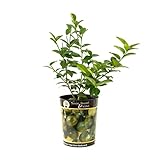
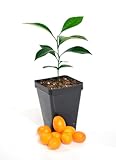
The limequat is a deliberate hybrid between the Key lime and the kumquat, and almost everything useful about it traces back to that pairing. It inherited the sharp aromatic juice of the lime together with the compact frame, the edible rind and the extra cold tolerance of the kumquat. That is why a plant that behaves like a lime can be grown in gardens where a true lime would not survive the winter.
What a limequat is, and the names it hides behind
You will meet this plant under several names, which causes real confusion when you go shopping. Eustis limequat is the best known variety, with small round fruit; it is also sold as Key lime limequat, and the group is sometimes listed as Citrus floridana or, unhelpfully, as “dwarf lemon”. They are the same kind of plant.
It grows as a large shrub or small evergreen tree, typically 1–4 m (roughly 3–13 ft), with dwarf selections that stay around 0.5 m and are often kept in pots or trained as bonsai. Growth speed is average. Leaves are green and elliptic, the flowers white with five petals and yellow stamens. Some cultivars carry thorns and some do not, which matters more than it sounds: a thorny tree planted where you have to reach through it is a tree you will stop harvesting from.
The fruit is small, about 1.5–3 cm, and mostly yellow. The rind is edible raw — sour with a slight bitterness — which is why limequats are so often used whole rather than squeezed.
Climate and cold tolerance
Limequat suits subtropical and Mediterranean climates and is generally placed in hardiness zone 8 and warmer. It can survive a temperature a little below 0°C (32°F), but it only grows properly above about 10°C (50°F). Those two figures describe different things and it pays to separate them: the first is survival through a brief dip, the second is the point below which the tree essentially stops working — little water uptake, no new growth, the plant simply waits.
The practical consequence is about timing rather than survival. Limequat ripens from autumn through to early spring, so the crop hangs on the tree through the coldest part of the year. A frost-free or at least sheltered site — a sunny wall, out of the frost pocket at the bottom of a slope — protects the fruit as much as the wood.
Sun, soil and watering
Give it full sun. It accepts half shade and still lives, but flowering, fruit set and flavour all follow light. Soil must be well drained, ideally loamy, and enriched with organic matter, humus and fertilizer. Citrus roots are shallow and demand oxygen; standing water around them causes trouble long before drought does.
Water requirement is modest for most of the year: a small amount, letting the soil breathe between waterings. When the tree is carrying fruit and there is no rain, increase it. Fruit sizing is essentially a water process, and a tree that swings between bone dry and soaked while the fruit fills gives you small, hard fruit and unnecessary drop. Mulch evens out that moisture better than extra irrigation does.
Where summers are hot and the main trunk is exposed to direct sun — a young tree, or one whose canopy has just been opened by pruning — whitewash the trunk with lime paint. Bare citrus bark scorches, scorched bark cracks, and cracks are how gummosis and foot rot get in.
Planting a limequat step by step
Planting season depends on your zone: spring to summer in zones 8–10a, spring to autumn in 10b, year round in zone 11. Avoid the hottest days of summer whatever your zone — a root ball that has not yet grown out cannot supply a canopy sitting in that heat.
- Choose a position where you can reach the fruit from all sides, especially with a thorny cultivar.
- Dig a hole as deep as the current root ball plus another 20–40%.
- Put organic matter, humus and dried leaves in the hole and mix them with some of the excavated soil, so the roots meet a blend rather than a pocket of pure compost.
- Loosen the outside of the root ball slightly, holding it above the hole. Roots that circled inside a pot will keep circling if you plant them untouched.
- Set the tree and backfill. Firm the soil moderately — pressed too hard it suffocates, left too loose the tree rocks in the wind and never anchors.
- Mulch the surface and water in well, then keep the root zone moist for the first two weeks while the roots make contact with the surrounding soil.
Seed, cutting, air layering or a grafted tree?
From seed
Sow in spring into moist to wet soil, in full sun to half shade. It is not difficult, and — unusually for citrus — a seed-grown limequat mostly does not need to be grafted afterwards to be worth keeping. Many citrus seeds produce seedlings that are effectively copies of the mother plant rather than a genetic lottery, which is why a seed-raised limequat behaves far more predictably than, say, a seed-raised apple. The trade-off is time: a seedling has to grow up before it flowers.
From cuttings
Cuttings need a controlled setup rather than luck. Use a sterilized knife and sterilized medium (a few minutes in the microwave does it) and root into something that stays evenly moist — peat soil, coconut coir or peat moss. Hold the temperature around 25–28°C (77–82°F), or a little higher, use a rooting hormone, and keep humidity very high; the target is a fog-like atmosphere, not a wet pot. A cutting has no roots and can only hold water through its leaves, so the humidity is not a nicety, it is the whole method. Never let the medium dry out. Air layering is the low-risk alternative, since the branch stays attached and fed while it roots.
Grafted trees
Grafting guarantees the fruit rather than merely the plant. A named cultivar fixes fruit size, where the taste sits between sweet and sour, how juicy or dry the flesh is, how many seeds you get, and when in the season it ripens. The rootstock answers a different set of problems: disease-free material, a base suited to your particular soil, and drought tolerance. If you have room for only one tree, look for two or more cultivars grafted onto it — different cultivars ripen at different dates, and one multi-grafted tree stretches the picking season considerably.
Pruning: the timing decides your crop
Prune after the fruit has been picked and before the bloom starts — usually winter, sometimes into spring. The window exists for one reason: flowers, and therefore fruit, form on the wood you are holding in your hand. Cut in that gap and you remove only spent wood; cut once the buds are moving and you throw the coming crop on the ground.
The work itself is light. Take out dead and damaged branches first, then prune to keep the tree small and within reach. On an Eustis, which fruits generously on a small frame, restraint pays: aim for an open, reachable shape rather than a hard cut back.
Limequat compared with Key lime
Because one of its names is “Key lime limequat”, people expect a Key lime. The differences are real:
- Fruit size — the limequat’s fruit is smaller.
- Tree size — the limequat tree is smaller too, which is exactly why it suits a courtyard, a pot or a bonsai pot.
- Taste — both are sour, but sour in different ways. The limequat carries a bitter edge and, thanks to the kumquat parent, a rind you can eat along with the flesh instead of discarding.
- Cold — that same kumquat side is what lets a limequat handle a brush with freezing.
Pests and diseases
The one that matters most is citrus leaf miner, and it matters most while the tree is young. The larvae tunnel inside new leaves, leaving silvery winding trails and curled, distorted growth. A mature tree carries the damage; a young tree trying to build its canopy loses much of the season’s growth to it, so protect the new flushes on a newly planted limequat.
Also watch for aphids, mealybugs and mites on soft new growth, and for ants — ants are not eating your tree, they are farming the aphids and mealybugs for honeydew and defending them from predators, so breaking the ant trail often collapses the infestation.
Citrus foot rot and citrus gummosis are the serious ones, and both are largely preventable. They take hold where the trunk base stays wet: soil or mulch heaped against the bark, irrigation aimed at the trunk, or a hollow where water sits after rain. Keep mulch pulled back from the trunk, keep the graft union clear of the soil line, water the root zone rather than the stem, and do not plant in a spot that puddles.
Harvest, uses and growing in a pot
In good conditions a limequat starts to bear fruit 1.5–3 years after planting, and the yield season runs from autumn through to early spring — a long window, and part of the plant’s appeal. The fruit is eaten raw, juiced, made into fruit leather or candied as sugared peel, and the peel is also used for its fragrance. Because the rind is edible, limequats reward uses that keep the fruit whole: sliced into drinks, preserved, or turned into marmalade.
Container growing is genuinely practical, particularly with dwarf forms near 0.5 m. The same rules apply, only sharper: free-draining mix, full sun, more water while the fruit is filling, and regular feeding, since a pot holds no reserves of its own.
For the full plant profile see our Limequat tree growing page.
See also: fruit tree grafting · grafting tools & supplies · rooting hormone for cuttings
See also: fruit tree grafting · grafting tools · rooting hormone for cuttings
More fruit-growing guides
- Growing fruit trees from seed
- How to prune fruit trees
- How to hand-pollinate flowers
- Why a tree flowers but won’t fruit
- How and when to fertilize
- Best fertilizer for citrus & fruit trees
Not sure which pruning approach applies? See our guide to choosing the right pruning method.