Plant Profile & Key Characteristics
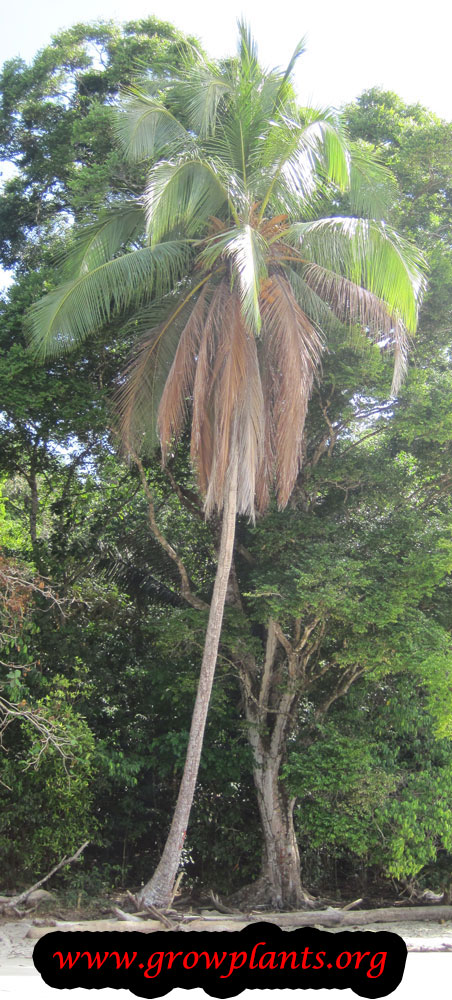
Overview: A tall single-trunk palm reaching 10-30 m, crowned with large pinnate fronds and grown for its edible nuts and iconic ornamental form. It is evergreen and suited to tropical and coastal landscapes.
Quick Specifications
| Specification | Attribute |
|---|---|
| Plant Type / Life Cycle | Perennial (evergreen palm) |
| Foliage Type | Evergreen |
| Mature Size | 10-30 m tall (30-100 ft) |
| Growth Rate | Fast to moderate |
| Root System | Fibrous, adventitious (no taproot — typical of palms) |
| Toxicity | Non-toxic — nut flesh and water edible |
| Hardiness | USDA zone 12+ |
Growth Form & Structure
- Height & Spread: 10-30 m (30-100 ft) tall; not suited to long-term container growing
- Growth Habit & Form: Tall single-trunk palm topped with a crown of large pinnate fronds
- Lifespan & Maturity: Long-lived; begins bearing fruit in about 5-7 years
Anatomy & Physical Features
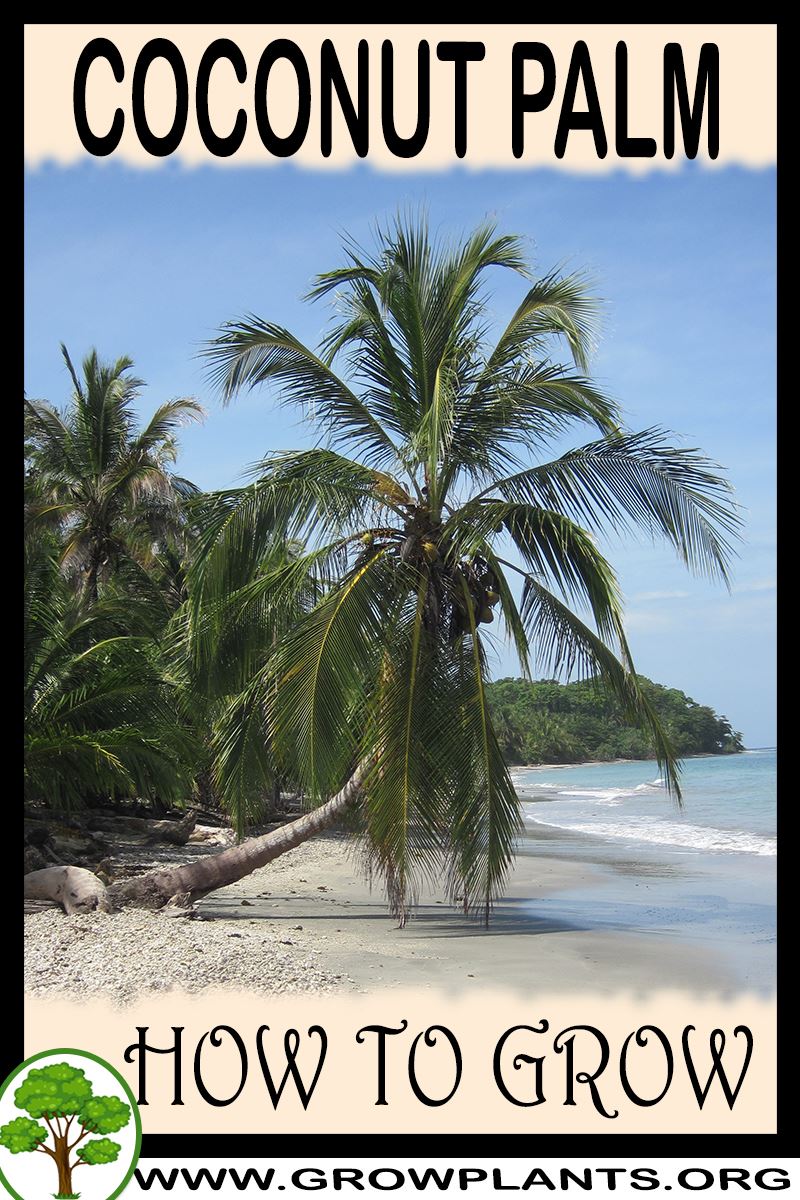
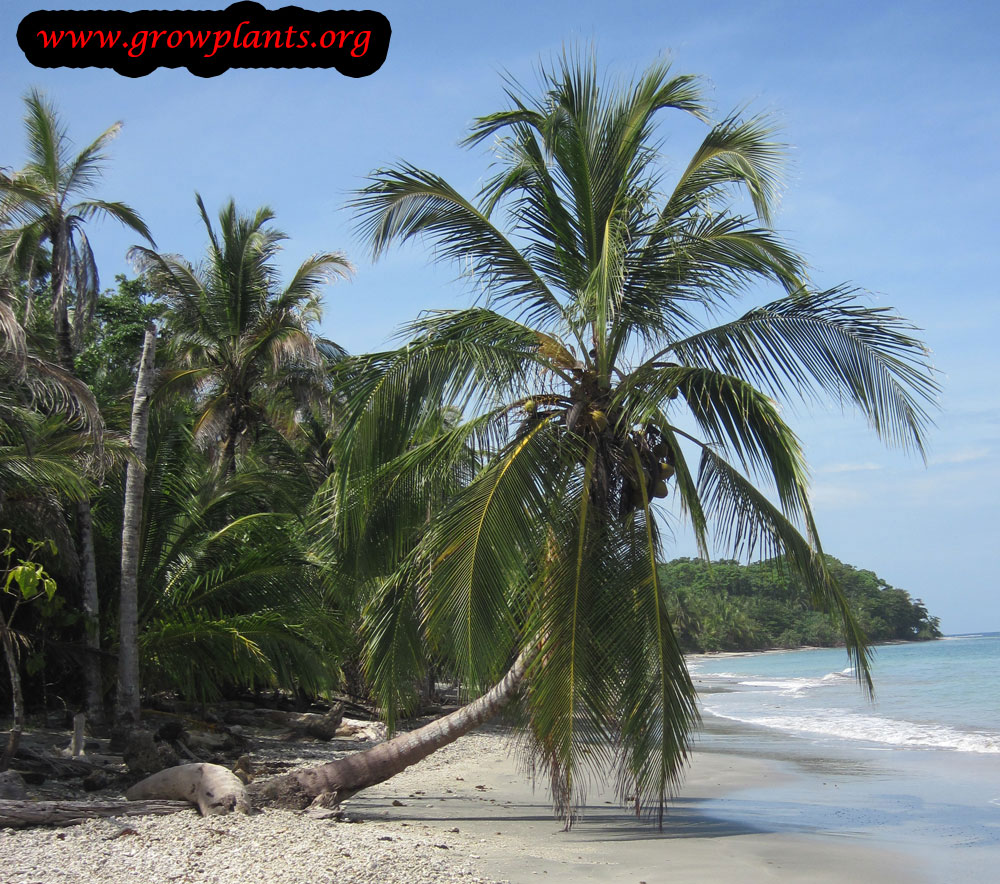
- Trunk & Bark: Single slender, ringed, often gently leaning grey trunk
- Leaves & Foliage: Large pinnate (feather) fronds up to 4-6 m long
- Flower Characteristics: Small white flowers in large branched clusters; wind- and insect-pollinated
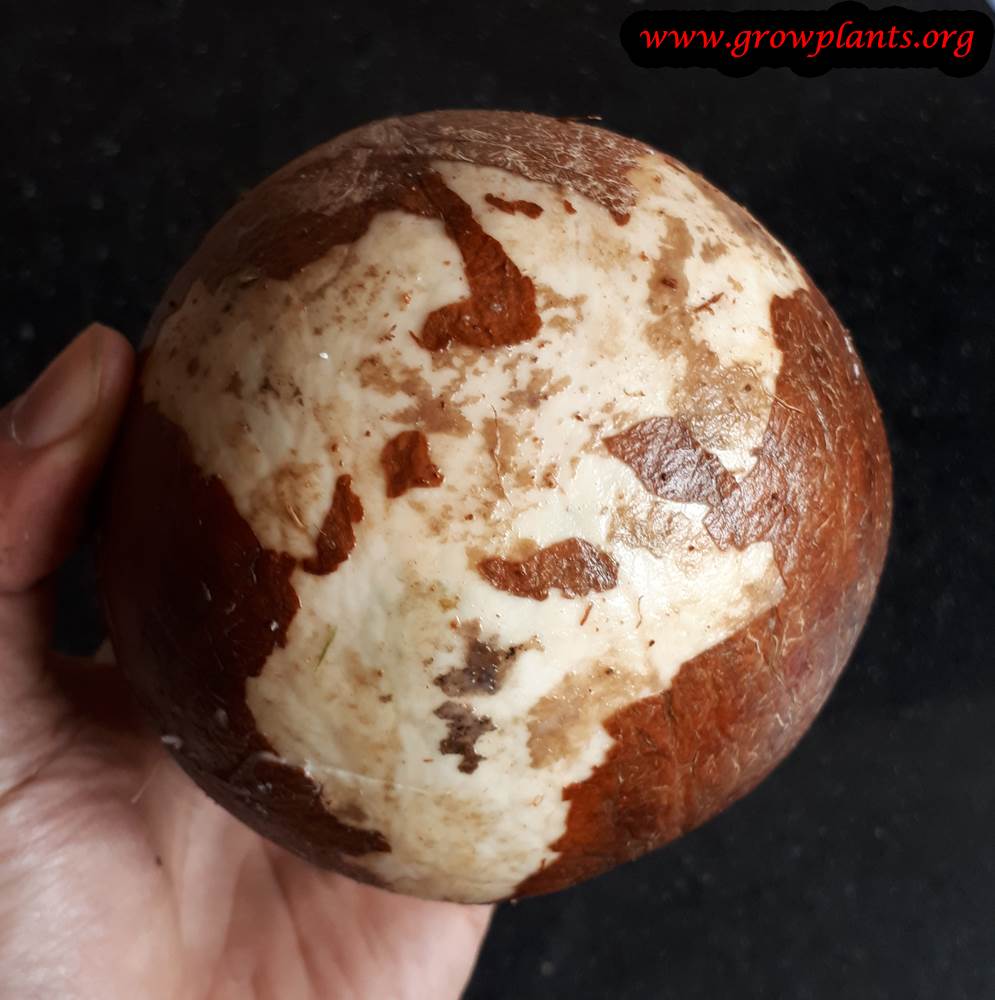
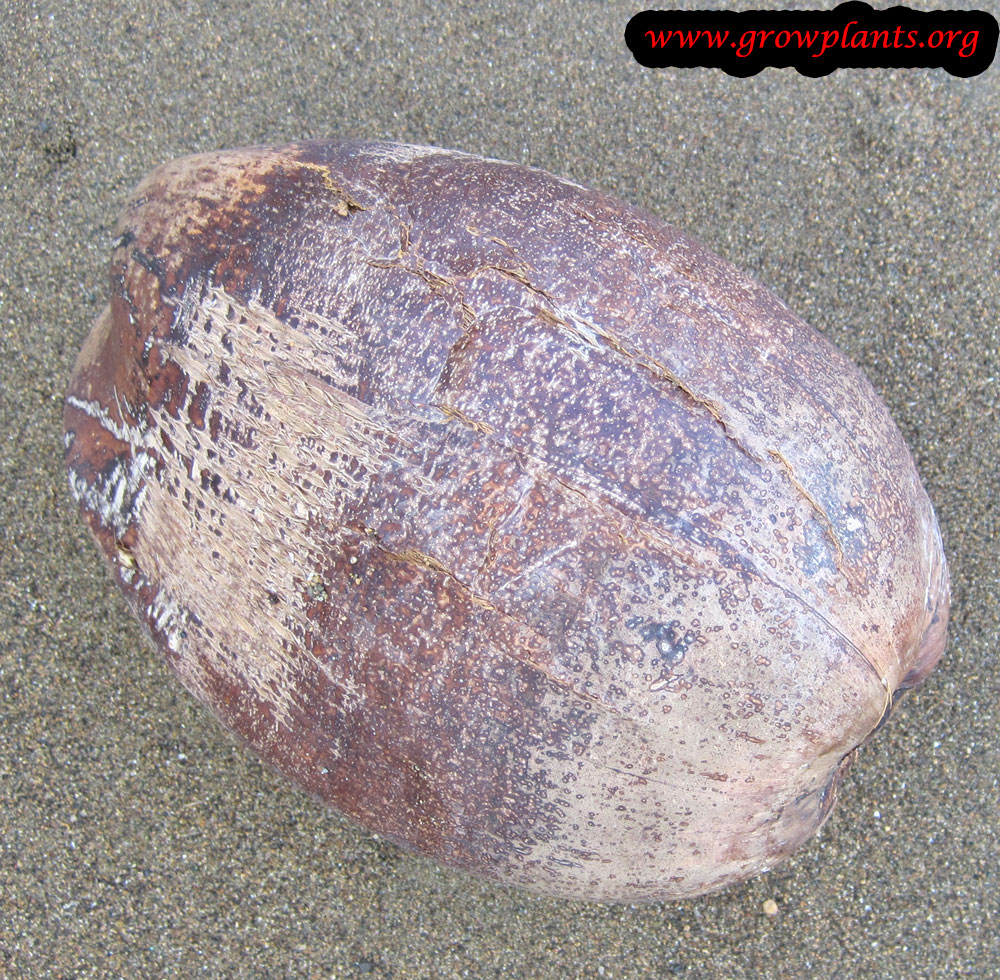
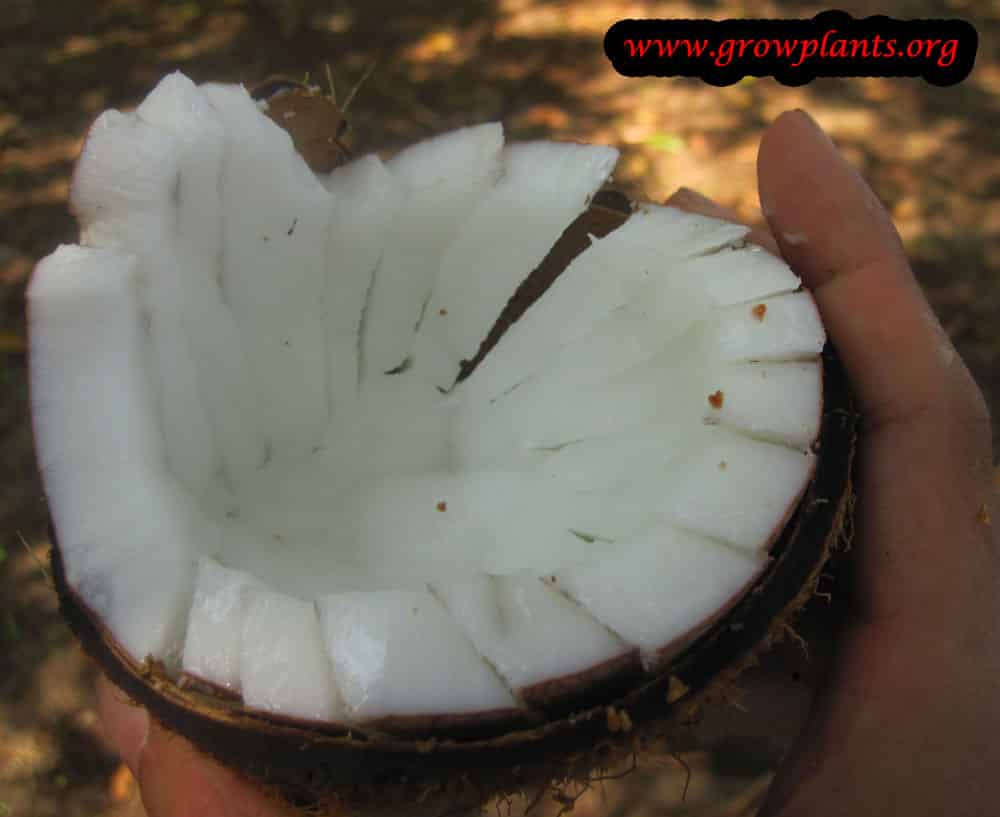
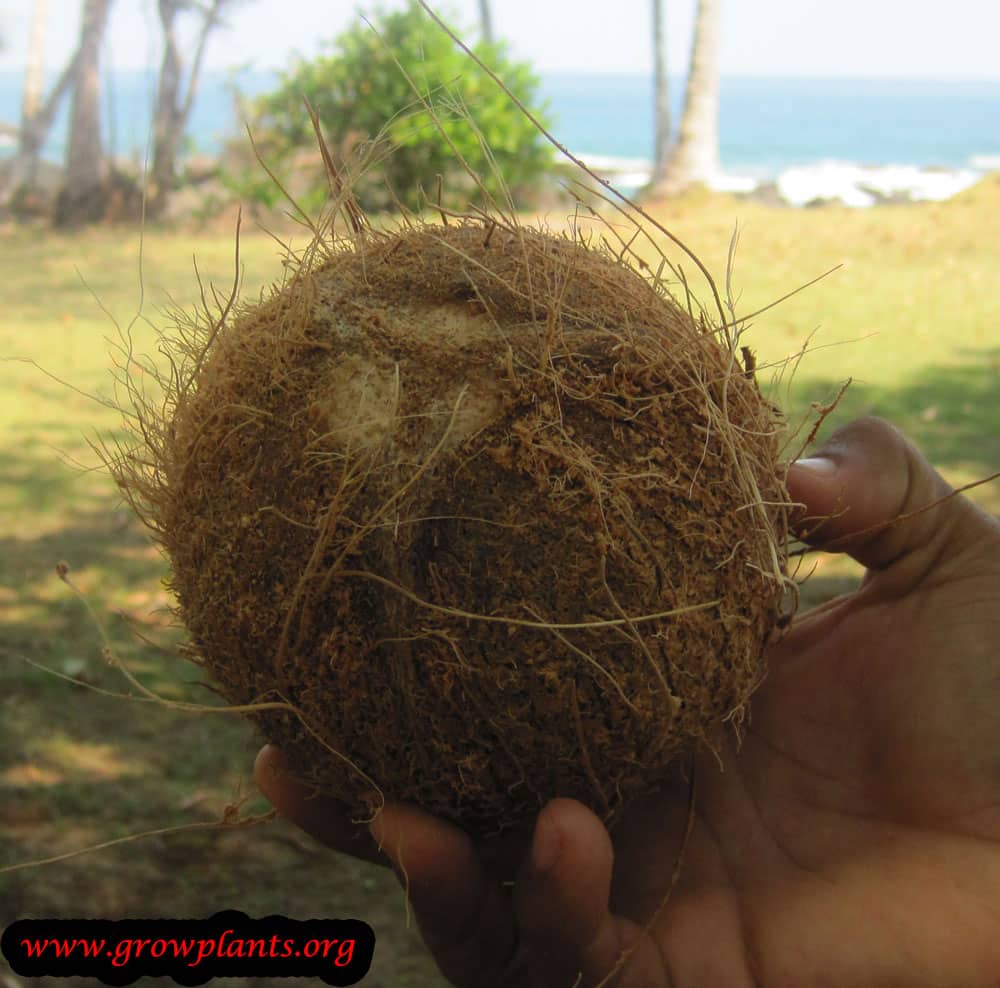
- Fruit Profile: Large fibrous-husked drupe (the coconut) with a hard shell marked by three “eyes”; edible white flesh and water
Primary Uses & Landscape Value
- Edible Uses: Nut flesh and water eaten and drunk fresh
- Functional & Ornamental Roles: Iconic ornamental and shade palm for tropical and coastal landscapes; a major economic crop
Care Guide: Planting, Soil & Watering
Overview: Coconut palm is a fast-to-moderate tropical palm (hardy only in zone 12+) that demands full sun, high humidity and warmth. It grows in sandy, free-draining coastal soil, tolerates salt, and needs generous, regular watering.
Quick Care Requirements
| Requirement | Ideal Condition |
|---|---|
| Planting Season | Year-round in suitable tropical climates |
| Growth Rate | Moderate to Fast |
| Soil Type | Sandy, free-draining |
| Water Need | High |
Planting & Establishment
- Best Planting Season: Plant year-round in frost-free tropical climates.
- How to Plant:
- Hole Preparation: Dig a hole wider and a little deeper than the root ball to loosen the surrounding soil.
- Soil Amendments: Mix organic matter into sandy soil to hold some moisture and nutrients while keeping drainage sharp.
- Planting Depth: Set the palm so the root collar sits at soil level; do not bury the base of the trunk.
- Growth Speed & Expectations: A fast-to-moderate grower that eventually reaches 10–30 m (30–100 ft); it is a landscape palm, not suited to container culture.
Soil, Watering & Drainage Care
- Soil Mix & Drainage Needs: Sandy, salt-tolerant, free-draining soil is ideal; constant waterlogging harms the roots despite its high water need.
- Watering Schedule & Technique:
- Young / Newly Planted: Keep young palms consistently and generously watered while they establish deep roots.
- Established: Water established palms deeply and regularly — they are thirsty but still need drainage.
- Seasonal Adjustments: Water heavily in the dry season and hot weather; ease off during cool, wet spells.
Climate, Light & Hardiness
Coconut palm is a true tropical species with essentially no frost tolerance, restricted to USDA zone 12 and warmer. It requires full sun and consistently high humidity and rainfall.
Quick Climate Specifications
| Climate Zones | Tropical |
|---|---|
| USDA Hardiness Zones | 12+ |
| Frost Tolerance | None |
| Light Conditions | Full sun |
Sunlight & Light Exposure
Optimal Light Setup
Needs full, unobstructed sun to grow and fruit well.
Temperature Extremes & Hardiness
USDA Hardiness & Regional Limits
Confined to USDA zone 12 and warmer - a genuinely frost-free, year-round tropical climate is required; even light, brief frost is generally fatal or severely damaging.
Wind, Humidity & Microclimate
Humidity Preferences
Thrives in consistently high humidity, characteristic of its native coastal tropical range.
Growing in Pots, Balconies & Indoors
Coconut palm (Cocos nucifera) is a tropical palm that reaches 10-30 m. The grower does not rate it as a houseplant. The grower advises against long-term container growing – it is a large palm that needs open ground to develop and fruit.
Quick Details
- Container Size: Not suited to long-term pots – a large tree; a big pot only holds a young plant for a while
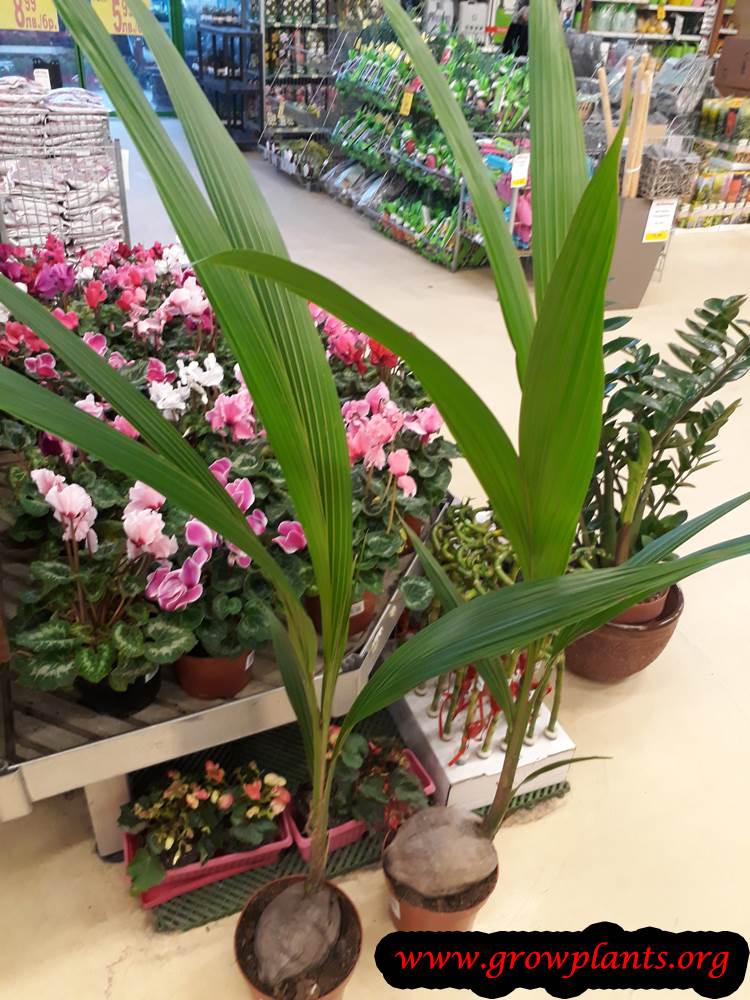
- Indoor Suitability: Not a houseplant – far too large; a young plant can sit in a bright spot only briefly
- Best Spot: Full sun
- Soil & Drainage: Free-draining mix while young in a pot
- Watering in Pots: Keep a potted young palm’s mix moist – pots dry fast in sun; never waterlogged
Indoors & On the Windowsill
- Houseplant limits: The grower marks it as not a houseplant. It grows into a 10-30 m palm and needs full sun, so it cannot be kept as an indoor plant beyond the seedling stage.
- While young: A young plant may live in a large pot in a bright, sunny position for a few years, but it must eventually go into open ground.
- Safety: Mature trees drop heavy fruit that can injure people below – another reason this is an outdoor, open-ground tree, not a patio or doorway plant.
On a Balcony or Patio
- Light & weight: While young it can stand on a sunny balcony or patio in a large, heavy, well-drained pot; pots dry fast in sun, so water often, and account for the considerable weight.
- Long term: As it grows it becomes too tall and heavy for a balcony and needs planting out.
Choosing the Pot, Soil & Long-Term Care
- Pot & drainage: A large pot with strong drainage holes for a young plant; empty any standing saucer so the roots never sit in water and rot.
- Potting mix: Well-aerated, free-draining mix – a good potting mix, or peat/coir blended with perlite or vermiculite and some organic matter.
- Feeding: Potted plants use up nutrients faster because watering leaches them out, so feed a little more often than plants in open ground; a potted palm benefits from a palm-suitable feed in the growing season.
- Moving on: Pot up as it grows and plan to plant it in open ground before it becomes root-bound and top-heavy.
Fertilizing & Feeding
A moderate feeder: this large, fast-growing tropical palm has substantial water and nutrient needs to sustain its canopy and long-term nut production, so steady feeding through its year-round warm-climate growing season suits it well.
Quick Fertilizing Specs
| Feeding Level | Moderate feeder |
|---|---|
| Main Nutrient Priority | A balanced palm-formulated fertilizer with potassium and magnesium supports this large, fast-growing tropical palm’s canopy and coconut production |
| Best Feeding Period | Through the warm, humid growing season typical of its tropical climate |
| Organic Options | Organic matter worked into the root zone, especially useful in sandy tropical soils |
| Reduce/Stop Feeding | Feeding continues through the warm season and eases only if growth visibly slows |
| Micronutrients | A palm-formulated fertilizer carrying manganese and magnesium as routine trace nutrients supports healthy fronds in this fast grower |
| Soil pH | Tolerates a range of well-drained soil, common in sandy coastal plantings |
Feeding by Growth Stage
Establishment after planting
Help a newly planted coconut palm establish roots in its tropical setting before it pushes into fast canopy growth.
| Nutrient direction | A balanced fertilizer supports steady root establishment as this fast-growing palm settles in. |
|---|---|
| Timing | At planting, any time within its year-round tropical growing season. |
| Frequency | A light feeding at planting is usually enough while roots establish. |
| Fertilizer types | A balanced complete fertilizer, Organic matter worked into sandy or fast-draining planting soil |
| Precautions | Keep the root zone consistently moist given this palm’s large water needs, and site it well away from walkways or structures since mature fruit can fall and pose a hazard. |
Established growth and nut production
Support this fast-growing tropical palm’s large canopy and long-term coconut production once established.
| Nutrient direction | A palm-formulated fertilizer with potassium and magnesium, applied through the warm season, supports frond health and nut development in this vigorous grower; routine manganese and magnesium in a complete palm product help prevent common frond problems. |
|---|---|
| Timing | Through the warm growing season, with growth possible year-round in fully tropical conditions. |
| Frequency | Regular feeding through the growing season suits this moderate-to-vigorous feeder. |
| Fertilizer types | A palm-formulated fertilizer with potassium and magnesium, Organic matter as a root-zone top-dressing in sandy soils |
| Routine trace nutrients | manganese, magnesium |
| Precautions | Maintain consistent watering given this palm’s large water demand, and continue positioning mature plantings away from foot traffic since falling coconuts are a known hazard. |
Nutrient Deficiency Signs & Corrections
Older fronds develop translucent yellow-to-orange spotting and leaflet tip dieback.
| Possible causes | low soil potassium relative to this vigorous grower’s demand, sandy, fast-draining coastal soil that leaches potassium quickly, a fertilizer program not formulated for palms |
|---|---|
| Appears first on | oldest fronds |
| What to check | fertilizer type and potassium content, soil drainage and sand content, frond age pattern of symptoms |
| Possible correction | Switch to a palm-formulated fertilizer with potassium and magnesium, applied per its label. |
New emerging fronds appear frizzled, stunted, or streaked.
| Possible causes | low soil manganese in alkaline or poorly drained soil, a fertilizer lacking routine manganese, root stress limiting uptake |
|---|---|
| Appears first on | newest emerging fronds |
| What to check | soil pH and drainage, fertilizer manganese content, root and trunk health |
| Possible correction | Apply a chelated manganese product per its label and use a complete palm fertilizer going forward. |
New leaves emerge small or misshapen and fail to unfold properly, and flowering or fruit set may be poor.
| Possible causes | low soil boron, a fertilizer program that never supplies boron, irregular watering affecting nutrient uptake during flowering |
|---|---|
| Appears first on | newest growth and developing flower stalks |
| What to check | history of any boron feeding, flowering and fruit-set pattern, overall new-growth appearance |
| Possible correction | Apply a labeled boron product at a light rate only if boron deficiency is confirmed, since boron has a narrow margin between deficiency and toxicity; correct gradually and monitor the response. |
Pruning, Training & Seasonal Maintenance
Coconut palm has a single growing point and tolerates only dead-frond sanitation – it never needs or benefits from structural pruning. Because it grows continuously in its tropical climate with no true dormancy, pruning can be carried out any time of year rather than in a fixed seasonal window. The main objective is removing fully dead fronds and, on mature fruit-bearing palms, managing the safety risk posed by heavy falling nuts near buildings, parking areas or walkways. Pruning has essentially no effect on fruiting timing.
Quick Pruning & Maintenance Specs
| Pruning Tolerance | Low – sanitation only |
| Primary Pruning Window | All year (no dormant season in its tropical range) |
| Typical Frequency | As fronds fully die, roughly a few times a year |
| Main Objective | Remove dead fronds; manage fruit-drop hazard on mature specimens |
| Young Plant Priority | No removal of any green frond – the palm is not yet fruiting (takes 5–7 years) and needs full leaf area to establish |
| Mature Plant Priority | Dead-frond removal plus periodic assessment of fruit clusters overhanging occupied areas |
| Best Tool Type | Pole pruner for smaller/younger specimens; professional arborist climbing work for mature palms |
| Avoid Heavy Pruning During | Always – no green-frond or crown pruning is tolerated at any age |
Pruning by Plant Age & Size
Newly Established
Remove only clearly dead fronds. There is no fruit-drop hazard yet since fruiting takes 5–7 years, so maintenance is minimal.
Young / Formative
No structural training applies to this single-trunk, single-crown palm.
Mature / Established
Continue dead-frond removal only. Once fruiting and reaching significant height (mature palms can be 10–30m), periodically assess whether heavy nut clusters hang over walkways, parking or seating areas – falling coconuts are a recognized safety hazard and controlled removal of at-risk clusters is a legitimate maintenance task distinct from routine pruning.
Special Growth to Remove
- Fully dead fronds only.
- On mature palms near structures or foot traffic, mature fruit clusters posing a drop hazard – removed for safety, not for plant health.
Tools
- Pole pruner – workable while the palm is still short enough to reach from the ground.
- Pruning saw – for the tough frond base once within reach.
Once a coconut palm reaches its mature height, frond and fruit-cluster removal is specialist arborist/climbing work rather than a homeowner task with hand tools – this is driven directly by the height and the documented falling-fruit hazard.
Tool Hygiene & Disease Risk
Routine. No transmissible pathogen is documented for this species in available data (palm aphid and fruit moth are pest, not disease, concerns) – clean, sharp tools are sufficient.
Cut Placement & Technique
Cut dead fronds leaving the base stub rather than a flush cut; never cut into the crown/growing point.
Heavy Pruning & Rejuvenation
Not tolerated at any age – a single growing point means no rejuvenation is possible, and removing green fronds only reduces vigor.
Post-Pruning Care
No special watering or feeding response is needed beyond normal care; inspect wound sites periodically for pest activity.
Common Pruning Mistakes
- Removing green fronds for a tidier look, weakening the crown.
- Leaving heavy fruit clusters unmanaged directly above walkways or parking on a mature palm.
- Attempting DIY climbing/pruning on a tall mature palm instead of using a trained professional.
When NOT to Prune
- Never remove living green fronds.
- Avoid unsupervised or amateur pruning/climbing on tall, mature specimens given the fall and fruit-drop hazard – this is professional work.
Pruning Troubleshooting
| Problem | Possible Cause | What to Check | Corrective Action |
| Reduced crown vigor | Over-removal of green fronds | Recent pruning history, frond count | Stop green-frond removal; let the crown recover |
| Sticky residue / distorted new fronds | Palm aphid infestation | Undersides of young fronds | Treat pest per local guidance; not a pruning issue |
| Nuts falling near occupied areas | Untended heavy fruit cluster on a mature palm | Fruit load position relative to walkways/structures | Arrange controlled professional removal of at-risk clusters |
Recommended Tools (by task)
- pole_pruner – dead-frond removal while the palm is still within ground-based reach.
- pruning_saw – cutting through tough frond bases.
Propagation Guide
Coconut palm is propagated exclusively from seed – the whole fibrous fruit (the coconut itself) functions as the seed and typically germinates while still attached to it. Site data confirms grafting or vegetative propagation is not used for this species. The technique itself is simple, though germination is slow, so overall difficulty for a home grower is easy.
Quick Propagation Specs
| Best Propagation Method | Seed (whole nut) |
| Propagation Difficulty | Easy (technique is simple, though germination is slow) |
| Best Propagation Season | Can be started year-round in consistently warm, humid conditions |
| Seed Germination Time | Commonly a few months, sometimes up to around a year |
| Germination Temperature | Warm, roughly 27-32°C (80-90°F), kept consistent |
| Seed Sowing Depth | Nut laid on its side and partly buried, with the upper end (containing the germination pores) left exposed |
Growing from Seed
Seed Handling & Viability
Use a mature, fully developed nut with the fibrous husk left on; a nut that still sloshes with liquid inside is a useful sign of viability.
Sowing Depth & Orientation
Lay the nut on its side and bury roughly two-thirds of it, leaving the top end exposed.
Germination Conditions
Warm, humid conditions with a consistently moist – not waterlogged – growing medium, matching this palm’s stated preference for humidity.
Germination Time
Slow; commonly a few months, and sometimes up to roughly a year.
Seedling Care
Once the shoot emerges, grow on in full sun with generous watering, matching this palm’s mature light and water needs. Avoid disturbing the developing root system while the seedling is still drawing on reserves from the nut.
Bloom & Flower Guide
Quick Details
- Bloom Season: More or less all year in a tropical climate
- Time to First Bloom: After several years of growth as the palm matures
- Flower Appearance: Small white flowers borne in large branched clusters among the fronds
- Edibility: The flowers are not eaten as such, though in some regions the flower stalk is tapped for its sweet sap
Detailed Blooming Overview
In the tropics the coconut palm can flower almost year-round once mature. Each large branched flower cluster (inflorescence) carries both male and female flowers, so a single palm can set fruit on its own, though insects and wind help. In some regions the young flower stalk is tapped for its sugary sap, used fresh or made into palm sugar.
Flower Characteristics
- Small white flowers in large, branched clusters emerging among the fronds.
- Both male and female flowers are carried on the same cluster.
Bloom Care & Thinning
- Pollination: Wind, bees and self-pollination all play a part in setting the coconuts.
Fruit & Uses
Coconut Palm is grown for its large edible fruit, commonly called a coconut, prized for its water, flesh, and oil. It is eaten raw straight from the shell, with the main effort being opening the tough fibrous husk and hard inner shell.
Quick Edible Specs
| Edible Parts | Fruit (technically a drupe, marketed as a “nut”) |
| Main Use(s) | Culinary – fresh water and flesh, cooking oil, milk/cream |
| Eaten Raw or Cooked | Raw (flesh is also pressed or processed for oil and milk) |
| Preparation Required | Remove fibrous husk and crack the hard shell to reach the water and flesh |
| Harvest Season | All year |
| Time to First Harvest | Several years from planting before the palm bears fruit |
| Storage | Whole coconuts store for weeks at room temperature; opened coconut water/flesh should be refrigerated and used promptly |
| Safety/Toxicity Caveat | None noted; falling fruit from tall palms is a physical hazard, not a food-safety one |
Fruit
The coconut is covered in a fibrous husk, with the hard inner nutshell marked by its characteristic three dark “eyes” at the crown. It is harvested year-round. Younger, green coconuts hold more sweet water and thinner, jelly-like flesh; more mature brown coconuts have firmer white flesh and less water. Opening the nut – removing the husk and cracking the shell – is the main work involved before the water can be drunk and the flesh eaten raw, grated, or pressed into oil or milk.
Preparation, Uses & Safety
The water is drunk fresh, and the flesh is eaten raw or used to make coconut milk, cream, and oil. No toxicity applies to the edible parts; the only real hazard is mechanical – falling fruit from a mature palm, which the site also flags as a general growing hazard.
Pests, Diseases & Troubleshooting
Overview: Coconut palms face a formidable lineup of specialist pests and lethal diseases in the tropics – boring beetles and weevils that can kill the crown, sap-sucking scales and mites that scar fruit and fronds, and phytoplasma/fungal diseases that are often fatal. Early detection, crown hygiene and prompt removal of infested or dead material are critical, because once borers or lethal yellowing take hold, control is difficult.
Quick Troubleshooting Overview
| Issue / Pest | Main Symptom | Primary Solution |
|---|---|---|
| Rhinoceros beetle | Bore holes at the crown; V-cut/scissored new fronds | Hook out beetles, remove rotting breeding sites |
| Red palm weevil | Wilting/collapsing crown, oozing tunnels, fermented smell | Remove/destroy palm, pheromone traps, systemic |
| Coconut scale | Yellow spots and whitish crusts under fronds; fronds dry | Horticultural oil, release predators, prune |
| Coconut mite | Pale triangular scars and warping on young nuts | Sulfur/oil to bunches, tolerant varieties |
| Lethal yellowing | Nut drop, blackened flowers, frond yellowing bottom-up, spear collapse | Remove infected palms; resistant types; control planthopper |
| Bud (heart) rot | Youngest spear wilts, pulls out easily, foul smell | Remove diseased tissue, copper fungicide, improve drainage |
Common Pests & Management
- Coconut rhinoceros beetle (Oryctes rhinoceros):
- Symptoms: Signature pest: large beetles bore into the crown to feed on developing fronds, leaving distinctive V-shaped or scissor-cut notches and bore holes when fronds unfurl; heavy attack deforms the crown.
- Prevention & Control: Hook beetles out of bore holes; destroy breeding sites (rotting logs, manure, compost, dead palms); use pheromone/light traps and the Oryctes virus/Metarhizium biocontrol where available; maintain plantation hygiene.
- Red palm weevil (Rhynchophorus ferrugineus):
- Symptoms: Lethal borer: grubs tunnel inside the trunk and crown, causing wilting, a collapsing crown, oozing holes, chewed fibre and a fermented smell; often detected only when the palm is nearly dead.
- Prevention & Control: Remove and destroy infested palms promptly, avoid wounding trunks, deploy aggregation pheromone traps, and use approved systemic/trunk treatments early where legal; strict quarantine of planting stock.
- Coconut scale (Aspidiotus destructor):
- Symptoms: Circular whitish/translucent scales crusting the undersides of fronds and on nuts, causing yellow spots, drying and premature frond death.
- Prevention & Control: Prune and burn heavily infested fronds; horticultural/mineral oil sprays; conserve and release predatory beetles (Chilocorus, Cryptognatha) and parasitoids.
- Coconut mite (Aceria guerreronis):
- Symptoms: Microscopic mites feed under the perianth of young nuts, producing pale triangular scars, corky warping and distortion, and premature nut drop.
- Prevention & Control: Difficult to control chemically; sulfur or oil applied to developing bunches gives partial control; grow tolerant varieties and maintain palm vigour and nutrition.
- Mealybugs & aphids (Nipaecoccus / palm aphids):
- Symptoms: White cottony mealybug clusters or aphid colonies on inflorescences and young fronds with honeydew and sooty mold.
- Prevention & Control: Horticultural oil or insecticidal soap on accessible growth; conserve natural enemies; hose off where reachable.
Diseases & Fungal Issues
- Lethal yellowing (phytoplasma (vectored by the planthopper Haplaxius crudus)):
- Symptoms: Signature disease: premature dropping of most nuts, blackening/death of new inflorescences, then progressive yellowing of fronds from the oldest upward, spear collapse and death within months.
- Treatment & Management: No cure – remove and destroy infected palms to reduce inoculum, plant resistant/tolerant varieties (e.g. certain dwarfs/hybrids), and manage the planthopper vector; antibiotic trunk injection only slows it in valued specimens.
- Bud (heart) rot (Phytophthora palmivora):
- Symptoms: The spear and youngest fronds wilt, brown and pull out easily from a foul-smelling rotted crown; can kill the palm as the growing point dies.
- Treatment & Management: Remove all rotted tissue back to clean growth, drench/protect the crown with copper fungicide, improve drainage and airflow, and avoid crown injury; act at the first spear symptom.
- Ganoderma butt rot (Ganoderma zonatum):
- Symptoms: Internal trunk rot at the base with a general decline; shelf-like (conk) fruiting bodies appear on the lower trunk.
- Treatment & Management: Incurable – remove and destroy affected palms and stumps, avoid replanting palms in the same spot, and prevent trunk wounds; no effective fungicide.
- Grey leaf spot / leaf blight (Pestalotiopsis palmarum):
- Symptoms: Grey to brown spots and blotches with yellow halos on fronds, merging into blighted areas, worse on stressed or under-fed palms.
- Treatment & Management: Prune affected fronds, improve nutrition (especially potassium), avoid overhead irrigation; copper fungicide on valued or severely affected palms.
Growing Difficulties & Abiotic Problems
- Potassium/magnesium deficiency:
- Cause & Symptoms: Very common in palms: older fronds show translucent yellow-orange spotting (K) or broad yellow bands with green centres (Mg), then necrosis.
- Correction Strategy: Apply a specialist palm fertilizer with controlled-release K and Mg (plus micronutrients); never treat older-frond symptoms as disease.
- Manganese deficiency (frizzle top):
- Cause & Symptoms: New fronds emerge weak, yellow-streaked, frizzled and reduced, in alkaline or waterlogged soils.
- Correction Strategy: Apply manganese sulfate to soil and as foliar feed, correct soil pH and drainage; act quickly as severe cases kill the bud.
- Boron deficiency:
- Cause & Symptoms: New leaves emerge hooked, crumpled or with multiple unopened spears and transverse cracking.
- Correction Strategy: Apply a carefully measured boron (borax) supplement – the margin between deficiency and toxicity is narrow – and correct drainage.
- Salt, drought & cold stress:
- Cause & Symptoms: Though salt-tolerant, coconuts scorch under severe drought and are killed by frost/cold.
- Correction Strategy: Irrigate in prolonged drought, mulch, and grow only in reliably frost-free tropical/subtropical conditions.
What Helps – Products & Tools
Management is mostly cultural and sanitary – remove breeding sites and infected palms, keep the crown clean, and feed a complete palm fertilizer. Tools include pheromone traps (rhinoceros beetle, red palm weevil), horticultural/mineral oil and predator releases for scale, sulfur/oil for mite, copper fungicide for bud rot and leaf spot, and specialist palm K/Mg/Mn/B nutrition; approved systemic insecticide for weevil where legal.