


Plant Profile & Key Characteristics
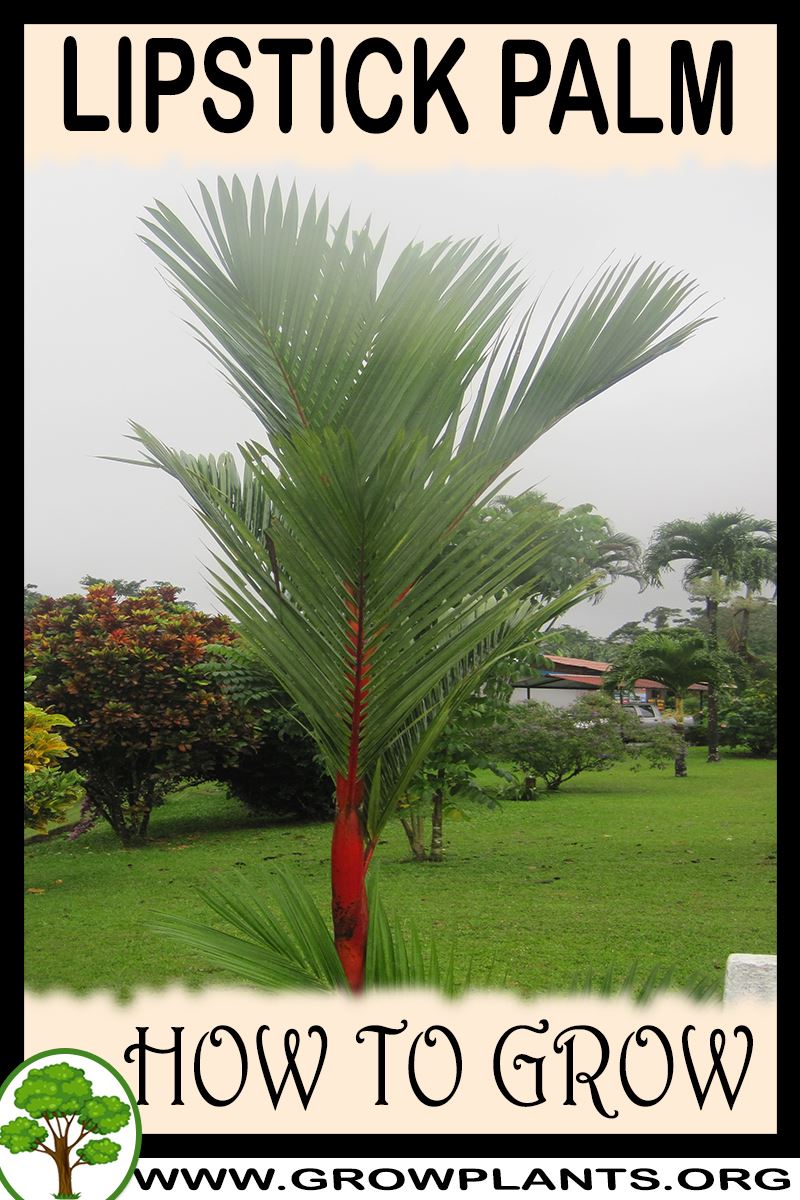
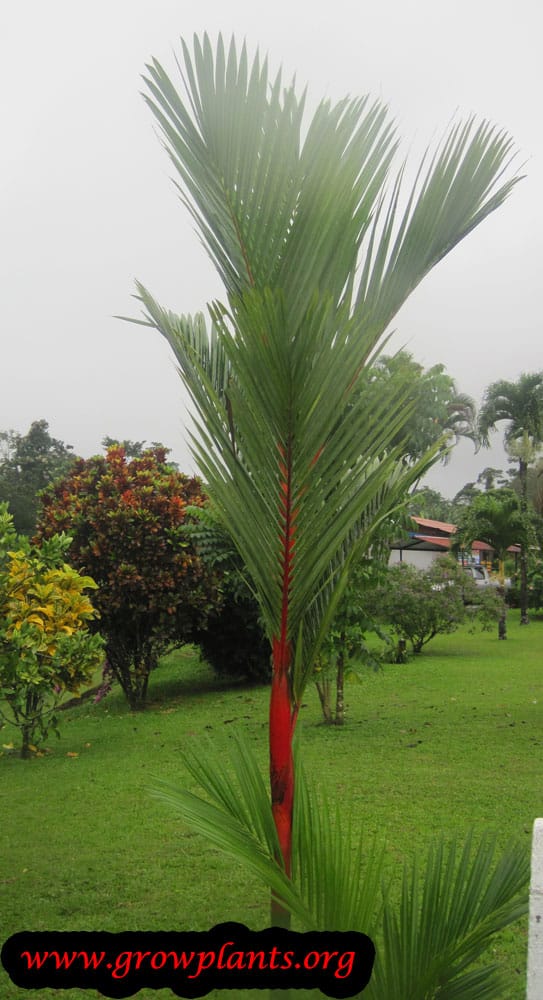
Overview: The lipstick palm is a striking tropical clustering palm growing 10-15 m (30-45 ft) tall, famous for its brilliant sealing-wax-red crownshaft and leaf bases. Evergreen and slow-growing, it is prized as an ornamental and its inner heart is edible.
Quick Specifications
| Specification | Attribute |
|---|---|
| Plant Type / Life Cycle | Perennial (evergreen palm) |
| Foliage Type | Evergreen |
| Mature Size | 10-15 m (30-45 ft) tall |
| Growth Rate | Slow |
| Root System | Fibrous (clumping palm) |
| Toxicity | Non-toxic (palm heart edible) |
| Hardiness | USDA zone 11 (frost-free tropics only) |
Growth Form & Structure
- Height & Spread: 10-15 m tall clumps in the tropical ground; can be grown indoors while young but is not suited to long-term container culture.
- Growth Habit & Form: Clustering (suckering) palm forming clumps of slender stems topped with pinnate fronds.
- Lifespan & Maturity: Slow-growing and long-lived once established in warmth and moisture.
Anatomy & Physical Features
- Trunk & Bark: Slender green stems topped by a vivid scarlet-red crownshaft and leaf bases (the ‘lipstick’); the inner tissue is edible.
- Leaves & Foliage: Green pinnate fronds over 2 m long.
- Flower Characteristics: Small white flowers borne in branched clusters, many per branch.
Primary Uses & Landscape Value
- Edible Uses: The inner heart of the stem is edible (palm heart).
- Functional & Ornamental Roles: Ornamental feature palm for tropical gardens; grown indoors or under glass while young.
Care Guide: Planting, Soil & Watering
Overview: The lipstick palm is a tender tropical palm that grows best in warm, humid, frost-free conditions and constantly moist, acidic, peaty soil. It needs abundant water and never wants to dry out.
Quick Care Requirements
| Requirement | Ideal Condition |
|---|---|
| Planting Season | Any time in warm, frost-free tropical conditions |
| Growth Rate | Slow |
| Soil Type | Rich, moist, peaty soil |
| Soil pH | Slightly acidic |
| Water Need | High – keep constantly moist, never let it dry out |
Planting & Establishment
- Best Planting Season: plant at any time within its tropical range, in warm, humid, frost-free conditions.
- How to Plant:
- Hole Preparation: dig a hole a little wider than the root ball in a warm, sheltered, humid spot.
- Soil Amendments: mix in plenty of peat and organic matter to build the acidic, moisture-holding soil this palm needs.
- Planting Depth: set the root ball level with the soil surface – do not bury the trunk.
- Growth Speed & Expectations: slow-growing, eventually reaching a tall palm over time.
Soil, Watering & Drainage Care
- Soil Mix & Drainage Needs: a moist, peaty, slightly acidic mix; it tolerates wet ground but must have warmth and humidity to thrive.
- Watering Schedule & Technique:
- Young / Newly Planted: keep constantly moist and humid while it establishes.
- Established: water generously and never allow the soil to dry out.
- Seasonal Adjustments: maintain moisture year-round and keep it warm and frost-free.
Climate, Light & Hardiness
Lipstick palm is a strictly tropical palm, hardy outdoors only in zone 11a and warmer. It grows in full sun to full (light) shade but requires constant warmth, high humidity, and frost–free conditions, making it one of the most cold–sensitive palms in this dataset.
Quick Climate Specifications
| Climate Zones | Tropical |
|---|---|
| USDA Hardiness Zones | 11a |
| Frost Tolerance | Very Low |
| Light Conditions | Full Sun to Full Shade (light shade) |
Sunlight & Light Exposure
Adapts from full sun to light full shade, though consistently warm, humid conditions matter more than exact light levels for this species.
Temperature Extremes & Hardiness
USDA Hardiness & Regional Limits
Hardy only in true tropical conditions, roughly zone 11a and warmer; it is not suited to any outdoor climate with cool winters.
Frost Sensitivity
Extremely frost–sensitive with essentially no cold tolerance; the site specifically calls for frost–free conditions.
Wind, Humidity & Microclimate
Humidity Preferences
Requires consistently high humidity, as specified for this species; dry air is poorly tolerated and can stress or damage foliage.
Growing in Pots, Balconies & Indoors
Lipstick palm (Cyrtostachys renda) is a stunning red-stemmed tropical palm. The grower marks it Yes as a houseplant but No for ordinary containers – a reminder that it only succeeds where it gets constant warmth, high humidity and permanently moist roots, as in a heated conservatory or greenhouse rather than an average dry room.
Quick Details
- Container Size: Not suited to ordinary pots (grower: No); needs a warm, humid, wet setting
- Indoor Suitability: A houseplant only in constant tropical warmth and humidity
- Best Spot: Bright light with part shade; warm and humid
- Soil & Drainage: Rich, moisture-retentive mix that never dries out
- Watering in Pots: Very generous – it likes wet feet and high humidity
Indoors & On the Windowsill
- Houseplant, with conditions: The grower marks it Yes indoors, but it demands consistent warmth, high humidity and constantly moist roots – realistic in a heated conservatory or terrarium-like setting, not a dry living room.
- Container caveat: He marks ordinary container growing No; it dislikes drying out and confinement, so treat pot culture as difficult and short-term at best.
- Windowsill: Too large and too demanding for a sill.
On a Balcony or Patio
- Light & humidity: Warmth, shelter and constant humidity are essential; ordinary balcony air is usually too dry and variable.
- Overwintering: Strictly tropical and frost-tender – it needs steady warmth all year.
Choosing the Pot, Soil & Long-Term Care
- If attempted in a pot: Use a large container that never dries out, with a rich, moisture-retentive mix; keep it warm, humid and consistently wet. Be aware the grower does not recommend standard pot culture.
- Potting mix: A well-aerated, organic-rich mix – peat or coir blended with perlite or vermiculite for free drainage.
- Feeding: Potted plants run their soil down fast as nutrients leach out, so feed more often than plants in open ground during active growth.
Fertilizing & Feeding
A sensitive, slow-growing tropical palm that is easily set back by fertilizer salts; it does best on a light, conservative feeding program paired with consistently moist, humid, slightly acidic conditions.
Quick Fertilizing Specs
| Feeding Level | Light |
|---|---|
| young_feeding | Hold off entirely until the palm shows clear new growth after planting |
| mature_feeding | Light, well-spaced feedings through the warm, humid growing season |
| Main Nutrient Priority | A gentle, complete palm fertilizer with manganese and iron, applied conservatively |
| Best Feeding Period | The warmest, most humid stretch of the year when growth is active |
| Organic Options | Well-rotted compost or peat-based amendments suit this palm’s preference for moisture-retentive, slightly acidic soil |
| Micronutrients | Manganese and iron are the most likely deficiencies, especially if the growing medium drifts away from its preferred acidity |
| Soil pH | Prefers a slightly acidic, peat-enriched, consistently moist growing medium |
| Reduce/Stop Feeding | Ease off if temperatures or humidity drop, since growth slows sharply outside warm, humid conditions |
Feeding by Growth Stage
Establishment after planting
Let this sensitive palm settle its roots undisturbed before introducing any fertilizer
| Nutrient direction | Hold feeding back entirely and rely on a rich, peat-enriched planting medium |
|---|---|
| Timing | The first stretch after planting, while the palm is adjusting to its new site |
| Frequency | No feeding is needed at this stage; this palm is described as very sensitive and tolerates disturbance poorly |
| Fertilizer types | No feeding is needed at this stage; focus on consistent moisture and humidity instead |
| Precautions | Do not fertilize until strong new growth confirms the palm has settled in; this species is known to react poorly to stress |
Established growth
Support gradual, steady growth without overwhelming a naturally slow, salt-sensitive palm
| Nutrient direction | A gentle, balanced, complete palm fertilizer with manganese and iron, kept on the conservative side |
|---|---|
| Timing | Warm, humid months when the palm is actively producing new growth |
| Frequency | Light feeding is usually enough; this palm responds poorly to a heavy or frequent program |
| Fertilizer types | A diluted, complete palm-formulated fertilizer with manganese and iron, Well-rotted compost worked lightly into the surrounding medium |
| Routine trace nutrients | manganese, iron |
| Precautions | Reduce feeding sharply if humidity or temperature drops; this species is easily stressed by both over-fertilizing and dry conditions |
Nutrient Deficiency Signs & Corrections
Newest fronds emerge pale yellow to whitish while older fronds remain green
| Possible causes | Iron deficiency, Growing medium that has drifted away from the slightly acidic range this palm prefers, Waterlogged or poorly drained soil |
|---|---|
| Appears first on | Newest emerging fronds |
| What to check | Medium pH and drainage, Consistency of moisture and humidity, Whether the planting mix still contains adequate peat or organic matter |
| Possible correction | Restore a slightly acidic, moisture-retentive medium and apply a chelated iron product per its label if the pattern continues |
New fronds emerge weak, streaked, and undersized with necrotic, frizzled leaflet tips
| Possible causes | Manganese deficiency, Cold or waterlogged medium locking out manganese, Medium pH drifting too far from slightly acidic |
|---|---|
| Appears first on | Newest emerging fronds and the growing point |
| What to check | Medium pH and drainage, Whether a complete palm fertilizer with manganese has been used recently, Recent temperature or humidity stress |
| Possible correction | Restore favorable acidity and drainage, and apply a chelated manganese product per its label if symptoms persist |
Older, lower fronds develop yellow-orange spotting and necrotic leaflet tips while newer fronds stay green
| Possible causes | Potassium deficiency, Long-term feeding with a nitrogen-heavy, potassium-poor product, General nutrient depletion in a moisture-leached medium |
|---|---|
| Appears first on | Oldest fronds first |
| What to check | Feeding history and fertilizer type used, Drainage and leaching from frequent watering, Whether older symptomatic fronds are removed too early |
| Possible correction | Switch to a complete palm fertilizer that reliably supplies potassium and avoid pruning off symptomatic fronds prematurely |
Pruning, Training & Seasonal Maintenance
Lipstick palm (Cyrtostachys renda) is a clustering, crownshaft-forming palm grown for its vivid red leaf sheaths. Its own facts describe it as a "very gentile" (delicate) tree, and that sensitivity should guide every cut: this is a self-cleaning crownshaft species that naturally releases spent fronds on its own, so the least intervention is usually the best intervention. Pruning is essentially limited to removing fully dead fronds at the base once they are loose, at any time of year, plus optional light thinning of an overcrowded clump to show off individual crownshafts. Forcing off a frond before it is ready, or over-handling this species, risks tearing the crownshaft tissue.
Quick Pruning & Maintenance Specs
| Pruning Tolerance | Low – self-cleaning crownshaft palm; minimal intervention, species is notably delicate |
| Primary Pruning Window | All year, but only once a frond is fully dead and loose |
| Main Objective | Sanitation of fully dead fronds; optional clump-density thinning |
| Young Plant Priority | Leave alone; let natural self-cleaning occur, do not force off half-attached fronds |
| Mature Plant Priority | Remove fully dead fronds at the base; thin an overcrowded clump only if individual crownshafts are being hidden |
| Best Tool Type | Precision snips or bypass secateurs on young/potted specimens; a pole pruner once mature (10-15 m) |
| Avoid Heavy Pruning During | Never force off a partially attached or still-greenish frond – this sensitive species tears easily at the crownshaft |
Pruning by Plant Age & Size
Newly Established
Hands-off. Remove nothing beyond truly dead, already-loose debris – this species is described as delicate and benefits from minimal disturbance while settling in.
Young / Formative
No structural training. If grown as a clustering specimen (the typical nursery form, sold as a clump of several stems), allow all stems to establish undisturbed.
Mature / Established
Sanitation of dead fronds at the base only. In dense clumps, occasional light thinning of overcrowded stems can give individual crownshafts room to be seen and improve airflow – an ornamental choice, not a health requirement.
Seasonal Pruning Schedule
Ongoing Sanitary
Objective: keep the crownshaft area clean without stressing a delicate species. Remove: only fully dead, brown fronds once loose at the base. Do not remove: any frond still green or only partially yellowing – let natural abscission finish on its own. Expected response: minimal, ongoing tidiness. Flowering impact: none – flowering is on current growth and unrelated to frond removal.
Special Growth to Remove
- Dead fronds at the base, removed only once fully brown and loose.
- In dense clustering specimens, occasional thinning of overcrowded basal stems – purely to give individual red crownshafts visibility and airflow, not because crowding harms the plant.
Container & Small-Space Pruning
This species is commonly sold and grown indoors as a young container specimen, though it is not typically suited to long-term planter/flowerpot culture outdoors – consistent with its eventual 10-15 m size making permanent pot culture impractical. While container-grown, avoid any pruning aimed at controlling size; a cut stem will not shrink or regrow smaller, and this delicate species responds poorly to unnecessary wounding. Prioritize consistent moisture and humidity (it needs a large amount of water) over corrective pruning.
Tools
Precision snips or bypass secateurs are sufficient for a young or clustering specimen at hand height; a pole pruner becomes necessary once a mature specimen reaches its full 10-15 m height.
Tool Hygiene & Disease Risk
Routine – no specific transmissible disease is noted for this species, but keep tools sharp to make clean cuts, since ragged cuts and unnecessary wounding are poorly tolerated by this sensitive palm.
Cut Placement & Technique
Cut only fully dead frond bases close to, but not into, the crownshaft. Never pull or force off a frond – sheaths release on their own when ready, and forcing them can tear the crownshaft.
Heavy Pruning & Rejuvenation
Not tolerated. Each stem has a single growing point, and there is no rejuvenation pruning for this genus.
Post-Pruning Care
Keep aftercare minimal but consistent: maintain steady warmth, humidity and its characteristically high water needs, and avoid any further disturbance right after a necessary cut, since this is a sensitive species that responds poorly to added stress.
Common Pruning Mistakes
- Forcing off a still-attached frond or sheath instead of waiting for natural drop, tearing the crownshaft on this sensitive species.
- Over-thinning a clustering clump for a "neater" look, when the multi-stem cluster is the entire ornamental point of this palm.
- Treating it like a rugged landscape palm when its own facts describe it as delicate and needing gentler handling.
When NOT to Prune
Avoid any pruning immediately after transplanting or relocating this "very gentile" species while it adjusts. Avoid removing any frond that has not fully browned and loosened.
Recommended Tools (by task)
- precision_snips or bypass_secateurs – clean, low-stress cuts on a young or clustering specimen.
- pole_pruner – reaching the crown safely on mature 10-15 m specimens.
Pruning Troubleshooting
| Problem | Possible Cause | What to Check | Corrective Action |
| Crownshaft looks torn or damaged near a recent cut | A frond was pulled or forced off before it was ready to self-release | Inspect the crownshaft tissue around the most recent frond removal | Let future fronds drop naturally; cut only fully dead, already-loose fronds |
| Individual stems in a clump look weak or the red crownshaft color fades | Overcrowding limiting light to individual stems, or general stress on this moisture- and humidity-dependent species | Watering consistency, humidity levels, clump density | Thin only lightly if truly overcrowded; prioritize consistent moisture and humidity over pruning as the fix |
Propagation Guide
Lipstick palm is propagated almost entirely from seed, which must be fairly fresh since it loses viability quickly once dried or stored; although the palm clusters into multiple stems, those stems share an interconnected, shallow root system that makes division a difficult, low-success option rather than a routine one. Combined with this palm’s need for warmth, humidity, and consistent moisture, overall difficulty is on the difficult side for home growers.
Quick Propagation Specs
| Best Propagation Method | Seed |
| Alternative Methods | Division of rooted offshoots (difficult, low success rate – mainly a specialist/nursery technique) |
| Propagation Difficulty | Difficult |
| Seed True-to-Type | Yes (true species) |
| Best Propagation Season | Warm season, or year-round where frost-free warmth and humidity can be maintained |
| Seed Germination Time | Often a couple of months or more, and can be irregular |
| Germination Temperature | About 27–32°C (80–90°F) |
| Seed Sowing Depth | Shallow, just covered |
Growing from Seed
Seed Handling & Viability
Seed viability drops quickly once dried, so sow fresh seed as soon as it’s cleaned of fruit pulp rather than storing it.
Dormancy & Pre-Sowing Treatment
No special dormancy-breaking treatment is typically needed beyond removing the fruit flesh before sowing.
Sowing Season
Sow whenever fresh seed is available, provided warm, frost-free conditions can be maintained – matching the site’s note that this palm needs frost-free warmth.
Sowing Depth & Orientation
Sow shallow, seed just covered, in a moist, well-draining mix; the site notes this species prefers moist, slightly acidic soil such as peat, which suits the germination mix too.
Germination Conditions
Warm and consistently humid conditions are important, echoing the humidity this palm needs as a mature plant.
Germination Time
Germination is often slow and can be uneven – allow a couple of months or more.
Seedling Care
Keep seedlings warm and humid, with some shade rather than full sun while young.
Division, Offsets, Pups & Suckers
This palm naturally clusters into multiple stems, but because those stems share a shallow, interconnected root system, separating an offshoot risks damaging the roots of the stems left behind and often fails to establish well. It is best treated as a specialist or nursery-scale technique rather than a reliable home method; most propagation, including commercial production, relies on seed instead.
Bloom & Flower Guide
Quick Details
- Bloom Season: Summer into autumn
- Flower Appearance: Many small white flowers borne in branched clusters along the stem – often dozens per branch
- Edibility: Grown as an ornamental for its brilliant red crownshaft; the flowers are not eaten
Detailed Blooming Overview
The lipstick palm is famous for its glossy scarlet crownshaft, and its flowering is a subtler pleasure – branched sprays of many small white flowers appearing in the warm months. These give way in time to small fruits.
Flower Characteristics
- Numerous tiny white flowers.
- Held in branched clusters, with dozens crowded onto each branch.
Bloom Care & Thinning
- Managing the bloom: Little is needed – give it constant warmth and moisture and let the flower sprays develop naturally.
Fruit & Uses
Lipstick palm is grown mainly for its brilliant red crownshaft, but the tender inner core of the trunk is edible, prepared in the same way as heart of palm taken from many other palm species. It is the pale growing-point pith that is eaten, not the fruit or the ornamental red sheath itself.
Quick Edible Specs
| Edible Parts | Inner trunk core / heart of palm |
|---|---|
| Main Use(s) | Heart of palm, eaten as a vegetable |
| Eaten Raw or Cooked | Raw or cooked |
| Preparation Required | Peel away the outer red sheath and fibrous layers to reach the pale, tender inner core |
| Harvest Season | Any time; harvest is destructive to that stem rather than seasonal |
| Storage | Best eaten fresh; the cut core discolors quickly |
| Safety/Toxicity Caveat | No toxicity reported for the inner core; harvesting removes the growing point of the stem it is taken from |
Pseudostem / Cane / Sap
The edible part is the pale, tender inner core of the trunk, reached by stripping away the bright red outer sheath and the tougher surrounding fiber – the same “heart of palm” preparation used across many palm species. Because Lipstick palm naturally forms a multi-stemmed clump, removing the growing point of one cane for its heart kills that individual stem but does not necessarily kill the whole clump (see Pruning for general guidance on cutting old canes/leaves).
Preparation, Uses & Safety
The inner core can be eaten raw, thinly sliced, or lightly cooked, similar to other heart-of-palm preparations. No toxicity is reported for this part. As with any heart-of-palm harvest, cutting into the growing point ends further growth from that particular stem, so it is a one-time harvest per cane rather than a repeatable one.
Pests, Diseases & Troubleshooting
Overview: Lipstick or sealing-wax palm (Cyrtostachys renda) is a tropical, warmth- and moisture-loving palm whose problems are the usual indoor and nursery palm pests – spider mites, scale and mealybugs – plus leaf-spot fungi and, in wet cool conditions, bud and root rot. Because it is very cold-sensitive, many of its worst ‘symptoms’ are actually chill and nutrient issues. Management is cultural: warmth, humidity, steady feeding and good drainage, with early cleaning of sap-suckers.
Quick Troubleshooting Overview
| Issue / Pest | Main Symptom | Primary Solution |
|---|---|---|
| Spider mites | Fine stippling and webbing, worst on indoor/dry plants | Raise humidity; hose down; horticultural oil |
| Scale insects | Brown or white bumps along leaflets and stems; honeydew | Wipe/scrape off; horticultural oil; repeat |
| Mealybugs | White cottony masses in crownshaft and leaf bases | Alcohol swab; insecticidal soap or oil; isolate |
| Leaf spot | Brown/black spots and blotches on fronds | Airflow; remove affected leaves; copper fungicide |
| Cold / nutrient damage | Brown tips, frizzled or discoloured new fronds | Keep warm; feed with K/Mg/Mn; correct deficiencies |
Common Pests & Management
- Spider mites (Tetranychus urticae):
- Symptoms: Especially indoors and in dry air, the leaflets show fine pale stippling, a dull bronzed look and fine webbing on the undersides; the palm looks dusty and loses colour.
- Prevention & Control: Raise humidity, hose or wipe down the fronds regularly, and apply horticultural oil or insecticidal soap to the undersides, repeating; keep the palm well-watered since drought stress favours mites.
- Scale insects (Coccus / Aspidiotus species):
- Symptoms: Brown, tan or white limpet-like bumps line the leaflets, midribs and stems, sucking sap, yellowing fronds and dropping honeydew that turns sooty; both armoured and soft scales occur.
- Prevention & Control: Scrape or wipe off by hand, treat with horticultural oil to smother crawlers, repeat every couple of weeks, and prune out heavily infested fronds; encourage parasitic wasps outdoors.
- Mealybugs (Pseudococcus / Planococcus species):
- Symptoms: White cottony masses gather in the crownshaft, leaf bases and new growth (and sometimes roots), sapping vigour and producing honeydew and sooty mould.
- Prevention & Control: Dab with an alcohol swab, spray insecticidal soap or horticultural oil into the crevices, check the root zone if the palm declines, and isolate affected plants.
- Palm aphids (Cerataphis / Aphis species):
- Symptoms: Dark aphids and their honeydew appear on new spear leaves and inflorescences, distorting growth and fostering sooty mould.
- Prevention & Control: Rinse off with water, spray insecticidal soap, and encourage natural predators; usually a minor problem.
- Caterpillars (palm leaf skeletonizer) (Homaledra sabalella):
- Symptoms: Caterpillars feed in webbed frass tunnels on the frond surface, skeletonising patches of leaflet tissue and leaving unsightly brown areas.
- Prevention & Control: Prune out infested fronds, clear the frass webbing, and treat with Bacillus thuringiensis (Bt) or spinosad on young larvae if damage is widespread.
- Thrips (various species):
- Symptoms: Silvery flecking and streaking on fronds, mostly cosmetic on an otherwise healthy palm.
- Prevention & Control: Monitor with sticky traps, hose down foliage, and spray insecticidal soap only if populations build.
Diseases & Fungal Issues
- Leaf spot (Pestalotiopsis / Exserohilum / Helminthosporium species):
- Symptoms: Small brown to black spots and blotches, sometimes with yellow halos, spread across the fronds in humid, crowded, wet conditions and can merge into large dead areas.
- Treatment & Management: Remove affected fronds, improve airflow and spacing, keep water off the foliage and avoid overhead watering, and apply a copper or labelled fungicide if spotting is severe.
- Bud (heart) rot (Phytophthora / Thielaviopsis species):
- Symptoms: The newest spear leaf turns brown, pulls out easily and the growing point rots with a foul smell, often after cold, wet or injury; this can kill single-stemmed shoots.
- Treatment & Management: Keep the crown dry and warm, avoid overhead watering and cold-wet conditions, drench the bud area with a copper or phosphonate fungicide at first signs, and remove and destroy rotted tissue; clumping habit helps survival.
- Ganoderma butt rot (Ganoderma zonatum):
- Symptoms: Older palms wilt and decline as the lower trunk rots internally, sometimes with shelf-like conks at the base; incurable.
- Treatment & Management: There is no cure – remove and destroy affected palms and stumps, avoid trunk wounds, and do not replant a susceptible palm in the same spot.
- Root rot (Pythium / Rhizoctonia species):
- Symptoms: In waterlogged or poorly aerated soil the roots brown and rot, fronds yellow and the palm declines.
- Treatment & Management: Improve drainage and aeration, water so the surface dries slightly between soakings, remove rotted roots, and refresh the mix; a soil-drench fungicide can protect remaining roots.
Growing Difficulties & Abiotic Problems
- Cold damage:
- Cause & Symptoms: This is a strictly tropical palm; temperatures below about 15°C, and certainly any chill or frost, brown the frond tips, discolour new growth and can rot the bud.
- Correction Strategy: Keep it consistently warm (ideally above 18°C), shelter from cold draughts, move container plants indoors before cool weather, and never expose it to frost.
- Nutrient deficiency (K, Mg, Mn):
- Cause & Symptoms: Palms are prone to potassium and magnesium deficiency (yellow-orange older-frond margins) and manganese deficiency (‘frizzle top’ – weak, frizzled, scorched new growth).
- Correction Strategy: Use a palm-specific fertiliser with potassium, magnesium and micronutrients; correct manganese shortage with a manganese sulfate application and avoid over-liming the soil.
- Leaf-tip burn from sun and salts:
- Cause & Symptoms: Young plants scorch in intense direct sun, and salt build-up from hard water or fertiliser browns the leaflet tips.
- Correction Strategy: Give bright filtered light (and shade young palms), maintain humidity, and flush the soil periodically to leach salts; trim damaged tips.
What Helps – Products & Tools
Keep horticultural oil and insecticidal soap for spider mites, scale and mealybugs, rubbing alcohol on swabs for spot-treating mealybugs and scale, Bacillus thuringiensis (Bt) or spinosad for leaf-skeletonizer caterpillars, and a copper or phosphonate fungicide for leaf spot and bud rot. A complete palm fertiliser (with K, Mg and Mn) prevents the most common ‘symptoms’, which are nutritional. Warmth and drainage matter most. Apply oils in the evening and follow the label.