Plant Profile & Key Characteristics
Overview: Ponytail palm (Beaucarnea recurvata) is a slow-growing evergreen succulent with a swollen, water-storing trunk topped by a rosette of long, arching leaves. It is grown as a drought-tolerant ornamental and houseplant.
Quick Specifications
| Specification | Attribute |
|---|---|
| Plant Type / Life Cycle | Perennial |
| Foliage Type | Evergreen (succulent) |
| Mature Size | Leaf rosette 0.5-2 m (20-80 in); trunk to 4-6 m (12-20 ft) |
| Growth Rate | Slow |
| Toxicity | Non-toxic / pet-safe |
| Hardiness | USDA zones 9-12 |
Growth Form & Structure
- Height & Spread: Trunk to 4-6 m (12-20 ft) with a leaf head 0.5-2 m (20-80 in) across in the ground; stays much smaller and slower in a container
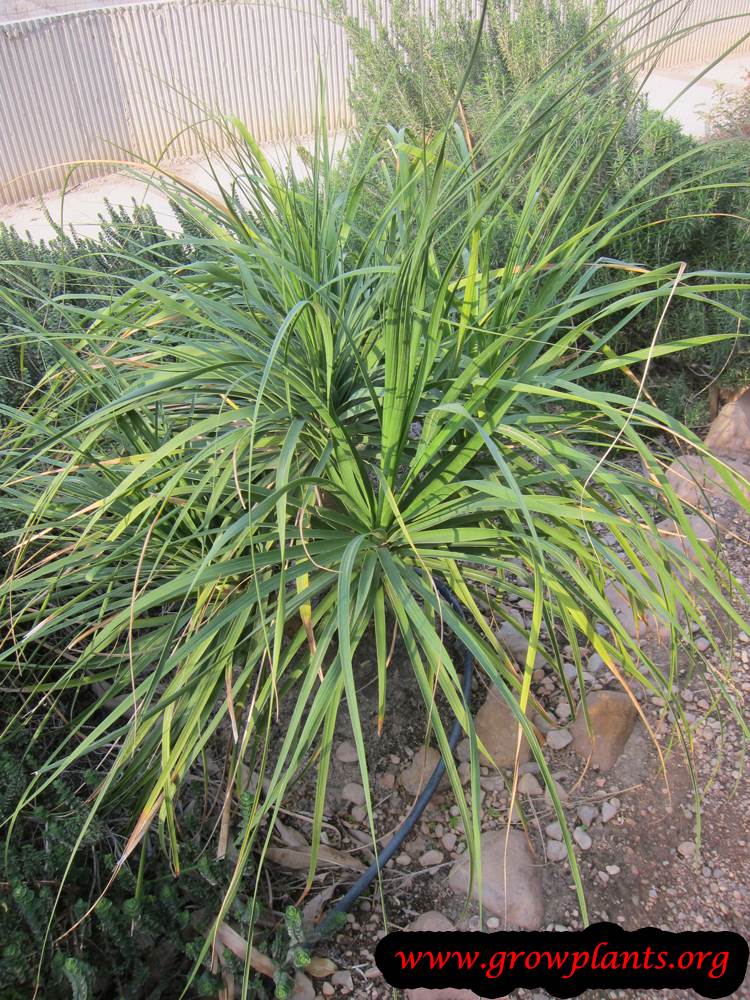
- Growth Habit & Form: Single swollen caudex tapering upward, crowned with a fountain-like rosette of strap leaves
- Lifespan & Maturity: Very long-lived and slow-growing; flowers only after many years
Anatomy & Physical Features
- Trunk & Bark: Brown, bulbous ‘elephant-foot’ base that widens toward the ground and stores water
- Leaves & Foliage: Long, narrow, arching green strap-like leaves borne in a rosette
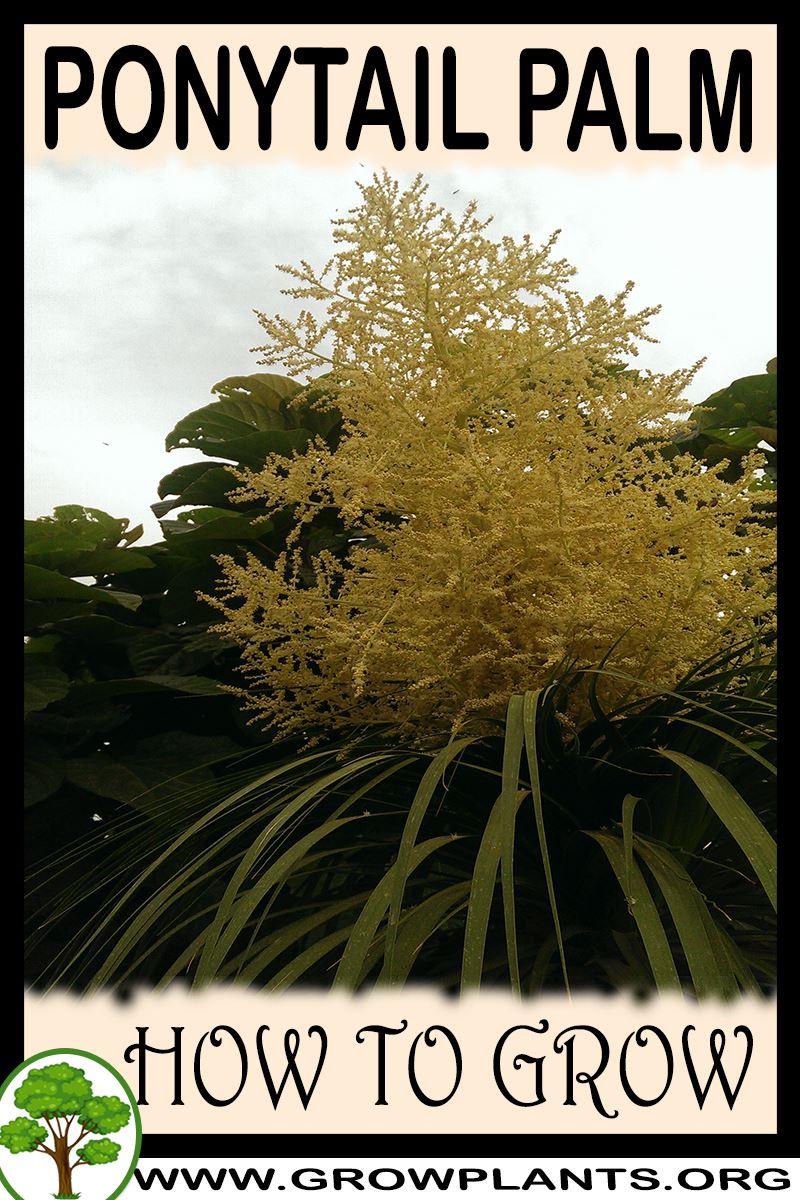
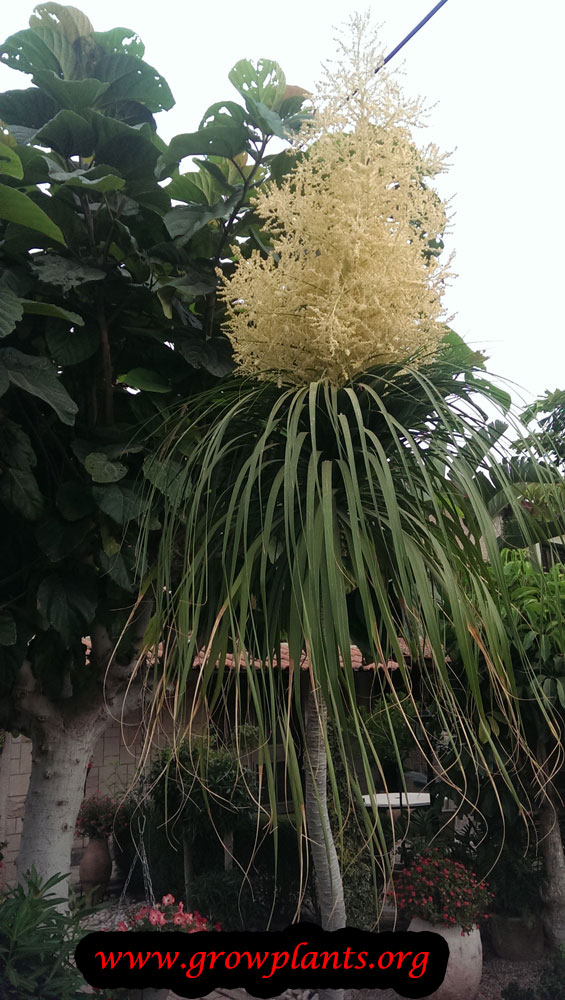
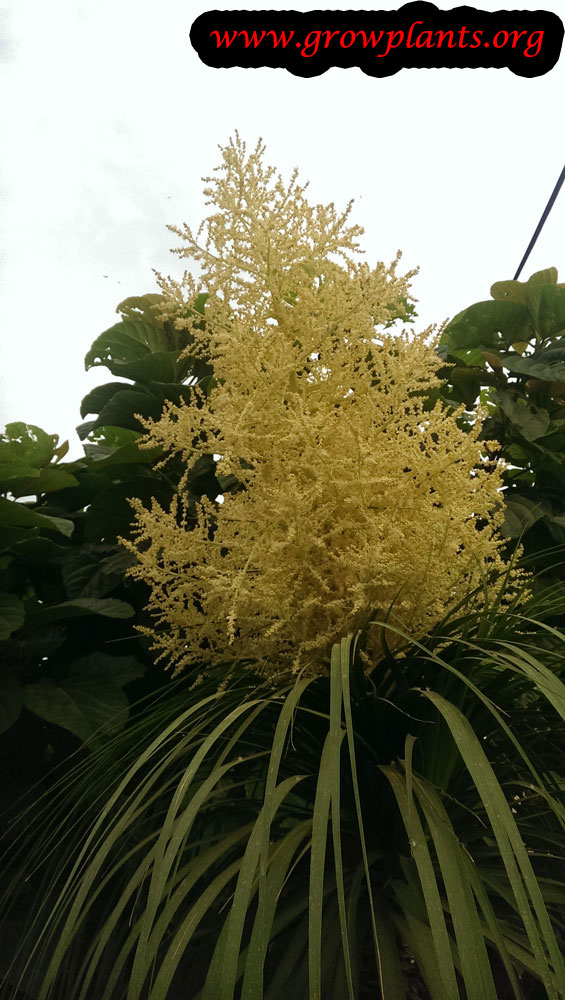
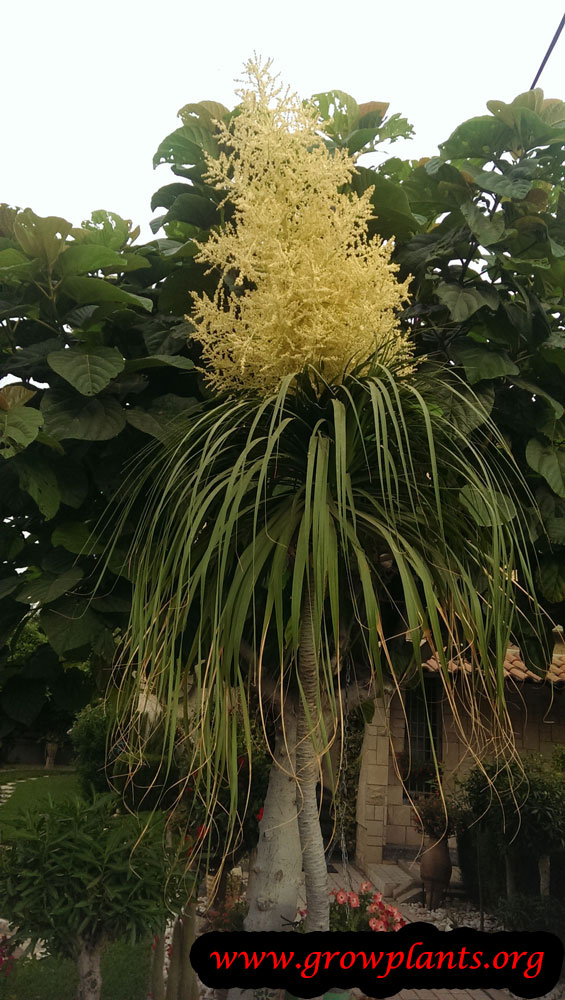
- Flower Characteristics: Small white-yellow or pink flowers in large plume-like clusters, produced only on mature plants (see the Bloom guide)
Primary Uses & Landscape Value
- Functional & Ornamental Roles: Drought-tolerant ornamental and sculptural houseplant or feature specimen
Care Guide: Planting, Soil & Watering
Overview: The ponytail palm (Beaucarnea recurvata) is a drought-tolerant succulent that stores water in its swollen trunk base and grows in full sun to shade in dry, sharply drained, sandy soil. It is best kept frost-free, needs only small amounts of water, and rots easily if the soil stays wet.
Quick Care Requirements
| Requirement | Ideal Condition |
|---|---|
| Planting Season | Year-round in frost-free climates; in cooler areas plant in spring |
| Growth Rate | Slow |
| Soil Type | Dry, sandy, very well-draining soil; best kept frost-free (though it can survive some frost) |
| Water Need | Low – water sparingly and let the soil dry out fully between waterings |
Planting & Establishment
- Best Planting Season: Plant year-round in frost-free climates; where winters are cold, plant in spring so it establishes before cool weather.
- How to Plant:
- Hole Preparation: Dig a hole about the size of the root ball in a hot, sharply drained position.
- Soil Amendments: Blend generous coarse sand or grit into the soil for fast drainage; rich organic matter is unnecessary.
- Planting Depth: Keep the swollen trunk base (caudex) at or slightly above soil level – never bury it, as buried tissue rots.
- Growth Speed & Expectations: Slow; the caudex and stalk build gradually over many years, ultimately to several metres.
Soil, Watering & Drainage Care
- Soil Mix & Drainage Needs: Use a gritty, very free-draining, sandy or cactus mix; in pots ensure ample drainage holes so the base never sits in water.
- Watering Schedule & Technique:
- Young / Newly Planted: Water lightly and infrequently, always letting the soil dry first.
- Established: Water deeply but rarely, allowing the soil to dry out completely between waterings; the trunk carries the plant through drought.
- Seasonal Adjustments: A little more in warm active growth; keep nearly dry through cool weather and winter.
Climate, Light & Hardiness
Ponytail palm is a caudex-forming succulent from desert, subtropical, and Mediterranean climates that grows best where winters stay frost-free. It tolerates everything from full sun to full shade, and while a mature plant can survive a brief light frost, cold is its main limiting factor.
Quick Climate Specifications
| Climate Zones | Desert, Subtropical, Mediterranean |
| USDA Hardiness Zones | Approximately 9–12 |
| Optimal Temp Range | Approximately 18–29°C (65–85°F) |
| Cold Damage Begins | Foliage and stem can be marked as temperatures approach freezing (around 0°C / 32°F) |
| Approx. Survival Minimum | Mature, established plants may briefly survive light frost a degree or two below freezing, but damage should be expected |
| Frost Tolerance | Low |
| Light Conditions | Full Sun / Half Shade / Full Shade |
Sunlight & Light Exposure
Optimal Light Setup
Very adaptable - it grows well anywhere from full sun to full shade, making it equally useful as an outdoor landscape specimen or a bright-room container plant.
Direct Sun Requirement
It tolerates strong direct sun once acclimated, but does not require it; indoors, a bright south- or west-facing window works well.
Shade & Heat Management
No special shading is needed - its light tolerance is broad, and its swollen water-storing base copes well with heat.
Best Exposure/Orientation
An open, bright exposure outdoors, or a sunny indoor window in climates too cold to grow it outside year-round.
Temperature Extremes & Hardiness
USDA Hardiness & Regional Limits
The site places it in hardiness zone 9–12, meaning it is best suited to frost-free or near-frost-free climates. Outside that range, it is commonly grown in containers and brought indoors for winter.
Cold Damage & Winter Protection
The plant grows best kept frost-free; a mature specimen can survive an occasional brief frost, but repeated or hard freezes cause damage or can kill it. Container culture with winter indoor protection is the practical solution in marginal climates.
Frost Sensitivity
Frost-sensitive overall - avoid exposing it to prolonged sub-freezing conditions.
Extreme Heat Tolerance
Excellent; as a drought-tolerant, water-storing succulent it thrives in hot desert and subtropical summers.
Wind, Humidity & Microclimate
Humidity Preferences
Tolerates both dry and average humidity levels; it does not need high humidity and prefers drier air over consistently damp conditions.
Dry-Air Tolerance
Very high - its swollen caudex base is an adaptation for surviving arid conditions.
Wind Tolerance
The sturdy, water-storing base generally copes well with moderate wind in the landscape.
Rainfall & Seasonal Moisture
Best suited to climates with a dry season and well-drained soil; in consistently wet climates it needs sharp drainage to avoid base rot.
Microclimate Recommendations
Choose an open, sunny site with excellent drainage; in marginal zones, a warm, sheltered wall position - or container culture that allows moving it indoors for winter - extends where it can be grown.
Growing in Pots, Balconies & Indoors
The ponytail palm (Beaucarnea recurvata) is a slow-growing succulent with a bulbous, water-storing base and a spray of arching leaves. The grower lists it as not-indoors, but it is in fact one of the easiest and most popular houseplants – very forgiving, pet-safe, and happy in a pot for years before it ever gets large. Give it as much light as you can.
Quick Details
- Container Size: A fairly snug pot – it likes to be a little pot-bound; size up slowly
- Indoor Suitability: An easy, long-lived houseplant in a bright spot
- Best Spot: Full sun to part shade; the brightest window indoors
- Soil & Drainage: Free-draining cactus/gritty mix – sharp drainage is key
- Watering in Pots: Sparingly – the swollen base stores water, so let the mix dry right out
Indoors & On the Windowsill
- As a houseplant: Although the grower marks it not-indoors, the ponytail palm is a classic, trouble-free houseplant. Stand it in your brightest spot; it tolerates less, but grows fastest and stays strongest in full light.
- Windowsill & young plants: Small plants suit a sunny sill; because it grows so slowly it stays room-sized for many years.
- Watering indoors: Water only when the mix has dried right out – with its water-storing base, under-watering is far safer than over-watering.
- Overwintering: Not frost-hardy – keep it indoors or bring it in before cold weather.
On a Balcony or Patio
- Light, heat & wind: It enjoys a warm, bright spot outdoors in the frost-free months; the pot dries fast in sun and reflected heat, so check it, but err on the dry side.
- Practicalities: Stand the pot on feet so water drains freely and does not pool on the balcony floor.
Choosing the Pot, Soil & Long-Term Care
- Pot & drainage: It prefers a snug pot; use strong drainage holes and no standing saucer. Terracotta breathes and dries fast, which suits its water-storing habit.
- Potting mix: A free-draining cactus/gritty mix, or a standard mix opened up with plenty of perlite, pumice or coarse sand.
- Feeding: Feed lightly once or twice through the growing season – it is a slow, undemanding plant.
- Repotting: Only every few years; it flowers and grows happily a little pot-bound, so do not over-pot.
Growing this plant in a greenhouse
A greenhouse can give ponytail palm frost protection, cold protection, humidity control and extra warmth.
Greenhouse at a glance
| Greenhouse suitability | Good - clearly useful |
|---|---|
| Main benefits | frost protection, cold protection, humidity control, extra warmth |
| Outdoor protection advisable below | about 2°C |
| Maintain greenhouse minimum | around 2°C for active growth |
| Suitable types | unheated greenhouse, polycarbonate greenhouse |
| Heating | Heating is optional - useful mainly for winter growing in cold areas. |
Related greenhouse guides
- Greenhouses: How to Choose the Right Greenhouse
- Polycarbonate Greenhouses: What to Look for Before Buying
- Greenhouse Climate Control: Temperature, Ventilation and Humidity
Fertilizing & Feeding
A very light feeder: despite the common name, this is a succulent, not a true palm – its swollen trunk base stores water and energy, so it thrives on lean feeding and can go a long stretch without fertilizer without any trouble.
Quick Fertilizing Specs
| Feeding Level | Light feeder |
|---|---|
| Main Nutrient Priority | A dilute, balanced feed applied sparingly; the water-storing trunk base means this plant rarely needs heavy feeding |
| Best Feeding Period | During the warm active growing season |
| Organic Options | A light top-dressing of compost worked into a fast-draining potting mix |
| Reduce/Stop Feeding | Taper off as growth slows in cooler, lower-light conditions |
| Micronutrients | Usually met by a complete fertilizer; correct only a diagnosed issue |
| Soil pH | Tolerates a wide range in a dry, well-drained mix |
Feeding by Growth Stage
Warm-season growth for a water-storing caudex succulent
Support slow trunk thickening and rosette leaf growth without pushing soft growth that this drought-adapted plant does not need.
| Nutrient direction | A light, balanced feed used sparingly suits this slow grower; its swollen trunk base already banks water and reserves. |
|---|---|
| Timing | During the warm growing season, easing off as light and temperature drop. |
| Frequency | Minimal feeding is usually enough; this is one of the lightest feeders among common succulent houseplants. |
| Fertilizer types | A dilute, balanced liquid fertilizer used sparingly, A light top-dressing of compost in a fast-draining mix |
| Precautions | Feed sparingly and let the mix dry between waterings; a plant that stores water in its trunk base is especially prone to rot if overfed or kept too moist. |
Cooler-season rest
Let this slow-growing succulent rest through the cooler part of the year without pushing tender new growth.
| Nutrient direction | None – withhold fertilizer while growth is slow or stopped. |
|---|---|
| Timing | During the cooler part of the year, when growth naturally slows. |
| Frequency | No feeding at this stage; resume only once active growth returns. |
| Fertilizer types | No feeding at this stage; do not fertilize until active growth resumes. |
| Precautions | Withhold fertilizer now; feeding a resting plant wastes nutrients and adds unnecessary stress heading into cooler weather. Its water-storing trunk base can draw on reserves through this slower period without any feeding. |
Nutrient Deficiency Signs & Corrections
Leaf color looks pale or washed out and growth, already slow for this succulent, becomes even slower over a full season.
| Possible causes | low available nitrogen in lean, well-drained soil that has gone unfed for a long time, nutrients leaching through fast-draining, sandy or gritty soil, general root stress from poor drainage or a waterlogged spot |
|---|---|
| Appears first on | older, lower leaves |
| What to check | how long since any feeding or soil amendment, drainage and soil texture around the root zone, overall plant vigor and leaf color |
| Possible correction | Apply a dilute, balanced or low-nitrogen fertilizer during the next active growing period and consider a light organic matter amendment. |
Leaf tips or margins brown and look scorched, especially on a container-grown plant.
| Possible causes | fertilizer salt buildup in a container with limited soil volume, feeding too often or too concentrated for this light-feeding succulent, poor drainage concentrating salts near the roots |
|---|---|
| Appears first on | leaf tips and margins |
| What to check | recent feeding frequency and strength, container or soil drainage and any visible salt crust on the surface, whether the plant is in-ground or containerized |
| Possible correction | Ease off feeding, water thoroughly to move accumulated salts through the drainage, then resume lighter feeding. |
Interveinal yellowing appears in older, lower leaves while newer growth keeps its normal color.
| Possible causes | magnesium deficiency on sandy, heavily leached soil, potassium excess from over-fertilizing interfering with magnesium uptake, general root stress from an overly wet or compacted mix |
|---|---|
| Appears first on | older leaves lower on the plant |
| What to check | whether yellowing is concentrated on older leaves, recent fertilizer history, especially high-potassium products, soil texture and drainage |
| Possible correction | Correct with a chelated or soluble magnesium product applied per its label, and review recent feeding for excess potassium. |
Pruning, Training & Seasonal Maintenance
Ponytail palm (Beaucarnea recurvata) is a slow-growing succulent with a swollen, water-storing trunk base topped by a rosette of spiny, spear-shaped leaves; despite the common name it is not a true palm, which matters for how it responds to pruning. Routine care is limited to removing dead leaves and spent flower stalks, which can be done any time of year. Because it grows so slowly and stores water in the trunk, it tolerates neglect far better than heavy cutting, and flowering takes many years to occur at all.
Quick Pruning & Maintenance Specs
| Pruning Tolerance | Low for routine care; the trunk itself can tolerate an occasional deliberate topping cut (see Heavy Pruning) |
| Primary Pruning Window | Any time (dead-leaf removal is not season-bound) |
| Typical Frequency | Ongoing, as leaves brown |
| Main Objective | Remove dead leaves and spent flower stalks; keep the rosette clean |
| Young Plant Priority | None – let the single rosette build the trunk’s water-storing base undisturbed |
| Mature Plant Priority | Dead-leaf and spent-flower removal; optional trunk-topping only if multi-head branching is deliberately wanted |
| Best Tool Type | Bypass secateurs for leaves; pruning saw only if deliberately topping the trunk |
| Avoid Heavy Pruning During | Winter / low-light, slow-growth periods, when recovery from any cut is slowest |
Pruning by Plant Age & Size
Newly Established
Leave the young rosette alone beyond removing clearly dead leaf tips; every green leaf is feeding the slow build-up of the water-storing trunk base.
Young / Formative
No structural training applies to a young single-head plant – there is nothing to shape. Multi-head, branched specimens sold in nurseries got that way either from natural age/damage or from a deliberate topping cut made years earlier, not from ongoing formative pruning.
Mature / Established
Routine care stays the same: remove dead leaves and old flower stalks. A grower who wants a branched, multi-head silhouette can choose to top the trunk at this stage (see Heavy Pruning & Rejuvenation); otherwise leave the single crown intact indefinitely.
Special Growth to Remove
Remove fully dead, brown leaves at their base; older leaves naturally droop and curl before dying, so distinguish a curling-but-still-green leaf (leave it) from a truly dead brown one (remove it). Cut out spent flower stalks once flowering has finished – a difficulties note in this plant’s own facts flags that it can take many years to bloom at all, so treat a bloom stalk as a rare event, not routine maintenance.
Container & Small-Space Pruning
Ponytail palm is a classic container and houseplant specimen. In a pot its slow growth rate already keeps it compact for years; leaf and spent-stalk removal is the only maintenance needed, and there is no pinching or heading technique used to control size the way there would be on a fast-growing shrub.
Tools
Bypass secateurs for dead-leaf removal, which are thin but can have a tough base. A pruning saw is only relevant if deliberately topping the trunk to force branching – not for routine maintenance.
Tool Hygiene & Disease Risk
Routine for leaf removal – clean, sharp tools are enough; the noted pests (weevil, snails, slugs) are not tool-transmitted. If deliberately topping the trunk, treat it as Increased risk: use a clean blade for that single large wound and let it callus in a dry, airy spot to avoid rot entering the water-storing tissue.
Cut Placement & Technique
Cut dead leaves close to their base rather than pulling them, which can strip live tissue at the attachment point. If topping the trunk, make one clean, level cut through the crown at the desired height.
Heavy Pruning & Rejuvenation
Unlike a true palm, which has a single growing point that dies if removed, Beaucarnea recurvata can be intentionally topped – cutting through the crown – and will typically respond by producing two or more new growing points (heads) below the cut, which is a known technique for creating a branched, multi-head specimen. This is an optional, cosmetic, one-time decision rather than routine maintenance: it leaves a visible scar, recovery is slow given the plant’s naturally slow growth rate, and it should only be done on an established plant with a well-developed trunk, not a young one still building its water-storing base.
Post-Pruning Care
After dead-leaf removal, no special aftercare is needed. After a deliberate topping cut, keep the plant on the dry side while the wound calluses, out of prolonged wet conditions that could invite rot into the trunk, and expect the new heads to take considerable time to emerge given this plant’s slow growth rate.
Common Pruning Mistakes
Cutting off leaves that are merely curling or drooping with age rather than actually dead, unnecessarily reducing the plant’s photosynthetic leaf surface; assuming it must be handled like a true palm and refusing to ever cut the crown, when a deliberate topping cut is in fact a legitimate technique for this species; topping the trunk in winter or low light when recovery is slowest.
When NOT to Prune
Avoid heavy leaf removal or any trunk-topping cut during winter or low-light periods when growth – and therefore recovery – is slowest. Avoid pruning immediately after repotting, when the plant is already under root stress.
Recommended Tools (by task)
- bypass_secateurs – routine removal of dead leaves and spent flower stalks at their base.
- pruning_saw – only for a deliberate, one-time topping cut through the trunk to force multi-head branching on a mature specimen.
Propagation Guide
Ponytail palm is most commonly raised from seed, which is straightforward and true to type, though it takes a long time to develop the plant’s signature swollen caudex. Removing and rooting a basal offset gives an instant, true-to-type plant with an established base already formed, and is the route used when that mature look is wanted sooner — overall a Moderate plant to propagate.
Quick Propagation Specs
| Best Propagation Method | Seed |
| Alternative Methods | Basal offsets/pups |
| Propagation Difficulty | Moderate |
| Seed True-to-Type | Yes |
| Vegetative True-to-Type | Yes, and it preserves the caudex form already developed on the parent |
| Best Propagation Season | Warm months; year-round in frost-free climates, otherwise spring |
Growing from Seed
Germination Conditions
Sow into a free-draining, sandy/succulent-type mix and keep it lightly moist, never soggy; germination is generally best in warm conditions, roughly 24–27°C (75–80°F).
Seedling Care
Grow young seedlings in bright light with careful, infrequent watering; the caudex base thickens gradually over years rather than in the seedling’s first season.
Division, Offsets, Pups & Suckers
Mature plants, especially multi-headed specimens or ones whose growing tip has been damaged or deliberately removed, will often produce basal offsets. Pups that emerge low, near the soil line, usually have their own root initials and can be separated with roots attached once large enough to handle. Offsets that form higher up the trunk (for example after topping a plant to force branching) generally lack their own roots at removal and should be treated as a cutting and rooted afterward in a free-draining mix, kept warm and only lightly watered until new roots are established.
Bloom & Flower Guide
Quick Details
- Bloom Season: Summer
- Time to First Bloom: Only on mature plants – often many years or decades old; it rarely flowers as an indoor pot plant
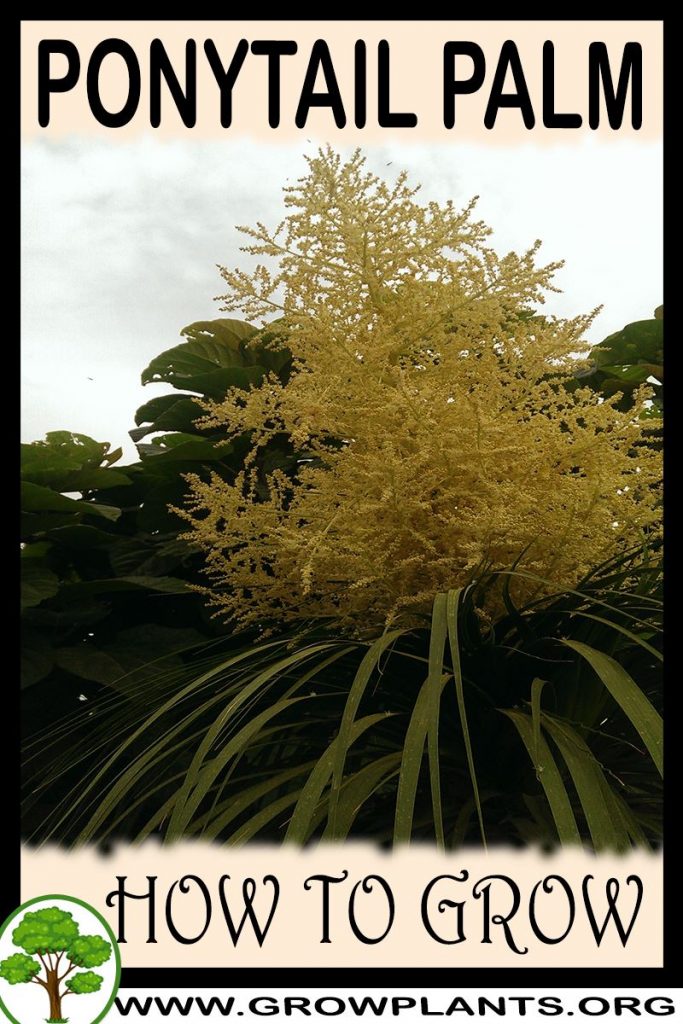
- Flower Appearance: A tall, branched plume of many tiny creamy white to pink flowers held above the foliage
- Edibility: Ornamental – not eaten; the plant is, however, non-toxic to cats and dogs
Detailed Blooming Overview
The ponytail palm is grown for its swollen, water-storing base and cascading foliage far more than for its flowers, which appear only on old, well-established plants. When it does bloom – most often on large specimens grown outdoors in warm climates – it sends up a tall, branched panicle crowded with tiny creamy flowers in summer. Plants are dioecious, so male and female flowers are borne on separate individuals.
Flower Characteristics
- Tiny individual flowers, creamy white to pink
- Massed by the hundreds into a tall, branched inflorescence above the leaf rosette
- Male and female flowers on separate plants (dioecious)
Bloom Care & Thinning
- What brings it on: Maturity, ample space for the roots, and bright light – indoor and young plants seldom bloom, and that is entirely normal.
- Aftercare: No thinning is needed; the spent flower stalk can simply be cut away once it fades.
- Pollination & seed: Insect-pollinated; because the plant is dioecious, both a male and a female are needed for viable seed.
Pests, Diseases & Troubleshooting
Overview: The ponytail palm (Beaucarnea recurvata) is a caudiciform succulent, not a true palm, and is one of the toughest, most drought-tolerant of houseplants; it is nearly pest-free and its one real killer is rot of the caudex and roots from overwatering. The few pests are indoor sap-suckers – mealybug, scale and spider mites – while brown leaf tips are almost always a watering, humidity or salt issue rather than disease. Keep it bright, warm and dry and it thrives on neglect.
Quick Troubleshooting Overview
| Issue / Pest | Main Symptom | Primary Solution |
|---|---|---|
| Overwatering rot (killer) | Soft, swollen or shrivelling caudex, wobbly base, yellowing | Stop watering, dry out, improve drainage; rescue firm top |
| Mealybugs | White cottony tufts among leaf bases | Alcohol swab, insecticidal soap/oil |
| Scale | Small brown bumps on leaves/stem | Scrape off, horticultural oil |
| Spider mites | Fine stippling and webbing on leaves in dry heat | Rinse, raise humidity, oil/soap |
| Brown leaf tips | Dry brown tips on the strappy leaves | Even watering, avoid salts/fluoride, raise humidity |
| Etiolation | Pale, stretched, floppy growth | More light |
Common Pests & Management
- Mealybugs (Pseudococcus spp.):
- Symptoms: White, cottony, waxy tufts tucked among the crowded leaf bases and in the crown, with sticky honeydew; growth slows and leaves yellow under heavy infestation.
- Prevention & Control: Dab colonies with a cotton bud of rubbing alcohol, rinse, and check the caudex crevices. Follow with insecticidal soap or horticultural oil into the leaf bases, and repeat to catch survivors; isolate infested plants.
- Scale insects (Coccidae / Diaspididae):
- Symptoms: Small brown or tan limpet-like bumps on the leaves and stem, sucking sap and causing yellow flecking and honeydew (soft scale).
- Prevention & Control: Scrape off with a fingernail or soft brush and apply horticultural oil to smother crawlers; repeat and monitor, as scale is easily reintroduced from other houseplants.
- Spider mites (Tetranychus urticae):
- Symptoms: Fine pale stippling and a dull look with faint webbing between the strappy leaves, appearing in hot, dry indoor air.
- Prevention & Control: Rinse the foliage, raise humidity, and improve airflow; treat with insecticidal soap or horticultural oil and repeat to break the cycle.
- Fungus gnats (Bradysia spp.):
- Symptoms: Small dark flies over the soil of an over-watered plant; a symptom of a too-wet mix more than a serious pest.
- Prevention & Control: Let the mix dry out thoroughly (which this plant wants anyway), use sticky traps, and apply Bti to the soil if needed; correcting watering usually solves it.
Diseases & Fungal Issues
- Caudex / stem and root rot (Pythium / Fusarium & bacteria):
- Symptoms: Soft, discoloured, sometimes foul-smelling tissue at the swollen base or roots, a wobbly or hollow-feeling caudex, and yellowing, collapsing leaves – the outcome of overwatering, cold-wet soil or poor drainage.
- Treatment & Management: Stop watering immediately and let the plant dry out. If rot is advanced, cut away all soft tissue back to firm, dry the wound, dust with fungicide or cinnamon, and re-root the healthy top in dry gritty mix; discard the rot and its soil.
- Leaf-tip fungal spotting (minor leaf-spot fungi):
- Symptoms: Occasional dark spots or blotches on the leaves in chronically damp, stagnant conditions; largely cosmetic and uncommon.
- Treatment & Management: Improve airflow, keep water off the foliage, and remove badly marked leaves; rarely needs fungicide.
Growing Difficulties & Abiotic Problems
- Overwatering rot (the main killer):
- Cause & Symptoms: The caudex stores water, so frequent watering – especially in low light, cold or a heavy mix – rots the base and roots and kills the plant.
- Correction Strategy: Use a gritty, free-draining cactus/succulent mix, water only when the soil is thoroughly dry (often every few weeks), and cut back sharply in winter. When unsure, do not water.
- Brown leaf tips:
- Cause & Symptoms: Dry, browning tips result from erratic watering (too dry then flooded), very dry air, or a build-up of salts, fluoride or chlorine from tap water and over-feeding.
- Correction Strategy: Water evenly (soak then dry), flush the pot occasionally with plain or rain water, ease off fertiliser, and raise humidity slightly; trim dead tips cosmetically.
- Etiolation:
- Cause & Symptoms: Insufficient light produces pale, thin, stretched, floppy leaves and a weak crown.
- Correction Strategy: Give bright light, including some direct sun; acclimatise gradually to avoid scorch.
- Cold damage:
- Cause & Symptoms: Exposure below its comfort range causes soft, discoloured, mushy tissue and predisposes the caudex to rot.
- Correction Strategy: Keep it warm and above about 10°C, and dry in winter; dry plants tolerate cool far better than wet ones.
What Helps – Products & Tools
This is a neglect-loving plant, so the main ‘tool’ is restraint with the watering can plus a gritty, free-draining mix. For the rare pest, rubbing alcohol, insecticidal soap and horticultural oil handle mealybug, scale and mites; sticky traps and Bti deal with fungus gnats from over-wet soil; and cinnamon or a fungicide aids rot surgery. Apply oils in the evening if the plant is ever outdoors near pollinators.