Plant Profile & Key Characteristics
Overview: A solitary, evergreen feather palm reaching 5-7 m (15-21 ft), grown mainly as an ornamental specimen and also for its edible fruit.
Quick Specifications
| Specification | Attribute |
|---|---|
| Plant Type / Life Cycle | Perennial (palm tree) |
| Foliage Type | Evergreen |
| Mature Size | 5-7 m tall (15-21 ft) |
| Growth Rate | Slow to Moderate |
| Root System | Fibrous (palm root system) |
| Toxicity | Non-toxic; fruit is edible |
| Hardiness | USDA zone 9+ |
Growth Form & Structure
- Height & Spread: 5-7 m (15-21 ft) in the ground; can be held for a time in a container but will not fruit well confined.
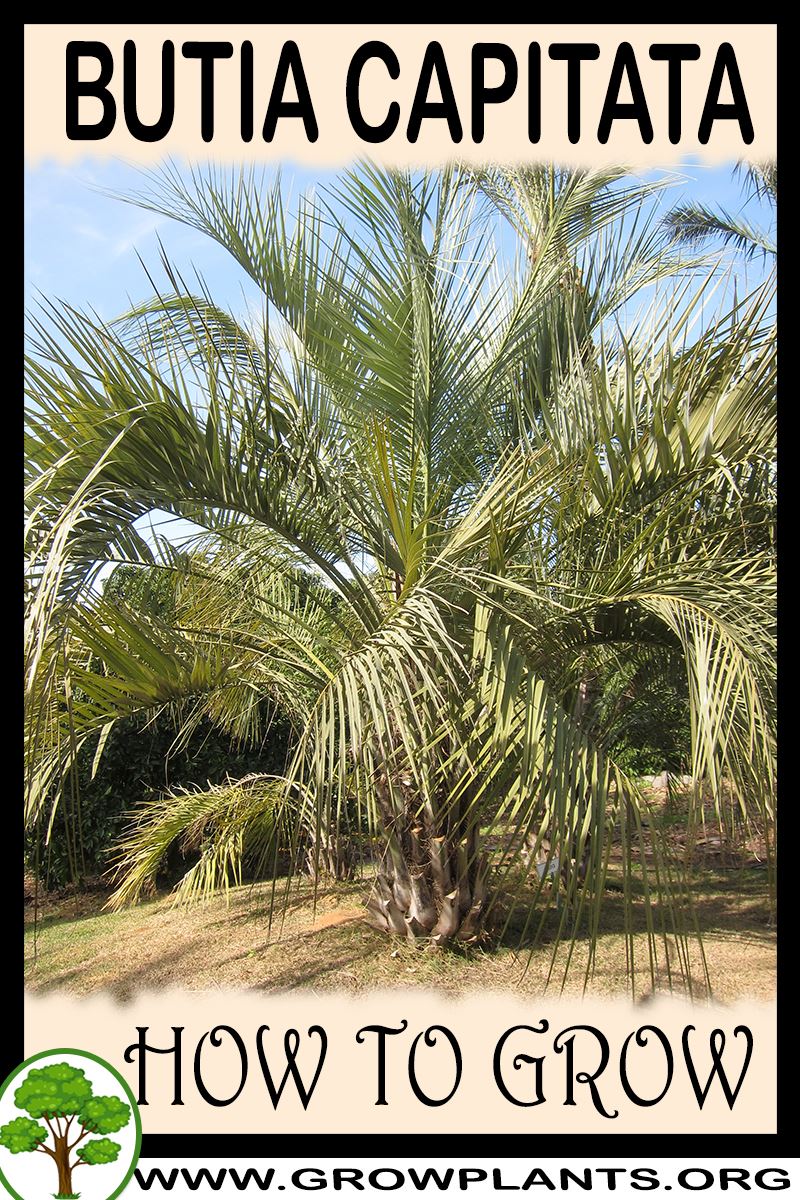
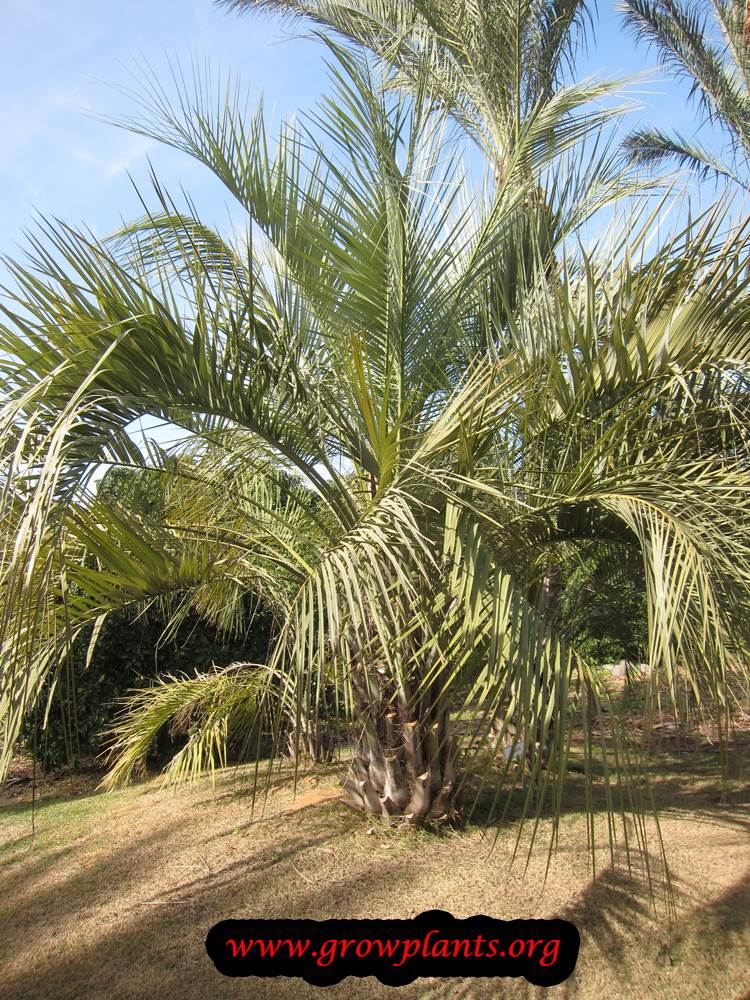
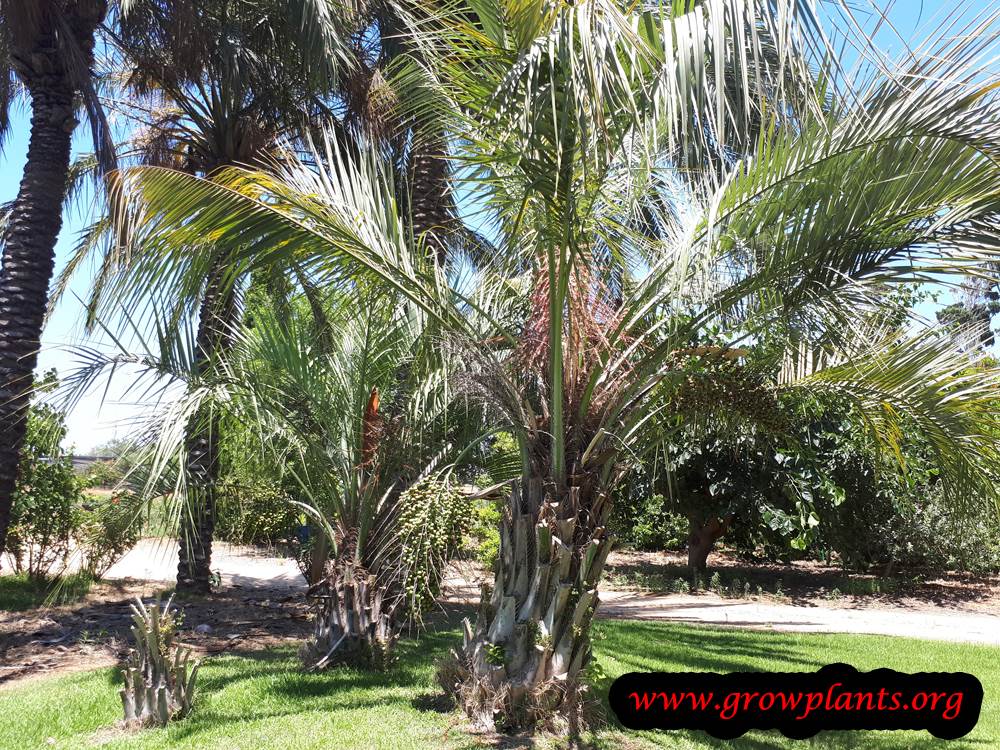
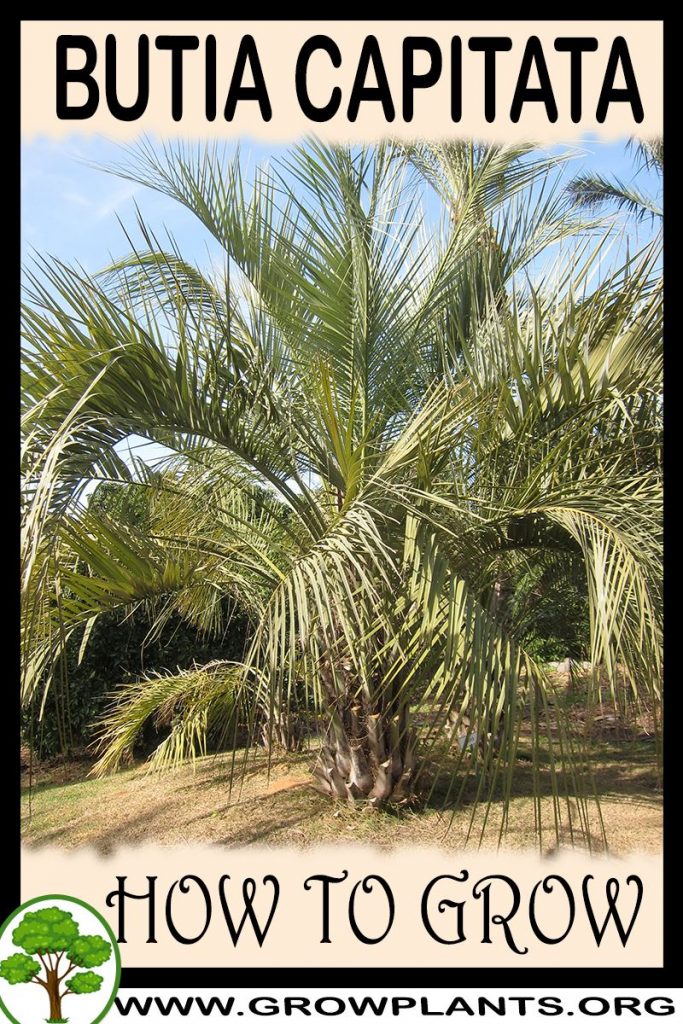
- Growth Habit & Form: Solitary feather palm with a stout trunk and an arching crown of pinnate fronds.
- Lifespan & Maturity: Slow-growing, long-lived palm that typically begins bearing fruit in about 3-4 years.
Anatomy & Physical Features
- Trunk & Bark: Single stout trunk, patterned with the persistent bases of old leaves.
- Leaves & Foliage: Long (1-3 m), arching, blue-green pinnate fronds with spiny leaf-stalk edges.
- Flower Characteristics: Yellow flowers borne in large branched inflorescences, wind-pollinated.
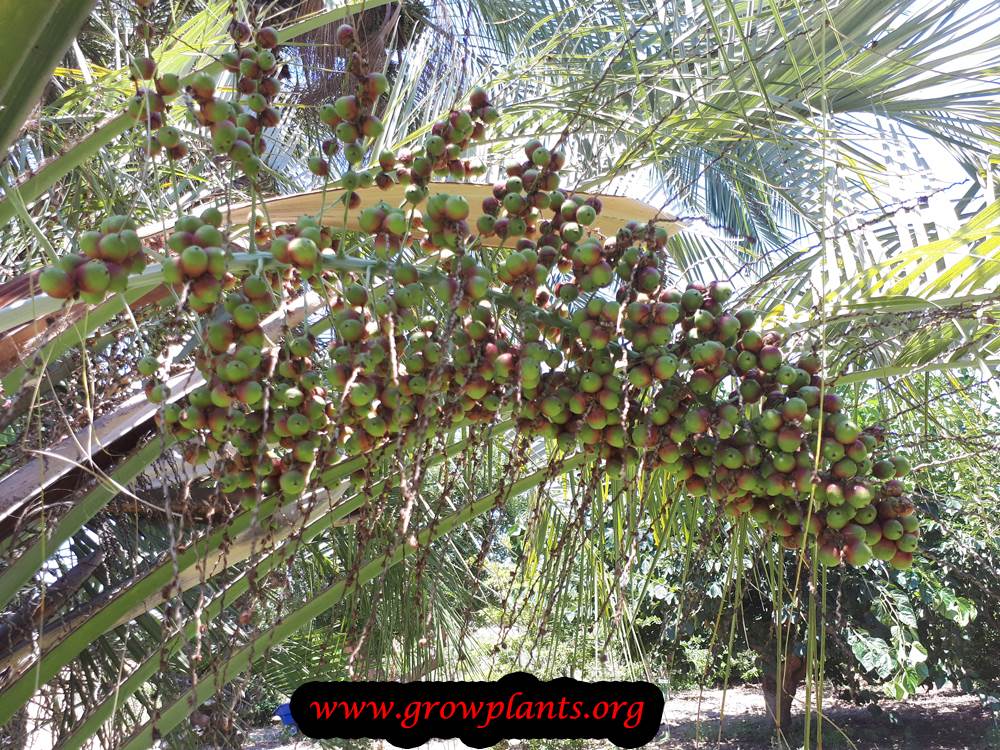
- Fruit Profile: Yellow, orange to reddish fruit with sweet-sour flesh, its flavour reminiscent of apricot, pineapple and banana.
Primary Uses & Landscape Value
- Edible Uses: Eaten raw and used for jam, juice, cakes; also dried or frozen.
- Functional & Ornamental Roles: Ornamental specimen and avenue palm, and a hardy edible-fruit palm.
Care Guide: Planting, Soil & Watering
Overview: A hardy, sun-loving feather palm for mediterranean, desert, subtropical and temperate gardens (hardiness zone 9+), taking cold down to roughly -8C. Give it a deep, free-draining soil and a moderate to generous supply of water.
Quick Care Requirements
| Requirement | Ideal Condition |
|---|---|
| Planting Season | Spring through autumn |
| Growth Rate | Slow to Moderate |
| Soil Type | Deep, free-draining |
| Water Need | Moderate to High |
Planting & Establishment
- Best Planting Season: Plant in the warm season, spring through autumn, so roots establish before winter cold.
- How to Plant:
- Hole Preparation: Dig a hole about twice the width of the root ball and no deeper, settling the palm at its original level in full sun.
- Soil Amendments: Improve heavy ground with grit and some organic matter so water drains freely around the roots.
- Planting Depth: Keep the base of the trunk at soil level – planting a palm too deep encourages rot.
- Growth Speed & Expectations: Slow to moderate; it takes several years to gain size and typically 3-4 years to begin fruiting.
Soil, Watering & Drainage Care
- Soil Mix & Drainage Needs: Deep, free-draining soil suits it best; standing water is the main risk, so open up heavy soils before planting.
- Watering Schedule & Technique:
- Young / Newly Planted: Water regularly and deeply through the first seasons to build a strong root system.
- Established: Once established water deeply but let the surface dry between waterings; it takes a moderate to generous supply.
- Seasonal Adjustments: Water more in summer heat and much less over cool, wet winters.
Climate, Light & Hardiness
Butia capitata (jelly palm) is an unusually cold-hardy feather palm suited to Mediterranean, desert, subtropical, and temperate climates, listed for USDA zone 9 and warmer. It demands full sun and, per the site's own care note, tolerates brief cold down to roughly −8°C (18°F) once established.
Quick Climate Specifications
| Climate Zones | Mediterranean, desert, subtropical, temperate |
|---|---|
| USDA Hardiness Zones | 9+ |
| Approx. Survival Minimum | Approximately −8°C (18°F) for an established plant, briefly |
| Frost Tolerance | Moderate |
| Light Conditions | Full sun |
Sunlight & Light Exposure
Optimal Light Setup
Requires full sun for healthy, compact growth.
Temperature Extremes & Hardiness
USDA Hardiness & Regional Limits
Notably cold-tolerant for a feather palm, suited to USDA zone 9 and warmer.
Cold Damage & Winter Protection
The trunk and crown of an established palm can briefly withstand temperatures down to around −8°C (18°F); younger, less-established palms should be considered more cold-sensitive than this figure suggests.
Frost Sensitivity
Occasional light frost is tolerated by mature specimens, but prolonged hard freezes go beyond its limits.
Growing in Pots, Balconies & Indoors
Butia capitata (jelly palm) is an ornamental, fruiting palm that reaches 5-7 m. The grower does not rate it as a houseplant. The grower says a container is possible, but this is a very large palm – a pot only works while it is young, and it will not crop well confined.
Quick Details
- Container Size: Container only while young – it is ultimately a very large palm and outgrows any pot
- Indoor Suitability: Not a houseplant – far too large; a young plant can sit in a bright spot only briefly
- Best Spot: Full sun
- Soil & Drainage: Free-draining mix while young in a pot
- Watering in Pots: Keep a potted young palm’s mix moist – pots dry fast in sun; never waterlogged
Indoors & On the Windowsill
- Houseplant limits: The grower marks it as not a houseplant. It grows into a 5-7 m palm and needs full sun, so it cannot be kept as an indoor plant beyond the seedling stage.
- While young: A young plant may live in a large pot in a bright, sunny position for a few years, but it must eventually go into open ground.
On a Balcony or Patio
- Light & weight: While young it can stand on a sunny balcony or patio in a large, heavy, well-drained pot; pots dry fast in sun, so water often, and account for the considerable weight.
- Long term: As it grows it becomes too tall and heavy for a balcony and needs planting out.
Choosing the Pot, Soil & Long-Term Care
- Pot & drainage: A large pot with strong drainage holes for a young plant; empty any standing saucer so the roots never sit in water and rot.
- Potting mix: Well-aerated, free-draining mix – a good potting mix, or peat/coir blended with perlite or vermiculite and some organic matter.
- Feeding: Potted plants use up nutrients faster because watering leaches them out, so feed a little more often than plants in open ground; a potted palm benefits from a palm-suitable feed in the growing season.
- Moving on: Pot up as it grows and plan to plant it in open ground before it becomes root-bound and top-heavy.
Fertilizing & Feeding
A moderate feeder: this cold-hardy, medium-to-slow-growing ornamental palm bears sweet, edible fruit, so steady but not heavy feeding with a palm-formulated product supports both frond health and fruit production.
Quick Fertilizing Specs
| Feeding Level | Moderate feeder |
|---|---|
| Main Nutrient Priority | A balanced palm-formulated fertilizer with potassium and magnesium supports this cold-hardy, fruit-bearing palm’s canopy and fruit production |
| Best Feeding Period | Through the warm growing season |
| Organic Options | Organic matter worked into the root zone at planting |
| Reduce/Stop Feeding | Feeding eases off as growth slows in cooler months |
| Micronutrients | A palm-formulated fertilizer that includes manganese and magnesium as routine trace nutrients supports healthy fronds |
| Soil pH | Tolerates a range of well-drained soil |
Feeding by Growth Stage
Establishment after planting
Help a newly planted jelly palm establish its root system before it settles into steady, moderate growth.
| Nutrient direction | A balanced fertilizer supports root establishment without pushing excessive top growth in this moderate-to-slow-growing palm. |
|---|---|
| Timing | At planting, during the warm growing season. |
| Frequency | A light feeding at planting is usually enough while roots establish. |
| Fertilizer types | A balanced complete fertilizer, Organic matter worked into the planting area |
| Precautions | Keep young plantings watered consistently through establishment, and avoid crowding since this palm can naturalize and spread if fallen fruit is left uncollected. |
Established growth and fruiting
Support this jelly palm’s canopy and its sweet, aromatic fruit once it is established and bearing.
| Nutrient direction | A balanced palm fertilizer with potassium and magnesium supports healthy fronds and fruit development; routine manganese and magnesium in a complete palm product help prevent the frond problems palms are prone to. |
|---|---|
| Timing | Through the warm growing season, once the palm is established. |
| Frequency | Regular feeding through the growing season suits this moderate feeder. |
| Fertilizer types | A palm-formulated fertilizer with potassium and magnesium, Organic matter as a root-zone top-dressing |
| Routine trace nutrients | manganese, magnesium |
| Precautions | Collect fallen fruit promptly since this palm can naturalize where fruit is left on the ground, and avoid crowding new plantings nearby. |
Nutrient Deficiency Signs & Corrections
Older, lower fronds show yellow-to-orange spotting and necrotic leaflet tips.
| Possible causes | low soil potassium, common in palms grown without a palm-formulated fertilizer, sandy or fast-draining soil that leaches potassium, competing nutrient demand from fruit development |
|---|---|
| Appears first on | oldest fronds |
| What to check | recent fertilizer type and whether it is palm-formulated, frond age pattern of symptoms, soil drainage |
| Possible correction | Switch to a palm-formulated fertilizer supplying potassium and magnesium, applied per its label. |
New emerging fronds appear frizzled, weak, or discolored.
| Possible causes | low soil manganese, especially in high-pH or poorly drained soil, a fertilizer program lacking routine manganese, root stress limiting nutrient uptake |
|---|---|
| Appears first on | newest emerging fronds |
| What to check | soil pH and drainage, fertilizer history for manganese content, overall root and trunk health |
| Possible correction | Apply a chelated manganese product per its label and switch to a complete palm fertilizer that includes manganese. |
Older fronds show broad yellow banding along the margins while the center of the leaflet stays green.
| Possible causes | low soil magnesium, leaching from regular watering, heavier potassium feeding without balancing magnesium |
|---|---|
| Appears first on | oldest fronds |
| What to check | frond banding pattern, recent fertilizer balance, soil magnesium status |
| Possible correction | Apply a labeled magnesium source and use a palm fertilizer that carries magnesium as a routine component. |
Pruning, Training & Seasonal Maintenance
Butia capitata is a solitary, single-growing-point palm that tolerates almost no pruning beyond removing fully dead fronds – cutting living green fronds permanently reduces the crown’s photosynthetic capacity and, because there is only one growing point, can weaken or kill the palm rather than trigger new growth. The main objective is sanitation, not shaping. The recorded safe window is autumn, though a clearly dead, fully brown frond can be removed for safety at any time. Pruning here has no effect on flowering or fruiting except for tidying spent fruit stalks after harvest.
Quick Pruning & Maintenance Specs
| Pruning Tolerance | Low – sanitation only |
| Primary Pruning Window | Autumn |
| Typical Frequency | As needed, once or twice a year as fronds fully die |
| Main Objective | Remove dead material only; protect the single crown |
| Young Plant Priority | Do not remove any green fronds – young palms need maximum leaf area to build trunk and root reserves |
| Mature Plant Priority | Remove only fully dead fronds and spent fruit stalks; leave frond-base stubs on the trunk |
| Best Tool Type | Pruning saw / pole pruner for reach on taller specimens |
| Avoid Heavy Pruning During | Shortly after a cold event, and any structural or green-frond removal at any time |
Pruning by Plant Age & Size
Newly Established
Remove only obviously dead, fully brown fronds. Do not thin or tidy a young palm for appearance – every green frond is contributing to building the trunk and root system.
Young / Formative
No structural training applies to a single-trunk, single-crown palm; the only intervention is dead-material sanitation.
Mature / Established
Continue removing only dead fronds, leaving the fibrous leaf-base stub attached – this stub protects the trunk tissue beneath it, which matters particularly at the cooler edge of this species’ range (hardy to roughly -8°C/18°F) where trunk insulation helps against frost. After a cold snap, wait for new spring growth before removing frost-stressed fronds, since a frond that looks damaged may still be alive and contributing reserves.
Special Growth to Remove
- Fully dead, brown fronds – remove leaving the base stub intact.
- Spent flower/fruit stalks once fruiting has finished, if desired for tidiness; picking the fruit itself becomes harder as the palm gains height, so periodic stalk cleanup is mainly a ground-level, younger-tree task.
Container & Small-Space Pruning
Container culture is possible but the palm rarely fruits well when confined and outgrows most pots; no special container pruning practice is warranted beyond the same dead-frond-only rule.
Tools
- Pruning saw – for the fibrous, tough frond bases near the trunk.
- Pole pruner – for fronds out of reach once the palm approaches its mature 5–7m height.
Tool Hygiene & Disease Risk
Increased risk. This species is a known host of the red palm weevil (Rhynchophorus ferrugineus), and pruning wounds are a documented entry point for this pest. Minimize the number of cuts, avoid unnecessary wounding, and where red palm weevil is active locally, disinfect blades between palms as a precaution.
Cut Placement & Technique
Cut the frond well out from the trunk, leaving the base stub rather than stripping it flush – a flush cut removes the trunk’s natural protective boot and creates a larger wound near living trunk tissue. Never cut into or damage the crown/growing point at the top.
Heavy Pruning & Rejuvenation
Not tolerated. This palm has one growing point and cannot resprout from old wood; heavy or repeated removal of green fronds (an over-pruned "hurricane cut" look) permanently reduces vigor and can be fatal.
Post-Pruning Care
Water normally; no feeding is tied to pruning. Monitor cut stubs for boring holes, frass or discoloration that could indicate weevil activity.
Common Pruning Mistakes
- Over-pruning to a tidy "pineapple" look by removing green fronds.
- Flush-cutting frond bases and stripping the protective trunk boot.
- Removing frost-damaged fronds before confirming they are actually dead.
When NOT to Prune
- Do not remove any green, living frond regardless of season.
- Avoid pruning immediately after a cold event – wait for spring regrowth to assess true damage.
Pruning Troubleshooting
| Problem | Possible Cause | What to Check | Corrective Action |
| Thin, reduced crown / stunted growth | Habitual over-removal of green fronds | Frond count and pruning history | Stop all green-frond removal; allow the crown to rebuild over seasons |
| Wilting or collapse of the new spear leaf | Possible red palm weevil boring, often via pruning wounds | Crown for holes, frass, foul odor | Contact an arborist/pest professional promptly; avoid further crown cuts |
| Rot developing at a cut frond base | Flush cut removed the protective stub, exposing tissue | Condition of the cut surface | On future cuts, leave the base stub intact |
Recommended Tools (by task)
- pruning_saw – tough, fibrous frond bases close to the trunk.
- pole_pruner – reaching fronds once the palm nears its mature height.
- blade_disinfectant – reduces the chance of spreading red palm weevil or pathogens between palms via wounded cuts.
Propagation Guide
Butia capitata is propagated primarily from seed. Routine propagation by suckers, pups, division, stem cuttings or leaf cuttings is not appropriate for this solitary palm.
Quick Propagation Specs
| Primary Method | Seed |
| Offshoots / Suckers | Not a routine method for this solitary palm |
| Stem or Leaf Cuttings | Not recommended |
Growing from Seed
Use mature, viable seed. Remove fleshy fruit material where present, clean the seed, and sow it in a clean, well-drained propagation medium. Keep the medium evenly moist but not waterlogged and provide warm conditions while germination and early root growth occur.
Seedling Care
Move seedlings carefully once they are established, protect young roots from damage, and increase light gradually as the young palm develops.
Bloom & Flower Guide
Quick Details
- Bloom Season: Summer
- Time to First Bloom: Only once the palm matures, typically after several years
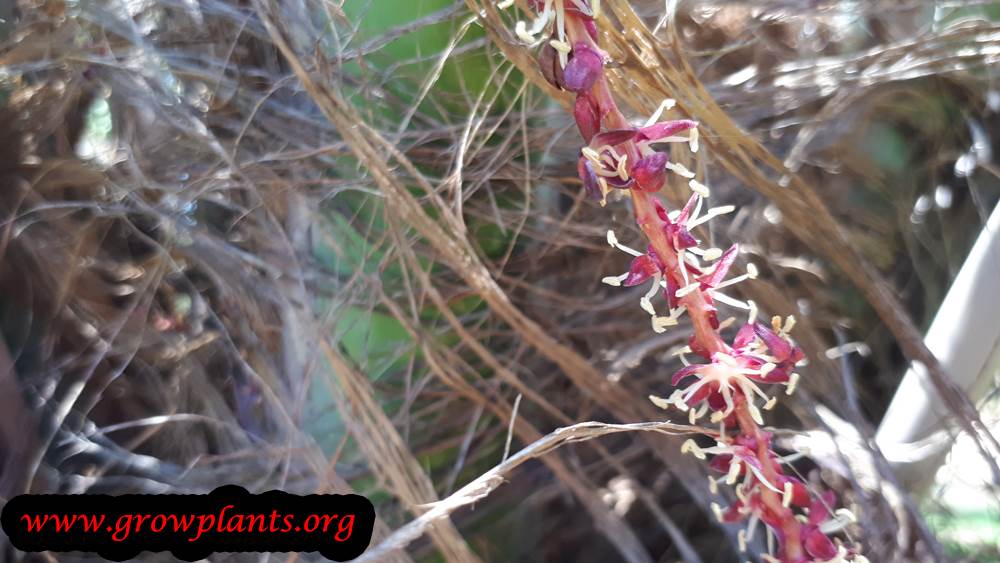
- Flower Appearance: Many small yellow flowers on a large branched cluster that emerges from a woody sheath
- Edibility: The flowers themselves are not eaten
Detailed Blooming Overview
The jelly palm flowers in summer, once it has grown to maturity – a process that takes several years. Each bloom cluster is a large, branched inflorescence carrying dozens of small yellow flowers, and it emerges dramatically from a woody protective sheath (a spathe). It is very much an ornamental event rather than a harvest of the flowers.
Flower Characteristics
- Many small yellow flowers borne on a large branched flower cluster (inflorescence).
- The whole cluster emerges from a woody sheath, or spathe.
Bloom Care & Thinning
- Managing the bloom: No thinning is needed; the display looks after itself.
- Pollination: Pollinated largely by wind, with insects also visiting the open flowers.
Fruit & Uses
Butia capitata (Jelly Palm) is grown for its edible fruit, eaten raw or processed into preserves and drinks. The ripe fruit is soft enough to eat straight off the palm, with no preparation required beyond removing the seed.
Quick Edible Specs
| Edible Parts | Fruit |
| Main Use(s) | Culinary – fresh eating, jelly/jam, juice, baking, frozen treats |
| Eaten Raw or Cooked | Raw (also cooked into jam/preserves) |
| Preparation Required | Deseed; ripe fruit can be eaten as-is otherwise |
| Harvest Season | Autumn |
| Time to First Harvest | Several years from planting; fruit is easier to pick while the palm is still young and low |
| Storage | Fresh fruit is short-lived; keeps longer dried, frozen, or made into jam/juice |
| Safety/Toxicity Caveat | None noted – only the fibrous seed is inedible |
Fruit
The fruit is yellow, orange, or reddish when ripe, with a sweet-and-sour flavor often compared to apricot, pineapple, or banana – the basis for the palm’s common name, Jelly Palm. Fruit is ready to pick in autumn. Because the crown grows taller each year, harvesting is easiest while the palm is young; on mature, tall specimens picking becomes harder and fallen fruit is often gathered instead. Birds and bats will also take fruit, so timely harvest helps reduce losses.
Preparation, Uses & Safety
Fruit is eaten fresh out of hand, or processed into jelly/jam (its best-known use), juice, baked goods, and frozen desserts; it can also be dried for longer storage. No toxicity is noted for the flesh – only the hard central seed is discarded.
Pests, Diseases & Troubleshooting
Overview: Jelly palm is a hardy, generally robust feather palm, but like all palms its serious threats are boring and rotting organisms – above all the red palm weevil and the incurable Ganoderma butt rot – alongside sap-sucking scale and mites, and nutrient deficiencies that show up as distorted or discoloured fronds. Most trouble is prevented by clean pruning, balanced palm nutrition, and vigilance for weevil entry.
Quick Troubleshooting Overview
| Issue / Pest | Main Symptom | Primary Solution |
|---|---|---|
| Red palm weevil | Wilting crown, chewed tunnels, oozing, frond collapse | Monitor/trap, systemic drench, remove infested palms |
| Scale insects | Bumps on fronds, yellowing, honeydew, sooty mould | Horticultural oil, prune, beneficials |
| Palm leaf skeletonizer | Frass tubes and browned, skeletonised fronds | Remove frass, Bt or spinosad |
| Spider mites | Stippling and webbing on fronds in dry heat | Hose off, oil/soap, raise humidity |
| Ganoderma butt rot | Conks at trunk base, general decline, wilting | No cure – remove palm and stump, do not replant palm |
| K / Mn deficiency | Frond discolouration, frizzled or spotted leaves | Correct palm fertiliser with K and Mn |
Common Pests & Management
- Red palm weevil (Rhynchophorus ferrugineus):
- Symptoms: The most dangerous pest of palms in warm regions: a large rusty-red snout beetle whose grubs tunnel through the crown and trunk. Early signs are wilting or collapsing central fronds, chewed fibrous tunnels, oozing fermented-smelling sap, and gnawing sounds inside; by the time the crown falls the palm is usually dead.
- Prevention & Control: Monitor with pheromone traps and inspect the crown regularly. Avoid unnecessary wounding and prune only in dry, cool conditions, sealing cuts, since fresh wounds attract egg-laying females. Apply preventive systemic or crown-drench treatments where the weevil is present, and report and remove/destroy infested palms promptly to protect nearby palms.
- Scale insects (armoured & soft scale, incl. Diaspis boisduvalii):
- Symptoms: Brown, grey, or white bumps and encrustations along frond midribs and undersides, with yellowing, honeydew and sooty mould from soft-scale species.
- Prevention & Control: Prune out heavily encrusted fronds, wash foliage, and spray horticultural oil to smother the insects, covering undersides and repeating. Conserve ladybirds and parasitic wasps that keep scale in check.
- Palm leaf skeletonizer (Homaledra sabalella):
- Symptoms: Fronds covered with tubes of frass (silk-and-droppings webbing) under which caterpillars graze the leaf surface, leaving brown, skeletonised, papery patches.
- Prevention & Control: Brush or wash away the frass tubes and remove badly affected fronds. Treat active larvae with Bacillus thuringiensis (Bt) or spinosad, targeting the feeding areas.
- Palm aphid & mealybugs (Cerataphis / Pseudococcus spp.):
- Symptoms: Palm aphids form dark, disc-like colonies on new fronds and flower stalks; mealybugs make white cottony tufts. Both leave honeydew and sooty mould.
- Prevention & Control: Hose off, wipe, and treat with insecticidal soap or horticultural oil; keep ants (which farm them) away from the trunk with barriers.
- Spider mites (Tetranychus spp.):
- Symptoms: Fine yellow stippling and a dusty, bronzed look to fronds with faint webbing, mainly on young or container palms in hot, dry, dusty conditions.
- Prevention & Control: Raise humidity and hose down fronds; treat with horticultural oil or insecticidal soap on undersides, repeating as needed.
Diseases & Fungal Issues
- Ganoderma butt rot (Ganoderma zonatum):
- Symptoms: A lethal trunk rot: older fronds wilt and droop, the palm declines, and shelf-like (conk) brackets – white then reddish-brown and varnished – form on the lower trunk. Internal trunk wood rots away.
- Treatment & Management: There is no cure and no effective fungicide. Remove and destroy the palm and as much of the stump and root as possible, and do not replant a palm in the same spot, as the fungus persists in the soil. Avoid trunk wounds, which create entry points.
- Bud / heart rot (Phytophthora / Thielaviopsis):
- Symptoms: The newest spear leaf discolours, wilts and pulls out easily with a foul smell, following prolonged wet, cold conditions or crown injury.
- Treatment & Management: Improve drainage and avoid water sitting in the crown; drench the bud with copper or a phosphonate fungicide at first signs. A palm that has lost its single growing point cannot recover.
- Leaf spots & false smut (Graphiola, Pestalotiopsis):
- Symptoms: Small brown, black or yellow-ringed spots on fronds, or the raised black wart-like fruiting bodies of Graphiola false smut in humid climates – usually cosmetic.
- Treatment & Management: Improve airflow, avoid overhead watering, and remove severely spotted fronds. Copper fungicide helps where spotting is heavy; keep the palm well-nourished to shrug off minor infections.
- Fusarium wilt (Fusarium oxysporum):
- Symptoms: One-sided frond death with a reddish-brown streak along the frond stalk (rachis); leaflets brown on one side of the midrib.
- Treatment & Management: There is no cure. Prune with sterilised tools (disinfect between palms), avoid spreading via contaminated blades or transplants, and remove severely affected palms.
Growing Difficulties & Abiotic Problems
- Potassium deficiency:
- Cause & Symptoms: Very common in palms: older fronds develop translucent yellow-orange flecking, then necrotic, frizzled, scorched leaflet tips while newer growth stays greener.
- Correction Strategy: Apply a controlled-release palm fertiliser with a high, balanced potassium content plus magnesium; correction is slow and must be sustained. Do not simply remove discoloured fronds – the palm reabsorbs nutrients from them.
- Manganese deficiency (‘frizzletop’):
- Cause & Symptoms: New fronds emerge weak, yellow, withered and frizzled with necrotic streaking, in alkaline or cold, waterlogged soils.
- Correction Strategy: Apply manganese sulphate to soil or as a foliar feed and correct high soil pH; act early, as severe cases kill the growing point.
- Cold / frost damage:
- Cause & Symptoms: Frond browning and spotting after hard freezes; though jelly palm is one of the hardier feather palms, extreme cold burns foliage and can rot the bud.
- Correction Strategy: Protect the crown in severe cold, avoid overhead water before freezes, and delay pruning damaged fronds until spring growth confirms what survived.
- Boron & nutrient imbalance:
- Cause & Symptoms: Deformed, crumpled or hook-tipped new leaves and multiple unopened spears from boron deficiency, common in leached or over-limed soils.
- Correction Strategy: Feed with a complete palm fertiliser containing micronutrients; correct boron cautiously, as the margin between deficiency and toxicity is narrow.
What Helps – Products & Tools
The essentials here are pheromone traps and, where the weevil is active, systemic or crown-drench insecticide for red palm weevil; horticultural oil and insecticidal soap for scale, mites, aphids and mealybugs; Bt or spinosad for skeletonizer and caterpillars; copper fungicide for leaf spots and bud rot; and – crucially – a complete controlled-release palm fertiliser (with K, Mg, Mn and boron) to prevent the deficiencies that disfigure palms.