

Plant Profile & Key Characteristics
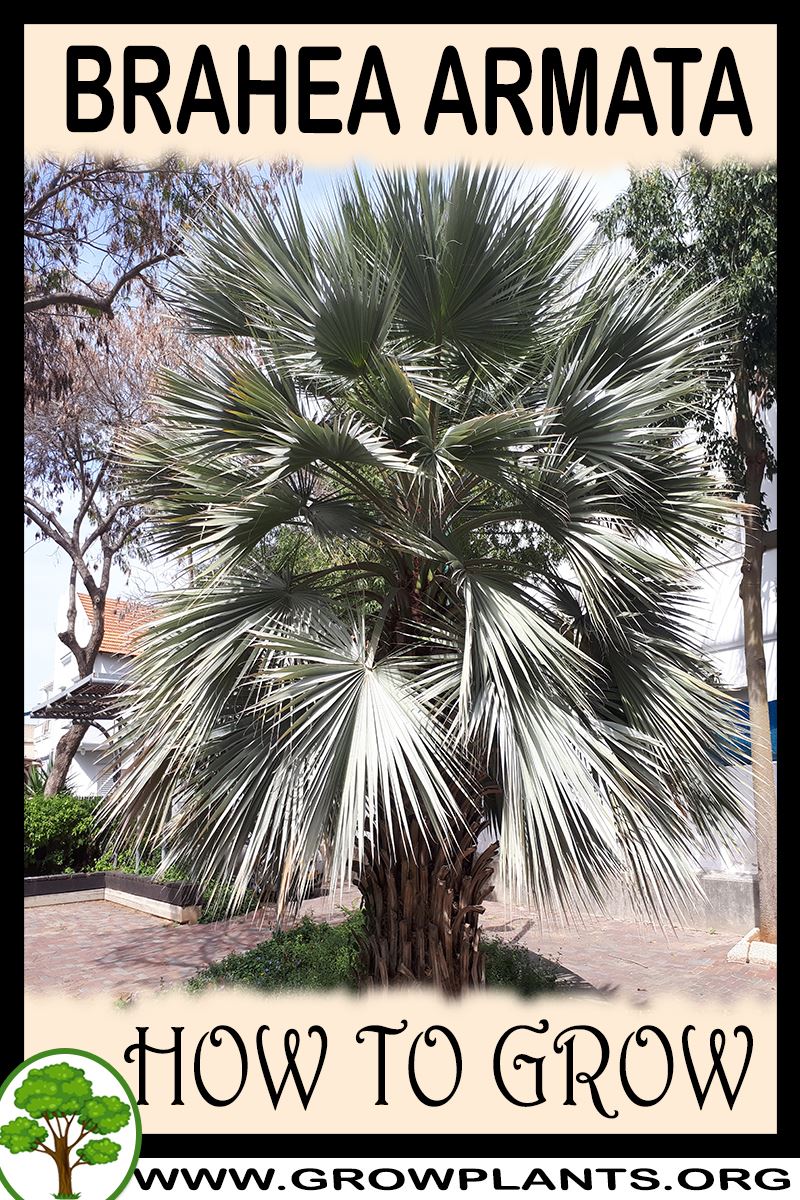
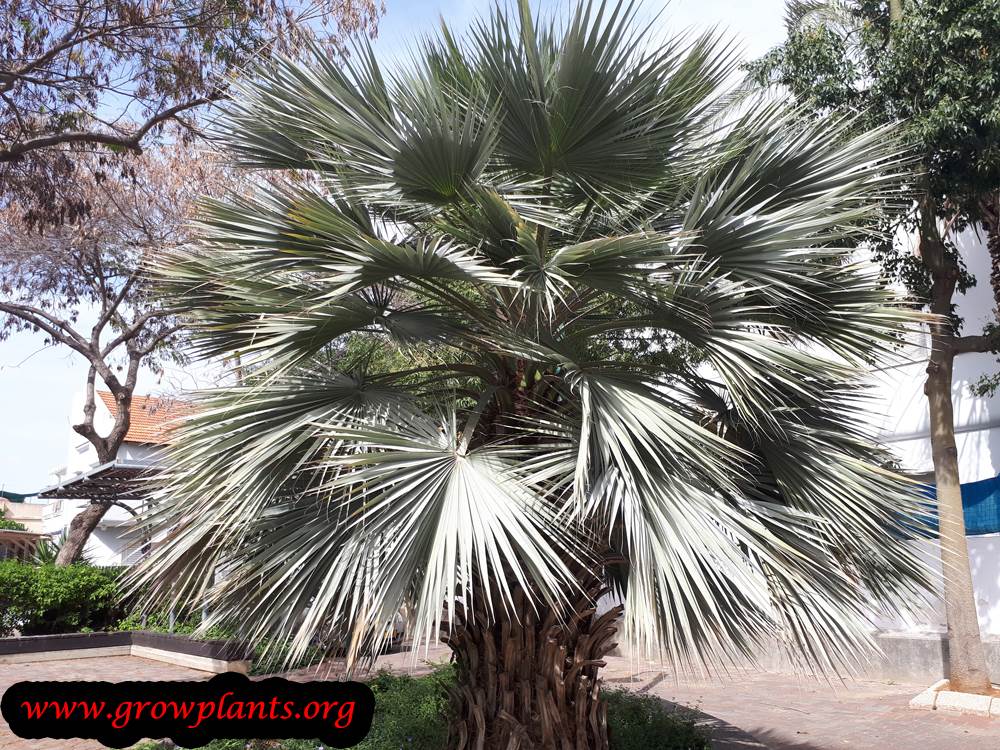
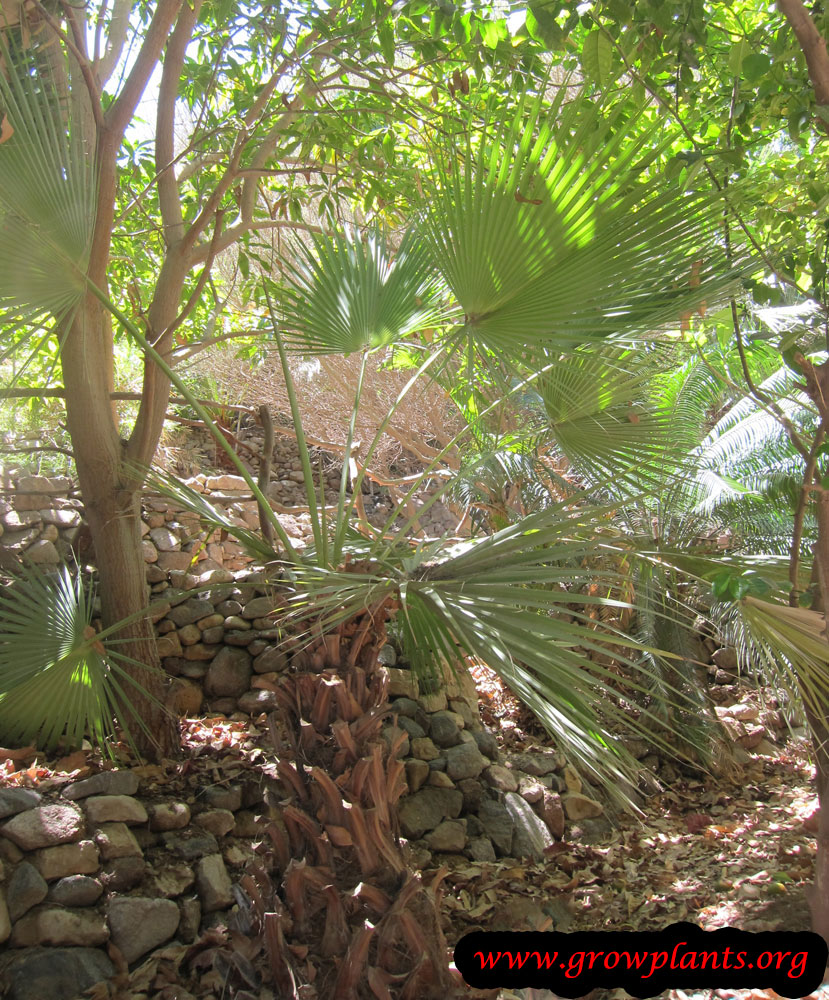
Overview: Brahea armata (Mexican blue palm) is a perennial evergreen fan palm, about 10-15 m tall, grown as an ornamental in tropical, mediterranean, desert, subtropical and temperate climates. It is prized for its silvery blue-grey fronds and dramatically long, arching flower stalks.
Quick Specifications
| Specification | Attribute |
|---|---|
| Plant Type / Life Cycle | Perennial (palm tree) |
| Foliage Type | Evergreen |
| Mature Size | 10-15 m tall (30-45 ft) |
| Growth Rate | Moderate |
| Root System | Fibrous, non-invasive (typical palm root system) |
| Hardiness | USDA zones 9-11 |
Growth Form & Structure
- Height & Spread: 10-15 m (30-45 ft) in the ground; can be container-grown only while young.
- Growth Habit & Form: Solitary fan palm with a single stout trunk topped by a rounded crown of costapalmate fronds.
- Lifespan & Maturity: Long-lived palm; slow to moderate to reach full height. Never cut the growing top.
Anatomy & Physical Features
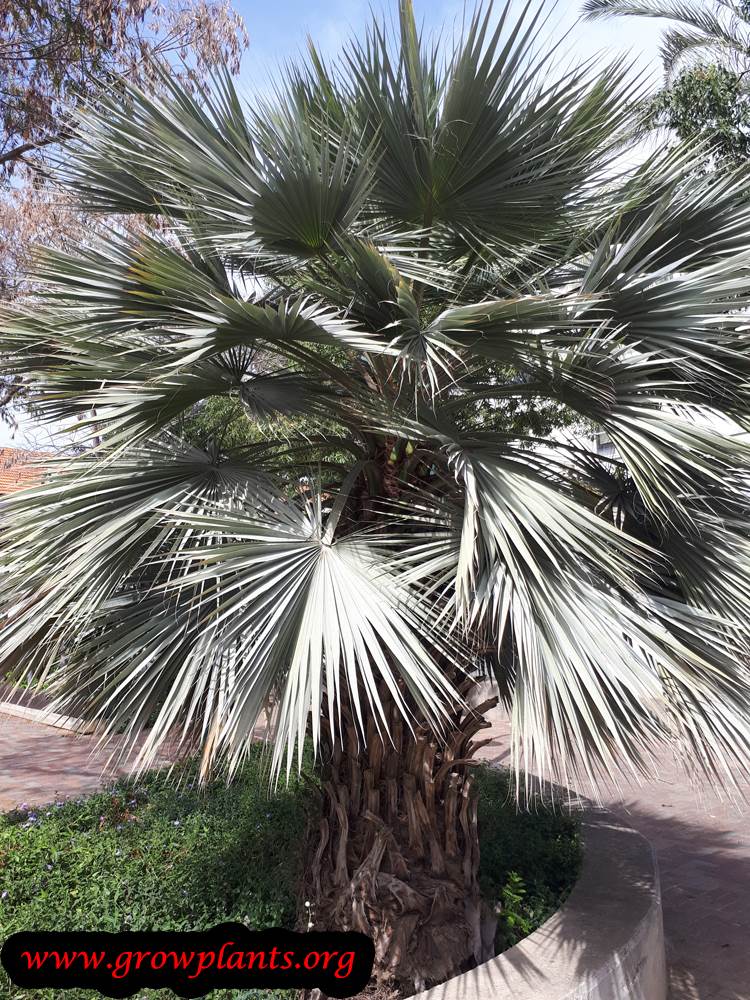
- Trunk & Bark: Single, stout trunk marked by persistent old leaf bases; no true bark.
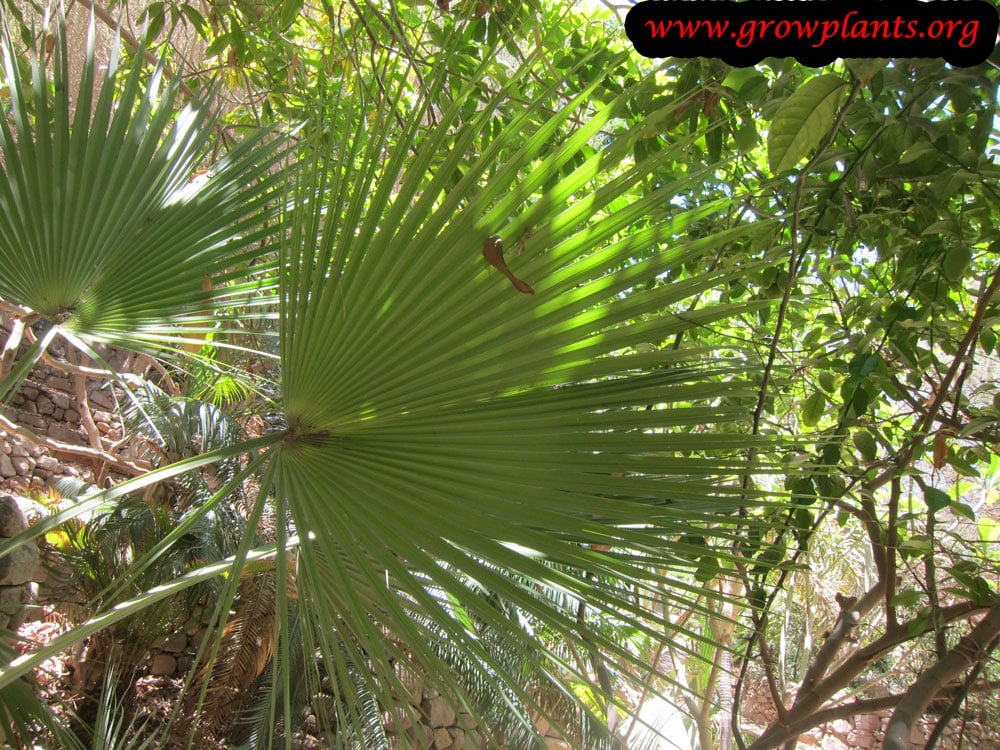
- Leaves & Foliage: Green to gray-blue fan-shaped fronds, 1-2 m across, shredded into narrow tines.
- Flower Characteristics: Yellow flowers on very long, arching branched stalks; dioecious, with male and female flowers on separate plants (summary only – see the Bloom guide).
Primary Uses & Landscape Value
- Functional & Ornamental Roles: Ornamental and specimen palm for dry and mediterranean gardens, valued for its blue foliage.
Care Guide: Planting, Soil & Watering
Overview: Brahea armata (Mexican blue palm) is a drought-tolerant fan palm with striking blue-grey fronds, suited to Mediterranean, desert, subtropical and warm-temperate gardens in full sun to light shade. It wants sharply drained soil, needs little water once established, and is hardy to around -5 C.
Quick Care Requirements
| Requirement | Ideal Condition |
|---|---|
| Planting Season | Warm season – spring through autumn |
| Growth Rate | Moderate (slow to establish) |
| Soil Type | Well-drained soil; tolerates poor, sandy ground |
| Water Need | Low to moderate – very drought-tolerant once established |
Planting & Establishment
- Best Planting Season: Plant in the warm season, spring to autumn, once the soil has warmed.
- How to Plant:
- Hole Preparation: Dig a hole the depth of the rootball and about twice as wide, breaking up heavy ground beneath for drainage.
- Soil Amendments: Add grit or coarse sand on heavy soil; this palm does not need rich ground and prefers lean, fast-draining conditions.
- Planting Depth: Set the base at soil level and keep the crown well above the soil – never bury the single growing point.
- Growth Speed & Expectations: Moderate once settled but slow to establish; ultimately a substantial 10-15 m palm.
Soil, Watering & Drainage Care
- Soil Mix & Drainage Needs: Sharp drainage is essential; the palm rots in soggy ground but thrives on dry, sandy or rocky soil.
- Watering Schedule & Technique:
- Young / Newly Planted: Water regularly through the first couple of seasons to establish deep roots.
- Established: Water deeply and only occasionally; mature palms are highly drought-tolerant.
- Seasonal Adjustments: More during summer heat, minimal in winter.
Climate, Light & Hardiness
Mexican blue palm is a broadly adaptable palm suited to tropical, Mediterranean, desert, subtropical, and temperate climates, hardy outdoors from about zone 9 through 11. It grows in full sun to half shade and, once established, can tolerate brief cold down to roughly −5°C (23°F).
Quick Climate Specifications
| Climate Zones | Tropics, Mediterranean, desert, subtropics, temperate |
|---|---|
| USDA Hardiness Zones | 9–11 |
| Approx. Survival Minimum | Established plants may briefly tolerate cold to roughly −5°C (23°F) |
| Frost Tolerance | Moderate |
| Light Conditions | Full Sun to Half Shade |
Sunlight & Light Exposure
Grows well in full sun to half shade, with full sun bringing out the best blue–gray frond color.
Temperature Extremes & Hardiness
USDA Hardiness & Regional Limits
Hardy outdoors from about zone 9 through 11 - one of the more cold–tolerant fan palms suited to desert and Mediterranean gardens.
Cold Damage & Winter Protection
The site notes it can handle brief cold to about −5°C (23°F) once established; young or container–grown plants are more vulnerable.
Frost Sensitivity
Tolerates brief, moderate frost once mature; prolonged hard freezes will damage fronds.
Wind, Humidity & Microclimate
Dry-Air Tolerance
Its low to average water needs and desert–climate adaptability indicate strong tolerance of dry air and arid conditions.
Wind Tolerance
As a sturdy desert–adapted fan palm, it generally tolerates open, windy sites well.
Growing in Pots, Balconies & Indoors
Blue hesper palm (Brahea armata) is a large, drought-hardy silver-blue fan palm. The grower marks it as not a houseplant and says pot growing works only while the plant is young – after that it needs the open ground.
Quick Details
- Container Size: A large, deep pot while young
- Indoor Suitability: Not a houseplant; container-suitable only in its early years
- Best Spot: Full sun to part shade
- Soil & Drainage: Very gritty, sharply drained mix
- Watering in Pots: Low – it is highly drought-tolerant; water sparingly
Indoors & On the Windowsill
- Not a houseplant: Marked No – a big fan palm that needs full sun.
- Container only while young: The grower is explicit that pots suit only the early years; a young plant makes a fine portable patio specimen before it must be planted out.
On a Balcony or Patio
- Light & shelter: Full sun; it handles heat and wind well, but keep the heavy pot stable.
- Watering & heat: Very drought-tolerant – water sparingly and let the mix dry; pots must never stay wet.
- Overwintering: Cold-hardier than most palms, but shelter potted roots in hard frost.
Choosing the Pot, Soil & Long-Term Care
- Pot & drainage: A large, deep pot while young with strong drainage holes; skip a standing-water saucer to avoid root rot. Terracotta breathes and dries quickly, which suits this plant.
- Potting mix: A well-aerated, organic-rich mix – peat or coir blended with perlite or vermiculite for free drainage.
- Feeding: Potted plants run their soil down fast as nutrients leach out, so feed more often than plants in open ground during active growth.
- Repotting: Pot up while young; plan to plant it in the ground once it outgrows a manageable container, as the grower advises.
Fertilizing & Feeding
A slow-growing, drought-tolerant fan palm prized for its powdery blue-gray fronds; it is a naturally light feeder compared with faster-growing palms, and overfeeding tends to push soft, fast growth that dulls the characteristic blue coloring.
Quick Fertilizing Specs
| Feeding Level | Light |
|---|---|
| young_feeding | A newly planted palm benefits from a light, balanced feed to support root establishment while its trunk is still forming. |
| mature_feeding | An established specimen needs only light, infrequent feeding, with attention to potassium and magnesium so its older fronds do not show deficiency. |
| Main Nutrient Priority | A light, balanced feed with dependable potassium and magnesium suits this slow grower; avoid pushing nitrogen, which favors soft green growth over the tight, powdery-blue form this palm is grown for. |
| Best Feeding Period | Feed lightly during the warm growing season when the palm is actively producing new fronds. |
| Organic Options | Composted organic mulch spread around, but kept clear of, the trunk suits this low-input, drought-tolerant species well. |
| Micronutrients | A palm fertilizer blend that includes manganese and magnesium as routine components addresses the trace-element issues common to this genus, even at light feeding rates. |
| Soil pH | Tolerates a wide range of well-drained soils; sharp drainage matters more to this species than any particular pH. |
| Reduce/Stop Feeding | Reduce feeding further in cooler weather, and always favor underfeeding over overfeeding with this naturally slow, low-input palm. |
Feeding by Growth Stage
Establishment
Help a newly planted palm root in and begin forming its trunk without forcing unnaturally fast, soft growth.
| Nutrient direction | A light, balanced feed to support steady root and frond establishment |
|---|---|
| Timing | The first growing seasons after planting, before the palm has reached significant size. |
| Frequency | Light, infrequent feeding through the warm growing season is enough for this naturally slow starter. |
| Fertilizer types | A balanced palm-formulated fertilizer applied at a light rate, A general balanced fertilizer as an alternative where palm-specific blends are unavailable |
| Routine trace nutrients | manganese, magnesium |
| Precautions | Prioritize sharp drainage over feeding, since this species is naturally drought-adapted and more sensitive to wet, poorly drained soil than to modest underfeeding. |
Established Growth
Maintain healthy, compact frond growth and the characteristic blue-gray coloring on a mature specimen.
| Nutrient direction | A light, balanced feed with dependable potassium and magnesium, kept well short of a heavy nitrogen push |
|---|---|
| Timing | During the warm growing season, if feeding at all. |
| Frequency | Minimal feeding is usually enough for an established specimen; this is one of the lighter-feeding palms in general landscape use. |
| Fertilizer types | A palm-specific fertilizer blend applied sparingly, supplying potassium and magnesium alongside modest nitrogen, A light application of a balanced general landscape fertilizer as an alternative |
| Routine trace nutrients | manganese, magnesium |
| Precautions | Heavy or frequent feeding tends to push fast, soft, greener growth that both looks out of character for this species and is more prone to damage than its naturally slow, sturdy habit. |
Nutrient Deficiency Signs & Corrections
Older, lower fronds develop yellow-orange spotting that progresses to frizzled, necrotic leaflet tips, while newer fronds stay a normal blue-gray.
| Possible causes | Insufficient potassium in the feeding program relative to this genus’s needs, A generic fertilizer lacking adequate potassium for palms, Sandy, fast-draining soil that leaches potassium readily |
|---|---|
| Appears first on | Oldest, lowest fronds first |
| What to check | Review whether the fertilizer used is palm-specific with adequate potassium, Assess soil type and drainage for nutrient leaching, Compare the oldest versus newest fronds for the classic old-frond-first pattern |
| Possible correction | Switch to a palm-specific fertilizer with adequate potassium and continue light, regular feeding, since existing symptoms on old fronds will not reverse but new growth should improve. |
Broad yellow banding runs along the margins of older fronds while the center of the leaflet stays a normal blue-gray.
| Possible causes | Insufficient magnesium in the feeding program, Excess potassium applied without balancing magnesium, Sandy soil that leaches magnesium readily |
|---|---|
| Appears first on | Oldest fronds first |
| What to check | Review whether magnesium is included in the fertilizer being used, Assess the potassium-to-magnesium balance in recent feeding, Check soil type and drainage |
| Possible correction | Use a palm fertilizer that includes magnesium as a routine component, applied lightly but consistently through the growing season. |
New emerging fronds are weak, stunted, and streaked with yellow or necrotic patches, sometimes called frizzle top.
| Possible causes | A manganese shortfall in the feeding program, Soil pH outside the range where manganese stays available to roots, Overly wet or poorly aerated soil restricting root uptake |
|---|---|
| Appears first on | Newest, innermost fronds first |
| What to check | Confirm whether the fertilizer used supplies manganese, Estimate the soil pH around the root zone, Check drainage and root health |
| Possible correction | Apply a chelated manganese product per its label promptly, since this deficiency can be serious if left uncorrected, and address any drainage issue found. |
Pruning, Training & Seasonal Maintenance
Brahea armata tolerates only minimal pruning, and the species’ own care guidance is explicit on the point that matters most: never cut the top of the plant. As a single-trunk fan palm, the crown holds the palm’s one growing point, and any damage there cannot be regrown or corrected. Routine work is limited to removing fully dead fronds in autumn; there is no size, shape, or structural pruning appropriate at any life stage.
Quick Pruning & Maintenance Specs
| Pruning Tolerance | Low – dead-frond removal only; the crown/growing point must never be cut |
| Primary Pruning Window | Autumn |
| Typical Frequency | As fronds fully die back, occasionally through the year |
| Main Objective | Remove only fully dead fronds while leaving the crown and growing point untouched |
| Young Plant Priority | No pruning beyond clearly dead lower leaves; the growing point is especially critical to protect while the palm is establishing |
| Mature Plant Priority | Old-frond removal only; the dense gray-blue fan crown is a product of natural growth, never of pruning |
| Best Tool Type | Pruning saw or pole pruner sized to reach and frond thickness; gloves for the sharply forked, tine-edged leaves |
| Avoid Heavy Pruning During | Always – and never cut the crown/top under any circumstance |
Pruning by Plant Age & Size
Newly Established
Leave the palm alone beyond removing any transplant-damaged leaves; the single growing point is especially vulnerable while the palm is re-establishing its roots.
Young / Formative
No structural training applies – a single-trunk palm has no branching framework to shape, and the crown must be left to develop on its own.
Mature / Established
Ongoing removal of fully dead, brown fronds only, handled carefully given the sharply forked, spoon- or fork-like tines at the leaf edges.
Special Growth to Remove
- Fully dead, brown fronds – the only routine cut needed for this species.
- Spent flower stalks can be removed once finished, for tidiness; the palm produces new inflorescences from the crown on its own each cycle, independent of any pruning.
Tools
- Pruning saw – sturdy dead-frond bases.
- Pole pruner – reaching fronds safely on a mature specimen (this species reaches 10–15 m), avoiding the need to climb near the crown.
Tool Hygiene & Disease Risk
High-risk: this species shares the red palm weevil (Rhynchophorus ferrugineus) pest pressure noted for Bismarck palm – fresh pruning wounds and any cutting into green tissue increase attraction risk. Keep cuts to the strict minimum, disinfect tools between palms where the weevil is present locally, and remove pruned material from the site rather than leaving it at the base.
Cut Placement & Technique
Cut the frond petiole a short distance from the trunk, never flush against or into the trunk itself, and never cut anywhere near the crown/growing point. Handle the sharply forked leaf tines carefully to avoid injury during removal and disposal.
Heavy Pruning & Rejuvenation
Not tolerated in any form. There is no rejuvenation practice for this species; the species-specific instruction to never cut the top reflects that damage to the single growing point is typically fatal or irreversible.
Post-Pruning Care
No feeding push is needed after routine dead-frond removal. After any pruning, watch the crown and trunk for early signs of red palm weevil activity, since fresh wounds are the period of highest risk.
Common Pruning Mistakes
- Cutting or damaging the crown/growing point, directly against this species’ own care guidance and typically fatal.
- Removing green fronds instead of only fully dead ones, creating unnecessary wounds and weevil-attraction risk.
- Handling the sharply forked leaf edges without gloves.
When NOT to Prune
Never cut the top/crown of the plant, at any age or season. Avoid removing any green fronds, and avoid pruning a recently transplanted specimen until it is established.
Recommended Tools (by task)
- pruning_saw – dead-frond base removal.
- pole_pruner – safe reach on a mature 10–15 m specimen without working near the crown by hand.
- blade_disinfectant – between palms in areas with red palm weevil pressure.
Pruning Troubleshooting
| Problem | Possible Cause | What to Check | Corrective Action |
| Crown decline or collapse after pruning | Cutting or injuring the growing point/top of the palm | Whether any cut was made at or near the crown rather than only on lower dead fronds | Stop all cutting near the crown immediately; damage to the growing point cannot be corrected by pruning |
| Boring holes, sap oozing, or frond wilting after pruning | Red palm weevil attracted to fresh pruning wounds | Crown and upper trunk near recent cuts for entry holes or frass | Seek professional red palm weevil assessment/treatment promptly; minimize further cutting |
Propagation Guide
Brahea armata is propagated primarily from seed. Routine propagation by suckers, pups, division, stem cuttings or leaf cuttings is not appropriate for this solitary palm.
Quick Propagation Specs
| Primary Method | Seed |
| Offshoots / Suckers | Not a routine method for this solitary palm |
| Stem or Leaf Cuttings | Not recommended |
Growing from Seed
Use mature, viable seed. Remove fleshy fruit material where present, clean the seed, and sow it in a clean, well-drained propagation medium. Keep the medium evenly moist but not waterlogged and provide warm conditions while germination and early root growth occur.
Seedling Care
Move seedlings carefully once they are established, protect young roots from damage, and increase light gradually as the young palm develops.
Bloom & Flower Guide
Quick Details
- Bloom Season: Summer into autumn
- Flower Appearance: Small creamy-yellow flowers carried on very long, arching branched stalks that reach out well beyond the crown
- Edibility: Ornamental palm — the flowers are not eaten
Detailed Blooming Overview
The Mexican blue palm is famous for its powder-blue fan leaves and, when mature, for spectacularly long flower stalks — arching sprays of small creamy flowers that extend far past the foliage. It flowers in the warm months once well established.
Flower Characteristics
- Small creamy-yellow flowers borne on long, arching, branched inflorescences.
Bloom Care & Thinning
- Encouraging bloom: Blooms with maturity in warm, dry-summer conditions; little is needed to manage it.
Fruit & Uses
Mexican blue palm produces small, olive-sized black fruits with a thin layer of sweet pulp around a large hard seed. The fruit is not cultivated as food and is, at most, eaten fresh in a minor, largely local way rather than harvested for any commercial or culinary purpose.
Quick Edible Specs
| Edible Parts | Fruit (thin sweet pulp) |
|---|---|
| Main Use(s) | Occasional fresh eating; minor traditional/foraged use |
| Eaten Raw or Cooked | Raw |
| Preparation Required | None beyond separating the thin pulp from the large seed |
| Harvest Season | Late summer–autumn, once fruit ripens to black |
| Storage | Best eaten fresh; not typically stored |
| Safety/Toxicity Caveat | No toxicity reported, but the edible flesh is thin and low-yield; do not assume this species matches the food value of the related Guadalupe palm (Brahea edulis) |
Fruit
The small, round fruit ripens from green to blue-black and hangs in large clusters below the crown. When fully ripe, the thin layer of pulp around the seed is sweet, though there is very little of it relative to the large central seed. Fruit is picked by hand once black and soft; where eaten, it is consumed out of hand rather than processed, and it is not grown commercially for food.
Preparation, Uses & Safety
the site’s own growing notes for this plant do not mention any edible use at all – this section reflects general reports for Brahea fruit and should be treated as provisional. No preparation beyond removing the pulp from the seed is required, and no toxicity is reported, but the amount of edible flesh is small and inconsistent. This species is easily confused with the closely related Brahea edulis (Guadalupe palm), which is far more consistently documented as edible; the two should not be treated as interchangeable when describing food use.
Pests, Diseases & Troubleshooting
Overview: The Mexican blue palm (Brahea armata) is a slow, exceptionally drought- and heat-tough fan palm that is largely trouble-free in dry climates. Its main pests are scale and spider mites, while its most serious disease threat is Ganoderma butt rot, an incurable trunk-base decay; leaf spots and micronutrient deficiencies round out the picture. Because it hates wet feet and overwatering, sharp drainage plus correct feeding of manganese and potassium prevent most problems.
Quick Troubleshooting Overview
| Issue / Pest | Main Symptom | Primary Solution |
|---|---|---|
| Scale insects | Bumps on fronds/stems; sticky honeydew and sooty mould | Horticultural oil; prune worst fronds |
| Spider mites | Fine stippling and webbing on fronds in hot, dry air | Hose foliage; miticidal oil |
| Ganoderma butt rot | Conks (brackets) at trunk base; wilting, general decline | No cure; remove tree and stump, don’t replant palm there |
| Frizzle top | New fronds weak, frizzled, necrotic – manganese deficiency | Apply manganese sulfate |
| Potassium deficiency | Older-frond yellow/orange spotting and tip necrosis | Slow-release palm fertiliser with K + Mg |
| Root rot | Decline in wet, heavy soil | Improve drainage; water deeply but infrequently |
Common Pests & Management
- Scale insects (Diaspididae / Coccidae):
- Symptoms: Brown, grey or white bumps clustered along the frond ribs, leaf undersides and stems; soft scales produce honeydew and sooty mould, while armoured scales cause yellow flecking and frond decline. The commonest palm pest.
- Prevention & Control: Wipe or prune off heavily infested fronds and conserve natural predators and parasitic wasps. Apply horticultural oil thoroughly to fronds and ribs to smother scale and crawlers, repeating to catch successive generations. Keep the palm vigorous, as stressed palms are more prone.
- Spider mites (Tetranychus / Oligonychus spp.):
- Symptoms: Fine pale stippling, a dull bronzed look and delicate webbing on fronds, worst in hot, dry, dusty conditions and on sheltered or indoor palms.
- Prevention & Control: Hose down the fronds periodically to remove dust and knock back colonies, and raise humidity where possible. For outbreaks use a miticidal horticultural oil or insecticidal soap, covering frond undersides; avoid drought-stressing the palm, which favours mites.
- Palm aphids / mealybugs (Cerataphis / Pseudococcus spp.):
- Symptoms: Sap-suckers on new spear leaves and frond bases – dark palm aphids or white cottony mealybugs – producing honeydew, sooty mould and some distortion of emerging growth. Mostly minor.
- Prevention & Control: Rinse off with water and support beneficial insects. Treat persistent colonies with insecticidal soap or horticultural oil directed at the crown and new growth. Ants tending the colonies can be baited to let predators work.
- Palm borers / weevils (Rhynchophorus / Cerambycidae):
- Symptoms: In some regions large weevil or beetle larvae bore into the crown or trunk of stressed or wounded palms, causing wilting spears, oozing and crown collapse. Uncommon on healthy Brahea but serious where present.
- Prevention & Control: Avoid wounding the trunk and crown, keep the palm healthy, and remove severely affected palms to reduce local populations. Where palm weevils are known, protect fresh pruning cuts and monitor with traps; prevention and sanitation are the main defences.
Diseases & Fungal Issues
- Ganoderma butt rot (Ganoderma zonatum):
- Symptoms: A lethal, incurable rot of the lower trunk. The first obvious sign is often a shelf-like conk (bracket fungus) forming at the trunk base; internally the wood is destroyed, and the palm wilts, its fronds collapse and it declines and dies. Any palm can be affected.
- Treatment & Management: There is no cure and no effective fungicide. Do not wound the trunk base (mower and trimmer damage are entry points). Remove and destroy affected palms including as much of the stump and root as possible, and do not replant another palm in the same spot, as the fungus persists in the soil.
- Pink rot (Nalanthamala vermoeseni):
- Symptoms: A weak, opportunistic pathogen that attacks stressed palms, causing rotting of the spear and emerging fronds with a characteristic pinkish spore mass, plus leaf-base and bud lesions.
- Treatment & Management: Correct the underlying stress – improve drainage, feeding and drought care – since healthy palms resist it. Remove infected tissue with clean tools and avoid overhead watering; a copper fungicide can protect the crown while the palm recovers vigour.
- Leaf spot & false smut (Graphiola phoenicis / various leaf-spot fungi):
- Symptoms: Small black, brown or yellow spots and blotches on fronds; false smut (Graphiola) appears as tiny black wart-like fruiting bodies, mainly in humid conditions. Usually cosmetic on this dry-climate palm.
- Treatment & Management: Improve air circulation, avoid overhead watering and remove badly spotted older fronds. Fungicides are rarely needed in the palm’s preferred dry, sunny conditions; copper can be used if leaf spotting is persistent and severe.
Growing Difficulties & Abiotic Problems
- Manganese deficiency (‘frizzle top’):
- Cause & Symptoms: New fronds emerge weak, reduced, frizzled and necrotic, with scorched, withered leaflets – a manganese deficiency common in alkaline, sandy or cold, wet soils where uptake is poor. Severe cases kill the growing point.
- Correction Strategy: Apply manganese sulfate as a soil treatment (and foliar for speed), and correct soil pH and drainage. Feed with a complete palm fertiliser that includes micronutrients to prevent recurrence.
- Potassium (and magnesium) deficiency:
- Cause & Symptoms: Older fronds develop translucent yellow-orange spotting, necrotic tips and margins, and a frizzled look, working up the palm over time – a very common palm nutrient disorder in leached soils.
- Correction Strategy: Use a slow-release palm-special fertiliser with a balanced supply of potassium and magnesium (and micronutrients). Never remove yellowing older fronds prematurely, as the palm draws mobile nutrients from them; correct the feeding instead.
- Root rot from overwatering / heavy soil:
- Cause & Symptoms: Despite loving dry heat, Brahea will decline, yellow and rot at the roots in waterlogged or heavy soils or with frequent irrigation.
- Correction Strategy: Plant in free-draining soil, water deeply but infrequently once established, and never let it sit wet. This slow palm is exceptionally drought-tolerant, so err on the dry side.
- Cold, transplant & sun stress:
- Cause & Symptoms: Though hardy for a palm, hard frost can burn fronds and spear; freshly transplanted palms sulk and brown while re-rooting, and deep shade weakens the characteristic blue fronds.
- Correction Strategy: Grow in full sun with good drainage, shelter from severe frost while young, and be patient after transplanting – keep the crown protected and do not overwater during establishment.
What Helps – Products & Tools
The core toolkit is horticultural / neem oil and insecticidal soap for scale, mites, aphids and mealybug, a slow-release palm-special fertiliser with potassium, magnesium and micronutrients, and manganese sulfate to correct or prevent frizzle top. A copper fungicide can protect the crown against pink rot and leaf spot, but note that Ganoderma butt rot has no chemical cure – prevention by avoiding trunk wounds is the only defence. Sharp drainage is the palm’s best insurance. Spray oils in the evening to protect pollinators.