Plant Profile & Key Characteristics
Also known as: sapota, chikoo, naseberry, or nispero
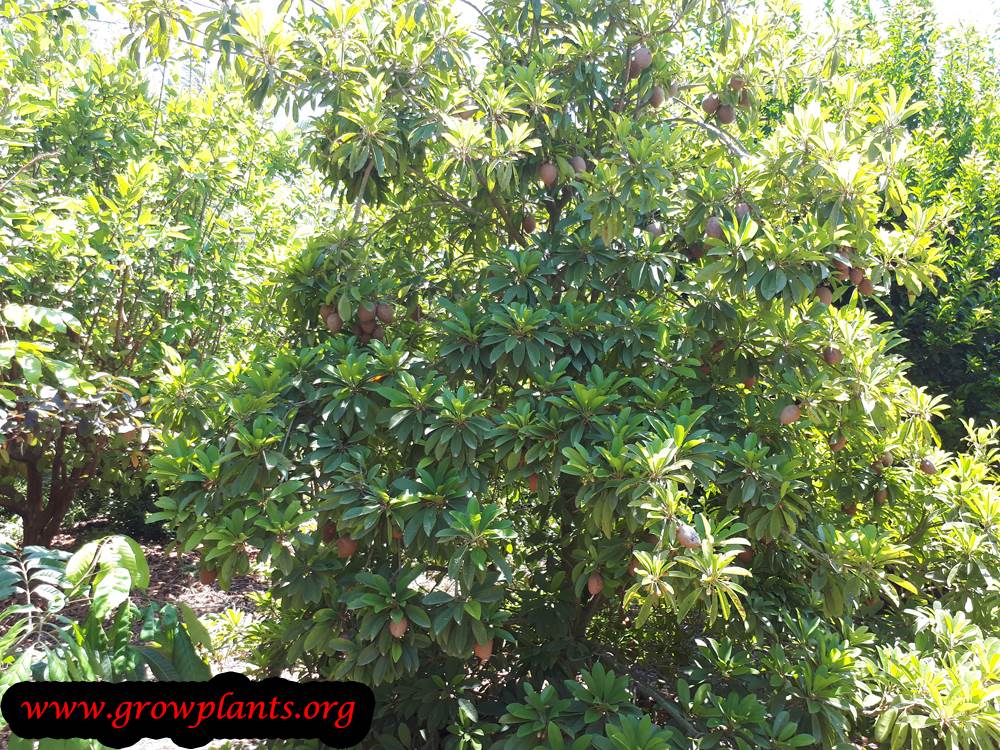
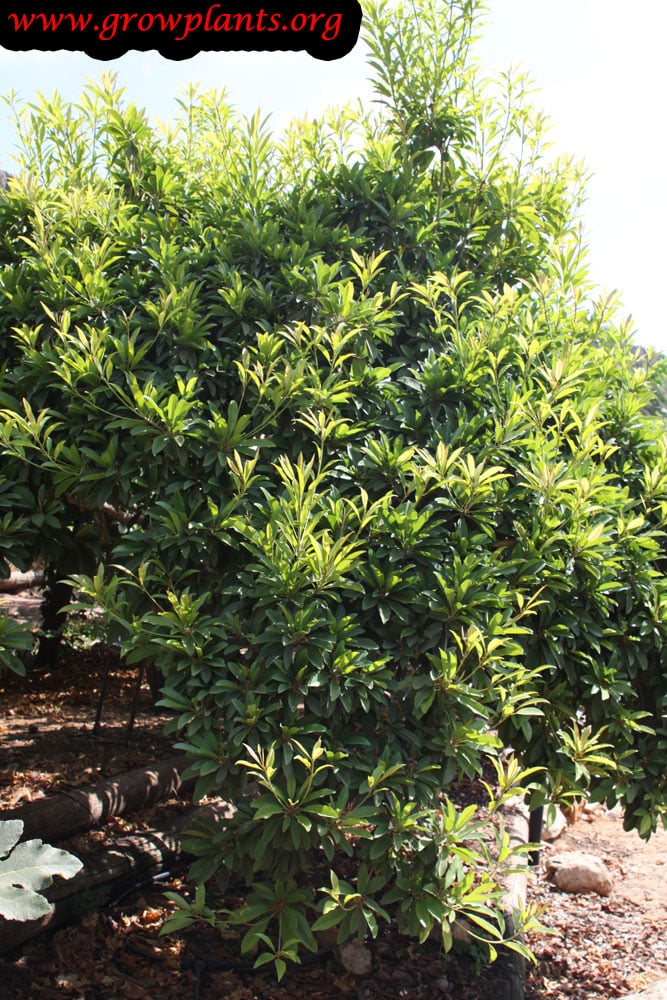
Overview: Sapodilla (Manilkara zapota) is a slow-growing evergreen tropical tree, 8-20 m (dwarfed to 1.5-3 m), grown for its sweet brown-fleshed fruit and as an ornamental; it becomes deciduous in cool winters.
Quick Specifications
| Specification | Attribute |
|---|---|
| Plant Type / Life Cycle | Perennial (evergreen; deciduous in cold) |
| Foliage Type | Evergreen |
| Mature Size | 8-20 m (24-60 ft); dwarf 1.5-3 m (5-10 ft) |
| Growth Rate | Slow (faster once established) |
| Toxicity | Ripe flesh edible; unripe fruit and seeds contain latex/saponins |
| Hardiness | USDA 10b+ (10a with care) |
Growth Form & Structure
- Height & Spread: 8-20 m (24-60 ft); can be kept dwarf (1.5-3 m) or as bonsai in large containers (min. 50-100 L / 10-20 gal).
- Growth Habit & Form: Evergreen tree with dense foliage; the trunk yields chicle latex.
- Lifespan & Maturity: Long-lived; grafted trees bear fruit in about 3-5 years (up to 10 from seed).
Anatomy & Physical Features
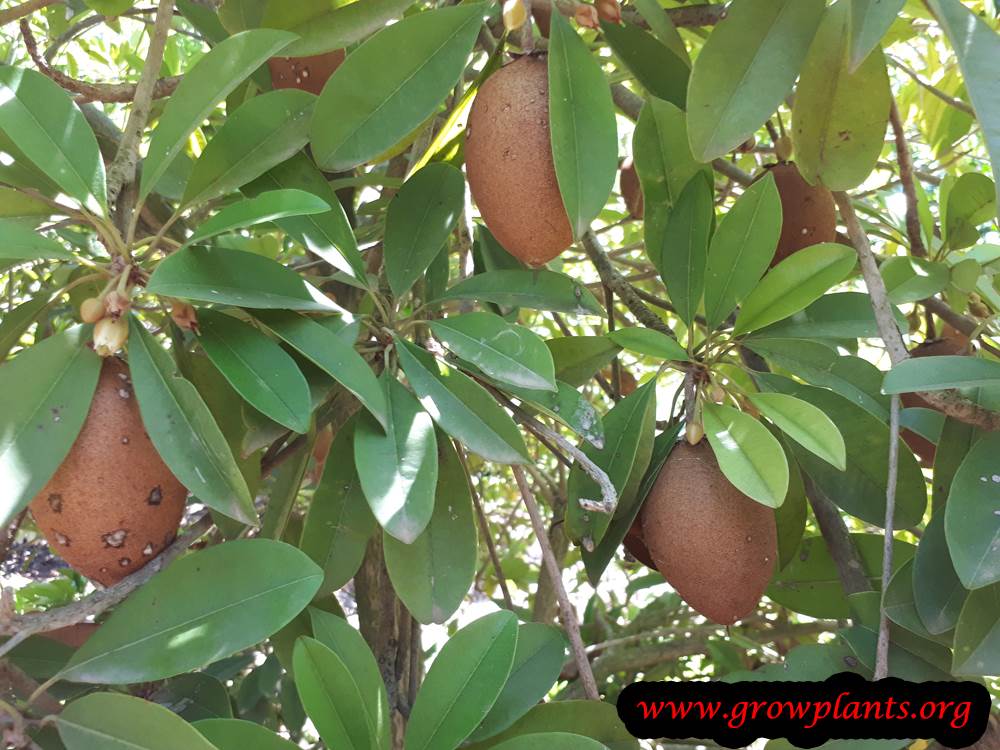
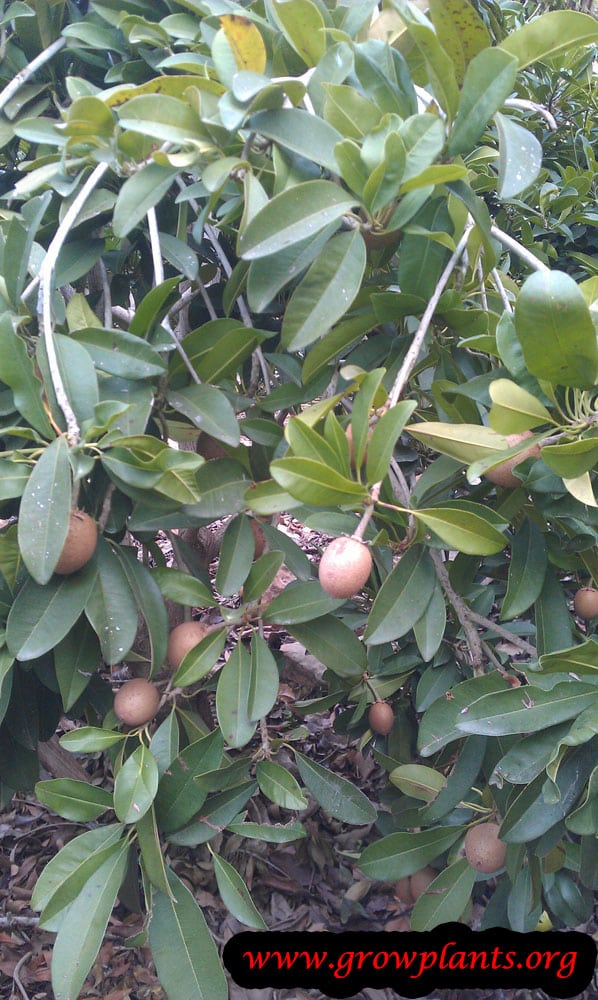
- Leaves & Foliage: Light-to-dark green leaves, glossy but not all year.
- Flower Characteristics: Small brown-yellow, hairy, bell-shaped flowers with three sepals and six stamens (see Bloom guide).
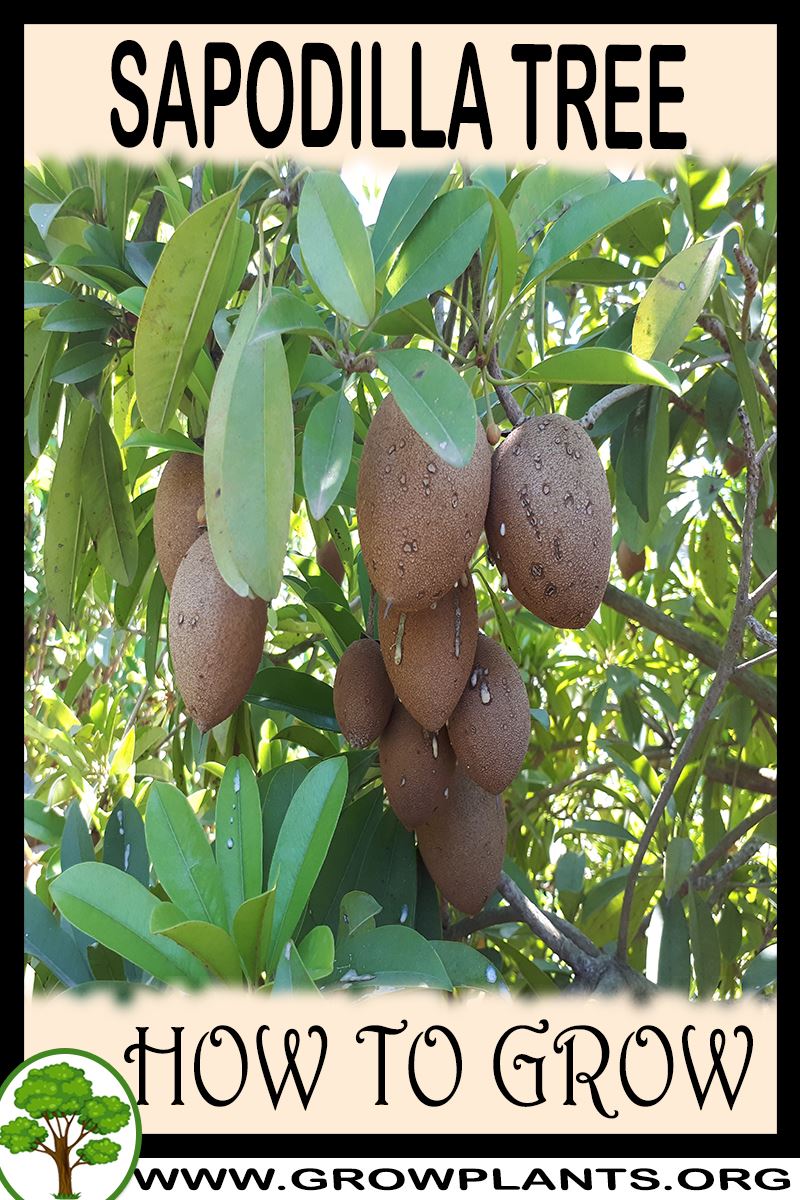
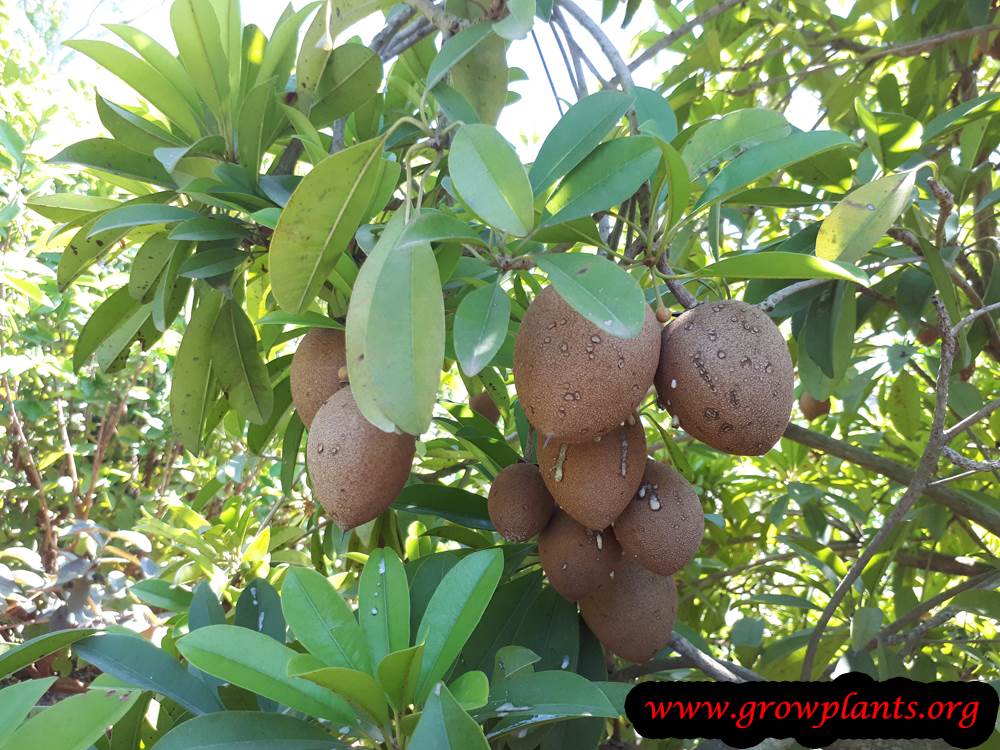
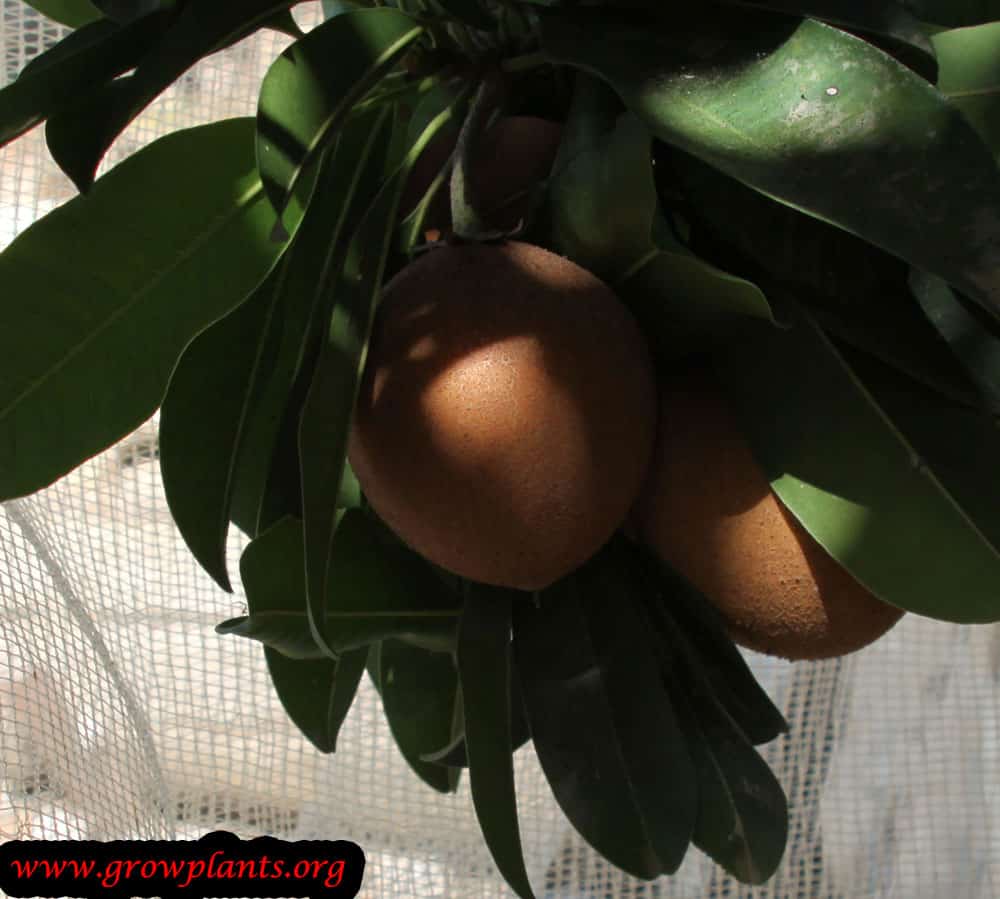
- Fruit Profile: Elliptic fruit 5-10 cm with brown hairy skin and sweet yellow-brown flesh recalling pear and date (see Fruit guide).
Primary Uses & Landscape Value
- Edible Uses: Eaten fresh; used for juice, ice cream, jams and cakes.
- Functional & Ornamental Roles: Fruit tree and ornamental/shade tree; source of chicle latex.
Care Guide: Planting, Soil & Watering
Overview: The sapodilla (Manilkara zapota) is a tropical, frost-sensitive fruit tree (zone 10b+, or 10a with winter protection when young) that grows best in full sun with rich, free-draining soil high in organic matter. It is slow to establish but needs steady, moderate to generous watering — especially while fruiting — and benefits from mulch to hold soil moisture.
Quick Care Requirements
| Requirement | Ideal Condition |
|---|---|
| Planting Season | Spring in zone 10a; spring–summer in 10b; spring–autumn in 11; year-round in 12+ |
| Growth Rate | Slow when young, faster after a few years |
| Soil Type | Rich, well-draining, high in organic matter |
| Water Need | Moderate to High — more during the fruiting season |
Planting & Establishment
- Best Planting Season: Plant in spring in zone 10a, spring to summer in 10b, spring to autumn in 11, or year-round in zone 12+; protect young trees from frost in marginal zones.
- How to Plant:
- Hole Preparation: Dig a hole 50–100% larger than the root ball.
- Soil Amendments: Mix organic matter, dead leaves and humus into the backfill, then return some soil and blend.
- Planting Depth: Set the tree at its original depth and cover lightly but firmly so it stays stable; add a stake if needed and prune weak or weeping branches.
- Growth Speed & Expectations: Slow at first — growth speeds up after a few years; reaches 8–20 m (24–60 ft) in the ground, or can be kept as a 1.5–3 m dwarf.
Soil, Watering & Drainage Care
- Soil Mix & Drainage Needs: Rich, free-draining soil with humus and organic matter; mulch to keep the soil moist. In containers (minimum 50–100 L / 10–20 gal) use potting or peat mix with perlite and organic matter, with plenty of drainage holes.
- Watering Schedule & Technique:
- Young / Newly Planted: Water twice on the first day, then daily for about two weeks, increasing the amount until the tree establishes.
- Established: Water moderately to generously with good drainage; never let a saucer of water sit under a potted tree for more than a day.
- Seasonal Adjustments: Increase watering during the fruiting season and reduce it in cool weather.
Climate, Light & Hardiness
Sapodilla thrives in tropical, Mediterranean, and subtropical climates in full sun, and prefers essentially frost-free conditions. Established trees handle brief cold better than young ones, which are frost-tender and may drop leaves (becoming temporarily deciduous) in a cold zone-10a winter.
Quick Climate Specifications
| Climate Zones | Tropical, Mediterranean, Subtropical |
|---|---|
| USDA Hardiness Zones | 10b+, and 10a with overwinter care while young |
| Approx. Survival Minimum | approximately −1 to 1.7°C (30–35°F) at the zone 10 boundary, briefly, for an established tree |
| Frost Tolerance | Low |
| Light Conditions | Full Sun (in zone 10, full sun is essential for the tree to survive winter) |
Sunlight & Light Exposure
Optimal Light Setup
Full sun for best growth and fruiting.
Direct Sun Requirement
Important, especially near its cold limit – at zone 10, site data notes the tree must be in full sun or it will not reliably survive winter; half shade is possible in warmer zones but delays fruiting.
Best Exposure / Orientation
The sunniest, most sheltered spot available, particularly in marginal zones.
Temperature Extremes & Hardiness
USDA Hardiness & Regional Limits
Reliable from zone 10b upward; zone 10a is workable, especially once the tree matures, but young trees need protection.
Cold Damage & Winter Protection
Better frost-free; mulch heavily in winter, and in zone 10a expect the tree to become temporarily deciduous in cold weather while young.
Frost Sensitivity
Low frost tolerance overall; mature trees manage brief cold noticeably better than young ones.
Extreme Heat Tolerance
Good in genuinely tropical and subtropical heat.
Wind, Humidity & Microclimate
Rainfall & Seasonal Moisture
Suited to tropical/subtropical rainfall; benefits from consistent moisture, with extra water useful in the fruiting season.
Microclimate Recommendations
A warm, full-sun, sheltered site is especially important near the cold edge of its range.
Growing in Pots, Balconies & Indoors
Sapodilla (Manilkara zapota) is a large tree, 8-20 m (24-60 ft), but the grower says it can be grown in a container if kept as a dwarf or bonsai – it will fruit at just 1.5-3 m (5-10 ft). It isn’t a houseplant, but it makes a good large-container patio tree. He gives a detailed potting method (see the Grower’s Tip).
Quick Details
- Container Size: 50-100 L (10-20 gal) minimum – bigger is better
- Indoor Suitability: Not a houseplant; a large-container patio tree kept dwarf
- Best Spot: Full sun (part shade delays fruiting)
- Soil & Drainage: Aerated, organic-rich mix that drains freely
- Watering in Pots: Keep the mix consistently moist and water freely in warm weather – pots dry fast; make sure drainage is sharp so roots never sit wet.
Indoors & On the Windowsill
- Houseplant limits: Not a houseplant – it needs strong, full sun that indoor light can’t provide.
- Windowsill growing: Too large for a sill; keep it in a big container outdoors.
- Overwintering: Frost-tender – in mild zones it must have full sun to survive winter, so in cold areas keep it potted and shelter it frost-free.
On a Balcony or Patio
- Light & weight: Give it the sunniest spot; a large pot is heavy, so make sure the balcony can take it, and check moisture, especially in the fruiting season when it wants extra water.
- Keep it dwarf: Limit the plant’s growth and train it as a dwarf or bonsai to keep it pot-sized.
Choosing the Pot, Soil & Long-Term Care
- Pot & drainage: Make plenty of drainage holes; use potting mix or peat soil with perlite and organic matter. If you use a saucer, never let water sit more than a day – overwatering destroys the soil and roots.
- Potting mix: Well-aerated, organic-rich mix – peat or coir with perlite and a little organic matter; it must drain freely.
- Feeding: Feed at least once a year and add humus, ideally twice, as the grower advises.
- Repotting: Every few years swap part of the soil (side and top) and trim some of the root ball rather than replacing everything.
Grower’s Container Tip
- Dwarf or bonsai, potted up in stages: Keep the plant small – grow it as a dwarf or bonsai and limit root growth. Start in a pot about 50% bigger than the root ball and move up a size at a time; don’t start a small tree in a huge pot. Use at least a 50-100 L (10-20 gal) container, bigger being better, and consider grafting for good-quality fruit.
Fertilizing & Feeding
A well-documented tropical orchard fruit tree – slow to start but steady once established, it responds well to nitrogen while young and a balanced, humus-rich routine once it settles into regular bearing.
Quick Fertilizing Specs
| Feeding Level | moderate |
|---|---|
| young_feeding | nitrogen-forward feeding paired with mulch, since this species grows slowly at first before speeding up |
| mature_feeding | balanced feeding through the growing season, stepped up with extra water during fruiting |
| Main Nutrient Priority | nitrogen while young, balanced through bloom and fruit development once established |
| Best Feeding Period | the main warm-season growth period |
| Organic Options | humus and organic matter worked in at planting and refreshed periodically |
| Micronutrients | a complete fruit-tree fertilizer generally supplies routine trace elements |
| Soil pH | prefers rich, well-drained soil |
| Reduce/Stop Feeding | protect and reduce feeding on young trees during any cold spell, since young trees are more cold-sensitive |
Feeding by Growth Stage
Newly planted
Help a newly planted Sapodilla establish through its characteristically slow early growth.
| Nutrient direction | Keep feeding light and balanced while the tree establishes; this species is naturally slow to start. |
|---|---|
| Timing | Once new growth resumes after planting. |
| Frequency | A light feeding through the first growing season is generally enough. |
| Fertilizer types | A diluted, balanced young-tree fertilizer, Humus and organic matter worked into the planting area |
| Precautions | Mulch heavily, especially through the winter, and keep fertilizer away from the trunk. |
Young tree, building growth
Push through this species’ naturally slow early growth phase toward faster growth as the tree matures.
| Nutrient direction | Lean nitrogen-forward to help the tree move past its characteristically slow start. |
|---|---|
| Timing | Through the active growing season. |
| Frequency | Regular light feedings across the growing season, tapering during any cool spell. |
| Fertilizer types | A nitrogen-forward complete fertilizer for young fruit trees |
| Routine trace nutrients | iron, manganese, zinc |
| Precautions | Protect young trees through cold weather and hold back on feeding a cold-stressed tree. |
Established, approaching bearing age
Support the tree as growth speeds up and it approaches its first regular fruiting.
| Nutrient direction | Move to a balanced feed as the tree matures, moderating nitrogen as it channels more energy into flowering. |
|---|---|
| Timing | Through the main growing season. |
| Frequency | A few feedings spread across the active season. |
| Fertilizer types | A balanced complete fertilizer for fruiting trees |
| Routine trace nutrients | iron, manganese, zinc |
| Precautions | Grafted trees reach bearing age faster and more reliably than seed-grown ones – feeding won’t substitute for that difference. |
Mature, bearing tree
Support flowering and fruit development on a mature, regularly bearing tree.
| Nutrient direction | Keep a balanced feed through bloom, with extra water alongside it during fruit development, since this species benefits from added moisture as fruit matures. |
|---|---|
| Timing | From the growth flush through fruit development. |
| Frequency | Light, regular feeding through the growing season. |
| Fertilizer types | A balanced complete fruiting-tree fertilizer |
| Routine trace nutrients | iron, manganese, zinc |
| Precautions | Step up watering alongside feeding during fruit development, matching this species’ preference for extra moisture as fruit matures. |
Nutrient Deficiency Signs & Corrections
Pale foliage and unusually slow growth, even accounting for this species’ naturally gradual early pace.
| Possible causes | Low soil nitrogen, Nutrient leaching from well-drained soil, Cold stress slowing uptake and masking a true deficiency, Root stress limiting uptake |
|---|---|
| Appears first on | Older leaves and overall reduced vigor |
| What to check | Growth rate versus what’s typical for a young tree of this species, Recent cold exposure, Time since the last feeding |
| Possible correction | Apply a nitrogen-forward fertilizer for young or actively growing trees once temperatures are reliably warm. |
New leaves yellow between green veins while veins stay green.
| Possible causes | High soil pH limiting iron availability, Poorly drained or waterlogged soil, Root damage limiting uptake, Genuinely low soil iron |
|---|---|
| Appears first on | Newest growth |
| What to check | Soil drainage and pH around the root zone, Whether neighboring trees show the same pattern, Recent root disturbance |
| Possible correction | Correct drainage and soil conditions first; apply a chelated iron product per its label if chlorosis persists. |
Scorched or browned margins on older leaves and fruit that fails to fill out well.
| Possible causes | Low soil potassium, Inconsistent watering during fruit development, Heavy fruit load depleting reserves, Sandy soil with poor nutrient retention |
|---|---|
| Appears first on | Older leaf margins |
| What to check | Fruit fill compared with prior seasons, Watering consistency during fruit development, Soil texture and drainage |
| Possible correction | Shift toward a potassium-forward feed as fruit develops, paired with the extra water this species benefits from at that stage. |
Pruning, Training & Seasonal Maintenance
Sapodilla is a slow-to-establish but eventually vigorous evergreen tree (8–20m in standard form, 1.5–3m as a dwarf), almost always grafted for fruit quality. Grower guidance lays out a clear formative method: keep the young trunk clear of side branches for the first 1–2m (3–6ft) before allowing lateral growth, then manage mainly weak, weeping, or infected wood afterward. The main structural session falls in winter, but light corrective work – especially removing spent fruiting wood – can continue through the year.
Quick Pruning & Maintenance Specs
| Pruning Tolerance | Moderate |
| Primary Pruning Window | Winter, with light work year-round, especially after fruiting |
| Typical Frequency | One structural winter session plus ongoing removal of weak/weeping/infected wood |
| Main Objective | Clear a 1–2m trunk on young trees; remove weak/weeping/diseased wood on mature trees |
| Young Plant Priority | Remove lateral branches below 1–2m to force a clean trunk; prune weak/weeping wood at planting |
| Mature Plant Priority | Remove weak, weeping, or diseased branches; prioritize fruit from strong wood |
| Best Tool Type | Bypass secateurs and loppers; saw and pole pruner for full-size standard trees |
| Avoid Heavy Pruning During | Active flowering, given the extended, climate-dependent bloom window |
Pruning by Plant Age & Size
Newly Established
At planting, prune away weak and weeping branches so the young tree starts with a sound framework.
Young / Formative
Continue removing side branches below roughly 1–2m so the tree develops a clean, clear trunk before lateral branching is allowed. Because grafted material is standard for this species, protect the graft union and remove any rootstock suckers.
Mature / Established
Keep removing weak, weeping, or infected wood as it appears. Since weaker branches are noted to carry lower-quality fruit, preferentially harvest – and remove where needed – fruit from those branches rather than from the strongest wood.
Seasonal Pruning Schedule
Dormant/Winter
Objective: the primary structural session, targeting weak, weeping, or diseased wood. Remove: weak, weeping, and diseased branches, plus any wayward growth. Do not remove: strong, healthy wood, especially anything currently setting fruit. Expected response: energy reallocated to stronger framework branches. Flowering/fruiting impact: light if kept selective.
Post-Harvest
Objective: clean up spent fruiting wood once a crop is picked. Remove: weak branches that carried the crop, spent twigs. Do not remove: branches setting up the next flush – bloom can occur across an extended spring-to-autumn window depending on climate. Expected response: encourages renewal growth. Flowering/fruiting impact: minimal if timed to avoid an overlapping bloom cycle.
Flowering & Fruiting Wood
Small flowers form in the leaf axils of relatively recent growth, and fruit takes roughly 8–10 months to mature from bloom to harvest. Because bloom itself can occur across spring through autumn depending on climate, a tree can be carrying open flowers and maturing fruit from different flushes at the same time – so cuts should target specific weak or spent branches rather than following one blanket seasonal pass.
Structural Pruning & Training
The defining structural method for this species is clearing the trunk of side branches for the first 1–2m before allowing lateral growth – a deliberate high-trunk training approach. Once that framework is set, structural work shifts to removing weak or weeping wood rather than continued leader control.
Special Growth to Remove
Remove rootstock suckers on this typically grafted species, along with weak, weeping, or infected branches. Fruit on weak branches is better harvested (or the branch removed) rather than left to mature, since it is documented to be of lower quality there.
Container & Small-Space Pruning
Dwarf sapodilla is well suited to containers. A container-grown dwarf is kept deliberately smaller overall, so the full 1–2m trunk-clearance target scales down accordingly, but the same principle – avoiding low, weak lateral branches near the base – still applies.
Tools
- Bypass secateurs – light removal of weak/weeping shoots and spent fruiting twigs.
- Loppers – clearing lateral branches below the trunk-clearance zone on young trees.
- Pruning saw – larger structural or diseased limbs on full-size mature trees.
- Pole pruner – height management on standard (non-dwarf) trees reaching 8–20m.
Tool Hygiene & Disease Risk
Routine for general shaping, but treat as Increased when removing infected wood: since the grower guidance specifically calls out cutting out infected branches, clean tools between cuts on diseased material to avoid spreading the problem to healthy wood.
Cut Placement & Technique
This species exudes a milky latex sap when cut, a defining trait of the sapodilla (chicle) family – larger cuts may bleed noticeably for a time, which is normal and not itself a disease sign. Make clean cuts just outside the branch collar, avoid flush cuts and stubs, and keep unnecessary large wounds off visible trunk sections.
Heavy Pruning & Rejuvenation
Avoid hard rejuvenation on young trees, since growth is naturally slow at that stage and recovery would be very slow as well. Established trees, once past the initial slow phase and growing faster, tolerate moderate renewal cuts on weak or weeping wood better, but heavy work should still be spread gradually rather than done all at once.
Post-Pruning Care
Expect some latex sap flow after cuts, which is normal. Keep young trees protected and consistently watered as they establish, and take particular care with fresh wounds on young trees in marginal (zone 10a) areas, where cold sensitivity is already a documented concern.
Common Pruning Mistakes
Letting lateral branches develop below the intended 1–2m trunk-clearance zone on a young tree, which is hard to correct later; leaving weak, weeping, or infected wood in place, where fruit quality is documented to suffer; hard-pruning a still slow-growing young tree and expecting a quick recovery.
When NOT to Prune
Avoid heavy pruning during active flowering, given the extended and climate-dependent bloom window. Avoid unnecessary large wounds on young trees during cold-sensitive establishment in marginal growing zones.
Recommended Tools (by task)
- bypass_secateurs – weak/weeping shoots and spent fruiting twigs: light, precise cuts.
- loppers – clearing low lateral branches during trunk-clearance training.
- pruning_saw – larger structural or diseased limbs on mature standard trees.
- pole_pruner – height management on standard trees reaching 8–20m.
Pruning Troubleshooting
| Problem | Possible Cause | What to Check | Corrective Action |
| Poor-quality or sparse fruit on certain branches | Fruit was left to develop on weak or weeping branches | Vigor of the branches carrying fruit | Preferentially harvest or remove fruit from weak branches; focus the crop on stronger wood |
| No clean trunk on a young tree | Side branches below 1–2m were not removed early | Height at which the first permanent branches occur | Remove low lateral branches while the tree is young to establish a clear trunk |
| Heavy sap/latex flow after a cut | Normal response for this latex-bearing species, not necessarily disease | Whether the cut otherwise looks healthy (no discoloration or odor) | No action needed for normal latex flow; investigate further only if other disease symptoms are present |
Propagation Guide
Sapodilla can be grown from seed, but the site is clear that grafted (or otherwise vegetatively propagated) trees are usually needed to reliably bear good fruit, since seedling trees vary and some fail to fruit well at all. Seed germination itself is straightforward, so overall difficulty is Moderate – easy to start a tree, but grafting or rooting cuttings for guaranteed fruiting quality takes more skill.
Quick Propagation Specs
| Best Propagation Method | Grafting (for reliable, known-quality fruiting); seed is the easiest way to simply grow a tree |
| Alternative Methods | Stem cuttings, rooted under mist/humidity |
| Propagation Difficulty | Moderate |
| Seed True-to-Type | Variable – seedling trees can differ in fruiting reliability, pod size, harvest timing and flavor strength |
| Vegetative True-to-Type | Yes |
| Best Propagation Season | Spring in hardiness zone 10a; spring–summer in zone 10b; spring–autumn in zone 11; year-round in zone 12+ |
| Seed Germination Time | 4–8 weeks (may be faster with fresh seed) |
| Germination Temperature | 24–29°C (75–84°F) |
| Seed Sowing Depth | About 2 cm (1 in) from the top of the seed |
Growing from Seed
Seed Handling & Viability
Fresher seed tends to germinate faster than older seed.
Dormancy & Pre-Sowing Treatment
Soak seeds in water for 24 hours at room temperature, changing the water a few times, before sowing.
Sowing Season
Spring in hardiness zone 10a; spring to summer in zone 10b; spring to autumn in zone 11; possible year-round in zone 12+.
Sowing Depth & Orientation
Sow about 2 cm (1 in) deep in a moist mix of vermiculite and peat soil. In nursery trays, space seedlings roughly 4×5 cm (about 1.8×2 in) apart; if sowing directly at final spacing, allow about 4×5 m (12×15 ft), adjusted for the intended tree design.
Germination Conditions
Full sun, consistently moist soil, and warm temperatures of 24–29°C (75–84°F) with high humidity.
Germination Time
Typically 4–8 weeks; fresher seed may germinate faster.
Seedling Care
Transplant seedlings once they have about 6 leaves; begin fertilizing once they reach about 10 leaves, and mulch around young plants.
Stem Cuttings
Cutting Type
Semi-hardwood – choose a fully grown, brown (not soft green) branch.
Cutting Preparation
Select mature, brown woody wood rather than soft green growth.
Rooting Setup
Root in moist soil under high humidity – an enclosed propagation box or greenhouse with good ventilation and air movement works well. Mist or fog the cutting regularly and never let it dry out. Keep temperatures around 25–29°C (77–84°F).
Rooting Hormone
A root-growth hormone formulated for woody cuttings is used in the site’s method – beneficial for this species.
Rooting Time
Not specified by the site; rooting of woody sapodilla cuttings under mist is typically a slow process taking many weeks to a few months, and results can be inconsistent – one reason grafting is generally preferred commercially. (General note, added with caution.)
Grafting & Budding
Why Grafting Is Used
The site states that grafting (or vegetative propagation generally) is important because some seedling trees fail to bear fruit well, and grafting lets a grower reproduce a tree with known pod size, fruiting season and flavor strength.
Rootstock
Not detailed by the site; commercially, sapodilla is typically grafted onto seedling Manilkara zapota rootstock. (General nursery practice, added with caution.)
Scion Selection
The site lists named varieties such as ‘Makok’ (sweet, medium fruit) and ‘Alano’ (medium, pear-like, sweet) as examples of the kind of known-quality material grafting would preserve.
Bloom & Flower Guide
Quick Details
- Bloom Season: Spring to autumn, shifting with the climate
- Flower Appearance: Small, bell-shaped, brownish flowers with a fine hairy coating, three sepals and six stamens
- Edibility: The flower is not eaten — sapodilla is grown for its fruit, so the bloom is best treated as ornamental
Detailed Blooming Overview
Sapodilla’s flowers are quiet and easy to miss: small, bell-shaped and clad in fine brown hairs, tucked among the leaves. They open over a long window — spring to autumn, varying by climate — and, once pollinated, are the starting point for the tree’s prized fruit. As a bloom in its own right it is understated but reliable.
Flower Characteristics
- Small and bell-shaped, yellow-brown and hairy.
- Three sepals and six stamens per flower.
- Borne singly among the leaves rather than in showy clusters.
Bloom Care & Thinning
- Pollination: worked by bees, so a bee-friendly setting supports a good flowering.
- Low-fuss bloom: no thinning or deadheading of the flowers is needed — simply keep the tree healthy through its flowering window.
Fruit & Uses
Sapodilla is grown for its sweet fruit, eaten fresh once fully soft-ripe – the flesh has a grainy, custard-like texture with a flavour often described as a blend of brown sugar, date and pear. The fruit is eaten raw out of hand or processed into juice, jams, cakes, ice cream and even a fermented drink; it is not cooked as a savoury food.
Quick Edible Specs
| Edible Parts | Fruit flesh (peel occasionally eaten after cleaning, but usually discarded) |
|---|---|
| Main Use(s) | Fresh eating, juice, ice cream, jams, cakes, alcoholic drinks |
| Eaten Raw or Cooked | Raw when fully ripe; also processed (juice/jam/baking/fermenting) |
| Preparation Required | Peel (standard practice); if eating the skin, scrub off the fuzzy hairs first; always remove the seeds |
| Harvest Season | Autumn to winter in tropical climates; summer to autumn in hardiness zone 10-11; possible year-round in zone 11-12, roughly 8-10 months after bloom |
| Time to First Harvest | Several years after planting; a grafted tree bears markedly sooner than a seed-grown one – see Propagation for details |
| Storage | Pick while still firm and let the fruit finish ripening off the tree at room temperature |
| Safety/Toxicity Caveat | Unripe fruit is latex-rich and astringent – inedible until fully soft; the smooth, hook-shaped seeds should never be swallowed (choking risk) |
Fruit
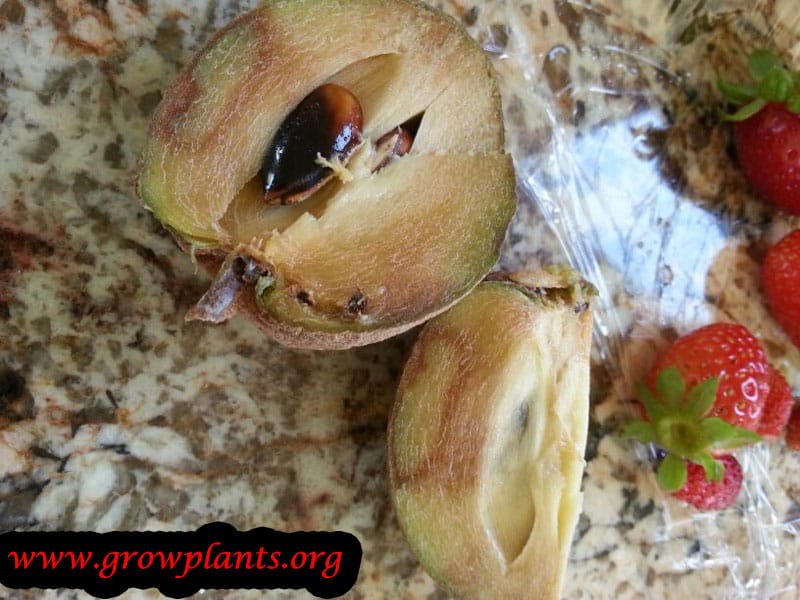
The fruit is elliptic, about 5-10 cm, with a brown, hairy peel; the flesh inside ranges from yellow to brown and tastes sweet. It is hard to judge ripeness early on, but once the surface hairs have developed enough that they rub off easily by hand, the fruit is ready to pick. Because sapodilla is climacteric, fruit is typically harvested while still firm and left to finish ripening and softening at room temperature before eating. The thin peel can technically be eaten after it has been thoroughly cleaned of its hairs, though most growers simply peel and discard it, eating only the soft flesh; the seeds are always removed and not eaten.
Preparation, Uses & Safety
Ripe fruit is halved or peeled, the dark seeds picked out, and the flesh eaten fresh, blended into juice, churned into ice cream, or cooked down into jams, cakes and alcoholic beverages. Do not eat unripe fruit: it is high in latex and tannins, making it astringent, gummy and unpleasant (and it becomes palatable only once fully soft-ripe). Always discard the hard, smooth seeds rather than swallowing them.
Pests, Diseases & Troubleshooting
Overview: Sapodilla (Manilkara zapota) is a hardy, latex-rich tropical fruit tree with relatively few serious pests: scale, mealybugs and aphids with their sooty mould, the sapodilla leaf webber caterpillar, and fruit flies on ripening fruit. Its toughness means an integrated, mostly cultural approach — sanitation, pruning, ant control and fruit protection — keeps it productive with minimal spraying.
Quick Troubleshooting Overview
| Issue / Pest | Main Symptom | Primary Solution |
|---|---|---|
| Scale & mealybugs | Bumps or white fluff on twigs and fruit; honeydew and sooty mould | Horticultural oil, ant control, prune infested wood |
| Aphids | Clusters on new flush; curling and honeydew | Hose off, insecticidal soap or neem |
| Leaf webber / bud borer | Webbed leaves and buds tied together; frass; caterpillars inside | Prune out webbed clusters; Btk; sanitation |
| Fruit flies | Stung, softening, dropping fruit with maggots | Bag fruit, sanitation, bait/lure traps |
| Anthracnose / leaf spot | Dark spots on leaves and fruit in wet weather | Airflow, sanitation, copper if severe |
| Root rot | Wilting and dieback in waterlogged soil | Improve drainage, avoid overwatering |
Common Pests & Management
- Scale insects (Coccidae / Diaspididae):
- Symptoms: Brown, grey or waxy bumps on twigs, leaf undersides and fruit; soft scale exude honeydew that blackens foliage with sooty mould, weakening shoots under heavy loads.
- Prevention & Control: Prune out heavily encrusted twigs, spray horticultural oil to smother scale, and control the ants that protect them; conserve ladybirds and parasitic wasps.
- Mealybugs (Planococcus / Ferrisia spp.):
- Symptoms: White cottony masses at shoot tips, leaf axils and on fruit stalks and calyx, with honeydew and sooty mould; feeding stunts new growth and dirties fruit.
- Prevention & Control: Dislodge with water, spot-treat with alcohol, and apply horticultural oil or insecticidal soap; manage ants and encourage natural predators.
- Aphids (Aphididae):
- Symptoms: Green or dark clusters on tender new flush, causing curling and distortion and depositing honeydew that draws ants and sooty mould.
- Prevention & Control: Blast off with water and use insecticidal soap or neem if needed; beneficials usually keep them in check outdoors.
- Sapodilla leaf webber / bud borer (Nephopteryx eugraphella):
- Symptoms: Caterpillars web together leaves, shoots, flowers and young fruit, feeding within the shelter and leaving frass; heavy attacks skeletonise foliage and destroy flush — the signature pest of sapodilla.
- Prevention & Control: Prune out and destroy webbed clusters as soon as they appear, keep the canopy open, and spray a Bacillus thuringiensis (Btk) product or a targeted insecticide into the webs for heavy infestations while sparing beneficials.
- Fruit flies (Anastrepha / Bactrocera spp.):
- Symptoms: Females sting maturing fruit; larvae tunnel the soft flesh, causing premature drop and internal rot.
- Prevention & Control: Bag developing fruit, collect and destroy fallen fruit promptly, and hang protein-bait or lure traps; orchard sanitation is the most reliable control.
Diseases & Fungal Issues
- Anthracnose & leaf spot (Colletotrichum / Pestalotiopsis / Phaeophleospora):
- Symptoms: Dark or grey-brown spots and blotches on leaves and fruit that enlarge in warm, wet, humid weather and can rot fruit.
- Treatment & Management: Prune for airflow, remove fallen infected debris, and avoid overhead wetting; a copper fungicide applied protectively during prolonged wet spells limits spread.
- Sooty mould:
- Symptoms: A black film coating leaves and fruit, growing on honeydew from scale, mealybugs and aphids rather than infecting the tree.
- Treatment & Management: Control the underlying sap-suckers and the mould flakes away; manage ants and honeydew producers for a lasting cure.
- Root & collar rot (Phytophthora / Pythium):
- Symptoms: Wilting, canopy thinning and dieback with dark, decayed roots in heavy or waterlogged soil.
- Treatment & Management: Plant in deep, free-draining soil, keep the trunk base dry, and avoid overwatering; improve drainage rather than relying on chemicals.
Growing Difficulties & Abiotic Problems
- Fruit drop:
- Cause & Symptoms: Premature shedding of young fruit from irregular watering, heat stress or poor pollination.
- Correction Strategy: Keep soil moisture even, mulch the root zone, and maintain steady care through fruit set.
- Sunburn:
- Cause & Symptoms: Bleached, scalded patches on exposed fruit or bark after sudden heat or heavy pruning.
- Correction Strategy: Retain enough canopy to shade fruit and limbs, and shade or whitewash exposed wood in fierce sun.
- Nutrient deficiency:
- Cause & Symptoms: Yellowing and weak growth on sandy, leached tropical soils.
- Correction Strategy: Feed with a balanced fruit-tree fertiliser plus minor elements and mulch organically to build fertility.
What Helps – Products & Tools
Care is mostly cultural — sanitation, open pruning, ant control and fruit protection. Useful products are horticultural oil and insecticidal soap for scale, mealybugs and aphids, a Btk spray for the leaf webber caterpillar, fruit-fly bait/traps and fruit bags for the crop, and a copper fungicide for anthracnose and leaf spot.
Varieties & Cultivars
- Makok: Sweet cultivar with medium fruits. — Shop Makok on Amazon
- Alano: Medium size fruit, like a pear with sweet taste. — Shop Alano on Amazon