Plant Profile & Key Characteristics
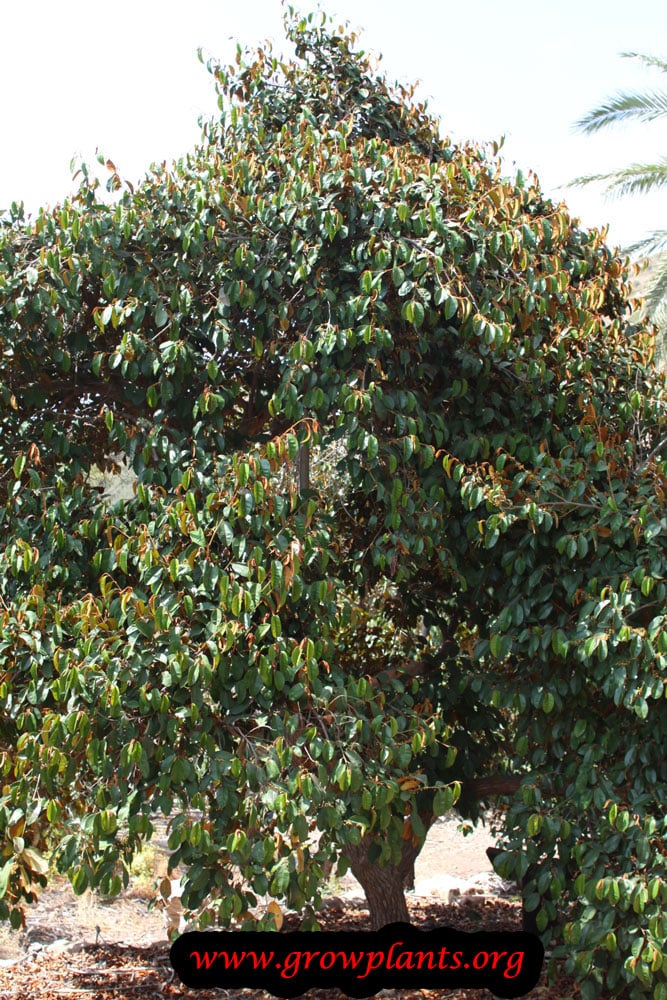
Overview: An evergreen tropical tree growing 8-20 m (24-60 ft) tall, cultivated chiefly for its sweet, milky star apple fruit. It doubles as a striking ornamental thanks to leaves that are glossy green above and golden-red beneath.
Quick Specifications
| Specification | Attribute |
|---|---|
| Plant Type / Life Cycle | Perennial (tree) |
| Foliage Type | Evergreen (semi-deciduous in cooler climates) |
| Mature Size | 8-20 m (24-60 ft) tall, smaller outside the tropics |
| Growth Rate | Slow to moderate |
| Hardiness | USDA zones 11+ (10b with winter protection) |
Growth Form & Structure
- Height & Spread: 8-20 m (24-60 ft) in the ground, smaller outside the tropics; not suited to container growing
- Growth Habit & Form: Broad evergreen tree with a dense, rounded canopy
- Lifespan & Maturity: Long-lived; begins bearing fruit in about 3-5 years in the tropics (5-18 years in cooler areas)
Anatomy & Physical Features
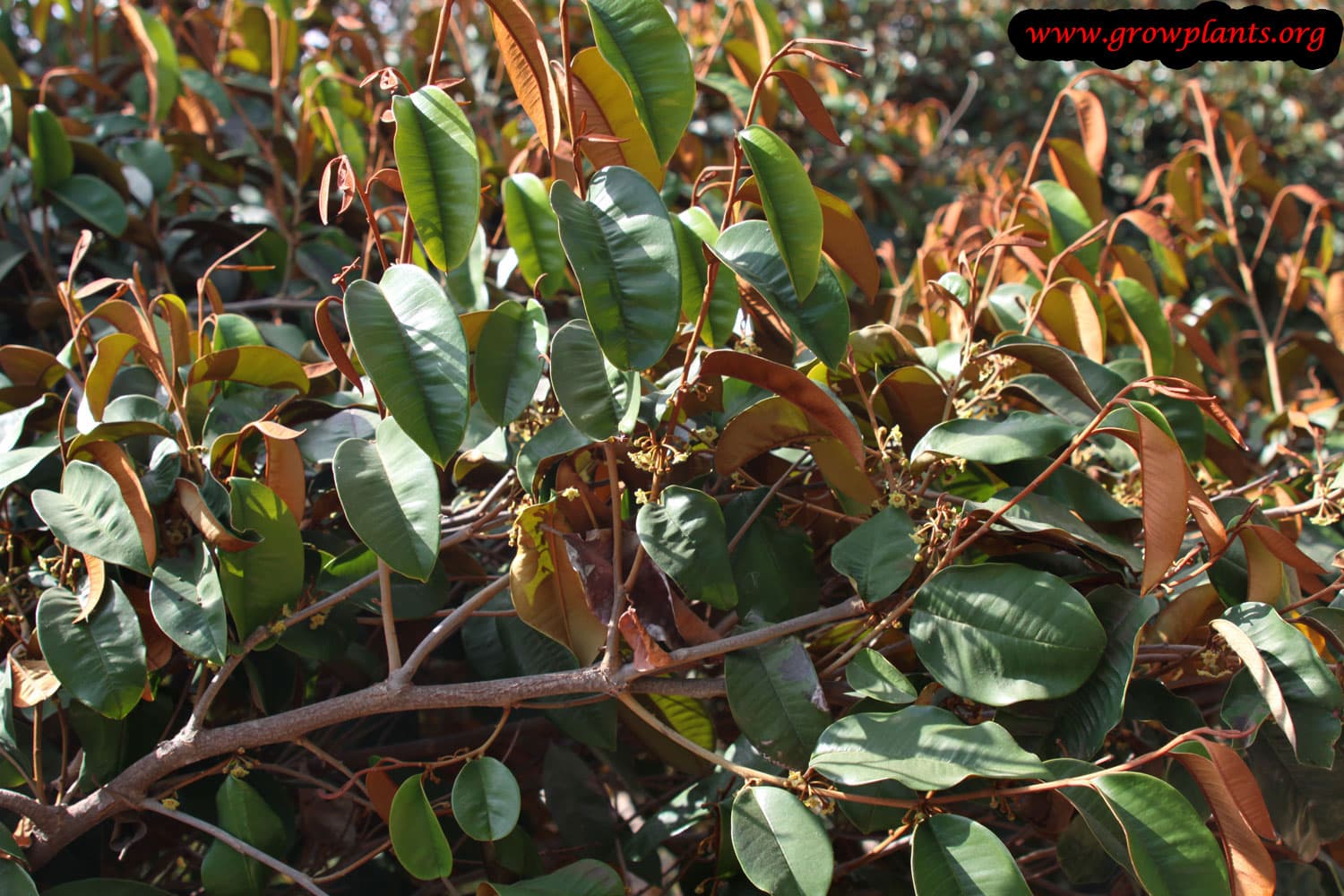
- Leaves & Foliage: Elliptic to oval leaves, glossy green above with a distinctive golden-red, satiny underside
- Flower Characteristics: Small yellow-white flowers borne in clusters
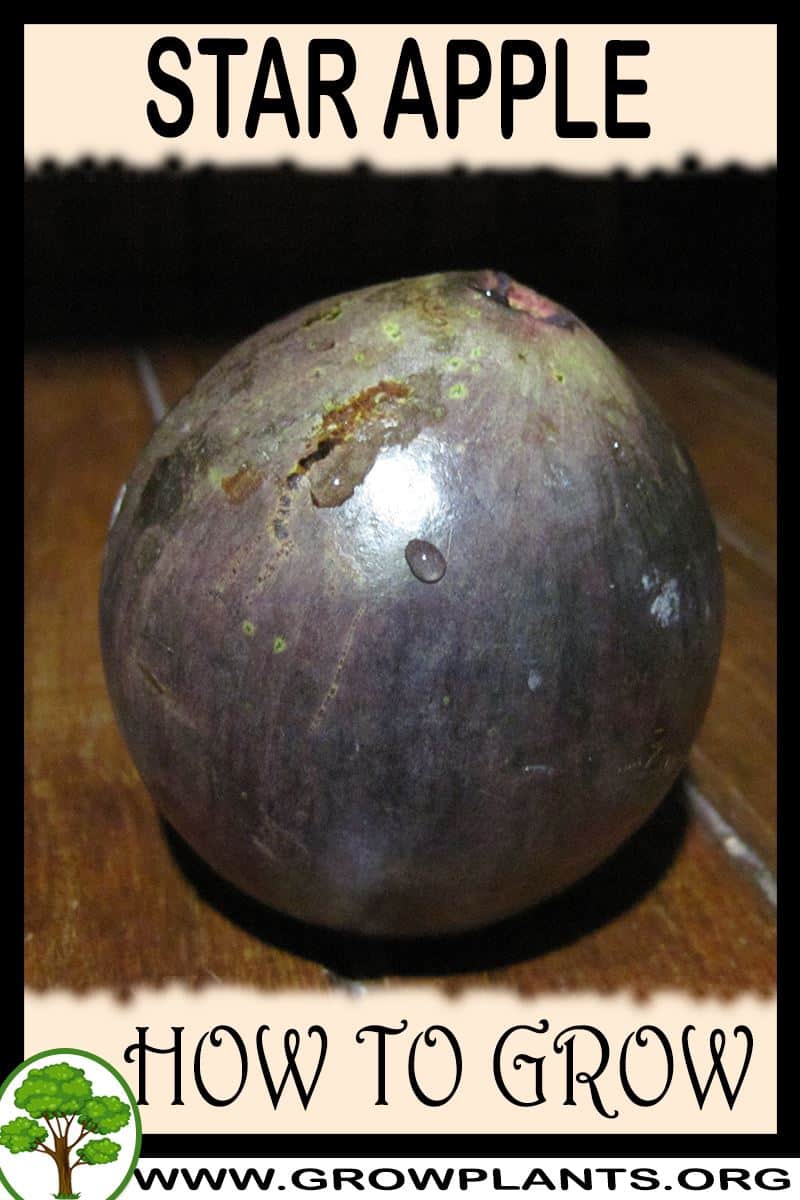
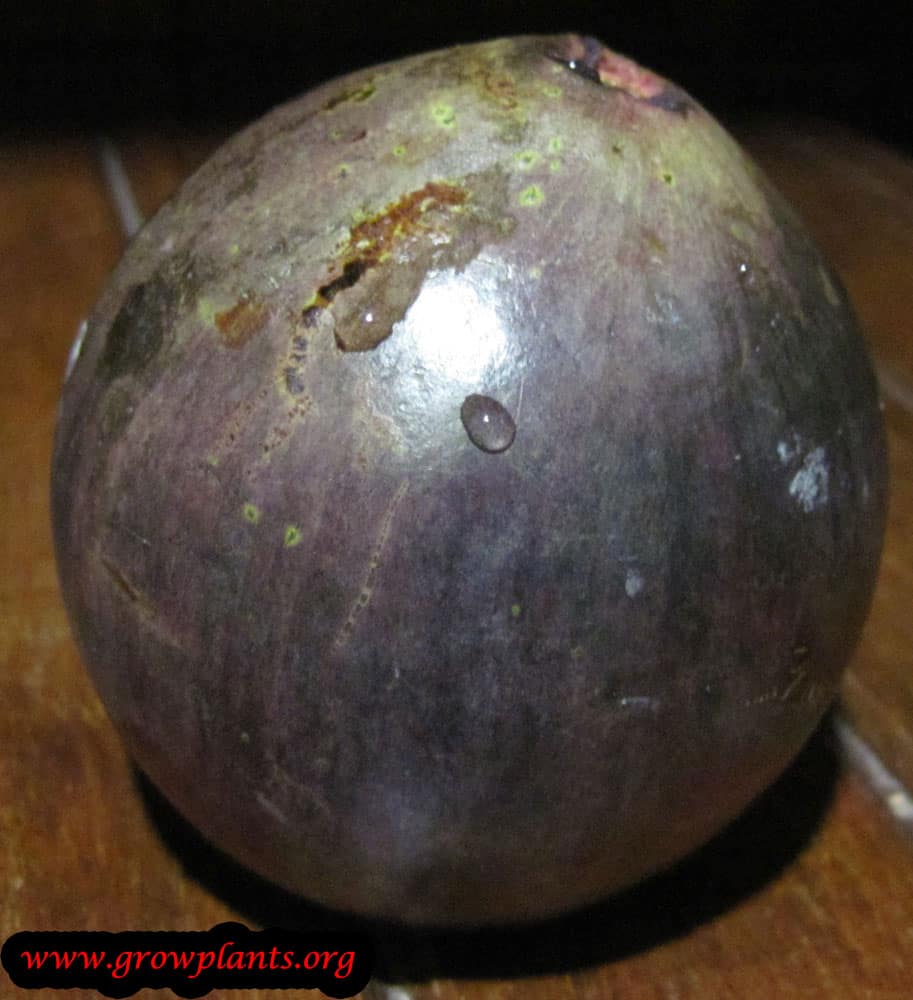
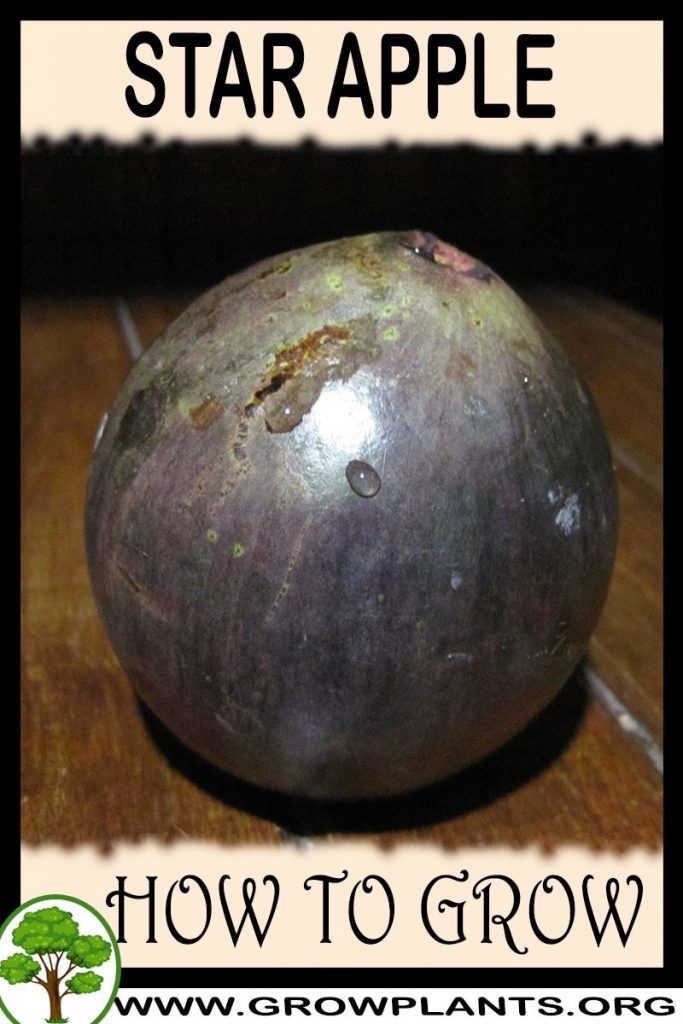
- Fruit Profile: Round purple to green-purple fruit with sweet, milky light-purple-to-white flesh (skin and latex are not eaten)
Primary Uses & Landscape Value
- Edible Uses: Ripe fruit eaten fresh, juiced, or used in cakes
- Functional & Ornamental Roles: Tropical fruit tree and ornamental shade tree with attractive bicolour foliage
Care Guide: Planting, Soil & Watering
Overview: The star apple (Chrysophyllum cainito) is a tropical evergreen fruit tree that needs warmth, full sun to part shade, and deep, rich, organic, well-draining soil kept evenly moist. Young trees are sensitive to cold and harsh sun outside the tropics and need generous but well-drained moisture to establish.
Quick Care Requirements
| Requirement | Ideal Condition |
|---|---|
| Planting Season | Warm season – spring through autumn (year-round in the tropics) |
| Growth Rate | Slow to Moderate |
| Soil Type | Deep, rich, organic, well-draining |
| Water Need | Moderate to High – keep evenly moist, never waterlogged |
Planting & Establishment
- Best Planting Season: Plant in the warm season – spring, summer or autumn (also winter in the tropics). It fruits reliably only in the tropics or a frost-free mediterranean climate (zone 11+, or 10b with winter protection for young trees).
- How to Plant:
- Hole Preparation: Dig a hole as deep as the current root ball plus an extra 20–40%.
- Soil Amendments: Mix organic matter, humus and dried leaves with some soil in the hole, and mulch after planting to hold moisture.
- Planting Depth: Loosen the root ball a little, set the tree so the collar sits at soil level, cover and firm gently so it is stable but not compacted; stake with a cane or bamboo if it is not steady.
- Growth Speed & Expectations: A slow-to-moderate grower reaching 8–20 m in the tropics (smaller elsewhere); a grafted tree fruits in about 3–5 years, and much longer outside the tropics.
Soil, Watering & Drainage Care
- Soil Mix & Drainage Needs: Deep, rich, free-draining soil; it resents waterlogging. It is not suited to container growing.
- Watering Schedule & Technique:
- Young / Newly Planted: Water every day (best in the morning) for the first two weeks; keep young trees mulched and, in marginal zones, shelter them from cold and harsh sun.
- Established: Water regularly and generously so the soil stays moist – it likes an average to large amount of water – but let excess drain freely.
- Seasonal Adjustments: More water in hot, dry weather; ease back in cool weather. In zone 10b, cover young trees over winter with dead leaves and a loose plastic wrap.
Climate, Light & Hardiness
Star apple is a tropical tree, evergreen in warm climates and semi-deciduous where it is cooler, growing in tropical and frost-free Mediterranean climates in full sun to half shade. Cold tolerance differs markedly with age: mature trees are noticeably hardier than young ones, which need winter protection near the cold edge of the range.
Quick Climate Specifications
| Climate Zones | Tropical, frost-free Mediterranean |
|---|---|
| USDA Hardiness Zones | 11+, and 10b with overwinter care while young |
| Optimal Temp Range | warm, generally above approximately 15°C (59°F) |
| Cold Damage Begins | below approximately 5°C (41°F) for young trees |
| Approx. Survival Minimum | mature trees may tolerate briefly down to about 3°C (37°F); young trees can be killed below about 5°C (41°F) |
| Frost Tolerance | Very Low |
| Light Conditions | Full Sun / Half Shade |
| Wind Tolerance | Low (can cause flower thinning) |
Sunlight & Light Exposure
Optimal Light Setup
Full sun to half shade; outside the tropics, young trees are especially sensitive to intense direct sun as well as cold.
Direct Sun Requirement
Beneficial for growth, but young trees outside the tropics need some protection from harsh sun exposure.
Best Exposure / Orientation
A warm, sheltered spot, especially while the tree is young.
Temperature Extremes & Hardiness
USDA Hardiness & Regional Limits
Zone 11+ for reliable outdoor culture; zone 10b is workable with overwinter protection, particularly while the tree is young.
Cold Damage & Winter Protection
Young trees are far more cold-sensitive than mature ones and can die below about 5°C (41°F); in zone 10b, cover young trees (with dead leaves and breathable plastic wrap, keeping air circulating) to at least 0.5 m (2 ft) up the trunk.
Frost Sensitivity
Very high, especially while young; mature trees have somewhat more buffer but remain frost-sensitive.
Extreme Heat Tolerance
Good in genuinely tropical heat; prefers warmth above roughly 15°C (59°F).
Wind, Humidity & Microclimate
Wind Tolerance
Fairly low during flowering – wind can cause flowers to thin out and reduce fruit set.
Rainfall & Seasonal Moisture
Suited to tropical rainfall patterns; benefits from consistent moisture.
Microclimate Recommendations
A warm, sheltered, wind-protected site benefits both cold tolerance and flowering/fruit set, especially while the tree is young.
Growing in Pots, Balconies & Indoors
The star apple (Chrysophyllum cainito) is a large tropical tree, reaching roughly 8-20 m (24-60 ft), and the grower confirms it is neither a houseplant nor a lasting container plant. At most a young seedling can spend its first years in a big tub before it needs the open ground.
Quick Details
- Container Size: Only viable while young – a large tub (40 L+ / 10 gal+); it soon outgrows any pot
- Indoor Suitability: Not suitable indoors
- Best Spot: Full sun to half shade, outdoors in a warm, frost-free climate
- Soil & Drainage: Rich, free-draining mix; keep evenly moist
- Watering in Pots: Average to generous – a potted young tree dries fast, so never let it fully dry out
Indoors & On the Windowsill
- Houseplant limits: This is a forest tree, not a houseplant – it grows far too large and needs strong light no room can provide.
- Young plants & overwintering: While young it is sensitive to cold and to harsh sun; in a cold climate a potted seedling can be moved to a bright, frost-free spot for the cool season, but plan to plant it out in the ground eventually.
On a Balcony or Patio
- Young specimen only: A seedling in a large tub can enjoy a warm, sunny patio for a few seasons. Walls and paving reflect heat and pots dry quickly, so check moisture often; shelter the young plant from cold winds.
Choosing the Pot, Soil & Long-Term Care
- Pot & drainage: Use a pot with plenty of drainage holes; skip a standing water saucer to avoid root rot. Terracotta breathes and dries faster, while glazed or plastic pots hold moisture longer.
- Potting mix: A well-aerated, organic-rich mix – peat or coir blended with perlite or vermiculite for drainage.
- Feeding: Potted plants need feeding more often than those in the ground, as nutrients leach out with each watering – feed lightly through the active growing season.
- Repotting: Refresh the mix or pot up about every two years; for an established specimen, replace part of the soil and lightly prune the roots and top growth.
Growing this plant in a greenhouse
A greenhouse can give star apple frost protection, cold protection, humidity control and extra warmth.
Greenhouse at a glance
| Greenhouse suitability | Conditional - depends on your climate |
|---|---|
| Main benefits | frost protection, cold protection, humidity control, extra warmth |
| Season extension | earlier spring & later autumn |
| Outdoor protection advisable below | about 10°C |
| Maintain greenhouse minimum | around 15°C for active growth |
| Suitable types | heated greenhouse, polycarbonate greenhouse |
| Heating | Heating is recommended in cold climates for continuous growth. |
Related greenhouse guides
- Greenhouses: How to Choose the Right Greenhouse
- Best Greenhouse Heaters
- Greenhouse Climate Control: Temperature, Ventilation and Humidity
- Polycarbonate Greenhouses: What to Look for Before Buying
Fertilizing & Feeding
Star apple grows into a substantial tropical tree that responds well to steady, moderate feeding paired with organic matter and mulch, tapering off as it matures into a settled bearing routine.
Quick Fertilizing Specs
| Feeding Level | Moderate; organic matter and mulch are a core part of its usual care alongside regular feeding. |
|---|---|
| young_feeding | A nitrogen-forward approach supports canopy development while the tree is young and not yet bearing. |
| mature_feeding | Balanced feeding through flowering, easing toward potassium-conscious feeding as the milky-fleshed fruit develops. |
| Main Nutrient Priority | Balanced nutrition overall, with extra nitrogen while young and attention to potassium during fruiting. |
| Best Feeding Period | Through the warm, active growing season. |
| Organic Options | Compost, mulch and other organic matter suit this tree well and are part of its typical care. |
| Reduce/Stop Feeding | Ease off feeding heading into the cooler part of the year, particularly while the tree is still young and cold-sensitive. |
Feeding by Growth Stage
Newly planted
Help a newly planted star apple settle its roots into organic-matter-amended soil and put out its first flush of glossy green, golden-backed leaves.
| Nutrient direction | Light, balanced nutrition focused on root establishment rather than pushing top growth. |
|---|---|
| Timing | In the weeks and months after planting, while the young tree is still becoming established. |
| Frequency | A light feeding at planting, with further light feedings only once new growth shows the tree has rooted in. |
| Fertilizer types | A balanced complete fertilizer used lightly, Compost, hummus and mulch worked into the planting area |
| Precautions | Young star apple trees are frost-sensitive, so protect newly planted trees through their first cool season rather than pushing soft new growth with heavy feeding going into winter. |
Young, non-bearing tree
Build a strong framework of branches and canopy on a young star apple before it begins bearing fruit.
| Nutrient direction | A nitrogen-forward feeding approach to encourage steady vegetative growth and canopy development. |
|---|---|
| Timing | Through the active growing season as the young tree puts on new growth. |
| Frequency | Several light feedings spread across the growing season suit a young, actively growing tree better than one heavy application. |
| Fertilizer types | A nitrogen-forward complete fertilizer for young trees, Organic matter and mulch to build soil fertility |
| Routine trace nutrients | iron, manganese, zinc |
| Precautions | Keep mulch pulled slightly back from the trunk, and ease off feeding heading into the cooler part of the year while the tree is still young and cold-sensitive. |
Established, pre-bearing
Support a maturing star apple that has outgrown its cold-sensitive juvenile stage as it approaches its first fruit set.
| Nutrient direction | Shift toward balanced feeding that supports continued canopy growth alongside the onset of flowering. |
|---|---|
| Timing | Through the active growing season as the tree matures toward its first crop. |
| Frequency | Regular light-to-moderate feedings through the growing season support a tree maturing toward its first harvest. |
| Fertilizer types | A balanced complete fruit-tree fertilizer, Organic matter and mulch maintained around the root zone |
| Routine trace nutrients | iron, manganese, zinc |
| Precautions | Avoid pushing excessive late-season nitrogen, which can favor leafy growth over the flowering the tree needs for its first fruit set. |
Mature, fruit-bearing
Support a mature, fruit-bearing star apple through flowering and the development of its purple, milky-fleshed fruit.
| Nutrient direction | Balanced nutrition through flowering, shifting toward potassium-conscious feeding as fruit develops. |
|---|---|
| Timing | Through the active growing season, spanning flowering and fruit development. |
| Frequency | Regular, moderate feedings through the growing season support flowering and fruit development better than a single heavy application. |
| Fertilizer types | A balanced to potassium-conscious complete fruit-tree fertilizer, Organic matter and mulch maintained around the root zone |
| Routine trace nutrients | iron, manganese, zinc |
| Precautions | Keep feeding consistent rather than heavy and infrequent, and ease off as the fruit approaches harvest. |
Nutrient Deficiency Signs & Corrections
Leaves yellow between the veins while the veins themselves stay dark green.
| Possible causes | High soil pH limiting iron or manganese availability, Waterlogged or compacted soil restricting root uptake, A genuine iron or manganese shortage in the soil |
|---|---|
| Appears first on | New growth toward the branch tips. |
| What to check | Soil pH and drainage, Whether only the newest leaves are affected, Recent watering and root health |
| Possible correction | Correct soil pH and drainage first; if yellowing persists, apply a chelated iron or manganese product per its label. |
Overall leaf color is pale and new growth stays thin and undersized rather than filling out the canopy.
| Possible causes | A general nitrogen shortage in poor or sandy soil, Root competition or crowding from nearby plants, Insufficient light for a young or shaded tree |
|---|---|
| Appears first on | New growth across the canopy. |
| What to check | Recent feeding history and soil fertility, Light exposure, Root zone competition |
| Possible correction | Confirm light and root conditions are adequate, then step up to a nitrogen-forward feeding if pale, thin growth continues. |
The tree flowers but sets little or no fruit.
| Possible causes | Insufficient pollinator activity during the flowering period, A boron shortage affecting flower and fruit development, A young tree flowering before it is physiologically ready to bear |
|---|---|
| Appears first on | The flower clusters and developing fruit. |
| What to check | Bee activity during bloom, Tree age and bearing history, Whether a soil or tissue test points to a boron shortage |
| Possible correction | Support pollinator activity, and only where a boron shortage is confirmed, apply a boron product carefully per its label – boron has a narrow margin between correction and toxicity. |
Pruning, Training & Seasonal Maintenance
Star apple needs only modest, mostly corrective pruning — the plant’s own care notes describe pruning about once a year, focused on removing weak and dead wood and lightly shaping the tree, not a heavy structural regime. The safest window is autumn into winter, ideally right after the fruit is picked, except in marginal hardiness zone 10b, where young trees are cold-sensitive and pruning is better delayed until spring after the tree has had a full season to establish. Because this is a large tree (8–20m in the tropics, smaller outside it) grown for fruit, timing mainly affects crop continuity and the cold-hardiness of young wood, not flowering itself.
Quick Pruning & Maintenance Specs
| Pruning Tolerance | Moderate |
| Primary Pruning Window | Autumn–Winter (post-harvest) in warm zones |
| Secondary Maintenance Window | Spring, for young trees in hardiness zone 10b |
| Typical Frequency | About once a year |
| Main Objective | Remove weak and dead wood; light shaping |
| Young Plant Priority | In zone 10b, let the tree establish size before shaping cuts and protect it from cold |
| Mature Plant Priority | Routine removal of weak/dead wood; shape maintenance |
| Best Tool Type | Bypass secateurs, loppers, or pruning saw depending on branch size |
| Avoid Heavy Pruning During | Autumn, on young trees in hardiness zone 10b (cold-sensitivity risk) |
Pruning by Plant Age & Size
Newly Established
Minimal pruning; in zone 10b, prioritize winter protection of young trees over shaping cuts.
Young / Formative
In consistently warm zones, develop an open, evenly-spaced branch framework. In hardiness zone 10b, let the tree grow up first, then begin formative pruning in spring once frost risk has passed — pruning in autumn/winter here risks pushing tender new growth into the cold.
Mature / Established
Routine removal of weak and dead branches; light shaping; keep the canopy manageable for harvest.
Seasonal Pruning Schedule
Post-Harvest (Autumn–Winter, warm zones)
Objective: remove weak and dead branches and shape once the crop is off the tree. Avoid: cuts that force a vegetative flush right before cold weather in marginal areas.
Pre-Growth / Early-Spring (zone 10b young trees only)
Objective: formative and corrective pruning once frost risk has passed, since autumn/winter cuts on young trees in this marginal zone expose tender new growth to cold.
Flowering & Fruiting Wood
Bloom follows an annual cycle occurring in winter in the tropics or spring outside them, with fruit set the following season. Pruning right after harvest, ahead of the next bloom cycle, avoids removing the wood that would carry the next flowering flush; avoid heavy cuts immediately before bloom.
Structural Pruning & Training
The focus here is corrective (weak and dead wood) rather than an imposed framework. Crossing or structurally weak branches should be removed to reduce future breakage, especially on a tree that reaches this large a mature size.
Special Growth to Remove
Weak, poorly-attached branches and dead wood, per the plant’s own care notes.
Tools
- bypass_secateurs — small dead/weak-wood cuts.
- loppers — mid-size branches.
- pruning_saw — larger structural removals once the tree matures toward 8–20m.
Tool Hygiene & Disease Risk
Routine — clean, sharp tools. Recorded pest pressure (aphids, Prodenia caterpillar) is not a documented tool-transmitted disease for this species.
Cut Placement & Technique
Use thinning cuts (remove weak or dead branches at their origin, just outside the branch collar) rather than heading cuts, to avoid stimulating a thicket of weak regrowth on a tree that is already prone to producing weak branches.
Heavy Pruning & Rejuvenation
Not indicated by this species’ moderate, once-a-year routine. Avoid hard rejuvenation cuts, particularly on young trees in marginal zone 10b, where cold sensitivity is already a documented risk.
Post-Pruning Care
In zone 10b, protect young trees’ pruning wounds and new growth from cold using the same mulch/cover practice already used for the whole plant. Avoid fertilizing specifically to force regrowth right before winter in marginal zones, since new soft growth is the most cold-sensitive tissue.
Common Pruning Mistakes
- Pruning young trees in autumn in marginal zone 10b and pushing tender growth into the cold season.
- Leaving weak, poorly-attached branches on this large tree until they break under fruit load.
When NOT to Prune
Avoid pruning young trees in autumn/winter in hardiness zone 10b — shift to spring instead. Avoid heavy cuts right before the bloom period.
Recommended Tools (by task)
- Routine removal of weak/dead twigs and light shaping: bypass_secateurs — matches the plant’s own light-touch, once-a-year routine.
- Removing mid-size weak or crossing branches on an establishing tree: loppers — for typical young-to-semi-mature branch diameters.
- Structural removal of large limbs on a mature tree: pruning_saw — needed once the tree reaches its mature 8–20m size.
Pruning Troubleshooting
| Problem | Possible Cause | What to Check | Corrective Action |
| Broken branches after fruit set | Weak branch attachment left unpruned | Branch angles and any previously-noted weak growth | Remove weak branches proactively during the annual post-harvest prune |
| Cold damage on a young tree after autumn pruning | Pruning stimulated new growth before winter in zone 10b | Timing of the last prune relative to first frost | Shift pruning to spring for young trees in marginal zones |
Propagation Guide
Star apple can be grown from seed, but the site notes that air layering – rated even more effective than grafting – is the preferred way to get a small tree that bears good-quality fruit sooner, especially outside the tropics. Difficulty is Moderate: seed needs consistent tropical warmth and humidity, and young trees are notably sensitive to cold and strong sun.
Quick Propagation Specs
| Best Propagation Method | Seed for a straightforward start; air layering is the site’s preferred vegetative method, rated ahead of grafting, for fruiting quality and speed |
| Alternative Methods | Grafting |
| Propagation Difficulty | Moderate |
| Seed True-to-Type | Variable – vegetative propagation (air layering preferred, or grafting) is recommended to ensure fruit quality and bring the tree into bearing sooner, particularly outside the tropics |
| Vegetative True-to-Type | Yes |
| Best Propagation Season | Spring to summer for sowing; the site’s general planting season is spring, summer, autumn (also winter in the tropics) |
| Seed Germination Time | 2–12 weeks, depending on conditions |
| Germination Temperature | At least about 26°C (79°F) |
| Seed Sowing Depth | 1–2 cm (0.5–1 in) |
Stem cuttings are also a possible vegetative method alongside air layering.
Growing from Seed
Seed Handling & Viability
Store seed in a dry, dark location at room temperature until sowing.
Sowing Season
Spring to summer.
Sowing Depth & Orientation
Sow in a hole about 4 times the size of the seed, in a mix of peat soil with perlite or vermiculite, covered lightly – the vermiculite helps keep the seed moist. The site recommends starting seed in individual pots rather than sowing directly, partly because this keeps the option open to graft the young tree later. Where transplanting from a nursery bed, space seedlings about 40×60 cm (16×24 in); direct, un-transplanted spacing is about 5×4 m (15×12 ft).
Germination Conditions
Moist soil and hot weather with high humidity, at least about 26°C (79°F).
Germination Time
2–12 weeks, depending on conditions.
Seedling Care
Keep seedlings warm and humid with consistently moist soil; in hardiness zone 10b, cover young seedlings over winter.
Air & Ground Layering
The site notes air layering is even more effective than grafting for producing a small, fruiting tree, and that vegetative propagation (by either method) helps ensure fruit quality and brings the tree into production sooner outside the tropics. The site does not detail the exact technique; standard practice for a woody tropical fruit tree is to wound or girdle a semi-hardwood branch, pack the wound with moist sphagnum moss or a similar medium, wrap it in plastic to hold moisture, and sever the rooted section once roots are well developed. (General method, added with caution – not from the site’s own data.)
Grafting & Budding
Why Grafting Is Used
As an alternative to air layering, grafting is not strictly required but can help ensure fruit quality and earlier bearing outside the tropics.
Bloom & Flower Guide
Quick Details
- Bloom Season: Winter in the tropics; spring in cooler subtropical areas
- Flower Appearance: Small (1-4 mm) yellow-white flowers in clusters
- Edibility: The flower is not eaten; the tree is grown for its edible star apple fruit
Detailed Blooming Overview
Star apple carries clusters of small, lightly fragrant yellow-white flowers along its shoots. The timing shifts with climate – winter flowering in the tropics, spring in cooler areas.
Flower Characteristics
- Small yellow-white flowers, 1-4 mm, in clusters; lightly fragrant.
Bloom Care & Thinning
- Pollination: Mainly bees.
- Thinning: Wind can naturally shed some of the bloom.
Fruit & Uses
Star apple is grown for its round fruit, eaten fresh for its sweet, milky-textured flesh once fully soft; the peel and seeds are not eaten. It is mainly eaten raw out of hand, though the pulp can also be juiced or used in cakes.
Quick Edible Specs
| Edible Parts | Fruit flesh only (peel and seeds excluded) |
|---|---|
| Main Use(s) | Fresh eating, juice, cakes |
| Eaten Raw or Cooked | Raw |
| Preparation Required | Peel and deseed – cut the fruit in half and scoop out the flesh, discarding skin and seeds |
| Harvest Season | Spring to summer in tropical climates; summer in non-tropical areas |
| Time to First Harvest | Several years after planting, longer outside a true tropical climate – see Propagation for grafting effects |
| Storage | Best eaten once fully ripe and soft; handle gently as the ripe fruit softens like other soft fruit |
| Safety/Toxicity Caveat | Peel and seeds are not eaten; stick to the soft inner flesh |
Fruit
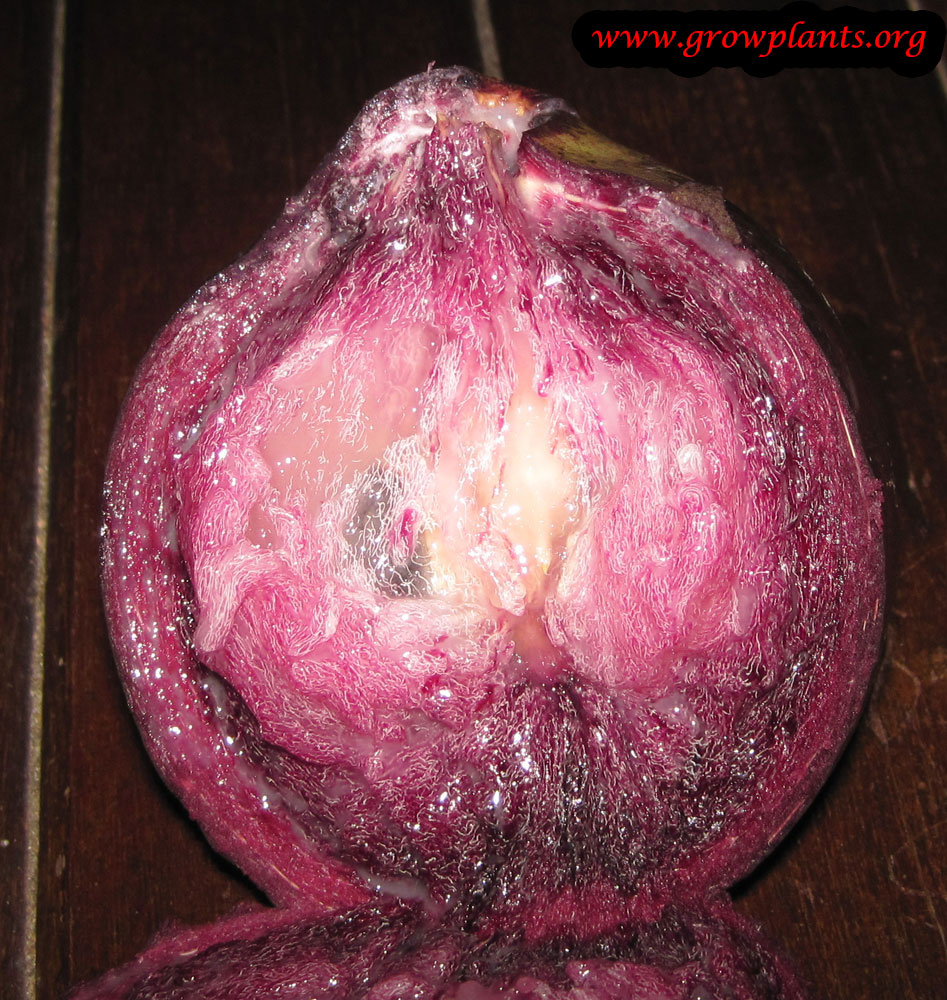
The fruit is purple with a green-purple shell; inside it is light purple to white with a sweet, milk-like, faintly latex-textured pulp (the origin of the “star apple / milk fruit” name – sliced crosswise, the flesh shows a star-shaped pattern). To eat it, cut the fruit in half and scoop out the flesh with a spoon; the peel and seeds are set aside and not eaten.
Preparation, Uses & Safety
The scooped flesh is eaten fresh, chilled, or used to make juice and cakes. Always discard the peel and seeds rather than eating them along with the flesh – the site’s own care notes are explicit that only the inner fruit is for eating.
Pests, Diseases & Troubleshooting
Overview: Star apple is a robust tropical fruit tree (Sapotaceae) with relatively few serious pests, its main threats being sap-sucking scale and mealybugs, fruit flies in the ripening fruit, and fungal or algal leaf and fruit spotting in humid conditions. Good drainage, orchard sanitation and prompt collection of dropped fruit keep it healthy.
Quick Troubleshooting Overview
| Issue / Pest | Main Symptom | Primary Solution |
|---|---|---|
| Scale insects | Bumps on twigs/leaves, sooty mould | Prune, horticultural oil, conserve parasitoids |
| Mealybugs | White cottony masses, honeydew | Oil/soap, ant control, beneficials |
| Fruit flies | Maggots and rot in ripening fruit | Bag fruit, traps, collect & destroy drops |
| Aphids | Curled tips, honeydew on new flush | Water jet, soap, beneficials |
| Anthracnose | Dark sunken spots on leaves/fruit | Sanitation, airflow, copper fungicide |
| Algal leaf spot | Rusty velvety spots on leaves | Improve airflow/light, copper |
Common Pests & Management
- Scale insects (Coccus spp., Aonidiella spp.):
- Symptoms: Fixed brown, black or waxy bumps along twigs, leaf veins and fruit; sticky honeydew and black sooty mould follow, and heavy infestations weaken shoots.
- Prevention & Control: Prune out and destroy encrusted twigs, and scrub or wipe accessible limbs. Conserve parasitic wasps and ladybird predators, and control the ants that farm scale. Horticultural oil smothers crawlers – cover leaf undersides and repeat.
- Mealybugs (Planococcus citri, Ferrisia virgata):
- Symptoms: White cottony clusters in leaf axils, under leaves and where fruit meets stalk; honeydew, sooty mould and stunted new growth.
- Prevention & Control: Dislodge with a water jet or a dab of horticultural oil/insecticidal soap. Control tending ants, conserve ladybirds and lacewings, and remove heavily infested fruit clusters.
- Fruit flies (Anastrepha spp., Bactrocera dorsalis, Ceratitis capitata):
- Symptoms: Females sting ripening fruit; maggots tunnel the pulp, which softens, browns and drops prematurely.
- Prevention & Control: Bag developing fruit, hang protein-bait or lure traps, and – most important – collect and destroy all fallen and over-ripe fruit to break the breeding cycle. Harvest promptly at maturity.
- Aphids (Aphis spp., Toxoptera spp.):
- Symptoms: Colonies on tender new flush and flower flushes, causing curled, distorted tips, honeydew and sooty mould.
- Prevention & Control: Hose off colonies, conserve ladybirds and hoverflies, and spot-treat soft growth with insecticidal soap or neem oil. Avoid excess nitrogen that pushes soft flushes.
Diseases & Fungal Issues
- Anthracnose (Colletotrichum gloeosporioides):
- Symptoms: Dark, sunken spots on leaves, shoot tips and especially fruit, expanding in warm wet weather with pink-orange spore masses; causes fruit rot and dieback.
- Treatment & Management: Prune for airflow, remove infected leaves and mummified fruit, and avoid overhead wetting. Copper-based protectant fungicide during prolonged wet spells; harvest and handle fruit carefully to limit post-harvest rot.
- Algal leaf spot (Cephaleuros virescens):
- Symptoms: Circular rusty-orange, slightly raised velvety patches on leaves (and sometimes bark) in shady, humid, crowded canopies.
- Treatment & Management: Open up the canopy for light and airflow, remove worst-affected leaves, keep the tree vigorous, and apply copper if widespread.
- Leaf spots and sooty mould (Pseudocercospora spp.; sooty mould fungi on honeydew):
- Symptoms: Brown angular leaf spots; separately, a black sooty film coating leaves and fruit wherever sap-suckers leave honeydew.
- Treatment & Management: Rake and destroy fallen leaves, improve ventilation, and control the underlying scale/mealybug/aphid populations – the sooty mould clears once the honeydew stops. Copper helps with true leaf spots.
- Root and collar rot (Phytophthora spp., Pythium spp.):
- Symptoms: Wilting, dieback and dark, decayed roots or basal bark on trees in heavy, waterlogged soil.
- Treatment & Management: Plant on a mound in free-draining soil, keep irrigation off the trunk, and avoid waterlogging. Remove severely affected trees; improve drainage before replanting.
Growing Difficulties & Abiotic Problems
- Cold and wind damage:
- Cause & Symptoms: This lowland tropical tree is frost-sensitive; cold snaps blacken young growth and chilling winds scorch leaves and drop fruit.
- Correction Strategy: Site in a warm, sheltered, frost-free spot, protect young trees over cold nights, and use windbreaks near the coast.
- Fruit drop and poor set:
- Cause & Symptoms: Young fruit drops from water stress, erratic irrigation or heat during flowering.
- Correction Strategy: Keep soil moisture even, especially through flowering and fruit fill, mulch to buffer the root zone, and feed in balance.
- Iron/zinc chlorosis on alkaline soil:
- Cause & Symptoms: Interveinal yellowing of new leaves on high-pH or waterlogged soils.
- Correction Strategy: Correct pH toward neutral-acidic, improve drainage, and apply chelated iron or a micronutrient foliar feed.
- Sticky latex staining:
- Cause & Symptoms: Cut or bruised fruit and shoots exude sticky white latex that stains hands and skins (a normal trait, not disease).
- Correction Strategy: Harvest cleanly at full maturity and handle fruit gently to reduce latex flow and blemishing.
What Helps – Products & Tools
Manage this tree mainly through sanitation, canopy airflow and good drainage. Useful products include horticultural oil and insecticidal soap (scale, mealybugs, aphids), fruit-fly lure/protein-bait traps and fruit bags, and copper-based protectant fungicide for anthracnose and algal leaf spot. Time oil sprays for the evening to protect pollinators.