

Plant Profile & Key Characteristics
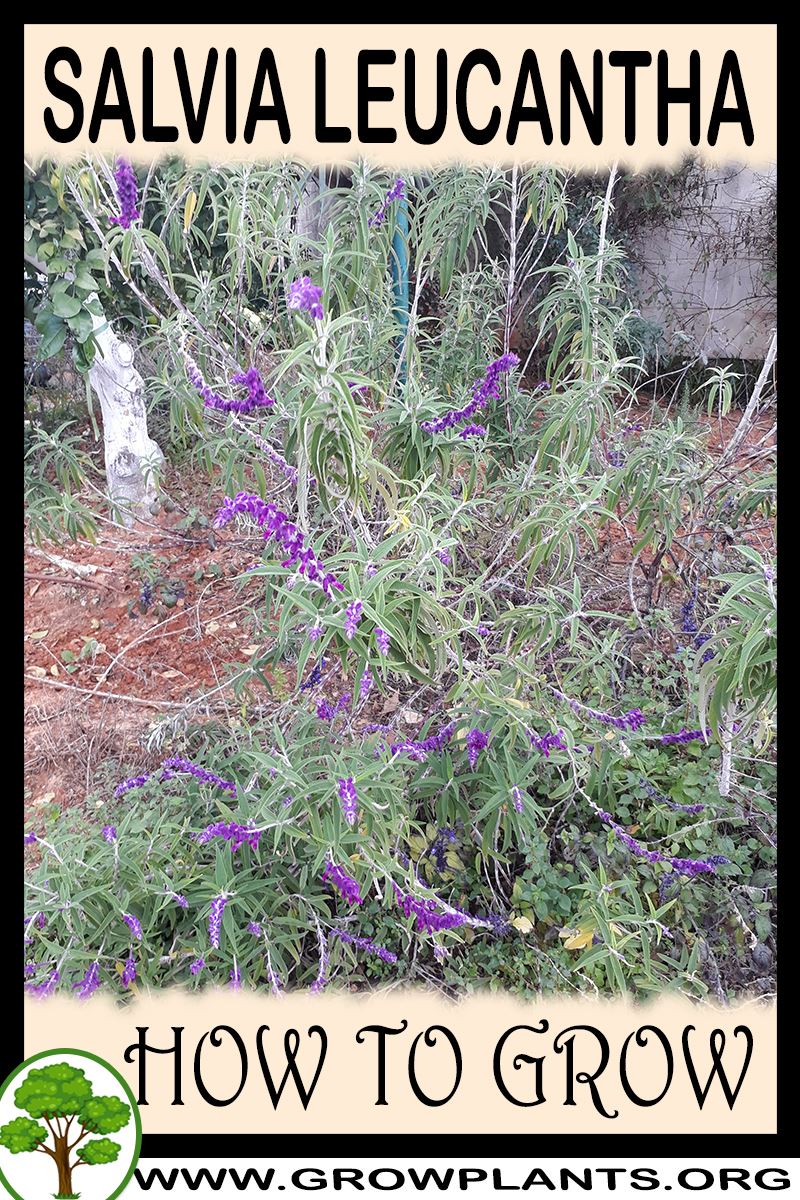
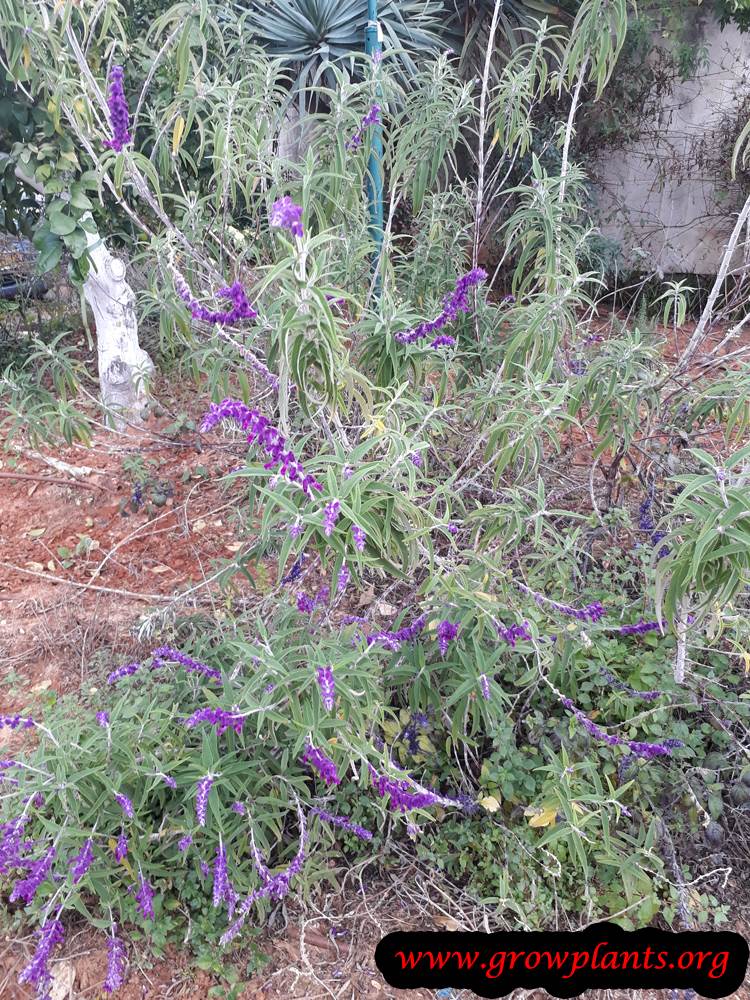
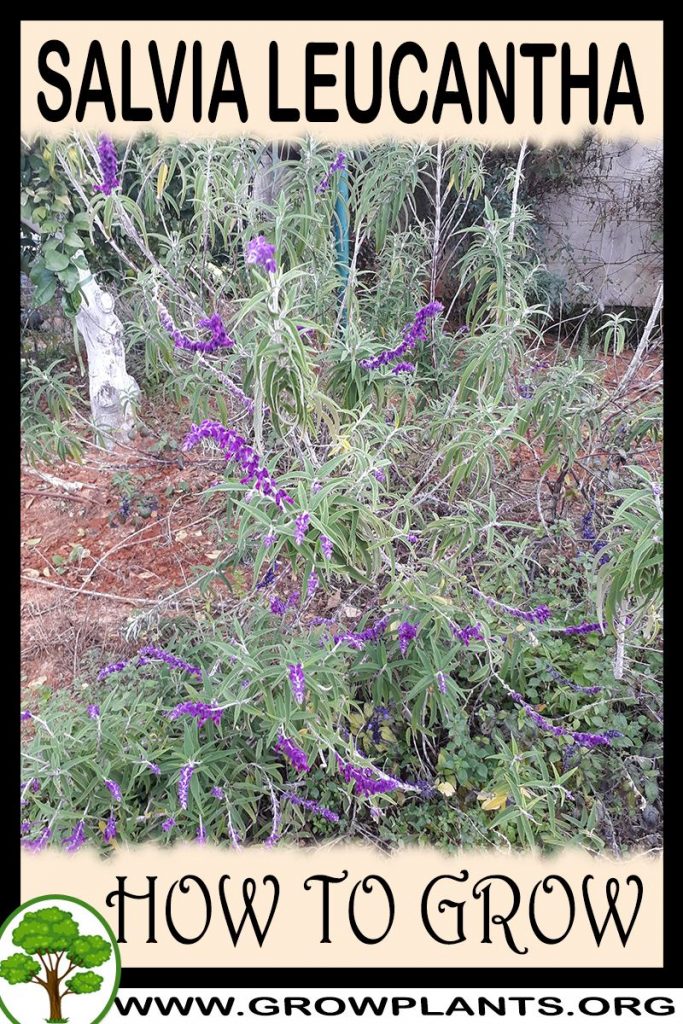
Overview: Mexican bush sage, an evergreen shrub 1-2 m (3-6 ft) tall, grown as an ornamental for its arching spikes of velvety purple-and-white flowers. It is a fast-growing, drought-tolerant, pollinator-friendly perennial.
Quick Specifications
| Specification | Attribute |
|---|---|
| Plant Type / Life Cycle | Evergreen perennial shrub |
| Foliage Type | Evergreen in frost-free climates |
| Mature Size | 1-2 m (3-6 ft) tall |
| Growth Rate | Fast |
| Hardiness | USDA zone 8b and warmer |
Growth Form & Structure
- Height & Spread: A large shrub 1-2 m (3-6 ft) tall in the ground; also grown in a 10-20 L (2.6-5.2 gal) container with free-draining soil.
- Growth Habit & Form: Vigorous, arching, clump-forming shrub that makes a large mound; can be aggressive and is renewed by hard pruning.
- Lifespan & Maturity: A perennial that reaches size quickly, flowering heavily into autumn.
Anatomy & Physical Features
- Leaves & Foliage: Narrow, ovate to elliptic grey-green aromatic leaves.
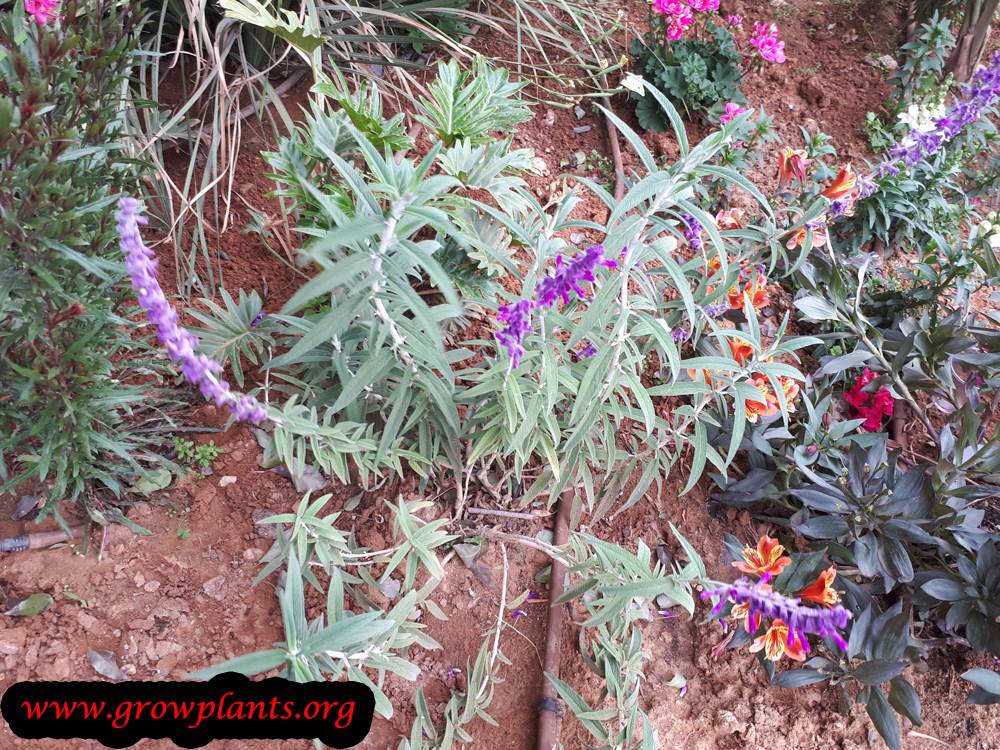
- Flower Characteristics: Arching spikes of velvety purple (or purple-and-white) flowers, very attractive to pollinators.
Primary Uses & Landscape Value
- Functional & Ornamental Roles: A bold late-season border ornamental and cut flower, drought tolerant and excellent for pollinator gardens and large containers.
Care Guide: Planting, Soil & Watering
Overview: Mexican bush sage (Salvia leucantha) is a fast-growing shrubby sage for full sun to light shade in well-draining soil enriched with organic matter. It is drought-tolerant once established, needing only modest water and sharp drainage.
Quick Care Requirements
| Requirement | Ideal Condition |
|---|---|
| Planting Season | Spring, summer or autumn |
| Growth Rate | Fast |
| Soil Type | Rich, well-draining soil |
| Water Need | Low to moderate — drought-tolerant once established; let the top few cm dry out between waterings |
Planting & Establishment
- Best Planting Season: Plant in spring, summer or autumn in mild, frost-free zones; where grown as an annual, plant in spring after the last frost.
- How to Plant:
- Hole Preparation: Dig a planting hole roughly twice as wide as the root ball but no deeper, so the roots can spread into loosened soil.
- Soil Amendments: Mix in some compost or organic matter, but keep drainage sharp — add grit on heavy soils so water never sits around the roots.
- Planting Depth: Set the plant at the same depth it grew in its pot, with the root collar level with the surface — never bury the stem, which invites rot.
- Growth Speed & Expectations: Expect fast growth in warm, favourable conditions, filling out its space within a single season.
Soil, Watering & Drainage Care
- Soil Mix & Drainage Needs: Provide rich but well-aerated soil that drains freely; in containers use a quality potting mix lightened with perlite or vermiculite, and ensure the pot drains freely so water never pools around the roots.
- Watering Schedule & Technique:
- Young / Newly Planted: Water regularly right after planting to settle the roots, keeping the soil lightly moist while the plant establishes.
- Established: Once established it is drought-tolerant — water deeply but infrequently, letting the top few centimetres dry out before watering again.
- Seasonal Adjustments: Increase watering during prolonged heat and cut right back over the cool, wet season, since soggy soil is the main cause of rot.
Climate, Light & Hardiness
Salvia leucantha (Mexican bush sage) grows in subtropical, Mediterranean, and tropical climates in full sun to half shade. It prefers temperatures above about 5°C (41°F) and is reliably perennial in warmer zones, with the marginal edge of its range needing extra winter care.
Quick Climate Specifications
| Climate Zones | Subtropical, Mediterranean, Tropical |
|---|---|
| USDA Hardiness Zones | 8b+ as a perennial, extending to zone 8a with proper overwinter care |
| Optimal Temp Range | Prefers temperatures above approximately 5°C (41°F) |
| Frost Tolerance | Low to Moderate |
| Light Conditions | Full Sun / Half Shade |
Sunlight & Light Exposure
Optimal Light Setup
Full sun to half shade both suit the plant; full sun generally produces the heaviest bloom.
Direct Sun Requirement
Tolerates direct sun for most of the day, with half shade acceptable in hotter climates.
Temperature Extremes & Hardiness
USDA Hardiness & Regional Limits
Reliably perennial from zone 8b upward. In zone 8a it can survive winter with proper overwinter care, though it may still be grown as an annual further north where the growing season is too short to establish from seed.
Cold Damage & Winter Protection
Mulching the base with wood chips or dead leaves ahead of winter protects the crown; sustained cold below roughly 5°C (41°F) stresses the plant and colder freezes kill top growth back to the ground.
Frost Sensitivity
Frost typically kills top growth, with the plant regrowing from the roots the following spring within its hardiness range; at the coldest edge of that range (zone 8a), this regrowth depends on adequate winter protection.
Extreme Heat Tolerance
Handles hot, subtropical and tropical summer heat well.
Growing in Pots, Balconies & Indoors
Salvia leucantha (Mexican bush sage) is not a houseplant, but the grower grows it well in containers – it is an excellent sunny balcony, patio or courtyard plant in a free-draining pot, flowering generously for pollinators.
Quick Details
- Container Size: 10-20 L (2.6-5.2 gal) (grower’s value)
- Indoor Suitability: Not an indoor plant – a sunny outdoor container plant
- Best Spot: Full sun to half shade
- Soil & Drainage: Well-ventilated, free-draining mix – potting mix, or peat with perlite/vermiculite, plus organic matter
- Watering in Pots: Small to average – water must run straight out
Indoors & On the Windowsill
- Houseplant reality: Not a houseplant – indoors the light is too weak for good growth and flowering. A very sunny sill may hold it briefly, but it wants full outdoor light to flower well.
- Overwintering: Where winters are too cold for it outdoors, a key reason to pot it is to move the container into a bright, frost-free spot over the cold months and keep it on the dry side.
On a Balcony or Patio
- Light & wind: Give it the sunniest spot; it thrives in the reflected warmth of walls and paving. Pots on a balcony or patio dry fast – walls, railings and paving reflect heat – so check moisture often and water more in warm, windy spells. Remember a full pot is heavy and sheds run-off when watered.
- Drainage first: Make sure water runs straight out – salvias dislike sitting wet, especially in a pot.
Choosing the Pot, Soil & Long-Term Care
- Pot & drainage: A 10-20 L (2.6-5.2 gal) pot suits it. Give a free-draining, well-ventilated mix with plenty of holes so water runs straight out, and the grower prefers no drip tray under the pot. Every few years swap out all or part of the soil. Use a potting mix, or peat with perlite or vermiculite, with some rich, organic matter added. Use a pot with strong drainage holes and skip a standing-water saucer so the roots never sit wet – that is the fastest route to root rot. Terracotta breathes and dries faster, while glazed or plastic pots hold moisture longer.
- Watering in pots: Small to average – let the mix dry a little between waterings; the grower prefers no drip tray.
- Feeding: Potted plants need feeding a little more often than those in the ground, as regular watering steadily leaches nutrients away – feed lightly through the growing season.
- Repotting: Grown on as a perennial, replace all or part of the soil every few years to keep it fresh and free-draining.
Fertilizing & Feeding
A fast-growing, spreading shrub with a long summer-through-winter bloom window, so steady light feeding through the growing season supports both its vigorous habit and its extended flower display.
Quick Fertilizing Specs
| Feeding Level | Moderate |
|---|---|
| Main Nutrient Priority | Balanced feeding with adequate nitrogen to keep pace with fast growth, without overdoing it on an already vigorous, spreading plant |
| Best Feeding Period | Spring through the long summer-to-winter bloom period |
| Soil pH | Prefers well-drained soil enriched with organic matter |
| Micronutrients | No routine micronutrient supplementation typically needed in organically enriched, well-drained soil |
| Organic Options | Responds well to compost or aged organic matter worked into the soil, which this species is noted to prefer |
| Reduce/Stop Feeding | Ease off feeding as the season cools, especially where winter protection at the base becomes necessary |
Feeding by Growth Stage
Spring Growth Flush
Support fast new growth as the plant breaks from winter dieback and puts on its vigorous spring flush
| Nutrient direction | Balanced feeding with adequate nitrogen for the plant’s naturally fast growth rate |
|---|---|
| Timing | As new growth resumes in spring |
| Frequency | Light, regular feeding through the spring growth flush |
| Fertilizer types | A balanced, general-purpose fertilizer for flowering shrubs, Compost or aged organic matter worked into the soil around the base |
| Precautions | This is a vigorous, spreading shrub, so avoid overfeeding, which pushes even more growth and makes it harder to keep contained |
Main Bloom Period
Sustain the velvety purple-and-white flower spikes through the start of its long bloom season
| Nutrient direction | Balanced feeding – adequate nitrogen alongside phosphorus and potassium supports strong flowering better than a phosphorus-heavy bloom product |
|---|---|
| Timing | Summer as the main flowering display begins |
| Frequency | Continue light, regular feeding as bloom begins, then scale back as the display becomes self-sustaining |
| Fertilizer types | A balanced, general-purpose flowering-plant fertilizer |
| Precautions | Avoid heavy feeding once flowering is well underway, since this species blooms reliably over a long stretch without much nutrient input |
Extended Autumn-into-Winter Bloom
Support the plant’s unusually long bloom window that carries flowering from summer through autumn and into winter
| Nutrient direction | Light, balanced feeding to keep the extended display going without pushing excess new growth this late in the season |
|---|---|
| Timing | Autumn into winter as the bloom display continues |
| Frequency | Feed sparingly at this point in the season – minimal feeding is usually enough to sustain the ongoing display |
| Fertilizer types | A light, balanced feeding, reduced compared with earlier in the season |
| Precautions | Avoid pushing new growth this late in the season in cooler climates, where tender growth is vulnerable to early cold snaps |
Cold-Snap Rest in Marginal Zones
Let the plant harden off and rely on winter base protection where it is grown at the edge of its hardiness range
| Nutrient direction | None – withhold fertilizer once cold weather sets in |
|---|---|
| Timing | Once hard frost arrives in marginal-hardiness locations |
| Frequency | No feeding at this stage |
| Fertilizer types | No feeding at this stage – apply a protective mulch layer over the base instead |
| Precautions | Do not fertilize after frost cuts the display back; wait for new spring growth before resuming feeding |
Nutrient Deficiency Signs & Corrections
Pale, light-green foliage and noticeably slower growth for what is normally a fast-growing shrub
| Possible causes | Nitrogen deficiency in poor or depleted soil, Waterlogged or compacted soil limiting root uptake, Root crowding from the plant’s own spreading, aggressive habit |
|---|---|
| Appears first on | Older, lower leaves first |
| What to check | Soil richness and organic matter content, Drainage and root health at the base, Whether the planting has become overcrowded from spreading |
| Possible correction | Improve soil organic matter and apply a balanced, nitrogen-forward feeding; divide or thin the planting if overcrowding is limiting root access to nutrients |
Browning or scorched-looking leaf margins and a weaker flower display for a plant known for its long bloom
| Possible causes | Potassium deficiency from a nitrogen-only feeding program, Drought stress limiting nutrient movement, Fast-draining soil that leaches nutrients quickly |
|---|---|
| Appears first on | Margins of older leaves |
| What to check | Whether feeding has skewed heavily toward nitrogen-only products, Watering consistency, Soil texture and drainage speed |
| Possible correction | Switch to a balanced fertilizer rather than a nitrogen-only product, and keep watering consistent |
Yellowing between the veins of new leaves while the veins stay green
| Possible causes | High soil pH limiting iron availability, Overly wet or compacted soil reducing root function, Root stress from recent transplanting or an old, unrefreshed container |
|---|---|
| Appears first on | Newest growth at the shoot tips |
| What to check | Soil pH and drainage, Recent root disturbance or soil changes, Whether the plant is in an old container with depleted soil |
| Possible correction | Correct pH toward the plant’s preferred organically enriched, well-drained range and apply a chelated iron product per its label if chlorosis persists |
Pruning, Training & Seasonal Maintenance
Mexican bush sage is a vigorous, fast-growing shrub that can reach 1–2m and is noted in its own care facts as an aggressive grower. It blooms on new growth from summer through winter, so the safest hard-cutback window is late winter/very early spring, once flowering has genuinely finished and before the new season’s growth begins. Given its vigor, it tolerates and benefits from a firm annual cutback to prevent a leggy, sparsely-flowered woody base.
Quick Pruning & Maintenance Specs
| Pruning Tolerance | Moderate–High |
| Primary Pruning Window | Late Winter / early Spring, once flowering has ended |
| Typical Frequency | One hard annual cutback |
| Main Objective | Control size/legginess of a fast, aggressive grower and maximize next season’s bloom |
| Young Plant Priority | Pinch to build a full framework |
| Mature Plant Priority | Hard renewal cutback |
| Best Tool Type | Bypass secateurs; loppers for old basal wood |
| Avoid Heavy Pruning During | Active bloom, which can run from summer into winter |
Pruning by Plant Age & Size
Newly Established
Minimal – remove only damaged growth while the plant establishes.
Young / Formative
Pinch tips through the first growing season to build a dense, multi-stemmed base; without early pinching, its noted aggressive vigor can quickly turn leggy.
Mature / Established
Annual hard cutback (to roughly 15–20cm above the woody base) once bloom finishes – its fast growth rate readily replaces the removed top growth within a single season.
Seasonal Pruning Schedule
Dormant / late Winter
Objective: renew growth and control size before spring. Remove: the past season’s spent flowering wood, cut hard. Do not remove: growth that is still actively flowering. Expected response: vigorous rebound given its fast growth rate. Flowering impact: none if timed after the display has genuinely finished – because bloom extends into winter, cutting too early in autumn sacrifices still-forming late flowers.
Ongoing Sanitary
Through the growing season, remove damaged growth; its fast, aggressive habit can let lower stems become shaded and weak.
Flowering & Fruiting Wood
Blooms on current-season growth produced after the winter cutback. Because flowering can extend into winter in warm climates, wait until the display has clearly finished before cutting back hard.
Structural Pruning & Training
Control spread given its noted aggressive, spreading habit; thin overcrowded stems at the annual cutback to keep an open base and reduce dense, disease-prone growth at the crown.
Special Growth to Remove
- Spent flower spikes.
- Any single stem becoming dominant enough to shade out the rest of the crown, given its vigorous growth.
Container & Small-Space Pruning
Manageable in a large (10–20L+) container, but its size (up to 2m) and vigor mean container specimens need a harder proportional annual cutback than in-ground plants to stay balanced with the root volume.
Tools
Bypass secateurs for the main cutback and stems; precision snips for deadheading during bloom; loppers only for thick, older woody basal stems on multi-year specimens.
Tool Hygiene & Disease Risk
Routine – clean, sharp tools are sufficient. Aphids are not cut-transmitted, so no special disinfection is required.
Cut Placement & Technique
Cut stems back to just above a strong pair of low buds near the woody base; avoid leaving long bare stubs, which die back.
Heavy Pruning & Rejuvenation
Tolerates a hard rejuvenation cutback well given its fast growth rate; full-size regrowth and flowering typically resume within the same growing season.
Post-Pruning Care
Water normally after the cutback to support the vigorous new flush; avoid extra feeding, since an already fast, aggressive grower can become even more prone to flopping if over-fertilized after a hard cut.
Common Pruning Mistakes
- Cutting back too early in autumn, losing the tail end of a bloom that can run into winter.
- Letting the aggressive habit go unchecked for multiple seasons, producing a sparse, top-heavy, poorly-flowering woody base.
When NOT to Prune
Avoid cutting while still actively flowering (summer through winter); in marginal zones (8a) avoid a hard cutback right before expected frost, leaving top growth as winter protection for the crown until early spring.
Recommended Tools (by task)
- bypass_secateurs – the main annual cutback of stems.
- precision_snips – deadheading through the bloom season.
- loppers – thick, old basal wood on mature multi-year plants.
Propagation Guide
Salvia leucantha roots readily from stem cuttings, which is the most practical method and the only realistic option where the plant is grown as a short-season annual — outside its perennial hardiness range the growing season is too short to raise it from seed to an established plant. Where it is grown as a perennial (hardiness zone 8b and warmer, or 8a with winter protection), seed is also possible. Propagation is easy either way.
Quick Propagation Specs
| Best Propagation Method | Stem cuttings |
| Alternative Methods | Seed (in perennial-hardiness climates) |
| Propagation Difficulty | Easy |
| Seed True-to-Type | Usually true-to-type |
| Vegetative True-to-Type | Yes |
| Best Propagation Season | Spring, summer, or autumn |
| Seed Germination Time | 2-3 weeks under optimal conditions, sometimes up to 5 weeks |
| Germination Temperature | 20-25°C (68-77°F) ideal; possible at 15-29°C (59-84°F) but slower with a lower germination rate |
| Seed Sowing Depth | 3-6mm (0.2-0.4in) |
Growing from Seed
Sowing Season
Spring to summer in hardiness zones below 10a (best in spring); spring, autumn, or winter in zone 10b and above — avoid sowing in hot summer days. Only practical where the frost-free season is long enough for the plant to establish — where grown as a short-lived annual, start from cuttings instead.
Sowing Depth & Orientation
Sow 3-6mm (0.2-0.4in) deep, at roughly 30x40cm (12x16in) spacing.
Germination Conditions
Moist, humid soil in a sunny spot at 20-25°C (68-77°F); germination is possible from 15-29°C (59-84°F) but slower and less complete.
Germination Time
Typically 2-3 weeks, sometimes up to 5 weeks.
Seedling Care
Keep soil moist in a sunny spot; increase watering through summer heat.
Stem Cuttings
Take cuttings from the fast-growing new growth. Where the plant is treated as an annual (outside its perennial hardiness zone), cuttings are the necessary starting method, since the frost-free season is too short to grow it from seed to an established plant. Root in a standard well-drained mix.
Bloom & Flower Guide
Quick Details
- Bloom Season: Summer through autumn, and into winter in mild climates
- Flower Appearance: Arching, velvety spikes of purple and white two-lipped flowers
- Edibility: Ornamental; strongly attracts bees, butterflies and hummingbirds
Detailed Blooming Overview
Mexican bush sage is grown for its arching, velvety flower spikes that carry the plant late into the year, from summer through autumn and often into winter where it stays mild. The woolly purple-and-white flowers are nectar-rich and a favourite of pollinators, and the plant shrugs off dry spells once established.
Flower Characteristics
- Arching, velvety spikes of purple and white two-lipped flowers
- Nectar-rich; draws bees, butterflies and hummingbirds
Bloom Care & Thinning
- Managing the bloom: Shear off spent spikes to tidy the plant and encourage more; it can be vigorous, so cut it back hard after flowering.
- Overwintering: Mulch the base in colder zones.
- Pollination: By bees and other pollinators.
Bloom Health & Protection
- Aphids sometimes gather on the tender flower spikes; insecticidal soap or neem oil keeps them down.
Pests, Diseases & Troubleshooting
Overview: Mexican bush sage is a robust, velvety, tender perennial that is very pest-resistant; aphids, whiteflies and spider mites are minor, while winter wet root rot and frost sensitivity are its real weaknesses.
Quick Troubleshooting Overview
| Issue / Pest | Main Symptom | Primary Solution |
|---|---|---|
| Aphids | Sticky, curling new shoots with clustered insects | Water jet, then insecticidal soap or neem |
| Spider mites | Fine stippling and webbing in hot, dry spells | Raise humidity; horticultural oil / soap |
| Whiteflies | White flies rising in clouds; honeydew | Sticky traps; insecticidal soap on undersides |
| Powdery mildew | White powdery coating on leaves | Improve airflow; sulphur or bicarbonate spray |
| Root / crown rot | Wilting and collapse in wet soil | Sharp drainage; avoid overwatering |
Common Pests & Management
- Aphids (Aphis / Myzus spp.):
- Symptoms: Clusters of small green, black or grey soft-bodied insects on tender new shoots, flower stalks and leaf undersides; sticky honeydew, sooty mould and distorted, curling young growth, often with ants in attendance.
- Prevention & Control: Blast colonies off with a firm jet of water in the morning; encourage ladybirds, lacewings and hoverflies by leaving some flowers; pinch out badly infested tips. If needed, treat with insecticidal soap or a light horticultural/neem oil, coating leaf undersides and repeating weekly.
- Two-spotted spider mites (Tetranychus urticae):
- Symptoms: Fine pale stippling or bronzing on the leaves, later a dusty look and delicate webbing on the undersides; leaves dry and drop. Flares up in hot, dry, dusty or indoor conditions.
- Prevention & Control: Raise humidity and hose the foliage down (mites hate moisture); remove heavily webbed leaves; avoid drought stress. Treat with horticultural oil or insecticidal soap, thoroughly wetting leaf undersides, and repeat every 5–7 days for several rounds.
- Whiteflies (Trialeurodes vaporariorum):
- Symptoms: Tiny white moth-like insects that fly up in clouds when the plant is disturbed, with scale-like nymphs and honeydew on the leaf undersides, leading to yellowing, weak growth and sooty mould. Worst on soft-leaved and greenhouse-grown salvias.
- Prevention & Control: Hang yellow sticky traps to monitor and reduce adults; spray leaf undersides with insecticidal soap or neem oil every 5–7 days to break the life cycle; improve airflow and avoid excess nitrogen. Encarsia parasitic wasps help under cover.
- Mealybugs (Pseudococcus / Planococcus spp.):
- Symptoms: White cottony tufts tucked into leaf axils, stem joints and around the base; sticky honeydew and sooty mould, with stunted, off-colour growth. Common on tender salvias overwintered indoors.
- Prevention & Control: Dab colonies with a cotton bud dipped in surgical spirit; isolate affected plants; wash off with insecticidal soap. Repeat neem or soap sprays every 7–10 days, and inspect new plants before bringing them in.
- Spittlebugs (froghoppers) (Philaenus spumarius):
- Symptoms: Frothy white ‘cuckoo spit’ on stems and leaf joints in late spring, sheltering a soft green nymph; slight distortion but usually little real harm.
- Prevention & Control: Largely cosmetic – wash the froth off with a jet of water; no spraying is normally needed. Because this insect can carry Xylella in affected regions, keep plants vigorous and buy from clean stock.
- Slugs & snails (Gastropoda):
- Symptoms: Ragged holes chewed in young leaves and soft new shoots, especially in spring and after rain, with slime trails on soil and foliage; most damaging to seedlings and fresh basal growth.
- Prevention & Control: Clear hiding places near the crown; hand-pick after dark; protect young plants with copper rings, grit or wool pellets; use iron-phosphate slug pellets sparingly where pressure is high.
Diseases & Fungal Issues
- Powdery mildew (Golovinomyces / Erysiphe spp.):
- Symptoms: White powdery patches on upper leaf surfaces and stems, spreading to coat the foliage; leaves may yellow, curl and drop. Worst in crowded plantings with poor airflow, humid nights and dry days.
- Treatment & Management: Space and prune for good air movement; avoid overhead watering late in the day; remove and bin affected leaves. Treat with a potassium-bicarbonate, sulphur or biofungicide spray, and choose mildew-tolerant varieties where it recurs.
- Grey mould / Botrytis (Botrytis cinerea):
- Symptoms: Fuzzy grey-brown mould on faded flowers, soft stems and crowded leaves, rotting and collapsing them; common in cool, damp, still conditions and on winter-protected plants.
- Treatment & Management: Remove spent flowers and dead material promptly; increase ventilation and reduce leaf wetness; avoid overcrowding. A biofungicide or, if severe, a labelled fungicide can help – but sanitation and airflow are the real fix.
- Root & crown rot (Rhizoctonia / Pythium / Phytophthora spp.):
- Symptoms: Wilting despite moist soil, blackened crown, mushy roots and sudden collapse – most often on Mediterranean sages sitting in wet, heavy ground over winter. This, not insects, is the biggest killer of shrubby salvias.
- Treatment & Management: Prevention is everything: plant in free-draining, gritty soil, avoid overwatering, and never let the crown sit wet. Improve drainage or grow in raised beds/pots. Remove and destroy collapsed plants; there is no reliable cure once rot is advanced.
- Leaf spot (Cercospora / Septoria spp.):
- Symptoms: Brown or purple-ringed spots that enlarge and merge on lower, older leaves in wet spells; heavy spotting yellows the leaves and causes drop.
- Treatment & Management: Remove and bin affected leaves; water at the base, not over the foliage; thin crowded growth for airflow. A copper-based fungicide can slow persistent outbreaks, but cultural control is usually enough.
Growing Difficulties & Abiotic Problems
- Wet feet & winter root rot:
- Cause & Symptoms: Salvias – especially shrubby Mediterranean and Mexican types – hate cold, soggy soil. Waterlogging in winter suffocates and rots the roots, causing yellowing, collapse and death often blamed on cold when drainage is the real culprit.
- Correction Strategy: Plant high in sharply drained, gritty soil; add horticultural grit to heavy ground or use raised beds and pots. Water sparingly once established, and cut back watering going into the cool season.
- Frost & cold damage:
- Cause & Symptoms: Tender salvias are cut down or killed by hard frost; foliage blackens and stems die back.
- Correction Strategy: Mulch the crown, grow in a sheltered spot, or overwinter frost-tender types under cover or as cuttings. Leave old top-growth on until the worst cold passes, then cut back as new shoots appear.
- Legginess & poor flowering:
- Cause & Symptoms: Too little light, sparse pruning or over-feeding with nitrogen makes plants sprawl with weak stems and few flowers.
- Correction Strategy: Give full sun; pinch young plants and cut back after each flush to keep them bushy; feed lightly. Many salvias flower far better when not over-pampered.
- Sunburn & heat/wind scorch:
- Cause & Symptoms: Bleached, brown-edged or crisped leaves where plants moved suddenly into fierce sun, hot drying wind or reflected heat without hardening off.
- Correction Strategy: Harden plants off gradually, keep them adequately (not excessively) watered in heat, and mulch the root zone; light afternoon shade helps in the hottest sites.
What Helps – Products & Tools
For the few pests salvias get, reach first for insecticidal soap, a light horticultural or neem oil, and yellow/blue sticky traps; a jet of water clears aphids and mites. For disease, airflow and good drainage do most of the work, backed by a potassium-bicarbonate or sulphur spray for powdery mildew and a copper fungicide for leaf spot or downy mildew. Always follow the label, and spray oils in the cool of the evening to protect the bees that love salvia flowers.