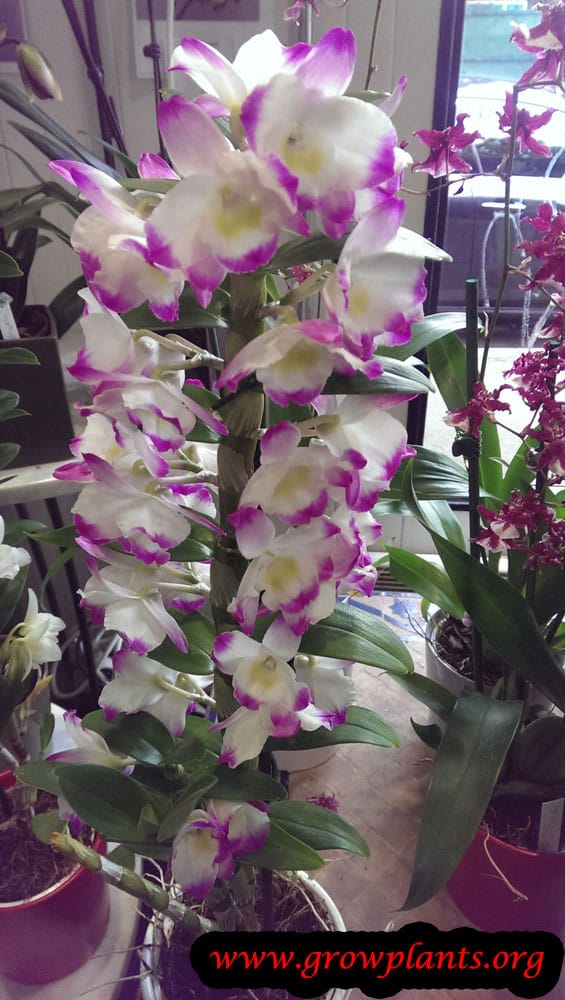
Plant Profile & Key Characteristics
Overview: Dendrobium nobile (Noble Dendrobium) is an evergreen orchid growing 30-70 cm tall from cane-like pseudobulbs. It is grown as an ornamental and cut-flower plant, and some species are used medicinally.
Quick Specifications
| Specification | Attribute |
|---|---|
| Plant Type / Life Cycle | Perennial (evergreen orchid) |
| Foliage Type | Evergreen |
| Mature Size | Height 30-70 cm (12-28 in) |
| Growth Rate | Moderate |
| Root System | Epiphytic aerial roots (grows from pseudobulbs) |
| Toxicity | Non-toxic |
| Hardiness | USDA zones 10b-11 (grown as a houseplant elsewhere) |
Growth Form & Structure
- Height & Spread: Grows 30-70 cm (12-28 in) tall; best grown in a small, snug pot or mounted, with fast-draining bark media rather than in soil.
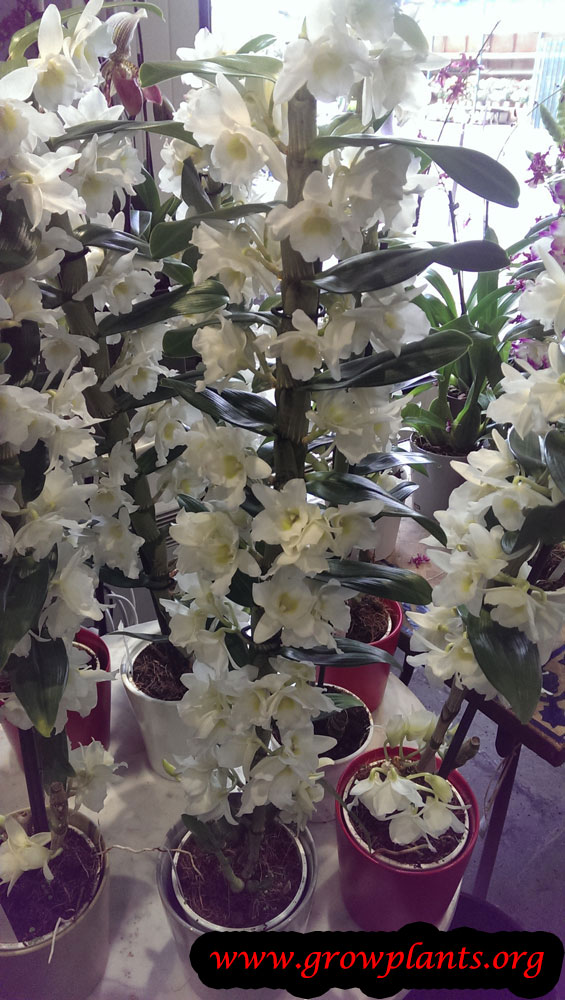
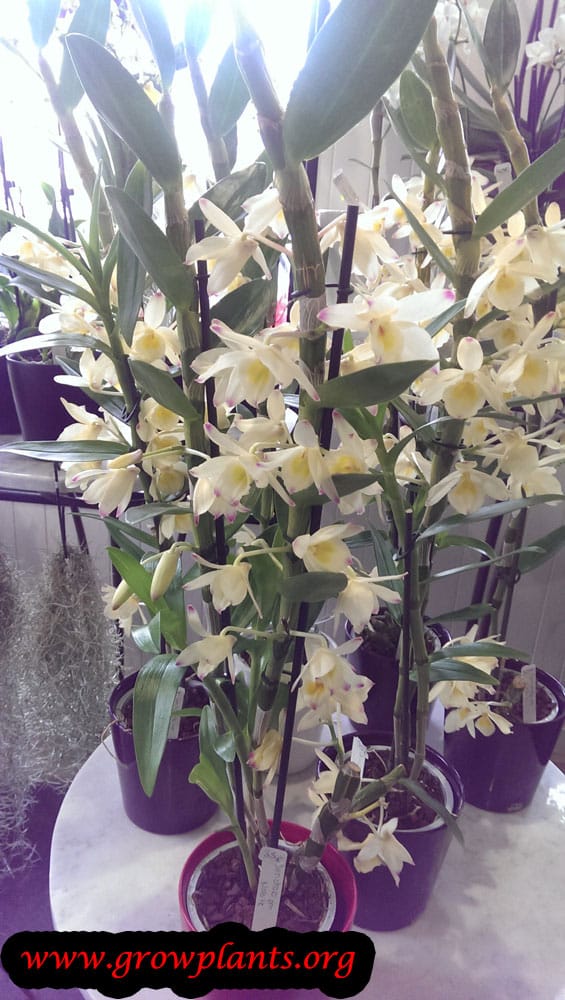
- Growth Habit & Form: Clump of upright cane-like pseudobulbs bearing leaves and arching flower sprays; epiphytic in habit.
- Lifespan & Maturity: Long-lived perennial orchid; blooms on mature canes.
Anatomy & Physical Features
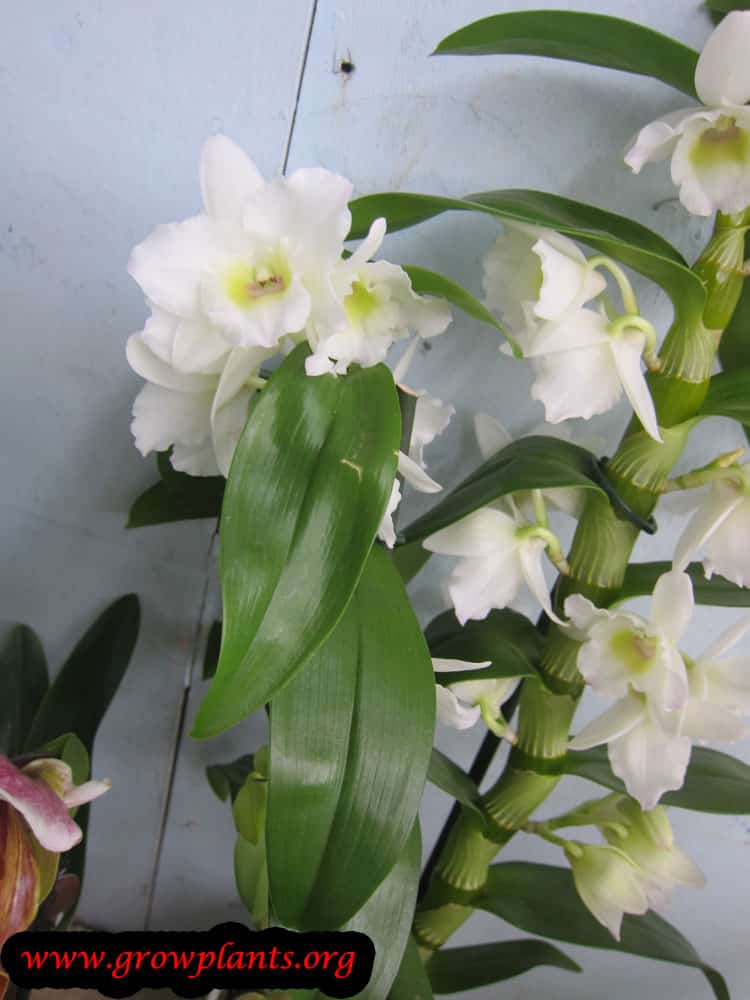
- Leaves & Foliage: Green, fleshy, oval leaves borne along bulb-like canes (pseudobulbs).
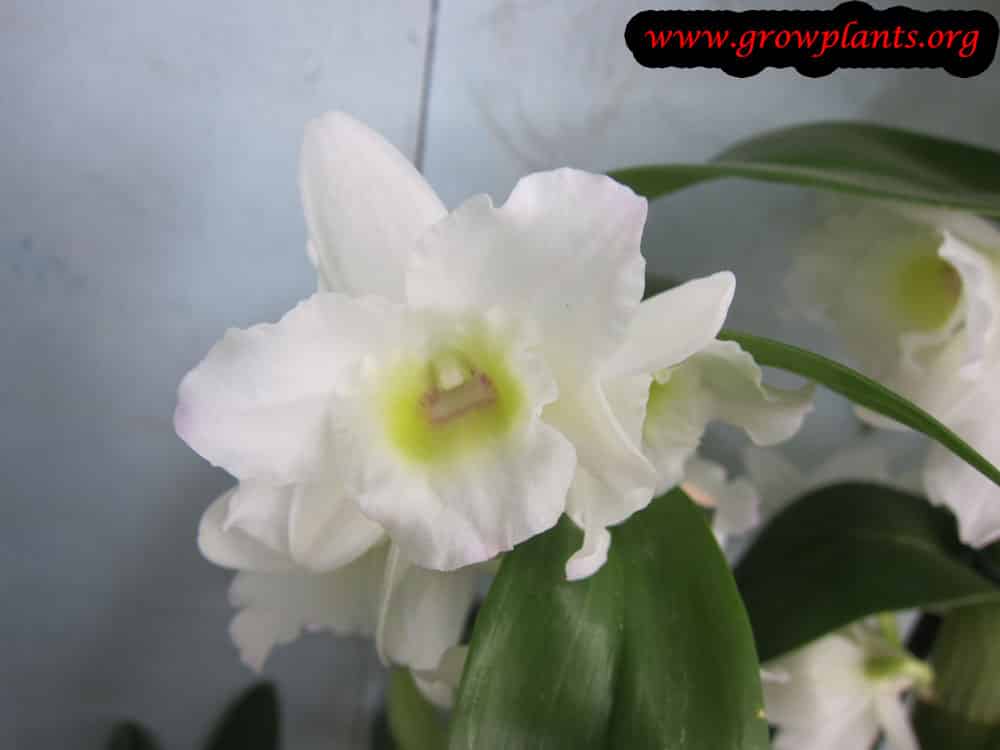
- Flower Characteristics: Showy flowers with five elliptic petals and a decorated trumpet-shaped lip in purple, white, yellow, orange and pink, usually multicoloured (full detail in the Bloom guide).
Primary Uses & Landscape Value
- Functional & Ornamental Roles: Ornamental flowering houseplant and cut flower; some species have traditional medicinal use.
Care Guide: Planting, Soil & Watering
Overview: Noble dendrobium is an orchid that grows in an open, fast-draining bark mix rather than soil, with high humidity around its roots. It needs moisture combined with excellent aeration and drainage, and prefers pure, room-temperature water.
Quick Care Requirements
| Requirement | Ideal Condition |
|---|---|
| Planting Season | In autumn, winter or spring |
| Growth Rate | Moderate |
| Soil Type | Open orchid bark or cork mix (not garden soil) |
| Water Need | Low to Moderate – keep the roots moist but never soggy |
Planting & Establishment
- Best Planting Season: Pot or repot in autumn through spring.
- How to Plant:
- Hole Preparation: Pot into a container just large enough for the roots – too big a pot holds excess moisture.
- Soil Amendments: Use fresh bark or cork chips rather than compost, and replace the medium before it breaks down and turns acidic.
- Planting Depth: Set the base at the surface of the bark, keeping the crown exposed and airy; a little inert material at the base adds aeration.
- Growth Speed & Expectations: Moderate.
Soil, Watering & Drainage Care
- Soil Mix & Drainage Needs: Coarse bark or cork in a well-drained pot with high humidity (around 50 percent); good airflow to the roots prevents rot.
- Watering Schedule & Technique:
- Young / Newly Planted: Keep the medium lightly moist with clean, room-temperature water – rainwater is ideal.
- Established: Water to keep the roots moist, allowing brief drying; never let it stand in water, and refresh the bark periodically.
- Seasonal Adjustments: Cooler nights and slightly drier conditions in autumn help trigger blooming; reduce watering in cold weather.
Climate, Light & Hardiness
Noble dendrobium is an epiphytic orchid grown in bright, filtered light and warm days, most often as a houseplant or in frost-free subtropical gardens. It is frost-tender - the site data lists hardiness zones 10b–11 - and, importantly, it needs a cool, drier winter rest to flower well.
Quick Climate Specifications
| Climate Zones | Subtropical, warm Mediterranean, or indoors |
|---|---|
| USDA Hardiness Zones | Approximately 10b–11 outdoors |
| Optimal Temp Range | Warm days ~18–27°C (64–81°F) |
| Cold Damage Begins | Sustained temperatures below about 5°C (41°F) |
| Approx. Survival Minimum | Near 1°C (34°F) briefly; tolerates brief highs to about 35°C (95°F) |
| Frost Tolerance | None |
| Light Conditions | Bright, filtered / indirect light |
| Wind Tolerance | Low |
Sunlight & Light Exposure
Optimal Light Setup
Give bright but filtered light - an east or lightly shaded window indoors, or dappled shade outdoors. Ample light drives flowering, while harsh, direct midday sun scorches the foliage.
Shade & Heat Management
Protect from direct hot sun; too little light, however, reduces flowering.
Temperature Extremes & Hardiness
USDA Hardiness & Regional Limits
Outdoors it needs a frost-free, subtropical setting (about zone 10b–11); elsewhere it is grown indoors or under glass.
Cold Damage & Winter Protection
Warm growing temperatures suit active growth, but sustained cold below about 5°C (41°F) is harmful and frost is fatal. Keep it away from cold windows and draughts in winter.
Cool Winter Rest for Flowering
Unlike many houseplants, this orchid initiates its flower buds after a period of cool nights and reduced watering in winter - roughly cool nights around 5–10°C (41–50°F) with warmer days. Without this cool, drier rest it tends to grow leaves (and offsets) instead of flowering. This is a genuine bloom trigger, distinct from any frost hardiness.
Wind, Humidity & Microclimate
Humidity Preferences
Prefers moderate to high humidity (around 50% and a little more), with fresh, gently moving air around the roots.
Dry-Air Tolerance
Low - hot, dry indoor air from heating or cooling stresses the plant; group plants or use a humidity tray to raise local humidity.
Microclimate Recommendations
A bright bathroom or kitchen, or a sheltered patio in warm months, provides the humidity and air movement it likes.
Growing in Pots, Balconies & Indoors
Dendrobium nobile (Dendrobium nobile) is a compact orchid (about 30-70 cm) and a genuine houseplant – the grower confirms it grows well indoors, and orchids are almost always grown in a pot rather than open ground. Give it bright, indirect light near a window and it makes a rewarding, long-flowering indoor plant.
Quick Details
- Container Size: A pot only about 20-40% larger than the root ball – orchids like to be snug
- Indoor Suitability: Yes – a true houseplant in bright, indirect light
- Best Spot: Bright, indirect light near a window, out of harsh midday sun
- Soil & Drainage: Never ordinary potting soil – use a coarse, open orchid medium (bark or cork chips) with lots of drainage holes
- Watering in Pots: Water moderately – water when the medium is nearly dry, then let it drain; let excess drain away and never leave the pot standing in water
Indoors & On the Windowsill
- A true houseplant: The grower confirms it thrives indoors – keep it near a bright window but out of harsh, direct midday sun.
- Windowsill growing: An east or shaded-south window is ideal; a clear pot lets you watch the roots and see when to water.
- Overwintering: As a tropical plant it is happiest indoors year round in cool climates – keep it warm, bright and away from cold draughts and frost.
On a Balcony or Patio
- Summering outdoors: It can spend warm spells on a shaded, sheltered balcony or patio in bright but indirect light – protect it from direct sun, drying wind and any chill. Pots and open orchid media dry quickly, so check moisture often.
Choosing the Pot, Soil & Long-Term Care
- Pot & drainage: A snug pot with many holes; a transparent pot is useful for watching the roots. Never let it sit in standing water – the fastest route to rot.
- Medium: A coarse, free-draining orchid mix of bark or cork chips (some more terrestrial types appreciate a little added coir or humus), not garden soil.
- Feeding & water quality: Feed with a dilute orchid fertiliser a few times a year; where possible use rain or distilled water, which orchids prefer.
- Repotting: Refresh the medium about every two years – bark breaks down and loses structure over time – and pot on when roots fill the container.
Growing this plant in a greenhouse
A greenhouse can give dendrobium nobile frost protection, cold protection, humidity control and extra warmth. Under warm enough conditions it can keep growing well beyond the normal outdoor season and potentially be maintained year-round - though continuous cropping is not guaranteed and depends on temperature and light.
Greenhouse at a glance
| Greenhouse suitability | Excellent - a major practical advantage |
|---|---|
| Main benefits | frost protection, cold protection, humidity control, extra warmth |
| Outdoor protection advisable below | about 5°C |
| Maintain greenhouse minimum | around 5°C for active growth |
| Suitable types | heated greenhouse, glass greenhouse, mini greenhouse |
| Heating | Heating is recommended in cold climates for continuous growth. |
Related greenhouse guides
- Greenhouses: How to Choose the Right Greenhouse
- Best Greenhouse Heaters
- Greenhouse Climate Control: Temperature, Ventilation and Humidity
- Best Mini Greenhouses
Fertilizing & Feeding
A light feeder overall, and one where timing matters as much as strength: this nobile-type orchid needs a cool, dry, unfed rest once its canes mature to trigger good flowering, so withholding fertilizer at the right time is as important as the light, weak feeding it gets during active summer growth.
Quick Fertilizing Specs
| Feeding Level | Light feeder |
|---|---|
| Main Nutrient Priority | Weak, balanced feeding during summer cane growth; withheld through the cool, dry rest that triggers flowering |
| Best Feeding Period | Spring and summer while canes are actively growing, resuming lightly once flower buds appear |
| Organic Options | A diluted organic liquid feed made for container or epiphytic plants can substitute for a synthetic fertilizer during the growing season |
| Micronutrients | Usually supplied by a complete, weak fertilizer formulated for orchids or container plants |
| Reduce/Stop Feeding | Feeding is stopped, not just reduced, during the cool, dry autumn-to-winter rest that this nobile-type orchid needs in order to flower well |
Feeding by Growth Stage
Summer vegetative growth
Support strong new cane growth during the warm growing season, since flower buds will later form at nodes along these canes.
| Nutrient direction | A weak, balanced fertilizer suited to epiphytic culture. |
|---|---|
| Timing | Spring into summer while new canes are actively lengthening. |
| Frequency | Light, regular feeding while canes are actively growing; ease off as growth slows toward autumn. |
| Fertilizer types | A weak, balanced fertilizer diluted for container-grown orchids, A fertilizer suited to bark or cork-chip mixes |
| Routine trace nutrients | iron, manganese |
| Precautions | Favor balanced feeding over heavy nitrogen – canes that grow too soft and lush can be more prone to problems and may flower less well later. |
Cool, dry rest to trigger flowering
Let the plant experience a cooler, drier rest period once canes mature – this pause is what encourages flower buds to form along the canes rather than more leafy growth.
| Nutrient direction | None – withhold fertilizer during this rest period. |
|---|---|
| Timing | Autumn into early winter, once summer cane growth has matured. |
| Frequency | No feeding at this stage. |
| Fertilizer types | No feeding at this stage; feeding begins again once flower buds are visible or new growth resumes. |
| Precautions | Do not fertilize during this rest, and reduce watering to what keeps the canes from shriveling – this rest is central to getting this orchid to flower well. |
Bloom along the canes
Support the plant through its bloom, when flowers open at nodes along the mature canes.
| Nutrient direction | Resume the same weak, balanced fertilizer once flower buds are visible; do not switch to a high-phosphorus product. |
|---|---|
| Timing | Winter into spring, as flower buds open along the canes. |
| Frequency | Light, regular feeding once buds and flowers are visible; keep it modest since flowering itself is not a heavy-feeding event. |
| Fertilizer types | The same weak, balanced fertilizer used during summer growth, Avoid high-phosphorus bloom-booster products |
| Routine trace nutrients | iron, manganese |
| Precautions | Avoid disturbing the plant or over-fertilizing while flowers are open, since buds and blooms can be sensitive to sudden change. |
Nutrient Deficiency Signs & Corrections
The plant grows canes normally through summer but produces few or no flowers over the following bloom season.
| Possible causes | continued fertilizing and heavy watering through what should be a cool, dry rest period, which favors leafy growth over flower bud formation in this nobile-type orchid, excess nitrogen relative to other nutrients during the growing season, favoring vegetative growth over flowering, insufficient light during the growing season limiting the energy available for flower bud formation |
|---|---|
| Appears first on | the bloom display as a whole, compared to canes that otherwise look healthy |
| What to check | whether feeding and heavy watering continued into what should be the rest period, recent fertilizer nitrogen content and feeding frequency, light levels during the growing season |
| Possible correction | Give the plant a true cool, relatively dry, unfed rest once canes mature before resuming feeding when buds appear. |
New canes come in noticeably thinner and shorter than earlier growths, and older leaves fade toward pale yellow-green.
| Possible causes | prolonged under-feeding during the active growing season, low light limiting overall growth and nutrient demand, root loss from past overwatering or rot limiting nutrient uptake |
|---|---|
| Appears first on | newest canes and older leaves |
| What to check | feeding history and strength during the growing season, root and cane condition, light levels |
| Possible correction | Resume a weak, balanced feeding routine through the active summer growth period. |
Older leaves develop yellowing between the veins while the veins themselves stay green.
| Possible causes | a feeding program that supplies little magnesium over an extended period, frequent watering that leaches nutrients from the root zone before uptake, root damage limiting nutrient uptake |
|---|---|
| Appears first on | older, lower leaves |
| What to check | feeding history and product composition, watering frequency, root condition |
| Possible correction | Use a fertilizer that includes magnesium, or apply a chelated micronutrient product per its label. |
New growth along the canes emerges pale yellow with veins that stay noticeably greener than the surrounding tissue.
| Possible causes | a medium or water source that has pushed conditions outside the range this orchid prefers, poor root aeration from a waterlogged or broken-down medium, an extended period without micronutrient feeding |
|---|---|
| Appears first on | newest growth |
| What to check | medium condition and drainage, water quality, recent feeding history |
| Possible correction | Address drainage first, then apply a chelated iron product per its label if chlorosis persists. |
Pruning, Training & Seasonal Maintenance
Dendrobium nobile is an epiphytic cane orchid with very low pruning needs, and the single most important rule for this species runs opposite to most orchids: its erect canes can flower repeatedly from the same nodes for two to three seasons, so mature canes are left in place after blooming rather than cut back. Routine work is limited to removing spent flower pedicels, naturally yellowing lower leaves, and fully exhausted multi-year canes. The safest window for any cutting is after flowering finishes and new growth begins, since removing material during bud formation or bloom sacrifices the current display.
Quick Pruning & Maintenance Specs
| Pruning Tolerance | Low |
| Primary Pruning Window | Spring, after flowering ends and new canes begin to emerge |
| Secondary Maintenance Window | Ongoing sanitary removal of yellow leaves and spent pedicels, any time |
| Typical Frequency | Light grooming several times a year; structural cane removal only every 3-4 years |
| Main Objective | Preserve multi-year reflowering canes while clearing exhausted growth |
| Young Plant Priority | Undisturbed establishment of roots and first canes |
| Mature Plant Priority | Retain 1-3 year old canes for repeat bloom; remove only fully spent canes |
| Best Tool Type | Precision snips, sterilized between cuts |
| Avoid Heavy Pruning During | Bud formation and flowering (autumn through spring) |
Pruning by Plant Age & Size
Newly Established
Newly potted or divided plants should not have canes or roots cut beyond removing obviously rotten tissue; let the plant settle through a full growing season before any structural removal.
Young / Formative
No structural training system applies to this cane orchid. The only formative step is patience: a new cane must fully mature and harden (visible leaf nodes, firm tissue) before it can flower, and a cane cut or damaged while still soft and green will not go on to bloom.
Mature / Established
The main decision each year is which canes to keep. Canes one to three years old are the plant’s active bloomers and should not be touched. Canes older than about four years that have stopped flowering, dropped their leaves, and shriveled can be cut at the base to tidy the clump and redirect energy.
Seasonal Pruning Schedule
| Stage | Objective | Remove | Do Not Remove | Expected Response / Flowering Impact |
| Post-Flowering | Tidy without sacrificing next year’s flowers | Spent flower pedicels; fully yellowed leaves | The cane itself, even once all its flowers have finished | Cane continues storing energy and can re-bud from the same nodes in a future season; cutting it here forfeits 1-2 future years of bloom |
| Ongoing Sanitary | General hygiene | Fully dead, shriveled, leafless canes (typically 4+ years old); rotten root tissue at repotting | Firm leafless older canes — they may still flower again | Improves airflow and appearance without reducing next season’s bloom |
Special Growth to Remove
- Spent flower pedicels — cut close to the node once the flower has fully dropped
- Naturally yellowing lower leaves
- Fully exhausted canes (shriveled, leafless, non-flowering, roughly 4+ years old) — cut at the base
- Rotten root tissue — trimmed at repotting, not on a routine schedule
Container & Small-Space Pruning
Grow in a snug, well-drained pot only slightly larger than the root mass; an oversized pot favors rot over growth. Root trimming is limited to clearly dead or rotten roots at repotting, not routine cutting. Because reflowering canes are kept for several years, the clump will get taller and heavier over time — this is expected and is not, by itself, a reason to cut canes back for size control.
Tools
- precision snips — for pedicels and yellow leaf tips
- bypass secateurs — for cutting through the tougher, fibrous base of a fully exhausted multi-year cane
Tool Hygiene & Disease Risk
High-risk. Dendrobium and other orchids are highly susceptible to virus transmission (e.g. Cymbidium mosaic virus, Odontoglossum ringspot virus) through contaminated blades, and infected plants cannot be cured. Disinfect blades between plants and between cuts on any symptomatic material.
Cut Placement & Technique
Cut spent pedicels close to the node without nicking the cane. When removing an exhausted cane, cut flush at the base near the rhizome rather than leaving a long stub, and avoid tearing the papery sheaths wrapping the cane.
Heavy Pruning & Rejuvenation
This species does not tolerate hard cutting-back of canes for rejuvenation — the canes are its flowering and storage structure. The equivalent rejuvenation tool is division: once a clump has six or more canes with multiple growth points, divide at repotting (every 2-3 years) into sections of at least three canes, keeping some leafless-but-firm older canes with each division since they still store energy and may flower again.
Post-Pruning Care
Let any cut on a cane or rhizome dry and callous before the next watering to reduce rot risk in humid growing conditions. Do not fertilize immediately after removing exhausted canes — resume normal feeding with the next new growth flush. Watch cut ends for softening or discoloration as an early sign of bacterial or fungal entry.
Common Pruning Mistakes
- Cutting a cane back to the base right after its first bloom — the most common mistake with nobile-type dendrobiums, forfeiting 1-2 future years of flowers from that cane
- Reusing unsterilized snips across multiple orchids, risking virus spread
- Removing leafless older canes that are still firm rather than only shriveled, dead ones
- Potting into an oversized container "for room to grow," which slows growth and raises rot risk
When NOT to Prune
Avoid cutting during bud formation and flowering (autumn through spring for this plant) — flowers and buds should not be removed unless spent. Avoid additional cane or root cuts immediately after repotting, beyond what was needed to clear rot, to let the plant recover.
Recommended Tools (by task)
- precision_snips — deadheading spent pedicels and trimming yellow leaf tips on thin, soft tissue
- blade_disinfectant — essential given real orchid virus transmission risk between cuts and plants
- bypass_secateurs — for cutting through the tougher, fibrous base of a fully exhausted multi-year-old cane
Propagation Guide
Dendrobium nobile is most reliably propagated by dividing an established clump or by removing rooted keikis (plantlets) that form on older canes, since the site’s own data notes vegetative reproduction is needed to keep an identical flower. Seed propagation is possible but is a specialist, lab-based technique that does not guarantee the same flower, so for most growers division/keiki propagation at Moderate difficulty is the practical route.
Quick Propagation Specs
| Best Propagation Method | Division of clumps, or removal of rooted keikis (plantlets) |
| Alternative Methods | Seed (asymbiotic flask culture, specialist only) |
| Propagation Difficulty | Moderate (division/keiki); Specialist (seed) |
| Seed True-to-Type | Usually true-to-type only from species-only pollination; hybrid crosses vary |
| Vegetative True-to-Type | Yes |
| Best Propagation Season | Spring, as new growth resumes |
| Seed Germination Time | Slow under sterile flask conditions – typically several weeks to a few months, with years to reach flowering size |
| Cutting Rooting Time | Keikis usually show their own roots within a few weeks to a couple of months while still attached to the cane |
| Germination Temperature | Roughly 20–25°C (68–77°F) under sterile lab conditions |
| Seed Sowing Depth | Not applicable – dust-like seed is sown on the surface of sterile agar medium, not soil |
Growing from Seed
Seed Handling & Viability
Dendrobium seed is dust-fine with no food reserves, so it cannot be sown in soil; it must be sown fresh onto sterile agar medium under lab conditions.
Germination Conditions & Time
Germination happens slowly and unevenly in flask culture; expect several weeks to a few months before visible protocorms, and considerably longer before seedlings are ready to deflask.
Stem Cuttings
Cutting Type
Leafless back canes (generally two or more years old) cut into sections, each with at least one or two nodes.
Best Timing
After flowering has finished, when spent leafless canes are available, often at spring repotting.
Cutting Preparation
Use a clean, sharp blade; the site’s own pruning guidance is to trim the flowering stem about 2 cm past the spent bloom, but leaving some older leafless canes on the plant (rather than cutting them fully away) allows dormant nodal buds on those canes to sprout keikis.
Rooting Setup
Lay cane sections horizontally on damp sphagnum moss in a warm, humid, bright spot out of direct sun; keep evenly moist, not soggy.
Rooting Hormone
Not necessary – keikis develop from dormant nodal buds rather than rooting a true cutting.
Rooting Time
New keikis typically emerge within a few weeks to a couple of months and form their own roots before they are ready to detach.
Division, Offsets & Keikis
Divide a congested clump into sections of at least a few canes each once the plant is out of active bloom. Keikis should be left attached until they have produced several roots of their own, several centimetres long, before being cut free with a clean blade.
Pot new divisions or detached keikis into a small, well-drained bark or cork-chip mix (matching the site’s general potting medium), using room-temperature clean water; keep humid and out of direct sun until new growth confirms establishment.
Bloom & Edible Flower Guide
Quick Details
- Bloom Season: Autumn, winter and spring
- Flower Appearance: Five spreading, elliptic petals with a central trumpet-shaped, decorated lip; purple, white, yellow, orange or pink, usually in more than one colour
- Edibility: The flowers of Dendrobium nobile are edible and are also long used as a medicinal plant; use only blooms grown clean of pesticides.
Detailed Blooming Overview
Noble Dendrobium is one of the best-loved of all the cane orchids. The grower describes five elliptic petals around a trumpet-shaped, decorated lip, in soft shades of purple, white, yellow, orange and pink, usually combined. The flowers open in twos and threes at the nodes all along the previous year’s canes, so a well-rested plant can flower over almost its whole length from autumn through spring.
Flower Characteristics
- Five elliptic petals with a central trumpet-shaped, decorated lip (grower’s description).
- Colours are purple, white, yellow, orange and pink, most often blended, with a contrasting eye in the lip.
- Flowers line the mature canes at the nodes rather than on a single terminal spike.
Bloom Care & Thinning
- Triggering bloom: A cool, bright, drier winter rest with cold nights is the classic trigger for a heavy flowering of Dendrobium nobile.
- After flowering: Leave the old canes in place — they can flower again and support the new growths.
- For edible use: Grow without pesticides and pick freshly opened flowers if they are to be eaten.
Bloom Health & Protection
- Botrytis petal blight can spot open flowers with small brown or translucent marks in cool, damp, still air — better ventilation and keeping water off the blooms is the first line of defence, with a fungicide only if it spreads.
- Aphids, scale and mealybugs are drawn to soft buds and flower spikes — wiping them off or treating with neem oil or insecticidal soap keeps the flowers clean.
- Bud blast (buds yellowing and dropping before they open) is usually a stress response to sudden changes in temperature, light or humidity, or to dry air — steady conditions while the plant is in spike prevent it.
Fruit & Uses
Dendrobium nobile is one of the classic source species for Shi Hu (Dendrobii Caulis), a traditional Chinese tonic herb made from its fleshy stems; the stem is the only part with a documented traditional use, taken from mature canes and used fresh or dried rather than as an everyday food. This is a traditional/medicinal-use note, not a culinary vegetable or fruit crop, and should not be treated as a general food source.
Quick Edible Specs
| Edible Parts | Stems/canes (mature growths only) |
|---|---|
| Main Use(s) | Medicinal-note – traditional Chinese tonic herb (Shi Hu), chewed fresh or brewed as tea |
| Eaten Raw or Cooked | Fresh stem chewed, or dried stem steeped/simmered as tea |
| Preparation Required | Dry & slice (for tea), or use fresh |
| Harvest Season | Mature canes are traditionally cut after they have flowered and hardened |
| Time to First Harvest | Canes need multiple growing seasons to mature before traditional harvest (see Pruning for cane growth cycle) |
| Storage | Dried, sliced stem stores well in a sealed, dry container |
| Safety/Toxicity Caveat | Positively identify the plant as D. nobile before any use. This is a traditional tonic use only, not a food crop, and no health or dosing guidance is implied here. |
Pseudostem / Cane / Sap
The mature, leafless canes are the part used traditionally. Once a cane has flowered and hardened over a season or two, it can be cut and either chewed fresh for its mucilaginous juice or dried and sliced for brewing as a tonic tea, following traditional Chinese herbal practice; young, actively growing canes are not used. Cutting mature canes for this purpose competes with the plant’s ornamental display, since the same canes carry the following year’s flowers – see Pruning for how cane removal affects blooming.
Harvesting
Only fully mature, hardened canes that have already flowered are traditionally harvested; younger green canes are left to grow on. Harvest timing follows cane maturity rather than a strict calendar season.
Preparation, Uses & Safety
Traditionally the stem is either chewed fresh for its juice or dried and cut into slices to steep or simmer as a tonic tea. This is reported here only as a traditional-use note, not a health or dosing recommendation. Because Dendrobium nobile is primarily cultivated and sold as an ornamental orchid, always confirm species identity before considering any use beyond ornamental display, and do not rely on this note for medical guidance.
Pests, Diseases & Troubleshooting
Dendrobium orchids are epiphytes whose fleshy canes and leaves attract specialist orchid pests – above all Boisduval scale and mealybugs – along with mites, thrips and aphids, while their real disease threats are bacterial and fungal rots and incurable orchid viruses. Management is about scrupulous hygiene, good airflow and careful watering rather than heavy spraying; catching scale and rot early is everything.
Quick Troubleshooting Overview
| Issue / Pest | Main Symptom | Primary Solution |
|---|---|---|
| Boisduval scale | White/yellow crusty specks on canes; yellowing | Scrub off, isolate, horticultural oil, repeat |
| Mealybugs | White cottony tufts in leaf axils and roots | Alcohol swab, horticultural oil, check roots |
| Spider / false spider mites | Silvery stippling, pitting on leaves in dry air | Raise humidity, rinse, horticultural oil |
| Thrips | Silver streaks, distorted buds and flowers | Sticky traps, sanitation, spinosad |
| Black rot | Soft black spreading rot on leaves/canes | Cut into clean tissue, dry out, copper/cinnamon |
| Bacterial soft rot | Wet, foul, collapsing soft spots | Cut out, dry, sterile tools, reduce wetness |
Common Pests & Management
- Boisduval scale (Diaspis boisduvalii):
- Symptoms: The classic Dendrobium pest: white, waxy, crusty specks (males) and yellow-brown limpet scales (females) collect on canes, leaf bases and under old sheaths; leaves yellow, spot and drop, and heavy colonies debilitate the plant.
- Prevention & Control: Isolate the plant at once; peel off dead sheaths where scale hides; scrub canes with a soft toothbrush and soapy water or alcohol; spray horticultural oil thoroughly, repeating every week or two to catch crawlers; discard hopelessly infested canes.
- Mealybugs (Pseudococcus / Planococcus spp.):
- Symptoms: White, cottony, waxy masses gather in leaf axils, under sheaths and on roots, sapping strength and coating growth in honeydew and sooty mould.
- Prevention & Control: Dab with a cotton bud dipped in rubbing alcohol; unpot and inspect roots for root mealybugs, repotting into fresh media if found; spray horticultural oil or insecticidal soap, repeating to catch new crawlers; isolate until clear.
- Spider & false spider mites (Tetranychus / Brevipalpus spp.):
- Symptoms: Fine silvery stippling and a pitted, sunken look develop on leaf undersides in warm, dry air, with faint webbing from true spider mites; leaves dull, pit and can drop.
- Prevention & Control: Raise humidity and rinse leaves, especially undersides; wipe leaves clean; treat with horticultural oil or insecticidal soap, repeating; false spider mites in particular need persistent, repeated treatment.
- Thrips (Frankliniella / Thrips spp.):
- Symptoms: Silvery streaks and flecking on leaves, distorted new growth, and browning, stippled or deformed flower buds and blooms; thrips can also spread viruses.
- Prevention & Control: Use blue sticky traps to monitor; remove spent flowers and weeds; keep plants clean; spot-treat with spinosad or insecticidal soap, rotating products, and protect opening flowers.
- Aphids (Aphididae spp.):
- Symptoms: Soft green, brown or black insects cluster on tender new growth and flower spikes, with sticky honeydew, distortion and virus spread.
- Prevention & Control: Rinse off with water, wipe from buds and spikes, and spot-treat with insecticidal soap in the evening; watch for the viruses aphids can carry.
- Slugs, snails & fungus gnats (Deroceras / Bradysia spp.):
- Symptoms: Slugs and snails chew roots, new growth and flowers at night; fungus gnats swarm over constantly wet media and their larvae damage fine roots.
- Prevention & Control: Hand-pick slugs after dark and use barriers or bait; let the medium dry appropriately between waterings, use yellow sticky traps and BTI drenches for gnats, and avoid stale, soggy potting mix.
Diseases & Fungal Issues
- Black rot (Phytophthora / Pythium):
- Symptoms: Soft, watery black or purple-brown lesions spread rapidly through leaves and canes, especially in cool, wet, poorly ventilated conditions, and can kill the plant if they reach the crown.
- Treatment & Management: Cut away all affected tissue back into clean, firm green tissue with a sterile blade; dust cuts with cinnamon or apply a copper fungicide; dry the plant out, improve airflow and reduce overhead water and stagnant wet.
- Bacterial soft/brown rot (Erwinia (Pectobacterium/Dickeya) / Acidovorax):
- Symptoms: Sunken, wet, foul-smelling soft spots appear on leaves and new growth and spread fast in warm, humid, wet conditions, collapsing tissue.
- Treatment & Management: Cut out infected tissue immediately with a sterile tool, keep foliage dry and improve air movement, and space plants; a copper bactericide can help, but fast removal and drying are the key controls.
- Fungal leaf spot & anthracnose (Colletotrichum / Cercospora spp.):
- Symptoms: Brown or black spots and blotches, sometimes with yellow halos or concentric rings, develop on leaves in humid, stagnant conditions.
- Treatment & Management: Remove spotted leaves, improve airflow and light, avoid wetting foliage late in the day, and apply a copper fungicide if it spreads; keep plants unstressed.
- Orchid viruses (Cymbidium mosaic virus / Odontoglossum ringspot virus):
- Symptoms: Colour-break, mottling, streaking, ringspots and necrotic flecks that never clear; growth and flowering steadily decline.
- Treatment & Management: There is no cure: isolate and ideally destroy confirmed virus-positive plants; sterilise cutting tools between every plant (flame or fresh blades), control sap-feeding insects, and buy clean stock.
Growing Difficulties & Abiotic Problems
- Root rot from overwatering / stale mix:
- Cause & Symptoms: Constantly wet or decomposed potting media suffocate and rot the roots, causing limp canes, shrivelling and collapse.
- Correction Strategy: Use a coarse, free-draining orchid mix, water thoroughly then let it approach dryness, and repot into fresh media every year or two before the mix breaks down.
- Cane shrivel / dehydration:
- Cause & Symptoms: Underwatering, dead roots or low humidity shrivel the pseudobulbs/canes and pleat the leaves.
- Correction Strategy: Check roots and rehydrate gradually, raise humidity with trays or grouping, and water more attentively once healthy roots regrow; balance moisture against the plant’s rest period.
- Sunburn / leaf scorch:
- Cause & Symptoms: Excess direct sun bleaches and scorches leaves with bleached or blackened patches.
- Correction Strategy: Give bright but filtered light, shade from harsh midday sun, and acclimatise plants gradually to brighter positions.
- Bud blast & poor flowering:
- Cause & Symptoms: Sudden environmental changes, drafts, dryness or overwatering cause buds to yellow and drop, and warm nights can stop nobile-types flowering.
- Correction Strategy: Keep conditions steady while in bud, provide the cool, drier winter rest nobile-type Dendrobiums need to initiate flowers, and avoid moving plants once buds form.
What Helps – Products & Tools
Orchid care leans on hygiene and gentle contact controls: horticultural oil and insecticidal soap (with alcohol swabbing) for Boisduval scale, mealybugs and mites; blue sticky traps and spinosad for thrips; and yellow traps plus BTI for fungus gnats. For disease, sterile cutting tools, cinnamon or copper on cut rot lesions, and better airflow do most of the work. Sterilise blades between plants to stop virus spread, and treat oils in the evening.