


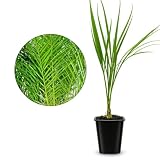


Plant Profile & Key Characteristics
Overview: A tall tropical palm reaching 10-20 m (33-66 ft), or 4-6 m (13-20 ft) in dwarf forms, grown for its acai berries and as an ornamental. A fast-to-moderate evergreen perennial for wet tropical climates.
Quick Specifications
| Specification | Attribute |
|---|---|
| Plant Type / Life Cycle | Perennial (evergreen palm tree) |
| Foliage Type | Evergreen |
| Mature Size | 10-20 m tall (33-66 ft); dwarf forms 4-6 m (13-20 ft) |
| Growth Rate | Moderate to Fast |
| Root System | Fibrous (typical of palms) |
| Toxicity | Non-toxic – berries are edible (used for juice, powder and ice cream) |
| Hardiness | USDA zone 12+ |
Growth Form & Structure
- Height & Spread: 10-20 m (33-66 ft) tall as a clustering palm; dwarf cultivars 4-6 m (13-20 ft). Not suited to container growing.
- Growth Habit & Form: Slender, clustering multi-stemmed palm with a crown of feathery fronds.
- Lifespan & Maturity: Long-lived palm; begins bearing fruit in about 5-8 years.
Anatomy & Physical Features
- Trunk & Bark: Slim, smooth, cane-like stems, several rising together in a clump.
- Leaves & Foliage: Large, pinnate (feather-like) evergreen fronds.
- Flower Characteristics: Red flowers borne in large branched clusters, dozens per branch (full detail in the Bloom guide).
- Fruit Profile: Small, round, black-purple acai berries, used mainly processed rather than eaten raw (full detail in the Fruit guide).
Primary Uses & Landscape Value
- Edible Uses: Berries pressed for acai juice, dried to powder, and used in ice cream and cooked dishes.
- Functional & Ornamental Roles: Tropical fruiting and ornamental palm; needs constant warmth and moisture.
Care Guide: Planting, Soil & Watering
Overview: The acai palm (Euterpe oleracea) is a fast-growing tropical palm (hardiness zone 12+) that needs constant warmth, high humidity and full sun to half shade. It thrives in moist, rich, acidic soil and requires generous, steady watering.
Quick Care Requirements
| Requirement | Ideal Condition |
|---|---|
| Planting Season | Year-round in warm, humid tropical climates |
| Growth Rate | Moderate to Fast |
| Soil Type | Moist, rich, acidic soil |
| Soil pH | Acidic |
| Water Need | High – keep the soil consistently moist |
Planting & Establishment
- Best Planting Season: In its warm, humid tropical range it can be planted year-round.
- How to Plant:
- Hole Preparation: Dig a hole a little wider than the root ball in a spot with rich, moisture-retentive soil.
- Soil Amendments: Blend in plenty of organic matter to enrich the soil and help it hold the steady moisture the palm needs.
- Planting Depth: Set the root ball level with the soil surface, keeping the trunk base unburied.
- Growth Speed & Expectations: A moderate-to-fast grower that becomes a tall palm, 10-20 m (dwarf cultivars 4-6 m).
Soil, Watering & Drainage Care
- Soil Mix & Drainage Needs: Grow in rich, moist, acidic ground; the source notes it is not suited to containers, so plant it in the ground where its roots have room and constant moisture.
- Watering Schedule & Technique:
- Young / Newly Planted: Keep the soil consistently moist while the palm establishes; never let it dry out.
- Established: Water generously and regularly – this is a wetland palm that needs a lot of water and high humidity.
- Seasonal Adjustments: Maintain steady moisture year-round in its tropical climate, watering more during hot, dry spells.
Climate, Light & Hardiness
Acai palm is a true tropical palm needing consistent warmth, high humidity, and abundant moisture year-round; it has essentially no cold tolerance and cannot be grown outdoors outside frost-free tropical climates. Full sun to half shade suits it, especially once established.
Quick Climate Specifications
| Climate Zones | Tropical |
| USDA Hardiness Zones | 12+ (per site data) |
| Cold Damage Begins | Chilling injury can begin at cool, above-freezing temperatures typical of tropical palms |
| Frost Tolerance | None |
| Light Conditions | Full Sun / Half Shade |
Sunlight & Light Exposure
Optimal Light Setup
Full sun once established gives the fastest growth; young palms appreciate light shade.
Direct Sun Requirement
Mature palms handle full tropical sun well when soil moisture and humidity are adequate.
Temperature Extremes & Hardiness
USDA Hardiness & Regional Limits
Zone 12+ reflects a true tropical palm with no meaningful frost tolerance; it is not suited to outdoor culture anywhere winter temperatures approach freezing.
Cold Damage & Winter Protection
Even brief cool spells can stress the palm; it needs consistently warm, frost-free conditions year-round with no realistic winter protection strategy for outdoor culture in marginal climates.
Frost Sensitivity
Frost-sensitive with no meaningful tolerance - a hard freeze is generally fatal.
Extreme Heat Tolerance
Tolerates tropical heat well provided humidity and soil moisture remain high.
Wind, Humidity & Microclimate
Humidity Preferences
Needs consistently high humidity, reflecting its native tropical wetland/riverine habitat.
Rainfall & Seasonal Moisture
Adapted to consistently moist, high-rainfall tropical conditions; it needs a big amount of water and does not tolerate a dry climate or prolonged drought.
Microclimate Recommendations
Best suited to humid, sheltered tropical sites; not a candidate for container culture and impractical to overwinter indoors given its ultimate size.
Growing in Pots, Balconies & Indoors
The acai palm is a tall tropical rainforest palm reaching 10-20 m, and the grower marks it as neither a houseplant nor a container plant. It needs constant moisture, high humidity and warmth, and it simply outgrows any pot – so it is not a realistic choice for indoors, a balcony or long-term container culture.
Quick Details
- Container Size: Not recommended – the grower marks it unsuitable for containers; a young seedling can be potted only very briefly before it needs open ground
- Indoor Suitability: Not a houseplant – too large, too thirsty and too humidity-hungry for indoor life
- Best Spot: Full sun to half shade in a warm, wet tropical climate, planted in the ground
- Soil & Drainage: Rich, constantly moist soil; it will not tolerate drying out
- Watering in Pots: A big, constant amount of water – very hard to sustain in a pot
Indoors & On the Windowsill
- Not suitable: The grower confirms it is not a houseplant. Its eventual height, need for constant moisture and tropical humidity make indoor life impractical.
- Overwintering: It is strictly tropical and frost-tender; outside a warm, wet climate it cannot be kept, and its size rules out simply moving it indoors for winter.
On a Balcony or Patio
- Why it won’t work: The grower marks it as not a container plant – a balcony or patio pot cannot supply the constant water, humidity and root run a fast, tall rainforest palm demands.
Choosing the Pot, Soil & Long-Term Care
- Only while a seedling: If started in a pot at all, keep a young plant in a large, constantly moist container in warmth and humidity, but expect it to need planting out into the ground before long – it is not a lasting container subject.
Fertilizing & Feeding
A moderate feeder: a balanced palm-specific fertilizer that includes magnesium and manganese supports steady frond growth, since palms are prone to those trace-element issues when fed a generic, non-palm fertilizer.
Quick Fertilizing Specs
| Feeding Level | Moderate feeder |
|---|---|
| Main Nutrient Priority | Balanced, palm-formulated feeding with magnesium and manganese |
| Best Feeding Period | Through the active growing season in warm, humid conditions |
| Organic Options | Compost or mulch worked around the root zone, kept away from the trunk |
| Reduce/Stop Feeding | Taper feeding if growth slows in cooler conditions |
| Micronutrients | A palm-specific fertilizer routinely supplies magnesium and manganese, which palms need on an ongoing basis |
| Soil pH | Acidic, consistently moist soil |
Feeding by Growth Stage
Newly planted palm
Help a newly planted palm root in without stressing tender new roots.
| Nutrient direction | A light, balanced palm fertilizer, applied away from the trunk. |
|---|---|
| Timing | Around planting and through the first season of establishment. |
| Frequency | Light feeding as the palm settles in. |
| Fertilizer types | A balanced, palm-formulated fertilizer applied lightly, Compost or mulch around the root zone |
| Precautions | Keep fertilizer away from the trunk and go light while roots are still establishing. |
Established palm
Sustain steady canopy growth and prevent the trace-element problems common in palms.
| Nutrient direction | A balanced, palm-specific fertilizer that routinely includes magnesium and manganese. |
|---|---|
| Timing | Through the active growing season. |
| Frequency | Regular light feedings during active growth. |
| Fertilizer types | A balanced palm-specific fertilizer with magnesium and manganese, Mulch maintained around the root zone |
| Routine trace nutrients | manganese, magnesium |
| Precautions | Use a palm-specific blend rather than a generic fertilizer; palms have distinct, ongoing trace-element needs. |
Nutrient Deficiency Signs & Corrections
Older fronds show broad yellow bands along the edges while the center stays green.
| Possible causes | low soil magnesium relative to a palm’s ongoing demand, use of a generic, non-palm fertilizer lacking magnesium, sandy soil that leaches magnesium readily |
|---|---|
| Appears first on | older, lower fronds |
| What to check | type of fertilizer used, soil texture and drainage, whether older fronds show the banding first |
| Possible correction | Switch to a palm-specific fertilizer that includes magnesium and apply per its label. |
New fronds emerge weak, small, and streaked or frizzled instead of full-sized.
| Possible causes | low manganese availability, common in palms fed a non-palm fertilizer, high soil pH reducing manganese uptake, poorly drained or compacted soil around the roots |
|---|---|
| Appears first on | newest emerging fronds |
| What to check | type of fertilizer used, soil pH and drainage, whether new fronds look frizzled or undersized |
| Possible correction | Apply a palm-specific fertilizer with manganese and improve drainage around the root zone. |
Overall frond color fades to pale green and new growth slows.
| Possible causes | low available soil nitrogen, sandy, fast-draining soil that leaches nutrients, infrequent feeding for a moderately demanding palm |
|---|---|
| Appears first on | older fronds first, then the whole canopy |
| What to check | recent feeding history, soil texture and drainage, whether growth has visibly slowed |
| Possible correction | Resume regular balanced, palm-specific feeding through the growing season. |
Pruning, Training & Seasonal Maintenance
Acai is a true palm – a clustering (multi-stemmed), single-growing-point-per-stem plant – so pruning tolerance is low and the safe rule is the one that applies to all palms: remove only fully dead, brown fronds, and never cut into the green crown, which is the plant’s entire photosynthetic engine and directly fuels the year-round flowering and fruiting this species is grown for. Because it is tropical and evergreen, this dead-frond removal happens year-round rather than in any one season, matching its own recorded pruning window. The one structural decision that does apply, and does not apply to solitary palms, is managing which of the multiple basal stems in the clump to keep.
Quick Pruning & Maintenance Specs
| Pruning Tolerance | Low – frond removal only; the green crown must not be touched |
| Primary Pruning Window | Year-round, as individual fronds fully die |
| Typical Frequency | As needed, ongoing |
| Main Objective | Remove dead material and manage clump density; protect every green frond |
| Young Plant Priority | Leave the single young crown undisturbed; remove only clearly dead or damaged leaf material |
| Mature Plant Priority | Remove fully dead fronds at the base cleanly, and thin overcrowded stems within the clump |
| Best Tool Type | Pruning saw for frond and stem bases; pole pruner for reaching fronds on a tall trunk |
| Avoid Heavy Pruning During | Never remove green fronds at any time, and avoid unnecessary wounding, given this species’ known susceptibility to palm weevil |
Pruning by Plant Age & Size
Newly Established
A young plant has a single, still-developing crown and no pruning is needed beyond removing anything clearly dead or damaged – the growing point must not be disturbed.
Young / Formative
Palms have no branch framework to train. As Acai’s clustering habit develops and new basal stems (this species’ natural multi-stemmed pattern) emerge, the only decision is which stems to allow to develop for a fuller clump versus removing an occasional crowded one for airflow – not a standard structural pruning task.
Mature / Established
On a mature clump, remove fully brown, dead fronds at their base as they occur, and thin out the weakest or most overcrowded stems within the clump periodically to keep the remaining stems vigorous, reaching typical mature heights of 10–20m (dwarf cultivars 4–6m).
Seasonal Pruning Schedule
Ongoing Sanitary (year-round): remove individual fronds only once they are fully brown and dead, cutting close to the trunk without tearing. There is no dormant season to schedule around in this tropical species, matching its recorded year-round pruning window; flowering and fruiting continue through the year and depend on keeping the green canopy intact.
Structural Pruning & Training
The only real structural decision on this clustering palm is stem density within the clump: unlike a solitary palm, new basal stems are a normal and wanted part of its growth habit, not a defect to correct, but an overcrowded clump can have its weakest, oldest or most crowded stems selectively removed at ground level to keep the remaining stems productive.
Special Growth to Remove
Fully dead, brown fronds, cut close to the trunk without damaging the trunk tissue. Old, spent stems that have declined after their productive years can be removed at the base. Unlike a solitary palm, the new basal stems (suckers) here are the plant’s normal clustering habit and are not something to routinely remove – only thin them if the clump has become overcrowded.
Tools
A pruning saw for cutting dead fronds and old stems cleanly at the base; a pole pruner for reaching fronds well up a mature 10–20m trunk without climbing. Loppers can handle smaller stems on younger or dwarf specimens.
Tool Hygiene & Disease Risk
Increased. Acai’s recorded pest, the red palm weevil (Rhynchophorus ferrugineus), can enter through fresh wounds, so avoid unnecessary cutting into living tissue and make clean cuts rather than tearing or stripping fronds by hand.
Cut Placement & Technique
Cut dead fronds close to the trunk with a saw rather than pulling or stripping them, which can tear trunk fibre and create a larger wound. When removing a stem from the clump, cut it at ground level rather than leaving a stub.
Heavy Pruning & Rejuvenation
Not tolerated. Each stem has a single growing point at its crown; removing green fronds or cutting back the crown (“hurricane cutting”) permanently weakens or kills that stem and is never an appropriate rejuvenation technique on a palm.
Post-Pruning Care
Monitor fresh cut sites for signs of pest entry or rot, since this species carries a known weevil risk; avoid creating unnecessary wounds during periods of active local pest pressure. No feeding is needed simply because dead material was removed.
Common Pruning Mistakes
- Removing green, still-functional fronds for a tidier look (“hurricane cutting”) – this starves the crown and measurably increases susceptibility to red palm weevil attack.
- Treating the clump’s basal stems as unwanted suckers and stripping them out, when this clustering habit is normal and desirable for the species.
- Tearing fronds off by hand instead of cutting cleanly, leaving a ragged wound.
When NOT to Prune
Never remove green fronds, regardless of season. Avoid creating pruning wounds unnecessarily where red palm weevil is active locally.
Recommended Tools (by task)
- pruning_saw – clean removal of dead fronds and old stems at the base.
- pole_pruner – reaching fronds safely on a mature 10–20m trunk without climbing.
- blade_disinfectant – reduces the chance of spreading pests/pathogens between cuts, given this species’ recorded weevil pressure.
Pruning Troubleshooting
| Problem | Possible Cause | What to Check | Corrective Action |
| Reduced vigour or fruiting | Over-removal of green fronds | How many healthy green fronds remain in the crown | Stop cutting anything but fully dead fronds; let the canopy rebuild |
| Crown or trunk rot / weevil damage | Wounds from improper or excessive pruning cuts | Inspect cut sites and crown for boring holes, frass or oozing | Use clean, close cuts with a sharp saw; seek local extension guidance if weevil damage is suspected |
| Weak, overcrowded stems in the clump | Too many basal stems left unthinned | Stem density and spacing at ground level | Selectively remove the weakest or oldest stems at the base to favour the strongest remaining ones |
Propagation Guide
Acai palm is grown almost exclusively from seed in practice, since palms lack the cambium layer needed to root from stem cuttings; because it is a clustering, multi-stemmed palm, it can also be increased by carefully separating a well-rooted basal sucker from an established clump, which the site notes is not required but is easy to do. Overall difficulty is moderate for both routes – seed needs fresh, warm, humid handling, and suckers need care to avoid root damage when separated.
Quick Propagation Specs
| Best Propagation Method | Seed |
| Alternative Methods | Division of rooted basal suckers/offshoots (clustering palm) |
| Propagation Difficulty | Moderate |
| Seed True-to-Type | Mostly uniform – grown as a true species rather than named clonal cultivars in typical cultivation |
| Vegetative True-to-Type | Yes |
| Best Propagation Season | All year in tropical/warm conditions; suckers best divided during active warm growth |
| Seed Germination Time | Irregular, often several weeks to a few months |
| Germination Temperature | Warm, roughly 27–30°C (80–86°F) |
| Seed Sowing Depth | Shallow, seed left at or just below the surface |
Growing from Seed
Seed Handling & Viability
Like most palm seed, acai seed is recalcitrant and loses viability quickly if dried or stored – clean off the fruit pulp and sow fresh rather than drying or storing it long-term.
Dormancy & Pre-Sowing Treatment
Removing the fruit pulp before sowing is recommended, as pulp left on the seed can slow or inhibit germination; no cold treatment is needed for this tropical species.
Sowing Season
All year in warm, humid conditions, per the site’s own planting-season notes.
Sowing Depth & Orientation
Sow shallowly, with the seed at or just below the surface.
Germination Conditions
Warm (roughly 27–30°C / 80–86°F) and consistently humid; bottom heat can help but is not essential.
Germination Time
Often irregular, ranging from several weeks to a few months.
Seedling Care
Keep young seedlings warm and humid; pot on once a few leaves have formed.
Division, Offsets, Pups & Suckers
As a clustering palm, established clumps produce basal suckers with their own root systems. Separate only well-rooted suckers – ones without adequate independent roots are unlikely to survive separation. Divide during active warm growth, and keep newly separated suckers humid and shaded until established.
Bloom & Flower Guide
Quick Details
- Bloom Season: Year-round in a warm, humid tropical climate
- Time to First Bloom: Several years after planting, once the palm is mature
- Flower Appearance: Many small reddish flowers on a large branched cluster below the crown
- Edibility: The flowers are not eaten – the palm is grown for its berries, which are covered elsewhere
Detailed Blooming Overview
The acai palm flowers more or less continuously in the tropics, sending out big branched clusters (panicles) of tiny flowers below the crownshaft. A single branch can carry dozens of flowers, and both male and female flowers appear on the same cluster.
Flower Characteristics
- Small, reddish flowers borne in large numbers on a branched cluster.
- Dozens of flowers on each branch of the cluster.
Bloom Care & Thinning
- Management: Little intervention is needed; in warm, humid conditions flowering carries on through the year.
- Pollination: Carried out by beetles, bees, wasps and flies.
Fruit & Uses
Acai palm is grown mainly for its small black-purple fruit, which is not eaten raw off the tree but is processed into juice, pulp, powder and ice cream. The clumping, multi-stemmed growth habit also means the tender growing tip of a stem can be harvested as a heart of palm, though this is a secondary use compared to the fruit.
Quick Edible Specs
| Edible Parts | Fruit; growing tip / heart of palm (secondary use) |
|---|---|
| Main Use(s) | Culinary – juice, pulp, powder, ice cream (fruit); heart of palm as a vegetable (stem tip) |
| Eaten Raw or Cooked | Fruit: not eaten raw as whole fruit – processed into juice/pulp/powder first; also used cooked. Heart of palm: eaten cooked or, once prepared, cold in salads. |
| Preparation Required | Fruit: soak/soften and de-pulp, then strain – the hard seed is discarded; thorough washing and hygienic processing recommended (see safety note below). Heart of palm: peel back the outer stem layers to reach the tender core, then cook. |
| Harvest Season | Fruit can be harvested all year |
| Time to First Harvest | Several years from planting before the palm bears fruit; picking also gets physically harder as the palm grows taller (see this plant’s Growing Guide for the exact bearing-age range) |
| Storage | Fresh fruit is highly perishable and is typically processed (juiced/pulped/frozen) soon after harvest rather than stored whole |
| Safety/Toxicity Caveat | Fresh acai pulp has occasionally been linked to contamination with triatomine (“kissing bug”) insects or their waste, a vector for Chagas disease in parts of South America – thorough washing, sorting and proper processing/pasteurization of the fruit before consumption is important |
Fruit
The fruit is small and round, ripening to a deep black-purple colour; birds are a common competing pest once fruit ripens. Fruit is harvested by cutting the fruiting bunches from the crown – an easy job while the palm is young and short, becoming progressively more difficult as the trunk grows tall. Because the fruit has only a thin layer of pulp around a large seed and is not palatable raw, harvested bunches are soaked, de-pulped and strained to separate the pulp from seed and skin; the resulting pulp is the base for acai juice, powder (dried/freeze-dried) and ice cream, or it can be cooked into other preparations.
Pseudostem / Cane / Sap
Euterpe oleracea is also a recognised source of heart of palm (palmito): the soft, tender growing tip taken from a stem, after the tough outer leaf bases and fibrous layers are peeled away and discarded. Because acai grows as a multi-stemmed clump, an occasional stem can be cut for its heart without necessarily killing the whole plant, unlike single-trunked palms. This is a much smaller part of this plant’s culinary profile than the fruit and is not the main reason it is grown.
Preparation, Uses & Safety
The primary use of this plant is the fruit, valued for its pulp rather than for raw eating – commercial and home use centres on juicing, powdering and cooking it into foods like ice cream. Because the fresh fruit has been associated with contamination risks (including the Chagas-disease-vector insects noted in this plant’s own growing notes above), fruit intended for consumption should be washed and processed carefully, and store-bought pasteurized/frozen pulp or powder is a safer route than casual raw handling of freshly picked fruit. Heart of palm requires cooking (or commercial processing) before eating and is not a raw-eaten part.
Pests, Diseases & Troubleshooting
Overview: The açaí palm is a fast-growing tropical clustering palm whose serious threats are the palm weevil complex plus sap-sucking pests (scale, mealybugs, mites) and defoliating caterpillars, while its most damaging disease is Phytophthora bud (heart) rot; leaf spots and fruit rots also occur. Because it is a heavy feeder in warm, wet soils, potassium and manganese deficiencies are common and often mistaken for disease. Vigorous, well-nourished, uncrowded palms with clean sanitation resist most problems.
Quick Troubleshooting Overview
| Issue / Pest | Main Symptom | Primary Solution |
|---|---|---|
| Palm weevil | Wilting spear, oozing/holes in crown, collapse | Pheromone traps, remove/burn infested palms, hygiene |
| Scale & mealybug | Bumps/cottony tufts on fronds; honeydew, sooty mould | Prune, oil, encourage parasitoids |
| Spider / palm mites | Stippling, bronzing, webbing on fronds | Rinse, raise humidity, oil/predatory mites |
| Caterpillars | Chewed/skeletonised fronds, frass | Handpick, BT (Bacillus thuringiensis) |
| Bud (heart) rot | Spear pulls out easily, foul smell, crown collapse | Improve drainage, copper/phosphonate, remove palm |
| K / Mn deficiency | Older-frond spotting / new-frond frizzletop | Palm fertiliser with K + Mn, micronutrients |
Common Pests & Management
- Palm weevil (Rhynchophorus palmarum):
- Symptoms: Large weevils whose grubs tunnel into the crown and trunk; early signs are a wilting or collapsing spear leaf, oozing and holes in the crown, chewing sounds inside, and eventual death of the growing point. This weevil also vectors the red ring nematode of palms.
- Prevention & Control: Use pheromone bucket traps to monitor and mass-trap adults, and keep palms unwounded (weevils are drawn to fresh cuts and stressed palms) – avoid unnecessary trunk/frond wounds and treat cuts. Remove and destroy (chip or burn) infested palms promptly to break the cycle; systemic insecticides are used preventively in high-pressure areas.
- Scale insects (Diaspididae / Coccidae (armoured & soft scale)):
- Symptoms: Brown, grey or white bumps and encrustations along fronds, rachis and stems that don’t rub off; soft scales exude honeydew that blackens with sooty mould, and heavy infestations yellow and weaken fronds.
- Prevention & Control: Prune out and destroy the worst-encrusted fronds, encourage parasitic wasps and ladybirds, and wash off honeydew. Apply horticultural oil for thorough coverage of fronds and leaf bases, repeating to catch crawlers; treat in the cool of the day.
- Mealybugs (Pseudococcus / Planococcus spp.):
- Symptoms: White cottony masses in leaf bases, on roots and in the crown, with honeydew and sooty mould; they weaken young palms and offsets.
- Prevention & Control: Wash off with a firm spray, dab colonies with dilute alcohol, and support predators such as Cryptolaemus and lacewings. Horticultural oil or insecticidal soap controls persistent infestations; check the root zone for root mealybug at potting.
- Spider & red palm mites (Tetranychus / Raoiella indica):
- Symptoms: Fine stippling, bronzing, yellowing and (for spider mites) webbing on fronds in hot, dry, dusty conditions; red palm mite shows as reddish colonies with cast skins on the underside of fronds.
- Prevention & Control: Rinse fronds and raise humidity to suppress mites, keep palms unstressed and dust-free, and release predatory mites where feasible. Horticultural oil or insecticidal soap helps in heavy cases; avoid broad-spectrum insecticides that flare mite outbreaks.
- Leaf-eating caterpillars (Brassolis / Opsiphanes spp. (palm skippers & owl butterflies)):
- Symptoms: Chewed, notched or skeletonised fronds, with frass and rolled leaf shelters; heavy defoliation stresses the palm and slows growth.
- Prevention & Control: Handpick and destroy caterpillars and egg masses, encourage birds and parasitic wasps, and spray Bacillus thuringiensis (BT) or spinosad on young larvae for a targeted, pollinator-safer control.
Diseases & Fungal Issues
- Bud (heart) rot (Phytophthora palmivora):
- Symptoms: The spear/newest leaf yellows, wilts and pulls out easily with a foul-smelling, slimy rotted base; the growing point collapses and, because palms have a single growing point per stem, that stem dies. Favoured by warm, very wet, poorly drained conditions and by crown wounds.
- Treatment & Management: Improve drainage and avoid water and debris collecting in the crown; avoid wounding the bud. On valued palms, drench/spray the crown with a copper fungicide or a phosphonate (phosphorous-acid) product at early stages. Remove and destroy palms with a rotted growing point, and improve airflow and sanitation to protect neighbours.
- Leaf spots & anthracnose (Colletotrichum / Pestalotiopsis / Helminthosporium spp.):
- Symptoms: Small yellow, brown or black spots and blotches on fronds, sometimes with yellow halos, coalescing into larger dead areas in warm, wet, crowded conditions; mostly cosmetic but weakening if severe.
- Treatment & Management: Improve airflow and avoid overhead watering, remove badly spotted fronds, and keep palms well-nourished to outgrow damage. Copper fungicides protect valued or nursery palms under sustained wet weather.
- Ganoderma butt rot (Ganoderma zonatum):
- Symptoms: General decline, wilting and a conk (shelf-like bracket) forming low on the trunk; the lower trunk rots internally and the palm collapses. Incurable once established.
- Treatment & Management: There is no cure: remove and destroy affected palms including as much of the stump/root as possible, do not replant a palm in the same spot, and avoid trunk wounds that provide entry.
- Fruit rot / anthracnose of bunches (Colletotrichum / Fusarium spp.):
- Symptoms: Dark sunken lesions and rot on developing and ripening fruit in wet weather, reducing yield and quality.
- Treatment & Management: Improve airflow around bunches, harvest promptly, and remove mummified fruit; copper protectants help in wet fruiting seasons.
Growing Difficulties & Abiotic Problems
- Potassium deficiency:
- Cause & Symptoms: Translucent yellow-orange flecking, then necrotic spotting and frizzled, scorched leaflet tips on the OLDER (lower) fronds; very common in sandy, leached tropical soils.
- Correction Strategy: Feed a palm-specific fertiliser with high, controlled-release potassium (balanced with magnesium to avoid inducing Mg deficiency); correct gradually over several feeds as older fronds cannot recover.
- Manganese deficiency (“frizzletop”):
- Cause & Symptoms: New (emerging) fronds are weak, chlorotic and frizzled with dead streaks and reduced leaflets; caused by low manganese, often in high-pH or waterlogged soils.
- Correction Strategy: Apply manganese sulfate as a soil drench and/or foliar feed, correct soil pH and drainage so manganese is available, and use a complete palm micronutrient program.
- Cold & wind damage:
- Cause & Symptoms: Browning, spotting or collapse of foliage after cold snaps below the palm’s tolerance, and tattered, scorched fronds in strong drying wind; this is a strictly tropical palm.
- Correction Strategy: Grow only in frost-free tropical/warm conditions or protect under cover; shelter from strong wind and maintain steady warmth and humidity.
- Transplant & drought stress:
- Cause & Symptoms: Wilting, frond browning and slow establishment after transplanting, or leaf scorch when the root zone dries – açaí is a moisture-loving swamp palm.
- Correction Strategy: Keep the root zone consistently moist (it tolerates wet, humus-rich soil), mulch well, provide humidity, and minimise root disturbance when transplanting.
What Helps – Products & Tools
For the açaí palm the key tools are pheromone bucket traps for palm weevil; horticultural oil and insecticidal soap for scale, mealybug and mites; Bacillus thuringiensis (BT) or spinosad for caterpillars; and a copper fungicide plus a phosphonate (phosphorous-acid) product for bud rot and leaf spots. Nutritionally, a controlled-release palm fertiliser rich in potassium and magnesium, plus manganese sulfate for frizzletop, prevents the common deficiencies. Sanitation – removing infested or rotted palms and keeping the crown clean – matters more than any single spray.


