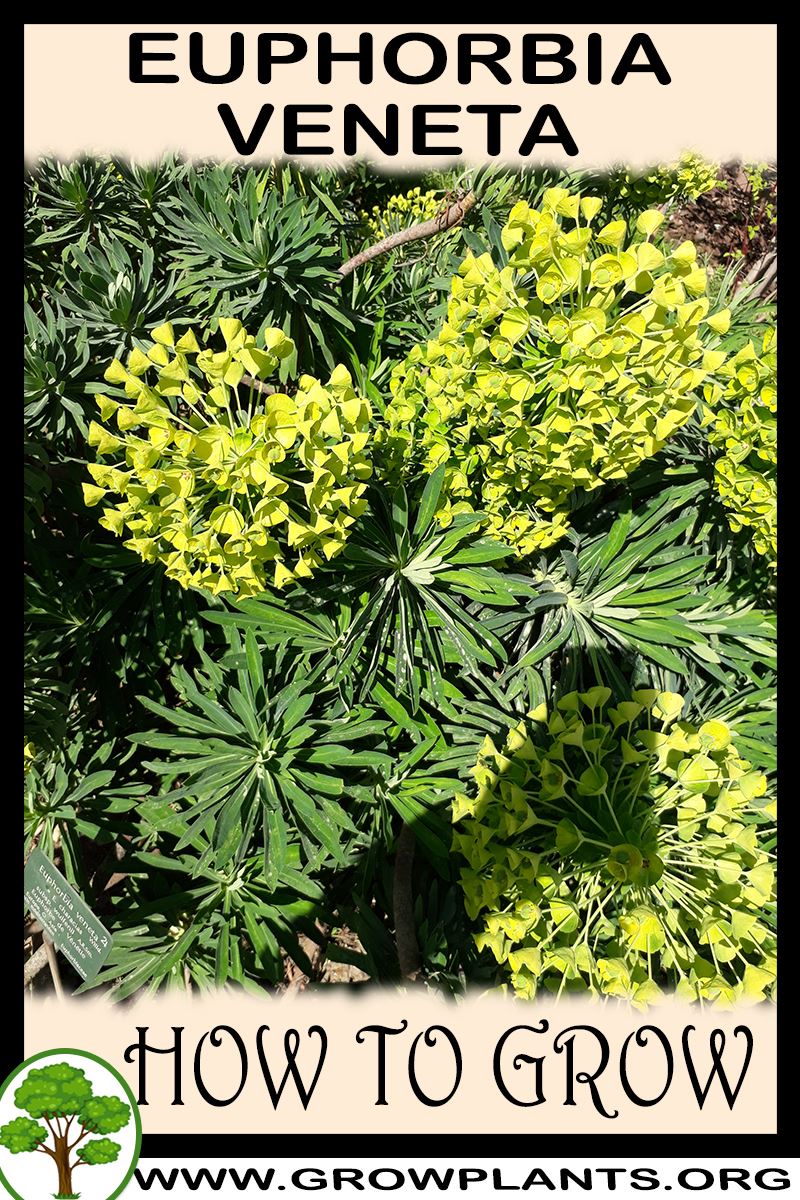
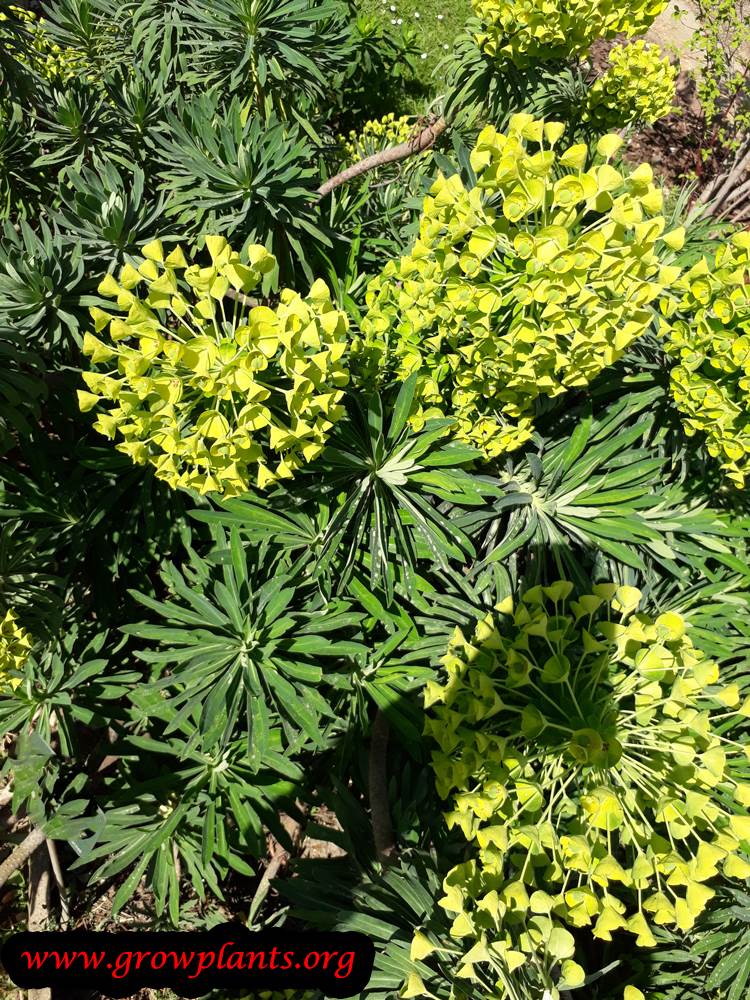
Plant Profile & Key Characteristics
Overview: A compact evergreen succulent shrub reaching about 20-60 cm (8-24 in), grown across Mediterranean and temperate gardens. It is a hardy perennial valued as an architectural, drought-tolerant ornamental.
Quick Specifications
| Specification | Attribute |
|---|---|
| Plant Type / Life Cycle | Perennial (evergreen succulent shrub) |
| Foliage Type | Evergreen |
| Mature Size | 20-60 cm tall (8-24 in) |
| Growth Rate | Slow to Moderate |
| Toxicity | Toxic – milky latex irritates skin and eyes and is poisonous if ingested (Euphorbia) |
| Hardiness | USDA zones 7-11 |
Growth Form & Structure
- Height & Spread: 20-60 cm (8-24 in) tall in the ground; stays at the small end of that range in a container.
- Growth Habit & Form: Bushy, upright succulent shrub with leaves in a circular, whorled pattern on fleshy stems.
- Lifespan & Maturity: Long-lived perennial that reaches full size slowly over several seasons.
Anatomy & Physical Features
- Leaves & Foliage: Green leaves arranged in a circular, whorled pattern around the stems.
- Flower Characteristics: Small green-yellowish flower heads with rounded, heart-shaped bracts borne in clusters (full detail in the Bloom guide).
Primary Uses & Landscape Value
- Functional & Ornamental Roles: Architectural, drought-tolerant ornamental for borders, gravel and Mediterranean-style gardens; happy in containers but not suited to indoor growing.
Care Guide: Planting, Soil & Watering
Overview: Euphorbia veneta is a hardy to about -3°C (zones 7–11) spurge that grows best in full sun to partial shade and free-draining soil. It is fairly drought-tolerant once established, needing only modest watering, and dislikes waterlogged ground.
Quick Care Requirements
| Requirement | Ideal Condition |
|---|---|
| Planting Season | Spring, summer or autumn |
| Growth Rate | Slow to moderate |
| Soil Type | Well-draining soil; tolerates lean, sandy or average garden ground |
| Water Need | Low to moderate – let the top of the soil dry before watering again |
Planting & Establishment
- Best Planting Season: Plant spring, summer or autumn; spring planting establishes it best before winter in colder zones.
- How to Plant:
- Hole Preparation: Wear gloves and take care with the milky sap, which is a skin and eye irritant common to all euphorbias. Dig a hole about twice the width of the root ball and the same depth, so the plant sits at the level it grew at, and loosen the sides for easy rooting.
- Soil Amendments: Work some grit or compost into heavy ground to open up drainage; these spurges dislike sitting in wet soil.
- Planting Depth: Set the plant so the crown sits at soil level – do not bury the stem base.
- Growth Speed & Expectations: Growth is slow to moderate – steady rather than rushed, picking up once the plant is well established.
Soil, Watering & Drainage Care
- Soil Mix & Drainage Needs: Give it free-draining soil, as it dislikes waterlogging. Lighten heavy ground with grit or compost, and in a container use a well-draining potting mix with added perlite or sand.
- Watering Schedule & Technique:
- Young / Newly Planted: Water regularly after planting to settle the roots and keep the soil lightly moist while it establishes.
- Established: Once established it is fairly drought-tolerant; water deeply but only when the top few centimetres of soil have dried.
- Seasonal Adjustments: Water more during prolonged heat and much less over the cooler months, when growth slows.
Climate, Light & Hardiness
This spurge suits Mediterranean, subtropical, and temperate gardens with mild-to-moderate winters, tolerating light frost but not hard freezes. It grows best in full sun to half shade in well-drained soil.
Quick Climate Specifications
| Climate Zones | Mediterranean, Subtropical, Temperate |
|---|---|
| USDA Hardiness Zones | 7–11 |
| Approx. Survival Minimum | Roughly −3°C (27°F) |
| Frost Tolerance | Low to Moderate |
| Light Conditions | Full Sun to Half Shade |
Sunlight & Light Exposure
Optimal Light Setup
Full sun to half shade both suit this plant.
Temperature Extremes & Hardiness
USDA Hardiness & Regional Limits
Hardy in USDA zones 7–11; site guidance indicates a minimum of roughly −3°C (27°F), so protection or a sheltered spot is worthwhile at the cold edge of its range.
Frost Sensitivity
Tolerates brief light frost but not hard or prolonged freezes.
Wind, Humidity & Microclimate
Rainfall & Seasonal Moisture
Needs good drainage; avoid waterlogged winter soil.
Growing in Pots, Balconies & Indoors
Euphorbia veneta is a sun-loving, drought-tolerant spurge. The grower confirms it is not a houseplant but grows well in containers, so grow it in a free-draining pot on a sunny patio or balcony. Its milky sap is an irritant and toxic, so handle it with gloves and keep it away from children and pets.
Quick Details
- Container Size: 15-25 L – it reaches about 20-60 cm
- Indoor Suitability: Not a houseplant; an outdoor architectural perennial for a sunny container
- Best Spot: Full sun to half shade – the sunnier the better
- Soil & Drainage: Free-draining potting mix; it tolerates lean, dry soil and dislikes wet feet
- Watering in Pots: Water moderately and let the surface dry between waterings; keep drier in the cool season
Indoors & On the Windowsill
- Not a houseplant: The grower marks it as unsuitable indoors – it needs full sun and airy, well-drained conditions a room cannot give.
- Windowsill: Only a very bright, sunny sill comes close, but it truly belongs outdoors in a pot on the patio.
- Cool rest: A hardy perennial, it keeps best outdoors with a cool winter; it is evergreen in mild areas.
- Safety: The white sap irritates skin and eyes and is toxic if eaten – wear gloves when cutting and keep it away from children and pets.
On a Balcony or Patio
- Light & wind: Give it a bright, sunny, sheltered spot; it makes a striking architectural pot plant. Reflected wall heat dries pots fast, so check moisture.
- Practicalities: Wear gloves when trimming the spent flower-stems, as cut stems bleed irritant sap; let runoff drain freely.
Choosing the Pot, Soil & Long-Term Care
- Pot & drainage: A pot with strong drainage holes; skip a standing-water saucer, which invites root rot. Terracotta breathes and dries faster (good for plants that hate wet feet); glazed or plastic pots hold moisture longer.
- Potting mix: Well-aerated potting mix – a peat-free or peat/coir blend opened up with perlite or vermiculite.
- Feeding: Feed sparingly – a weak balanced feed a few times in the growing season; these plants dislike rich conditions and lush, soft growth.
- Repotting: Refresh the top of the mix each year and pot on or divide every couple of years, lightly trimming roots and old growth to keep it vigorous.
Fertilizing & Feeding
A well-drained-soil spurge that naturally grows in lean conditions; light, low-nitrogen feeding is enough to keep its rounded stem clusters healthy without pushing weak, overgrown structure.
Quick Fertilizing Specs
| Feeding Level | Light feeder |
|---|---|
| Main Nutrient Priority | Low-nitrogen feeding during the active growing season |
| Best Feeding Period | Spring into early summer while growth is active |
| Organic Options | A light topdressing of compost worked lightly into well-drained soil |
| Micronutrients | Rarely an issue in well-drained garden or container soil; correct specific issues only when diagnosed |
| Soil pH | Tolerates a wide range provided drainage is good |
| Reduce/Stop Feeding | Stop feeding as growth slows going into the cooler part of the year |
Feeding by Growth Stage
Active growing season
Support new stem and leaf growth in the plant’s characteristic dense, rounded clusters.
| Nutrient direction | A light, low-nitrogen feeding to support steady growth while keeping stems compact and sturdy. |
|---|---|
| Timing | From spring growth through the main flowering period. |
| Frequency | An occasional light feeding is usually enough through the growing season. |
| Fertilizer types | A light-strength, low-nitrogen complete fertilizer |
| Precautions | Avoid rich, high-nitrogen feeding, which tends to produce loose, weak growth in this plant. Handle with gloves, since the sap is irritating and the plant is considered poisonous. |
Cool-season rest
Let growth slow naturally as temperatures drop toward the colder edge of this plant’s hardiness range.
| Nutrient direction | None – withhold fertilizer while growth is slow through the cooler season. |
|---|---|
| Timing | Through the cooler autumn and winter months. |
| Frequency | No feeding at this stage. |
| Fertilizer types | No feeding at this stage – resume light feeding when spring growth restarts |
| Precautions | Do not fertilize slow or dormant growth; cold, over-fed soil raises the risk of stem and root rot. |
Nutrient Deficiency Signs & Corrections
Overall growth looks pale and notably weak or stalled through the active growing season.
| Possible causes | very lean, nutrient-poor soil, long-term lack of any feeding, root stress from poor drainage or a cramped container |
|---|---|
| Appears first on | newer stem growth |
| What to check | soil or potting-mix fertility history, drainage and root space, overall vigor compared to prior seasons |
| Possible correction | Apply a light, low-nitrogen feeding rather than a heavy or high-nitrogen product. |
The base of the plant softens or blackens and stems collapse despite otherwise normal conditions.
| Possible causes | poorly drained or waterlogged soil, overwatering, especially in containers, overly rich or over-fed soil weakening this low-demand plant |
|---|---|
| Appears first on | the crown and base of the stems |
| What to check | soil or potting-mix drainage, recent watering frequency, recent feeding history |
| Possible correction | Improve drainage, let soil dry between watering, and avoid rich, over-fed soil going forward. |
New leaves emerge pale yellow while the leaf veins stay green.
| Possible causes | high soil or potting-mix pH limiting iron availability, waterlogged or poorly drained conditions, root damage limiting nutrient uptake |
|---|---|
| Appears first on | the newest leaves |
| What to check | soil or potting-mix pH, drainage quality, recent watering pattern |
| Possible correction | Correct pH toward a more favorable range or apply a chelated iron product per its label if a true deficiency is confirmed. |
Pruning, Training & Seasonal Maintenance
Euphorbia veneta (Mediterranean spurge, in the E. characias group) is a compact evergreen subshrub (20–60 cm) whose individual stems are biennial: each grows vegetatively through its first year, flowers with showy chartreuse bracts in its second spring, and then declines. Pruning tolerance is moderate, but the technique is very specific – once a stem has flowered it should be cut right out at its base rather than tipped or headed, making room for the new basal shoots that will flower the following year. The irritant milky sap also shapes safe handling.
Quick Pruning & Maintenance Specs
| Pruning Tolerance | Moderate |
| Primary Pruning Window | After flowering (late spring–summer), once bracts fade |
| Typical Frequency | Once a year, per flowered stem |
| Main Objective | Remove spent (post-flowering) stems at the base to make way for next year’s flowering shoots |
| Young Plant Priority | Do not disturb first-year vegetative stems – they are next year’s flowers |
| Mature Plant Priority | Cut only stems that have already flowered, right at ground level |
| Best Tool Type | Bypass secateurs |
| Avoid Heavy Pruning During | Active flowering, and never cut into the current year’s non-flowered basal shoots |
Pruning by Plant Age & Size
Newly Established
Leave a newly planted specimen unpruned for its first year so its stems can complete their vegetative phase before flowering.
Young / Formative
No structural training system is used; the plant naturally forms an upright, rounded subshrub through the two-year life cycle of its individual stems.
Mature / Established
Each year, identify stems that have just finished flowering and cut them out completely at the base, while carefully leaving the shorter, non-flowered current-year shoots untouched – these will flower the following spring.
Structural Pruning & Training
The defining structural task for this species is biennial stem renewal: remove only stems that have flowered, cutting them to the ground, never partway. Avoid brushing against or damaging the softer new basal shoots while doing so, since they are next year’s flowering wood.
Special Growth to Remove
- Fully spent, flowered stems – removed entirely at the base once bracts fade and turn papery.
Tools
- Bypass secateurs – for clean base cuts on the moderately thick, pithy stems.
Tool Hygiene & Disease Risk
Routine for pathogens, but treat sap contact as the main risk: the milky latex is an irritant to skin and eyes, so wear gloves and eye protection and avoid touching your face while cutting; rinse tools and hands after pruning.
Cut Placement & Technique
Cut flowered stems as close to ground level as possible in a single clean cut – heading or tipping a flowered stem is ineffective since that stem will not flower again and simply looks untidy if left partial.
Heavy Pruning & Rejuvenation
Not a hard-rejuvenation plant in the usual sense: because renewal happens stem-by-stem every year as part of routine maintenance, there is no need for – and no benefit to – cutting the whole plant down at once.
Post-Pruning Care
Water normally; no feeding is needed after the annual stem removal. Wash off any sap contact promptly.
Common Pruning Mistakes
- Cutting or damaging the new, non-flowered basal shoots while removing spent flowered stems – this sacrifices next year’s flowers.
- Heading back a flowered stem instead of removing it entirely at the base.
- Handling sap-bearing cut stems without gloves.
When NOT to Prune
Do not prune while stems are still flowering, and never cut into current-season vegetative shoots that have not yet bloomed.
Recommended Tools (by task)
- Mature plants, removing spent flowered stems at ground level → bypass_secateurs – clean, close base cuts without crushing neighboring new shoots.
Propagation Guide
This shrubby Mediterranean spurge self-sows readily from seed, and the site confirms vegetative reproduction is not strictly necessary, but stem cuttings are a quick way to bulk up or replicate a particular plant. The latex sap is an irritant, so cut material should be handled with care; propagation is easy overall.
Quick Propagation Specs
| Best Propagation Method | Seed |
| Alternative Methods | Stem Cuttings |
| Propagation Difficulty | Easy |
| Seed True-to-Type | Usually true-to-type, with some variation in habit possible from open pollination |
| Vegetative True-to-Type | Yes |
| Best Propagation Season | Seed: Spring; Cuttings: Spring to early Summer |
| Cutting Rooting Time | Typically a few weeks |
| Seed Sowing Depth | Shallow, just covered |
Growing from Seed
Seed Handling & Viability
Wear gloves when collecting; ripe capsules split explosively, so gather pods just before they open or let the plant self-sow.
Sowing Season
Spring, within the site’s spring/summer/autumn planting window.
Sowing Depth & Orientation
Sow shallowly, just covering the seed.
Germination Conditions
Cool to moderate temperatures, kept moist but well-drained, matching this plant’s preference for free-draining soil.
Germination Time
Typically a few weeks and can be uneven.
Seedling Care
Handle with gloves; pot on once true leaves appear and avoid overwatering.
Stem Cuttings
Cutting Type
Firm, non-flowering young shoot tips.
Best Timing
Spring to early summer.
Cutting Preparation
Take short tip cuttings and let the cut ends bleed briefly or dip them in water before inserting, since thick, undried latex can hinder rooting; always wear gloves, as the sap is a skin and eye irritant.
Rooting Setup
A free-draining, gritty cutting mix with gentle warmth.
Rooting Hormone
Optional — can help but is not essential for this genus.
Rooting Time
Typically a few weeks under warm conditions.
Bloom & Flower Guide
Quick Details
- Bloom Season: Spring and summer
- Flower Appearance: Domed clusters of green-yellow “flowers” – the rounded, heart-shaped “petals” are really coloured bracts around tiny true flowers
- Edibility: Not edible – the milky sap is toxic and irritates skin and eyes
Detailed Blooming Overview
This spurge is grown for its long-lasting chartreuse flower heads, which hold their colour for weeks through spring and summer. What look like the petals are actually coloured bracts, arranged into rounded or heart-shaped cups; the real flowers are the tiny structures nestled inside them. Handle with care, as the white sap is a caustic irritant.
Flower Characteristics
- Green-yellow heads made up of showy, long-lasting bracts.
- The bracts form rounded or heart-shaped cups around tiny true flowers.
- Carried in clusters at the stem tips.
Bloom Care & Thinning
- Encouraging bloom: Full sun and free-draining soil give the best heads.
- After flowering: Cut the spent flowering stems back to the base – wear gloves, as the milky sap irritates skin and eyes.
- Safety: All parts and the sap are toxic if eaten and the latex is a skin and eye irritant.
Pests, Diseases & Troubleshooting
Overview: Mediterranean shrubby spurge is a tough, drought-hardy evergreen perennial with few serious pests; the realistic issues are aphids and mites on soft spring growth, occasional scale, and foliar fungal problems (powdery mildew, leaf spot) plus root rot in wet, poorly drained soils. Its copious latex is notably irritant, so always protect skin and eyes.
Quick Troubleshooting Overview
| Issue / Pest | Main Symptom | Primary Solution |
|---|---|---|
| Aphids | Clusters on new shoots, honeydew, distortion | Water jet, beneficials, insecticidal soap |
| Spider mites | Stippling, bronzing, webbing in dry heat | Raise humidity, rinse, oil / predatory mites |
| Powdery mildew | White powdery film on leaves | Improve airflow; sulfur or potassium-bicarbonate spray |
| Leaf spot / rust | Brown or rusty spots and pustules on leaves | Remove affected leaves; copper if severe |
| Root rot | Wilting, blackened base in wet soil | Improve drainage; reduce watering |
| Latex contact | Skin / eye irritation when cut | Wear gloves and eye protection |
Common Pests & Management
- Aphids (Aphis / Macrosiphum spp.):
- Symptoms: Clusters of green, black or grey soft-bodied insects on soft new shoots, flower stems and bud clusters; sticky honeydew, sooty mould and distorted new growth.
- Prevention & Control: Blast off with a firm water jet and squash small colonies. Encourage ladybirds, lacewings and hoverflies with companion planting. Treat persistent infestations with insecticidal soap or a light horticultural oil, spraying in the cool of the evening to protect pollinators.
- Spider mites (Tetranychus urticae):
- Symptoms: Fine pale stippling, bronzing and a dull cast to the foliage, with fine webbing under leaves in hot, dry spells.
- Prevention & Control: Raise humidity and airflow; rinse foliage to knock back populations. Release predatory mites where practical. Spot-treat with horticultural oil or insecticidal soap and avoid broad-spectrum sprays that remove natural enemies.
- Whitefly (Trialeurodes vaporariorum):
- Symptoms: Clouds of tiny white flies from the undersides of leaves when disturbed; yellowing, honeydew and sooty mould on softer, leafy growth.
- Prevention & Control: Monitor with yellow sticky traps; encourage Encarsia and lacewings. Rinse foliage and treat leaf undersides with insecticidal soap or horticultural oil, repeating weekly.
- Sap-sucking scale & mealybug (Coccidae / Pseudococcidae):
- Symptoms: Brown bumps along stems or white cottony tufts in leaf axils, with honeydew and sooty mould; more common on plants under cover.
- Prevention & Control: Wipe off with dilute alcohol, prune out badly infested stems, and support natural enemies. Smother remaining insects with horticultural oil applied in the evening.
Diseases & Fungal Issues
- Powdery mildew (Podosphaera / Erysiphe spp.):
- Symptoms: White powdery patches on upper leaf surfaces and stems, later yellowing and early leaf drop; worst in crowded plants with poor airflow and warm days/cool nights.
- Treatment & Management: Space and thin for airflow, avoid excess nitrogen and overhead watering. Remove affected leaves. Sulfur, potassium-bicarbonate or a light horticultural-oil spray checks spread; choose airy sites.
- Rust (Melampsora / Uromyces spp.):
- Symptoms: Orange, brown or rusty pustules on leaf undersides with yellow flecking above; premature leaf drop in wet seasons.
- Treatment & Management: Remove and destroy infected leaves and clean up debris at season’s end. Improve airflow and keep foliage dry. A sulfur or copper fungicide can protect valued plantings if rust is recurrent.
- Root & crown rot (Pythium / Phytophthora / Rhizoctonia spp.):
- Symptoms: Wilting despite moist soil, browning at the crown, blackened roots and collapse; follows heavy, waterlogged or poorly drained soil.
- Treatment & Management: Plant in free-draining soil, avoid waterlogging and don’t bury the crown. Reduce watering, improve drainage, and remove severely affected plants; refresh soil where rot has occurred.
- Grey mould (Botrytis cinerea):
- Symptoms: Fuzzy grey mould on faded flowers, soft stems and damaged tissue in cool, damp, still weather.
- Treatment & Management: Remove faded flowers and dead material promptly, improve airflow, and avoid overhead watering late in the day.
Growing Difficulties & Abiotic Problems
- Root rot from overwatering:
- Cause & Symptoms: Wilting, yellowing and a blackened crown in heavy, wet or poorly drained soil.
- Correction Strategy: Grow in free-draining soil, water only as needed and avoid waterlogging; don’t bury the crown when planting.
- Chlorosis:
- Cause & Symptoms: Yellowing leaves with green veins in very alkaline, cold or waterlogged soils.
- Correction Strategy: Improve drainage and soil structure; feed a balanced fertiliser and, on alkaline soils, apply chelated iron if needed.
- Sunscald & leaf scorch:
- Cause & Symptoms: Bleached or browned leaf patches and crisped margins in intense sun or drying wind, especially on soft spring growth.
- Correction Strategy: Site with appropriate light for the species, keep evenly moist during establishment, and shelter from harsh drying wind.
- Latex irritation:
- Cause & Symptoms: Milky sap released when stems are cut irritates skin and eyes and is toxic if ingested.
- Correction Strategy: Wear gloves and eye protection when cutting or dividing; wash off any sap promptly; keep away from eyes.
What Helps – Products & Tools
For spurges the mainstays are horticultural (neem) oil and insecticidal soap for mealybug, scale, whitefly and mites; isopropyl alcohol on cotton swabs for spot-treating mealybug and scale; yellow sticky traps for monitoring whitefly; predatory mites and Cryptolaemus for biological control; and, for disease, a copper fungicide for leaf/stem spot plus sulfur or potassium bicarbonate for powdery mildew. The best “product”, though, is a fast-draining gritty mix and disciplined watering. Always wear gloves and eye protection because of the irritant latex, and spray oils in the cool of the evening.