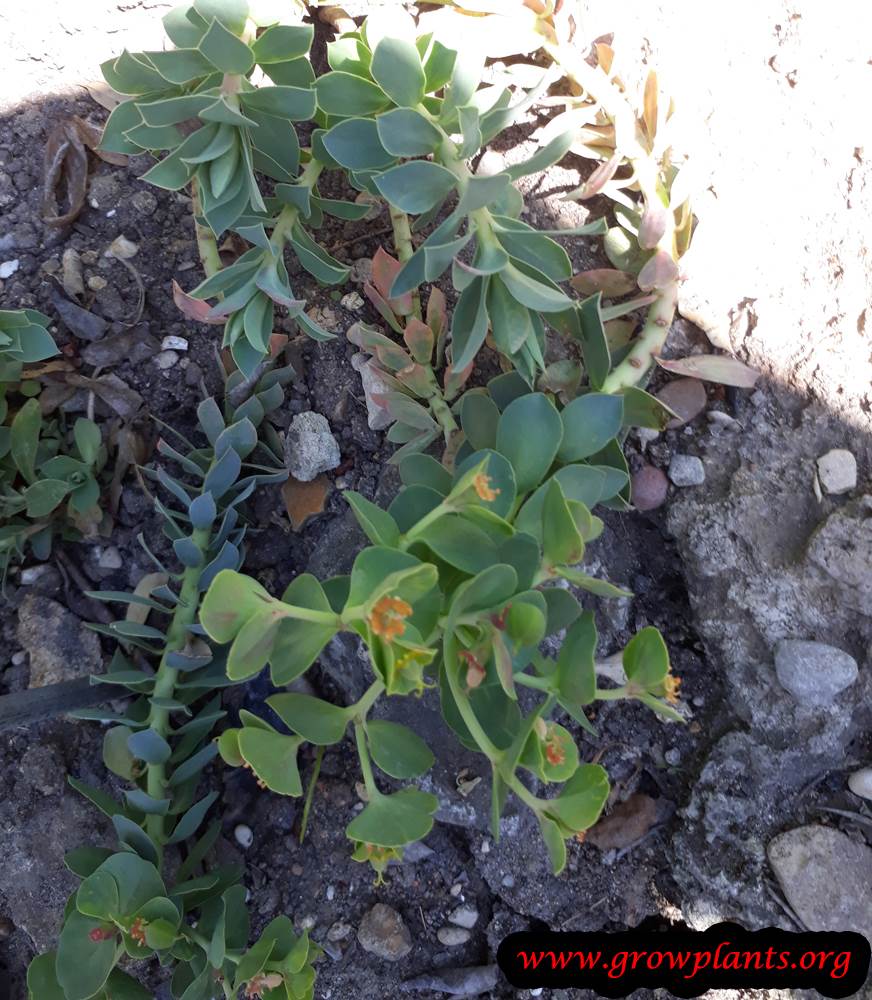
Plant Profile & Key Characteristics
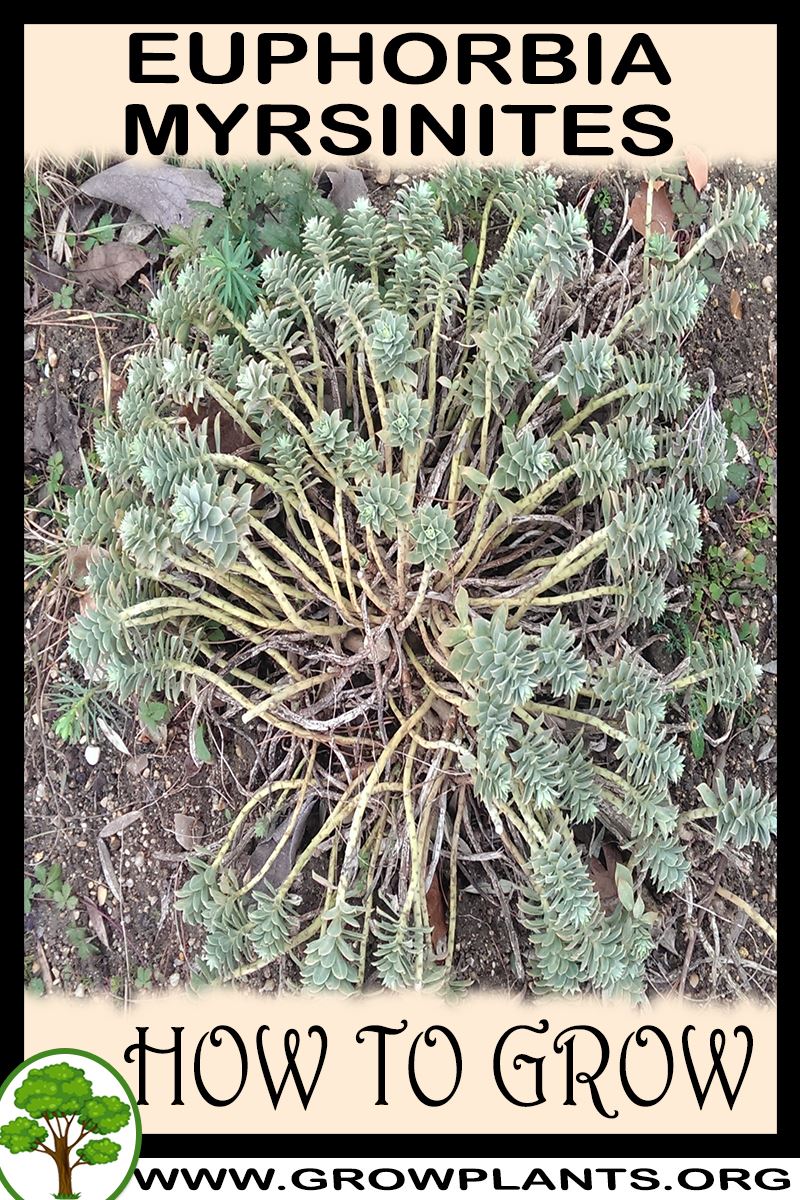
Overview: Euphorbia myrsinites (Myrtle Spurge) is a low, evergreen trailing succulent subshrub 10-20 cm (4-8 in) tall with spiralled blue-green leaves and yellow spring bracts. It is a drought-tolerant ornamental for rockeries and dry banks.
Quick Specifications
| Specification | Attribute |
|---|---|
| Plant Type / Life Cycle | Perennial |
| Foliage Type | Evergreen |
| Mature Size | 10-20 cm (4-8 in) tall |
| Growth Rate | Slow |
| Toxicity | Toxic – the milky latex sap is a skin, eye and mucous-membrane irritant and is poisonous to people and pets if ingested. |
| Hardiness | USDA zones 5-10 |
Growth Form & Structure
- Height & Spread: Low at 10-20 cm (4-8 in) but trailing, so stems sprawl outward over rocks and walls; suited to rockeries and pots rather than indoors.
- Growth Habit & Form: A sprawling, trailing evergreen succulent subshrub; stiff stems radiate outward, clothed in spiralled fleshy leaves.
- Lifespan & Maturity: Slow-growing; long-lived and self-seeding.
Anatomy & Physical Features
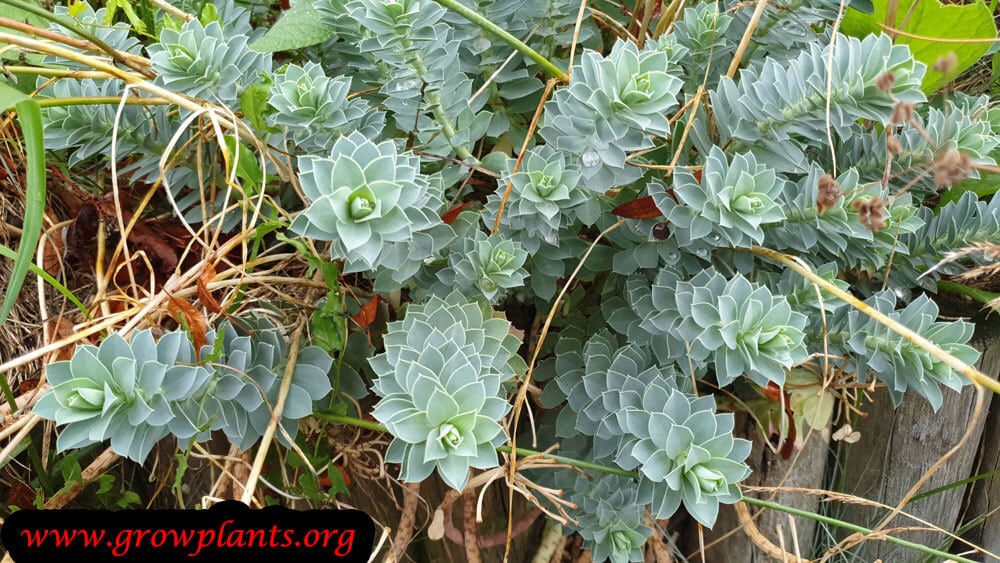
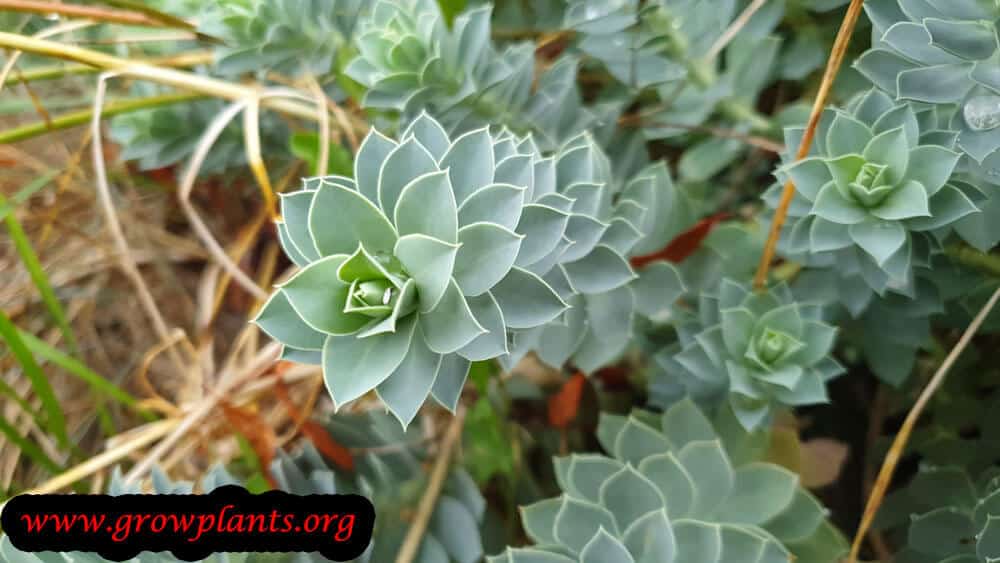
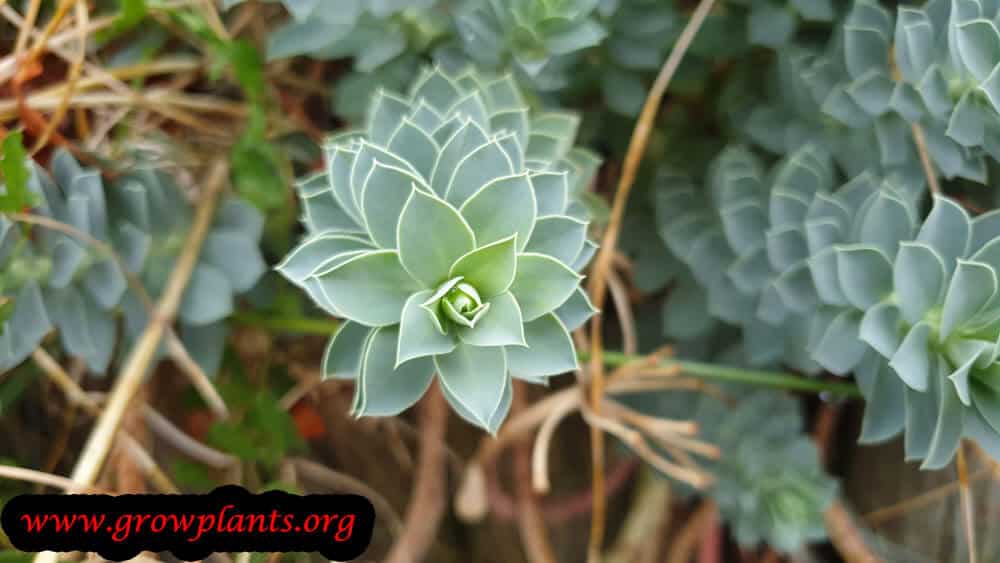
- Leaves & Foliage: Blue-green, fleshy, pointed elliptic leaves arranged spirally in a rosette along the stems.
- Flower Characteristics: Green flowers with showy yellow bracts, clustered in rosette-like heads at the stem ends, in spring and summer.
Primary Uses & Landscape Value
- Functional & Ornamental Roles: Ornamental drought-tolerant groundcover for rockeries, gravel gardens, dry banks and containers.
Care Guide: Planting, Soil & Watering
Overview: Euphorbia myrsinites is a cold-hardy (zones 5–10) spurge that grows best in full sun to partial shade and free-draining soil. It is fairly drought-tolerant once established, needing only modest watering, and dislikes waterlogged ground.
Quick Care Requirements
| Requirement | Ideal Condition |
|---|---|
| Planting Season | Spring or summer |
| Growth Rate | Slow |
| Soil Type | Well-draining soil; tolerates lean, sandy or average garden ground |
| Water Need | Low – water sparingly and let the soil dry out between waterings |
Planting & Establishment
- Best Planting Season: Plant in spring or summer; this trailing, drought-tolerant spurge is ideal for a sunny rockery or wall.
- How to Plant:
- Hole Preparation: Wear gloves and take care with the milky sap, which is a skin and eye irritant common to all euphorbias. Dig a hole about twice the width of the root ball and the same depth, so the plant sits at the level it grew at, and loosen the sides for easy rooting.
- Soil Amendments: Work some grit or compost into heavy ground to open up drainage; these spurges dislike sitting in wet soil.
- Planting Depth: Set the plant so the crown sits at soil level – do not bury the stem base.
- Growth Speed & Expectations: Expect slow growth; these plants build up gradually and often speed up a little as they mature, so patience pays off.
Soil, Watering & Drainage Care
- Soil Mix & Drainage Needs: Give it free-draining soil, as it dislikes waterlogging. Lighten heavy ground with grit or compost, and in a container use a well-draining potting mix with added perlite or sand.
- Watering Schedule & Technique:
- Young / Newly Planted: Water regularly after planting to settle the roots and keep the soil lightly moist while it establishes.
- Established: Once established it is fairly drought-tolerant; water deeply but only when the top few centimetres of soil have dried.
- Seasonal Adjustments: Water more during prolonged heat and much less over the cooler months, when growth slows.
Climate, Light & Hardiness
Euphorbia myrsinites (myrtle spurge) is among the hardier ornamental spurges, growing across Mediterranean, desert, subtropical and temperate climates in full sun to half shade. Its USDA zone 5–10 range means it tolerates real winter cold, well beyond what most succulent Euphorbias survive.
Quick Climate Specifications
| Climate Zones | Mediterranean, Desert, Subtropical, Temperate |
|---|---|
| USDA Hardiness Zones | 5–10 |
| Frost Tolerance | Moderate |
| Light Conditions | Full Sun / Half Shade |
Sunlight & Light Exposure
Optimal Light Setup
Full sun keeps the blue-green rosettes compact; half shade is also tolerated.
Direct Sun Requirement
Yes - performs best with strong direct light for most of the day.
Shade & Heat Management
Some afternoon shade helps in the hottest desert and subtropical summer positions.
Best Exposure / Orientation
An open, sunny rock-garden or border position, matching its low, spreading rosette habit.
Temperature Extremes & Hardiness
USDA Hardiness & Regional Limits
Hardy outdoors across USDA zones 5–10, a genuinely wide range that includes temperate climates with cold winters, not just mild Mediterranean or subtropical ones.
Cold Damage & Winter Protection
As a zone-5-rated perennial, it is built to take real winter freezes without special protection in most of its listed range; gardeners at the very cold edge of zone 5 may still mulch new plantings their first winter.
Frost Sensitivity
Notably more frost-tolerant than typical succulent spurges - established plants shrug off routine winter frost within their hardiness range.
Extreme Heat Tolerance
Also copes well with desert and subtropical summer heat, making it useful across a very broad climate span.
Wind, Humidity & Microclimate
Dry-Air Tolerance
Comfortable in the low humidity typical of Mediterranean and desert climates, given its drought-tolerant nature.
Rainfall & Seasonal Moisture
Adapts to a range of seasonal rainfall patterns across its listed zones, but consistently prefers well-drained soil over sustained wet conditions.
Microclimate Recommendations
Well suited to open rock gardens and slopes where both winter cold and summer drought are part of the normal cycle.
Growing in Pots, Balconies & Indoors
Euphorbia myrsinites (myrtle spurge) is a low, trailing evergreen succulent perfect for spilling over a pot edge. Only 10-20 cm (4-8 in) tall, it sprawls sideways The grower does not rate it as a houseplant but confirms it grows well in a planter or container out in the sun.
Quick Details
- Container Size: 12-20 L (3-5 gal), or a broad low bowl to show off the trailing stems
- Indoor Suitability: Not a houseplant; at most a bright, sunny windowsill
- Best Spot: Full sun to part shade
- Soil & Drainage: Gritty, sharply draining cactus/succulent mix
- Watering in Pots: Sparse – let the mix dry fully between waterings
Indoors & On the Windowsill
- Not a true houseplant: The grower does not recommend this one indoors – it is a sun-loving succulent that sulks and stretches in typical room light.
- On the windowsill: If you want to try it inside, only the brightest, sunniest sill will do; anywhere darker and it will grow weak and leggy.
- Overwintering: In cold-winter areas move the pot to a frost-free, bright spot and keep it nearly dry until growth resumes in the warm season.
- Safety: All Euphorbias bleed a milky latex sap that irritates skin and eyes and is toxic if eaten – keep it away from children and pets and wear gloves when pruning.
On a Balcony or Patio
- Light & wind: Give it the brightest spot the balcony offers; shelter exposed plants from strong wind and stake any tall or top-heavy growth. Walls and paving reflect heat, so pots dry quickly – check moisture often in warm weather.
- Practicalities: A filled pot is heavy once watered, so make sure the balcony can take the weight and stand it where drainage runoff will not be a nuisance.
Choosing the Pot, Soil & Long-Term Care
- Pot & drainage: 12-20 L (3-5 gal), or a broad low bowl to show off the trailing stems with strong drainage holes; skip a standing water saucer so the roots never sit wet. Terracotta breathes and dries fast, while glazed or plastic pots hold moisture longer.
- Potting mix: A gritty, free-draining cactus and succulent mix – loam or coir cut with plenty of coarse sand, grit or perlite.
- Watering: Water sparingly and let the mix dry out completely between waterings – in a pot, overwatering is the fastest way to rot the roots.
- Feeding: Potted plants exhaust their soil faster because nutrients leach out with every watering – feed lightly but regularly through the growing season.
- Repotting: Refresh the mix or pot up about every couple of years, teasing out and lightly trimming the roots of established plants.
Fertilizing & Feeding
This low, trailing, cold-hardy succulent (Myrtle spurge) thrives on neglect. It is adapted to lean, well-drained rocky or sandy soil, and rarely needs more than a very light feeding during active growth; rich soil and heavy feeding tend to make it lanky and floppy rather than its natural tight rosette form.
Quick Fertilizing Specs
| Feeding Level | Light |
|---|---|
| Main Nutrient Priority | A light, low-nitrogen feed if growth looks unusually sparse; this species is adapted to lean soil and often needs no supplemental feeding at all |
| Best Feeding Period | Spring and early summer while rosettes are actively producing new growth |
| Soil pH | Adapted to lean, well-drained soil and tolerates a wide range of soil pH |
| Reduce/Stop Feeding | Stop feeding as the plant slows down going into summer heat or winter cold, when it is naturally dormant or resting |
| Organic Options | This species generally performs best with no added organic feeding at all; if anything, a very light compost top-dress is enough |
Feeding by Growth Stage
Spring active growth
Support tight, compact rosette growth typical of the species without pushing lanky, floppy stems
| Nutrient direction | A very light, low-nitrogen feeding is enough for this lean-soil-adapted species; most established plantings need little to no supplemental feeding at all |
|---|---|
| Timing | During spring and early summer when new rosette growth is most active |
| Frequency | Feeding is rarely needed; if used, a single light application during active spring growth is generally sufficient for the season |
| Fertilizer types | A very dilute, complete fertilizer formulated for succulents, used sparingly if at all, A light compost top-dress as a gentler alternative to liquid feeding |
| Precautions | Avoid rich soil or heavy feeding, which produces lanky, weak growth instead of the tight rosette habit this species is valued for; wear gloves when handling it, since the sap is irritating to skin and eyes |
Heat and cold rest
Let the plant coast through summer heat or winter cold without pushing new growth it does not need
| Nutrient direction | None – withhold fertilizer during periods of heat or cold rest |
|---|---|
| Timing | During summer heat or winter cold when growth naturally pauses |
| Frequency | No feeding at this stage |
| Fertilizer types | No feeding at this stage; this drought-tolerant species needs little water or attention while resting |
| Precautions | Do not fertilize during the rest period, since this species is adapted to lean conditions and feeding now offers no benefit and risks salt injury |
Nutrient Deficiency Signs & Corrections
Rosettes look unusually sparse, small, or pale compared with the plant’s typical dense blue-green growth
| Possible causes | A genuine nutrient deficiency, which is uncommon in this lean-soil-adapted species but can occur in very poor or heavily leached soil, Overcrowding or shading from neighboring plants reducing light, Root stress from soil that stays too wet for this drought-adapted species, Normal seasonal thinning as the plant heads into summer heat or winter cold |
|---|---|
| Appears first on | Newest rosette growth at stem tips |
| What to check | Soil drainage and how wet the site stays after rain or watering, Light exposure and any recent shading from nearby growth, Season and whether this coincides with the plant’s normal rest period, General soil fertility in the planting area |
| Possible correction | Rule out overwatering and shading first, since both are more likely than a true nutrient deficiency; a single light feeding during active spring growth can help if the soil is genuinely very poor |
New rosette leaves yellow between the veins while the veins remain green
| Possible causes | Iron deficiency associated with high soil pH or waterlogged conditions that limit iron uptake, Overwatering causing root stress, which this species is especially sensitive to, Natural lighter coloring of brand-new growth before it matures |
|---|---|
| Appears first on | Newest rosette leaves |
| What to check | Soil drainage and whether the site holds water longer than this species prefers, Whether the yellowing is limited to new growth, which points toward iron, Recent rainfall or watering patterns |
| Possible correction | Improve drainage first, since this is usually the root cause in this species; a chelated iron product applied per its label can help if chlorosis persists in an otherwise healthy, well-drained planting |
Stems or rosette bases turn soft, mushy, or blackened rather than staying firm
| Possible causes | Root or crown rot from overwatering or heavy, slow-draining soil, which is the leading problem in this species, Salt buildup from occasional over-fertilizing of a species that needs very little feeding, Prolonged wet weather in a poorly sited planting |
|---|---|
| Appears first on | Base of stems or lower rosettes |
| What to check | Firmness of the stem base and roots, Drainage of the planting site, especially after rain, Any recent heavy feeding this low-demand species did not need |
| Possible correction | This is almost always a drainage or overwatering problem rather than a nutrient one; improve site drainage and avoid further feeding until the plant recovers |
Pruning, Training & Seasonal Maintenance
Euphorbia myrsinites is a low, slow-growing rosette subshrub (10–20cm) that spreads as a groundcover. Its stems are biennial in habit: a stem grows for a season, flowers in spring/summer from a rosette at its tip, and then that individual stem declines while new stems arise from the base. Pruning here means cutting spent, post-bloom stems back to the base to keep the clump tidy and productive – it can be done any time the stems finish flowering, plus removing infected or damaged leaves as they appear.
Quick Pruning & Maintenance Specs
| Pruning Tolerance | Low–Moderate |
| Primary Pruning Window | After the spring–summer bloom finishes, as individual stems decline |
| Secondary Maintenance Window | Any time, for infected or damaged leaf/stem removal |
| Typical Frequency | Once per bloom cycle per stem, as each flowered stem finishes |
| Main Objective | Remove spent flowered stems at the base; tidy the rosette mat and limit self-seeding |
| Young Plant Priority | No cutting – let the rosette mat establish and spread |
| Mature Plant Priority | Cut spent, post-bloom stems to the base to make room for new basal growth |
| Best Tool Type | Precision snips |
Pruning by Plant Age & Size
Newly Established
No pruning – allow the groundcover mat to fill in undisturbed.
Young / Formative
No structural training; this species forms its rosette-mat habit on its own.
Mature / Established
Ongoing renewal: as each stem finishes flowering and begins to decline (its biennial pattern), cut it back to the base to keep the clump looking fresh and to make space for the new stems that replace it.
Seasonal Pruning Schedule
Post-Flowering
Objective: remove spent flowering stems once bloom fades. Remove: the flowered stem, cut back to its base near the crown. Do not remove: non-flowered younger stems still actively growing. Expected response: new basal stems fill the gap over the following season. Flowering impact: none negative – the removed stem had already finished its one bloom cycle, and this cut also helps limit self-seeding from spent flower heads.
Ongoing Sanitary (all year)
Objective: remove infected or damaged leaves as noticed to keep the mat healthy. Remove: visibly infected or dead leaf/stem tissue. Do not remove: healthy blue-green foliage.
Special Growth to Remove
Spent, post-bloom flowering stems (biennial die-back) are the main thing to remove, cut at the base. Infected or dead leaves should also be removed as seen. Because this species can self-seed readily, removing spent flower heads promptly before seed drop also helps keep its spread under control in the garden.
Container & Small-Space Pruning
Suits containers well (not typically grown as an indoor houseplant). In a pot, the same base-cut renewal approach applies at a smaller scale, and prompt removal of spent flower stems is especially useful in containers to prevent volunteer seedlings appearing in nearby beds.
Tools
Precision snips – every stem on this low, fine-textured subshrub is thin enough for small snips; no larger tools are ever needed.
Tool Hygiene & Disease Risk
Routine: clean, sharp snips are sufficient; no specific transmissible disease is documented for this species.
Cut Placement & Technique
Cut spent stems close to the base, near the crown, rather than partway up, since the whole stem above the cut has already finished its life cycle. The sap is poisonous and can irritate skin/eyes on contact – wear gloves, especially since this is a low, kneeling task that puts hands and face close to the plant.
Post-Pruning Care
No extra watering or feeding needed after removing spent stems; keep to the species’ normal small-water regime. Watch the crown area for any sign of rot where old stems were cut, particularly if the site stays damp.
Common Pruning Mistakes
Leaving spent flowered stems in place indefinitely, which lets seed disperse and can let the species become weedy in the surrounding garden; cutting mid-stem rather than back to the base, which leaves an unsightly dead stub since that stem won’t regrow past the cut.
When NOT to Prune
Avoid cutting into actively growing, non-flowered stems – only spent, post-bloom stems should be removed. Avoid heavy disturbance of the mat while it is actively spreading in spring.
Recommended Tools (by task)
- precision_snips – sufficient for base-cutting spent flowered stems and removing damaged leaves on this low, fine-stemmed groundcover.
Propagation Guide
Euphorbia myrsinites is easiest to propagate from stem cuttings or from seed, which it produces and scatters readily from its own explosively splitting capsules — a trait typical of the genus — so self-sown seedlings often appear nearby without any help. Grafting is not needed and, per the site’s own note, vegetative propagation is easy.
Quick Propagation Specs
| Best Propagation Method | Stem cuttings |
| Alternative Methods | Seed, including self-sown seedlings; rooted trailing stem sections |
| Propagation Difficulty | Easy |
| Seed True-to-Type | Usually true-to-type (species) |
| Vegetative True-to-Type | Yes |
| Best Propagation Season | Spring through summer |
| Seed Germination Time | A few weeks, can be uneven |
| Cutting Rooting Time | A few weeks |
| Germination Temperature | About 15–21°C (59–70°F) |
| Seed Sowing Depth | Surface-sow or barely cover |
Growing from Seed
Seed Handling & Viability
Capsules split explosively when ripe, scattering seed some distance — collect promptly if you want to control where it lands, since this species self-sows freely once established.
Sowing Season
Spring or summer, per the site’s recommended planting season.
Sowing Depth & Orientation
Surface-sow or barely cover.
Germination Conditions
Cool to moderate temperatures in a well-drained gritty mix.
Germination Time
A few weeks; can be uneven.
Stem Cuttings
Cutting Type
Non-flowering stem tips.
Best Timing
Spring through summer.
Cutting Preparation
Wear gloves — the sap is irritant, as the site’s own note warns this plant is poisonous. Allow the cut end to callus for a few days before inserting.
Rooting Setup
Well-drained gritty mix, bright light, sparing water.
Rooting Hormone
Optional.
Rooting Time
A few weeks.
Runners & Stolons
The trailing, procumbent stems typical of this species may root where they touch moist soil. Such rooted sections can be cut free from the parent and lifted once they have their own root system, similar to a low groundcover.
Bloom & Flower Guide
Quick Details
- Bloom Season: Spring and early summer
- Flower Appearance: Green flowers ringed by bright yellow bracts, in a rosette-like cluster at the stem tips
- Edibility: Not edible – the sap is a strong skin and eye irritant, and the plant is a noxious weed in some regions
Detailed Blooming Overview
Myrtle spurge is grown for its blue-green trailing stems, topped in spring and early summer with domed clusters of green flowers ringed by bright yellow bracts. The sap is a strong irritant, and the plant self-seeds aggressively – it is listed as a noxious weed in some regions.
Flower Characteristics
- Green flowers set off by showy yellow bracts.
- Arranged in a rosette-like cluster at the stem tips.
Bloom Care & Thinning
- Handling: Wear gloves and eye protection – the sap is strongly irritant.
- Managing the bloom: Remove flower heads before they run to seed to curb its aggressive spread.
- Position: Full sun and sharp drainage.
Pests, Diseases & Troubleshooting
Overview: The Myrtle spurge / donkey-tail spurge (Euphorbia myrsinites) is, like most of the genus Euphorbia, far more often lost to cultural mistakes than to pests. As a leafy spurge it is generally robust and drought-tough, bothered mainly by aphids, occasional spurge rust and powdery mildew, and by root rot only where drainage is poor. Cultural care carries it a long way; chemicals are rarely needed.
Quick Troubleshooting Overview
| Issue / Pest | Main Symptom | Primary Solution |
|---|---|---|
| Overwatering / root rot | Wilting, yellowing, mushy crown in wet soil | Improve drainage; water less |
| Aphids | Clusters on shoot tips & flower heads; sticky honeydew | Blast off with water; insecticidal soap/neem |
| Spurge rust | Orange/yellow pustules on leaves and stems | Remove affected growth; improve airflow; fungicide if severe |
| Powdery mildew | White powder on leaves in humid, still air | Space plants; sulfur/potassium-bicarbonate spray |
| Latex burns (handling) | Skin/eye irritation from cut sap | Wear gloves & eye protection; wash off promptly |
Common Pests & Management
- Aphids (Aphis & Macrosiphum spp.):
- Symptoms: Soft green, black or yellow insects clustered on tender new shoots, leaves and flower heads; distorted growth, sticky honeydew and sooty mould. Colonies build fast in mild, sheltered conditions.
- Prevention & Control: Dislodge with a firm jet of water, encourage ladybirds and lacewings, and spray insecticidal soap or neem to the undersides of the growth if numbers climb. Avoid heavy nitrogen feeding, which fuels soft, aphid-prone growth.
- Spider mites (Tetranychus urticae):
- Symptoms: Fine pale stippling and a dull, bronzed skin, worst in hot dry air; in bad cases fine webbing over the growing tips. On green-stemmed cactiform species the damage shows as permanent russet scarring.
- Prevention & Control: Raise humidity and airflow and avoid heat-stress. Rinse the plant, then apply horticultural oil or a labelled miticide, repeating to catch newly hatched mites; rotate actives to avoid resistance. Predatory mites work well in enclosed spaces.
- Mealybugs, incl. root mealybug (Pseudococcus & Rhizoecus spp.):
- Symptoms: Soft white, cottony tufts tucked into ribs, spine cushions, branch junctions and the growing point; sticky honeydew and sooty mould follow. Root mealybugs hide below soil as a white, mealy crust on roots and inside the rootball, causing unexplained stalling and slow decline — always suspect them when a euphorbia sulks with no pest visible above ground.
- Prevention & Control: Inspect crevices and roots at every repot; isolate new plants. Dab colonies with a cotton bud dipped in isopropyl alcohol, then follow with neem or insecticidal soap, repeating every 7–10 days. For root mealybug, bare-root, wash the roots, drench with a soil-applied systemic and repot into fresh gritty mix in a clean pot.
- Slugs & snails:
- Symptoms: Ragged holes and chewed edges on leaves and soft new shoots, with silvery slime trails, worst in damp shaded conditions and on outdoor plantings. They mostly damage leafy growth rather than hard stems.
- Prevention & Control: Clear damp debris and hiding places, water in the morning, and set beer traps or hand-pick after dark. A ring of grit or iron-phosphate bait protects vulnerable young growth.
Diseases & Fungal Issues
- Spurge rust (Melampsora / Uromyces spp.):
- Symptoms: Powdery orange, yellow or brown pustules on leaves and stems, sometimes with distortion and premature leaf-fall; a characteristic disease of the leafy spurges in damp seasons.
- Treatment & Management: Remove and bin affected growth, clear old stems at season’s end, and improve spacing and airflow. A sulfur or labelled fungicide checks severe outbreaks.
- Powdery mildew (Oidium / Podosphaera spp.):
- Symptoms: A white powdery bloom on leaves and soft stems, with yellowing and distortion beneath, in humid but still air with big day/night swings.
- Treatment & Management: Open up airflow and space plants, avoid shade and overhead water, and spray sulfur, potassium bicarbonate or a biofungicide at the first sign (avoid sulfur in high heat, which can scorch the plant).
- Fungal stem & leaf spot (Cercospora, Alternaria spp.):
- Symptoms: Sunken tan, brown or black spots and blotches on stems or leaves, sometimes with concentric rings or a yellow halo; favoured by overhead water sitting on the plant and by poor airflow.
- Treatment & Management: Improve ventilation, keep water off the stems, and remove affected parts with a sterile blade. A copper fungicide checks spread in persistent cases; avoid misting.
- Root, basal & stem rot (Pythium, Phytophthora, Fusarium, Rhizoctonia):
- Symptoms: The number-one killer of this plant. Soft, water-soaked, blackening tissue at the base or along a stem, often with a foul smell; the rot travels upward or downward and can collapse the whole plant within days. Usually starts from cold, wet, airless soil or a wound.
- Treatment & Management: Prevent it — a gritty, sharply draining mix, a pot with drainage, warmth and restrained watering. At the first soft patch, cut back to clean firm tissue with a sterile blade, dust the wound, let it callus, and re-root the healthy top if the base is lost. Drench survivors sparingly; a biofungicide (Bacillus/Trichoderma) helps protect fresh roots.
Growing Difficulties & Abiotic Problems
- Overwatering (root & stem rot — the killer):
- Cause & Symptoms: Soggy, airless soil starves and drowns the roots; the base yellows, softens and blackens, and the plant collapses. This, not any pest, is what kills most of these euphorbias.
- Correction Strategy: Use a gritty, mineral-rich free-draining mix and a pot with a drainage hole, water only when the mix has dried, and cut watering right back in cool or dim conditions.
- Sunburn & etiolation (light problems):
- Cause & Symptoms: A sudden move into fierce direct sun scorches the skin with pale or brown corky patches that never heal; too little light does the opposite — pale, thin, stretched (etiolated) growth that leans and topples.
- Correction Strategy: Give bright light but acclimatise gradually to strong sun over a couple of weeks, and shade during the fiercest midday heat. Increase light slowly to firm up drawn growth.
- Nutrient / salt issues:
- Cause & Symptoms: Overfeeding or hard water builds salts that scorch root tips and brown leaf/stem margins; starvation shows as overall paling.
- Correction Strategy: Feed lightly in growth only, flush the pot occasionally with clean water, and use rainwater where the supply is hard.
- Caustic milky latex (handling hazard):
- Cause & Symptoms: Every part of the plant bleeds a white latex when cut, snapped or bruised. On skin it causes burning, redness and blistering; splashed in the eye it can cause intense pain, inflammation and, in severe cases, temporary or lasting vision damage. It is also toxic if ingested by people or pets.
- Correction Strategy: Always wear nitrile gloves and eye protection when pruning, repotting or taking cuttings; keep the plant away from the face and never rub your eyes while handling it. Seal cut cuttings by rinsing or blotting the latex, work out of reach of children and animals, and wash skin and tools immediately with soap and water. If latex contacts the eye, flush with water and seek medical advice.
What Helps — Products & Tools
This spurge needs little: a strong jet of water plus insecticidal soap or neem for aphids, sulfur or potassium bicarbonate for powdery mildew and rust, and iron-phosphate slug bait outdoors. Good drainage and spacing matter more than any product.