Plant Profile & Key Characteristics
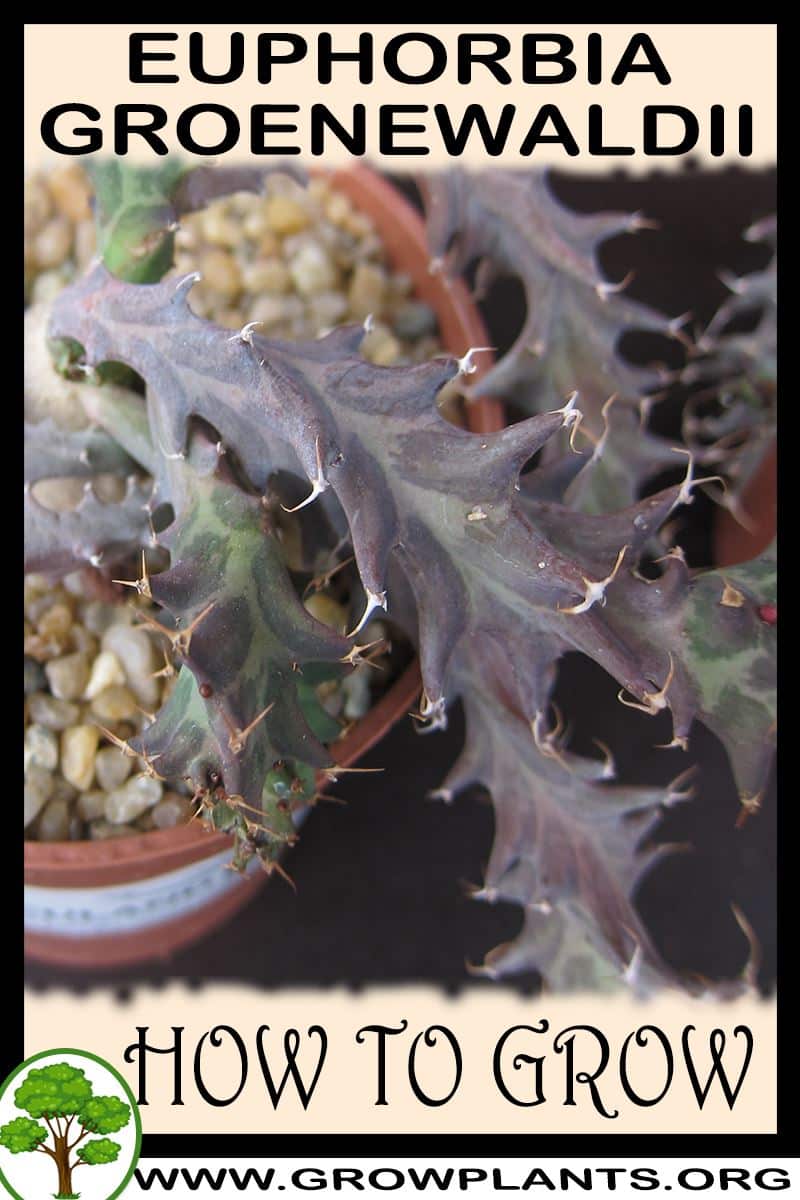
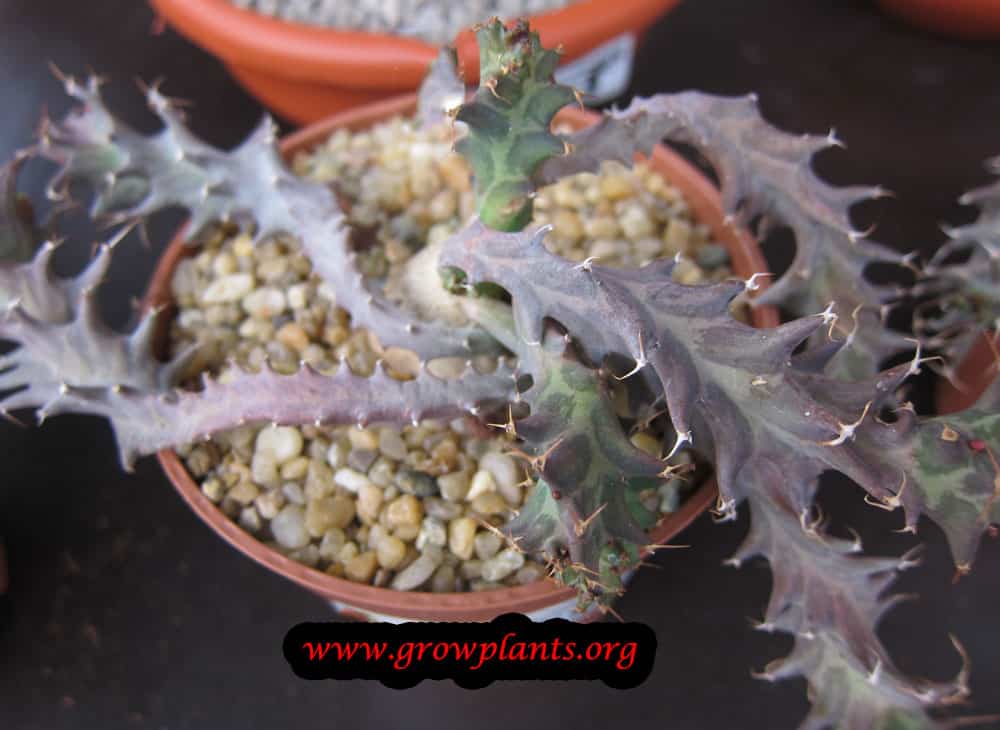
Overview: Euphorbia groenewaldii is a small, evergreen succulent subshrub 10-30 cm (4-12 in) tall with twisted, spiralling green-to-purple stems and few leaves. It is a rare, drought-tolerant ornamental grown as a collector’s plant and in containers.
Quick Specifications
| Specification | Attribute |
|---|---|
| Plant Type / Life Cycle | Perennial |
| Foliage Type | Evergreen (persistent succulent stems, largely leafless) |
| Mature Size | 10-30 cm (4-12 in) tall |
| Growth Rate | Slow |
| Toxicity | Toxic – the milky latex sap is a skin, eye and mucous-membrane irritant and is poisonous to people and pets if ingested. |
| Hardiness | USDA zones 10-12 |
Growth Form & Structure
- Height & Spread: Stays small at 10-30 cm (4-12 in); suited to pots and grown indoors in bright light.
- Growth Habit & Form: A low subshrub whose green-to-purple stems twist into a spiralled, tuberculate form, mostly without leaves.
- Lifespan & Maturity: Slow-growing; long-lived.
Anatomy & Physical Features
- Leaves & Foliage: Sparse, small green linear leaves; the twisted spiral stems are the main feature.
- Flower Characteristics: Small green-and-brown flowers only 1-2 mm across, in spring.
Primary Uses & Landscape Value
- Functional & Ornamental Roles: Ornamental collector’s succulent for containers and warm, dry gardens.
Care Guide: Planting, Soil & Watering
Overview: Euphorbia groenewaldii is a drought-tolerant euphorbia succulent that grows best in partial to full shade and warm, frost-free (zones 10–12) conditions. It needs sharply-drained, gritty soil and only light, occasional watering, as excess moisture at the roots quickly causes rot.
Quick Care Requirements
| Requirement | Ideal Condition |
|---|---|
| Planting Season | Spring, summer or autumn (warm season) |
| Growth Rate | Slow |
| Soil Type | Sharp-draining, sandy or gritty cactus/succulent mix, low in organic matter |
| Water Need | Low – water sparingly and let the soil dry out between waterings |
Planting & Establishment
- Best Planting Season: Plant through the warm season – spring, summer or autumn – in a frost-free spot.
- How to Plant:
- Hole Preparation: Wear gloves and take care with the milky sap, which is a skin and eye irritant common to all euphorbias. Dig a hole about twice the width of the root ball but no deeper, so the plant sits at the level it grew at, and loosen the sides so the roots spread easily.
- Soil Amendments: Blend plenty of coarse sand, grit, perlite or pumice into the backfill to guarantee fast drainage; only a little organic matter is needed.
- Planting Depth: Set the plant so the root collar sits right at soil level – never bury the stem, which invites rot in a succulent.
- Growth Speed & Expectations: Expect slow growth; these plants build up gradually and often speed up a little as they mature, so patience pays off.
Soil, Watering & Drainage Care
- Soil Mix & Drainage Needs: These succulents rot quickly in soggy soil, so drainage is everything. Use an open, gritty cactus mix (sand, perlite, lava grit or pumice); in a pot, add a coarse layer at the base and keep the drainage holes clear.
- Watering Schedule & Technique:
- Young / Newly Planted: Water lightly but regularly while the roots or cuttings establish, keeping the mix barely moist and never wet.
- Established: Once established, water deeply but infrequently, always letting the top of the soil dry out before watering again – overwatering is the quickest way to kill it.
- Seasonal Adjustments: Give a little more water during hot, active growth and cut back sharply in cool weather, keeping it nearly dry through a cold or dormant winter.
Climate, Light & Hardiness
Euphorbia groenewaldii is a small succulent subshrub of desert, Mediterranean and subtropical climates that, unusually for the genus, prefers shade rather than direct sun. Its cold tolerance is limited to essentially frost-free conditions.
Quick Climate Specifications
| Climate Zones | Desert, Mediterranean, Subtropical |
|---|---|
| USDA Hardiness Zones | 10–12 |
| Frost Tolerance | Very Low |
| Light Conditions | Full Shade |
Sunlight & Light Exposure
Optimal Light Setup
Full shade suits this species best; it does not need or particularly want strong direct sun.
Shade & Heat Management
Provide filtered or full shade, especially through peak summer heat, to keep the plant comfortable.
Best Exposure / Orientation
A north-facing spot or a position shaded by larger plants, walls, or structures works well.
Temperature Extremes & Hardiness
USDA Hardiness & Regional Limits
Grows outdoors year-round only in USDA zones 10–12; in colder climates it needs container culture with winter protection.
Cold Damage & Winter Protection
Frost and prolonged cold damage the stems. Move container-grown plants under cover or indoors before temperatures approach freezing.
Frost Sensitivity
Very low frost tolerance - essentially a frost-free plant.
Extreme Heat Tolerance
Tolerates warm desert and subtropical heat well as long as it is kept out of the harshest direct sun.
Wind, Humidity & Microclimate
Dry-Air Tolerance
Adapted to the arid air typical of desert and Mediterranean climates.
Rainfall & Seasonal Moisture
Suited to climates with a distinct dry season; avoid prolonged wet spells or waterlogging.
Microclimate Recommendations
Site it in the shade of taller plants or structures and away from frost pockets.
Growing in Pots, Balconies & Indoors
Euphorbia groenewaldii is a small, compact succulent that the grower confirms can be grown indoors as a houseplant. Unusually for a euphorbia it tolerates lower light (the grower even lists full shade), which makes it genuinely indoor-friendly, though bright indirect light keeps it at its best.
Quick Details
- Container Size: A small, shallow, free-draining pot suits its compact, shallow-rooted form
- Indoor Suitability: A genuine houseplant; tolerates lower light but prefers a bright indirect spot
- Best Spot: The grower lists full shade; indoors give bright, indirect light for the best form
- Soil & Drainage: Gritty, sharp-draining cactus mix
- Watering in Pots: A small amount; let it dry between waterings
Indoors & On the Windowsill
- A real houseplant: The grower confirms it grows indoors, and it copes with lower light better than most euphorbias – a good choice for a bright shelf or windowsill. A ready-made cactus and succulent soil mix provides that structure without mixing it yourself.
- Overwintering: Frost-tender – keep it indoors over winter in cold climates, which suits its life as a houseplant anyway.
On a Balcony or Patio
- Light & drainage: It takes bright shade to sun on a balcony; keep drainage sharp and let it dry between waterings, as overwatering is the main risk.
Choosing the Pot, Soil & Long-Term Care
- Pot & drainage: A small pot with strong holes and no standing saucer; terracotta helps it dry between waterings.
- Potting mix: A gritty cactus or succulent mix.
- Feeding: A light cactus feed in the growing season only.
- Safety: Like all euphorbias, the milky sap is toxic and a skin, eye and mouth irritant – wear gloves when cutting, wash off any sap, and keep the plant away from children and pets. Never treat any part as edible.
Fertilizing & Feeding
A small, slow-growing subshrub succulent with twisted, spiraling stems and few or no leaves – unlike most succulent Euphorbias it tolerates full shade and suits indoor growing, but it still needs only minimal feeding to stay healthy and compact.
Quick Fertilizing Specs
| Feeding Level | Light feeder |
|---|---|
| Main Nutrient Priority | Low-nitrogen, balanced feeding that supports the plant’s slow, compact form without pushing soft growth |
| Best Feeding Period | The warm season while the plant is actively growing |
| Soil pH | Prefers a lean, well-drained soil; not particular about soil richness |
| Micronutrients | No routine micronutrient supplementation needed |
| Organic Options | A lean mineral succulent mix suits this species better than an organically rich one |
| Reduce/Stop Feeding | Ease off feeding as growth slows in cooler weather |
Feeding by Growth Stage
Warm-Season Active Growth
Support slow, steady growth of the plant’s distinctive twisted, spiraling stems, whether grown outdoors in shade or as an indoor plant.
| Nutrient direction | Light, low-nitrogen feeding – this species is a small, deliberate grower that does not need rich feeding regardless of whether it’s grown indoors or in a shaded outdoor spot. |
|---|---|
| Timing | During the warm months when the plant is actively growing. |
| Frequency | Feed sparingly – a light application at the start of the growing season is usually enough for this slow grower. |
| Fertilizer types | A dilute, low-nitrogen fertilizer formulated for cacti and succulents |
| Precautions | Handle with a degree of care as is typical for the genus, and let the soil dry between waterings; because this species tolerates shade and indoor conditions, avoid the temptation to feed more heavily to compensate for lower light – it will not speed growth and raises the risk of rot instead. |
Cool-Season Rest
Let the plant rest through its slow-growth period without pushing new tissue it doesn’t need.
| Nutrient direction | None – withhold fertilizer during the rest period. |
|---|---|
| Timing | The cooler months when growth naturally slows. |
| Frequency | No feeding at this stage. |
| Fertilizer types | No feeding at this stage |
| Precautions | Do not fertilize during the rest period; combined with cooler temperatures and reduced watering, feeding now mainly raises the risk of rot rather than supporting growth. |
Nutrient Deficiency Signs & Corrections
Unusually pale, weak new stem growth on an already slow-growing plant.
| Possible causes | Nitrogen deficiency in very old, depleted potting mix, Chronic overwatering weakening the root system, Very low light, even beyond this species’ shade tolerance, limiting vigor |
|---|---|
| Appears first on | New stem growth at the tips |
| What to check | How long since the potting mix was refreshed, Watering habits and whether the soil ever fully dries out, Light levels, especially if grown indoors |
| Possible correction | Refresh old potting mix with a lean, well-drained succulent blend and apply only a light, dilute feeding if new growth stays weak. |
Sections of stem softening or dying back, more than expected for this species’ normally slow but steady growth.
| Possible causes | Overwatering, especially if paired with recent feeding, Poorly drained potting mix holding excess moisture, Snails or slugs damaging soft tissue, which can then invite rot |
|---|---|
| Appears first on | Individual stem sections, often lower or older growth |
| What to check | Watering frequency and drainage, Any visible pest damage from snails or slugs, Whether feeding has been paired with heavy watering |
| Possible correction | Let the soil dry fully between waterings, improve drainage, control any snail or slug activity, and hold off on feeding until healthy new growth resumes. |
Yellowing new stem growth despite otherwise normal care.
| Possible causes | Overly rich or high-pH potting mix limiting iron availability, Waterlogged mix reducing root function, Root stress from stagnant, compacted potting mix |
|---|---|
| Appears first on | Newest stem growth |
| What to check | Potting mix richness and drainage, Watering frequency, How long since the potting mix was last refreshed |
| Possible correction | Repot into a leaner, better-draining mix; a chelated iron product per its label can help if chlorosis persists. |
Pruning, Training & Seasonal Maintenance
Euphorbia groenewaldii is a small (10–30cm), slow-growing subshrub with twisted, spiralling, mostly leafless stems – its appeal is the natural spiral form, not a shaped silhouette. Pruning tolerance is low and purely sanitary: the only cutting this species genuinely needs is removal of dead or damaged stem tissue, which can be done at any time of year rather than on a seasonal schedule.
Quick Pruning & Maintenance Specs
| Pruning Tolerance | Low |
| Primary Pruning Window | Any time (as dead tissue appears) |
| Typical Frequency | Occasional – only when dead sections appear |
| Main Objective | Sanitary removal of dead stem tissue; preserve the natural spiral growth form |
| Young Plant Priority | No cutting – allow the spiral stem habit to develop untouched |
| Mature Plant Priority | Remove dead stem sections only; do not reshape the spirals |
| Best Tool Type | Precision snips |
Pruning by Plant Age & Size
Newly Established
No pruning at all – remove only obviously damaged growth from transplant handling.
Young / Formative
No structural training applies to this species; the spiralling stem form is inherent and should not be cut for shape.
Mature / Established
Ongoing priority stays the same as when young: remove dead stem tissue as it appears. There is no mature-stage restructuring objective for this plant.
Seasonal Pruning Schedule
Ongoing Sanitary (all year)
Objective: keep the clump free of dead or rotting stem material. Remove: fully dead, shriveled, or rotted stems, cut back to healthy tissue. Do not remove: living stems regardless of how twisted or unusual their form looks – the spiral habit is normal, not a defect. Expected response: minimal, since this is a slow grower; new growth is not stimulated by this kind of cut. Flowering impact: none – the tiny green-brown spring flowers are unaffected by sanitary removal of unrelated dead stems.
Special Growth to Remove
Only dead or rotted stem material. There are no suckers, watersprouts, or spent flower stems worth managing on a plant this small and slow-growing – the individual flowers are only 1–2mm and not deadheaded.
Container & Small-Space Pruning
This species is well suited to containers and can be grown indoors. In a pot, keep the same minimal, sanitary-only approach; there is no need for height or spread control given its compact 10–30cm mature size, and no root-pruning is indicated.
Tools
Precision snips only – every cut on this plant is small-diameter and selective; no secateurs, loppers, or saw are ever warranted at this scale.
Tool Hygiene & Disease Risk
Routine: clean, sharp snips are sufficient. No specific transmissible disease is documented for this species; the main practical concern is the milky latex sap gumming the blade tip between cuts.
Cut Placement & Technique
Cut cleanly into healthy tissue just below any dead/rotted section, leaving no stub of dead material against the living stem. The sap is an irritant on contact with skin – use gloves for anything beyond a token snip.
Heavy Pruning & Rejuvenation
Not applicable – this species does not tolerate or need rejuvenation pruning. It stays small and slow-growing by nature, so there is no overgrown state to cut back from.
Post-Pruning Care
Let the cut dry in the plant’s normal light-shade conditions; avoid adding extra water after cutting, since this species is grown on a "small amount of water" regime and excess moisture around a fresh wound raises rot risk.
Common Pruning Mistakes
Trimming the spiral stems for a "neater" look – the twist is the plant’s natural and desirable form, not something to correct; and cutting without gloves, given the irritant sap.
When NOT to Prune
Avoid cutting shortly after repotting or transplanting, and avoid cutting purely for cosmetic reshaping – this species has no design-pruning tradition the way some related Euphorbias do.
Recommended Tools (by task)
- precision_snips – the only tool this plant’s scale and pruning needs (dead-tissue removal) call for.
Propagation Guide
Euphorbia groenewaldii can be grown from seed or from short sections cut from its slender, spiraled stems; grafting is not required. Propagation itself is straightforward, but because the site notes this is a slow-growing plant, new starts take time to bulk up, so overall difficulty is best rated moderate.
Quick Propagation Specs
| Best Propagation Method | Stem cuttings |
| Alternative Methods | Seed |
| Propagation Difficulty | Moderate (slow to establish) |
| Seed True-to-Type | Usually true-to-type (species) |
| Vegetative True-to-Type | Yes |
| Best Propagation Season | Spring through autumn |
| Seed Germination Time | A few weeks, can be slow |
| Cutting Rooting Time | Several weeks to a couple of months, reflecting this species’ generally slow growth |
| Germination Temperature | About 20–25°C (68–77°F) |
| Seed Sowing Depth | Surface-sow or barely cover |
Growing from Seed
Sowing Season
Spring through autumn.
Germination Conditions
Warm temperatures, a gritty well-drained mix, and light, even watering.
Germination Time
Can be slow, in keeping with this species’ generally slow growth rate.
Stem Cuttings
Cutting Type
A short section of the twisted stem.
Best Timing
Spring through summer.
Cutting Preparation
Given the milky latex sap, allow the cut end to dry and callus for several days to a week before inserting into mix.
Rooting Setup
Well-drained gritty mix in light shade; water sparingly.
Rooting Hormone
Optional; not required for rooting.
Rooting Time
Several weeks, and can be slow given this species’ naturally slow growth.
Division, Offsets, Pups & Suckers
As stems mature they may produce additional shoots from the base; where a shoot has developed its own roots it can be separated and potted on, though this species typically offsets more slowly than many other clustering euphorbias.
Bloom & Flower Guide
Quick Details
- Bloom Season: Spring
- Flower Appearance: Tiny green-and-brown flowers, only about 1-2 mm across
- Edibility: Not edible – the plant is toxic and its milky sap irritates skin and eyes
Detailed Blooming Overview
A rare, tuberous South African succulent, Euphorbia groenewaldii produces tiny green-and-brown flowers, only a millimetre or two across, in spring. As with all spurges, the milky sap is an irritant.
Flower Characteristics
- Minute flowers, roughly 1-2 mm.
- Green marked with brown.
Bloom Care & Thinning
- Handling: Wear gloves – the sap is a skin and eye irritant.
- Position: Bright light suits it best.
Pests, Diseases & Troubleshooting
Overview: The Groenewald’s euphorbia (Euphorbia groenewaldii) is, like most of the genus Euphorbia, far more often lost to cultural mistakes than to pests. Its worst enemy is overwatering, which triggers fast-moving stem and root rot; the sap-sucking pests it does attract (mealybugs, spider mites and scale) hide in ribs, spines and at the soil line. Manage it culturally first with a gritty free-draining mix, cautious watering and good light, and reach for sprays only when a problem is confirmed.
Quick Troubleshooting Overview
| Issue / Pest | Main Symptom | Primary Solution |
|---|---|---|
| Overwatering / root & stem rot | Soft, blackening, collapsing base or stems; foul smell | Dry out; cut back to firm tissue; improve drainage |
| Mealybugs | White cottony fluff in crevices, spines and at soil line | Spot-treat with alcohol; neem/insecticidal soap; check roots |
| Spider mites | Fine stippling, dull skin, webbing in dry heat | Raise humidity/airflow; horticultural oil or miticide |
| Scale | Brown/tan bumps on stems that don’t rub off; sticky honeydew | Scrape off; horticultural oil; systemic if heavy |
| Latex burns (handling) | Skin/eye irritation from cut sap | Wear gloves & eye protection; wash off promptly |
Common Pests & Management
- Mealybugs, incl. root mealybug (Pseudococcus & Rhizoecus spp.):
- Symptoms: Soft white, cottony tufts tucked into ribs, spine cushions, branch junctions and the growing point; sticky honeydew and sooty mould follow. Root mealybugs hide below soil as a white, mealy crust on roots and inside the rootball, causing unexplained stalling and slow decline — always suspect them when a euphorbia sulks with no pest visible above ground.
- Prevention & Control: Inspect crevices and roots at every repot; isolate new plants. Dab colonies with a cotton bud dipped in isopropyl alcohol, then follow with neem or insecticidal soap, repeating every 7–10 days. For root mealybug, bare-root, wash the roots, drench with a soil-applied systemic and repot into fresh gritty mix in a clean pot.
- Spider mites (Tetranychus urticae):
- Symptoms: Fine pale stippling and a dull, bronzed skin, worst in hot dry air; in bad cases fine webbing over the growing tips. On green-stemmed cactiform species the damage shows as permanent russet scarring.
- Prevention & Control: Raise humidity and airflow and avoid heat-stress. Rinse the plant, then apply horticultural oil or a labelled miticide, repeating to catch newly hatched mites; rotate actives to avoid resistance. Predatory mites work well in enclosed spaces.
- Scale insects (soft & armoured — Coccus, Diaspis spp.):
- Symptoms: Fixed brown, tan or grey bumps along stems and in rib grooves that do not rub off like dirt; soft scales weep honeydew and blacken the plant with sooty mould. Cactiform stems can carry heavy colonies hidden along the ridges.
- Prevention & Control: Scrape or wipe off with an alcohol-dampened cloth, then coat with horticultural oil to smother crawlers, repeating over several weeks. A soil-applied systemic helps with stubborn armoured scale on woody stems.
- Aphids (Aphis & Macrosiphum spp.):
- Symptoms: Soft green, black or yellow insects clustered on tender new shoots, leaves and flower heads; distorted growth, sticky honeydew and sooty mould. Colonies build fast in mild, sheltered conditions.
- Prevention & Control: Dislodge with a firm jet of water, encourage ladybirds and lacewings, and spray insecticidal soap or neem to the undersides of the growth if numbers climb. Avoid heavy nitrogen feeding, which fuels soft, aphid-prone growth.
- Fungus gnats (Bradysia spp.):
- Symptoms: Small dark flies running over the soil surface; their larvae feed on roots and organic matter in constantly damp mix, weakening seedlings and rot-prone succulents. Their presence is itself a warning that the mix is too wet.
- Prevention & Control: Let the surface dry between waterings, top-dress with grit or sand, and use yellow sticky traps. A Bacillus thuringiensis var. israelensis (Bti) drench or beneficial nematodes clears the larvae.
Diseases & Fungal Issues
- Root, basal & stem rot (Pythium, Phytophthora, Fusarium, Rhizoctonia):
- Symptoms: The number-one killer of this plant. Soft, water-soaked, blackening tissue at the base or along a stem, often with a foul smell; the rot travels upward or downward and can collapse the whole plant within days. Usually starts from cold, wet, airless soil or a wound.
- Treatment & Management: Prevent it — a gritty, sharply draining mix, a pot with drainage, warmth and restrained watering. At the first soft patch, cut back to clean firm tissue with a sterile blade, dust the wound, let it callus, and re-root the healthy top if the base is lost. Drench survivors sparingly; a biofungicide (Bacillus/Trichoderma) helps protect fresh roots.
- Fungal stem & leaf spot (Cercospora, Alternaria spp.):
- Symptoms: Sunken tan, brown or black spots and blotches on stems or leaves, sometimes with concentric rings or a yellow halo; favoured by overhead water sitting on the plant and by poor airflow.
- Treatment & Management: Improve ventilation, keep water off the stems, and remove affected parts with a sterile blade. A copper fungicide checks spread in persistent cases; avoid misting.
- Powdery mildew (Oidium / Podosphaera spp.):
- Symptoms: A white powdery bloom on leaves and soft stems, with yellowing and distortion beneath, in humid but still air with big day/night swings.
- Treatment & Management: Open up airflow and space plants, avoid shade and overhead water, and spray sulfur, potassium bicarbonate or a biofungicide at the first sign (avoid sulfur in high heat, which can scorch the plant).
Growing Difficulties & Abiotic Problems
- Overwatering (root & stem rot — the killer):
- Cause & Symptoms: Soggy, airless soil starves and drowns the roots; the base yellows, softens and blackens, and the plant collapses. This, not any pest, is what kills most of these euphorbias.
- Correction Strategy: Use a gritty, mineral-rich free-draining mix and a pot with a drainage hole, water only when the mix has dried, and cut watering right back in cool or dim conditions.
- Sunburn & etiolation (light problems):
- Cause & Symptoms: A sudden move into fierce direct sun scorches the skin with pale or brown corky patches that never heal; too little light does the opposite — pale, thin, stretched (etiolated) growth that leans and topples.
- Correction Strategy: Give bright light but acclimatise gradually to strong sun over a couple of weeks, and shade during the fiercest midday heat. Increase light slowly to firm up drawn growth.
- Edema (oedema):
- Cause & Symptoms: Corky bumps or blisters on stems/leaves when roots take up water faster than the plant transpires it, in cool humid spells with wet soil.
- Correction Strategy: Water less during dull, humid weather, improve airflow and warmth, and avoid watering late in the day.
- Natural corking / basal browning:
- Cause & Symptoms: Firm, dry, tan-to-grey bark forming at the oldest base of a columnar stem — a normal ageing process, not rot. It is dry and hard, unlike the soft wet blackening of rot.
- Correction Strategy: None needed; simply distinguish this harmless firm corking from soft, smelly rot before acting.
- Cold & chilling damage:
- Cause & Symptoms: These are frost-tender plants; cold snaps or cold draughts cause translucent, water-soaked, then browning tissue, soft collapse and leaf drop, and open the door to rot.
- Correction Strategy: Keep above about 10–13°C, well away from cold glass and draughts, and keep the plant dry when cool.
- Caustic milky latex (handling hazard):
- Cause & Symptoms: Every part of the plant bleeds a white latex when cut, snapped or bruised. On skin it causes burning, redness and blistering; splashed in the eye it can cause intense pain, inflammation and, in severe cases, temporary or lasting vision damage. It is also toxic if ingested by people or pets.
- Correction Strategy: Always wear nitrile gloves and eye protection when pruning, repotting or taking cuttings; keep the plant away from the face and never rub your eyes while handling it. Seal cut cuttings by rinsing or blotting the latex, work out of reach of children and animals, and wash skin and tools immediately with soap and water. If latex contacts the eye, flush with water and seek medical advice.
What Helps — Products & Tools
For this euphorbia the useful kit is simple: isopropyl alcohol and neem or insecticidal soap for mealybugs, scale and aphids; horticultural oil or a miticide for spider mites; yellow sticky traps and a Bti drench for fungus gnats; a copper fungicide for stem spot; and, above all, a gritty free-draining mineral mix with a biofungicide to prevent the rot that does the real damage. Always wear gloves and eye protection because of the caustic latex.