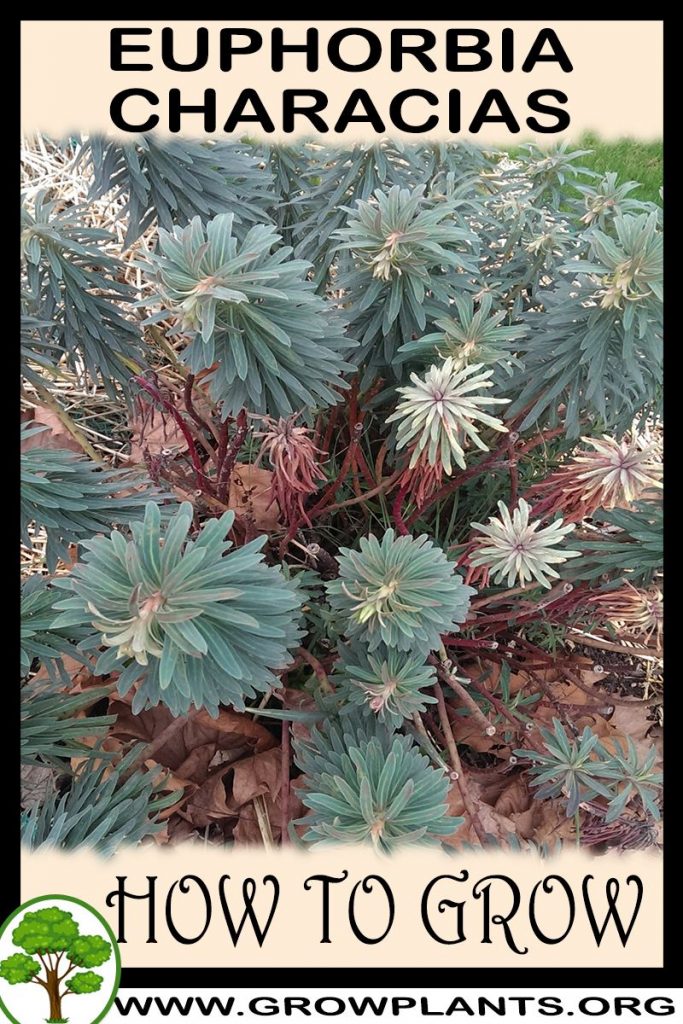
Plant Profile & Key Characteristics
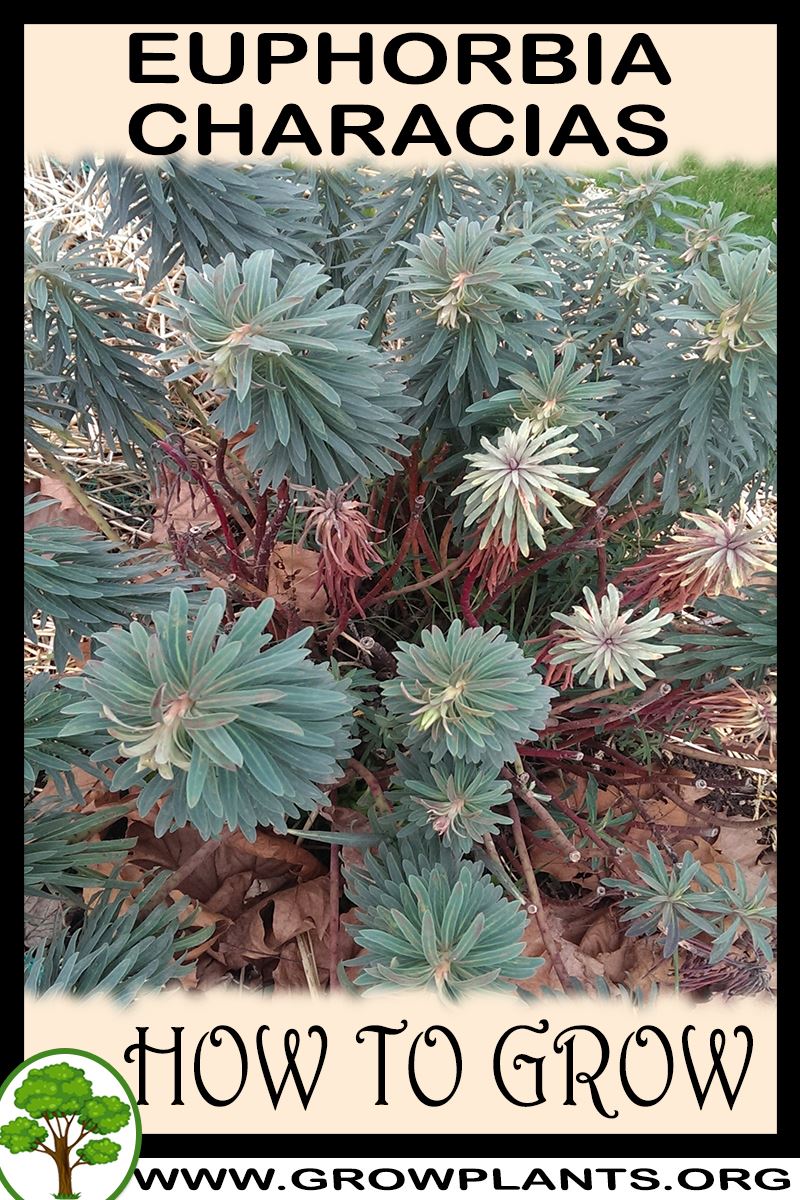
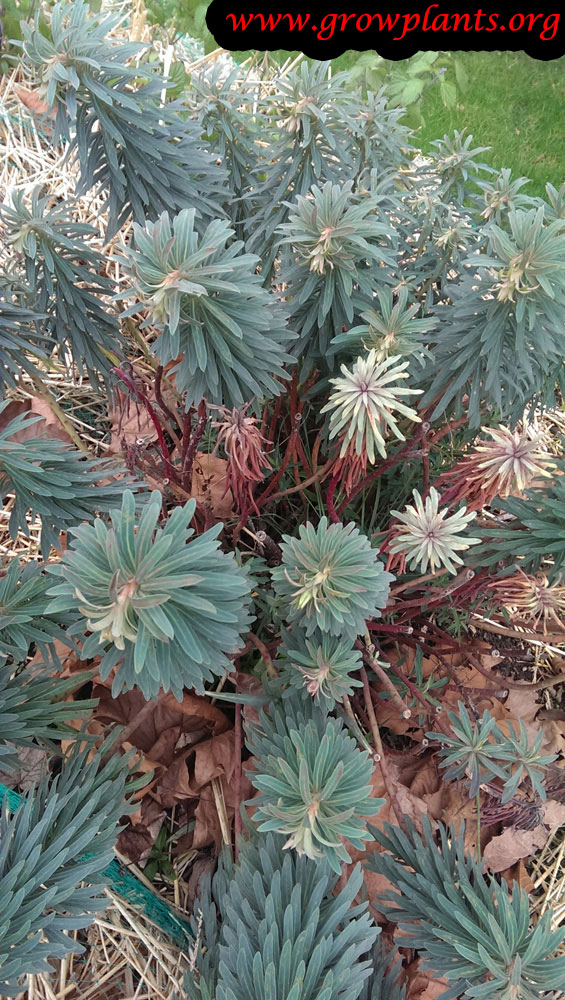
Overview: An evergreen clump-forming subshrub reaching 50-150 cm, with blue-green foliage and dome-shaped clusters of chartreuse flower heads. It is a popular drought-tolerant ornamental for Mediterranean-style borders.
Quick Specifications
| Specification | Attribute |
|---|---|
| Plant Type / Life Cycle | Perennial (evergreen subshrub) |
| Foliage Type | Evergreen |
| Mature Size | 50-150 cm (1.8-5 ft) tall |
| Growth Rate | Slow to moderate |
| Toxicity | Toxic – the milky latex irritates skin and eyes |
| Hardiness | USDA zones 7-10 |
Growth Form & Structure
- Height & Spread: An upright clump 50-150 cm (1.8-5 ft) tall; container-friendly.
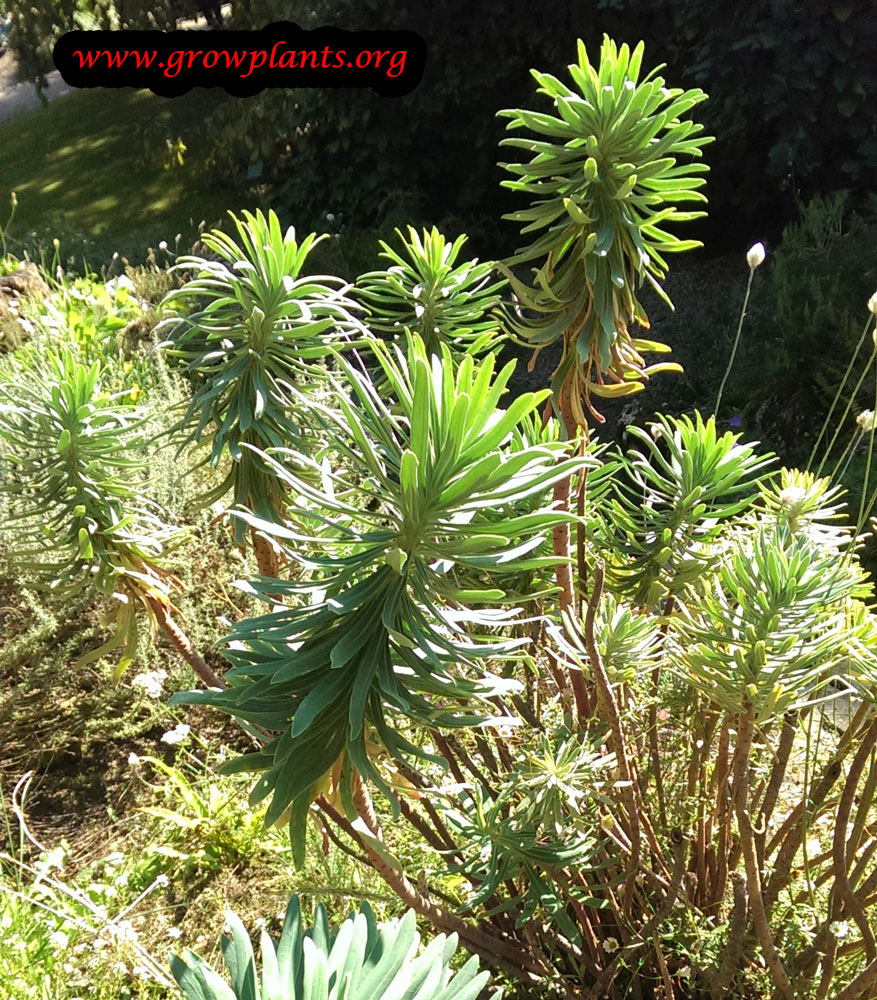
- Growth Habit & Form: Bushy evergreen subshrub with upright stems in a rounded clump.
- Lifespan & Maturity: A fairly short-lived perennial that is quick to reach flowering size.
Anatomy & Physical Features
- Leaves & Foliage: Blue-green (greyish) leaves, white-edged in some cultivars, arranged spirally around the stems.
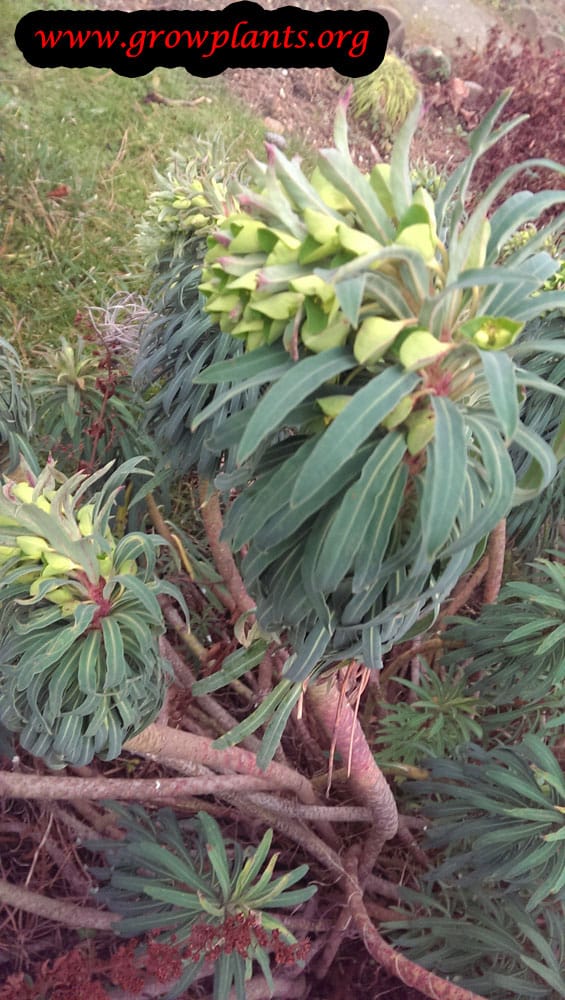
- Flower Characteristics: Long-lasting chartreuse green-yellow flower heads with rounded bract cups, in spring and summer.
Primary Uses & Landscape Value
- Functional & Ornamental Roles: Drought-tolerant ornamental for borders, gravel and Mediterranean gardens; noted historically for medicinal use.
Care Guide: Planting, Soil & Watering
Overview: Euphorbia characias (Mediterranean spurge) is an evergreen subshrub that thrives in full sun and well-drained soil. Drought-tolerant once established, it needs only low to moderate water and dislikes wet feet.
Quick Care Requirements
| Requirement | Ideal Condition |
|---|---|
| Planting Season | Warm season – spring through autumn |
| Growth Rate | Slow to Moderate |
| Soil Type | Well-drained, tolerant of poor and dry soil |
| Water Need | Low to Moderate (dry between waterings) |
Planting & Establishment
- Best Planting Season: Plant in the warm season, spring through autumn; it is hardy to about -3°C.
- How to Plant:
- Hole Preparation: Dig a hole as wide as, and no deeper than, the root ball.
- Soil Amendments: Improve heavy soil with grit for drainage; it does not need rich soil.
- Planting Depth: Set the root collar level with the soil surface.
- Growth Speed & Expectations: Slow to moderate, forming a rounded evergreen mound.
Soil, Watering & Drainage Care
- Soil Mix & Drainage Needs: Free-draining soil or a gritty potting mix; excellent for dry, Mediterranean-style plantings and containers with drainage.
- Watering Schedule & Technique:
- Young / Newly Planted: Water regularly to establish in the first season.
- Established: Water sparingly, letting the top few cm dry fully between waterings; very drought-tolerant.
- Seasonal Adjustments: Little to no water in winter; an occasional deep watering in summer heat.
Climate, Light & Hardiness
Euphorbia characias (Mediterranean spurge) suits Mediterranean, subtropical, and temperate climates in full sun to half shade. It is one of the more cold-hardy ornamental euphorbias, tolerating light frost down to about −3°C (27°F).
Quick Climate Specifications
| Climate Zones | Mediterranean, Subtropical, Temperate |
|---|---|
| USDA Hardiness Zones | 7–10 |
| Approx. Survival Minimum | Approximately −3°C (27°F) for an established plant |
| Frost Tolerance | Moderate |
| Light Conditions | Full Sun / Half Shade |
Sunlight & Light Exposure
Optimal Light Setup
Full sun to half shade both suit this Mediterranean shrub, which is naturally adapted to bright, open sites.
Direct Sun Requirement
Tolerates direct sun for most of the day; half shade is also acceptable, especially in hotter climates.
Temperature Extremes & Hardiness
USDA Hardiness & Regional Limits
Hardy across zones 7–10, a relatively broad range for a succulent-type euphorbia, reflecting good winter cold tolerance for the genus.
Cold Damage & Winter Protection
Tolerates brief cold down to about −3°C (27°F); well-drained soil is important in winter, since cold combined with wet roots is more damaging than cold alone.
Frost Sensitivity
More frost tolerant than many succulent euphorbias, though hard or prolonged freezes below its survival threshold will damage or kill the plant.
Extreme Heat Tolerance
Handles hot, dry Mediterranean summers well once established.
Growing in Pots, Balconies & Indoors
Mediterranean spurge (Euphorbia characias) is an evergreen, architectural shrub for sunny gardens and patios, not a houseplant. In a large container it makes a striking, drought-tough balcony or patio plant.
Quick Details
- Container Size: A pot only 20-50% wider than the root ball – roots stay shallow, so width matters more than depth
- Indoor Suitability: Not a houseplant – an outdoor Mediterranean shrub; a sunny sill only while very small
- Best Spot: Full sun to half shade
- Soil & Drainage: Free-draining potting mix; thrives in poor, dry soils and dislikes waterlogging
- Watering in Pots: Sparing – let the mix dry between waterings; overwatering is the main killer in pots
Indoors & On the Windowsill
- Not an indoor plant: This evergreen Mediterranean spurge is a garden and patio shrub, not a houseplant – it needs full sun and fresh air. At most a very small plant could sit briefly on the sunniest windowsill, but it belongs outdoors.
- Overwintering indoors: Most of these are tender – in cold climates a pot lets you bring it into a bright, frost-free room for winter, kept nearly dry until warmth and light return.
On a Balcony or Patio
- Light & warmth: Give it the brightest, warmest corner – sunny walls and paving throw back the heat these desert plants love. Pots dry faster there, so check the mix, but still water sparingly. Shelter tall or top-heavy stems from strong wind.
- Practicalities: Use a stable, heavy-based pot for tall specimens, and make sure drainage water runs away freely rather than pooling under the pot.
Choosing the Pot, Soil & Long-Term Care
- Pot & drainage: A pot 20-50% wider than the root ball with strong drainage holes; skip a standing-water saucer to avoid root rot. Terracotta breathes and dries faster than glazed or plastic.
- Potting mix: A free-draining potting mix kept open with grit or perlite; these tolerate poor, dry soils but hate waterlogging.
- Feeding: Feed lightly – a dilute general feed once or twice in the warm growing season; nutrients leach from pots faster than open ground.
- Repotting: Refresh the mix and pot up every couple of years, trimming the roots to keep a shrub in scale.
Fertilizing & Feeding
A light feeder: this Mediterranean border succulent thrives on lean soil and needs only modest feeding during active growth, tapering off as its rest period approaches.
Quick Fertilizing Specs
| Feeding Level | Light feeder |
|---|---|
| Main Nutrient Priority | Balanced, low-nitrogen feeding that keeps the blue-green foliage full without forcing floppy growth |
| Best Feeding Period | Spring through early summer as new growth and flower clusters develop |
| Organic Options | A modest amount of compost worked into the planting area; avoid rich, moisture-retentive beds |
| Reduce/Stop Feeding | Ease off feeding as summer heat sets in and again once the plant slows for its rest period |
| Micronutrients | Usually unnecessary in well-drained garden soil; correct only a diagnosed deficiency |
| Soil pH | Tolerates a wide range but prefers well-drained soil over heavy, waterlogged ground |
Feeding by Growth Stage
Spring growth and flowering
Support the flush of new blue-green foliage and the tall flower clusters this species is grown for.
| Nutrient direction | A diluted, low-nitrogen fertilizer applied lightly as new growth and flower stalks emerge. |
|---|---|
| Timing | From the start of spring growth through early summer flowering. |
| Frequency | A light feeding at the start of the season is usually enough for this undemanding border plant. |
| Fertilizer types | A diluted, low-nitrogen or balanced fertilizer, Well-drained garden soil with modest organic matter |
| Precautions | Avoid heavy feeding, which produces lax, floppy stems that flop over; keep gloves on and avoid contact with the milky sap, which is a skin and eye irritant. |
Summer heat and winter rest
Let the plant coast through summer heat stress and its cool-season rest without pushing new growth.
| Nutrient direction | None – withhold fertilizer once the main flowering flush has finished for the year. |
|---|---|
| Timing | Through summer heat and again during the cool-season rest. |
| Frequency | No feeding at this stage; resume light feeding only when fresh spring growth clearly returns. |
| Fertilizer types | No feeding at this stage; hold off fertilizing until active growth resumes. |
| Precautions | Do not fertilize now – feeding a plant that has stopped active growth encourages weak, disease-prone regrowth and wastes nutrients. |
Nutrient Deficiency Signs & Corrections
Foliage fades to a washed-out pale green and flower stalks emerge thin and sparse.
| Possible causes | low available nitrogen in lean, well-drained garden soil, nitrogen leaching after heavy rain or irrigation, competition from surrounding plantings |
|---|---|
| Appears first on | overall foliage color and new flower stalks |
| What to check | recent feeding history, soil organic matter and texture, how much the bed is watered or rained on |
| Possible correction | Apply a diluted, low-nitrogen fertilizer as spring growth begins. |
Newest leaves emerge yellowish while the veins remain visibly greener, and older foliage stays normal.
| Possible causes | alkaline soil limiting iron availability, waterlogged or compacted soil, root stress from recent division or transplanting |
|---|---|
| Appears first on | the newest leaves at branch tips |
| What to check | soil pH, drainage and how quickly the bed dries after watering, recent transplanting or root disturbance |
| Possible correction | Improve drainage and check soil pH first, then apply a chelated iron product per its label if yellowing persists. |
Interveinal yellowing on older, lower leaves while the veins themselves stay green.
| Possible causes | magnesium leaching from sandy or free-draining garden soil, low soil magnesium reserves, heavy rainfall washing nutrients from the root zone |
|---|---|
| Appears first on | older, lower leaves |
| What to check | soil texture and drainage rate, recent heavy rain or irrigation, overall feeding history |
| Possible correction | Apply a labeled magnesium source such as Epsom salt if the pattern is consistent with magnesium deficiency. |
Pruning, Training & Seasonal Maintenance
Each flowering stem of Mediterranean spurge is effectively biennial: it grows vegetatively for a season, flowers the following spring/summer, and then that individual stem is spent and should be cut out at the base to make room for new stems already rising from the crown. Light sanitary trimming can happen at any time, but the one deliberate structural cut – removing spent flowered stems – is a post-flowering task, not a genuinely “any time” job. All parts exude an irritant milky latex that is a notable skin and eye hazard, so pruning always calls for gloves and eye protection.
Quick Pruning & Maintenance Specs
| Pruning Tolerance | Moderate |
| Primary Pruning Window | After flowering finishes (late Spring/early Summer) – removing spent flowered stems |
| Secondary Maintenance Window | Light sanitary trimming at any time of year |
| Typical Frequency | Annual – one post-bloom stem-renewal pass |
| Main Objective | Renew the clump by clearing spent flowering stems for new ones |
| Mature Plant Priority | Annual removal of spent flowered stems at the base |
| Best Tool Type | Bypass secateurs |
| Avoid Heavy Pruning During | While stems are actively flowering (Spring/Summer) |
Pruning by Plant Age & Size
Newly Established
No pruning while the clump establishes.
Young / Formative
No structural training needed – it forms its own rounded, mounding clump of stems.
Mature / Established
Each year, once an individual stem’s flower cluster fades and browns, cut that stem out at ground level, leaving younger, unflowered stems untouched.
Seasonal Pruning Schedule
Post-Flowering
Objective: renew the clump. Remove: only stems that have finished flowering, cut at the base. Do not remove: still-vegetative or budding stems – they carry next year’s bloom. Expected response: fuller, better-lit clump as new shoots already rising from the crown fill the space. Flowering impact: none – if anything, prompt removal of spent stems improves next season’s display by reducing crowding.
Ongoing Sanitary
Trim any frost-damaged or broken growth as needed through the rest of the year.
Flowering & Fruiting Wood
Flowers form at the tip of stems that grew the previous season – effectively one-year-old wood. Once a stem has flowered it will not re-flower, so the correct response is to remove that spent stem rather than prune it back and expect a repeat bloom. Cutting a still-vegetative, unflowered stem removes a future year’s flower display, which is why routine cutting should target only spent stems.
Structural Pruning & Training
Renewal pruning is the whole structural strategy here: continually replacing older flowered stems with new ones keeps the clump full and floriferous rather than a tangle of old, spent growth.
Special Growth to Remove
Spent flowered stems – the main ongoing task. No suckers or watersprouts are relevant.
Container & Small-Space Pruning
Grows well in a container at this size (50–150cm). In a pot, prompt removal of spent stems matters even more, since a container clump has less room to carry unproductive old growth alongside new shoots.
Tools
Bypass secateurs for cutting individual stems at the base; blade disinfectant to wipe the blade of latex after handling cut stems, before moving to another plant.
Tool Hygiene & Disease Risk
Routine for disease transmission, but always treat the latex itself as the hazard – wear gloves and eye protection, avoid touching the face while pruning, and wipe the blade of sap afterward.
Cut Placement & Technique
Cut spent stems as low as possible, right down at the base of the clump near ground level, rather than partway up.
Heavy Pruning & Rejuvenation
A full hard cutback of the whole clump is not standard practice, since it would remove both spent and unflowered future-blooming stems together. Rejuvenation instead happens gradually and continuously, one stem at a time, as each finishes flowering.
Post-Pruning Care
Wash skin promptly if sap makes contact. No special watering or feeding changes are needed after removing a few spent stems.
Common Pruning Mistakes
- Shearing the whole plant uniformly, as if it were a single-flush shrub, sacrificing stems that hadn’t flowered yet.
- Handling the sap without gloves or eye protection.
When NOT to Prune
Avoid cutting stems that are still actively flowering or budding; avoid unnecessary handling during hot, dry stress periods, when sap loss is more damaging to the plant.
Recommended Tools (by task)
- bypass_secateurs – selective removal of spent stems at the base.
- blade_disinfectant – sap cleanup between plants.
Pruning Troubleshooting
| Problem | Possible Cause | What to Check | Corrective Action |
| Poor flowering next season | Unflowered (vegetative) stems were cut instead of spent ones | Whether removed stems had already flowered | Only remove stems once they’ve flowered; leave vegetative stems until their second year |
| Sparse, leggy clump | Spent stems left in place for multiple years | Crowding of old, flowered growth | Remove spent stems promptly at the base each year after bloom |
Propagation Guide
Euphorbia characias grows readily from seed — it self-sows freely once established in a garden — and can also be increased from basal cuttings taken in spring. Seed is the easier, more practical method for most growers; cuttings are useful for preserving a particular foliage form (such as a variegated selection) that seed will not reproduce reliably.
Quick Propagation Specs
| Best Propagation Method | Seed |
| Alternative Methods | Basal stem cuttings |
| Propagation Difficulty | Easy |
| Seed True-to-Type | Usually true-to-type for the species; variegated or selected forms do not come true from seed |
| Vegetative True-to-Type | Yes |
| Best Propagation Season | Spring through autumn |
Growing from Seed
Sow in spring, summer, or autumn. This species self-seeds readily where established, so seedlings often appear naturally around the parent plant and can be lifted and moved while small.
Stem Cuttings
Take basal (new-growth) cuttings in spring rather than older, woodier stems — fresh growth roots more readily. Because a cut releases a large amount of milky latex sap, let the cut end firm up briefly before inserting into a well-drained rooting mix; wear gloves, as the sap is a skin and eye irritant.
Bloom & Flower Guide
Quick Details
- Bloom Season: Late winter to spring, sometimes into early summer
- Flower Appearance: Dome-shaped clusters of lime green-yellow flower heads, each with two rounded lobes
- Edibility: Not edible; the milky sap irritates skin and eyes
Detailed Blooming Overview
Mediterranean spurge is one of the more ornamental euphorbias in flower. From late winter into spring it lifts dome-shaped clusters of chartreuse, green-yellow flower heads above its blue-green foliage. The eye-catching colour comes largely from the bracts surrounding each small flower (cyathium), which has two rounded lobes that give the head a soft, rounded look.
Flower Characteristics
- Dome-shaped clusters of green-yellow flower heads
- Each flower (cyathium) has two rounded lobes, with the bracts providing much of the colour
Bloom Care & Thinning
- Managing the bloom: Cut spent flowering stems right back to the base once they fade, as each stem flowers only once.
- Safety: Wear gloves when cutting; the milky sap is a skin and eye irritant and toxic if swallowed.
- Pollination: By insects drawn to the nectar glands.
Pests, Diseases & Troubleshooting
Overview: Mediterranean spurge (Euphorbia characias) is a shrubby, non-succulent spurge, and euphorbias of this type are troubled mainly by sap-suckers – aphids, whitefly, spider mites, scale and mealybug – plus fungal leaf spots and powdery mildew, with root rot in wet soil; they are generally tough and easy. A crucial safety point: the milky white latex is caustic and toxic, badly irritating skin and especially eyes, so always wear gloves and eye protection when cutting or handling. This tough Mediterranean shrub is prone chiefly to aphids on the flower-heads and can get powdery mildew and a fungal spot in damp conditions; its sap is notably irritant.
Quick Troubleshooting Overview
| Issue / Pest | Main Symptom | Primary Solution |
|---|---|---|
| Root / stem rot | Soft, blackening, collapsing base or stems | Gritty free-draining mix, dry between waterings, warmth |
| Mealybug | White cottony tufts in growth points, crevices or roots | Alcohol/oil, isolate, root drench for root mealybug |
| Spider mite | Stippling, corky scarring and fine webbing | Raise humidity, rinse, miticide if severe |
| Scale | Immobile bumps on stems | Scrape off, horticultural oil |
| Edema | Corky, warty bumps on stems or leaves | Reduce water and humidity, improve airflow and light |
| Toxic latex | Skin/eye burns from cut or bruised sap | Wear gloves and eye protection; wash off at once |
Common Pests & Management
- Aphids (Aphididae):
- Symptoms: Colonies of green, black or grey aphids cluster on the soft new shoots and around the flower-heads, distorting growth and leaving honeydew and sooty mould; a common early-season pest of shrubby euphorbias.
- Prevention & Control: Hose off, encourage ladybirds, hoverflies and parasitic wasps, and use insecticidal soap on heavy colonies; avoid over-feeding with nitrogen. Wear gloves – cut stems bleed irritant latex.
- Whitefly (Aleyrodidae):
- Symptoms: Tiny white flies rise in clouds when foliage is disturbed, with nymphs on the leaf undersides sucking sap and excreting honeydew that blackens with sooty mould.
- Prevention & Control: Use yellow sticky traps, hose off, and treat with insecticidal soap or horticultural oil; encourage Encarsia and other natural enemies under cover, and clear infested debris.
- Spider mites (Tetranychus urticae):
- Symptoms: Fine pale stippling, dull bronzing and faint webbing on leaves in hot, dry conditions, dulling the foliage.
- Prevention & Control: Raise humidity and rinse foliage, relieve drought stress, and use insecticidal soap or horticultural oil; predatory mites help under cover.
- Scale & mealybugs (Coccoidea / Pseudococcidae):
- Symptoms: Bumps or white cottony tufts on stems and leaf undersides, sapping the plant and leaving honeydew and sooty mould.
- Prevention & Control: Prune out or wipe off colonies, treat with horticultural oil, control ants, and conserve natural enemies; wear gloves to avoid the latex.
Diseases & Fungal Issues
- Root & stem rot (Phytophthora / Pythium / Fusarium):
- Symptoms: Wilting, yellowing and dark rotted roots and stem base in waterlogged or poorly drained soil, which can kill the plant.
- Treatment & Management: Plant in free-draining soil, avoid overwatering and heavy wet ground, improve drainage, and remove badly affected plants; keep the crown from sitting in water.
- Powdery mildew (Erysiphe / Podosphaera):
- Symptoms: White powdery coating on leaves and stems in crowded, humid or shaded conditions, disfiguring the foliage.
- Treatment & Management: Grow in good light with airflow, avoid crowding, remove affected growth, and spray sulfur or potassium bicarbonate if it takes hold.
- Fungal leaf spot (Cercospora / Alternaria):
- Symptoms: Brown or dark leaf spots and blotches, sometimes with yellow halos, causing leaf drop in wet weather.
- Treatment & Management: Improve airflow, remove fallen and spotted leaves, avoid overhead watering, and use copper only if it becomes severe.
Growing Difficulties & Abiotic Problems
- Edema (oedema):
- Cause & Symptoms: Corky, warty bumps or blisters on stems or leaf undersides where the plant takes up water faster than it transpires, typically in cool, humid, overcast, overwatered conditions.
- Correction Strategy: Reduce watering and humidity, improve airflow and light, and space plants; the existing corky bumps are permanent but new growth will be clean once conditions are corrected.
- Sunburn, scorch & etiolation:
- Cause & Symptoms: Sudden strong sun bleaches and scorches tissue, while too little light causes soft, pale, elongated (etiolated) growth that flops; light-change stress is common when plants are moved.
- Correction Strategy: Acclimatise gradually to stronger light over a couple of weeks, give bright light for tight characteristic growth, and provide light shade in the fiercest heat; move plants between conditions slowly.
- Cold damage & natural corking:
- Cause & Symptoms: Cold or frost blackens and softens tissue on these warm-climate plants, while older stems develop normal brown corky bark (not disease) with age.
- Correction Strategy: Keep plants above their cold limit and dry in cool weather (cold plus wet is lethal), and distinguish firm, dry corking from soft, spreading rot, which needs cutting out.
- Toxic irritant latex (handling hazard):
- Cause & Symptoms: Every cut or bruise bleeds copious milky latex that burns and blisters skin and can cause severe, even lasting, eye injury; sap can also irritate airways and is poisonous if ingested.
- Correction Strategy: Always wear gloves and eye protection when pruning, propagating or handling; keep the sap off skin and well away from eyes and mouth, wash off immediately with soap and water, work in ventilation, and keep children and pets away from cut plants.
What Helps – Products & Tools
For Mediterranean spurge the key ‘products’ are a gritty free-draining mix and careful watering rather than pesticides. Keep horticultural oil and rubbing alcohol (mealybug, scale, mites), insecticidal soap (aphids, whitefly), a systemic drench for root mealybug, sulfur or potassium bicarbonate for mildew, and a fungicide plus sulfur for cut rot surfaces. And essential PPE – gloves and eye protection – for the caustic latex.