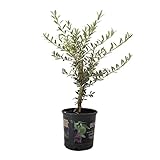
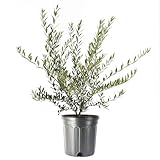
An olive tree asks for very little. Poor soil, full sun, not much water, a cut back every few years – that is genuinely the whole care list. What an olive will not do is work to your timetable, and almost every question growers ask about olives is really about fruit: when it will come, why the tree skipped a year, how to get a tree that never fruits at all, and whether any of this is possible in a pot.
Fruitless olive trees: what they actually are
A fruitless olive is not a different species and not a lesser plant. It is Olea europaea, the same tree as any cropping olive, in a form selected or grafted so that it sets little or no fruit. The silvery-green leaves, the gnarled trunk that people plant olives for in the first place, the drought tolerance, the evergreen habit, the winter pruning – all identical.
 Olive Tree Fertilizer – Liquid Plant Food for Bigger Harvests, 8 oz
 Olive Tree Fertilizer – Liquid Plant Food for Bigger Harvests, 32 oz
A fertilizer formulated for olives/Mediterranean plants supports fruiting on container-grown trees: As an Amazon Associate we earn from qualifying purchases.
The differences are entirely practical, and there are two of them:
- Far less mess. A cropping olive drops fruit, and ripe olives are black-purple and greasy – a nuisance on a lawn and a stain problem every autumn over paving, a driveway or a pool surround.
- Less work. A fruiting olive spends a large share of its energy ripening a crop, and that crop obliges you to manage it: netting or fruit-fly traps through the season, harvesting, then processing what you pick. A fruitless olive puts that energy into wood and foliage instead.
If you want an olive for the look of it – a courtyard specimen, a formal pair by a doorway, a drought-proof street tree – fruitless is the sensible choice, and you give up nothing ornamental. The tree still blooms in summer with the same small yellow-green flowers in clusters.
How to start a fruitless olive tree
There are two reliable routes, and one that quietly ruins people’s plans.
- Cuttings or other vegetative propagation from a known fruitless tree. A rooted cutting is a clone, so a cutting from a fruitless tree is a fruitless tree. Nothing is left to chance.
- Seedling rootstock plus a grafted sterile cultivar. Sow ordinary olive seed, grow the seedlings on, then graft a sterile fruitless cultivar onto each. Slower, but much cheaper if you want several matched trees, and the seedling gives you a vigorous root system.
The route that does not work: sowing seed from a fruitless tree and expecting fruitless offspring. Olive seedlings are not true to the parent – that is the whole reason cuttings and grafting exist – so a seed-grown tree may fruit as freely as any other olive, and you will not find out for several years.
When does an olive tree start to bear fruit?
An olive planted as a young tree normally shows its first fruit 2 to 3 years after planting, and the full realistic range is 2 to 5 years. But “first fruit” and “a crop” are different milestones. The first season usually yields a handful of olives – enough to prove the tree works, not enough to cure a jar of. A quantity worth pressing for oil or brining properly takes several more years while the tree builds the branch framework that carries it.
How you started the tree moves you within that range. Grafted trees and rooted cuttings begin with mature wood and fruit at the early end. Seedlings take longer, and the fruit they eventually produce is an unknown – it may be excellent, it may be small and unremarkable, and there is no way to tell in advance.
Why an olive tree skips a year
Some olive cultivars only bear every second year, and this catches out growers who assume something has gone wrong. It has not. A heavy crop consumes the reserves the tree would otherwise put into forming next season’s flower buds, so a big year is followed by a light or empty one, and the tree settles into an on/off rhythm. The trait is stronger in some cultivars than others.
You can soften the swing rather than eliminate it:
- Thin the bloom on a young tree. For the first two years, remove flowers deliberately. A young olive allowed to carry a full crop spends on fruit what it should spend on roots and trunk, and starts its alternate-bearing cycle early.
- Thin in a heavy year, so the tree keeps enough in reserve to set buds for the following season.
- Feed and water after harvest. The tree is rebuilding then, and that is when next year’s crop is decided.
- Keep the canopy open. Light reaching the inner wood is what makes that wood productive.
Graft, cutting or seed?
All three work with olives. They are not interchangeable.
Grafting
Grafting comes into its own when you already have an olive in the ground. If a mature tree in your garden produces mediocre fruit, or you inherited an unknown seedling, you can graft the cultivar you actually want onto it and keep the established root system – which means fruit years sooner than starting a new tree. Grafting is also how sterile fruitless olives are produced commercially.
Cuttings and vegetative propagation
For a new plant of a known cultivar, a cutting is the straightforward answer: an exact clone, with the same fruit, habit and fruiting behaviour. If you have tasted the olives from a particular tree and want that tree, take a cutting rather than a seed.
Seed
Sowing olive seed does produce fruiting trees – it is simply a gamble, because the seedling will not match its parent. Its best use is as rootstock for grafting.
Climate, cold tolerance and where olives will grow
Olive suits Mediterranean, subtropical and temperate climates and is reliable in hardiness zones 8 to 11, taking winter lows down to around −8 °C (18 °F). That is far hardier than most people expect from a tree so associated with hot, dry summers, and it puts olives within reach of many gardens that could never keep a citrus alive.
Plant in spring, summer or autumn. In zone 11 you can also plant in winter, because winter there is mild enough that a newly planted root system is never at risk. Everywhere colder, avoid winter planting for exactly that reason: an olive that has not yet rooted out into the surrounding soil is much more vulnerable to cold than an established one.
Site, soil and water
Give an olive full sun – shade produces a thin, sparse tree and little or no fruit. Water is where growers most often go wrong, because the instinct with a young fruit tree is to be generous. An olive needs only a small amount of water: it evolved for long dry summers, and permanently wet soil around the roots invites root problems and Verticillium wilt rather than growth. Water a newly planted tree while it establishes, then taper off.
Growth is medium to slow even in good conditions, and a mature tree reaches 5 to 15 m (15 to 45 ft). Plan for that at planting time – an olive placed too close to a wall is a problem you inherit in a decade.
Pruning an olive tree
Prune in winter, when the tree is not growing. Olives take hard pruning better than almost any other fruit tree: you can cut back to leave only the main branches, and it is entirely reasonable to do this once every few years rather than annually.
What you are trying to achieve:
- Height you can harvest from. A 12 m olive full of fruit you cannot reach is not a crop.
- An open centre. Light and air moving through the canopy make the inner wood productive and dry the foliage faster after rain – which matters directly for leaf spot, discussed below.
- Removal of dead and crossing wood, at any time you spot it.
Flowering and pollination
Olives bloom in summer, carrying small yellow-green flowers in clusters. Pollination is done by bees and flies, so avoid insecticide sprays across the flowering period if you want a crop. The bloom is easy to miss, but the number of flowers set in summer is the ceiling on what you can harvest in autumn.
Growing olive trees in pots
Olives grow well in containers, but the pot size question depends on your goal.
- For ornament, almost any reasonable pot will do. A restricted root run keeps the tree small, which for a patio specimen is the point.
- For fruit, you need a genuinely large container. Fruit is expensive for a plant to make, and root volume sets the limit on how much of it the tree can support.
One caution: an olive’s drought tolerance is earned in open ground, where its roots range widely. A pot holds a small fixed volume of soil that dries fast in summer sun, so a potted olive does need checking – it still wants little water, but it cannot go and find its own.
Harvest, and what to do with the crop
Olives ripen in autumn, occasionally as late as winter. You do not have to wait for full ripeness: olives can be picked before they are fully ripe, and the stage you pick at decides what you get.
- Green olives are picked early, before the colour turns. They are firmer and are the usual choice for table curing.
- Black-purple olives are fully ripe, softer and oilier.
Do not judge your tree by tasting one off the branch. Fresh olives will not harm you, but they are intensely bitter. Olives are a processed fruit by nature: the bitterness has to be drawn out by curing first. A large crop goes three ways – pressed for oil, cured or pickled for the table, or cooked into dishes once cured.
Through the season the fruit demands one job: cover the tree with a net, or hang fruit-fly traps. Left unprotected, a crop that looks perfect from the outside can be almost entirely maggoty inside.
Pests and diseases
- Olive fruit fly – the most damaging pest of the crop. The female lays into developing fruit and the larva feeds inside, so the damage is invisible until you cut an olive open. Traps and netting are the practical defence, and both have to be in place before the fruit is attacked, not after.
- Spilocaea oleaginea (peacock spot) – a leaf fungus that produces dark ringed spots and, in a bad year, strips the tree of foliage and reduces the crop. It thrives on leaves that stay wet, which is why an open, well-pruned canopy is a real control measure and a congested one is an invitation.
- Aphids and ants – aphids cluster on soft new growth and on developing fruit, distorting both. Ants farm them for honeydew and drive off their predators, so a trail of ants up the trunk usually leads to the aphid colony.
- Tetranychus urticae (two-spotted spider mite) – a hot, dry-weather pest. Look for fine pale stippling on the leaves and, at high numbers, webbing.
- Verticillium wilt – a soil-borne fungus and the most serious problem here, because there is no spray for it. It typically kills one branch or one side of the tree at a time. Avoid planting into ground where susceptible crops have recently grown, remove affected wood, and do not keep the soil wet.
Two cultivars worth knowing
- Souri – a slow-growing tree with fruit that has a low moisture content and a taste that is slightly bitter and spicy. The low moisture is what makes it valued for oil, and the slow growth makes it a manageable tree in a garden.
- Picual – fruit that ripens purple with a white dot, oval in outline and rounder through the middle. Grown mainly for oil.
For the full plant profile see our Olive tree growing page.
See also: fruit tree grafting · grafting tools & supplies · rooting hormone for cuttings
See also: fruit tree grafting · grafting tools
More fruit-growing guides
- Growing fruit trees from seed
- How to prune fruit trees
- How to hand-pollinate flowers
- Why a tree flowers but won’t fruit
- How and when to fertilize