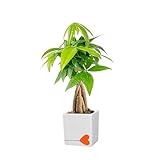
Marula (Sclerocarya birrea) is one of the easiest large fruit trees to keep alive and one of the easiest to get wrong. It is drought tolerant, fast growing and almost careless about soil quality, so the growing part rarely fails. What fails is the fruiting, and it fails for a reason no amount of watering or feeding will fix: marula flowers are male or female, and they are borne on separate trees. Plant one seedling and you have roughly a coin-flip chance of owning a tree that can never set fruit on its own.
Why one marula tree is usually not enough
Marula is dioecious. Each tree is either male, producing pollen, or female, producing the flowers that become fruit. The flowers themselves are tiny – only 1-2 mm across and green-yellow – so you cannot pick out the sex of a young tree by eye at a glance, and a seedling gives no clue at all until it finally blooms.
That has three practical consequences:
- A lone female tree will flower beautifully and drop every flower without setting fruit.
- A lone male tree will never fruit at all, no matter how well grown.
- You will not find out which you have until the tree blooms, which on a seedling is at least five years away.
There is one small escape hatch worth knowing about: a few cultivars have been reported to set fruit from a female tree alone. It is the exception, not something to plan a garden around. If fruit is the goal, assume you need both sexes.
The grafting solution: male on the side, female on top
Grafting is how growers get around the sex problem in a garden that has room for one tree instead of two. Rather than planting a male and a female and giving up double the space, you graft both sexes onto the same trunk.
The placement matters more than beginners expect. The recommended arrangement is to graft the male low, on the side of the tree, and the female on top. A tree pushes its strongest growth into its leader, so whatever sits at the top of the canopy dominates over the years, and you want that dominant, sunlit portion to be the female wood, because that is the wood that carries the crop. The male only has to supply pollen, and a modest side branch produces far more than one female tree can use. Put the male on top and you slowly end up with a large male tree carrying a struggling female twig.
Grafting also brings the usual advantages: it fixes the identity of the fruit, and a grafted tree normally bears sooner than a seedling, as does a tree started from a cutting.
Seed, cutting or grafted tree?
All three routes work. They differ in how long you wait and how much you know about what you will get.
Seed
Marula is not difficult to raise from seed, but seed gives you no certainty: you do not know the sex of the plant, you do not know the quality of the fruit, and some marula strains produce large seeds with only a thin layer of fruit around them – a poor result after a five-year wait. Seed is a good route to a shade tree, a bonsai subject, or rootstock to graft onto later; it is a poor route to a crop.
Cuttings and grafted trees
Vegetative propagation reproduces a known parent exactly, so you know the sex and the fruit quality in advance, and the tree comes into bearing in fewer years. If you are buying, a grafted tree carrying both sexes is the single best purchase you can make.
How to grow marula from seed
- Sow in spring, into moist soil, in a warm position.
- Give the seedlings full sun to half shade while they are small.
- Keep the soil moist to wet during germination and early growth. The drought tolerance marula is famous for belongs to an established tree, not to a seedling.
- Grow on in full sun once the plants are up and moving.
- Plan from the start to graft, or to raise several seedlings so that the odds give you at least one of each sex.
Climate, soil and light
Marula suits desert, Mediterranean and subtropical climates and is reliable in hardiness zones 10 to 12 – winter lows of roughly -1 °C (30 °F) at the very coldest. It is evergreen to semi-deciduous, so in a cool or dry spell it may shed part of its canopy and re-leaf later.
The soil requirement is short: well drained. Marula does not ask for richness, but it will not tolerate standing water around its roots.
Light is less negotiable than it looks. Full sun is the target. A young tree will accept half shade, but it grows noticeably more slowly there, and a shaded marula that never reaches full sun is not certain to fruit at all. If the only space you have is shaded now but will be sunny once the tree gains height, that can work. Permanent shade is not worth attempting.
Planting a marula tree
Planting season is winter, spring or summer.
- Dig a hole as deep as the root ball plus about 40% extra.
- Put organic matter, humus and dried leaves into the hole and mix them with some of the excavated soil.
- Loosen the outside of the root ball slightly before setting the tree in, so roots grow outwards rather than circling.
- Backfill and firm the soil moderately – pressed too hard you squeeze the air out of the root zone, left too loose the tree will rock and never anchor.
- Mulch the surface to hold moisture in the soil.
- Water in, then water every day for the first two weeks, preferably in the morning.
- Check stability. If the tree moves in the wind, support it with a bamboo cane or stake so it cannot go over.
Water and feeding: generous early, relaxed later
A marula will survive on a small amount of water, but it grows better with more, and in the early years growth is exactly what you want – the sooner the tree gets to size, the sooner it flowers and reveals its sex.
Once the tree is large you can cut watering right back: its roots reach deep enough that they may tap groundwater, which is where marula earns its reputation as a drought-tolerant tree.
Feeding follows the same pattern. While the tree is young, add nitrogen and keep it mulched. Nitrogen drives leaf and shoot growth, mulch keeps the surface roots cool and moist, and together they shorten the wait to first flowering. A mature marula needs very little.
Pruning
Prune in autumn to winter, when growth has stopped. Marula needs little: take out branches that grow downwards, which shade the interior, catch in the way and rarely carry useful crop, and beyond that prune only for shape. On a grafted tree, watch for vigorous shoots from the male portion and shorten them if they start competing with the female leader.
Size, siting and containers
Marula reaches 10-30 m (30-100 ft) tall and 5-8 m wide, occasionally more. It is a genuine shade tree and needs to be placed like one: well clear of buildings, paving and drains, with room for the crown. Growth is medium to fast, so a small nursery plant becomes a large tree faster than you expect.
It is not a houseplant and it is not suited to a planter or pot in the ordinary sense. The one exception is bonsai, where marula makes an attractive subject – but a bonsai marula is grown for its form, not for fruit.
Pests
The main pest is aphids, which cluster on soft new growth and distort it. On a young tree that matters, because every damaged flush costs growing time. Knock them off with a jet of water or treat early. Watch for ants running up the trunk: they farm aphids for honeydew and protect them from predators, so a trail of ants is often the first sign of an infestation you have not yet spotted.
Fruit: when it comes and what to do with it
Expect the first fruit 5-6 years after planting, and longer before the tree carries a serious quantity. A grafted tree or one started from a cutting bears sooner. Bloom is in spring to summer, and the fruiting season runs from summer through autumn into winter, varying with the cultivar.
The fruit is yellow-green and juicy. You do not need to climb for it: ripe marula falls, and is normally collected from the ground, which makes harvesting a 30 m tree far less daunting than it sounds. Gather fruit promptly and often, since it is juicy and will not sit on the ground indefinitely.
Uses:
- Fresh – eaten raw.
- Juice, on its own or blended.
- Alcohol – marula ferments readily and is the base of the cream liqueur the tree is best known for, which is why it is often sold as the “Amarula plant”.
- The seed – white-yellowish inside and edible as a nut, so nothing is wasted once the flesh is used.
For the full plant profile see our Marula tree growing page.
See also: fruit tree grafting · grafting tools & supplies · rooting hormone for cuttings
See also: fruit tree grafting · grafting tools
More fruit-growing guides
- Growing fruit trees from seed
- How to prune fruit trees
- How to hand-pollinate flowers
- Why a tree flowers but won’t fruit
- How and when to fertilize
- Growing tropical fruit in cool climates
For the general techniques behind this (cuttings, division, layering, grafting), see our plant propagation methods guide.