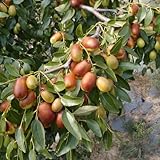
The jujube (Ziziphus jujuba), often sold as Chinese date, is a deciduous — very occasionally evergreen — shrub or small tree grown for round to oval red-purple fruit of 2–5 cm. It is one of the most forgiving fruit trees you can put in a hot, dry garden: it grows across hardiness zones 6–11 in subtropical, desert, Mediterranean and temperate climates, and it crops on a small amount of water. What it is not is a plant you can ignore. Jujube comes with thorns, a strong habit of throwing suckers around the garden, and a fruit that fruit flies find irresistible. Most of the skill in growing it lies in managing those three things.
Climate, Sun and Water: Why the Cool Winter Matters
Jujube wants a cool winter. Because it is deciduous, it drops its leaves and shuts down for a dormant period, and that cold rest is what lets it push a clean, synchronised flush of growth and flower in spring. In a climate with no real winter, growth and bloom straggle out instead of arriving together, and the crop suffers for it.
Water requirement is small to average, and an established tree is genuinely drought tolerant — which makes overwatering a far more common mistake here than underwatering.
Give it full sun if you want fruit. Jujube will survive in half shade and even in shade, but a shaded tree simply will not bear much — the sugar that fills a fruit comes from leaves in direct light, so a shaded jujube puts what it has into wood instead.
Mature size is 3–10 m (10–33 ft) and growth is medium to slow, so it will not run away from you overhead. The suckers are another matter.
Seed, Graft or Nursery Plant?
You can start jujube from seed or from a plant, but for fruit the honest answer is that grafting is necessary. A seedling does not reproduce the parent’s fruit, and grafted trees give noticeably bigger fruit — the whole point of choosing a named cultivar. On top of that, some cultivars produce seed that is simply not viable and will never germinate, no matter how correctly you sow it. Either way, a jujube starts bearing after about 2–3 years, which is fast for a fruit tree.
How to Grow Jujube from Seed, Step by Step
The sowing season is early spring. There are two workable routes.
Route one: cold storage and soaking
- Keep the seeds cool from the moment you collect them. Store them in the refrigerator right through until sowing. Jujube seed comes out of a fruit that ripens in late summer or autumn but germinates in spring; the cold period mimics the winter it would otherwise sit through, and seed kept warm and dry all that time germinates poorly.
- Soak the seeds in water for 24 hours before sowing. Warm water is fine. Change the water every few hours — this washes out the germination inhibitors that leach from the stone and keeps the water from going stale and sour around the seed.
- Make a hole and bury each seed 2–3 cm (about 1 inch) below the surface.
- Cover and water, then keep the soil moist — not wet — until germination. Letting the pot dry out once at the wrong moment kills a seed that has already started to move.
Route two: let winter do the work
Sow directly in the ground straight after fruiting, leave the seed in the soil right through the winter, and simply keep it moist in the spring. This is the same cold treatment as the refrigerator, done outdoors, and it saves handling. The trade-off is that you have less control — you cannot check the seed, and rodents and dry spells are on their own schedule.
What to Check Before You Buy a Jujube Tree
Nursery choice matters more with jujube than with most fruit trees, because cultivar decides both flavour and how badly fruit fly will hit you.
- Know the cultivar, or better, taste the fruit first. Flavour varies enormously between varieties.
- Match the ripening season to your pest pressure. If your area has a lot of fruit fly, choose an early or late-yielding variety so the fruit is not hanging during peak fly season. Sometimes you have to compromise on flavour to get a variety whose fruit is not attacked so easily.
- Inspect the graft. Confirm there is one and that the union looks sound — and confirm that what you are being sold is a grafted tree, not a rooted basal sucker.
- Check the trunk for holes, which mean borers.
- Check the leaves for distortion, which can indicate disease.
- Look at the soil in the pot for ant nests or other insects riding along.
Thorns, Suckers and an Aggressive Habit
The recognised difficulties with jujube are thorns, aggressive growth and basal shoots, and the suckers are the one that catches people out. Jujube throws shoots from its roots, and left alone they will fill a garden bed — this is a plant that spreads sideways underground rather than politely staying where it was planted.
Remove suckers as they appear, cutting them off where they emerge rather than mowing the tops, which only encourages more. And remember that on a grafted tree every sucker comes from the rootstock, below the graft, so it will never carry the fruit you bought the tree for — a sucker allowed to grow into a trunk quietly replaces your cultivar with an unknown one.
Pruning: Keep It Small on Purpose
Prune in winter, while the tree is bare and you can see its structure. The standard advice with jujube is to keep the tree small, and the reason is the thorns: a tall jujube is genuinely unpleasant to harvest and to work in. A tree held low is picked from the ground, netted easily, and inspected without a ladder.
Jujube also grows perfectly well in a planter or container, which is another way to keep it in bounds and to stop the suckers colonising open ground. It is not a houseplant, though — it needs its winter outdoors.
Flowers and Pollination
The flowers are tiny, only 1–2 mm, yellow to white-green, carried in clusters on young stems next to the older wood, and they open in spring. Pollination is by insects, mainly bees, and some varieties are self-pollinating. Because self-fertility depends on the cultivar, the safe approach where you cannot confirm it is to plant more than one tree and to avoid spraying anything that knocks out bees while the tree is in bloom.
Harvest, Ripening and Using the Crop
Harvest runs from summer into autumn. Cultivars differ: some carry fruit over several months, others give you only a summer crop or only an autumn one, which is worth knowing before you plant.
You do not have to wait for full colour on the tree. Jujube can be picked while still partly green and left to finish ripening indoors — a useful trick, because fruit off the tree is fruit the birds and fruit flies cannot reach.
Jujubes are eaten raw, dried, or turned into beverages, including alcoholic ones, and they have a long history of medicinal use. Drying is the obvious answer to a glut.
Protecting the Fruit from Fruit Fly and Birds
Jujube fruit is attacked easily, mainly by fruit fly and also by birds. No single measure solves it; stack several.
- Pick earlier. Harvesting while fruit is still partly green and ripening it indoors takes the crop out of the fly’s window.
- Choose the season. Late cultivars that carry fruit into the cold part of the year escape most of the pressure.
- Net the tree once bloom is over. Netting before that shuts out the bees you need.
- Collect every infected and fallen fruit and destroy it. This is the least glamorous and most effective step — maggots in dropped fruit complete their life cycle in the soil under your tree and come back as next month’s flies.
- Hang traps. Fruit flies are drawn to the colour yellow, to vinegar and to rotting fruit, and any trap design that combines those works on the same principle.
Pests on the Tree, and a Use for the Leaves
Beyond the fruit, the pests to watch for are caterpillars and mites. Caterpillars chew leaves and strip young growth quickly, so catch them early by inspection. Mites are far smaller and show as fine stippling, dulling and eventual leaf drop, and they thrive in hot, dry, dusty conditions — exactly the conditions a jujube is usually grown in.
The leaves themselves have uses: as an insect repellent and in medicinal applications, including against parasites. Harvest them from early spring through summer, while they are in active growth and before the tree begins shutting down for its deciduous rest.
For the full plant profile see our Jujube tree growing page.
See also: fruit tree grafting · grafting tools & supplies · rooting hormone for cuttings
See also: fruit tree grafting · grafting tools
More fruit-growing guides
- Growing fruit trees from seed
- How to prune fruit trees
- How to hand-pollinate flowers
- Why a tree flowers but won’t fruit
- How and when to fertilize
For the general techniques behind this (cuttings, division, layering, grafting), see our plant propagation methods guide.