Plant Profile & Key Characteristics
Overview: A small evergreen tree growing 3-9 m tall, grown mainly for its medicinal fruit, which is also edible, and sometimes as an ornamental. It tolerates a range of light levels and can be container-grown indoors.
Quick Specifications
| Specification | Attribute |
|---|---|
| Plant Type / Life Cycle | Perennial (evergreen tree) |
| Foliage Type | Evergreen |
| Mature Size | 3-9 m (10-27 ft) |
| Growth Rate | Moderate to Fast (slow when young in cooler zones) |
| Toxicity | Fruit edible (mainly medicinal); seeds edible only after cooking |
| Hardiness | USDA zone 12+ (11 with winter care) |
Growth Form & Structure
- Height & Spread: 3-9 m (10-27 ft); can be kept small in containers and grown indoors, where it needs hand pollination to fruit.
- Growth Habit & Form: Evergreen shrubby tree.
- Lifespan & Maturity: Bears fruit in about 1.5-5 years.
Anatomy & Physical Features
- Leaves & Foliage: Large, glossy dark-green leaves.
- Flower Characteristics: Small white flowers borne in connected clusters.
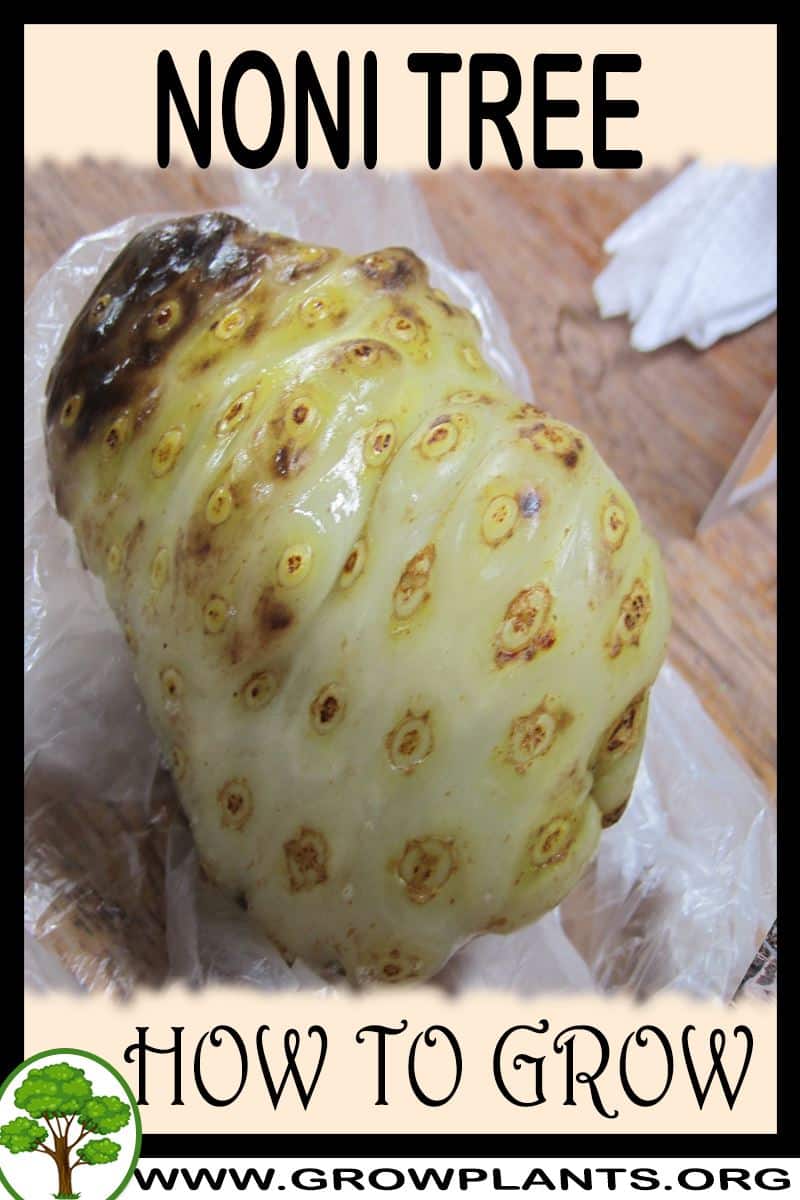
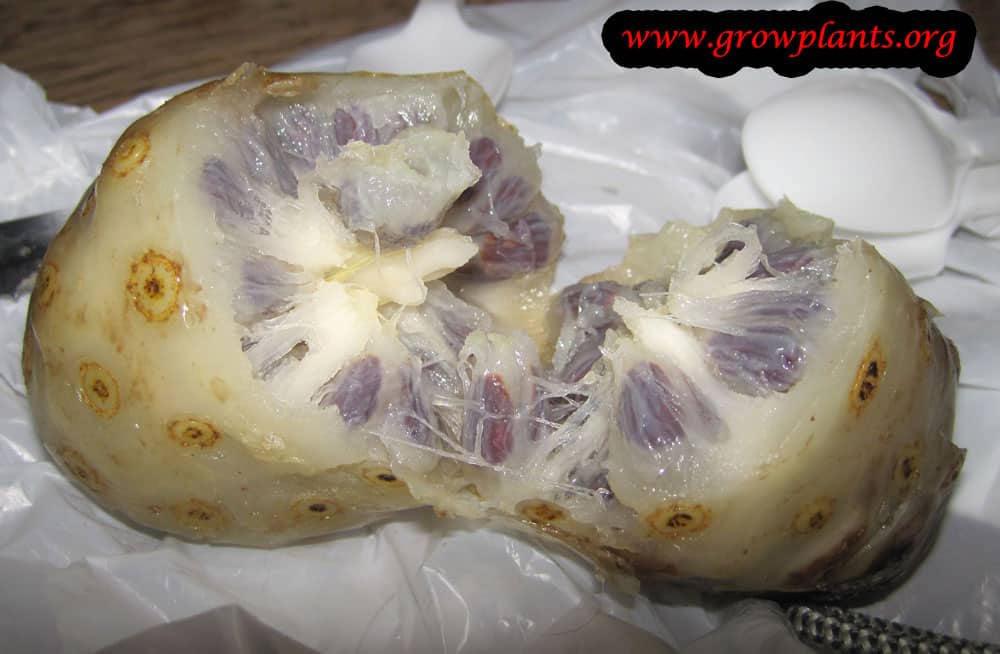
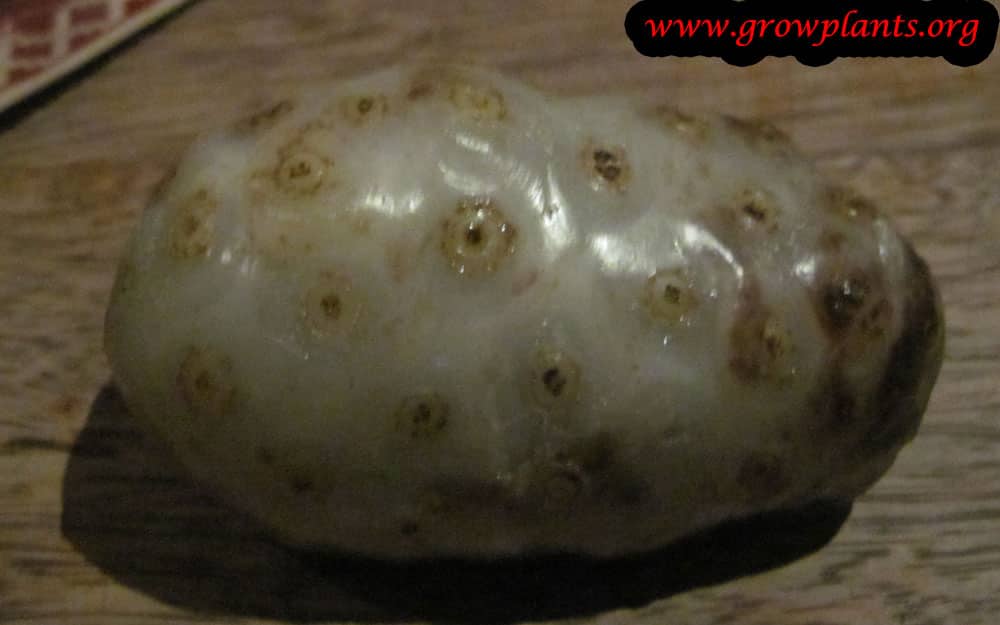
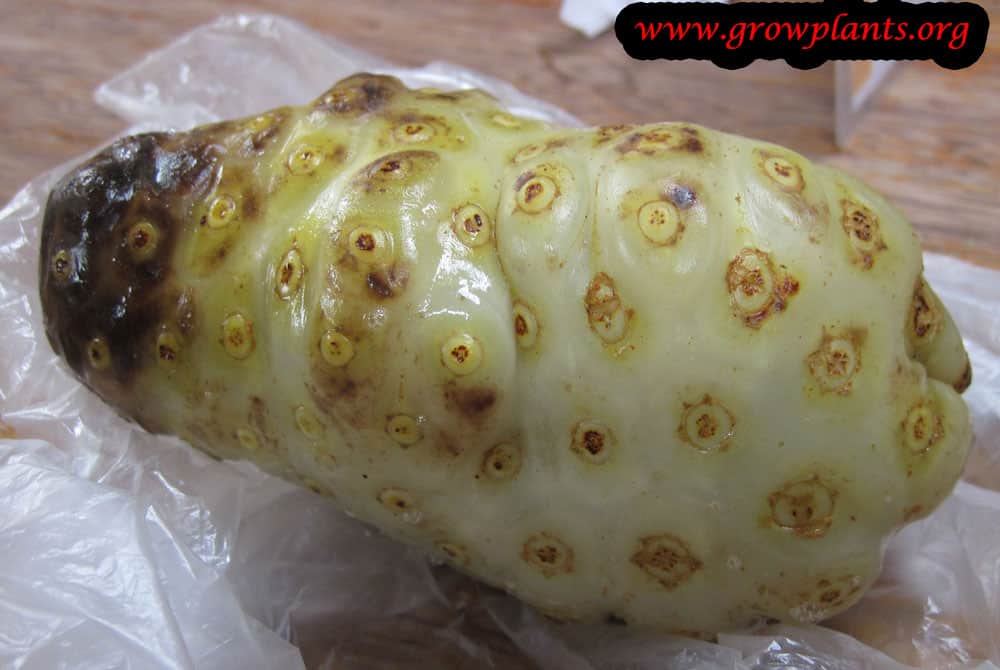
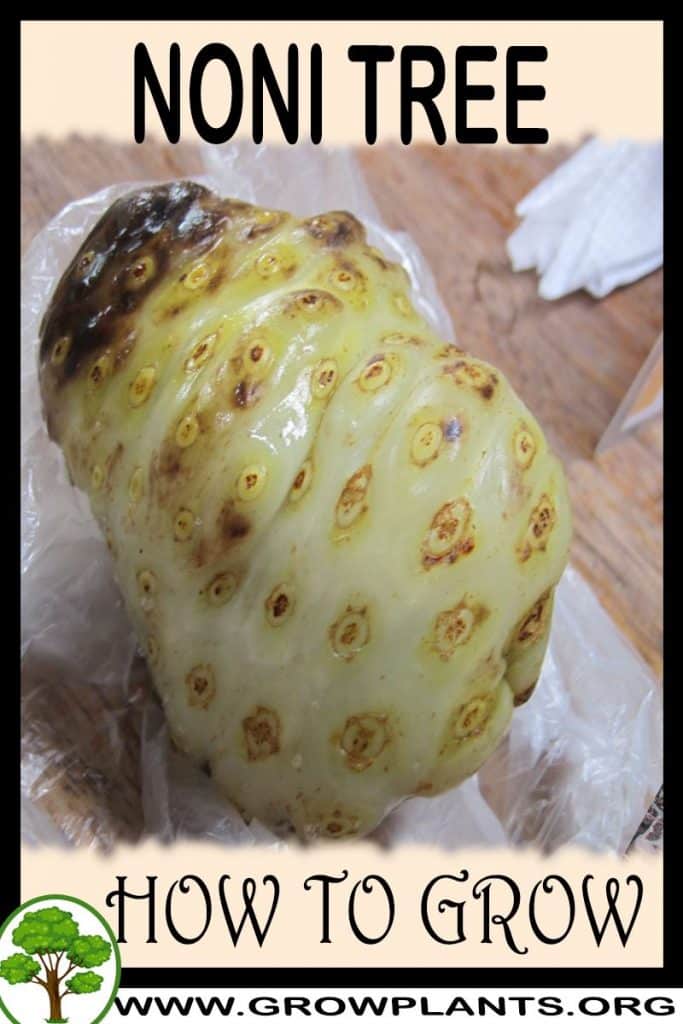
- Fruit Profile: Knobbly, white-cream ovoid fruit 4-10 cm with a pungent, cheese-like smell.
Primary Uses & Landscape Value
- Edible Uses: Fruit juiced or cooked (primarily for medicinal use); seeds edible after cooking.
- Functional & Ornamental Roles: Medicinal fruit tree, also grown as an ornamental.
Care Guide: Planting, Soil & Watering
Overview: The Noni tree (Morinda citrifolia) is a tropical evergreen for full sun to part shade that is frost-tender when young (keep above about 10°C; hardiness zone 11–12+). It needs rich, well-drained but moisture-retentive soil and steady watering.
Quick Care Requirements
| Requirement | Ideal Condition |
|---|---|
| Planting Season | Spring to autumn in zone 11; year-round in zone 12+ |
| Growth Rate | Fast to Moderate |
| Soil Type | Rich, well-draining, moisture-retentive |
| Water Need | Moderate – keep moist, do not let it dry out |
Planting & Establishment
- Best Planting Season: Plant from spring to autumn in zone 11, or at any time of year in zone 12+.
- How to Plant:
- Hole Preparation: Dig a hole as deep as the root ball plus an extra 50–70%.
- Soil Amendments: Mix organic matter, humus and dried leaves into the soil for a rich, free-draining bed.
- Planting Depth: Set the plant with the root collar at soil level, firm gently, then mulch to hold moisture.
- Growth Speed & Expectations: Fast to moderate, though slower while young in cooler zone 11 conditions.
Soil, Watering & Drainage Care
- Soil Mix & Drainage Needs: Use rich, well-drained soil and mulch to retain moisture; the tree likes moist ground but not waterlogging.
- Watering Schedule & Technique:
- Young / Newly Planted: Water newly planted trees daily (best in the morning) for the first two weeks, then regularly, keeping the soil moist.
- Established: Water established trees deeply and moderately, keeping the soil from drying out.
- Seasonal Adjustments: Add a heavy layer of mulch and reduce watering in winter; protect and cover young trees when temperatures drop below about 10°C.
Climate, Light & Hardiness
Noni is a true tropical-to-subtropical tree that grows in full sun to full shade (with adequate light) and needs consistent warmth to thrive outdoors. It has limited cold tolerance, with young plants noticeably more vulnerable than mature ones.
Quick Climate Specifications
| Climate Zones | Tropical, Subtropical (or indoor as a houseplant) |
|---|---|
| USDA Hardiness Zones | 12+, and 11 with the right overwinter care |
| Optimal Temp Range | warm, generally above approximately 10°C (50°F) |
| Cold Damage Begins | below approximately 10°C (50°F) |
| Approx. Survival Minimum | mature trees may tolerate briefly down to about 5°C (41°F); young plants are more vulnerable |
| Frost Tolerance | Very Low |
| Light Conditions | Full Sun / Half Shade / Full Shade with adequate light |
Sunlight & Light Exposure
Optimal Light Setup
Full sun to half shade gives the best growth; it also tolerates fairly deep shade as long as some light reaches it.
Direct Sun Requirement
Not strict – this species is flexible across a wide light range.
Shade & Heat Management
Handles heat well when grown in full sun with adequate moisture.
Best Exposure / Orientation
Any warm, sheltered exposure with reasonable light suits it.
Temperature Extremes & Hardiness
USDA Hardiness & Regional Limits
Best treated as a true zone 12+ tropical for reliable outdoor culture; zone 11 is workable with consistent overwinter protection.
Cold Damage & Winter Protection
Growth suffers once temperatures drop below about 10°C (50°F); cover young trees and add heavy mulch through winter in marginal zones.
Frost Sensitivity
Very frost-sensitive, particularly while young.
Extreme Heat Tolerance
Good in a genuinely tropical/subtropical climate with adequate soil moisture.
Wind, Humidity & Microclimate
Humidity Preferences
Prefers consistently moist, humid tropical conditions.
Dry-Air Tolerance
Low to moderate; increase watering during dry, low-humidity spells.
Rainfall & Seasonal Moisture
Naturally suited to humid, rainfall-rich tropical climates; needs supplemental water through dry seasons.
Microclimate Recommendations
A warm, humid, sheltered site well away from cold air pockets is best, especially for young trees.
Growing in Pots, Balconies & Indoors
Noni (Morinda citrifolia) is a 3-9 m (10-27 ft) tree, but the grower confirms it can be grown indoors as a houseplant – you just have to hand-pollinate the flowers to get fruit. Kept in a pot and pruned small, it doubles as a patio plant, and he gives a detailed potting method (see the Grower’s Tip).
Quick Details
- Container Size: A large, deep container; pot up in stages (grower didn’t state a final size)
- Indoor Suitability: Yes – can be grown indoors; hand-pollinate flowers for fruit
- Best Spot: Full sun to part shade; tolerates full shade with good light
- Soil & Drainage: Aerated, organic-rich mix that drains freely
- Watering in Pots: Keep the mix lightly moist – pots dry faster than open ground; water once the surface starts to dry.
Indoors & On the Windowsill
- A real houseplant: Yes – the grower grows it indoors. Give it plenty of light and hand-pollinate the flowers, since indoors there are no insects to do the job.
- Light indoors: It is adaptable – full sun to shade with light – but the brighter the spot, the better it grows and fruits.
- Keep it small: Prune and pot-limit it to keep this naturally large tree houseplant-sized.
On a Balcony or Patio
- Light & warmth: Happy in full sun to part shade on a patio; pots dry faster than open ground, so check moisture. Note the ripe fruit can smell unpleasant near a seating area.
- Overwintering: Frost-tender, so in cold areas keep it potted and move it indoors to a bright spot for winter.
Choosing the Pot, Soil & Long-Term Care
- Pot & drainage: Use good drainage; a saucer is fine but let it dry out before watering again. Rich mix, peat soil or potting mix all suit it.
- Potting mix: Well-aerated, organic-rich mix – peat or coir with perlite and a little organic matter; it must drain freely.
- Feeding: Potted plants use up their food faster because nutrients leach out with each watering, so feed a little more often than plants in open ground.
- Refresh the soil: Swap the soil every few years, as the grower advises, since it loses vitality over time.
Grower’s Container Tip
- Keep small, pot up in stages: Keep the plant small in a pot. Start in a container 40-50% bigger than the root ball and move up a size each time the roots fill it, until you reach the desired final pot. Use rich mix (peat soil and/or potting mix) and swap the soil every few years as it loses vitality.
Growing this plant in a greenhouse
A greenhouse can give noni tree frost protection, cold protection, humidity control and extra warmth. In the right climate it may also be kept growing through winter, depending on how much warmth and light are provided.
Greenhouse at a glance
| Greenhouse suitability | Conditional - depends on your climate |
|---|---|
| Main benefits | frost protection, cold protection, humidity control, extra warmth |
| Season extension | earlier spring & later autumn |
| Outdoor protection advisable below | about 10°C |
| Maintain greenhouse minimum | around 15°C for active growth |
| Suitable types | heated greenhouse, glass greenhouse, polycarbonate greenhouse |
| Heating | Heating is recommended in cold climates for continuous growth. |
Related greenhouse guides
- Greenhouses: How to Choose the Right Greenhouse
- Best Greenhouse Heaters
- Greenhouse Climate Control: Temperature, Ventilation and Humidity
- Polycarbonate Greenhouses: What to Look for Before Buying
Fertilizing & Feeding
A fast, tropical grower that responds well to a handful of feedings spread across the active season rather than one heavy dose – keep nitrogen forward while young and shift toward balanced feeding as the tree matures and fruits.
Quick Fertilizing Specs
| Feeding Level | moderate |
|---|---|
| young_feeding | nitrogen-forward feeding with organic matter to build the plant quickly |
| mature_feeding | several balanced feedings spread across the active growing season |
| Main Nutrient Priority | nitrogen while young, balanced once mature and fruiting |
| Best Feeding Period | spring through the main warm-season growth period |
| Organic Options | organic matter and mulch worked in at planting and refreshed through the winter |
| Micronutrients | a complete fruit-tree fertilizer generally supplies routine trace elements |
| Soil pH | prefers rich, moist, well-drained soil |
| Reduce/Stop Feeding | cut back on cooler-season or low-light growth, especially for container and indoor-grown plants |
Feeding by Growth Stage
Newly planted
Settle a newly planted Noni into rich, well-drained soil.
| Nutrient direction | Hold off until the plant is established, then apply fertilizer to support the transition to active growth, per the plant’s own planting guidance. |
|---|---|
| Timing | After the plant is established following planting, once new growth resumes. |
| Frequency | A light initial feeding is enough once establishment is clear. |
| Fertilizer types | A diluted, balanced young-tree fertilizer, Organic matter and humus worked into the planting area |
| Precautions | Wait until the plant is clearly established before fertilizing – feeding too early can stress fresh roots. |
Young tree, building growth
Build a strong young canopy on a fast-growing tropical tree.
| Nutrient direction | Lean nitrogen-forward to support fast vegetative growth typical of this species. |
|---|---|
| Timing | Through the warm active growing season. |
| Frequency | A handful of feedings spread across the growing season works well for this fast grower. |
| Fertilizer types | A nitrogen-forward complete fertilizer for young tropical fruit trees |
| Routine trace nutrients | iron, manganese, zinc |
| Precautions | Protect and mulch young trees heavily through any cool spells, and hold back on feeding a cold-stressed plant. |
Established, approaching bearing age
Support a maturing tree as it transitions toward regular flowering and fruiting.
| Nutrient direction | Move toward balanced feeding, keeping nitrogen moderate as the tree shifts energy toward reproductive growth. |
|---|---|
| Timing | Spring through the main growing season. |
| Frequency | Several feedings spread across the active season. |
| Fertilizer types | A balanced complete fertilizer for fruiting trees |
| Routine trace nutrients | iron, manganese, zinc |
| Precautions | Container-grown plants need more frequent light feeding than in-ground trees, since nutrients wash out of pots faster. |
Mature, bearing tree
Support the near-continuous flowering and fruiting typical of a mature Noni in warm climates.
| Nutrient direction | Keep balanced feeding going through the active season, since this species can flower and fruit almost continuously in the warmest climates and draws steadily on nutrients. |
|---|---|
| Timing | Through the main growing season, wherever the climate allows continued bloom. |
| Frequency | Several light, evenly spaced feedings across the growing season suit this tree’s steady fruiting habit. |
| Fertilizer types | A balanced complete fruiting-tree fertilizer |
| Routine trace nutrients | iron, manganese, zinc |
| Precautions | Ease back on feeding during any cool-season slowdown, particularly for container or indoor-grown trees. |
Nutrient Deficiency Signs & Corrections
Pale green to yellow older leaves and a slower pace of new growth than expected for this typically fast grower.
| Possible causes | Low soil nitrogen, Frequent watering leaching nutrients from container soil, Root-bound container limiting uptake, Cool temperatures slowing growth and masking a true deficiency |
|---|---|
| Appears first on | Older, lower leaves |
| What to check | Time since the last feeding, especially for container-grown plants, Growth rate compared with the plant’s usual fast pace, Whether the plant is root-bound |
| Possible correction | Resume a nitrogen-forward feeding program once temperatures and growth pick back up. |
New leaves yellow between green veins.
| Possible causes | High soil or irrigation pH, Waterlogged or compacted soil, Root stress from a recent repot, Low soil iron |
|---|---|
| Appears first on | Newest leaves |
| What to check | Drainage in the container or planting site, Recent watering or repotting history, Soil pH |
| Possible correction | Correct drainage and soil pH first; apply a chelated iron product per its label if the chlorosis persists. |
Marginal leaf scorch on older leaves and fruit that develops unevenly.
| Possible causes | Low soil potassium, Near-continuous fruiting depleting reserves faster than a seasonal fruiter, Sandy or fast-draining soil, Underwatering limiting nutrient movement |
|---|---|
| Appears first on | Older leaf margins |
| What to check | Whether the tree has been fruiting heavily and continuously, Watering consistency, Soil drainage and texture |
| Possible correction | Shift toward a potassium-forward feed given the near-continuous fruiting habit of this species in warm climates. |
Pruning, Training & Seasonal Maintenance
Noni is a fast-to-medium growing evergreen tree (3–9m, usually kept much smaller in cultivation) that can flower and fruit almost continuously in warm climates. That means pruning here is less about a single calendar window and more about reading each branch: non-flowering wood can be cut back at any time of year, winter is the best slot for broader structural work, and the constant rule is to remove dead wood and spent branches once they’ve finished fruiting rather than cutting through an active crop.
Quick Pruning & Maintenance Specs
| Pruning Tolerance | Moderate |
| Primary Pruning Window | Winter, for general structural work |
| Secondary Maintenance Window | Any time, on branches currently without flowers |
| Typical Frequency | Ongoing light maintenance plus one heavier winter session |
| Main Objective | Size/height control and removal of spent fruiting wood |
| Young Plant Priority | Build an open framework; set height early, especially in containers |
| Mature Plant Priority | Remove dead wood and spent fruiting branches; manage overall size |
| Best Tool Type | Bypass secateurs and loppers; saw for older wood on full-size outdoor trees |
| Avoid Heavy Pruning During | On any branch currently flowering or carrying developing fruit |
Pruning by Plant Age & Size
Newly Established
Remove only damaged growth while the young tree establishes.
Young / Formative
Build an open, manageable framework. Because this species grows quickly, guide its height and spread early – particularly for container or indoor specimens, where it is easier to keep a young plant compact than to cut back an overgrown one later.
Mature / Established
Remove dead wood at any time. Once an individual branch finishes its fruiting cycle, it can be cut back or thinned. Because the plant can be flowering, fruiting, and resting on different branches simultaneously, treat pruning as an ongoing, selective task rather than one seasonal overhaul.
Seasonal Pruning Schedule
Ongoing Sanitary
Objective: keep pace with a plant that can flower and fruit nearly year-round. Remove: dead wood, and any branch once it has finished fruiting. Do not remove: branches currently in flower or carrying developing fruit. Expected response: continuous light regrowth. Flowering/fruiting impact: none if cuts are kept selective.
Dormant/Winter (Structural)
Objective: the one broader session for size and structural control, timed for when bloom is lightest – winter, or the quieter part of the cycle outside fully tropical zones where bloom runs spring to autumn rather than all year. Remove: oversized branches, crowded interior growth, excess height. Do not remove: all fruiting wood at once. Expected response: stimulates a fresh flush of growth. Flowering/fruiting impact: a temporary dip right after, recovering as new growth establishes.
Flowering & Fruiting Wood
Noni flowers and fruits along current growth in a near-continuous cycle through warm-climate conditions, rather than in one narrow season on wood of a fixed age. Because of this, pruning decisions are best made branch by branch – cut a given branch once it has finished its own fruiting cycle, not by calendar date alone.
Structural Pruning & Training
Manage overall height and spread, since this fast grower can otherwise outpace its space, and thin crowded interior growth to keep light reaching developing fruit.
Special Growth to Remove
Remove dead branches as they appear, and remove individual branches once they have finished fruiting to make room for a new flowering flush.
Container & Small-Space Pruning
Noni is commonly grown in containers and indoors. Because it grows fast enough to reach several meters, proactive, regular light pruning is more effective than an occasional hard cutback for keeping a container or indoor specimen compact and manageable.
Tools
- Bypass secateurs – routine, branch-by-branch removal of spent fruiting wood.
- Loppers – structural size and height control.
- Pruning saw – older, thicker wood on full-size outdoor trees.
Tool Hygiene & Disease Risk
Routine: clean, sharp tools are sufficient. Aphids are the main documented pest pressure, which is not tool-transmissible, so blanket disinfection between cuts is not required.
Cut Placement & Technique
Heading cuts are acceptable for height control on this fast grower; cut just above a node. When removing a spent fruiting branch, cut back to a point that will readily regenerate new flowering shoots.
Heavy Pruning & Rejuvenation
Tolerated moderately – the fast-to-medium growth rate allows fairly quick recovery. A harder cutback can be used to control size or rejuvenate a leggy specimen, best timed for the lighter part of the bloom cycle, with an expected temporary reduction in flowers and fruit before the plant recovers.
Post-Pruning Care
After a heavier cut, keep watering consistent (this species prefers an average amount of water) and watch fresh growth for aphids. No special feeding is needed immediately after pruning.
Common Pruning Mistakes
Cutting flowering or fruiting branches on a fixed calendar rather than by their individual bloom stage; letting an indoor or container plant grow unchecked until it outgrows the space; assuming a near-continuous bloomer never needs a structural reset.
When NOT to Prune
Avoid cutting any branch that is actively flowering or carrying developing fruit – on this species the crop is close to ongoing rather than strictly seasonal, so timing is judged branch by branch.
Recommended Tools (by task)
- bypass_secateurs – routine removal of spent fruiting branches: precise, branch-by-branch cuts.
- loppers – structural size/height control: handles thicker framework wood.
- pruning_saw – larger old wood on mature outdoor trees approaching full size.
Pruning Troubleshooting
| Problem | Possible Cause | What to Check | Corrective Action |
| Flowering/fruiting stops or slows | A whole-plant pruning session removed too many actively flowering branches at once | Recent pruning against each branch’s individual bloom stage | Prune branch by branch after each finishes fruiting, not all at once |
| Plant outgrowing its container or space | Fast growth rate without proactive size control | Growth history and pruning frequency | Increase pruning frequency; control height early rather than waiting for a hard cutback |
| Sparse fruiting on old, leggy growth | No renewal cutting on unproductive old wood | Age and vigor of fruiting branches | Selectively remove old leggy branches after fruiting to stimulate fresh flowering shoots |
Propagation Guide
Noni tree is most commonly and easily started from seed, which the site describes with a specific pre-sowing soak treatment and typically germinates within 2–7 weeks. Vegetative reproduction (through cuttings) is not required, but the site notes it is worth doing when growers want extra assurance of quality, since seedling variability is otherwise the main uncertainty; overall this species is Easy to propagate.
Quick Propagation Specs
| Best Propagation Method | Seed |
| Alternative Methods | Stem cuttings (used mainly to guarantee fruit quality) |
| Propagation Difficulty | Easy |
| Seed True-to-Type | Yes |
| Vegetative True-to-Type | Yes |
| Best Propagation Season | Spring to autumn in hardiness zone 11; all year in hardiness zone 12+ |
| Seed Germination Time | 2–7 weeks |
| Germination Temperature | About 25–29°C (77–84°F) during the pre-sowing soak and germination period |
| Seed Sowing Depth | About 2 cm (1 in) |
Start seeds in individual pots.
Growing from Seed
Seed Handling & Viability
Clean the seed and store it in a dry, dark location until sowing.
Dormancy & Pre-Sowing Treatment
Remove the seed’s white outer covering by hand, then soak the seed in water for 48 hours at about 25–29°C (77–84°F) with high humidity before sowing.
Sowing Season
Spring to autumn in hardiness zone 11; all year in hardiness zone 12+.
Sowing Depth & Orientation
Sow at about 2 cm (1 in) deep, ideally in vermiculite or a rich, peat-based soil.
Germination Conditions
Needs moist soil and high humidity; half shade tends to give the best germination, though full sun or full shade are also possible.
Germination Time
2–7 weeks.
Seedling Care
Keep seedlings moist – this is important for their development – and once established, space or transplant at about 40×50 cm (16–20 in).
Stem Cuttings
The site lists vegetative reproduction as an option, mainly to give extra assurance of plant and fruit quality, though it does not give a specific cutting technique for this species. Noni is generally reported to root reasonably readily from semi-hardwood stem cuttings under warm, humid conditions, though exact rooting times are not documented here.
Bloom & Flower Guide
Quick Details
- Bloom Season: Nearly year-round in warm tropics; spring through autumn in cooler frost-free areas
- Flower Appearance: Small white flowers clustered together on a fleshy head
- Edibility: The flower is not eaten; noni is grown mainly for its medicinal fruit
Detailed Blooming Overview
Noni flowers are small and white, set on a rounded fleshy head. As the flowers are pollinated, that head swells into the familiar knobbly noni fruit, so flowers and developing fruit are carried over a long season.
Flower Characteristics
- Small white tubular flowers grouped on a common fleshy head.
Bloom Care & Thinning
- Pollination: Bees and moths.
- Thinning: A young or weak plant may drop some of its bloom; feeding and establishing it well supports steadier flowering.
Fruit & Uses
Safety note first: noni fruit is edible but has a strong, unpleasant cheese-like smell that makes it hard to eat raw, so it is most often juiced or cooked rather than eaten fresh; the site also notes the small brown seeds are edible if cooked first, though this is a less common, less-documented use and should be treated cautiously rather than as a routine food. Ripe fruit is mainly used for juice, with cooking as an alternative to eating it raw.
Quick Edible Specs
| Edible Parts | Fruit; seeds (only if cooked – see caution below) |
|---|---|
| Main Use(s) | Culinary (juice, cooked) – also long used traditionally/medicinally, no health claims implied here |
| Eaten Raw or Cooked | Fruit: cooked or juiced preferred, raw is possible but not recommended. Seeds: cooked only |
| Preparation Required | Cook – recommended for the fruit and required for the seeds per site |
| Harvest Season | Year-round in the warmest zones (12+), spring–autumn in cooler zone 11 |
| Time to First Harvest | Fruits within a few years of planting (see Propagation for detail) |
| Storage | Not specified on site |
| Safety/Toxicity Caveat | Strong odor makes raw fruit unpalatable to most people; seeds should not be eaten uncooked |
Fruit
The fruit is white-cream, made up of many small fused segments forming a bumpy, roughly ball-shaped fruit 4–10 cm across. When ripe it can be eaten raw, though the smell and taste (often compared to cheese) make this unappealing to most people, so juicing or cooking is preferred. Mice are the main pest competing for ripe fruit, which sometimes needs to be netted or trapped for.
Seeds, Pods & Nuts
The small brown seeds inside the fruit are reported by the site as edible, but only once cooked – they should not be eaten raw. This is a minor, less-established use compared to the fruit itself.
Preparation, Uses & Safety
Most harvests are juiced or cooked rather than eaten out of hand. Noni has a long history of traditional/medicinal use in the Pacific region in addition to being eaten as a food in times of scarcity; no medical claims are made here. If trying the seeds, cook them first as noted on site; if trying the raw fruit, be prepared for a strong smell and taste that many find unpleasant.
Pests, Diseases & Troubleshooting
Overview: Noni is a hardy coastal tropical tree that is generally vigorous but can host scale, mealybugs, aphids and whiteflies with their attendant sooty mold, root-knot nematodes in sandy soils, and Phytophthora-driven blights and rots in wet ground. Good drainage, sanitation and encouraging natural enemies keep it healthy with little spraying.
Quick Troubleshooting Overview
| Issue / Pest | Main Symptom | Primary Solution |
|---|---|---|
| Scale / mealybugs | Bumps or white fluff on stems, sooty mold | Wipe off, horticultural oil, control ants |
| Aphids / whiteflies | Curled tips, honeydew, clouds of white flies | Rinse, beneficials, insecticidal soap |
| Root-knot nematodes | Stunting, yellowing, galled roots | Improve soil, organic matter, resistant sites |
| Black flag / leaf blight | Blackened leaves and stem tips, dieback | Improve drainage, copper, remove debris |
| Fruit / stem rot | Soft rotting fruit and cankered stems | Sanitation, airflow, copper |
Common Pests & Management
- Scale insects (Coccidae / Diaspididae):
- Symptoms: Brown or tan bumps and soft scales on stems, leaf midribs and fruit stalks, with sticky honeydew, sooty mold and gradual yellowing.
- Prevention & Control: Wipe off with an oiled cloth, apply horticultural oil to smother the rest, and control the ants that farm and protect them; encourage parasitic wasps and ladybugs.
- Mealybugs (Pseudococcus / Planococcus spp.):
- Symptoms: White cottony masses in leaf axils, on fruit and roots, with honeydew and weak growth.
- Prevention & Control: Wash off, treat with horticultural oil, and manage ants; repeat and inspect fruit clusters and root crown.
- Aphids and whiteflies (Aphis / Bemisia spp.):
- Symptoms: Aphids curl new shoots with honeydew; whiteflies rise in clouds from leaf undersides and cause yellowing, both fostering sooty mold and spreading viruses.
- Prevention & Control: Rinse foliage, use yellow sticky traps for whiteflies, and encourage beneficials; insecticidal soap or neem clears heavier colonies.
- Root-knot nematodes (Meloidogyne spp.):
- Symptoms: Stunting, wilting in heat, yellowing and poor vigor, with knotted galls on roots when dug; worst in sandy, warm soils.
- Prevention & Control: Build up organic matter and mulch, keep trees well-watered and vigorous, plant in clean or amended soil, and rotate or solarize infested ground before planting.
- Fruit flies (Bactrocera / Ceratitis spp.):
- Symptoms: Stung, softening fruit with maggots inside where fruit flies breed in the pungent ripe fruit.
- Prevention & Control: Collect and destroy fallen and overripe fruit, hang protein-bait or pheromone traps, and harvest promptly; sanitation is the key control.
Diseases & Fungal Issues
- Black flag disease / dieback (Phytophthora spp.):
- Symptoms: Blackening of leaves and stem tips that hang like a flag, with dieback of shoots, in wet, poorly drained conditions.
- Treatment & Management: Improve drainage, avoid waterlogging and overhead irrigation, prune out and destroy affected shoots, and apply a copper or phosphonate fungicide; site trees on mounds in heavy soil.
- Anthracnose / leaf blight (Colletotrichum spp.):
- Symptoms: Dark, sometimes sunken spots on leaves and fruit, enlarging and merging in warm, wet weather.
- Treatment & Management: Prune for airflow, remove infected leaves and fruit, and avoid overhead watering; a copper fungicide protects in wet spells.
- Stem and root rot (Phytophthora / Fusarium spp.):
- Symptoms: Wilting, bark cankers, and soft, discolored roots and stem base in wet or compacted soil.
- Treatment & Management: Plant in free-draining soil, avoid mechanical wounding and waterlogging, and remove severely affected trees; drench with copper or phosphonate early.
Growing Difficulties & Abiotic Problems
- Waterlogging decline:
- Cause & Symptoms: Noni tolerates salt and drought but suffers in constantly wet, compacted soil, yellowing and predisposing it to root diseases.
- Correction Strategy: Plant in well-drained soil or on mounds, avoid overwatering, and improve soil structure with organic matter.
- Nutrient chlorosis:
- Cause & Symptoms: Yellowing between veins on poor, alkaline or sandy soils reflects iron or micronutrient shortage.
- Correction Strategy: Feed with a balanced fertilizer, correct iron with chelate on alkaline soils, and mulch to build fertility.
- Cold and wind damage:
- Cause & Symptoms: Being tropical, noni is damaged by cold and cutting wind at the leaf and shoot tips.
- Correction Strategy: Site in a warm, sheltered position and protect young trees from cold and strong wind.
What Helps — Products & Tools
Noni needs little intervention. Keep horticultural oil and insecticidal soap for scale, mealybugs, aphids and whiteflies, ant baits to break the ant-scale partnership, protein-bait fruit-fly traps for the fruit, and a copper or phosphonate fungicide for Phytophthora blights and rots. Good drainage and sanitation do more than any spray.