Plant Profile & Key Characteristics
Overview: The cashew tree (Anacardium occidentale) is an evergreen tropical tree reaching 6-12 m (20-40 ft). It is grown for its edible cashew nut and cashew apple, and also as an ornamental shade tree.
Quick Specifications
| Specification | Attribute |
|---|---|
| Plant Type / Life Cycle | Perennial (evergreen tree) |
| Foliage Type | Evergreen |
| Mature Size | 6-12 m (20-40 ft) tall |
| Growth Rate | Fast to moderate |
| Root System | Deep taproot |
| Toxicity | Nutshell and its oil contain caustic urushiol (toxic/irritant); kernel edible only after roasting; cashew apple edible |
| Hardiness | USDA zone 12+ |
Growth Form & Structure
- Height & Spread: 6-12 m (20-40 ft) tall in the ground; not suited to container growing
- Growth Habit & Form: Spreading evergreen tree with a broad, dome-shaped canopy
- Lifespan & Maturity: Long-lived tree; begins bearing nuts in about 4-5 years
Anatomy & Physical Features
- Leaves & Foliage: Green obovate leaves, red when young, arranged in rosette-like clusters
- Flower Characteristics: Small white or pink five-petalled flowers, some with pink or white stripes, borne in clusters; self- or cross-pollinated (see the Bloom guide)
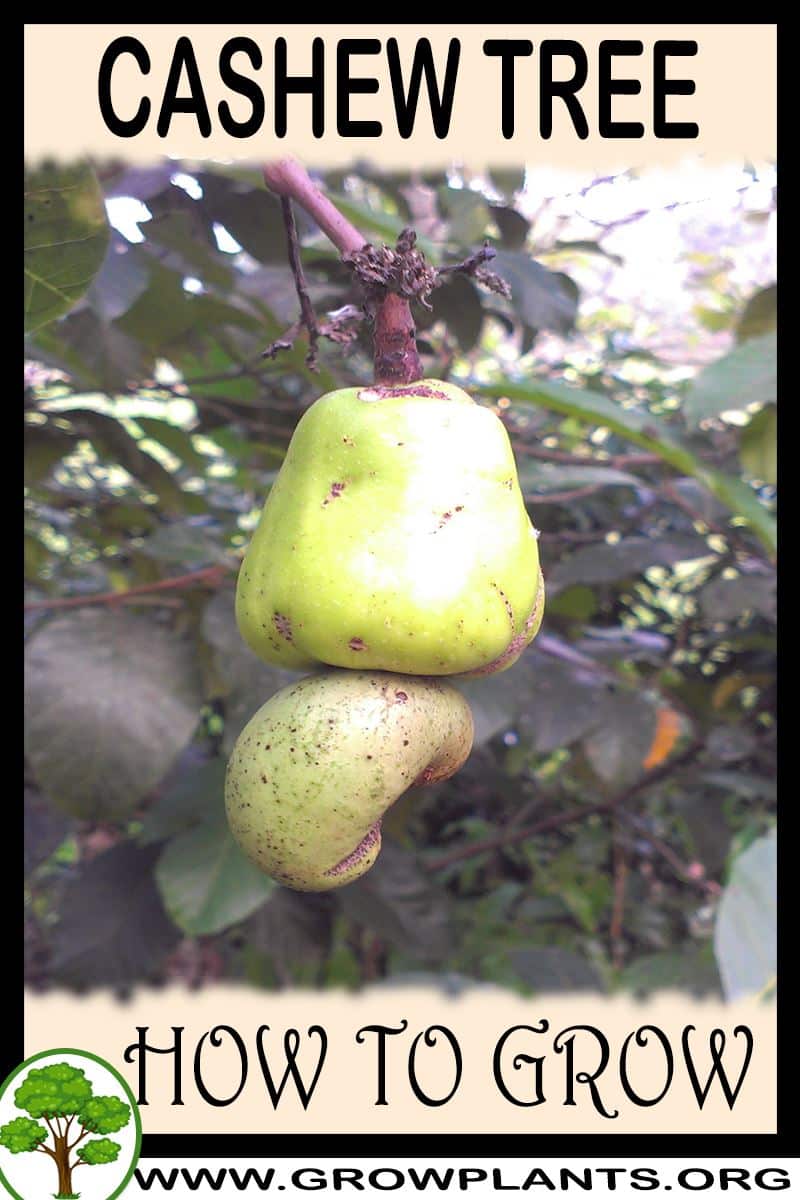
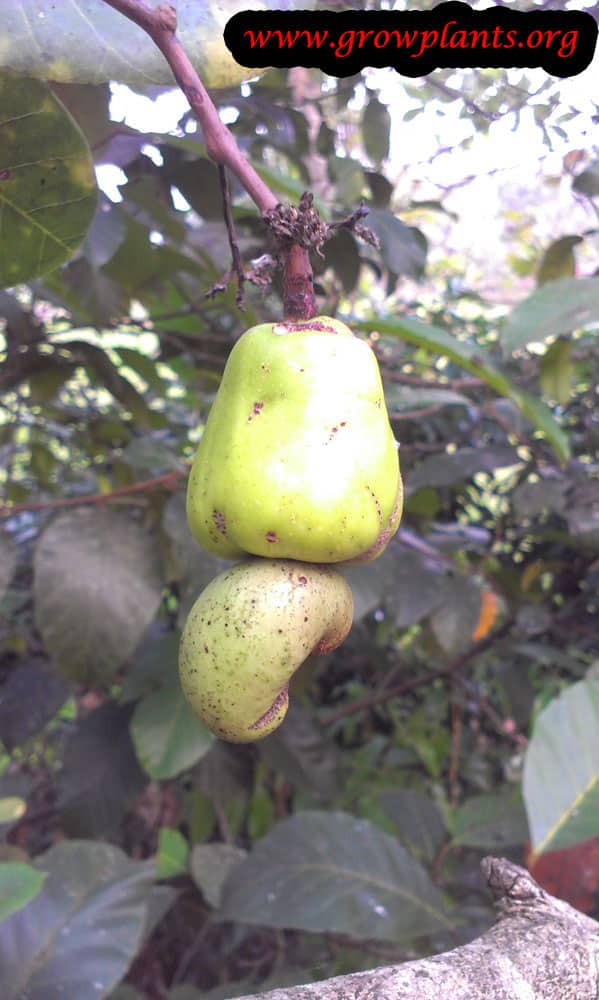
- Fruit Profile: A fleshy, juicy cashew apple in red, orange, yellow or green, with the kidney-shaped nut hanging beneath (see the Fruit guide)
Primary Uses & Landscape Value
- Edible Uses: Cashew apple eaten fresh or juiced; the kernel eaten roasted (not raw)
- Functional & Ornamental Roles: Fruit-and-nut tree, also used as an ornamental shade tree
Care Guide: Planting, Soil & Watering
Overview: The cashew tree (Anacardium occidentale) is a fast-growing tropical evergreen for hot, humid, frost-free climates (hardiness zone 12+, needing temperatures above about 10 C), grown in full sun. It is adaptable to sandy, well-draining soils and, with its deep root system, appreciates a warm, bright, open site.
Quick Care Requirements
| Requirement | Ideal Condition |
|---|---|
| Planting Season | Year-round in suitably warm tropical conditions |
| Growth Rate | Moderate to Fast |
| Soil Type | Well-draining, sandy to loam soil |
| Water Need | Moderate to High while establishing and fruiting |
Planting & Establishment
- Best Planting Season: In a true tropical climate it can be planted year-round; choose a warm, sheltered, sunny spot.
- How to Plant:
- Hole Preparation: Dig a generous hole to loosen the soil for the tree’s deep, spreading root system.
- Soil Amendments: Improve heavy soils with organic matter and grit for drainage; cashew tolerates lean, sandy ground but dislikes waterlogging.
- Planting Depth: Set the root ball level with the surrounding soil, keeping the trunk base and root collar unburied.
- Growth Speed & Expectations: A vigorous tree reaching 6-12 m; give it plenty of room, as it is not suited to container growing.
Soil, Watering & Drainage Care
- Soil Mix & Drainage Needs: Well-draining soil is important despite its moisture needs; it grows naturally on sandy, free-draining ground and will not tolerate soggy roots. It is not suited to containers.
- Watering Schedule & Technique:
- Young / Newly Planted: Water young trees regularly to keep the root zone moist while they establish.
- Established: Give a moderate to generous, deep watering, allowing the soil surface to dry between waterings; mature trees are fairly drought-hardy.
- Seasonal Adjustments: Water more through hot, dry periods and reduce in cooler, wetter weather.
Climate, Light & Hardiness
The cashew (Anacardium occidentale) is a strictly tropical evergreen tree that needs constant warmth, high humidity and full sun. The site rates it for hardiness zone 12 and above and advises keeping it above roughly 10°C (50°F), so it is unsuited to any cool or frost-prone climate.
Quick Climate Specifications
| Climate Zones | Tropical |
|---|---|
| USDA Hardiness Zones | 12+ |
| Cold Damage Begins | Below about 10°C (50°F), per the site |
| Frost Tolerance | None |
| Light Conditions | Full sun |
| Wind Tolerance | Moderate |
Sunlight & Light Exposure
Optimal Light Setup
A full-sun tree; strong tropical light drives flowering and nut production.
Direct Sun Requirement
Direct sun for most of the day is essential.
Best Exposure / Orientation
A hot, open, fully sunny position is required.
Temperature Extremes & Hardiness
USDA Hardiness & Regional Limits
Rated by the site for zone 12 and above - a demanding, fully tropical, frost-free requirement. Outside the true tropics it can only be grown under continuously warm protected conditions.
Cold Damage & Winter Protection
The site advises keeping it above about 10°C (50°F). Cool temperatures below that stall growth and cause chilling injury; there is no frost tolerance at all. Young trees are especially vulnerable to cold.
Frost Sensitivity
Extremely frost-sensitive - any frost is fatal.
Extreme Heat Tolerance
Excellent; it is fully adapted to sustained tropical heat.
Frost-Free Growing Season
Requires year-round warmth. Only a continuously frost-free, warm season supports its flowering-to-harvest cycle.
Wind, Humidity & Microclimate
Humidity Preferences
The site notes it needs high humidity; a moist tropical atmosphere suits it best.
Dry-Air Tolerance
Lower than many tropical trees given its stated humidity preference; very dry air is not ideal.
Wind Tolerance
Moderate; shelter from strong wind protects flowering and fruit set.
Microclimate Recommendations
A hot, humid, frost-free, sheltered, sunny site is essential - realistically only true tropical climates or heated protected environments.
Growing in Pots, Balconies & Indoors
Both of the grower’s key facts point the same way: this is not a houseplant, and it is not suited to long-term container growing. The cashew tree is a full-size evergreen nut tree (6-12 m), best grown in open ground; a pot is only a temporary home for a young seedling.
Quick Details
- Container Size: Not recommended long-term; only a deep nursery pot for a young seedling
- Indoor Suitability: Not a houseplant – a large outdoor tree
- Best Spot: Full sun, in the open ground
- Soil & Drainage: Deep, free-draining soil
- Watering: Regular water while young and establishing
Indoors & On the Windowsill
- Not for indoors: A large tree needing full sun – no room or windowsill will suit it.
- Young plants only under cover: In a climate colder than its range, a seedling can be kept in a pot in a bright, frost-free spot for its first winters, but it must ultimately go in the ground.
On a Balcony or Patio
- Ground, not balcony: This tree isn’t a practical balcony or patio container subject – it needs room to root and spread. Grow it in the garden where the climate allows.
- While young in a pot: keep it in the deepest pot you can, in full sun and sheltered from wind, and move it on before the roots circle.
Choosing the Pot, Soil & Long-Term Care
- Not a long-term pot plant: The grower marks containers as unsuitable. The cashew develops a deep taproot and wide crown that outgrow any pot. A young seedling can spend its first year or two in a deep pot, but plan to plant it in open ground.
- If you must start it in a pot: use the deepest container you can (to suit the developing taproot), a free-draining mix and strong drainage holes; skip a standing water saucer to avoid root rot; terracotta breathes and dries faster, while glazed or plastic holds moisture longer.
- Feeding & moving on: feed lightly while young and pot on before it becomes root-bound – then transplant to its permanent site.
- Safety: The cashew’s fruit and the raw nutshell contain a caustic, toxic oil – never handle or eat the raw shell; keep children and pets away.
Growing this plant in a greenhouse
A greenhouse can give cashew tree frost protection, cold protection and protection from rain. In the right climate it may also be kept growing through winter, depending on how much warmth and light are provided.
Greenhouse at a glance
| Greenhouse suitability | Conditional - depends on your climate |
|---|---|
| Main benefits | frost protection, cold protection, protection from rain |
| Season extension | earlier spring & later autumn |
| Outdoor protection advisable below | about 10°C |
| Maintain greenhouse minimum | around 10°C for active growth |
| Suitable types | heated greenhouse, glass greenhouse, polycarbonate greenhouse |
| Heating | Heating is recommended in cold climates for continuous growth. |
Related greenhouse guides
- Greenhouses: How to Choose the Right Greenhouse
- Best Greenhouse Heaters
- Greenhouse Climate Control: Temperature, Ventilation and Humidity
- Polycarbonate Greenhouses: What to Look for Before Buying
Fertilizing & Feeding
A moderate feeder: young trees appreciate nitrogen-forward feeding to build structure, while bearing trees do best with balanced nutrition and steady potassium through the growing season.
Quick Fertilizing Specs
| Feeding Level | moderate |
|---|---|
| young_feeding | Nitrogen-forward feeding through the growing season to build the tree. |
| mature_feeding | Balanced feeding with steady potassium to support cropping. |
| Main Nutrient Priority | Nitrogen while young; balanced nutrition with potassium once bearing. |
| Best Feeding Period | From when growth resumes through active growth and crop development. |
| Organic Options | Compost, well-rotted manure, and organic mulch over the root zone. |
| Micronutrients | A complete tree fertilizer usually supplies iron, manganese, and zinc; watch for chlorosis on alkaline soils. |
| Soil pH | Best in well-drained soil that is slightly acidic to near-neutral. |
| Reduce/Stop Feeding | Ease off feeding after harvest and through the cool, dormant season. |
Feeding by Growth Stage
Newly planted tree
Help the young tree establish roots after planting.
| Nutrient direction | Go light on fertilizer at first; let roots settle, then begin light balanced feeding once new growth appears. |
|---|---|
| Timing | The first season after planting. |
| Frequency | Feed sparingly until the tree is established and actively growing. |
| Fertilizer types | Light application of a balanced complete fertilizer, Compost or well-rotted organic matter worked into the planting area |
| Precautions | Keep fertilizer off the trunk and avoid heavy feeding, which can burn tender new roots. |
Young, non-bearing tree
Build a strong framework of branches and roots during the years before bearing.
| Nutrient direction | A nitrogen-forward complete fertilizer to drive steady vegetative growth and canopy development. |
|---|---|
| Timing | Through the growing seasons before the tree begins to bear. |
| Frequency | Feed through the active growing season, tapering as growth slows toward the cool season. |
| Fertilizer types | Nitrogen-forward complete tree fertilizer, Slow-release granular tree fertilizer, Compost or organic matter |
| Routine trace nutrients | iron, manganese, zinc |
| Precautions | Avoid late-season nitrogen that pushes tender growth vulnerable to cold. |
Established tree approaching bearing
Maintain healthy growth and prepare the tree to carry a crop.
| Nutrient direction | Shift toward a balanced complete fertilizer as the tree matures and prepares to fruit. |
|---|---|
| Timing | As the tree fills out and nears bearing age. |
| Frequency | Feed through the active growing season with balanced nutrition. |
| Fertilizer types | Balanced complete tree fertilizer, Slow-release granular feed, Compost or organic matter |
| Routine trace nutrients | iron, manganese, zinc |
| Precautions | Keep nutrition balanced; excess nitrogen can delay or reduce fruiting. |
Mature, bearing tree
Support a healthy canopy and a good crop year after year.
| Nutrient direction | A balanced complete fertilizer with steady potassium to support nut development. |
|---|---|
| Timing | Each growing season, with feeding concentrated as growth resumes and through crop development. |
| Frequency | Feed through the active growing season; ease off after harvest as the tree slows. |
| Fertilizer types | Balanced complete fertilizer with potassium, Slow-release granular tree fertilizer, Compost or organic matter |
| Routine trace nutrients | iron, manganese, zinc |
| Precautions | Watch for micronutrient chlorosis on alkaline soils and correct the cause rather than overfeeding. |
Nutrient Deficiency Signs & Corrections
Overall pale, yellow-green foliage with weak, slow growth.
| Possible causes | Low soil nitrogen, Heavy leaching in sandy or frequently watered soils, Cold or waterlogged soil limiting uptake |
|---|---|
| Appears first on | Older, lower leaves |
| What to check | Feeding history, Whether the oldest leaves yellow first, Soil drainage and temperature |
| Possible correction | Apply a nitrogen-forward complete fertilizer during the growing season and build soil organic matter. |
New leaves yellow between green veins, most on the youngest growth.
| Possible causes | High or alkaline soil pH making iron unavailable, Waterlogged, poorly aerated roots, Cold soil slowing uptake |
|---|---|
| Appears first on | Youngest leaves |
| What to check | Soil pH, Drainage and root health, Whether yellowing is interveinal on new leaves |
| Possible correction | Correct soil pH and drainage; apply a chelated iron product per its label if needed. |
Small, narrow leaves clustered in rosettes at shoot tips with shortened internodes.
| Possible causes | Low available zinc, High soil pH reducing zinc uptake, Sandy, low-organic soils |
|---|---|
| Appears first on | New shoot tips |
| What to check | Leaf and internode size on new growth, Soil pH, History of micronutrient issues |
| Possible correction | Correct high pH and apply a zinc product per its label if a deficiency is confirmed. |
Poor nut set, misshapen or aborted kernels, and dieback of shoot tips.
| Possible causes | Low soil boron, Sandy soils and heavy leaching, Dry conditions limiting boron movement to developing nuts |
|---|---|
| Appears first on | Developing nuts and shoot tips |
| What to check | Nut set and kernel fill, Soil boron history, Whether shoot tips die back |
| Possible correction | Correct only a confirmed shortage; apply boron carefully to a soil test and label, as the safe margin is narrow. |
Pruning, Training & Seasonal Maintenance
Cashew (Anacardium occidentale) is a spreading tropical evergreen (Anacardiaceae) that needs only light pruning — but it carries a serious handling hazard, because its sap and shell oil contain caustic, urushiol-type compounds that burn and blister skin. Pruning aims to build an open framework with a clear trunk, then keep the dense canopy light and airy for better flowering and to limit fungal problems in the humid tropics. It flowers and fruits on the tips of the current season’s growth, so light annual cutting after harvest encourages fresh flowering flushes.
Quick Pruning & Maintenance Specs
| Pruning Tolerance | Low–Moderate – light shaping, not hard cutting |
| Primary Pruning Window | After harvest (about summer, after fruiting) |
| Secondary Maintenance Window | Remove deadwood/watersprouts as needed |
| Typical Frequency | Formative early; then light annual thinning |
| Main Objective | Open, well-lit framework; clear trunk; airflow |
| Young Plant Priority | Clear a low trunk; select spreading scaffolds |
| Mature Plant Priority | Thin crowded/inward wood; deadwood; height for access |
| Best Tool Type | Secateurs/loppers, saw; disinfectant for humid-tropic disease |
| Avoid Heavy Pruning During | Flowering/fruit set and prolonged wet weather |
Pruning by Plant Age & Size
Newly Established
Remove only damaged shoots and begin clearing the lowest branches to establish a clean trunk to about knee-to-waist height, which keeps the developing canopy off the ground and eases harvest and airflow.
Young / Formative
Select three to four well-spaced, wide-angled scaffolds to form an open, spreading framework. Cashew naturally makes a dense, low, spreading head, so formative work is about lifting and opening it, not building height.
Mature / Established
Keep it light: remove deadwood, crossing and strongly inward branches to let light into the canopy, take off low water sprouts, and contain height for picking — good light penetration is directly linked to flowering and yield.
Seasonal Pruning Schedule
Post-Harvest
Objective: light structural tidy once fruiting is over. Remove deadwood, crowded and inward shoots and any diseased wood; open the canopy modestly. Expected response: fresh flushes that carry the next terminal flowers and fruit.
Ongoing Sanitary
In the humid tropics stay ahead of dieback and anthracnose by removing dead and diseased wood promptly — cutting back to clean wood and improving airflow.
Flowering & Fruiting Wood
Flowers are borne in panicles at the ends of the current season’s shoots, each yielding the swollen cashew apple and its attached nut. Because fruiting is terminal on new growth, light pruning that encourages healthy new flushes supports cropping, while opening the canopy to light improves flower set on the outer wood; heavy heading, by contrast, pushes vegetative regrowth and delays fruiting.
Structural Pruning & Training
Build and maintain an open, spreading framework: clear trunk, well-spaced scaffolds, and thinning of the crowded interior so light and air reach through. In this species thinning genuinely helps — a dense, shaded, humid canopy both crops poorly and holds disease.
Special Growth to Remove
Remove low water sprouts and any shoots crowding the trunk clearance; take out dead and diseased wood as a priority. Seedling trees have no graft-sucker issue, though grafted orchard trees should have below-union shoots removed.
Container & Small-Space Pruning
Cashew is not a container or indoor plant; it is a spreading orchard tree that needs open ground and warmth, so size is managed by light in-ground thinning and height reduction rather than pot culture.
Tools
Secateurs and loppers handle most cuts and a pruning saw the larger limbs. The critical point is protection, not the tool: wear thick gloves, long sleeves and eye protection, because the sap is caustic.
Tool Hygiene & Disease Risk
High-risk for the OPERATOR, and increased for disease. The caustic urushiol-type sap can cause severe dermatitis and eye injury, so cover skin and eyes fully and never burn the prunings — the smoke is toxic. For disease, disinfect blades when cutting out dieback or anthracnose so you do not spread it through a humid canopy; clean tools thoroughly of sticky sap afterwards.
Cut Placement & Technique
Use clean thinning cuts back to a lateral or the collar; avoid stubs and flush cuts; cut diseased wood back into healthy tissue. Work deliberately to minimise sap contact and splash.
Heavy Pruning & Rejuvenation
Cashew does not respond well to hard cutting — it is best kept in shape by light annual work. An old or misshapen tree can be reduced only cautiously and gradually over several seasons; a severe cutback risks sunburn, disease entry and a long loss of cropping.
Post-Pruning Care
After opening the canopy, watch newly exposed bark for sunburn in the tropical sun and monitor cuts for dieback in wet weather. Water normally; heavy feeding after pruning is unnecessary.
Common Pruning Mistakes
- Handling the sappy wood without full skin and eye protection — the sap burns.
- Burning the prunings, which releases toxic smoke.
- Hard-heading the tree and losing terminal fruiting wood while forcing vegetative regrowth.
- Leaving a dense, shaded, humid canopy that crops poorly and harbours disease.
When NOT to Prune
Do not prune during flowering and fruit set, or in prolonged wet weather when dieback and anthracnose spread most readily through fresh cuts.
Recommended Tools (by task)
- bypass_secateurs — light thinning and shaping cuts on shoots and small wood.
- loppers — for crowded and inward branches up to a few centimetres.
- pruning_saw — for the occasional larger limb and clearing the trunk.
- blade_disinfectant — to clean caustic sap from blades and to sterilise when cutting dieback/anthracnose.
Pruning Troubleshooting
| Problem | Possible Cause | What to Check | Corrective Action |
| Skin burns/rash after pruning | Contact with caustic urushiol-type sap | Protection worn; sap on tools and skin | Cover skin/eyes fully; wash off sap; never burn prunings |
| Poor flowering and fruiting | Dense shaded canopy / bearing tips removed | Light penetration and where cuts were made | Thin to open the canopy; keep cutting light and post-harvest |
| Dieback / anthracnose spreading | Disease moved on dirty blades in humid canopy | Blade cleanliness and dead/diseased wood | Disinfect blades; remove diseased wood to clean tissue |
| Sunburnt limbs after opening the canopy | Bark suddenly exposed to tropical sun | Newly exposed trunk and scaffolds | Open gradually; whitewash exposed bark |
Propagation Guide
Cashew is usually grown from seed — the nut — sown fresh, since viability falls quickly in storage; superior selections are reproduced by grafting or air layering. Moderate. Handle the seed with care, as the shell contains a caustic, toxic oil.
Quick Propagation Specs
| Best Propagation Method | Seed (fresh) |
| Alternative Methods | Grafting; air layering (for selected clones) |
| Propagation Difficulty | Moderate |
| Seed True-to-Type | Variable |
| Vegetative True-to-Type | Yes |
| Best Propagation Season | Warm season |
| Seed Germination Time | Usually a couple of weeks to a month in warmth |
| Germination Temperature | Warm, roughly 25–30°C (77–86°F) |
| Seed Sowing Depth | A few centimetres |
Growing from Seed
Seed Handling & Viability
Sow fresh nuts; viability declines with storage, so do not hold them long. Handle carefully — the shell contains a caustic, toxic oil, matching the plant’s toxicity note.
Sowing & Germination
Sow a few centimetres deep in warm, free-draining, moist media, often direct, because cashew forms a taproot and resents disturbance. Germination is warm and typically takes a couple of weeks to a month, sometimes unevenly.
Seedling Care
Grow warm; transplant young or sow in situ to protect the taproot.
Grafting & Budding
Named, higher-yielding cashews are reproduced by grafting — for example side or wedge grafting — or by air layering onto seedling rootstock, to keep the clone true and crop earlier. Air layering is done on semi-mature wood in the warm season.
Bloom & Flower Guide
Quick Details
- Bloom Season: Autumn (timing shifts with the tropical dry season)
- Time to First Bloom: Usually three to five years from a young tree
- Flower Appearance: Small five-petalled flowers in white to pink, sometimes striped, borne in branching clusters (panicles)
- Edibility: The flower is not eaten; treat the bloom as ornamental. (The cashew apple and the processed nut are the edible parts, and the raw nut shell is caustic and must be processed first.)
Detailed Blooming Overview
The cashew tree produces branching sprays of small, lightly fragrant flowers that open white and often age or blush to pink, some cultivars showing fine pink or white stripes. Each panicle carries a mix of male and bisexual flowers, and it is the bisexual ones that go on to form the curious cashew apple with its single nut hanging below. Flowering leads into the tree’s main fruiting flush.
Flower Characteristics
- Small, five-petalled flowers in white to pink, sometimes striped.
- Borne in branching terminal clusters, mixing male and bisexual flowers.
- Lightly fragrant and attractive to bees and other pollinators.
Bloom Care & Thinning
- Managing the bloom: No thinning is needed; only a portion of the flowers set fruit and the rest drop naturally.
- For a good set: Both self- and cross-pollination occur, but a warm, dry spell during flowering gives the best fruit set.
- Pollination: Pollinated by bees and other insects, so avoid spraying open flowers to protect them.
Fruit & Uses
The cashew has two edible parts: the soft, juicy cashew apple (the swollen fruit stalk), eaten fresh or juiced, and the kidney-shaped kernel. However, the shell around the kernel contains a caustic, toxic oil, so the nut must be properly roasted and shelled before eating — raw, in-shell cashews should never be cracked and eaten at home.
Quick Edible Specs
| Edible Parts | Fruit (cashew apple) and nut (kernel) |
|---|---|
| Main Use(s) | Cashew apple eaten raw or juiced; kernel eaten after roasting/shelling |
| Eaten Raw or Cooked | Apple raw; kernel only after proper roasting/processing |
| Preparation Required | Kernel must be roasted and the toxic shell removed before eating |
| Harvest Season | Winter to spring |
| Time to First Harvest | A few years from planting (see growing notes) |
| Safety/Toxicity Caveat | The shell (and fruit) contain a caustic toxic oil — never eat raw in-shell nuts |
Fruit
The cashew apple — red, orange, yellow or green and juicy in an apple or pear shape — hangs above the nut. It is eaten fresh or pressed for juice.
Seeds, Pods & Nuts
The white kidney- or half-moon-shaped kernel (botanically not a true nut, but used as one) grows below the apple inside a shell the site explicitly flags as toxic. The kernel is edible, but only after the shell’s caustic oil has been driven off by proper roasting and the kernel shelled.
Preparation, Uses & Safety
Hazard: the shell contains a caustic, urushiol-type oil that can burn skin and is unsafe to ingest; the site also notes the fruit and shell contain toxicity. Commercial cashews are heat-processed and shelled before sale. Eat the cashew apple fresh or as juice; eat the kernel only after it has been properly roasted and shelled — do not attempt to crack and eat raw in-shell cashews.
Pests, Diseases & Troubleshooting
Overview: Anacardium occidentale (cashew) is a tropical Anacardiaceae tree grown for its nuts and cashew apples. Its most damaging pest by far is the tea mosquito bug, alongside cashew stem and root borer, leaf miner, red-banded thrips and blossom/leaf webbers; the key diseases are anthracnose, powdery mildew of the flowers and dieback. Management centres on orchard hygiene, timely control at flowering, and healthy, unstressed trees.
Quick Troubleshooting Overview
| Issue / Pest | Main Symptom | Primary Solution |
|---|---|---|
| Tea mosquito bug | Black lesions on shoots/flowers, dieback, nut loss | Sanitation, prune, timely flowering control |
| Stem & root borer | Bark tunnels, gumming, wilting, tree death | Swab wounds, remove grubs, keep trees vigorous |
| Red-banded thrips | Silvery-then-brown scorched leaves | Encourage predators, insecticidal soap/oil |
| Leaf/blossom webber | Webbed, tied leaves and flowers, defoliation | Prune webs, Bt, remove affected shoots |
| Anthracnose | Black sunken spots on leaves, flowers, nuts | Airflow, prune, copper fungicide at flowering |
| Powdery mildew | White powder on inflorescences, nut drop | Prune density, sulphur/labelled fungicide |
Common Pests & Management
- Tea mosquito bug (Helopeltis antonii):
- Symptoms: Slender mosquito-like bugs whose feeding leaves dark, sunken necrotic lesions on tender shoots, leaves, flower panicles and young nuts; heavy attack blackens and kills shoots and can cause major nut loss – the number-one cashew pest.
- Prevention & Control: Keep the canopy open by pruning for airflow and light, remove and destroy affected shoots, encourage weaver ants and other natural enemies, and time any control to the flushing and flowering stages when the bug is most active.
- Cashew stem and root borer (Plocaederus ferrugineus):
- Symptoms: Large grubs tunnel under the bark of the trunk and roots, producing gum and frass at the base, yellowing, wilting and – if the trunk is girdled – death of the whole tree.
- Prevention & Control: Inspect trunk bases regularly, swab or clean out affected bark and remove grubs by hand, keep trees vigorous and unwounded, and destroy severely infested trees to protect the orchard.
- Red-banded thrips (Selenothrips rubrocinctus):
- Symptoms: Silvery flecking that turns bronze and scorched on leaves and young nuts, with black specks of excreta; heavy feeding causes leaf fall.
- Prevention & Control: Encourage predatory thrips, mites and lacewings, hose down foliage, and use insecticidal soap or horticultural oil, spraying in the evening.
- Leaf and blossom webbers (Various Lepidoptera):
- Symptoms: Caterpillars web and tie together leaves and flower panicles, feeding inside the shelter and causing defoliation and flower/nut loss.
- Prevention & Control: Prune out and destroy webbed shoots and panicles, encourage birds and parasitic wasps, and apply Bacillus thuringiensis (Bt) to young larvae.
- Leaf miner (Acrocercops syngramma):
- Symptoms: Pale blistered mines and blotches inside tender young leaves, distorting and browning the new flush.
- Prevention & Control: Remove and destroy mined leaves, protect and encourage parasitic wasps, and keep new flushes vigorous so trees outgrow damage.
- Mealybugs & scale (Pseudococcus / Coccus spp.):
- Symptoms: White cottony masses or brown bumps on shoots and leaf undersides, with honeydew and sooty mould, often tended by ants.
- Prevention & Control: Encourage ladybirds and parasitic wasps, control ants, and smother colonies with horticultural oil.
Diseases & Fungal Issues
- Anthracnose (Colletotrichum gloeosporioides):
- Symptoms: Black or reddish-brown sunken spots on leaves, shoots, flowers and young nuts that enlarge, causing blossom blight, twig dieback and nut drop in warm, wet weather.
- Treatment & Management: Prune for airflow and remove infected shoots and mummified nuts, avoid overhead wetting, and apply a copper fungicide protectively at flushing and flowering; harvest and sanitation reduce carry-over.
- Powdery mildew (Oidium anacardii):
- Symptoms: White powdery growth on flower panicles, young shoots and nuts, causing flower blast and heavy nut drop – a major flowering-stage disease.
- Treatment & Management: Open up the canopy, remove affected panicles, and apply wettable sulphur or a labelled fungicide at the critical flowering stage, protecting pollinators by spraying in the evening.
- Dieback / pink disease (Botryosphaeria / Corticium salmonicolor):
- Symptoms: Branch dieback with cankers, gumming and, in pink disease, a salmon-pink fungal crust on the bark in very humid conditions.
- Treatment & Management: Prune out and burn affected branches well below the canker, paint large cuts, improve airflow, and apply a copper paste to wounds.
- Damping-off / root rot (nursery) (Pythium / Phytophthora spp.):
- Symptoms: Seedling collapse and root rot in wet, poorly drained nursery beds.
- Treatment & Management: Use clean, free-draining media, avoid overwatering, and provide airflow and warmth for young plants.
Growing Difficulties & Abiotic Problems
- Bird & bat damage to fruit:
- Cause & Symptoms: Birds and fruit bats feed on ripe cashew apples, matching the source note.
- Correction Strategy: Use netting on small trees, harvest promptly, and tolerate some loss on large orchard trees.
- Drought / water stress:
- Cause & Symptoms: Prolonged drought reduces flowering, nut set and nut size.
- Correction Strategy: Mulch, water young trees during establishment and dry spells, and choose suitable rootstocks and sites.
- Poor drainage / root rot:
- Cause & Symptoms: Waterlogged or heavy soil causes root decline and dieback.
- Correction Strategy: Plant on well-drained sites or mounds, avoid waterlogging, and improve heavy soils before planting.
- Nutrient deficiency:
- Cause & Symptoms: Zinc, boron and other deficiencies cause poor flowering, distorted growth and low nut set.
- Correction Strategy: Test soil and correct deficiencies with appropriate foliar or soil feeds, keeping nutrition balanced.
What Helps – Products & Tools
Cashew management combines sanitation and timing with targeted products: prune and destroy infested shoots for tea mosquito bug and webbers; use Bacillus thuringiensis (Bt) for caterpillars; insecticidal soap or horticultural oil for thrips, mealybugs and scale; a copper fungicide for anthracnose and dieback; and wettable sulphur or a labelled fungicide for powdery mildew at flowering. Time flowering sprays for the evening to protect pollinators and follow all labels and harvest intervals.