

Plant Profile & Key Characteristics
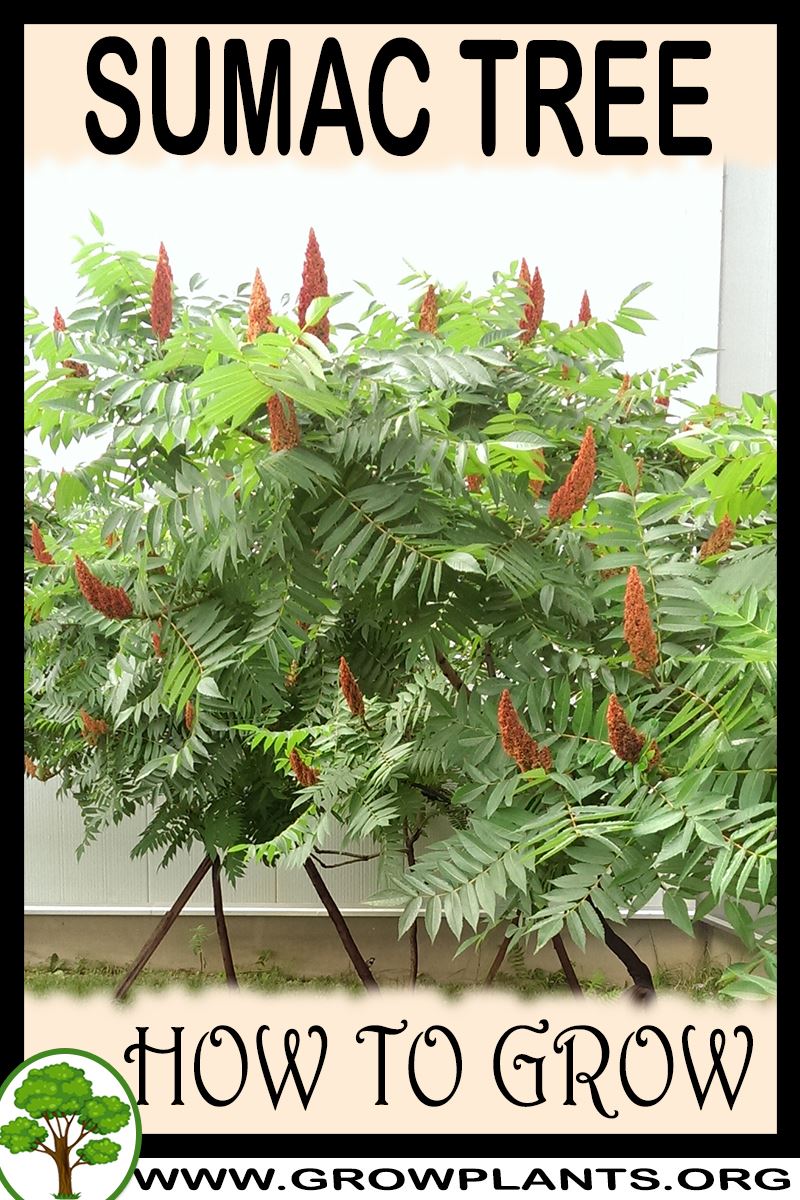
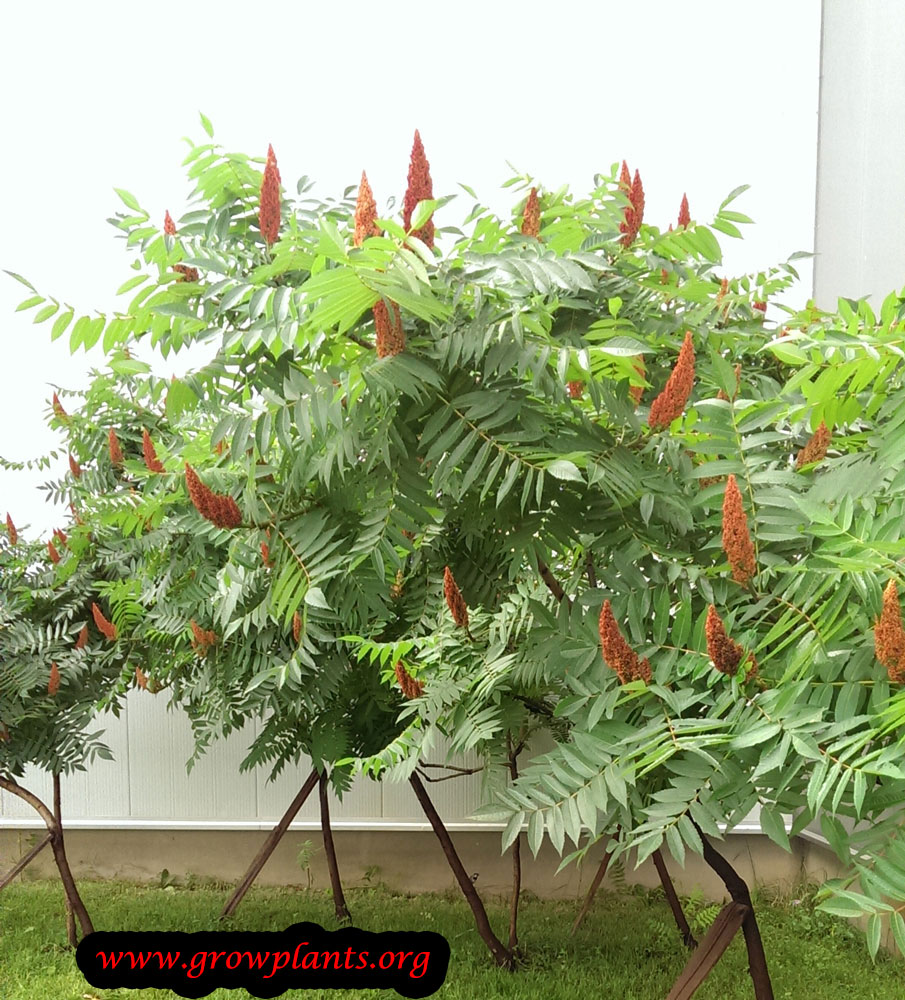
Overview: A deciduous shrub or small tree 1-9 m (3-28 ft) tall with pinnate foliage, grown as an ornamental and for its edible, tangy red fruit used as a spice. It suckers freely from the roots.
Quick Specifications
| Specification | Attribute |
|---|---|
| Plant Type / Life Cycle | Perennial (deciduous shrub or tree) |
| Foliage Type | Deciduous (occasionally evergreen in mild climates) |
| Mature Size | 1-9 m (3-28 ft) |
| Growth Rate | Moderate |
| Root System | Suckering — spreads by root shoots and can be invasive |
| Toxicity | Fruit edible (culinary sumac spice); non-toxic |
| Hardiness | USDA zones 5-10 |
Growth Form & Structure
- Height & Spread: 1-9 m (3-28 ft) in the ground, forming spreading colonies; also grown in containers to restrain it.
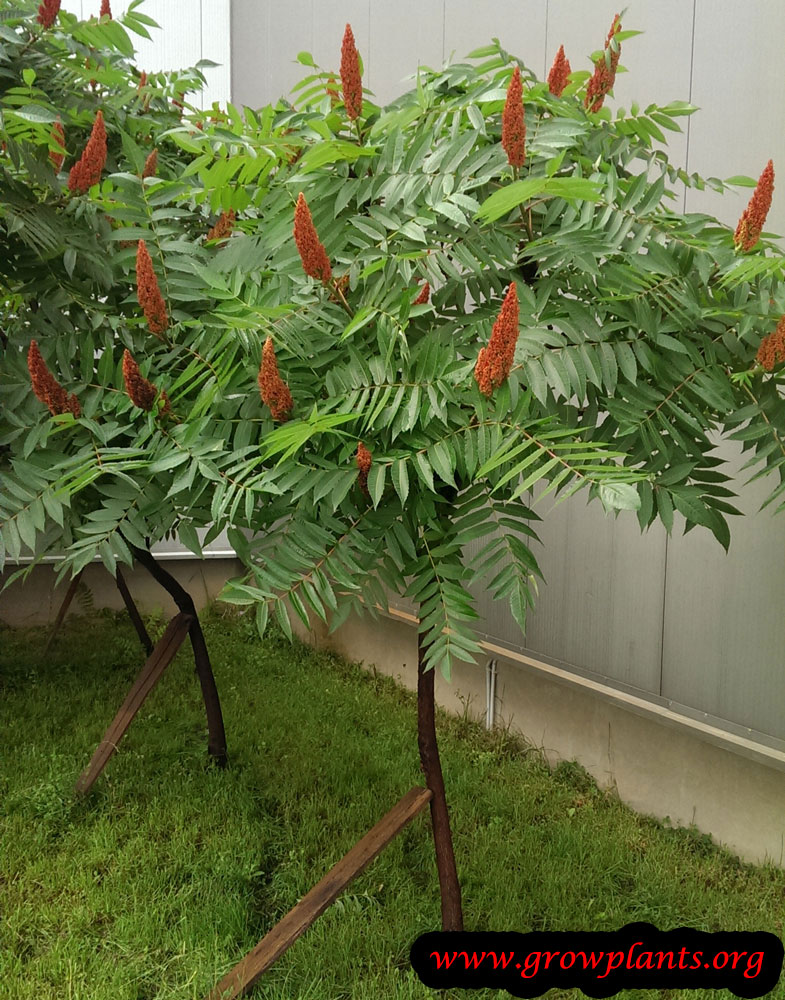
- Growth Habit & Form: Upright, suckering shrub or small tree with an open canopy of pinnate leaves.
- Lifespan & Maturity: Colony-forming and long-lived; bears fruit in about 2-4 years.
Anatomy & Physical Features
- Leaves & Foliage: Green, elliptic leaflets arranged in a pinnate leaf.
- Flower Characteristics: Small yellow-white flowers borne in clusters on stalks, pollinated by bees.
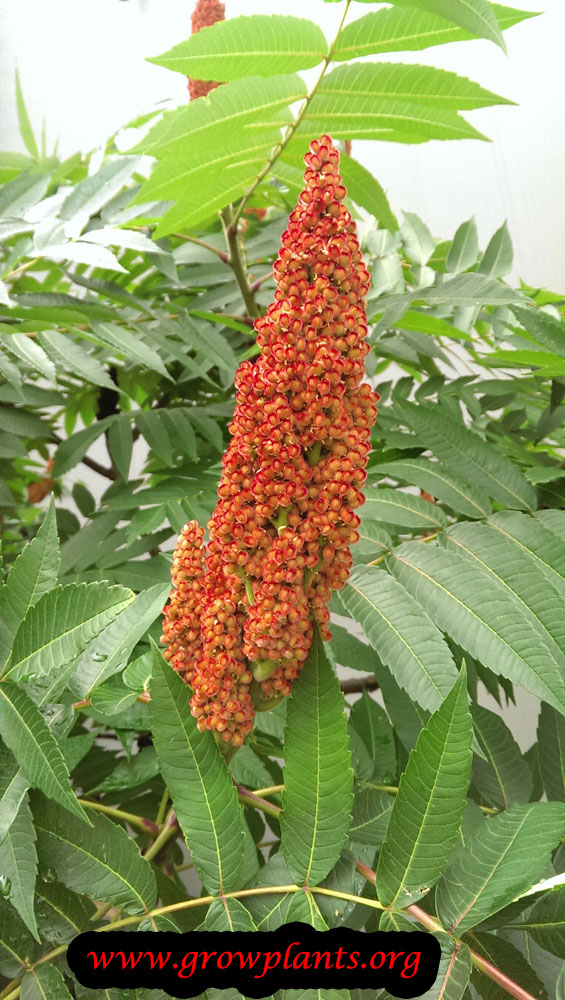
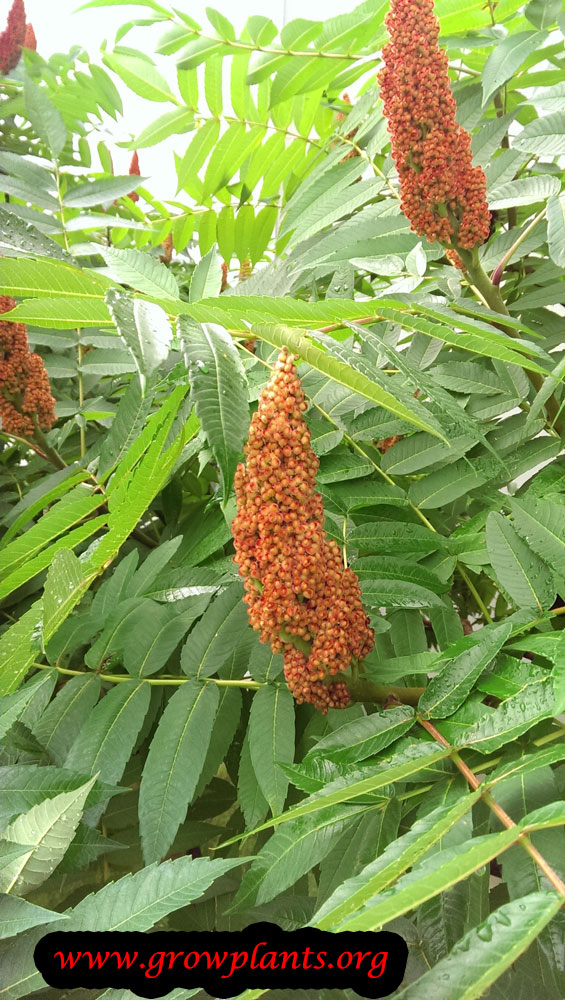
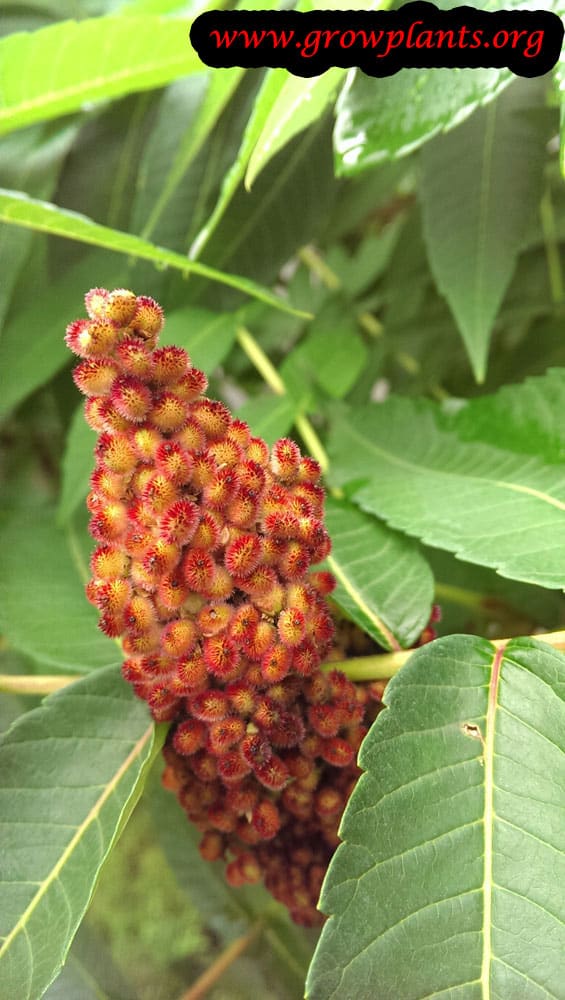
- Fruit Profile: Clusters of red drupes 2-3 cm across with a tangy, tart flavour.
Primary Uses & Landscape Value
- Edible Uses: Dried fruit ground into the spice sumac and steeped as a tea; also used traditionally in herbal medicine.
- Functional & Ornamental Roles: Ornamental shrub or small tree valued for foliage and fruit clusters.
Care Guide: Planting, Soil & Watering
Overview: This sumac (Rhus coriaria) is a tough, deciduous large shrub or small tree that thrives in full sun to part shade in free-draining soil. It is very drought tolerant and needs a cool winter with some chilling to grow and fruit well.
Quick Care Requirements
| Requirement | Ideal Condition |
|---|---|
| Planting Season | Spring or autumn |
| Growth Rate | Moderate |
| Soil Type | Well-draining; tolerant of poor, dry soils |
| Water Need | Moderate — very drought tolerant once established |
Planting & Establishment
- Best Planting Season: Plant in spring or autumn, when the weather is mild, so roots establish before summer heat or winter cold.
- How to Plant:
- Hole Preparation: Dig a hole about twice the width of the root ball and no deeper, loosening the surrounding soil so the spreading roots can travel.
- Soil Amendments: Not demanding — a little compost helps on poor soil, but avoid over-rich, wet ground, as sharp drainage matters more than fertility.
- Planting Depth: Set the top of the root ball level with the soil surface and keep the trunk base at grade. Note it suckers freely and can spread from the roots.
- Growth Speed & Expectations: A moderate grower that can eventually reach several metres; be aware it produces suckers and can form a thicket if not managed.
Soil, Watering & Drainage Care
- Soil Mix & Drainage Needs: Give it well-drained soil; it tolerates poor, rocky and dry ground but dislikes wet feet. Suitable for a large, well-drained container.
- Watering Schedule & Technique:
- Young / Newly Planted: Water regularly through the first season to establish the roots, keeping the soil moist but not waterlogged.
- Established: Once established it is highly drought tolerant and needs little or no extra water except in prolonged drought.
- Seasonal Adjustments: Water occasionally in extreme summer heat while young; keep drier in winter, when the plant is dormant and needs its chilling period.
Climate, Light & Hardiness
Sumac (Rhus coriaria) is a hardy temperate-to-subtropical shrub or small tree that suits Mediterranean and continental climates, growing best in full sun to light shade. It is cold-tolerant across the site's hardiness zones 5–10 and benefits from a distinct cool winter.
Quick Climate Specifications
| Climate Zones | Temperate, subtropical, Mediterranean |
|---|---|
| USDA Hardiness Zones | 5–10 |
| Frost Tolerance | Moderate to High |
| Light Conditions | Full sun to partial shade |
| Wind Tolerance | Moderate to High |
Sunlight & Light Exposure
Optimal Light Setup
Full sun gives the best growth, fruiting and autumn colour; it also accepts partial shade.
Direct Sun Requirement
For reliable flowering and fruit set, choose an open, sunny position.
Best Exposure / Orientation
A warm, bright, south- or west-facing site produces the strongest crops of the fragrant, edible fruits.
Temperature Extremes & Hardiness
USDA Hardiness & Regional Limits
The site rates sumac for zones 5–10, a wide range spanning cold-winter continental areas through to mild Mediterranean climates. It is a tough, adaptable plant, and can sucker aggressively.
Cold Damage & Winter Protection
As a deciduous-capable species it is well adapted to freezing winters within its zone range; the top may die back in the hardest cold but generally regrows. Little protection is needed inside the rated zones.
Extreme Heat Tolerance
Good heat tolerance, consistent with its Mediterranean origins.
Chilling Requirement
The site notes a winter chill requirement (“chill hours in the winter”). A period of cool winter dormancy supports normal bud break and fruiting; in very mild, warm-winter areas insufficient chilling can reduce cropping. A precise chill-hour figure is not established here, so treat this as a moderate cool-winter need rather than an exact number.
Wind, Humidity & Microclimate
Humidity Preferences
Prefers the drier air of Mediterranean and continental climates over persistently humid conditions.
Dry-Air Tolerance
High; it is a naturally drought- and dry-air-tolerant species.
Wind Tolerance
Moderate to high; established plants handle exposed, breezy sites.
Microclimate Recommendations
A sunny, free-draining site with a genuine cool winter gives the best balance of hardiness and fruiting.
Growing in Pots, Balconies & Indoors
The grower confirms the sumac tree is not a houseplant – it is a deciduous shrub or tree (1-9 m). It does grow well in a large container while young, giving a fine sun-loving patio or courtyard plant, but a big woody specimen ultimately wants the open ground.
Quick Details
- Container Size: a large 40 L+ (10 gal+) tub; it only stays pot-happy while young
- Indoor Suitability: Not a houseplant – too large and sun-hungry
- Best Spot: Full sun to part shade
- Soil & Drainage: Free-draining mix; it dislikes wet feet
- Watering in Pots: Water when the top of the mix dries; drought-tolerant once established
Indoors & On the Windowsill
- Not for indoors: the sumac tree is an outdoor a deciduous shrub or tree (1-9 m) – it needs full sun and space no room can give.
- Overwintering: Where winters are colder than it likes, a young plant in a pot can be sheltered in a bright, frost-free spot for the cold months and moved back out in the warm season.
On a Balcony or Patio
- Light & wind: Give it the sunniest spot; walls and paving throw back heat so pots dry fast – check moisture in summer, and stake or shelter the top growth from wind.
- Keep it in bounds: Prune each year to hold it to size and keep it flowering or dense in the pot.
- Practicalities: A full pot of moist soil is heavy – check the balcony can take the weight, and stand pots so drainage water runs off cleanly instead of pooling.
Choosing the Pot, Soil & Long-Term Care
- Pot & drainage: a large 40 L+ (10 gal+) tub with strong drainage holes; skip a standing water saucer to avoid root rot; terracotta breathes and dries faster, while glazed or plastic holds moisture longer.
- Potting mix: A light, aerated mix – peat or coir blended with perlite or vermiculite so roots get both moisture and air.
- Feeding: Potted plants use up their soil faster as nutrients wash out with each watering, so feed a little and often through the growing season.
- Repotting: Pot up or root-prune every year or two; a large woody plant will eventually outgrow any pot and is best planted out.
Fertilizing & Feeding
A moderate feeder: young trees appreciate nitrogen-forward feeding to build structure, while bearing trees do best with balanced nutrition and steady potassium through the growing season.
Quick Fertilizing Specs
| Feeding Level | moderate |
|---|---|
| young_feeding | Nitrogen-forward feeding through the growing season to build the tree. |
| mature_feeding | Balanced feeding with steady potassium to support cropping. |
| Main Nutrient Priority | Nitrogen while young; balanced nutrition with potassium once bearing. |
| Best Feeding Period | From when growth resumes through active growth and crop development. |
| Organic Options | Compost, well-rotted manure, and organic mulch over the root zone. |
| Micronutrients | A complete tree fertilizer usually supplies iron, manganese, and zinc; watch for chlorosis on alkaline soils. |
| Soil pH | Best in well-drained soil that is slightly acidic to near-neutral. |
| Reduce/Stop Feeding | Ease off feeding after harvest and through the cool, dormant season. |
Feeding by Growth Stage
Newly planted tree
Help the young tree establish roots after planting.
| Nutrient direction | Go light on fertilizer at first; let roots settle, then begin light balanced feeding once new growth appears. |
|---|---|
| Timing | The first season after planting. |
| Frequency | Feed sparingly until the tree is established and actively growing. |
| Fertilizer types | Light application of a balanced complete fertilizer, Compost or well-rotted organic matter worked into the planting area |
| Precautions | Keep fertilizer off the trunk and avoid heavy feeding, which can burn tender new roots. |
Young, non-bearing tree
Build a strong framework of branches and roots during the years before bearing.
| Nutrient direction | A nitrogen-forward complete fertilizer to drive steady vegetative growth and canopy development. |
|---|---|
| Timing | Through the growing seasons before the tree begins to bear. |
| Frequency | Feed through the active growing season, tapering as growth slows toward the cool season. |
| Fertilizer types | Nitrogen-forward complete tree fertilizer, Slow-release granular tree fertilizer, Compost or organic matter |
| Routine trace nutrients | iron, manganese, zinc |
| Precautions | Avoid late-season nitrogen that pushes tender growth vulnerable to cold. |
Established tree approaching bearing
Maintain healthy growth and prepare the tree to carry a crop.
| Nutrient direction | Shift toward a balanced complete fertilizer as the tree matures and prepares to fruit. |
|---|---|
| Timing | As the tree fills out and nears bearing age. |
| Frequency | Feed through the active growing season with balanced nutrition. |
| Fertilizer types | Balanced complete tree fertilizer, Slow-release granular feed, Compost or organic matter |
| Routine trace nutrients | iron, manganese, zinc |
| Precautions | Keep nutrition balanced; excess nitrogen can delay or reduce fruiting. |
Mature, bearing tree
Support a healthy canopy and a good crop year after year.
| Nutrient direction | A balanced complete fertilizer with steady potassium to support fruit development. |
|---|---|
| Timing | Each growing season, with feeding concentrated as growth resumes and through crop development. |
| Frequency | Feed through the active growing season; ease off after harvest as the tree slows. |
| Fertilizer types | Balanced complete fertilizer with potassium, Slow-release granular tree fertilizer, Compost or organic matter |
| Routine trace nutrients | iron, manganese, zinc |
| Precautions | Watch for micronutrient chlorosis on alkaline soils and correct the cause rather than overfeeding. |
Nutrient Deficiency Signs & Corrections
Overall pale, yellow-green foliage with weak, slow growth.
| Possible causes | Low soil nitrogen, Heavy leaching in sandy or frequently watered soils, Cold or waterlogged soil limiting uptake |
|---|---|
| Appears first on | Older, lower leaves |
| What to check | Feeding history, Whether the oldest leaves yellow first, Soil drainage and temperature |
| Possible correction | Apply a nitrogen-forward complete fertilizer during the growing season and build soil organic matter. |
New leaves yellow between green veins, most on the youngest growth.
| Possible causes | High or alkaline soil pH making iron unavailable, Waterlogged, poorly aerated roots, Cold soil slowing uptake |
|---|---|
| Appears first on | Youngest leaves |
| What to check | Soil pH, Drainage and root health, Whether yellowing is interveinal on new leaves |
| Possible correction | Correct soil pH and drainage; apply a chelated iron product per its label if needed. |
Small, narrow leaves clustered in rosettes at shoot tips with shortened internodes.
| Possible causes | Low available zinc, High soil pH reducing zinc uptake, Sandy, low-organic soils |
|---|---|
| Appears first on | New shoot tips |
| What to check | Leaf and internode size on new growth, Soil pH, History of micronutrient issues |
| Possible correction | Correct high pH and apply a zinc product per its label if a deficiency is confirmed. |
Pruning, Training & Seasonal Maintenance
Sumac (Rhus coriaria) is a deciduous, suckering shrub or small tree (Anacardiaceae) grown for its tart red spice drupes. It tolerates pruning well and regenerates strongly from the base, but its defining trait is that it spreads by root suckers into a thicket, so the main pruning job is containing that colony while keeping an open, fruitful framework. Prune when dormant in winter; because it fruits in terminal panicles on the current season’s shoots, moderate cutting does not cost you the crop.
Quick Pruning & Maintenance Specs
| Pruning Tolerance | High – coppices and resprouts vigorously |
| Primary Pruning Window | Dormant winter |
| Secondary Maintenance Window | Growing-season sucker removal |
| Typical Frequency | Annual winter tidy plus ongoing sucker control |
| Main Objective | Contain suckering colony; keep an open, fruitful frame |
| Young Plant Priority | Choose single-trunk or multi-stem form; build a low framework |
| Mature Plant Priority | Remove suckers, deadwood, crossing; renew old stems |
| Best Tool Type | Secateurs & loppers; saw for old stems; spade for suckers |
| Avoid Heavy Pruning During | The growing season if you want to conserve the crop |
Pruning by Plant Age & Size
Newly Established
Remove only damaged shoots and decide the form now — either a single clean trunk for a small tree or a multi-stem shrub. Start suckling off unwanted basal shoots early so a thicket never gets going.
Young / Formative
For a small tree, select one leader and clear the lower stems; for a shrub, keep a handful of well-spaced strong stems. Head back to encourage a branched, low framework that carries fruiting panicles within reach.
Mature / Established
Each winter remove deadwood, crossing and the weakest old stems, and cut suckers back to the root. Because it fruits on new shoot tips, this renewal keeps a supply of vigorous panicle-bearing wood.
Seasonal Pruning Schedule
Dormant / Winter
Objective: the main structural and renewal cut. Remove deadwood, crossing stems and the oldest exhausted wood, and thin a congested crown. Do not shear the whole plant blindly — keep strong current shoots, since those carry the summer panicles.
Ongoing Sanitary / Sucker Control
Through spring and summer, sever root suckers as they appear (cut or dig them below soil level) to stop the colony spreading — the source notes this plant as invasive with shoots.
Flowering & Fruiting Wood
Sumac bears its flower and then fruit panicles at the tips of the current season’s growth, so vigorous new shoots are what you want. Winter renewal that encourages strong fresh extension actually supports cropping; only stripping or shearing off the developing shoot tips in the growing season would sacrifice the spice harvest.
Structural Pruning & Training
Select and space main stems, remove crossing and inward wood, and control height so the panicles are reachable. Old, tired stems can be cut low to a strong shoot for renewal; the plant resprouts readily.
Special Growth to Remove
Root suckers are the key target — cut or dig them out at the root unless you deliberately want a spreading colony or are propagating from them. On grafted stock (rare) remove anything below the union.
Container & Small-Space Pruning
In a large container the confined roots curb suckering, which is an advantage; keep a single trunk or a few stems, head back annually to hold size, and root-prune when repotting. Some gardeners grow sumac purely as a coppiced foliage plant, cutting it low each winter for large ornamental leaves at the cost of fruit.
Tools
Secateurs handle shoots and panicle wood, loppers take two- to four-centimetre stems, and a pruning saw deals with old trunks. A sharp spade is the real sucker tool — slice suckers off below ground. Wear gloves.
Tool Hygiene & Disease Risk
Routine — clean sharp tools; aphids are the main pest and there is no major tool-borne disease. As an Anacardiaceae the sap can irritate sensitive skin (this is the edible, non-toxic sumac, not poison sumac), so wear gloves and wash up.
Cut Placement & Technique
Use thinning cuts back to a lateral or the collar rather than random heading; cut suckers cleanly below soil level, not just at the surface where they re-grow; remove old stems low to a strong replacement shoot.
Heavy Pruning & Rejuvenation
Fully tolerated — sumac can be coppiced hard and will resprout vigorously. Use this to renovate a neglected, twiggy plant, accepting that a very hard cut sacrifices that season’s fruit while strong new wood rebuilds.
Post-Pruning Care
Water after hard renewal to fuel the resprout; no heavy feeding is needed on this tough plant, and over-feeding only drives yet more suckering. Keep on top of the flush of suckers that often follows a hard cut.
Common Pruning Mistakes
- Cutting suckers at the surface instead of below ground, which just multiplies them.
- Shearing off the current-season shoot tips in summer and losing the spice panicles.
- Feeding hard after pruning and triggering an even bigger thicket of suckers.
When NOT to Prune
Avoid heavy cutting once the shoots are extending and forming panicles if you want a crop, and avoid working the plant when the sap is running strongly if your skin is sensitive.
Recommended Tools (by task)
- bypass_secateurs — for shoots, panicle wood and thinning cuts.
- loppers — for older 2–4 cm stems and renewal cuts.
- garden_spade — to slice root suckers off below soil level and contain the colony.
Pruning Troubleshooting
| Problem | Possible Cause | What to Check | Corrective Action |
| Spreading thicket of suckers | Root suckering (invasive habit) | Suckers around the base and beyond | Sever suckers below soil level; repeat through season |
| Little or no fruit | Current-season shoot tips removed in summer | Whether panicle-bearing new shoots were cut | Prune when dormant; retain vigorous new shoots |
| Congested, twiggy, unproductive crown | Old wood never renewed | Proportion of old vs young stems | Thin oldest stems low; coppice hard to rejuvenate |
| Weak regrowth after a hard cut | No water/over-feeding after coppicing | Soil moisture and sucker flush | Water in; go easy on feed to limit suckering |
Propagation Guide
Sumac spreads naturally by root suckers, so lifting rooted suckers or taking root cuttings is the easiest way to reproduce it. Seed is viable but has a hard, water-resistant coat that must be scarified before it will germinate. Easy by suckers, moderate by seed.
Quick Propagation Specs
| Best Propagation Method | Root suckers / division |
| Alternative Methods | Root cuttings; seed (scarified) |
| Propagation Difficulty | Easy |
| Seed True-to-Type | Variable |
| Vegetative True-to-Type | Yes |
| Best Propagation Season | Seed in spring; suckers and root cuttings in the dormant season to spring |
| Germination Temperature | Warm after treatment, roughly 20–25°C (68–77°F) |
| Seed Sowing Depth | Shallow |
Growing from Seed
Seed Handling
Collect the ripe red drupes and clean off the fruit flesh.
Dormancy & Pre-Sowing Treatment
The hard seed coat is the main barrier: scarify it (nick or abrade, or use a hot-water soak) so water can penetrate. A period of cold, moist stratification afterwards can further improve germination.
Sowing Season & Germination
Sow in spring; even after treatment germination is often erratic.
Division, Offsets, Pups & Suckers
Sumac suckers freely from the roots — the same habit that makes it spread aggressively. In the dormant season, detach rooted suckers with a piece of root attached and replant them. This is the quickest, most reliable route.
Leaf & Root Cuttings
Sections of root taken while the plant is dormant will regenerate new shoots, giving an easy way to bulk up a chosen plant.
Bloom & Flower Guide
Quick Details
- Bloom Season: Spring into early summer
- Time to First Bloom: A few years from planting, once the shrub is well established
- Flower Appearance: Small yellow-white flowers packed onto upright stalks in dense clusters (panicles)
- Edibility: The flower itself is not eaten; treat the bloom as ornamental (it is the later fruit that yields the sumac spice)
Detailed Blooming Overview
Sicilian sumac carries dense, upright plumes of tiny yellow-white flowers in spring and early summer. Individually the flowers are insignificant, but massed on their stalks they form conspicuous cone-shaped heads that hum with bees. These pollinated clusters go on to form the reddish fruit heads later in the season.
Flower Characteristics
- Small yellow-white flowers borne on upright stalks in dense clusters.
- Forming cone-shaped plumes at the branch tips.
- Nectar- and pollen-rich, and much visited by bees.
Bloom Care & Thinning
- Managing the bloom: Little is needed; leave the flower heads in place if you want the ornamental fruit clusters that follow.
- Pollination: Pollinated by bees, so avoid spraying open flowers to protect the visiting insects.
Fruit & Uses
The edible part of the sumac tree is its cluster of small red drupes (the “berries”), which are dried and ground into the tart, lemony sumac spice or steeped for a tea. The fruit is used dried and processed rather than eaten fresh in any quantity.
Quick Edible Specs
| Edible Parts | Fruit – small red drupes borne in clusters |
|---|---|
| Main Use(s) | Culinary spice and tea; also traditionally used medicinally |
| Eaten Raw or Cooked | Dried (not eaten fresh in quantity) |
| Preparation Required | Dry and grind the drupes into powder, or steep for tea |
| Harvest Season | Summer to autumn, when the fruit is fully red |
| Time to First Harvest | A few years from planting (see growing notes) |
| Storage | Dried drupes and ground powder keep well |
| Safety/Toxicity Caveat | Use only the edible red-fruited sumac; never the white-fruited poison sumac |
Fruit
The red drupes ripen in dense clusters roughly 2–3 cm across and are picked when fully coloured in summer and autumn. Birds compete for the ripe fruit, so harvest promptly. Little special handling is needed at picking — the clusters are simply cut and dried.
Preparation, Uses & Safety
Dried and ground, the drupes become the familiar tart sumac spice used to season savoury dishes; they can also be steeped to make a sour, lemon-like tea. The site also records traditional medicinal use (traditionally used only — no health claims are made here).
Safety: Only the red-fruited edible sumac (Rhus coriaria) should be used. The unrelated poison sumac (Toxicodendron vernix) bears white to cream-coloured drupes and is toxic — the red-versus-white fruit colour is the key identification cue.
Pests, Diseases & Troubleshooting
Sumacs (Rhus) are tough, drought-tolerant shrubs and small trees that suffer few pests; their most serious threat is Verticillium wilt, with aphids (including gall-forming aphids), scale and leaf beetles as minor nuisances. Well-drained soil, good hygiene and avoiding root damage prevent nearly all trouble – and vigorous suckering is more often the grower’s headache than any pest.
Quick Troubleshooting Overview
| Issue / Pest | Main Symptom | Primary Solution |
|---|---|---|
| Aphids & gall aphids | Curled shoots or pouch-like galls on leaves | Water jet, soap/neem; galls cosmetic, prune if wanted |
| Scale insects | Brown/white bumps on stems, sooty mould | Horticultural oil, prune out, control ants |
| Sumac flea beetle / leaf beetles | Chewed, skeletonised leaves | Handpick, encourage predators, tolerate light damage |
| Spider mites | Stippled, bronzed leaves in hot dry air | Hose foliage, horticultural oil |
| Verticillium wilt | Sudden wilt/dieback of branches; stained wood | No cure; remove wood, avoid stressing/wounding roots |
| Suckering (invasive) | Dense suckers spreading from roots | Mow/dig suckers, root barrier, avoid root damage |
Common Pests & Management
- Aphids (incl. sumac gall aphid) (Aphididae; Melaphis rhois):
- Symptoms: Ordinary aphids curl and distort soft shoots with honeydew and sooty mould, while the sumac gall aphid forms conspicuous reddish, pouch- or horn-like galls on the leaves. The galls look alarming but do little real harm.
- Prevention & Control: Hose off ordinary aphid colonies and encourage ladybirds, lacewings and hoverflies. Insecticidal soap or neem controls heavy infestations; spray in the evening to protect pollinators. Leaf galls are cosmetic – simply prune off affected leaves if you dislike them.
- Scale insects (Coccidae / Diaspididae):
- Symptoms: Immobile brown, grey or white bumps on stems and leaf undersides that sap vigour and produce honeydew and sooty mould, often tended by ants.
- Prevention & Control: Prune out or scrub off light infestations, control ants, and encourage parasitic wasps and ladybirds. Horticultural or neem oil, thoroughly coating the scales, gives good control.
- Sumac flea beetle & leaf beetles (Blepharida rhois and allies):
- Symptoms: Beetles and their larvae chew and skeletonise the foliage in summer; damage is usually cosmetic on an established shrub.
- Prevention & Control: Handpick beetles and larvae, encourage birds and predatory insects, and tolerate light feeding. Only heavy, repeated defoliation warrants a spinosad or pyrethrin spray.
- Spider mites (Tetranychidae):
- Symptoms: Fine pale stippling and bronzing of leaves with faint webbing in hot, dry, dusty positions; heavy attacks cause early leaf drop.
- Prevention & Control: Hose down foliage, keep plants watered to reduce drought stress, conserve predatory mites, and treat hotspots with horticultural oil or insecticidal soap.
Diseases & Fungal Issues
- Verticillium wilt (Verticillium dahliae):
- Symptoms: Whole branches suddenly wilt, yellow and die back, often on one side of the plant, with dark streaking stained into the sapwood when a stem is cut. A soil-borne vascular wilt and the most serious disease of Rhus, sometimes killing the plant.
- Treatment & Management: There is no cure. Prune out dead wood well below the staining (disinfecting tools between cuts), keep the plant vigorous with sound watering and mulch to help it wall off the fungus, and avoid wounding roots. Do not replant susceptible species in known infested soil.
- Leaf spot & anthracnose (Cercospora / Colletotrichum spp.):
- Symptoms: Brown or purplish spots and blotches on the leaves in wet weather, sometimes causing early leaf drop; rarely serious.
- Treatment & Management: Rake up fallen leaves, improve airflow, and avoid overhead watering. Copper fungicide is only needed in persistently wet seasons.
- Rust & powdery mildew (Pileolaria / Erysiphe spp.):
- Symptoms: Orange rust pustules on leaf undersides (rust) or white powdery patches (powdery mildew), mostly cosmetic.
- Treatment & Management: Remove affected leaves, improve airflow, and avoid drought stress. Sulfur checks powdery mildew where troublesome.
- Root & crown rot (Phytophthora / Armillaria spp.):
- Symptoms: Decline, thinning canopy and dieback in wet, poorly drained soil as roots and crown decay.
- Treatment & Management: Plant in free-draining soil, water sparingly once established, and avoid heavy, wet ground. Remove severely affected plants and improve drainage before replanting.
Growing Difficulties & Abiotic Problems
- Invasive suckering:
- Cause & Symptoms: Sumacs sucker vigorously from the roots – the source’s ‘invasive, shoots’ note – and can form dense thickets, especially where roots are cut or disturbed.
- Correction Strategy: Mow or dig out suckers regularly, install a root barrier, site the plant where suckering is acceptable, and avoid cultivating around the roots, which stimulates more suckers.
- Root rot from wet soil:
- Cause & Symptoms: These drought-tolerant plants resent waterlogging, which rots the roots and causes dieback.
- Correction Strategy: Grow in well-drained soil, water only to establish, and avoid heavy, wet sites.
- Leaf scorch / chlorosis:
- Cause & Symptoms: Drought, dry wind or very alkaline soil cause marginal scorch and yellowing.
- Correction Strategy: Mulch and water in extreme drought, and correct persistent chlorosis on limey soils with chelated iron.
- Birds on fruit:
- Cause & Symptoms: The clustered fruits are attractive to birds (noted in the source), which is generally beneficial for seed dispersal but can add to self-seeding.
- Correction Strategy: No action is needed; remove seed heads before they ripen if self-seeding is unwanted.
What Helps – Products & Tools
Sumacs seldom need spraying: keep insecticidal soap, neem and horticultural oil for occasional aphids, scale and mites, and copper or sulfur only if leaf spot, rust or mildew appears in wet weather. There is no chemical cure for Verticillium wilt, so the real tools are good drainage, clean pruning and a root barrier to manage suckering.