Plant Profile & Key Characteristics
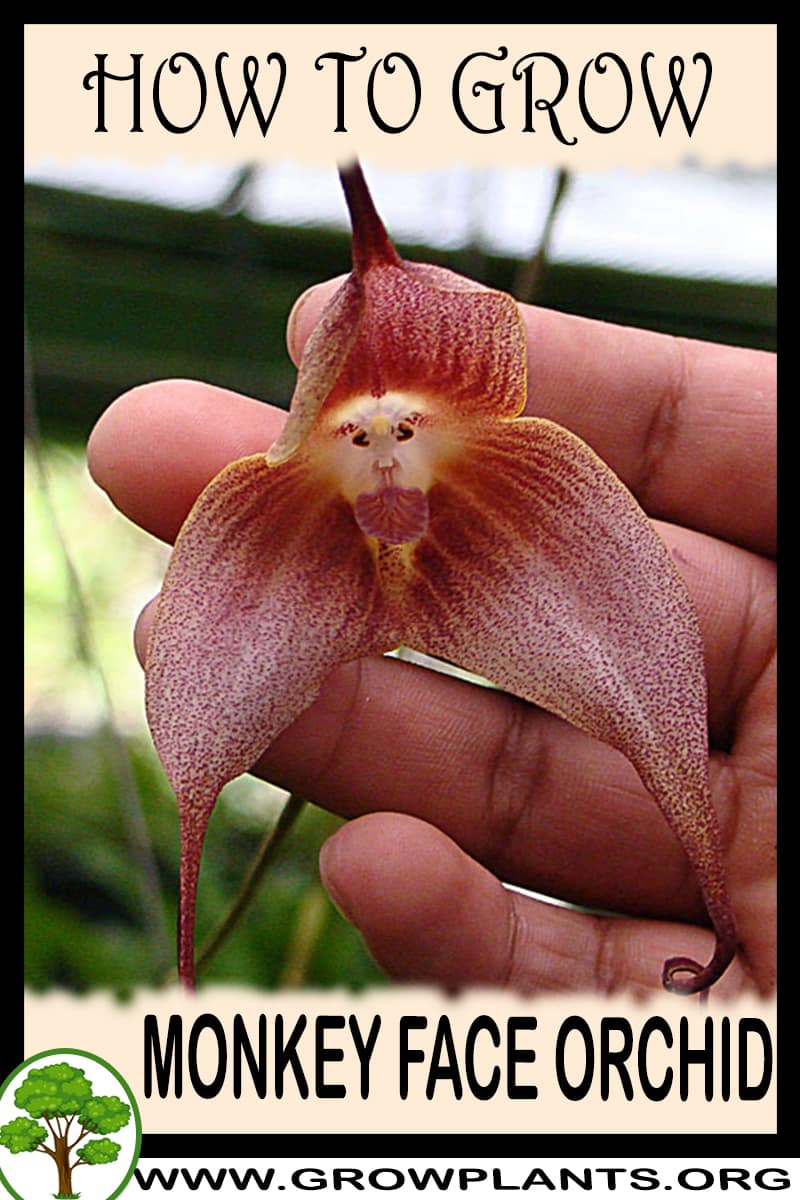
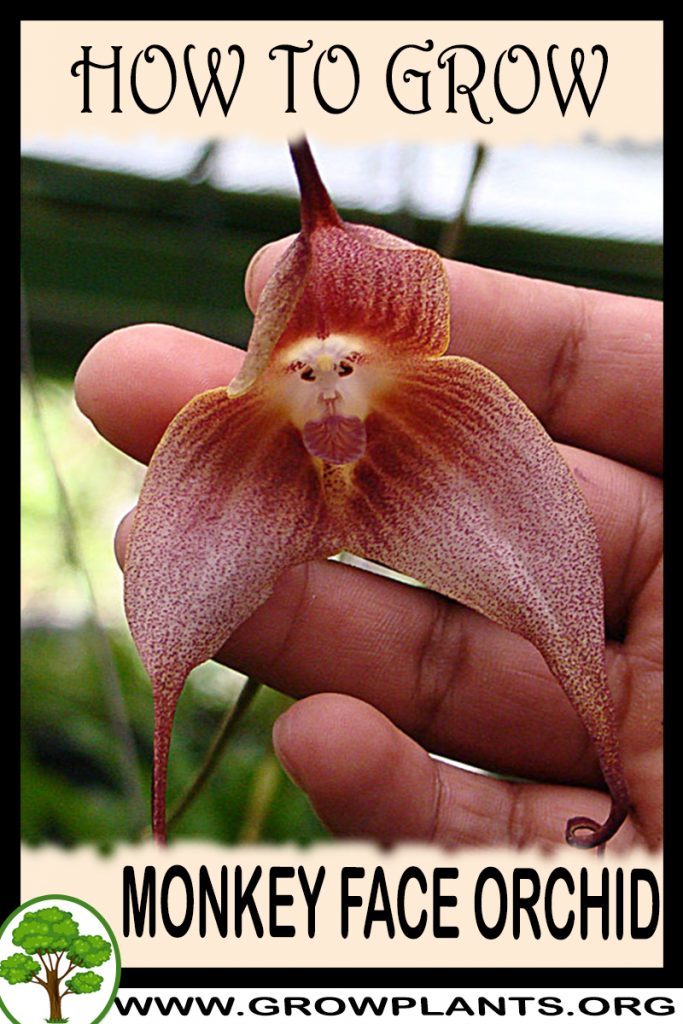
Overview: The monkey face orchid (Dracula simia) is a compact evergreen epiphytic orchid, 20–50 cm (8–20 in), grown as a specialist ornamental for flowers that resemble a monkey’s face. It is a cool-growing, high-humidity plant cultivated in open, hanging baskets.
Quick Specifications
| Specification | Attribute |
|---|---|
| Plant Type / Life Cycle | Perennial (evergreen epiphytic orchid) |
| Foliage Type | Evergreen |
| Mature Size | 20–50 cm (8–20 in) |
| Growth Rate | Moderate |
| Root System | Epiphytic – fleshy aerial roots from a short rhizome, no true soil roots |
| Hardiness | USDA zones 10–11 |
Growth Form & Structure
- Height & Spread: Reaches 20–50 cm; grown in hanging baskets with many side and bottom holes so the downward- and side-facing flowers can emerge.
- Growth Habit & Form: Clump-forming epiphyte with fleshy linear leaves and no pseudobulbs.
- Lifespan & Maturity: Long-lived perennial that can flower year-round in the right cool, humid conditions.
Anatomy & Physical Features
- Leaves & Foliage: Green, fleshy, linear leaves.
- Flower Characteristics: Flowers whose markings recall a monkey’s face, in many colours and often multi-coloured with stripes or spots.
Primary Uses & Landscape Value
- Functional & Ornamental Roles: Specialist collector’s orchid for cool greenhouses, terrariums and hanging baskets.
Care Guide: Planting, Soil & Watering
Overview: The Monkey face orchid (Dracula simia) is a cool-growing epiphytic orchid grown in an open, airy medium rather than ordinary soil. It needs cool temperatures, high humidity and steady moisture, and its pendent flowers are best displayed in a basket that lets them emerge from the sides and base.
Quick Care Requirements
| Requirement | Ideal Condition |
|---|---|
| Planting Season | Year-round, under controlled growing conditions |
| Growth Rate | Moderate |
| Soil Type | Not soil — an open, free-draining epiphyte medium of sphagnum moss with a little bark |
| Water Need | High — keep the medium evenly moist and maintain high humidity (65% and above) |
Planting & Establishment
- Best Planting Season: Repot or mount at any time of year while the plant is in active growth, ideally in cool conditions.
- How to Plant:
- Soil Amendments: Use loose sphagnum moss with a little bark for an open, moisture-retentive medium; skip ordinary potting soil and heavy, fertiliser-rich compost.
- Planting Depth: Set the crown at the surface of the moss so the growing point stays exposed and is not buried.
- Growth Speed & Expectations: Growth is moderate; with stable cool, humid conditions the plant produces new leaves and can flower through much of the year.
Soil, Watering & Drainage Care
- Soil Mix & Drainage Needs: The medium must stay open and free-draining — use a basket or pot with large openings so air reaches the roots and excess water drains freely, preventing rot.
- Watering Schedule & Technique:
- Young / Newly Planted: Keep the fresh medium evenly moist while new roots establish, misting to sustain humidity.
- Established: Water often enough that the moss never dries out, using clean, low-mineral water; pair generous watering with strong humidity and gentle air movement.
- Seasonal Adjustments: Keep conditions cool year-round and avoid hot, dry spells; water slightly less if growth slows in cooler, darker months.
Climate, Light & Hardiness
Monkey face orchid grows naturally in cool, very humid cloud-forest conditions and needs steady coolness rather than tropical heat to bloom well. It prefers deep, filtered shade and is only reliably hardy outdoors in mild, frost-free subtropical climates.
Quick Climate Specifications
| Factor | Detail |
|---|---|
| Climate Zones | Subtropical; cool, humid cloud-forest-type microclimate |
| USDA Hardiness Zones | 10–11 |
| Optimal Temp Range | Approximately 6–8°C (43–46°F) at night, around 20°C (68°F) by day, with no hot summer spike |
| Frost Tolerance | None |
| Light Conditions | Full shade with bright, filtered light |
| Wind Tolerance | Low |
Sunlight & Light Exposure
Optimal Light Setup
Bright, dappled shade similar to a cloud-forest understory; the fleshy leaves have no tolerance for direct sun.
Shade & Heat Management
Keep it consistently shaded and well ventilated; heat build-up around the plant is more of a threat than light levels are.
Best Exposure/Orientation
A north-facing window, shaded greenhouse bench, or deeply shaded, hanging position (the flowers emerge downward and to the sides) works well; avoid direct midday or afternoon sun.
Temperature Extremes & Hardiness
USDA Hardiness & Regional Limits
The site data places this orchid in hardiness zone 10–11, so it can only live outdoors year-round in warm, essentially frost-free climates.
Cold Damage & Winter Protection
No specific cold-damage threshold is established, but as a tropical cloud-forest epiphyte it has no meaningful frost tolerance; move it under cover or indoors if nights threaten to drop well below its preferred 6–8°C (43–46°F) range.
Frost Sensitivity
Frost sensitive; any frost or near-freezing exposure should be treated as damaging.
Extreme Heat Tolerance
Poor. It is notably intolerant of hot summer conditions – growth and flowering decline if daytime temperatures run consistently well above the roughly 20°C (68°F) it prefers.
Wind, Humidity & Microclimate
Humidity Preferences
Very high humidity is important, ideally 65% or more, reflecting its cloud-forest origin.
Dry-Air Tolerance
Poor; dry indoor or greenhouse air needs to be offset with misting, a humidity tray, or a humidifier.
Wind Tolerance
As a fine-rooted epiphyte grown in an open, well-ventilated pot, it benefits from gentle air movement but is not suited to strong or drying wind.
Rainfall & Seasonal Moisture
Adapted to consistently moist, humid conditions without a real dry season; avoid letting the growing area dry out for long periods.
Microclimate Recommendations
A cool, shaded, humid greenhouse or indoor growing space is ideal; in warm climates use evaporative cooling, shading, or siting away from heat-trapping surfaces to keep summer temperatures from climbing too high.
Growing in Pots, Balconies & Indoors
Monkey face orchid (Dracula simia) is a compact orchid (about 20-50 cm) and a genuine houseplant – the grower confirms it grows well indoors, and orchids are almost always grown in a pot rather than open ground. Give it bright, indirect light near a window and it makes a rewarding, long-flowering indoor plant. It also wants high humidity, so a bright bathroom, a humidity tray or regular misting helps.
Quick Details
- Container Size: A pot only about 20-40% larger than the root ball – orchids like to be snug
- Indoor Suitability: Yes – a true houseplant in bright, indirect light
- Best Spot: Shaded, cool light – never direct sun
- Soil & Drainage: Never ordinary potting soil – use a coarse, open orchid medium (bark or cork chips) with lots of drainage holes
- Watering in Pots: Keep the medium consistently moist and humid – don’t let it dry out fully; let excess drain away and never leave the pot standing in water
Indoors & On the Windowsill
- A true houseplant: The grower confirms it thrives indoors – keep it near a bright window but out of harsh, direct midday sun.
- Windowsill growing: An east or shaded-south window is ideal; a clear pot lets you watch the roots and see when to water. It also wants high humidity, so a bright bathroom, a humidity tray or regular misting helps.
- Overwintering: As a tropical plant it is happiest indoors year round in cool climates – keep it warm, bright and away from cold draughts and frost.
On a Balcony or Patio
- Summering outdoors: It can spend warm spells on a shaded, sheltered balcony or patio in bright but indirect light – protect it from direct sun, drying wind and any chill. It also wants high humidity, so a bright bathroom, a humidity tray or regular misting helps. Pots and open orchid media dry quickly, so check moisture often.
Choosing the Pot, Soil & Long-Term Care
- Pot & drainage: A snug pot with many holes; a transparent pot is useful for watching the roots. Never let it sit in standing water – the fastest route to rot.
- Medium: A coarse, free-draining orchid mix of bark or cork chips (some more terrestrial types appreciate a little added coir or humus), not garden soil.
- Feeding & water quality: Feed with a dilute orchid fertiliser a few times a year; where possible use rain or distilled water, which orchids prefer.
- Repotting: Refresh the medium about every two years – bark breaks down and loses structure over time – and pot on when roots fill the container.
Fertilizing & Feeding
A light feeder: this cool-growing orchid needs dilute, regular balanced feeding during active growth, then a genuine rest after flowering rather than being pushed to bloom continuously.
Quick Fertilizing Specs
| Feeding Level | Light feeder |
|---|---|
| Main Nutrient Priority | A dilute, balanced complete orchid fertilizer rather than a high-phosphorus bloom formula |
| Best Feeding Period | While new leaves and roots are actively developing in cool, humid conditions |
| Micronutrients | A complete orchid fertilizer generally covers routine needs; correct only a diagnosed deficiency |
| Reduce/Stop Feeding | Feeding is withheld for a period after flowering so the plant can recover rather than being pushed to bloom again right away |
Feeding by Growth Stage
Active leaf and root growth
Support the fleshy, linear leaves and fine roots this rhizomatous species produces between bloom cycles, under cool, consistently humid conditions.
| Nutrient direction | A dilute, nitrogen-leaning balanced fertilizer supports steady new growth and helps the plant rebuild strength for its next bloom. |
|---|---|
| Timing | Whenever new leaf or root growth is visibly underway, particularly in the period after a bloom cycle finishes. |
| Frequency | Regular light feedings suit this cool-growing species better than infrequent heavy ones. |
| Fertilizer types | A balanced, complete orchid fertilizer diluted well below label strength for regular container feeding, An occasional plain-water flush through the sphagnum and bark mix to prevent salt buildup |
| Routine trace nutrients | iron, manganese |
| Precautions | Flush the mix with plain water periodically to prevent salt buildup, since this species needs a generous amount of water and steady high humidity. |
Flowering
Support the distinctive monkey-face-patterned blooms while allowing the plant to flower on its own natural cycle.
| Nutrient direction | Keep to the same balanced fertilizer used during growth, with adequate potassium; a high-phosphorus ‘bloom booster’ is not needed and forcing repeated blooming can weaken the plant. |
|---|---|
| Timing | Whenever a flower is developing or open under good cool, humid conditions. |
| Frequency | Continue the same light, regular feeding used for growth through the bloom period. |
| Fertilizer types | A balanced, complete orchid fertilizer at the same dilute strength used during active growth |
| Routine trace nutrients | iron, manganese |
| Precautions | Avoid switching to a high-phosphorus ‘bloom booster’ product, and avoid any practice aimed at forcing continuous reblooming, which can seriously weaken this species. |
Recovery rest after flowering
Let the plant recover its strength after a bloom cycle rather than pushing it directly into another one, which this species tolerates poorly.
| Nutrient direction | None – withhold fertilizer for a short recovery period immediately after a flower fades. |
|---|---|
| Timing | Immediately after a flower has faded, before new active growth resumes. |
| Frequency | No feeding during this short recovery period. |
| Fertilizer types | No feeding at this stage; plain water only, maintaining humidity, until new active growth is visible. |
| Precautions | Resume light feeding once new leaf or root growth signals the plant has moved back into active growth. |
Nutrient Deficiency Signs & Corrections
New leaves emerge pale and undersized, and overall growth is noticeably slow even under otherwise good conditions.
| Possible causes | insufficient nitrogen during active growth, fertilizer diluted too far or applied too infrequently, fine roots reduced by a waterlogged or broken-down mix |
|---|---|
| Appears first on | newest leaves |
| What to check | feeding routine and dilution during active growth, drainage and condition of the sphagnum and bark mix, root health |
| Possible correction | Resume regular light feeding with a balanced fertilizer while growth is active, and refresh the mix if it has broken down. |
Flowers are weak or short-lived and the plant is slow to recover strength after a bloom cycle.
| Possible causes | insufficient potassium reaching the plant during growth ahead of bloom, fertilizer imbalance skewed heavily toward nitrogen, repeated blooming attempted without an adequate recovery rest |
|---|---|
| Appears first on | developing flowers and the leaves supporting them |
| What to check | balance of the fertilizer used during growth, whether adequate rest was allowed after the last bloom, overall feeding consistency |
| Possible correction | Use a balanced fertilizer with adequate potassium during growth and allow a proper recovery rest between bloom cycles rather than forcing continuous flowering. |
Leaf and root tips brown or blacken, which can be mistaken for this species’ general sensitivity to heat and low humidity.
| Possible causes | fertilizer salts accumulating in the mix from regular feeding without flushing, irrigation water high in dissolved minerals, a mix that stays too wet without adequate drainage |
|---|---|
| Appears first on | root tips and leaf tips |
| What to check | frequency of plain-water flushing between feedings, water source used for irrigation, drainage of the pot and open mix |
| Possible correction | Flush the mix thoroughly with plain water between feedings and confirm the pot drains freely given this species’ need for an open, humid root run. |
Pruning, Training & Seasonal Maintenance
Monkey face orchid (Dracula simia) shares its genus’s pleurothallid growth habit — no pseudobulb, single leaves from a creeping rhizome, and flowers that hang pendent below the foliage. Pruning tolerance is low. Its own care notes are somewhat more specific than the closely related Dracula orchid entry: they list dead leaves, roots and the bloom stem as routine cutting targets, on an all-year, opportunistic basis rather than a fixed season. That said, because Dracula-type peduncles can produce further flowers from the same growth over time, a spent-looking bloom stem is best left until it is fully dry rather than cut the moment its current flower fades, unless it is clearly finished.
Quick Pruning & Maintenance Specs
| Pruning Tolerance | Low – sanitary grooming plus considered bloom-stem removal |
| Primary Pruning Window | None fixed – opportunistic, whenever leaves, roots or a bloom stem are unmistakably finished |
| Typical Frequency | As needed, checked at each watering |
| Main Objective | Remove dead leaves, roots and fully spent bloom stems without losing a still-viable peduncle |
| Mature Plant Priority | Confirm a bloom stem is fully dry before cutting it, since it may still reflower |
| Best Tool Type | Small precision snips, disinfected |
| Avoid Heavy Pruning During | While a bloom stem is green, or while inducing repeat flowering — its own notes warn that forcing continuous bloom can weaken or kill the plant |
Pruning by Plant Age & Size
Newly Established
Remove only obviously dead or rotten tissue on a freshly potted or mounted division; leave the rhizome tip undisturbed.
Young / Formative
No structural training; the key early decision is culture, not cutting — an open basket or mount so pendent flowers can hang clear.
Mature / Established
Remove fully dead leaves and roots as part of routine grooming; remove a bloom stem only once it is entirely brown and dry, rather than as soon as flowering slows, since its own notes caution against over-inducing bloom (which can exhaust and even kill the plant) — restraint applies to both forcing new flowers and to cutting spent-looking ones prematurely.
Seasonal Pruning Schedule
| Ongoing Sanitary | Objective: keep the plant clean while protecting reflowering potential. Remove: fully dead leaves, dead/mushy roots, and bloom stems only once completely dry. Do not remove: any bloom stem that still shows green or firm tissue. Expected response: none for leaf/root removal; premature bloom-stem removal forfeits possible future flowers. Flowering impact: cutting a living peduncle too early is the main pruning-related risk to this plant’s flowering. |
Structural Pruning & Training
No branch or shape training. As with its genus-mate, the structural priority is an open, hanging basket or mount so the pendent flowers are not obstructed — pruning does not substitute for correct container choice.
Special Growth to Remove
Fully brown dead leaves cut at the base; dead or mushy roots trimmed at repotting; bloom stems removed at their base once entirely dried and clearly non-living.
Container & Small-Space Pruning
Grown in an open-bottomed basket or on a mount in sphagnum with a little bark, chosen specifically so downward-hanging flowers are not blocked. Root trimming at repotting removes only dead or mushy roots with a disinfected blade.
Tools
Precision snips only — every cut is a fine leaf, root or slender peduncle.
Tool Hygiene & Disease Risk
High-risk, as with all orchids — disinfect blades between cuts and between plants to avoid mechanically spreading orchid viruses.
Cut Placement & Technique
Cut dead leaves and roots flush at their base. Cut a bloom stem at its point of origin only once fully dry, rather than partway up or while any green remains.
Heavy Pruning & Rejuvenation
Not tolerated — there is no framework to cut back into. Its own notes are explicit that over-forcing bloom stresses the plant, which is the more likely cause of decline here than any lack of cutting.
Post-Pruning Care
No fertilizer push after grooming. Keep humidity and moisture steady, and avoid pushing the plant into continuous reflowering, since its own notes warn this can kill it — let it rest between bloom cycles rather than compensating with pruning or feeding.
Common Pruning Mistakes
Cutting a bloom stem as soon as its current flower fades rather than checking if it is still green; over-inducing repeat flowering instead of letting the plant rest; and growing it in a closed pot that traps the pendent flowers.
When NOT to Prune
Do not cut a bloom stem that still has green or firm tissue, and do not attempt to force additional bloom cycles back-to-back — its own care notes flag this as capable of killing the plant.
Recommended Tools (by task)
- precision_snips – the only tool needed, for dead-leaf, dead-root and fully-dried-bloom-stem removal.
- blade_disinfectant – routine between cuts and plants given orchid virus transmission risk.
Propagation Guide
Monkey face orchid (Dracula simia) is most practically propagated by dividing an established clump. Seed propagation is possible, but like other orchids it requires sterile flask culture and is a specialist method rather than a normal home-propagation technique. Note: genuine orchid seed is extremely fine, dust-like, and cannot realistically germinate outside sterile flask culture, so “orchid seeds” offered for ordinary home growing are very commonly mislabeled or fake.
Quick Propagation Specs
| Best Propagation Method | Division of established clumps |
| Alternative Method | Sterile flask culture from seed |
| Propagation Difficulty | Moderate by division; specialist by seed |
| Vegetative True-to-Type | Yes |
Division
Divide only a healthy, well-established plant with enough growth to support more than one viable section. Each division should retain a healthy portion of the rhizome, active growth and a functioning root system.
Potting Divisions
Replant divisions into an open, free-draining orchid medium and keep them in the cool, humid, bright-indirect conditions preferred by established Dracula plants while new roots develop.
Growing from Seed
Orchid seed is extremely small and lacks the stored food reserves found in many ordinary garden seeds. Reliable propagation therefore uses sterile asymbiotic flask culture or specialist laboratory techniques. This is substantially more difficult than dividing an established plant.
Note: Germination (in flask, under sterile culture) typically begins after at least 4 weeks, but full seedling development can take many months to over a year.
Bloom & Flower Guide
Quick Details
- Bloom Season: Possible year-round — but best not forced to bloom continuously, which weakens the plant
- Flower Appearance: Triangular, tailed flowers whose centre strikingly resembles a monkey’s face; black, purple, red, blue, pink, white, orange, yellow, brown or green, often patterned
- Edibility: Ornamental — grown for its flowers, not eaten (orchid foliage and flowers are generally non-toxic)
Detailed Blooming Overview
The Monkey Face Orchid is the flower that famously looks like a small monkey peering out. The grower notes the resemblance — which takes a little imagination to see — across a wide colour range, and wisely cautions that although the plant can flower at any time of year, it should not be pushed to bloom constantly, as that will exhaust and eventually kill it. As with other Dracula, the spikes often descend, so the plant is best in a basket.
Flower Characteristics
- Triangular, tailed flowers whose centre resembles a monkey’s face (grower’s description).
- Colours span black, purple, red, blue, pink, white, orange, yellow, brown and green, striped, spotted or plain.
- Spikes often grow downward, so the flowers hang below the plant.
Bloom Care & Thinning
- Do not over-force: As the grower stresses, let the plant rest between flowerings rather than driving it to bloom all the time.
- Growing for the flowers: Use an open basket so the descending spikes can emerge freely.
- Conditions: Keep it cool, shaded, very humid and airy, and remove spent blooms.
Bloom Health & Protection
- Botrytis petal blight can spot open flowers with small brown or translucent marks in cool, damp, still air — better ventilation and keeping water off the blooms is the first line of defence, with a fungicide only if it spreads.
- Aphids, scale and mealybugs are drawn to soft buds and flower spikes — wiping them off or treating with neem oil or insecticidal soap keeps the flowers clean.
- Bud blast (buds yellowing and dropping before they open) is usually a stress response to sudden changes in temperature, light or humidity, or to dry air — steady conditions while the plant is in spike prevent it.
Pests, Diseases & Troubleshooting
Dracula are cool-growing, high-humidity epiphytic orchids from cloud forests, and their health hinges on getting the environment right: constant cool temperatures, high humidity, and gentle but steady air movement. Pests are the usual orchid suspects — scale, mealybug, mites, thrips, and slugs — but the greater danger is rot and Botrytis, which take hold quickly if humidity is high without airflow, or if the plant is kept too warm and stagnant. Manage them culturally first: clean, buoyant, cool, moist air and scrupulous hygiene prevent far more trouble than any spray.
Quick Troubleshooting Overview
| Issue / Pest | Main Symptom | Primary Solution |
|---|---|---|
| Scale & mealybug | Brown bumps or white cottony tufts on leaves and pseudobulbs | Alcohol swab, insecticidal soap, horticultural oil |
| Spider mites | Fine stippling, silvering — a sign the plant is too warm/dry | Cool humid air, rinse foliage, horticultural oil |
| Thrips | Silvery scarring and black specks on leaves and buds | Blue sticky traps, insecticidal soap, spinosad |
| Slugs & snails | Chewed leaves, roots and flowers; slime trails at night | Hand-pick after dark, iron-phosphate bait, barriers |
| Black rot | Water-soaked black lesions spreading through leaves/crown | Cut out, drench with copper/phosphonate, dry the crown |
| Botrytis | Tan spots on flowers, fuzzy grey mould in damp still air | Improve airflow, remove blooms, lower leaf wetness |
Common Pests & Management
- Scale insects (Coccus / Diaspis / Boisduval scale):
- Symptoms: Brown or tan limpet bumps and, with Boisduval scale, white waxy clusters and cottony males on leaves, along the midrib, and on pseudobulbs and rhizomes; honeydew and sooty mould accompany soft scale. A serious, persistent orchid pest.
- Prevention & Control: Isolate the plant. Scrub visible scale off with a soft toothbrush and dab with alcohol, then smother with horticultural oil, repeating every 1–2 weeks to catch crawlers. Remove badly infested sheaths and old leaves where scale hides.
- Mealybugs (Pseudococcus / Planococcus spp.):
- Symptoms: White cottony tufts in leaf axils, under sheaths, on flower spikes, and among the roots; sticky honeydew and sooty mould follow. Hard to eradicate because they hide in crevices and the media.
- Prevention & Control: Dab colonies with an alcohol swab and treat with insecticidal soap or horticultural oil, repeating regularly. Check and, if needed, repot to inspect roots. Keep isolated until several treatments show it clean.
- Spider mites & false spider mites (Tetranychus / Brevipalpus spp.):
- Symptoms: Fine silvery stippling and a sunken, pitted, or silvered look to leaf undersides; a warning sign the plant is being grown too warm and too dry for a Dracula. Fine webbing in severe cases.
- Prevention & Control: First correct the environment — cooler, more humid, moving air suppresses mites naturally. Rinse the foliage and apply horticultural oil or a miticidal soap to leaf undersides, repeating to break the cycle.
- Thrips (Frankliniella / Thrips spp.):
- Symptoms: Silvery scarring and streaking on leaves, tiny black frass specks, and pitted, discoloured or deformed flowers and buds. Fast, slender insects that hide in sheaths and blooms.
- Prevention & Control: Use blue sticky traps to monitor. Remove infested blooms and old sheaths. Apply insecticidal soap or spinosad, treating buds and leaf undersides, and repeat to reach successive generations.
- Slugs & snails (Deroceras / Helix spp.):
- Symptoms: Ragged chewed holes in leaves, and grazed root tips and flowers; silvery slime trails betray them. Especially damaging to soft new growth and the pendent flower spikes Dracula send downward.
- Prevention & Control: Hand-pick after dark or set beer/board traps. Keep the growing area clean of debris and hiding spots. Use iron-phosphate bait or copper-tape barriers around benches; grit or diatomaceous earth deters movement.
- Aphids (Aphis / Myzus spp.):
- Symptoms: Clusters of soft green, black or brown insects on tender new growth, buds and flower spikes; sticky honeydew, sooty mould, and distorted buds follow. They can also transmit orchid viruses.
- Prevention & Control: Rinse them off with a gentle water spray and wipe growth clean. Apply insecticidal soap or horticultural oil to soft growth, and support natural predators. Remove badly infested spikes.
Diseases & Fungal Issues
- Black rot (Pythium ultimum / Phytophthora cactorum):
- Symptoms: Water-soaked, purplish-black rot that spreads rapidly through leaves and into the crown and roots, often after cool wet stagnant spells or water sitting in the crown; affected tissue is soft and blackened.
- Treatment & Management: Cut out all diseased tissue well into healthy green, using a sterile blade, and let the wound dry. Drench with a copper or phosphonate (phosphorous-acid) fungicide. Reduce crown wetness, improve airflow, and never let water pool in the growing point.
- Bacterial soft & brown rot (Erwinia (Pectobacterium) / Acidovorax spp.):
- Symptoms: Fast-spreading soft, water-soaked, translucent then brown lesions with a foul smell; tissue turns slimy and collapses, worst in warm, wet, stagnant conditions.
- Treatment & Management: Excise affected tissue into clean growth with a sterilised blade and discard it; dab cuts with cinnamon or a copper/bactericidal product. Dry the plant out, boost air movement, and avoid overhead watering and crown wetness.
- Botrytis (grey mould / petal blight) (Botrytis cinerea):
- Symptoms: Small tan-to-brown flecks and spots on the flowers that enlarge in cool, damp, still air; a fuzzy grey mould develops on decaying blooms and tissue.
- Treatment & Management: Increase air circulation and lower leaf/flower wetness — the key control for this cool-grower. Promptly remove spent and spotted flowers and any dead tissue. Apply a suitable fungicide only if it persists despite better airflow.
- Fungal leaf spots & anthracnose (Colletotrichum / Cercospora spp.):
- Symptoms: Round to irregular tan, brown or blackened spots, sometimes with yellow halos or concentric rings, often starting at leaf tips or wounds and worsening in wet, poorly ventilated conditions.
- Treatment & Management: Remove and destroy spotted leaves and improve ventilation. Keep foliage dry, avoid overhead watering late in the day, and apply a copper-based fungicide if spots continue to spread.
Growing Difficulties & Abiotic Problems
- Heat stress (signature issue for a cool-grower):
- Cause & Symptoms: Dracula are cool cloud-forest orchids; sustained warmth (much above the mid-20s°C) and warm nights cause limp, yellowing leaves, bud blast, failure to flower, and general decline, and predispose the plant to mites and rot.
- Correction Strategy: Keep them cool day and night with a real night-time drop; provide shade and evaporative cooling in warm spells. If your climate is hot, this species may simply not be viable without a cool, humid growing case.
- Low humidity & stagnant air:
- Cause & Symptoms: Too-dry air shrivels roots and browns leaf tips, while high humidity without air movement invites rot and Botrytis — the balance that makes these orchids demanding.
- Correction Strategy: Maintain consistently high humidity (around 70–90%) together with gentle, continuous air movement from a fan. Aim for buoyant, moving, moist air rather than still saturation.
- Crown & media rot from water sitting:
- Cause & Symptoms: Water lodging in the crown or old, decomposed, waterlogged media suffocates roots and starts rot; these orchids resent both drying out fully and staying sodden.
- Correction Strategy: Grow in fresh, open, moisture-retentive but airy media (fine bark/sphagnum in net pots or baskets, or mounted) and repot before the mix breaks down. Water to keep evenly moist, never soggy, and keep the crown dry.
- Water quality & salt sensitivity:
- Cause & Symptoms: Like many fine-rooted epiphytes, Dracula are sensitive to hard water and fertiliser salts, which brown root tips and leaf margins.
- Correction Strategy: Water with rainwater, RO, or distilled water, and feed at quarter to half strength, flushing regularly with plain water to leach salts.
What Helps – Products & Tools
For Dracula the emphasis is environmental control plus gentle products: horticultural / neem oil and insecticidal soap for scale, mealybug, mites, thrips and aphids; rubbing alcohol for spot-dabbing; blue sticky traps for thrips; iron-phosphate slug bait and copper-tape barriers for slugs and snails; a copper or phosphorous-acid (phosphonate) fungicide for black rot and leaf spots; and above all a fan for air movement plus rainwater/RO water to prevent rot and salt burn.
Frequently Asked Questions
How do you grow a monkey face orchid?
Grow it cool and humid rather than warm – it needs cool temperatures, high humidity and steady moisture. Use an open epiphyte medium of loose sphagnum moss with a little bark rather than ordinary potting soil, and set it in a hanging basket with many side and bottom holes so the downward-facing flowers can emerge freely. Give it deep, filtered shade rather than direct sun, and water often enough that the moss never dries out, using clean, low-mineral water, while always letting excess drain away rather than leaving the pot standing in water.
Can a monkey face orchid be grown as a houseplant indoors?
Yes – the grower confirms it grows well indoors, and orchids like this are almost always grown in a pot rather than open ground. Give it bright, indirect light near a window, and boost humidity with a bright bathroom, a humidity tray, or regular misting.
Should a monkey face orchid be kept flowering all year round?
No. Although the plant can flower at any time of year, it should not be pushed to bloom constantly, as that will exhaust and eventually kill it, so its own notes caution against over-inducing bloom (which can exhaust and even kill the plant) and instead call for a rest between bloom cycles.
What are the biggest health risks for a monkey face orchid?
The greater danger is rot and Botrytis, which take hold quickly if humidity is high without airflow, or if the plant is kept too warm and stagnant. Because Dracula are cool cloud-forest orchids, sustained warmth (much above the mid-20s°C) and warm nights cause limp, yellowing leaves, bud blast, failure to flower, and general decline, and predispose the plant to mites and rot.
How often should a monkey face orchid be repotted?
Refresh the medium about every two years, since the bark breaks down and loses structure over time, and pot the plant on when its roots fill the container.