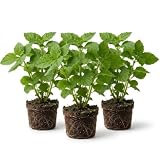
Patchouli, Pogostemon cablin, is a herbaceous perennial shrub best known for a scent almost everyone recognises and very few people have met on the living plant. It is not a difficult thing to grow — the honest answer to “is patchouli hard?” is no — but it is a plant with one clear demand, and everything else follows from it. Patchouli wants to stay moist. Get the water right and the rest of the plant looks after itself.
It stays modest in size at 0.5–1 m (20–40 inches), grows at a medium pace, and belongs in hardiness zone 10 and above, in tropical, subtropical or Mediterranean climates. It is evergreen where the winter allows, and its leaves are green, elliptic and serrated along the edge — the classic look of the mint family it belongs to.
Light, soil and water: the three things that matter
Give patchouli full sun to half shade, in moist, rich soil, with an average to big amount of water. That is the entire recipe, and the water half of it is the part that gets people into trouble, because patchouli sits at the wet end of the herb spectrum. Most aromatic herbs — rosemary, sage, thyme — want lean soil and dry feet. Patchouli wants the opposite: a rich soil that holds moisture, and enough water to keep it there. Treat it like a Mediterranean herb and it will sulk, wilt and stall.
Why the amount of water is not a fixed number
How much water your plant actually needs depends on the conditions you are growing it in, and it is worth understanding the variables rather than following a schedule:
- Sun exposure. A plant in full sun loses far more water through its leaves than the same plant in half shade, and needs correspondingly more.
- Soil type. Sandy soil requires more water, because it drains fast and holds very little between waterings. Rich, heavier soil holds moisture and stretches the interval.
- Wind. Wind dries out both the soil surface and the foliage, and an exposed, breezy position will need noticeably more watering than a sheltered one.
- Mulch. A mulch layer slows evaporation from the soil surface and is the simplest way to hold moisture around a plant that wants to stay moist — particularly useful in a hot, sunny spot.
Check the soil rather than the calendar. A plant in sandy soil, in full sun, in a wind may need water several times more often than one in rich, mulched, sheltered ground.
Starting patchouli: seed, cutting or plant
All three work, and for once there is no clear winner. You do not need to graft, and patchouli grown from seed is neither difficult nor especially slow — but nor does it have any advantage over a cutting. The choice comes down to what you can get hold of and what you want.
The one situation where the answer is definite: if you want a specific variety, start from a cutting or a plant. A named variety does not come true from seed, so vegetative propagation is the only way to reproduce it.
From seed
- Check that the seed is fresh. Old patchouli seed germinates poorly, and this is the single most common reason a sowing fails. If you are buying, buy from somewhere with turnover.
- Sow in spring. That is the ideal window, though depending on your climate you can sow through to summer or even autumn — the further into the season you go, the warmer your climate needs to be for the seedlings to make useful growth.
- Give full sun to half shade; half shade is the safer choice for seedlings in a hot climate.
- Keep the soil moist and the humidity up. Patchouli germinates in warmth and damp, and a seedbed that dries out between waterings will lose the lot.
- Water at the average amount while the seedlings are small, and increase as they grow.
From cuttings
Cuttings are straightforward: put the cut stem either into a glass of water or straight into moist soil and keep it there. This is a mint-family plant, and like most of its relatives it roots readily from a stem. Spring is the natural time to do it, alongside the rest of the planting season.
Planting out
The planting season runs across spring, summer and autumn. Spring is best; summer planting is possible but less advisable, because a new plant with a small root system in the heat of summer is being asked to keep up with a rate of water loss it cannot yet manage.
Growing patchouli indoors and in containers
Two answers here, and they are different. Containers: yes. Patchouli grows well in a planter or flowerpot, and given its modest final size that is a completely reasonable way to keep it — especially if you need to move it out of a cold winter.
Indoors: not really. Patchouli is not recommended as a houseplant. You can grow it on a windowsill in half shade and it will survive, but it is not a natural indoor plant — it wants more light and more humidity than a living room offers, and it will grow thin and disappointing in a dim corner. Think of a container patchouli as an outdoor plant that comes inside when it has to, not as a permanent houseplant.
Flowering: the timeline nobody warns you about
Patchouli does not flower in its first season, and this catches people out. The plant begins to produce flowers at around half a year old, but it does not reach full bloom until roughly a year and a half. If your young plant has not flowered, it is almost certainly not doing anything wrong — it is simply not old enough yet.
The season is autumn. The flowers are small, pink-purple, carried on spikes, and fragrant — and they are the reason to grow the plant beyond its leaves, since patchouli’s aromatic parts are the raw material for essential oil, perfume and soap.
Harvesting and using the leaves
The leaves are edible, which surprises people who only know patchouli as a fragrance. They are used for beverages, in salad, and cooked.
Harvesting runs all year round, and the method is refreshingly relaxed: once the plant is established, you can trim it freely. There is no need to ration yourself or work around a harvest window. As with most soft-stemmed aromatics, regular picking encourages the plant to branch and produce more leaf, so harvesting and shaping are effectively the same job.
For quality, cut the leaves when they are young and fully grown — that is, fully expanded but not yet old and tough. A leaf still enlarging has not developed its full character; an old leaf has coarsened. The window between the two is where the best flavour and aroma sit.
One caution that belongs with the harvest rather than buried in a warnings list: patchouli can cause skin problems. The same aromatic compounds that make it valuable can irritate sensitive skin on prolonged contact, and that is more likely during a heavy harvest or a long pruning session than during ordinary handling. If you know your skin reacts to aromatic plants, wear gloves when you are cutting a lot of it at once.
Pruning
Prune in autumn to winter, after flowering, and prune for design — shaping the plant and keeping it compact rather than any structural necessity. In practice, a patchouli you harvest leaves from regularly needs very little separate pruning; the two jobs merge.
Pests and diseases
Two problems to know about, and both connect back to the plant’s love of moisture:
- Nematodes. These are microscopic soil-dwelling roundworms that attack the roots. The damage is invisible from above until the plant starts to stunt, yellow and wilt in warm weather despite adequate water — a plant that wilts when the soil is clearly moist is the classic sign that the problem is underground. Because they live in the soil, growing in a container with fresh potting soil sidesteps the issue entirely, and rotating where you plant helps in the ground.
- Fungal disease. The predictable risk for a plant that wants moist soil and high humidity. Fungal problems thrive in exactly those conditions, especially where air movement is poor. The defence is not to water less — patchouli genuinely needs the water — but to give the plant space and air: adequate spacing, water the soil rather than soaking the foliage where you can, and keep the plant open by regular harvesting rather than letting it become a dense, damp thicket.
Before you buy
- It needs a warm climate — zone 10 and above, tropical, subtropical or Mediterranean.
- It needs moist, rich soil and average to plenty of water. Do not treat it like a dry-garden herb.
- Full sun to half shade.
- Final size is only 0.5–1 m (20–40 inches) — it fits in a pot or a small bed.
- Seed, cutting or plant all work; buy a plant or cutting if the variety matters, and check the date on the seed.
- Expect flowers from about six months, and a full display at around eighteen.
For the full plant profile see our Patchouli plant growing page.
See also: rooting hormone for cuttings
See also: using rooting hormone