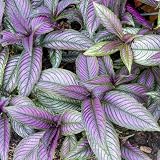
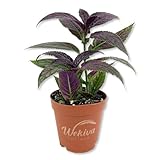
Persian shield is grown for one thing: the leaves. Strobilanthes dyerianus is a shrub with elliptic foliage in iridescent purple, striped and shot through with green and blue, and the entire point of caring for it well is to keep that colour saturated. Nothing about the plant is difficult — it needs no grafting, no specialist compost and no complicated feeding — but it is a sensitive plant in the sense that it tells you immediately, through the leaves, when a condition is wrong.
Is Persian Shield a Perennial or an Annual?
Botanically it is a perennial evergreen shrub. Whether it behaves like one in your garden depends entirely on your winter.
- Zone 11 and above: a true perennial, in the ground, year after year.
- Zone 10b: perennial with the right overwintering care.
- Zones 4–10a: grown as an annual outdoors — planted in spring, enjoyed through the season, and either discarded or brought in.
- Indoors anywhere: it grows very happily as a houseplant, which is how most gardeners in cold climates keep the same plant going for years.
This is why the propagation question matters so much. If you are treating it as an annual, you cannot rely on seed you saved from a plant that never got the chance to flower and ripen it — you start from a cutting or from a bought plant each year, or you take cuttings in late summer and overwinter those small plants on a windowsill instead of trying to keep a large specimen alive.
Why the Colour Fades — the Two Conditions That Control It
Two environmental factors govern how good the foliage looks, and both are easy to get wrong.
Temperature
Below about 20 °C (68 °F) the colour looks noticeably less good. A plant sitting in a cool room or a chilly spring garden is not dying — it is simply not producing its best pigment, and it will dull towards green. If your Persian shield has gone flat and disappointing, check the temperature before you change anything else.
Humidity
Humidity affects colour too, and it does something more visible: when the air is dry, the leaves turn brown. Brown edges and brown patches on Persian shield are an air-moisture problem far more often than a watering problem. Indoors in winter, next to a radiator or an air-conditioning outlet, is the classic place for this to happen. Group it with other plants, stand it on a wet pebble tray, or move it out of the dry airstream. Watering harder will not fix dry air — it will only give you soggy roots on top of brown leaves.
Light, Water and Soil
Light
Persian shield is unusually flexible: it grows in full sun, half shade or full shade — but not full sun in hot climates, where the leaves scorch. The practical rule is that the hotter and brighter your region, the more shade it wants. In a hot climate put it in half or full shade; in a mild one it will take direct sun and colour up well. Indoors it does fine in the softer light of a room.
Water
It survives on a small amount of water but clearly prefers more — average to generous is where it looks best, in consistently moist (not waterlogged) soil. The right amount depends on everything around it: wind, sun, temperature, soil, and whether it is indoors or out. That last one is the trap. Indoors it needs less water than outdoors, because there is no wind and no sun load, so evaporation is a fraction of what it is in the garden. Over-watering an indoor Persian shield on an outdoor schedule is the single most common way to lose one.
Soil
Give it rich soil with plenty of organic matter. Feed lightly rather than heavily — a little fertiliser goes a long way on a plant this size.
How to Plant It
Planting season is spring in zones 4–10b, spring to summer in zone 11, and all year in zone 12 and above. Indoors you can plant from spring through autumn, though even an indoor plant is still influenced by outdoor temperatures through the window and the room.
- Dig a hole as deep as the current root ball plus an extra 100–200%.
- Put organic matter, humus and dried leaves into the hole and mix them thoroughly with the excavated soil. You are building a zone of loose, rich soil the roots can move straight into.
- Backfill until the hole is reduced to the size of the root ball.
- Set the plant in and gently loosen the outside of the root ball before covering it. A pot-bound root ball that is never teased apart tends to keep circling instead of spreading outwards.
- Cover with soil but do not press hard — compacted soil restricts both air and drainage.
- Add humus on top and finish with mulch to hold moisture in the soil.
- Water in, then water every day for the next two weeks while the plant establishes.
Growing in Containers and Indoors
At 0.3–1 m (12–40 in) and a medium growth rate, Persian shield is a small plant and containers suit it perfectly. A pot also solves the annual problem in cold zones: you grow it outside for the season, then lift the whole container indoors before cold weather rather than starting again each spring. Just remember to cut back the watering once it comes inside, and keep it away from dry heat sources so the leaves do not brown.
Propagation: Cuttings Beat Seed
Both routes work, but they are not equivalent. Cuttings are the best way to propagate Persian shield because they guarantee the leaf colour you are looking at. Seedlings vary, and colour on this plant ranges from deep purple through to green with every mixture in between — the purple may sit on the inner part of the leaf or the outer. If you have a plant whose colouring you like, a cutting reproduces it exactly; a seed is a lottery.
Taking cuttings
Cuttings want warmth, humidity and shade — at least 25 °C (77 °F), high humidity, and almost full shade. Shade matters because an unrooted cutting cannot replace the water its leaves lose in sun. Two methods:
- In water: stand the cutting in water and change the water every few days — stale water goes low in oxygen and the cut end rots before it roots.
- In soil: use peat-based compost with a root growth hormone and keep the soil moist throughout.
From seed
Seed is easy enough if you want to try it. Make holes about 0.5 cm deep, cover with soil but do not press it down, keep the soil moist, and place the pot in half shade. Sow in spring.
Flowers, Pruning and Pests
Persian shield flowers from spring into summer: purple, cone-shaped and slightly trumpet-like, carried on a spike. They are a pleasant bonus rather than the reason to grow the plant — and if you are growing it for foliage and do not need seed, cut the flower stems off so the plant puts its energy into leaves instead.
Pruning is minimal: once a year, and purely for shape. You can prune at any time of year. Cutting back stems that have grown leggy encourages branching lower down, which is what keeps the plant looking full rather than thin and stretched.
Watch for moth caterpillars, aphids and mealybug. Those vivid purple leaves are, unhelpfully, very attractive to insects, so inspect new growth regularly — especially leaf undersides and the joints where mealybug hides. Catching an infestation while it is a few insects is the whole game on a plant grown for perfect foliage.
For the full plant profile see our Persian shield plant growing page.
See also: rooting hormone for cuttings
See also: best rooting hormone
For the general techniques behind this (cuttings, division, layering, grafting), see our plant propagation methods guide.