
Carnations have a reputation as a florist’s flower rather than a gardener’s, which does them a disservice. Dianthus caryophyllus – the clove carnation – is easy to raise from seed, easy to root from a cutting, and will flower for months if you handle it correctly. The two things worth understanding before you start are how long the bloom actually lasts and what you can do to extend it, and how differently the plant behaves depending on how cold your winters are.
When do carnations bloom, and in what colours?
Carnations bloom from summer into autumn. That is a long window compared with most herbaceous flowers, and it is the main reason to give them a place in a bed rather than only in a vase.
The colour range is unusually wide:
- Purple
- Magenta
- White
- Red
- Lilac
- Pink
- Yellow
Many cultivars also carry a picotee edge – the border of each petal marked out in a stronger shade of the same colour, or a contrasting one. It is a distinctive detail, and it is what makes carnations read as ornate even at a distance.
 2,600 Chabaud Mix Clove Carnation Flower Seeds, Dianthus Caryophyllus
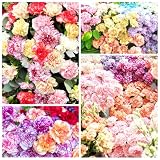 Mix Carnation Seeds for Planting - 3000+ Dianthus Caryophyllus Seeds, Perennial Chabaud Flower Mix,
To start carnations from seed rather than cuttings, these are worth a look: As an Amazon Associate we earn from qualifying purchases.
The flower form is as recognisable as the colour: double or multi-petalled blooms with jagged, fringed petal edges, carried above narrow grey-green elliptic leaves. The foliage is worth mentioning on its own – that cool grey-green tone is a good foil for hot colours in a border, and because carnations are evergreen in mild climates the leaves earn their space outside the flowering season too.
How to keep them blooming longer
A carnation’s flowering season is not fixed; it responds to what you do. Three things extend it:
- Deadhead immediately. Cut the flower stem as soon as a bloom dies, without waiting for a tidy-up session. A plant allowed to set seed reads that as a job done and slows its flower production.
- Feed in spring, before flowering starts. Fertiliser applied once the plant is already in full bloom is late; the buds were determined earlier. Spring feeding is what builds a heavy display.
- Keep the soil moist through the bloom season. Carnations want an average to generous amount of water, and moisture matters most while the plant is carrying flowers. Mulch to hold it in.
Growing carnations from seed
Carnations are not difficult from seed, which makes them one of the better options for filling a border cheaply. The requirements are modest and specific.
Sowing conditions
- Soil: moist, well-drained, and clean. Clean matters – carnation seedlings are vulnerable to damping-off in soil that carries fungal problems, so start in fresh medium rather than recycled potting mix.
- Light: full sun.
- Depth: 0.5 cm. This is shallow, and it is the number people most often get wrong. Buried deeper, the seed exhausts its reserves before the shoot reaches daylight.
When to sow
Sow in spring. In a warm climate you can also sow in autumn, which gives the seedlings a mild season to establish in and brings the first flowers forward.
Step by step
- Fill trays or pots with clean, well-drained seed compost and moisten it before sowing.
- Sow the seed and cover with just 0.5 cm of soil.
- Place in full sun.
- Keep the surface consistently moist but never waterlogged – water sitting on the surface is what invites damping-off.
- Grow the seedlings on until they are sturdy, then plant out.
The one thing seed will not give you is certainty about colour. If you want a specific shade, take a cutting from a plant you have seen flowering instead.
Propagating carnations from cuttings
Cuttings are easy and they guarantee the colour, because a rooted cutting is a clone of its parent. Vegetative propagation is not necessary – seed works fine – but it is the method to choose when you want more of a particular plant.
Choosing the material
Take a stem that has not flowered and carries no buds. This is the single most important choice. A stem in flower or in bud is directing its resources into that flower; a vegetative shoot puts them into roots, which is precisely what you need.
Conditions
- Temperature above 20–25 °C (68–77 °F), and the water must not be cold. Cold water on a cutting stalls root initiation.
- High humidity, since the cutting has no roots and cannot replace what its leaves lose.
- Half shade rather than full sun – direct sun on an unrooted cutting is simply a water demand it cannot meet.
Rooting in water
Stand the stem in water and change the water every few days. Stale water goes low in oxygen and high in bacteria, and a cutting that has begun to root will rot rather than continue.
Rooting in soil
Use peat-based, moist soil and a rooting hormone. Water with a spray rather than a can – misting keeps the soil surface and the leaves damp without dislodging the cutting or flooding a stem that has no roots to drink with. Keeping the humidity high, by covering the pot, does most of the work.
Rooting a carnation from a bought bouquet
You can propagate from a florist’s carnation, and it is worth knowing the extra steps, because bouquet stems are not the same as garden material.
- Cut the stem from the bottom to give a fresh surface.
- Cut off the flowers, and prevent any remaining buds from opening. Every bloom you leave is energy the stem spends on flowering instead of rooting.
- Clean the stem thoroughly. Cut flowers are very often treated with floral preservative, and that residue sits on and in the stem base. Cleaning it off first is the step people skip, and it is why bouquet cuttings so often fail.
- Change the water daily and wash the container out every few days – a much stricter routine than for a garden cutting, since the stem has already been standing in treated water.
- Once the stem is clean, move it into soil: peat-based, kept moist, with rooting hormone on the cut end.
Soil, planting and site
Carnations want slightly alkaline, well-drained soil – an unusual preference among garden flowers, most of which are happier slightly acid. If your ground is naturally acid, this is worth correcting rather than ignoring, because a carnation on the wrong side of neutral will look permanently unimpressed. Keep the soil moist through flowering and use a mulch.
How to plant
- Dig a hole rather larger than the root ball.
- Work in organic matter, chopped dead leaves and humus.
- Set the plant in and cover it lightly – carnations do not want to be planted deep or firmed down hard.
- Water every day for the first weeks, until the plant has clearly established.
When to plant
Plant in spring if you are growing carnations as annuals. If you are in hardiness zone 10b to 11 and treating them as perennials, you can plant at almost any point in the year, though winter is best avoided.
Sun, shade and climate – including the zone question
Carnations are full-sun plants that will also grow in half shade, but which of those you should choose depends entirely on where you garden:
- In a cool climate, plant in full sun. In shade the plant will flower noticeably less, and the whole point is the flowers.
- In a hot climate, half shade actually suits them better, and they grow well in it.
The perennial-or-annual question follows the same logic. In zones 10b to 11, a carnation is a perennial evergreen that persists year after year. In zones 3 to 9 it is grown as an annual – winter ends it, and you sow again in spring. Neither is wrong; they are simply two different ways of using the same plant, and knowing which one applies to you prevents the disappointment of waiting through spring for a plant that is not coming back.
Expect a plant 20–60 cm (8–24 in) tall, growing at a fast to medium rate – quick enough that a spring sowing genuinely flowers the same summer.
Pruning and deadheading
There are two separate jobs here, and conflating them costs you flowers.
- Deadheading happens continuously, immediately after each flower dies. Cut the flower stem back. This is what keeps the display going.
- Pruning proper is an autumn to winter job on plants you are overwintering – tidying the shape and cutting back spent growth once the season is over.
Growing carnations in pots
Carnations grow well in containers, and their modest size makes them a natural fit for a pot or window box. What does not work is growing them indoors – they are not houseplants. They need real sun, and an indoor windowsill will give you a lanky plant with few flowers. Keep pots outside, use a free-draining mix on the alkaline side, and water more attentively than you would in the ground, since a container dries fast during the flowering season when the plant’s demand is highest.
Pests, diseases and one safety warning
- Rust – orange-brown pustules on leaves and stems. It thrives where air movement is poor and foliage stays wet, so space plants properly and water the soil rather than the leaves.
- Gall – abnormal swellings on stems or at the base of the plant. Affected material is best removed.
- Aphids – cluster on soft new shoots and flower buds, distorting the bloom before it even opens.
- Mealybugs – small, white and waxy, tucked into leaf joints and the crown of the plant, where they are easy to miss until numbers are high.
One thing to know before planting: carnations are toxic to dogs. If you have a dog that chews plants, site them accordingly or choose something else for that part of the garden.
For the full plant profile see our Carnation plant growing page.
See also: rooting hormone for cuttings
See also: best rooting hormone


