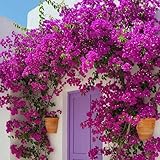
Bougainvillea is the plant people fall for on holiday and then struggle with at home – usually because they treat it like a flowering shrub that wants feeding and watering. It does not. It is a vigorous, thorny, drought-loving climber that colours up best when it is hot, dry and cut back hard once a year. Get those instincts the right way round and it is close to unstoppable.
Bougainvillea flowers: the colour is not the flower
The first thing to understand is that the colour everyone photographs is not petals. The actual bougainvillea flower is small and white to yellowish, tucked in the centre of each cluster. The dramatic coloured sheets around it are bracts – modified leaves, arranged in threes around the true flowers.
That distinction is practical, not pedantic. Bracts are leaf tissue, so they last far longer than a petal would, which is why a bougainvillea can look as though it has been in flower for months. It has: the tiny real flowers come and go while the bracts hold their colour.
The colour range
Bracts come in white, purple, pink, red, purplish, light orange and yellow, with an enormous number of hues in between – this is one of the most variable ornamental plants in cultivation for colour. Some cultivars carry more than one colour on the same plant, such as white and pink together.
If a multicoloured plant is what you want, note how it is produced: seed will not give it to you reliably, and the recommended route is grafting – putting two or more cultivars onto one plant so it flowers in several colours at once.
When bougainvillea blooms
Bougainvillea can bloom most of the year, with the main flush in spring and summer. The length of that season is dictated by climate: the hotter the climate, the better it blooms and the longer the display lasts. Combined with dry weather, heat is the trigger. A bougainvillea in a cool, damp summer produces leaves; the same plant in heat and drought produces bracts. This is why the standard advice for a green, flowerless bougainvillea is to give it more sun and less water, not more fertiliser.
Bougainvillea ‘Raspberry Ice’: what it actually is
‘Raspberry Ice’ is a variegated selection of Bougainvillea brasiliensis. Its leaves are green with white to cream margins, and its bracts are magenta to purple. The pairing is what makes it popular – the variegated foliage is decorative in its own right, so the plant is worth looking at even between flushes, which is not true of a plain green bougainvillea.
Its requirements are slightly more particular than the genus average:
- Frost free, or no more than light frost. This is the limiting factor.
- Full sun. Variegated leaves have less green tissue to work with, so shade costs them more than it costs a plain-leaved plant – and shade also costs you bracts.
- Well-drained soil, slightly acidic.
- A small amount of water. Less than you think, and less than most garden shrubs.
Caring for ‘Raspberry Ice’
Day to day, care is mostly pruning. Once it is established in a sunny, well-drained spot with light watering, this plant does not need much attention – but it does need cutting, because an unpruned bougainvillea turns into a bare-stemmed tangle with all its colour on the outside and nothing behind it.
Pruning can be done at any time of year, but the best time is before winter – the end of autumn into the start of winter, after the blooming season. Cut:
- Inner branches. After a few years the interior of the plant stops receiving sun and those stems atrophy. Opening the plant up so light reaches inside each branch is the difference between a shrub with substance and a shell of growth over dead wood.
- Dead branches, wherever they are.
- The outer foliage, all of it, when you want renewed growth. This is the hard renewal cut, and it looks brutal – but bougainvillea is an aggressive grower and responds by rebuilding from the inside out.
‘Raspberry Ice’ can be grown in a flowerpot, which is the usual solution in a climate where winter frost is a real risk: a potted plant can be moved to shelter. A container also restricts the roots, and a slightly restricted, slightly dry bougainvillea is a well-flowering bougainvillea.
Is the variegated form harder to grow?
A fair question, because variegated forms of many plants are weaker. With variegated ‘Raspberry Ice’ the answer is essentially no: there are no growing difficulties that the non-variegated plant does not also have. Some growers consider it slightly less strong than the plain-leaved form, and there is a botanical logic to that – white tissue does no photosynthesis, so a variegated plant has less leaf area doing the work. In practice it means giving it full sun and not much else.
The same goes for pests. It can get aphids, leaf miner and moths, like any bougainvillea, but in practice pests mostly have little effect on it. It is a strong plant. If a variegated ‘Raspberry Ice’ is struggling, look at frost, drainage and shade long before you look for insects.
Climate and cold tolerance
Bougainvillea grows in Mediterranean, subtropical and tropical climates and belongs in hardiness zone 10 and above, where winter lows stop around −1 °C (30 °F). With the right care it can be grown in zone 9, roughly −7 °C (20 °F).
A frost-free site is better, but bougainvillea can survive frost – the plant may be knocked back and lose its leaves, then rebuild. The tools for pushing it into zone 9 are simple: mulch the plant over winter, particularly in zones 9 to 10a, to protect the root zone, and keep it dry, since cold plus waterlogged soil is a far more reliable killer than cold alone.
When and how to plant bougainvillea
The best planting season is spring, though in the right climate it can be planted all year. By zone:
- Zone 9 – spring and summer.
- Zone 10 – spring to summer.
- Zone 11 – spring to autumn.
- Zone 12 – any time of year.
The point of the warmer-season planting is to give the plant the whole hot period to root out before it meets its first cold or wet spell.
- Dig a hole as deep as the root ball, plus another 60–110% in width and depth, so the roots have loosened soil to move into.
- Mix organic matter, humus and dried leaves with some of the excavated soil and put it into the hole.
- Loosen the outside of the root ball slightly above the hole, so the roots grow outward instead of circling.
- Set the plant and backfill, firming the soil moderately. Too hard compacts out the air; too loose and the plant will not be stable.
- Mulch to keep moisture in the soil.
- Water in, then water every day for two weeks, preferably in the morning.
- Stake it with a bamboo cane or stick if it is not stable – a top-heavy young bougainvillea blown about in the wind cannot root properly.
The daily fortnight of watering is a one-off establishment measure, not the plant’s ongoing regime. After that, bougainvillea wants dry conditions.
Ongoing care: water, feeding and support
Two things will spoil a bougainvillea faster than neglect: too much water and poor drainage. Well-drained soil is essential, and the plant can die in flooding. In wet ground or a badly drained pot, the roots go first and the collapse is often mistaken for disease.
Feed 2 to 4 times a year – enough to keep growth going, not so much that you get a wall of leaf at the expense of bracts.
Most bougainvilleas need trellising. Despite the climber label, the plant has no twining stems or tendrils: it scrambles, hooking itself along with its thorns. It cannot climb a wall unaided, so it needs wires, a trellis or a frame, and stems tied in where you want them. Decide the shape early – bougainvillea is grown as a shrub, a small tree, a climber, a hedge, a topiary subject and even as bonsai, and the training you do in the first two years determines which of those you end up with.
Pruning, in full
Bougainvillea pruning has three distinct purposes, and it helps to know which one you are doing.
Health and structure
Prune at the end of autumn to the start of winter, after blooming, ideally once a year. Take out dead branches and open up the interior. The reason inner branches matter so much is specific to this plant: as it thickens, the inside is shaded out, those stems atrophy, and the plant becomes a hollow shell of live growth over dead wood. Opening each branch so light gets in keeps the whole framework alive.
Renewal
When a plant has become leggy and tired, prune all the outer foliage to force renewed growth. Doing this after flowering, going into winter, costs you the least display.
Shape
Trimming is what creates topiary and bonsai forms. For a hedge, prune once a year – that annual cut is what keeps the hedge dense rather than open and woody at the base.
Propagating bougainvillea
You can start bougainvillea from a plant, a seedling, seed – which is very easy – or vegetatively. Cuttings and layering are the routes that reproduce a named cultivar exactly, and grafting is the route to a multicoloured plant.
Cuttings
Cuttings can be rooted in water, changing the water every day, but they do better in soil, and better again with rooting hormone. Either way, the conditions decide the outcome: take cuttings in the warm season, keep humidity high, and root them in half shade. A cutting has no roots to replace lost water, so full sun and dry air will kill it before it can root – which is the exact opposite of what the mature plant wants.
Layering
The simplest method of all: bend a stem down onto the soil and cover it. It roots while still attached to and fed by the parent plant, then you sever it. For a plant that produces long, flexible stems anyway, this is close to foolproof.
Problems, pests and thorns
- Aphids – on soft new growth, which is also where the next flush of bracts is forming.
- Leaf miner – the pale winding tunnels inside the leaf. Unsightly rather than fatal on a plant this vigorous; remove badly affected leaves.
- Moths – caterpillars chewing foliage, sometimes rolling leaves together.
- Flooding – the most lethal problem. Bougainvillea can die outright in waterlogged soil.
- Aggressive growth – it is a vicious grower, and in a small garden the annual prune is not optional. Planted against a wall or a neighbour’s fence with no plan for cutting it, it becomes a serious job within a few years.
- Thorns – most bougainvilleas are armed, though some cultivars have no thorns. If you are training one over a doorway, a path or anywhere children pass, either choose a thornless cultivar or place it where nobody has to push past it. Wear thick gloves and long sleeves when pruning.
For the full plant profile see our Bougainvillea plant growing page.
See also: rooting hormone for cuttings
See also: using rooting hormone
See also: growing bougainvillea in pots · bougainvillea colours
Related guides
Why bougainvillea won’t bloom (and how to fix it)
A bougainvillea that grows lush and green but won’t flower is almost always too comfortable. To push blooms: give it at least 5 hours of direct sun; keep it slightly dry — overwatering produces leafy growth and few flowers; and go easy on nitrogen — feed with a phosphorus- and potassium-rich feed in spring and summer, adding nitrogen only if leaves pale. Because bougainvillea flowers on new growth, prune after each flush rather than during it. Handle roots gently at planting — they are fragile and root disturbance is a common cause of a plant that sulks and refuses to bloom. In cold areas grow it in a pot so it can move inside before frost.
Not sure which pruning approach applies? See our guide to choosing the right pruning method.