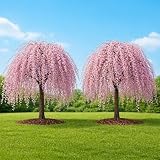
A weeping mulberry is a tree of the genus Morus, sold as Morus pendula, whose branches arch over and hang down instead of reaching up. That single trait changes almost everything about how you handle it. An ordinary mulberry mostly grows itself; a weeping mulberry has to be built, because the shape you buy it for is a shape it cannot produce on its own once the leader has stopped going up.
It is a deciduous perennial for temperate and Mediterranean climates, hardy in zones 5–10, reaching 3–5 m (10–15 ft), fast to medium in growth, and grown as much for its silhouette as for its fruit.
The one decision that determines everything: fruit or no fruit
Weeping mulberry carries male and female flowers on separate trees. The flowers themselves are small and white, joined together into little cone-shaped clusters, and they open in spring, pollinated by bees and flies. Only a female tree with a male nearby will fruit.
This matters because mulberry fruit is genuinely messy. The listed problems with the tree are not disease or difficulty — they are that the fruit makes a lot of dirt and attracts a lot of insects. Ripe mulberries drop, stain paving and are trodden indoors. So decide up front what you actually want:
- Ornamental only — choose a sterile cultivar or a male tree. Far less mess and far less work, and you keep the whole point of the plant, which is the weeping form.
- Fruit — you need a female and a male in the same area, and you accept the cleanup.
- Both — possible, but site the tree where dropped fruit lands on soil or lawn, never over a patio, a path or a parking space.
This also answers the reverse question. If a weeping mulberry never fruits, the usual explanations are that it is a sterile ornamental cultivar propagated by cutting or graft, or simply that it is male. Occasionally — and this is rare — it is a female with no male anywhere near enough to pollinate it.
How to prune a weeping mulberry into shape
This is the part people get wrong, and the mistake is usually kindness: letting a young tree do as it likes. A weeping mulberry weeps from a fixed head, so the height of that head is set once, early, and you live with it for the life of the tree.
- While the tree is young, let it grow upward and keep removing the side branches. Every side shoot you leave steals energy from the leader and starts a weeping curtain at the wrong height. You want a single clean stem climbing.
- When the stem reaches the height you want, prune off all the branches from the sides.
- Then prune the top. Cutting the leader stops upward extension and forces the tree to break out below the cut — and those new shoots are the ones that arch over and begin weeping. This is the moment the tree becomes what you bought it for.
- From then on, prune to maintain. Take out all the small, weak and dead branches, and thin the inner ones so the structure stays open.
Choose that final height deliberately. Keeping the tree short is recommended, and the reason is practical: a short weeping mulberry with a big crop is manageable, while a tall one leaves the fruit above your reach and the mess below it.
Pruning season
The main pruning season is the end of autumn and the start of winter — in practice, once the leaves have dropped and the whole branch structure is visible. Diseased or infested branches are the exception: cut those out the moment you find them, at any time of year, because leaving them is how the problem spreads.
Renewal and ongoing care
Care requirements are low overall. Beyond dead and inner branches, the useful trick for an old, congested or tired tree is a renewal cut: prune off all the outer foliage. The tree responds with fresh growth from inside the framework and rebuilds a denser, better-shaped curtain. A neglected weeping mulberry ends up as a thin shell of long tangled shoots with dead wood inside, and renewal is the way back from that.
Water, light and site
Water needs are small for most of the year — this is a tough tree, and overwatering serves it no better than drought. The exception is the fruiting season, when you should add irrigation. Fruit swelling is a water-driven process, and a fruiting tree left dry gives you small, dry, disappointing mulberries.
Grow it in full sun. It tolerates half shade, but sun gives you both denser growth and sweeter fruit.
Planting season is the end of winter to early spring, while the tree is still dormant or barely moving, so the roots establish before the first summer.
It is not a houseplant, but it does grow in a container. In a pot the shaping discipline above matters even more, since a container tree is short anyway and the head height determines whether the curtain reaches the ground or hangs at eye level.
Dwarf weeping mulberry: do you need one?
Dwarf cultivars of weeping mulberry do exist, and weeping mulberries are also sometimes grafted onto a dwarf mulberry rootstock to hold their size down.
But for most gardens you do not need either. The height of a weeping mulberry is easy to control by pruning — specifically by controlling the height of the main stem before you let it break into its weeping head, exactly as described above. If you want a small weeping mulberry, stop the leader low. The genetics matter far less than that one decision.
Fruit: season, yield and handling the crop
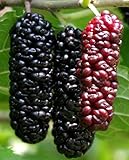
The fruit is an aggregate of many small segments packed into a cone shape, 1–4 cm long, ripening white, pink, red, purple from light to dark, or black — colour depends entirely on the cultivar.
Expect fruit after about 2 years, and up to 2–3 years for a full crop. Harvest comes early spring in warm climates and early summer in temperate ones. In the first year the bloom should be thinned so the young tree puts its energy into building a framework rather than into a crop it is too small to carry; after that, no thinning is needed.
Picking mulberries by hand is slow and stains everything. The standard solution is to spread a sheet or a large sheet of plastic under the tree and shake the branches, letting the ripe fruit fall and collecting it in one go. This suits a weeping mulberry particularly well, since the crop hangs in a neat circle within reach. Netting the tree is possible but not recommended — on a dense weeping canopy nets are awkward to fit, they catch on the hanging branches, and they trap wildlife.
You will get a lot at once, so plan for it: mulberries are eaten raw, juiced, made into jam, or baked into cakes.
Pests and diseases
The tree itself is troubled mainly by silkworm — mulberry is the classic silkworm food plant, so the caterpillars strip leaves given the chance.
The crop attracts a different set of problems. Birds take ripe fruit, and the Mediterranean fruit fly lays in ripening fruit, which is one more argument for picking promptly and clearing fallen fruit from the ground — rotting windfalls under the tree are a breeding site that guarantees a worse year next season.
Buying a weeping mulberry: what to check
Start with the ornamental-or-edible decision above, because it changes which tree you should be looking at. Then, at the nursery:
- Taste the fruit if you can, and decide which colour you want — white or black are the usual choices, and they are different fruits in flavour, not just in appearance.
- Check how it was propagated. Weeping mulberry is best started from a plant or by vegetative propagation. Grafting is not strictly necessary, but it guarantees the fruit you were shown; starting from cutting or graft is the recommended route. Seed is possible and even easy, but it is not recommended, since a seedling is neither predictable in fruit nor guaranteed to be female.
- If it is grafted, find the graft union and inspect it. It should be present, clean and sound. A poor union is a future failure point on a tree whose entire canopy hangs from one place.
- Look at the trunk for holes — holes mean borers.
- Check that the tree is free of pests and disease, and look at the leaves for distortion, which is often the first visible sign of disease.
- Look at the soil surface in the pot for ant nests or other insects. You are buying the root ball as much as the tree, and whatever lives in it comes home with you.
For the full plant profile see our Weeping mulberry growing page.
See also: fruit tree grafting · grafting tools & supplies · rooting hormone for cuttings
See also: how to graft fruit trees · grafting tools
Not sure which pruning approach applies? See our guide to choosing the right pruning method.