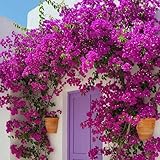
Bougainvillea peruviana, sometimes sold as Peru buganvilla, is a perennial climbing vine grown for colour and used as a hedge or screen. It is evergreen in warm conditions and can drop its leaves over summer in others, carries small oval green leaves of 2–4 cm, and grows in tropical, subtropical and Mediterranean climates in hardiness zone 9 and above. Left to itself it reaches 0.6–2 m (2–6 ft), though it is flexible enough to be trained as a bonsai at the other extreme.
One point of vocabulary is worth getting right, because it changes how you judge the plant: the colourful part is not the flower. The true flowers are small and white-yellowish. The magenta-rose or purple sheets of colour are bracts — modified leaves surrounding the flowers. That is why a bougainvillea in “full bloom” holds its display for weeks: bracts are leaf tissue and last far longer than the tiny flowers inside them.
Water: the one thing that kills this plant
Bougainvillea peruviana’s requirements are low, and the most common mistake is kindness. It grows happily on a small amount of water (it simply grows more slowly) and does well on an average amount. What it will not tolerate is standing water, which can kill the plant outright — flooding is fatal.
Two practical consequences:
- Well-drained soil is not a preference, it is the requirement. Get the drainage right and the watering regime becomes forgiving. Get it wrong and no amount of careful watering will save the plant, because water simply sits around the roots.
- Seasonal wet is survivable; permanent wet is not. A plant that sits waterlogged during a rainy season will come through it. A plant sitting in a poorly drained pot or a low spot in the garden year-round will not.
The plant also prefers dry weather generally, and this is where the trade-off sits: full sun, real heat and a good amount of water together produce fast growth, while leaner watering gives you a slower, more manageable plant. Decide which you actually want before you set up irrigation.
Light, heat and when it blooms
Give it full sun. It will grow in half shade, but it blooms noticeably less — and since the bracts are the entire point, half shade is a compromise rather than an option. Heat is the other bloom driver: the hotter the climate, the better the plant flowers and the longer the display lasts.
That shows directly in the flowering calendar:
- Zones 9–10a: from late spring to midsummer, and sometimes into late summer.
- Zones 10b–11a: from spring through to autumn.
- Zone 11b and above: potentially all year round.
If your plant is healthy but stingy with colour, look at sun and heat before you look at feeding.
Planting season by zone
Planting time follows the same climate logic — the warmer the zone, the wider the window:
- Zone 9 and above: plant in spring and summer.
- Zone 10b and above: autumn planting is also possible.
- Zone 11b and above: you can plant in winter as well.
The principle behind it: a newly planted vine needs to establish roots before it meets cold, so the colder your zone, the more of the warm season it should have ahead of it at planting.
Cold tolerance and winter protection
The plant prefers frost-free conditions but can survive frost. Zone 9 corresponds to winter lows of about −6.7 °C (20 °F), which marks the practical cold limit. Where frost is expected, cover the plant with mulch over winter. Mulch protects the crown and root zone specifically — top growth may be burned back by a hard frost, but a plant whose roots and base came through insulated will regrow, whereas one frozen at the root will not. This is also the reason the plant is worth keeping in a container at the cold edge of its range, where it can be moved.
Pruning: the inner-branch problem
Pruning is the heart of bougainvillea care, and it addresses a specific structural failure. Prune at the end of autumn or the start of winter — the rule is to prune after the blooming season, so you are never cutting off the display you waited for.
Why the middle of the plant dies out
After a few years, the interior of an established bougainvillea stops receiving light. The outer shell of growth shades everything behind it, and the inner stems atrophy — you end up with a hollow plant: a dense green skin over a mess of bare, dead wood. Once that has happened it does not reverse on its own, because there is no light reaching the buds that would break.
What to cut
- Prune the inner branches. Thin the interior deliberately so that light reaches into the plant and each branch has room to grow. This is preventive work — you are keeping the inside alive rather than reviving it.
- Remove dead branches entirely.
- For renewal, prune all the outer foliage. On a plant that has already gone hollow, taking off the outer shell is what re-exposes the interior to light and forces new growth from inside. It looks drastic and it is the correct treatment.
Do this on a cycle and the plant stays dense and floriferous to the centre instead of retreating to a hollow shell.
Trellising, training and shaping
This is a vine, and it needs trellising or support for the new growth from the outset. Untied new shoots flop, tangle and end up shading the plant’s own interior — the very problem the pruning above exists to fix. Tie growth in as it extends and direct it where you want colour.
At the other end of the scale, the plant responds well to being kept small and shaped: it can be designed as a bonsai, and growing it as a compact specimen in a container and training it into a form is a well-established way to use it. The same species will therefore give you either a 2 m hedge or a shaped miniature, depending entirely on how hard you prune and how you restrict the roots.
The two real difficulties
- It is an aggressive grower. In full sun, heat and generous water this vine is genuinely vigorous and will swamp neighbouring plants and structures if you let it. Site it where you can get around it with loppers, and prune on schedule rather than in emergency.
- It has spines. Bougainvillea stems are armed, and the spines are sharp enough to make careless pruning or tying-in unpleasant. Gloves and long sleeves make the annual prune a different job.
Propagation: seed, cuttings and multi-colour grafting
Nothing here needs grafting or vegetative propagation to succeed — you have a genuinely free choice of method.
From seed
Bougainvillea peruviana is very easy to start from seed. Sow in spring to summer, keep the soil moist, and give the seedlings full sun. Moist soil plus full sun sounds contradictory for a drought-tolerant plant, but seedlings have no root system to draw on yet; the drought tolerance comes later.
From cuttings
Cuttings work either in water or directly in soil. Whichever you choose, keep the medium moist at all times and place the cutting in half shade. The half shade is not a preference of the mature plant — it is protection for a cutting that has no roots and therefore cannot replace water lost through its leaves in full sun.
Grafting — more than one colour on one plant
Grafting is not needed, but it is possible, and it enables the trick that makes bougainvillea collections interesting: graft several different bract colours onto the same plant. A single trained vine can then carry magenta-rose and purple together. Since the plant is easy from seed and easy from cuttings, grafting is best thought of as a display technique rather than a propagation necessity.
Growing in a container
Bougainvillea peruviana is not suitable as an indoor plant, but it grows well in a planter or pot outdoors, and the container is actually one of the best ways to keep it in check.
- Drainage is the first priority. Everything said above about standing water is amplified in a pot, where the plant cannot escape a saturated root zone.
- Replace the soil every couple of years. Potting media collapse over time, and once the mix has lost its structure, drainage goes with it.
- Grow it deliberately small. A container plant kept compact and shaped is the ideal use of a pot here — and it means you can move the plant under cover where winters bring frost.
Pests
- Aphids — clustering on soft new shoot tips and around developing bracts, distorting growth and leaving honeydew.
- Leaf miners — larvae tunnelling between the upper and lower surfaces of the leaf, leaving pale winding tracks. Damage is cosmetic on a healthy plant; removing badly mined leaves is usually enough.
- Moths — their caterpillars chew leaves and young growth. Look for the caterpillars rather than the adults, and inspect the interior of the plant, which is exactly where the annual thinning gives you access.
Note the pattern: a plant kept open by pruning is one you can actually inspect and treat, while a hollow, congested bougainvillea hides everything until the damage is obvious.
For the full plant profile see our Bougainvillea peruviana growing page.
See also: rooting hormone for cuttings
See also: best rooting hormone
Related guides
Not sure which pruning approach applies? See our guide to choosing the right pruning method.