
Scale insects are among the most easily overlooked plant pests — they often look like small, immobile bumps or crusty flecks stuck to stems and leaves rather than “insects” at all. Left alone they weaken plants, drip sticky honeydew and invite sooty mould. This is a general guide; scale insects are a large and varied group, so biology and the best response differ by species and plant — treat this as the framework and follow guidance specific to your plant and any product you use.
What scale insects are
Scale insects are small sap-sucking insects that spend most of their lives fixed in one spot under a protective covering, which is why they rarely look like typical bugs. They fall into two broad groups that behave differently:
- Soft scales secrete a waxy layer that is part of their body; many produce large amounts of sticky honeydew, leading to sooty mould and ants.
- Armored (armoured) / hard scales sit under a separate hard, shell-like cover that lifts off the insect beneath; they generally produce little or no honeydew.
Knowing which broad type you have helps, because honeydew and sooty mould point to soft scale, while dry, limpet-like scabs that don’t leave sticky residue point to armored scale. Not every scale species behaves identically, so treat these as general tendencies.
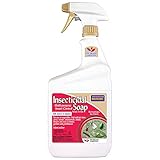 Bonide Insecticidal Soap, 32 oz Ready-to-Use Spray Multi-Purpose Insect Control for Organic Gardening Indoor
 Garden Safe Insecticidal Soap Insect Killer Spray, 32 Oz
The usual controls for scale are insecticidal soap or horticultural oil: As an Amazon Associate we earn from qualifying purchases.
Common visual symptoms
- Small round, oval or elongated bumps — brown, tan, grey, white or black — on stems, leaf undersides and leaf nodes.
- Bumps that don’t brush off easily and may reveal a soft insect underneath when scraped.
- Sticky honeydew on leaves and surfaces below (soft scale), often turning black with sooty mould.
- Ants trailing up stems to feed on honeydew.
- Yellowing leaves, poor growth, leaf drop and dieback where infestations are heavy.
Where to look
- Stems and woody nodes — a favourite site, especially in leaf axils and along the underside of branches.
- Leaf undersides and along the midrib and veins.
- Leaf nodes and new growth, where sheltered conditions suit them.
Damage they cause
By drawing sap, scale insects sap plant vigour: leaves yellow, growth slows, and heavily infested stems can die back. Soft scales’ honeydew coats foliage and grows black sooty mould, which is unsightly and blocks light from the leaf. Ants that farm the honeydew can also protect scale from natural predators, letting numbers build.
The crawler stage — the key to control
Newly hatched scale insects, called crawlers, are tiny and mobile before they settle and form their protective covering. This crawler stage is the point at which scale is most vulnerable and most treatments work best — once the adults are covered by wax or a hard shell, that covering shields them. Watching for crawlers (and timing action to them) makes control far more effective than treating settled adults alone.
Conditions that favour scale
- Warm, sheltered spots — indoors, greenhouses and mild climates where they breed year-round.
- Stressed or overcrowded plants with poor airflow.
- Ant activity that protects colonies from predators.
- Bought-in plants that arrive already carrying scale.
Inspection & isolation
Check stems, nodes and leaf undersides regularly, especially on houseplants and known favourites like citrus, ficus, orchids and many ornamentals. Inspect new plants before bringing them in, and isolate any that are infested so crawlers don’t spread to your other plants.
Physical & manual removal
- Rub or scrape off scales with a fingernail, soft cloth or an old toothbrush — practical on houseplants and light infestations.
- Dab with a cotton bud to lift individual scales from small plants.
- Wipe leaves afterwards to remove honeydew and sooty mould.
Pruning heavily infested material
Where a stem or branch is crusted with scale, pruning it out (and disposing of it, not composting near plants) can remove a large part of the population at once and let the plant recover. Don’t remove so much that you seriously weaken the plant — balance removal against the plant’s health.
Cultural & biological control
Keep plants healthy and unstressed, improve airflow, and control ants so predators can work. A range of natural enemies — ladybirds (including species that specialise on scale), parasitic wasps and lacewings — attack scale, and are especially useful under glass. Avoiding broad-spectrum sprays helps preserve them.
Treatment principles
- Start with physical removal and improving conditions — often enough on houseplants and light cases.
- Target the crawler stage for any spray, when the insects are exposed.
- Horticultural oils work by smothering and are commonly used against scale; apply out of hot sun and follow the label.
- If using a product, several options exist, but no single product is right for every scale species or every plant. Choose one labelled for your plant and pest, follow the label exactly, and don’t exceed labelled rates. The hard covering of adults makes coverage and timing important.
Repeated inspection
Scale populations overlap and rebuild, and covered adults survive many single treatments, so keep checking and repeat control as the label allows until you no longer find live scale or new crawlers.
Prevention
- Inspect and isolate new plants before adding them to your collection.
- Check favourites (citrus, ficus, orchids, bay, many houseplants) regularly.
- Keep plants healthy, spaced and well ventilated.
- Control ants, which shelter scale from predators.
- Wipe down and clean plants you bring indoors for winter.
Common mistakes
- Mistaking scale for harmless bumps or part of the bark until it spreads.
- Spraying settled adults and ignoring the crawler stage.
- Leaving honeydew and sooty mould, and ignoring the ants that protect the colony.
- Assuming one product suits every scale and plant, or exceeding label rates.
Quick questions
Are those brown bumps on my stems insects? Very likely scale insects — scrape one gently; if a soft body is underneath, or there’s sticky honeydew nearby, it’s scale.
Why is my plant sticky and black? Soft scales excrete honeydew that grows black sooty mould; clearing the scale stops it.
Can I just wipe scale off? On houseplants and light infestations, yes — manual removal plus watching for crawlers often controls it, though heavy cases may need pruning and repeated treatment.
Related guides
◀ Back to the Plant Problems hub to diagnose by symptom, pest or disease.


