
The right sprayer makes treating plants faster, safer and far more effective — whether you’re misting a few houseplants, spot-treating a rose bed, or covering a whole vegetable plot. This guide helps you choose the application equipment: the sprayer and applicator types, how they differ, and which suits your plants and garden size. It is not a pesticide guide and does not tell you what to spray — always follow the label of any product you use, and see our plant pests & protection guides for treatment choices.
As an Amazon Associate GrowPlants earns from qualifying purchases. We recommend product types that genuinely suit the task; prices and availability are set by Amazon. GrowPlants does not sell these products.
Match the sprayer to the job
There is no single best sprayer — the right one depends on how many plants you treat, whether you’re indoors or out, and how much precision and reach you need. The main types below each suit a different scale of work.
Trigger & hand sprayers
Squeeze-trigger bottles (typically ~0.5–1 litre / 16–32 oz) are ideal for houseplants, seedlings and spot-treating a few plants. They’re cheap, precise and easy to aim at leaf undersides where many pests hide, but tiring and slow for large areas. Look for an adjustable nozzle (stream to mist) and comfortable trigger action.


Fine-mist sprayers
Continuous-mist or pressurised misting bottles give an even, gentle fine spray that suits foliage, seedlings, humidity-loving houseplants and delicate applications. Some use a pump-up pre-pressure so you get continuous mist without constant squeezing — easier on the hand for indoor plant collections.


Pump / pressure sprayers
Pump-up pressure sprayers (commonly ~1–8 litres / 0.25–2 gal) hold pressure so you spray continuously with an even output — the workhorse for borders, shrubs, rose beds and small vegetable plots. A lance/wand extends reach, and an adjustable nozzle changes the pattern. Larger tanks cover more ground but get heavy when full.


Backpack sprayers
Backpack (knapsack) sprayers (~10–20 litres / 2.5–5 gal) carry the load on your shoulders for extended spraying across large gardens, orchards and allotments. They offer the best reach and endurance and often a longer lance, at the cost of weight, size and price — overkill for a few plants.


Hose-end applicators
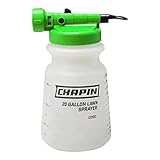
Hose-end sprayers attach to a garden hose and draw from a reservoir, mixing as water passes through — convenient for covering large areas quickly, and often used for feeding. They give less precise concentration and coverage than a dedicated pressure sprayer, so they suit broad application more than careful spot-treatment. Check the applicator’s stated mixing ratios.


Nozzles, wands & spray patterns
- Adjustable nozzle — twist from a fine mist (even foliar coverage) to a narrow stream (reach and spot-treatment). The single most useful feature on any sprayer.
- Lance / wand — extends reach under and over foliage and up into shrubs; look for an angled or telescopic wand for leaf undersides.
- Cone vs fan vs stream — a cone/mist covers leaves evenly, a fan suits broad low growth, a stream reaches distant or high spots.
How to choose — the key criteria
- Capacity — more volume means fewer refills but more weight. Match tank size to how much you treat at once.
- Reach — wand length and pressure decide whether you can cover tall shrubs or only low plants.
- Precision — trigger and mist sprayers aim tightly; hose-end applicators are broad.
- Indoor vs outdoor — indoors favour small, drip-free, fine-mist or trigger bottles; outdoors favour pump or backpack units.
- A few plants vs a large garden — a handful of houseplants needs only a trigger/mist bottle; a large plot justifies a pump or backpack sprayer.
- Comfort & build — trigger feel, shoulder straps, seals and pump action matter over a long session.
Sprayer types at a glance
| Type | Best for | Typical capacity | Reach | Precision |
|---|---|---|---|---|
| Trigger / hand | Houseplants, seedlings, a few plants | ~0.5–1 L | Short | High |
| Fine-mist | Foliage, seedlings, delicate indoor use | ~0.3–1 L | Short | High |
| Pump / pressure | Borders, shrubs, small plots | ~1–8 L | Medium | Medium–high |
| Backpack | Large gardens, orchards | ~10–20 L | Long | Medium |
| Hose-end | Broad coverage / feeding large areas | Hose-fed reservoir | Medium | Low |
Cleaning, storage & replaceable parts
- Rinse thoroughly after every use — flush the tank, wand and nozzle with clean water so residues don’t clog jets or carry over to the next job.
- Dedicate a sprayer where practical — many gardeners keep separate sprayers for different purposes to avoid cross-contamination; label them clearly.
- Store empty, clean and dry, out of frost and direct sun, with the pressure released.
- Choose models with replaceable parts — seals, O-rings, nozzles and wands wear out; being able to replace them extends a sprayer’s life and prevents leaks.
Compatibility & safety
Sprayers are not universally compatible with every product. Seals, gaskets, tank materials and nozzles vary between models, and some substances can degrade certain materials.
- Check the manufacturer’s information for what a sprayer is rated to handle — don’t assume a sprayer is suitable for a given chemical unless its documentation says so.
- Never mix incompatible products, and follow the label of whatever you apply — this guide does not provide mixing rates or recipes.
- Follow all personal-safety guidance on the product you use, and avoid spraying open flowers when pollinators are active.
Which sprayer for which gardener?
- A few houseplants → a trigger or fine-mist bottle.
- A rose bed or mixed border → a small pump/pressure sprayer with an adjustable nozzle.
- A large garden, orchard or allotment → a backpack sprayer for reach and endurance.
- Broad feeding or coverage over a big area → a hose-end applicator.
FAQ
What sprayer is best for indoor plants? A small trigger or continuous fine-mist bottle — precise, drip-free and easy to aim at leaf undersides.
Do I need a backpack sprayer? Only for large areas. For a few plants or a single bed, a trigger or small pump sprayer is easier and cheaper.
Can I use one sprayer for everything? You can, but rinse it thoroughly between uses; many gardeners keep separate, labelled sprayers to avoid cross-contamination, and always check a sprayer is rated for what they put in it.
Related guides
As an Amazon Associate GrowPlants earns from qualifying purchases. GrowPlants does not sell these products.