

Plant Profile & Key Characteristics
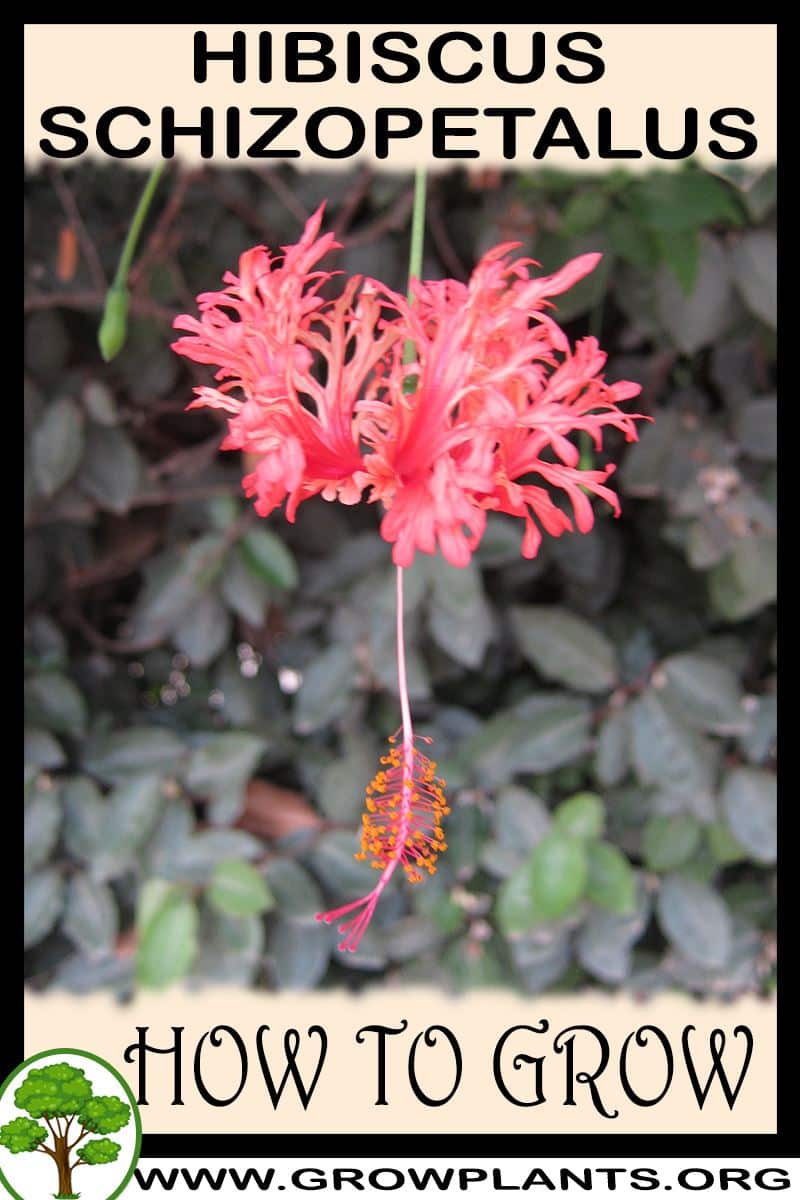
Overview: Hibiscus schizopetalus (coral or spider hibiscus, Japanese lantern) is an evergreen shrub of 1-3 m grown as an ornamental and hedge for its distinctive pendant flowers with deeply fringed petals and a long protruding style. It suits tropical and subtropical zones 10a+.
Quick Specifications
| Specification | Attribute |
|---|---|
| Plant Type / Life Cycle | Perennial (shrub) |
| Foliage Type | Evergreen |
| Mature Size | 1-3 m tall (3-10 feet) |
| Growth Rate | Fast |
| Hardiness | USDA zone 10a+ |
Growth Form & Structure
- Height and Spread: Reaches 1-3 m (3-10 feet); grows in containers of about 10-20 L (2-4 gallons) or larger; not suited as an indoor houseplant.
- Growth Habit and Form: Arching, open shrub with slender branches that carry pendant flowers.
- Lifespan and Maturity: Fast-growing perennial shrub.
Anatomy & Physical Features
- Leaves and Foliage: Green, oval leaves, serrated at the edge in some cultivars.
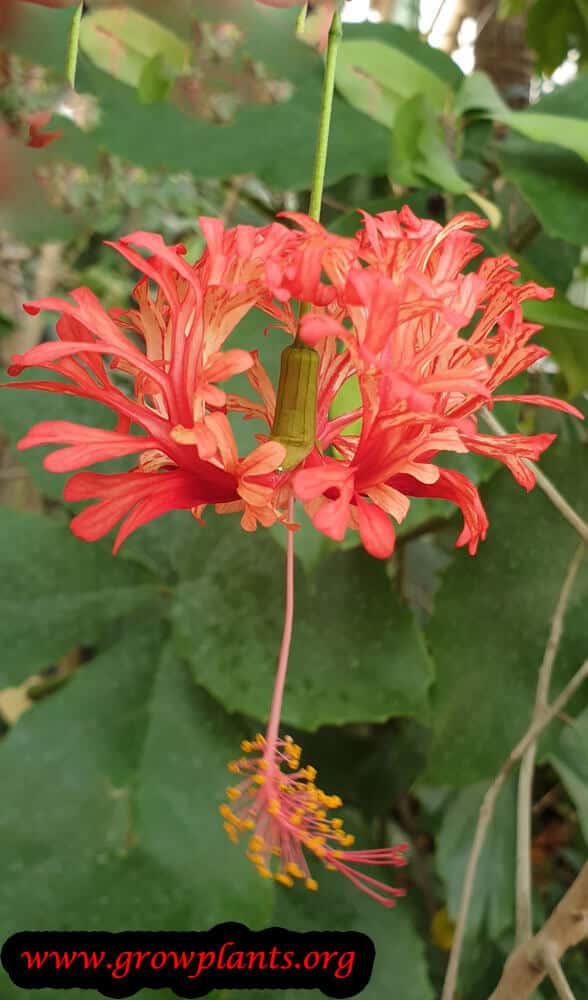
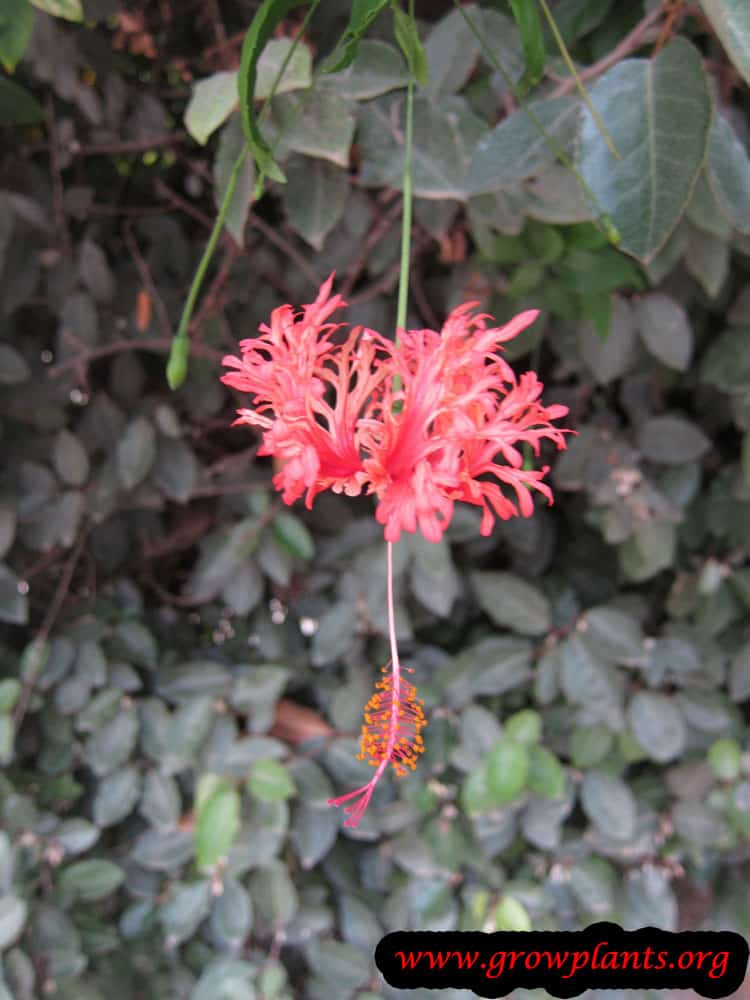
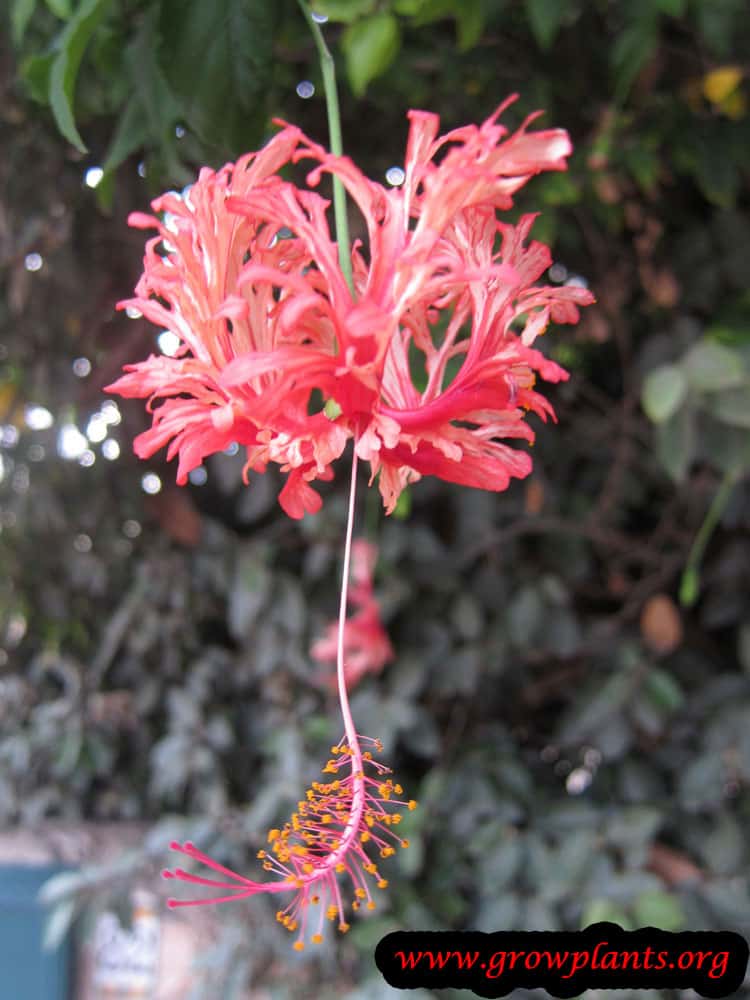
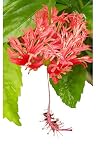
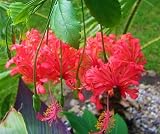
- Flower Characteristics: Pendant red (rarely pink) flowers 4-7 cm with deeply lobed, reflexed petals and a showy style 4-10 cm long (full detail in the Bloom accordion).
Primary Uses & Landscape Value
- Functional and Ornamental Roles: Ornamental flowering shrub and hedge; effective cascading over walls.
Care Guide: Planting, Soil & Watering
Overview: Coral (spider) hibiscus is a fast-growing frost-tender shrub for full sun to light shade, growing in rich soil with organic matter and mulch. It likes warm conditions and steady, moderate moisture.
Quick Care Requirements
| Requirement | Ideal Condition |
|---|---|
| Planting Season | Spring; year-round in frost-free zones |
| Growth Rate | Fast |
| Soil Type | Rich soil with organic matter and mulch |
| Water Need | Moderate – keep evenly moist, protect from frost (hardy only above about -2C/29F) |
Planting & Establishment
- Best Planting Season: Plant in spring in zone 10a, spring to summer in 10b, spring to autumn in zone 11, and year-round in zone 12+.
- How to Plant:
- Hole Preparation: Dig the hole about 50% wider than the root ball so roots can spread into loosened soil.
- Soil Amendments: Work plenty of organic matter into the backfill (compost, well-rotted leaves and humus), then mulch the surface to hold moisture; hold back on fertiliser until the plant has established.
- Planting Depth: Set the plant so the top of the root ball sits level with the surrounding soil, firm it in gently and stake if unstable, without burying the stem.
- Growth Speed & Expectations: Fast-growing – makes an arching, open shrub quickly in warm conditions.
Soil, Watering & Drainage Care
- Soil Mix & Drainage Needs: Rich soil improved with organic matter and mulched to hold moisture; keep it well-drained and never leave water standing beneath a pot. It is cold-sensitive below about -2C (29F).
- Watering Schedule & Technique:
- Young / Newly Planted: Water twice on planting day, then daily for the first two weeks, giving extra water until new growth appears.
- Established: Water regularly to keep the soil evenly moist, letting the top dry slightly between waterings.
- Seasonal Adjustments: More water in hot, dry weather; ease off through cooler months.
Climate, Light & Hardiness
Hibiscus schizopetalus (coral/Japanese lantern hibiscus) is a distinctly tropical, frost-tender shrub, reliably perennial in USDA zone 10b and warmer, survivable in zone 10a with winter protection. It needs full sun and, per the site's own data, tolerates cold only down to roughly −2°C (29°F).
Quick Climate Specifications
| Climate Zones | Tropical, Mediterranean, subtropical |
|---|---|
| USDA Hardiness Zones | 10b+, and 10a with overwinter protection |
| Approx. Survival Minimum | Approximately −2°C (29°F) |
| Frost Tolerance | Very Low |
| Light Conditions | Full sun |
Sunlight & Light Exposure
Optimal Light Setup
Requires full sun for healthy growth and flowering.
Temperature Extremes & Hardiness
USDA Hardiness & Regional Limits
One of the more frost-tender hibiscus species here, reliably outdoor-perennial only from zone 10b upward.
Cold Damage & Winter Protection
Cold tolerance is limited to around −2°C (29°F) even briefly; in zone 10a, winter protection (such as covering or moving containers under shelter) is needed to get it through cold snaps.
Frost Sensitivity
Even light frost is likely to damage or kill this species; it is not a plant for climates with regular hard freezes.
Growing in Pots, Balconies & Indoors
Japanese lantern hibiscus (Hibiscus schizopetalus) is a graceful, sun-loving shrub for a large pot on a sunny balcony or patio – not a houseplant, as indoor light is too weak for its dangling flowers.
Quick Details
- Container Size: 10-20 L (2-4 gal), larger is fine
- Indoor Suitability: Not a houseplant – it needs full sun to flower
- Best Spot: Full sun
- Soil & Drainage: Potting soil or a peat-and-perlite (or other light) mix, kept moist but free-draining
- Watering in Pots: Water regularly to keep the mix evenly moist; do not let water sit in the saucer.
Indoors & On the Windowsill
- Houseplant limits: The grower marks it as not an indoor plant; low light means few or none of its distinctive pendant flowers.
- Overwintering indoors: Being tender, a potted plant can be moved to a bright, frost-free spot for a cold winter and back to full sun afterwards.
On a Balcony or Patio
- Light and wind: Give it the sunniest, warmest spot for the best flowering; walls and railings reflect heat so pots dry quickly – check moisture daily in hot spells and shelter it from strong wind. A drip irrigation kit with a timer can take over that watering check automatically.
- Overwintering: Where winters are cold, a potted plant is easy to move into a bright, frost-free spot for the cold season and back out when it warms – a key reason to grow tender hibiscus in a container.
- Practicalities: A large watered pot is heavy – check the balcony can take it, and manage drainage runoff with a tray or pot feet.
Choosing the Pot, Soil & Long-Term Care
- Pot and drainage: 10-20 L (2-4 gal) with strong drainage holes. If it stands in a tray, do not let water pool there for days – that leads to root rot. Choose a pot with strong drainage holes; if you stand it on a saucer, empty the saucer promptly so the roots never sit in water. Terracotta breathes and dries faster, while glazed or plastic pots hold moisture longer.
- Potting mix: Use a well-aerated, organic-rich mix – a good potting soil, or peat/coir blended with perlite or vermiculite for drainage and air.
- Watering: Water regularly to keep the mix evenly moist – pots dry out far faster than open ground, so check often in heat – but never leave it standing wet.
- Feeding: Potted plants run through their soil faster because nutrients leach out with every watering, so feed a little more often than you would in open ground. Adding humus, organic matter and a mulch layer, as the grower advises, helps hold moisture and nutrients.
Grower’s Container Tip
- Pot up gradually and root-prune from the side: The grower’s own method: move up one pot at a time, only about 50% larger than the root ball, mixing in some fresh soil at each step until you reach the final container size. After that, every few years replace part of the soil and cut back some roots – you can do this from the side of the pot without lifting the whole plant out. Adding humus, organic matter, fertilizer and a mulch layer on top helps keep the soil moist and fed.
Fertilizing & Feeding
An evergreen tropical-to-subtropical shrub grown for its distinctive fringed, pendant flowers and often used as a hedge: balanced feeding through the warm growing season supports steady growth and bloom, easing off during any cooler slowdown.
Quick Fertilizing Specs
| Feeding Level | Moderate feeder |
|---|---|
| young_feeding | A balanced starter feeding with organic matter worked into the planting hole |
| mature_feeding | Regular, balanced feeding through the warm growing season, especially where kept trimmed as a hedge |
| Main Nutrient Priority | Balanced nutrition with adequate nitrogen to support fast growth, hedge density, and the deeply lobed, pendant flowers |
| Best Feeding Period | Spring through summer, the main active growth and bloom period |
| Organic Options | Compost, aged organic matter, and mulch worked in and maintained around the root zone |
| Soil pH | Prefers rich, well-drained soil without an extreme pH |
| Reduce/Stop Feeding | Reduce or pause feeding during any cool-season slowdown in growth |
Feeding by Growth Stage
Spring Growth
Support new shoot and leaf growth as the plant resumes active growth, including where it is trimmed as a hedge.
| Nutrient direction | A balanced, complete fertilizer to build strong, well-branched growth. |
|---|---|
| Timing | As active growth resumes in spring in cooler parts of its range, or with the return of consistently warm weather. |
| Frequency | Light, regular feeding through this period supports steady growth without forcing overly soft shoots. |
| Fertilizer types | Balanced complete fertilizer for flowering shrubs |
| Precautions | Where kept as a tight hedge, avoid overfeeding, which can outpace how quickly it can be shaped and pruned. |
Warm-Season Bloom
Support the plant’s distinctive fringed, pendant flowers through its main flowering period.
| Nutrient direction | Continue balanced feeding with adequate nitrogen through bloom. |
|---|---|
| Timing | Through the warm season, and nearly year-round in consistently warm, frost-free climates. |
| Frequency | Light, steady feeding through bloom sustains flowering without pushing excess leafy growth. |
| Fertilizer types | Balanced complete fertilizer for flowering shrubs |
| Precautions | In hedges grown for screening, feed evenly along the row to avoid patchy density. |
Cool-Season Slowdown
Let growth slow naturally where cooler weather reduces activity, avoiding new growth that has little time to harden.
| Nutrient direction | None – withhold fertilizer while growth is clearly slowed. |
|---|---|
| Timing | During the coolest part of the year, where growth visibly slows. |
| Frequency | No feeding at this stage. |
| Fertilizer types | No feeding at this stage – resume once active growth returns |
| Precautions | Do not fertilize while growth is slow; unused nutrients can build up in the soil or wash away before the plant can use them. |
Nutrient Deficiency Signs & Corrections
Pale green leaves and thinner, weaker shoot growth or a sparse-looking hedge during the growing season.
| Possible causes | Low available nitrogen in the soil, Nitrogen leached away by heavy rain or watering, Frequent hedge trimming removing growth faster than feeding replaces it |
|---|---|
| Appears first on | Older, lower leaves first. |
| What to check | Recent feeding history relative to pruning frequency, Soil drainage and rainfall, Overall density compared to earlier in the season |
| Possible correction | Resume balanced, nitrogen-adequate feeding through the active growing season. |
New leaves yellow between the veins while the veins remain green.
| Possible causes | High or alkaline soil pH limiting iron availability, Waterlogged or poorly drained soil, Cool, wet conditions slowing root uptake |
|---|---|
| Appears first on | Youngest leaves at the growing tips. |
| What to check | Soil pH, Drainage around the root zone, Whether symptoms follow cold or wet weather |
| Possible correction | Correct overly alkaline soil where practical and apply a chelated iron product per its label if the pattern persists. |
Vigorous leafy growth with noticeably fewer of the plant’s characteristic pendant flowers.
| Possible causes | A feeding program heavily skewed toward nitrogen with little else, Insufficient direct light reducing bloom regardless of feeding, Overly frequent pruning removing developing flower buds |
|---|---|
| Appears first on | Whole-plant flowering pattern rather than an individual leaf. |
| What to check | Recent fertilizer type and frequency, Light exposure through the growing season, Pruning timing relative to bud formation |
| Possible correction | Return to a balanced, complete fertilizer, confirm the plant gets adequate sun, and time pruning to avoid removing developing buds. |
Pruning, Training & Seasonal Maintenance
Coral hibiscus tolerates moderate pruning, but its ornamental value comes from graceful, arching branches carrying pendulous, deeply lobed "lantern" flowers on long dangling styles – so the objective is to renew and guide that arching form, not to create a dense formal outline. The safest window is late winter, before the main spring growth push; pruning mid-bloom removes flowers still developing on the arching tips.
Quick Pruning & Maintenance Specs
| Pruning Tolerance | Moderate |
| Primary Pruning Window | Late winter, before the spring growth push |
| Secondary Maintenance Window | Light tidying (dead flowers and leaves) through the growing season |
| Typical Frequency | One structural/renewal prune per year |
| Main Objective | Renew arching flowering canes while preserving the weeping habit |
| Young Plant Priority | Select a few strong arching leaders from the base; remove weak, crowded competitors |
| Mature Plant Priority | Renew the oldest arching canes at the base; thin crowded basal growth |
| Best Tool Type | Bypass secateurs for shoots; loppers for thicker base canes |
| Avoid Heavy Pruning During | Active bloom, and shortly before a cool spell in marginal (10a) sites – this species is more cold-tender than most garden hibiscus |
Pruning by Plant Age & Size
Newly Established
Remove only damaged growth and let the plant establish its natural arching habit before any structural pruning.
Young / Formative
Select several strong arching leaders from the base as the main framework. Avoid heading these back hard, since shortening the arch reduces the pendulous flower display that defines this species. Remove weak or crowded competing basal shoots.
Mature / Established
Periodically remove the oldest, least-productive arching canes at the base to make room for vigorous new arching growth (cane-renewal logic), and thin dense basal growth for airflow.
Seasonal Pruning Schedule
Pre-Growth / Late Winter
Objective: renew arching flowering wood. Remove dead or damaged canes and take renewal cuts on old arching canes at the base. Do not head back young, vigorous arches, since flowers hang along their length. The response is fresh arching shoots that flower through the warm season.
Ongoing Sanitary
Remove dead flowers and leaves as noticed through the growing season, matching the source guidance for this species.
Flowering & Fruiting Wood
Flowers form along the current season’s arching shoots, hanging from long pedicels and showy styles. Hard heading cuts partway along a cane shorten the arch and reduce the pendulous display, so favor renewal cuts at the base of whole old canes over heading mid-cane.
Structural Pruning & Training
Although this species is usable for hedging, formal shearing is a poor fit: shearing removes the arching branch tips where the lantern flowers dangle, destroying the ornamental display. If used as an informal screen, prune selectively by thinning and renewing individual canes rather than shearing a uniform outline. Manage height and spread by removing whole canes at the base, not by topping the arches.
Special Growth to Remove
Remove weak or crowded basal shoots that compete with the chosen arching leaders, and dead flowers and leaves. This species is typically grown from cuttings on its own roots; on the rare grafted specimen, remove any growth below the graft union.
Container & Small-Space Pruning
The wide arching habit needs room to display properly, making this species less naturally suited to tight spaces than compact shrubby hibiscus. In a container, select fewer, well-spaced arching canes and stake or support them rather than crowding many stems; light regular pinching of young shoots keeps a container specimen more compact without heading off the arches.
Tools
Bypass secateurs for most cane and shoot work; loppers for thicker old basal canes at renewal time.
Tool Hygiene & Disease Risk
Routine – clean, sharp tools for normal renewal cuts; increase care (disinfect between cuts) only if removing dieback or clearly diseased wood.
Cut Placement & Technique
Use base-level cane removal for the oldest canes rather than heading mid-arch. When shaping young leaders, cut just above an outward-facing bud.
Heavy Pruning & Rejuvenation
The plant tolerates moderate rejuvenation – cutting the oldest third of canes to the base in late winter – better than a uniform hard shearing across the whole plant, which would remove most of the arching flowering wood at once and take a full season to recover its display. Stagger renewal over two to three seasons on very overgrown plants.
Post-Pruning Care
Water normally. This species is more cold-sensitive than other ornamental hibiscus (chilling injury reported near -2C/29F), so avoid encouraging a flush of tender new growth going into a cool spell. Watch new shoots for aphids, mealybugs and mites.
Common Pruning Mistakes
Shearing into a hedge shape and losing the pendulous flower display; heading back arching canes mid-length instead of removing whole canes at the base; letting basal growth become overcrowded, which shades out the flowering arches.
When NOT to Prune
Avoid pruning right after transplanting; avoid pruning shortly before a cool spell in marginal (10a) sites, given this species’ relative cold sensitivity; avoid cutting during the heaviest bloom period, when cuts remove developing lantern flowers.
Recommended Tools (by task)
- bypass_secateurs – routine shoot and cane cuts.
- loppers – thicker basal canes at renewal time.
- soft_ties_stakes – optional support for select arching canes on container specimens or in wind-exposed spots, so the pendulous growth is not snapped.
Pruning Troubleshooting
| Problem | Possible Cause | What to Check | Corrective Action |
| Few or no pendulous flowers after pruning | Shoot tips, where flowers form, removed by shearing | Whether the plant was recently sheared into a formal shape | Switch to selective cane renewal and thinning; avoid shearing |
| Sparse arching canes, mostly upright growth | Repeated heading instead of base renewal | Where cuts were made along the canes | Remove old canes at the base to encourage fresh arching replacements |
| Crowded, weak basal growth | Insufficient thinning of basal shoots | Density at the crown | Thin to the strongest leaders in late winter |
| Cold-damaged tips after pruning | Pruning stimulated tender growth before a cool spell | Timing of the last cut relative to the weather | Shift pruning to a safer window away from cold snaps |
Propagation Guide
Hibiscus schizopetalus (coral hibiscus) is not hard to raise from seed, but stem cuttings are used whenever a particular flower color or plant size needs to be guaranteed, since seedlings can vary in these traits. Neither grafting nor any other vegetative method is required, and propagation overall is easy.
Quick Propagation Specs
| Best Propagation Method | Seed |
| Alternative Methods | Stem cuttings |
| Propagation Difficulty | Easy |
| Seed True-to-Type | Variable – flower color and plant size are not guaranteed from seed |
| Vegetative True-to-Type | Yes – cuttings reproduce flower color and plant size exactly |
| Best Propagation Season | Spring, summer or autumn for seed (temperature matters more than the calendar month; avoid autumn sowing where winters are cold); early spring, before new growth resumes, for cuttings |
| Seed Germination Time | 14–25 days |
| Cutting Rooting Time | A few weeks |
| Germination Temperature | 20–26°C (68–80°F) |
| Seed Sowing Depth | 0.5–1 cm (0.2–0.4 in), covered lightly without pressing down |
Growing from Seed
Seed Handling & Viability
Store seed in a dry, dark location until sowing.
Sowing Season
Spring, summer or autumn – temperature is more important than the calendar month, but avoid autumn sowing where winters are cold.
Sowing Depth & Orientation
Sow at 0.5–1 cm depth, covering lightly without pressing the soil down. For transplants, space seedlings roughly 3×5 cm apart and hold off transplanting until they have about 5 leaves; direct-sown plants are spaced around 1×1 m (40×40 in).
Germination Conditions
Full sun and consistently moist soil at 20–26°C (68–80°F) with humidity; water at an average-to-generous rate.
Germination Time
14–25 days.
Seedling Care
Once seedlings reach about 5 leaves, fertilizer and mulch can be added.
Stem Cuttings
Best Timing
Early spring, or once temperatures reach about 20–26°C (68–79°F), and ideally before the plant resumes growth after dormancy.
Cutting Preparation
Choose stems that are not about to bloom.
Rooting Setup
Root in moist, peat-based soil with high humidity; a small greenhouse or a perforated plastic box is strongly recommended to hold humidity around the cutting.
Rooting Hormone
A rooting hormone is used in the site’s method and is beneficial for success.
Rooting Time
A few weeks.
Bloom & Flower Guide
Quick Details
- Bloom Season: Spring through summer and into autumn, and longer in frost-free climates
- Time to First Bloom: Fast – young plants and cuttings flower once established in warmth
- Flower Appearance: Pendant red (rarely pink) flowers, 4-7 cm, with deeply cut, lacy recurved petals and a long, showy protruding style 4-10 cm
- Edibility: Ornamental only – grown for its unusual flowers, not for eating
Detailed Blooming Overview
Coral hibiscus is unmistakable: its red flowers hang down like little lanterns, the five petals so deeply and finely cut that they look fringed and recurved, while a long, elegant style dangles well beyond them tipped with pollen and stigma. Individual flowers are relatively short-lived, but a healthy plant produces them steadily from spring through autumn, and nearly year-round where it is warm. It flowers on new growth, so light pruning keeps the show going.
Flower Characteristics
- Pendant flowers, 4-7 cm, in red (rarely pink).
- Five petals deeply lobed and lacy, recurving into a ball-like shape.
- A very long, showy style (4-10 cm) protruding well beyond the petals; visited by bees and flies.
Bloom Care & Thinning
- Pruning for bloom: Flowers form on new shoots, so light regular trimming encourages fresh flowering growth.
- Feeding: A hibiscus in good light, warmth and feed flowers far more freely.
- Pollination: Bees and flies visit the flowers; no intervention is needed.
Bloom Health & Protection
- Bud drop from aphids or hibiscus flower-feeders: Sap-sucking aphids and thrips on the buds can cause them to drop before opening; a strong water jet, insecticidal soap or a neem-based spray usually keeps them down.
- Whitefly and mealybugs: Common on tender flowering growth under warm conditions; encouraging natural predators or using insecticidal soap or neem oil helps hold them back.
Pests, Diseases & Troubleshooting
Overview: Hibiscus schizopetalus is a tender, warmth-loving tropical hibiscus grown for its large showy blooms. Across the genus, hibiscus are magnets for sap-sucking insects — aphids, whitefly, mealybugs (including the serious pink hibiscus mealybug), spider mites and thrips — and they suffer bud drop, leaf spot and root rot when stressed. Manage them with vigilant scouting, strong plant health, and organic controls first (water jets, soaps, oils, beneficials), keeping stronger products for outbreaks.
Quick Troubleshooting Overview
| Issue / Pest | Main Symptom | Primary Solution |
|---|---|---|
| Aphids | Colonies on buds & shoot tips; honeydew, sooty mould | Hose off; insecticidal soap; beneficials |
| Whitefly | Clouds of tiny white flies under leaves; sticky honeydew | Yellow sticky traps; oil/soap; Encarsia |
| Mealybugs | White cottony masses; distorted growth | Alcohol/oil; control ants; ladybird predators |
| Hibiscus gall midge | Yellow buds drop before opening (maggots inside) | Pick & destroy dropped/yellow buds |
| Spider mites | Stippling, bronzing and webbing in heat | Hose; raise humidity; horticultural oil |
| Root rot / bud drop | Wilting in wet soil; buds yellow and drop | Improve drainage; reduce stress; steady watering |
Common Pests & Management
- Aphids (Aphis gossypii and others):
- Symptoms: Dense colonies of soft green, yellow or black aphids on shoot tips, buds and leaf undersides, coating growth in honeydew and sooty mould and distorting new leaves and flowers.
- Prevention & Control: Blast off with water, encourage ladybirds, lacewings and hoverflies, and use insecticidal soap or neem oil in the evening. Control ants, which farm and protect aphids.
- Whitefly (Bemisia tabaci / giant whitefly Aleurodicus dugesii):
- Symptoms: Clouds of tiny white moth-like flies rising when the plant is disturbed, with sticky honeydew and sooty mould on leaves; a chronic hibiscus pest under warm conditions.
- Prevention & Control: Hang yellow sticky traps, spray horticultural oil or insecticidal soap to the leaf undersides, and introduce the parasitic wasp Encarsia formosa under glass; keep plants unstressed.
- Mealybugs, incl. pink hibiscus mealybug (Maconellicoccus hirsutus):
- Symptoms: White cottony masses on shoot tips, buds and leaf axils; the pink hibiscus mealybug injects a toxic saliva that causes severely bunched, distorted “bonsai-like” growth and is a serious quarantine pest.
- Prevention & Control: Dab colonies with alcohol, wash off, use horticultural oil, and control tending ants. For pink hibiscus mealybug, biological control (the ladybird Cryptolaemus and parasitoid wasps) is the mainstay; report suspected outbreaks in regulated areas.
- Hibiscus gall midge (Contarinia maculipennis):
- Symptoms: Flower buds turn yellow and drop before opening; splitting a fallen bud reveals tiny white or yellow maggots inside. A common cause of frustrating bud drop on tropical hibiscus.
- Prevention & Control: Collect and destroy all yellowing and dropped buds to break the cycle (do not leave them on the ground), cultivate the soil surface beneath the plant, and time any treatment to the bud stage.
- Spider mites (Tetranychus urticae):
- Symptoms: Fine pale stippling, bronzing and fine webbing on leaf undersides, worst in hot, dry, dusty conditions; leaves yellow and drop.
- Prevention & Control: Raise humidity and hose down foliage, introduce predatory mites, and apply horticultural oil or insecticidal soap; avoid drought stress.
- Thrips (Frankliniella spp.):
- Symptoms: Silvery flecking on leaves and, importantly, streaked, distorted flowers and buds that may drop before opening.
- Prevention & Control: Use blue sticky traps, remove weeds and spent blooms, and apply insecticidal soap or spinosad; encourage predatory mites.
Diseases & Fungal Issues
- Leaf spot & bacterial leaf spot (Cercospora, Pseudomonas spp.):
- Symptoms: Brown, tan or angular water-soaked spots on leaves, sometimes with yellow haloes, leading to yellowing and leaf drop in warm, wet weather.
- Treatment & Management: Remove affected leaves, improve airflow, avoid overhead watering, and use a copper fungicide for persistent bacterial or fungal spotting.
- Root & collar rot (Phytophthora / Pythium):
- Symptoms: Wilting despite moist soil, yellowing lower leaves, and dark, decayed roots and stem base in wet, poorly drained ground.
- Treatment & Management: Improve drainage, avoid overwatering, plant at the correct depth, and remove badly rotted plants; prevention through good drainage is far more effective than cure.
- Botrytis / grey mould (Botrytis cinerea):
- Symptoms: Fuzzy grey mould on flowers and soft growth in cool, damp, crowded conditions.
- Treatment & Management: Remove spent blooms and dead tissue, improve airflow, and avoid wetting the flowers.
Growing Difficulties & Abiotic Problems
- Bud drop:
- Cause & Symptoms: Flower buds yellow and drop before opening due to stress — sudden temperature swings, dryness, overwatering, low light or a check to growth (as well as gall midge or thrips). Correction Strategy: Keep watering, light and temperature steady, avoid moving plants in bud, and rule out midge/thrips.
- Chlorosis (iron / manganese deficiency):
- Cause & Symptoms: Yellowing leaves with green veins, common on hibiscus in alkaline or waterlogged soil where iron uptake is blocked. Correction Strategy: Improve drainage, acidify slightly, and apply chelated iron/manganese; feed with a balanced fertiliser.
- Overwatering & poor drainage:
- Cause & Symptoms: Yellow leaves, wilting and root rot from soggy soil. Correction Strategy: Let the top of the soil dry between waterings and ensure containers drain freely.
- Cold sensitivity:
- Cause & Symptoms: Leaf yellowing, drop and dieback below about 10–12°C, as tropical hibiscus are frost-tender. Correction Strategy: Protect from cold, bring indoors or under cover in cool climates, and avoid cold draughts.
What Helps — Products & Tools
For hibiscus keep insecticidal soap and neem/horticultural oil for aphids, whitefly, mealybugs and mites; yellow sticky traps for whitefly; spinosad for thrips; copper fungicide for leaf spot; and chelated iron for chlorosis. Beneficials — ladybirds, lacewings, Encarsia and predatory mites — do much of the work if you avoid harsh sprays. Steady watering and good drainage prevent most of the abiotic troubles.