



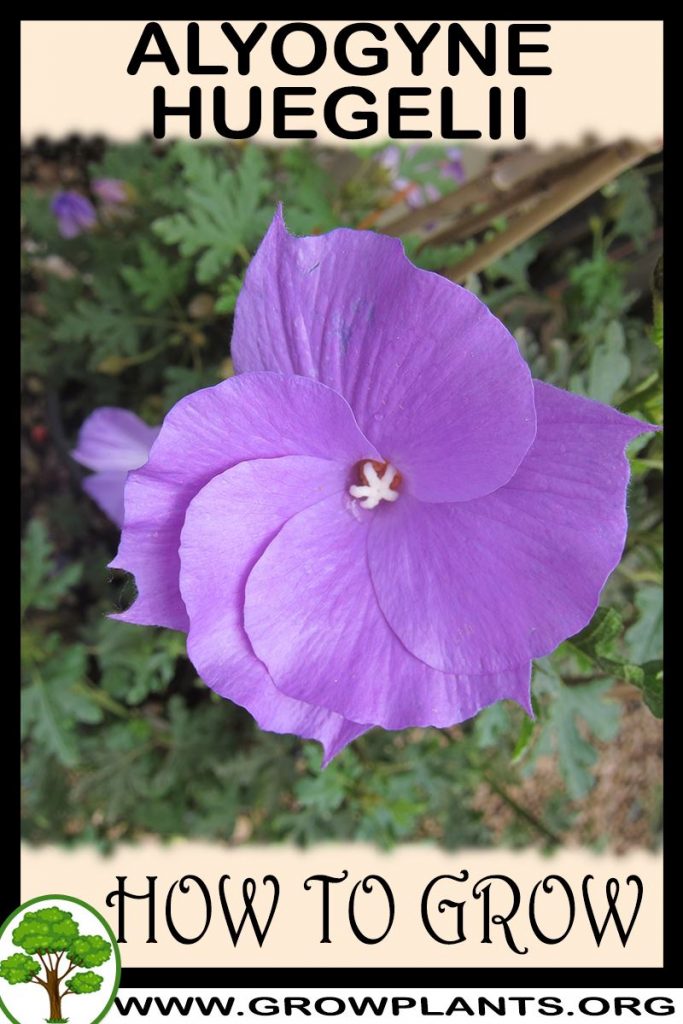
Plant Profile & Key Characteristics
Overview: Alyogyne huegelii (lilac hibiscus) is a fast-growing deciduous shrub reaching 1-2 m (3-6.5 ft), in the mallow family. It is grown mainly as an ornamental flowering hedge for its large hibiscus-like blooms.
Quick Specifications
| Specification | Attribute |
|---|---|
| Plant Type / Life Cycle | Perennial (woody shrub) |
| Foliage Type | Deciduous |
| Mature Size | 1-2 m (3-6.5 ft) tall |
| Growth Rate | Fast to moderate |
| Toxicity | Non-toxic (mallow family) |
| Hardiness | USDA zone 9+ |
Growth Form & Structure
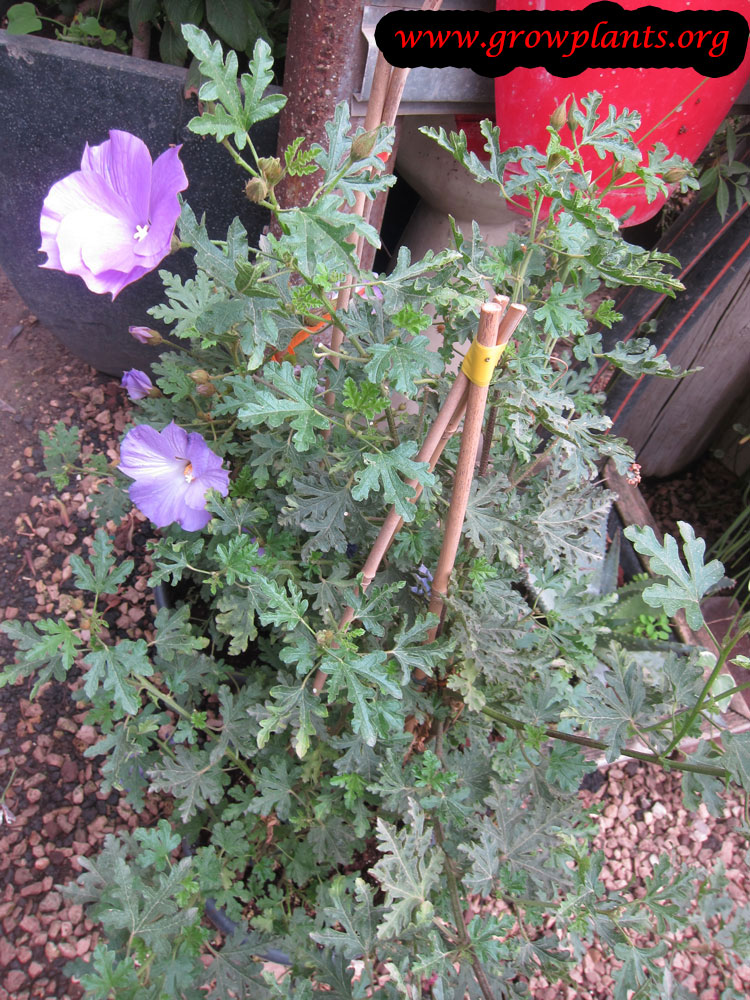
- Height & Spread: 1-2 m (3-6.5 ft) tall in the ground; also suited to large planters and containers
- Growth Habit & Form: Upright, bushy shrub often used as an informal hedge; can be vigorous and self-seeding
- Lifespan & Maturity: Reaches full size quickly under good conditions
Anatomy & Physical Features
- Leaves & Foliage: Green, deeply lobed and jagged leaves, usually with five lobes
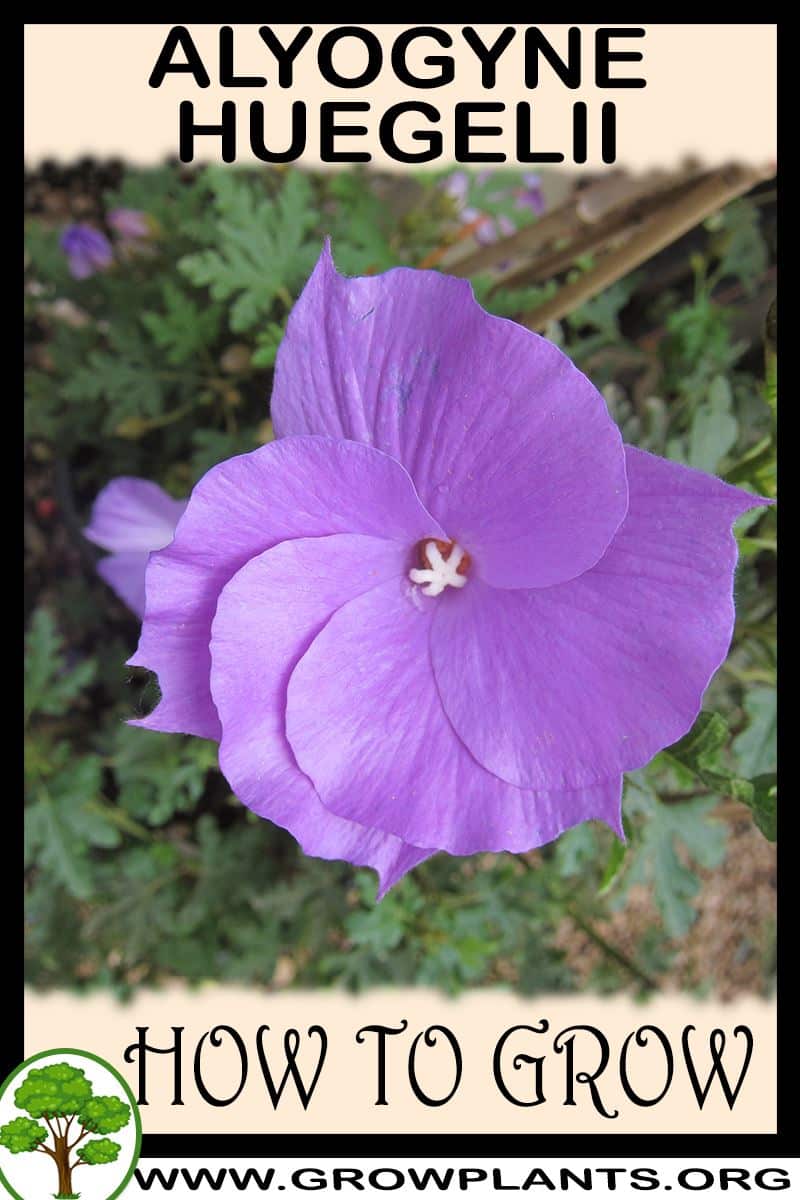
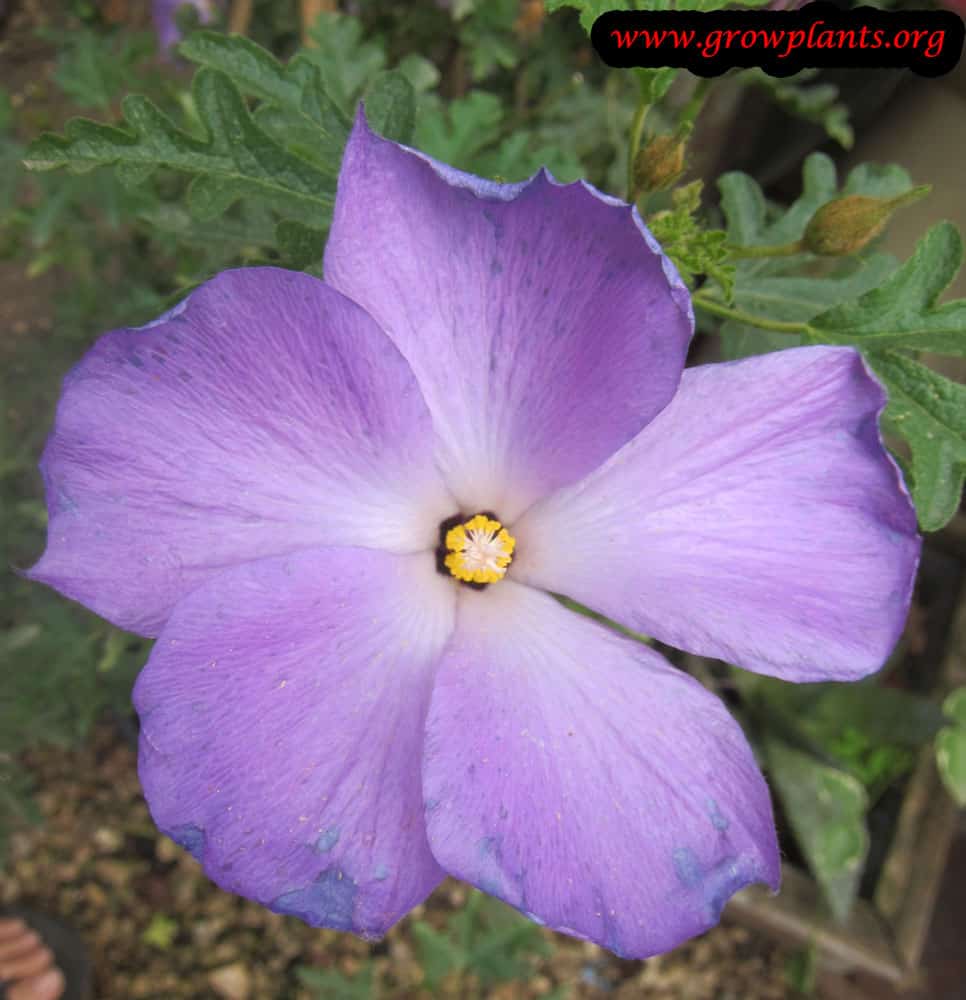
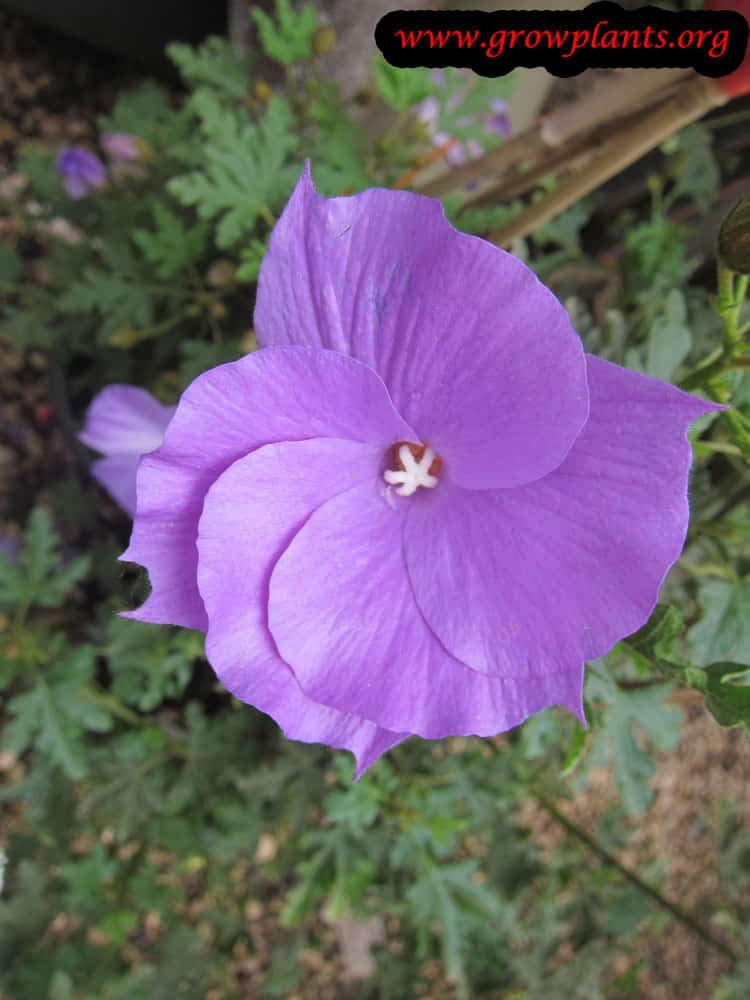
- Flower Characteristics: Large trumpet- to saucer-shaped blooms in purple, white or pink with a darker red-burgundy centre and five petals (see the Bloom guide)
Primary Uses & Landscape Value
- Functional & Ornamental Roles: Ornamental flowering shrub and informal hedge or screen
Care Guide: Planting, Soil & Watering
Overview: Alyogyne huegelii (lilac hibiscus) is a fast-growing evergreen-to-deciduous shrub for warm, frost-free gardens (hardiness zone 9+), flowering best in full sun to light shade. It performs best in light, well-draining soil and, once established, tolerates dry spells well.
Quick Care Requirements
| Requirement | Ideal Condition |
|---|---|
| Planting Season | In the mild part of the year – winter, spring or summer in frost-free zones |
| Growth Rate | Moderate to Fast |
| Soil Type | Light, well-draining soil |
| Water Need | Moderate – water regularly while establishing, then let the top of the soil dry between waterings |
Planting & Establishment
- Best Planting Season: Plant during the cooler, milder months – winter through spring, or summer in frost-free areas – to let roots establish before extremes.
- How to Plant:
- Hole Preparation: Dig a hole about twice the width of the root ball to loosen the surrounding soil for the fast-spreading roots.
- Soil Amendments: On heavy ground, work in compost and coarse grit to improve drainage; this shrub dislikes wet feet.
- Planting Depth: Set the root ball so its top sits level with the surrounding soil, keeping the stem base unburied.
- Growth Speed & Expectations: A vigorous shrub that can reach 1-2 m fairly quickly, rewarding a sunny, sharply-drained spot with abundant hibiscus-like blooms.
Soil, Watering & Drainage Care
- Soil Mix & Drainage Needs: Sharp drainage is the priority, as waterlogged soil causes root problems. In pots use a free-draining potting mix and a container with generous drainage.
- Watering Schedule & Technique:
- Young / Newly Planted: Water regularly to keep the root zone moist while the young shrub establishes in its first season.
- Established: Water deeply but infrequently, letting the top few centimetres dry between waterings; established plants are quite drought-tolerant.
- Seasonal Adjustments: Water more in prolonged summer heat and reduce sharply in cool or wet weather.
Climate, Light & Hardiness
Lilac hibiscus grows in subtropical, Mediterranean, temperate, and tropical climates, hardy outdoors from about zone 9 upward. It grows in full sun to half shade and has moderate cold tolerance typical of a warm–temperate shrub.
Quick Climate Specifications
| Climate Zones | Subtropics, Mediterranean, temperate, tropics |
|---|---|
| USDA Hardiness Zones | 9+ |
| Frost Tolerance | Moderate |
| Light Conditions | Full Sun to Half Shade |
Sunlight & Light Exposure
Grows best in full sun to half shade; full sun supports the fullest, most continuous flowering.
Temperature Extremes & Hardiness
USDA Hardiness & Regional Limits
Hardy outdoors from about zone 9 upward; further north it needs a warm, sheltered site or container culture with winter protection.
Cold Damage & Winter Protection
Hard freezes can damage or kill top growth; a warm, sheltered position and well–drained soil help at the cooler edge of its range.
Frost Sensitivity
Tolerates only light, brief frost once established; harder freezes cause significant dieback.
Wind, Humidity & Microclimate
Its well–drained soil preference and Mediterranean/subtropical adaptability suggest good tolerance of dry, breezy conditions typical of those climates.
Growing in Pots, Balconies & Indoors
Blue hibiscus (Alyogyne huegelii) is a free-flowering, sun-loving shrub that the grower marks as not a houseplant but confirms can be grown in containers. In a pot on a sunny patio or balcony it flowers well; indoors it lacks the light to bloom.
Quick Details
- Container Size: A medium to large pot (mature size 1-2 m)
- Indoor Suitability: Not a houseplant – needs full sun to flower
- Best Spot: Full sun to part shade
- Soil & Drainage: Free-draining, light mix
- Watering in Pots: Moderate to generous; let the surface dry between waterings
Indoors & On the Windowsill
- Not a houseplant: Marked No – it needs full sun to flower, which indoor light cannot supply; blooms fade in shade.
- Windowsill: A very bright, sunny sill might sustain a young plant, but expect little flowering without strong direct sun.
On a Balcony or Patio
- Light & shelter: The sunniest spot; shelter from strong wind and stake if exposed, as it is a soft-wooded shrub.
- Watering & heat: Pots dry fast against warm walls – check often in summer, but avoid waterlogging.
- Overwintering: Frost-tender – move the pot under cover where winters are cold.
Choosing the Pot, Soil & Long-Term Care
- Pot & drainage: A medium-to-large pot with strong drainage holes; skip a standing-water saucer to avoid root rot. Terracotta breathes and dries fast, while glazed or plastic holds moisture longer.
- Potting mix: A well-aerated, organic-rich mix – peat or coir blended with perlite or vermiculite for free drainage.
- Feeding: Potted plants run their soil down fast as nutrients leach out, so feed more often than plants in open ground during active growth.
- Repotting: Refresh the mix or pot up about every two years; on established plants, lightly prune the root ball and top growth to keep them balanced.
Fertilizing & Feeding
A fast-growing flowering hedge shrub that benefits from a steady, moderate feeding program through its growing and blooming months, tapering off as it moves into its winter rest.
Quick Fertilizing Specs
| Feeding Level | Moderate |
|---|---|
| young_feeding | Keep feeding light while a newly planted shrub establishes its root system |
| mature_feeding | A steady, moderate program from spring growth through summer bloom |
| Main Nutrient Priority | A balanced, complete fertilizer with adequate nitrogen to support hedge growth and flowering |
| Best Feeding Period | Spring into summer, as new growth and flower buds develop |
| Organic Options | Well-rotted compost worked into the root zone supports steady background fertility for a hedge planting |
| Micronutrients | Iron is worth watching for in alkaline or heavy soils, where new growth can turn pale |
| Soil pH | Prefers well-drained soil and tolerates a range of pH, though heavy alkaline ground raises the risk of iron chlorosis |
| Reduce/Stop Feeding | Stop feeding as the shrub sheds leaves and enters its winter rest |
Feeding by Growth Stage
Spring growth flush
Support fresh leaf and stem growth as the shrub comes out of winter dormancy
| Nutrient direction | A balanced, complete fertilizer with adequate nitrogen to drive new foliage and set up strong bloom later |
|---|---|
| Timing | As new growth resumes in spring after winter dormancy |
| Frequency | A steady, moderate feeding as new growth pushes out is generally sufficient |
| Fertilizer types | A balanced, complete granular or liquid fertilizer, Well-rotted compost worked into the surrounding soil |
| Routine trace nutrients | iron |
| Precautions | Avoid heavy nitrogen-only feeding, which can push soft growth at the expense of flowering later in the season |
Bloom period
Sustain flower production through the spring and summer bloom window
| Nutrient direction | A balanced, complete fertilizer; there is no need to shift toward a high-phosphorus ‘bloom booster’ product |
|---|---|
| Timing | Spring through summer while the shrub is actively flowering |
| Frequency | A moderate, well-spaced feeding program through the bloom period supports continued flowering |
| Fertilizer types | A balanced, complete granular or liquid fertilizer, Diluted liquid feed for container-grown plants |
| Routine trace nutrients | iron |
| Precautions | Deadhead spent flowers and avoid over-fertilizing, which can encourage leafy growth over continued bloom |
Winter dormancy
Let the shrub rest through its natural leaf-drop and slowdown period
| Nutrient direction | None – withhold fertilizer while the plant is dormant |
|---|---|
| Timing | Winter, while the shrub has dropped leaves and growth has stopped |
| Frequency | No feeding is needed during dormancy |
| Fertilizer types | No feeding is needed at this stage; resume only once new spring growth appears |
| Precautions | Do not fertilize a dormant shrub; wait for clear signs of new spring growth before feeding again |
Nutrient Deficiency Signs & Corrections
Overall pale, weak growth with smaller-than-normal leaves and reduced flowering
| Possible causes | Nitrogen deficiency, Root competition from surrounding plants or a hedge row, Poor soil fertility or infrequent feeding |
|---|---|
| Appears first on | General foliage, most noticeable on older leaves first |
| What to check | Feeding history, Soil fertility and organic matter content, Root competition from nearby hedge plants |
| Possible correction | Apply a balanced, complete fertilizer with adequate nitrogen and improve soil organic matter over time |
New growth emerges pale yellow with green veins while older leaves stay a normal green
| Possible causes | Iron deficiency, Alkaline soil limiting iron availability, Waterlogged or compacted soil restricting root uptake |
|---|---|
| Appears first on | Newest leaves |
| What to check | Soil pH, Drainage around the root zone, Recent watering practices |
| Possible correction | Correct pH where practical and apply a chelated iron product per its label if the pattern continues |
Leaf margins on older leaves show scorching or yellowing and flowering is reduced or weak
| Possible causes | Potassium deficiency, Long-term feeding with a nitrogen-heavy, potassium-poor fertilizer, Sandy or well-leached soil low in potassium |
|---|---|
| Appears first on | Older leaf margins first |
| What to check | Feeding history and fertilizer type used, Soil texture and drainage, Overall bloom performance compared to previous seasons |
| Possible correction | Switch to a balanced, complete fertilizer that reliably supplies potassium alongside nitrogen |
Pruning, Training & Seasonal Maintenance
Alyogyne huegelii (Lilac hibiscus) is a fast-to-medium growing, hibiscus-relative shrub grown as an informal specimen or clipped ornamental hedge for its large trumpet flowers. It sheds some or all of its leaves in the cool season, and winter – while it is bare or lightly leaved – is the best window for structural and shaping cuts, because flowers form on the coming season’s new growth: a winter prune sets up a fuller spring/summer bloom rather than removing it. Its vigorous growth rate means it takes shaping and hedging well, but heavy cuts should still be timed to winter dormancy, not to the active flowering season.
Quick Pruning & Maintenance Specs
| Pruning Tolerance | Moderate – vigorous growth supports shaping/hedging cuts, but timing matters |
| Primary Pruning Window | Winter (dormant/leafless season) |
| Secondary Maintenance Window | Light deadheading during spring/summer bloom |
| Typical Frequency | Annual winter shape/renewal, plus deadheading as needed |
| Main Objective | Shape or hedge form, and setting up next season’s flowering wood |
| Young Plant Priority | Pinch tips to encourage branching and a full, multi-stemmed form given its fast growth |
| Mature Plant Priority | Winter structural shaping or hedge trim; periodically renew the oldest wood at the base |
| Best Tool Type | Bypass secateurs for informal/selective shaping; hedge shears only if formally clipped as a hedge |
| Avoid Heavy Pruning During | Active spring/summer flowering – this removes the current season’s blooms and developing buds |
Pruning by Plant Age & Size
Newly Established
Remove only damaged growth while the root system establishes; do not hard-prune a first-year plant.
Young / Formative
Pinch the tips of young plants to encourage branching and build a full, multi-stemmed form – particularly useful if training the plant as a hedge, given how fast it grows.
Mature / Established
Winter shaping or hedge trim to maintain size and form; periodically remove the oldest, least productive wood at the base to renew vigor on this fast-growing shrub.
Seasonal Pruning Schedule
Dormant / Winter
Objective: the main structural or shaping cut while the plant is bare or lightly leaved, ahead of spring growth. Remove: crossing or crowded stems, spent old wood, and hedge-shaping cuts. Do not remove: more than roughly a third of the canopy at once on an older, woodier specimen. Expected response: a vigorous new growth flush from spring. Flowering impact: positive – removing old wood stimulates the new growth that carries the spring/summer flowers.
Ongoing Sanitary (bloom season)
Objective: tidy appearance and reduce self-seeding. Remove: spent flower heads. Do not remove: developing buds or flowers still opening. Expected response: encourages continued bloom. Flowering impact: neutral to positive, and specifically curbs the unwanted seedlings this species is noted to produce.
Flowering & Fruiting Wood
Like its hibiscus relatives, Alyogyne huegelii blooms on the current season’s new growth rather than on older wood. A winter structural prune, done while the plant is dormant or bare and before the spring flush begins, does not sacrifice the coming season’s flowers – it stimulates the new growth that will carry them. Avoid hard cuts once spring growth and flower buds are already forming, since that removes flowering wood that is actively developing.
Structural Pruning & Training
Remove crossing or rubbing branches and reduce interior congestion to keep an open, floriferous form. Control height and spread with the winter shaping cut. Renewal-prune the oldest, woodiest stems at the base periodically on this fast grower to keep the shrub, or hedge, full rather than leggy.
Special Growth to Remove
- Spent flower heads – deadhead regularly, both to encourage continued bloom and specifically to curb the self-seeding this species is noted to be prone to (listed growing difficulty: "Invasive").
- Any dead wood following winter dieback.
Container & Small-Space Pruning
This species can be grown in a large planter. The same winter-shaping principle applies at a smaller scale, with more frequent light tip-pinching through the growing season to keep a compact, well-branched container specimen rather than relying on one big winter cut alone.
Tools
Bypass secateurs for selective, informal shaping and deadheading; hedge shears only where the plant is being maintained as a formal clipped hedge. On an informal specimen, selective cuts with secateurs preserve a better natural flowering form than shearing the whole surface.
Tool Hygiene & Disease Risk
Routine for pruning cuts – clean, sharp tools are enough. This species’ known pest issue (nematode-induced root galls) is soil-borne, not spread through pruning cuts, so no special blade-sterilization protocol is warranted on that account.
Cut Placement & Technique
Use thinning cuts back to a healthy bud or side-branch for informal shaping to preserve natural form. For a clipped hedge, shear to a consistent outline, accepting a less naturalistic bloom display in exchange. Deadhead spent flowers just above the next set of healthy leaves or buds.
Heavy Pruning & Rejuvenation
Tolerated reasonably well given this plant’s fast-to-medium growth rate: an overgrown or leggy specimen can be cut back hard in winter to renew its shape, expecting a vigorous spring flush. This will delay and reduce that season’s flowering while the plant regrows, so avoid rejuvenating every single year.
Post-Pruning Care
Normal watering after a winter structural prune is enough; avoid extra feeding timed to the cut, since the plant’s own vigorous growth habit will drive regrowth on its own.
Common Pruning Mistakes
- Pruning hard during active spring/summer bloom, removing the season’s flowers.
- Letting spent flowers go to seed, feeding this species’ noted tendency to self-seed and become a nuisance.
- Shearing a specimen meant to look informal, sacrificing flowering wood and natural form for a boxy outline.
When NOT to Prune
Avoid pruning during active spring/summer flowering, which removes current and developing blooms. Avoid heavy pruning during hot, dry stress periods.
Recommended Tools (by task)
- bypass_secateurs – selective winter shaping cuts and deadheading on an informal specimen.
- hedge_shears – only if the plant is maintained as a formal clipped hedge.
- loppers – removing older, thicker renewal wood at the base on a mature shrub.
Pruning Troubleshooting
| Problem | Possible Cause | What to Check | Corrective Action |
| Few or no flowers after pruning | Pruning was done during spring/summer, removing current-season flowering wood, or missed the winter window entirely | When the last prune was done relative to bloom season | Shift structural pruning to winter; limit summer work to light deadheading only |
| Unwanted seedlings appearing around the plant | Spent flowers were left to set seed, consistent with this species’ noted self-seeding tendency | Whether deadheading has been kept up through the bloom season | Deadhead spent flowers regularly before they set seed |
| Sparse, leggy growth despite regular shearing | Repeated surface shearing leaves a hollow, unproductive interior on a shrub that flowers better with selective thinning | Canopy density and where flowers are actually forming (mostly at the surface) | Periodically renewal-prune some older stems back hard in winter to stimulate fresh interior growth |
Propagation Guide
Lilac hibiscus is most reliably propagated from semi-hardwood stem cuttings, which preserve the exact flower colour of the parent plant since the site notes flower colour varies (purple, white, or pink) and seed-grown plants won’t necessarily match. Cuttings root readily and this fast-to-medium growing shrub is generally easy to propagate.
Quick Propagation Specs
| Best Propagation Method | Semi-hardwood stem cuttings |
| Alternative Methods | Seed |
| Propagation Difficulty | Easy |
| Seed True-to-Type | Variable (flower colour can vary between purple, white, and pink) |
| Vegetative True-to-Type | Yes (cuttings match the parent’s flower colour) |
| Best Propagation Season | Cuttings taken in the active growing season, spring–summer, per the site’s planting window |
| Cutting Rooting Time | Commonly a few weeks under warm, humid conditions |
| Germination Temperature | About 20–25°C (68–77°F) |
| Seed Sowing Depth | Shallow, just covered |
Growing from Seed
Seed Handling & Viability
No special handling is typically needed; sow reasonably fresh seed for best results.
Dormancy & Pre-Sowing Treatment
A brief soak, or lightly nicking the hard seed coat, can help germination along, as with many shrubby mallow-family relatives.
Sowing Season
Sow in the warmer months, matching the site’s winter–spring–summer planting window.
Sowing Depth & Orientation
Sow shallow, seed just covered, in a well-draining mix.
Germination Conditions
Warm, evenly moist conditions suit germination.
Germination Time
Commonly a few weeks.
Seedling Care
Seedlings grow away quickly, in keeping with this shrub’s fast-to-medium growth rate; pinch young plants to encourage bushiness.
Stem Cuttings
Cutting Type
Semi-hardwood tip cuttings taken from non-flowering shoots root most reliably; softwood cuttings can also be used earlier in the growing season.
Best Timing
Take cuttings during active growth, spring into summer, rather than the site’s winter pruning window – winter material is more dormant and roots less readily.
Cutting Preparation
Take a short tip cutting with a few leaves, remove the lower leaves, and trim just below a node.
Rooting Setup
A free-draining cutting mix (such as perlite or sand blended with potting mix), kept consistently moist with high humidity around the leaves (a propagator lid or covered pot helps), roots this shrub well.
Rooting Hormone
Not strictly necessary – this species is a relatively easy rooter – but a rooting hormone can speed things along and improve consistency.
Rooting Time
Commonly a few weeks under warm, humid conditions.
Bloom & Flower Guide
Quick Details
- Bloom Season: Spring and summer
- Time to First Bloom: Often in its first year, on a well-grown young plant
- Flower Appearance: Large trumpet-shaped flowers with five petals in white, purple or pink, with a deep red-burgundy centre
- Edibility: Ornamental – grown for its flowers, not for eating
Detailed Blooming Overview
Alyogyne huegelii (lilac hibiscus) is a fast-growing shrub that carries big, silky, hibiscus-like flowers through spring and summer. Each bloom is a broad trumpet of five overlapping petals in soft purple, pink or white, glowing with a rich red-burgundy eye at the centre. Individual flowers are short-lived, but the plant produces them in succession over a long season.
Flower Characteristics
- Large, trumpet-shaped flowers with five petals.
- Colours white, purple or pink.
- A deep red-burgundy centre.
Bloom Care & Thinning
- Prolonging the display: A light trim after the main flush keeps the shrub bushy and encourages more buds; each flower lasts only a day or two, so fresh ones open continually.
- Encouraging bloom: Full sun and free-draining soil bring the best flowering on this drought-tolerant shrub.
Pests, Diseases & Troubleshooting
Overview: Alyogyne huegelii (blue hibiscus) is a fast, drought-tolerant Australian Malvaceae shrub that is largely pest-resistant in the open garden but, like true hibiscus, attracts sap-sucking pests – aphids, whitefly, spider mites, mealybugs and scale – on soft new growth. Its single greatest killer is root rot in wet or heavy soil, so sharp drainage and restrained watering matter more than any spray.
Quick Troubleshooting Overview
| Issue / Pest | Main Symptom | Primary Solution |
|---|---|---|
| Aphids | Sticky, curled shoot tips and buds | Water-blast, beneficials, insecticidal soap |
| Whitefly | White flies clouding leaf undersides | Yellow sticky traps, Encarsia, insecticidal soap |
| Spider mites | Stippling, bronzing and webbing in heat | Hose foliage, predatory mites, horticultural oil |
| Mealybugs & scale | White tufts / brown bumps, sooty mould | Alcohol swab, horticultural oil, encourage predators |
| Root-knot nematode | Root galls, stunting, wilting in heat | Improve soil life, mulch, avoid infested soil |
| Root rot | Wilting in wet soil, blackened roots | Plant high in sharp-draining soil, water less |
Common Pests & Management
- Aphids (Aphis / Myzus spp.):
- Symptoms: Clusters of soft green or black insects on new shoots and buds, causing curling, sticky honeydew and sooty mould; can cause bud drop.
- Prevention & Control: Blast off with water, conserve ladybirds and lacewings, control ants, and use insecticidal soap or neem on undersides for persistent colonies.
- Whitefly (Trialeurodes vaporariorum / Bemisia spp.):
- Symptoms: Tiny white flies rising in clouds when the shrub is brushed; nymphs and honeydew on leaf undersides encourage sooty mould, a classic Malvaceae problem.
- Prevention & Control: Hang yellow sticky traps, introduce Encarsia parasitic wasps, keep plants unstressed, and wash foliage or apply insecticidal soap to undersides.
- Two-spotted spider mite (Tetranychus urticae):
- Symptoms: Fine pale stippling, dull bronzed leaves and delicate webbing in hot, dry weather; heavy attacks cause leaf drop.
- Prevention & Control: Avoid drought stress, hose down foliage, release predatory mites (Phytoseiulus), and apply horticultural oil or insecticidal soap.
- Mealybugs (Pseudococcus / Planococcus spp.):
- Symptoms: White cottony waxy masses in leaf axils and shoot tips with honeydew and distorted growth.
- Prevention & Control: Dab with an alcohol swab, wash plants down, introduce mealybug destroyer (Cryptolaemus), and use horticultural oil for lingering colonies.
- Scale insects (Coccus / Saissetia spp.):
- Symptoms: Small brown, tan or waxy bumps along stems and leaf veins that suck sap and drip honeydew, weakening the plant.
- Prevention & Control: Scrub off light infestations, prune out heavily encrusted wood, encourage parasitic wasps and ladybirds, and smother crawlers with horticultural oil.
- Root-knot nematode (Meloidogyne spp.):
- Symptoms: Stunting, poor vigour and heat-of-day wilting despite moisture; roots show characteristic swollen galls when lifted (matching the source ‘nematode/galls’ note).
- Prevention & Control: Build up soil organic matter and beneficial microbes, mulch to keep roots cool, avoid moving infested soil, and grow in fresh or solarised soil where galling has occurred.
Diseases & Fungal Issues
- Root and collar rot (Phytophthora / Pythium spp.):
- Symptoms: Sudden wilting, yellowing and dieback in wet or heavy soil, with dark, decayed roots and stem base; the most common cause of plant loss.
- Treatment & Management: Plant high in sharp, free-draining soil, never waterlog, water deeply but infrequently, and remove and replace badly affected plants; improve drainage before replanting.
- Leaf spot (Fungal (various)):
- Symptoms: Brown or purplish leaf spots in humid, crowded or overhead-watered conditions.
- Treatment & Management: Improve airflow and spacing, water at the base, remove spotted leaves, and apply a copper fungicide only if spread is significant.
- Sooty mould (Capnodium spp.):
- Symptoms: Black superficial coating on leaves following honeydew from aphids, whitefly, mealybugs or scale, reducing light to the leaf.
- Treatment & Management: Control the underlying sap-suckers; the mould then weathers away, and foliage can be washed to speed recovery.
Growing Difficulties & Abiotic Problems
- Root rot from overwatering / heavy soil:
- Cause & Symptoms: Blue hibiscus resents wet feet; soggy or clay soil suffocates roots and causes wilting and collapse.
- Correction Strategy: Grow in gritty, free-draining soil or raised beds, water deeply but let it dry between times, and avoid summer overwatering.
- Frost damage:
- Cause & Symptoms: Growth blackens and dies back in hard frost; it is only lightly frost-hardy.
- Correction Strategy: Site in a warm, sheltered spot, protect young plants with fleece, and prune out frost-killed wood in spring.
- Iron chlorosis:
- Cause & Symptoms: Yellowing between veins on young leaves in very alkaline soils.
- Correction Strategy: Add organic matter, avoid overwatering, and apply chelated iron if needed.
- Bud drop:
- Cause & Symptoms: Sudden changes in water, heat or feeding cause flower buds to drop before opening.
- Correction Strategy: Keep watering and conditions even, avoid drought stress, and feed moderately with a balanced low-nitrogen fertiliser.
What Helps – Products & Tools
Favour cultural fixes and gentle products: insecticidal soap and horticultural/neem oil for aphids, whitefly, mites, mealybugs and scale crawlers; yellow sticky traps for whitefly; and, for disease, sharp drainage plus a copper fungicide for leaf spot. There is no simple cure for root-knot nematode, so rely on healthy soil, mulch and clean planting sites. Spray oils in the evening to protect pollinators and follow the label.
Frequently Asked Questions
How do you grow and care for Alyogyne huegelii?
Grow Alyogyne huegelii in light, well-draining soil in full sun to light shade, where it flowers best; it is a fast grower suited to frost-free gardens (hardiness zone 9+). Water regularly to keep the root zone moist while a young shrub establishes, then once established water deeply but infrequently, letting the top few centimetres dry between waterings, since it tolerates dry spells well.
What is Alyogyne huegelii?
Alyogyne huegelii, the lilac hibiscus, is an ornamental shrub grown for its large, satiny mauve-purple, hibiscus-like flowers, and is often planted as a flowering informal hedge.
When should you prune Alyogyne huegelii?
Prune in winter, while the shrub is bare or lightly leaved – this is the best window for structural and shaping cuts, because flowers form on the coming season’s new growth. Avoid pruning during active spring/summer flowering, which removes current and developing blooms; limit summer work to light deadheading only.
Can you grow Alyogyne huegelii from seed?
Yes: sow seed shallow, just covered, in a well-draining mix, and keep it warm and evenly moist, with germination commonly taking a few weeks. Keep in mind that flower colour varies (purple, white, or pink) and seed-grown plants won’t necessarily match the parent, so take semi-hardwood cuttings instead if you want to guarantee a particular flower colour.
Can Alyogyne huegelii be grown in a pot?
Yes, it can be grown in a container on a sunny patio or balcony, where it flowers well; it needs full sun to flower, which indoor light cannot supply, so it isn’t suited as a houseplant. Use a medium to large pot with strong drainage holes and a free-draining, light mix.