
Plant Profile & Key Characteristics
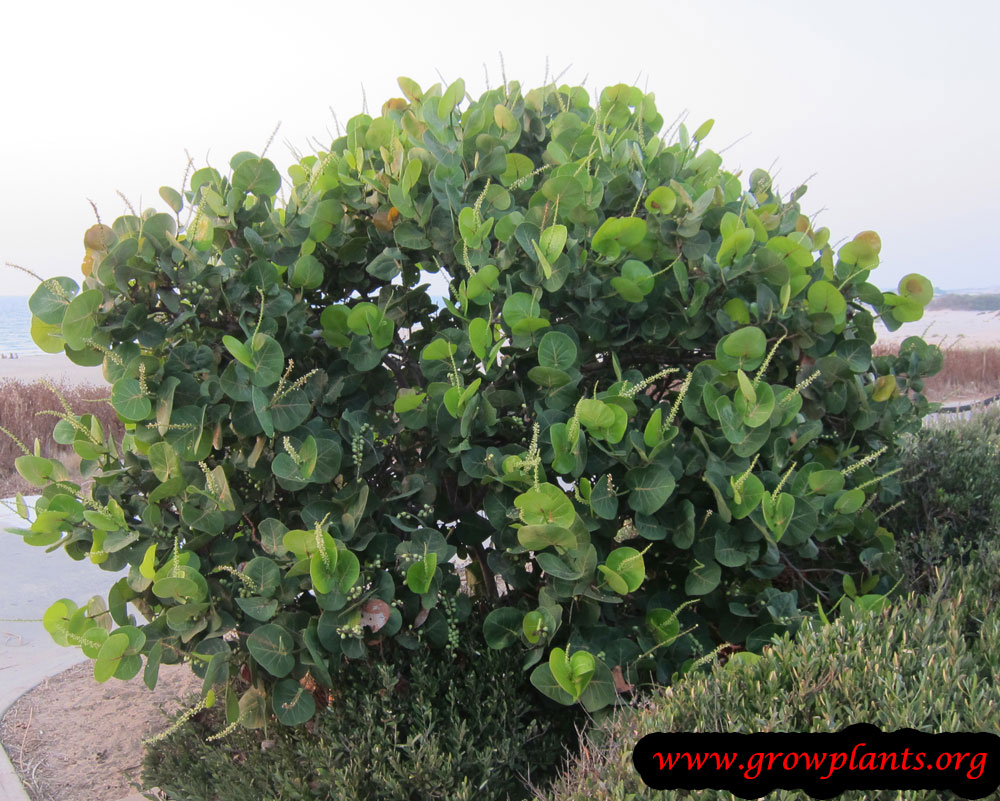
Overview: A versatile evergreen that can be grown as a spreading shrub, single-trunk tree or trained vine, from 1 to 10 m, prized for its round leathery leaves and edible grape-like fruit. It is salt- and coast-tolerant and can also be kept as a hedge or bonsai.
Quick Specifications
| Specification | Attribute |
|---|---|
| Plant Type / Life Cycle | Perennial (evergreen tree / shrub) |
| Foliage Type | Evergreen (semi-deciduous in cooler areas) |
| Mature Size | 1-10 m (3-30 ft) |
| Growth Rate | Fast (moderate in poorer conditions) |
| Toxicity | Non-toxic — fruit edible |
| Hardiness | USDA zone 10+ |
Growth Form & Structure
- Height & Spread: 1-10 m (3-30 ft) depending on training; grows in large containers (25-50 L+), can be kept as bonsai or hedge, and tolerates coastal salt
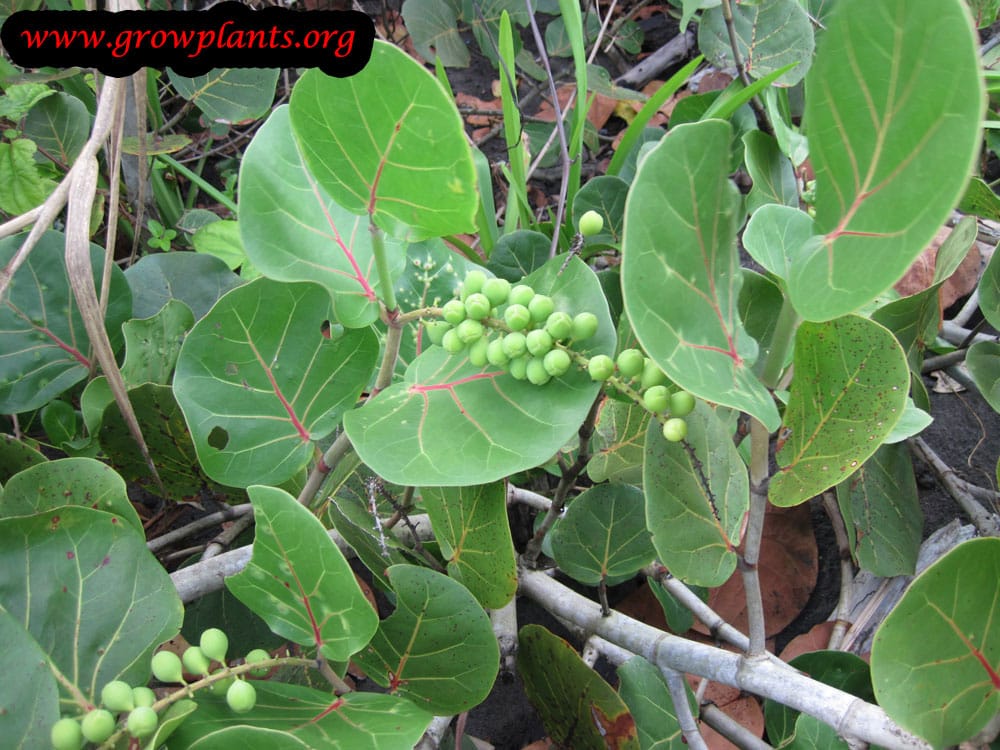
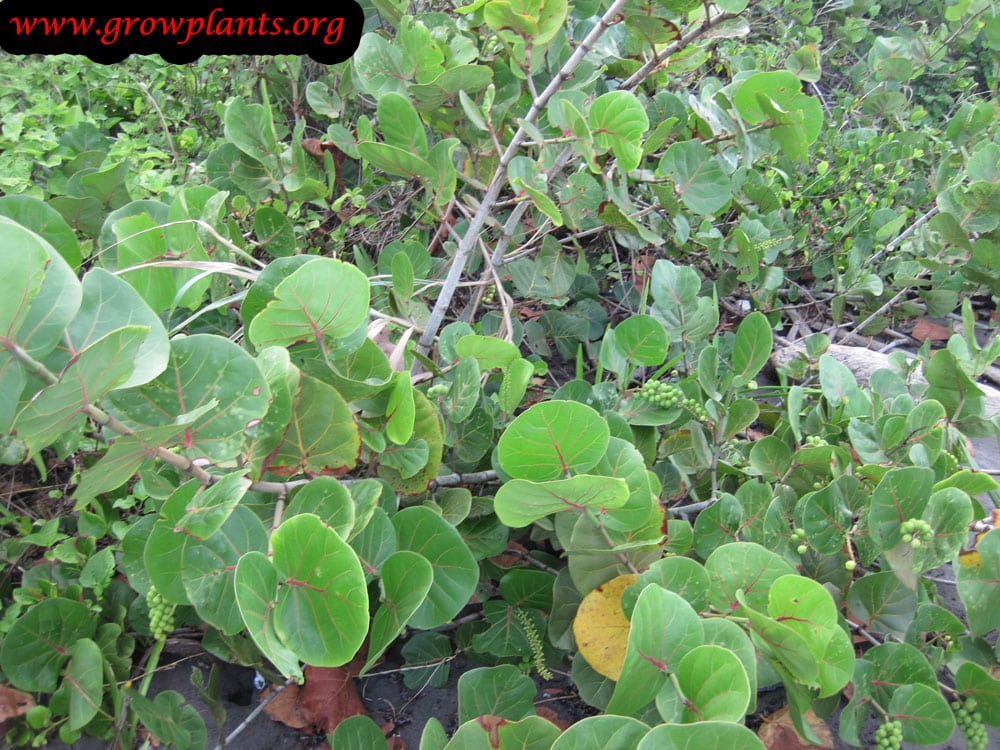
- Growth Habit & Form: Versatile form — grown as a spreading shrub, single-trunk tree or trained vine, with a dense leathery canopy
- Lifespan & Maturity: Long-lived; begins bearing fruit in about 2-5 years
Anatomy & Physical Features
- Trunk & Bark: Can be trained to a single woody trunk as a standard tree or as bonsai
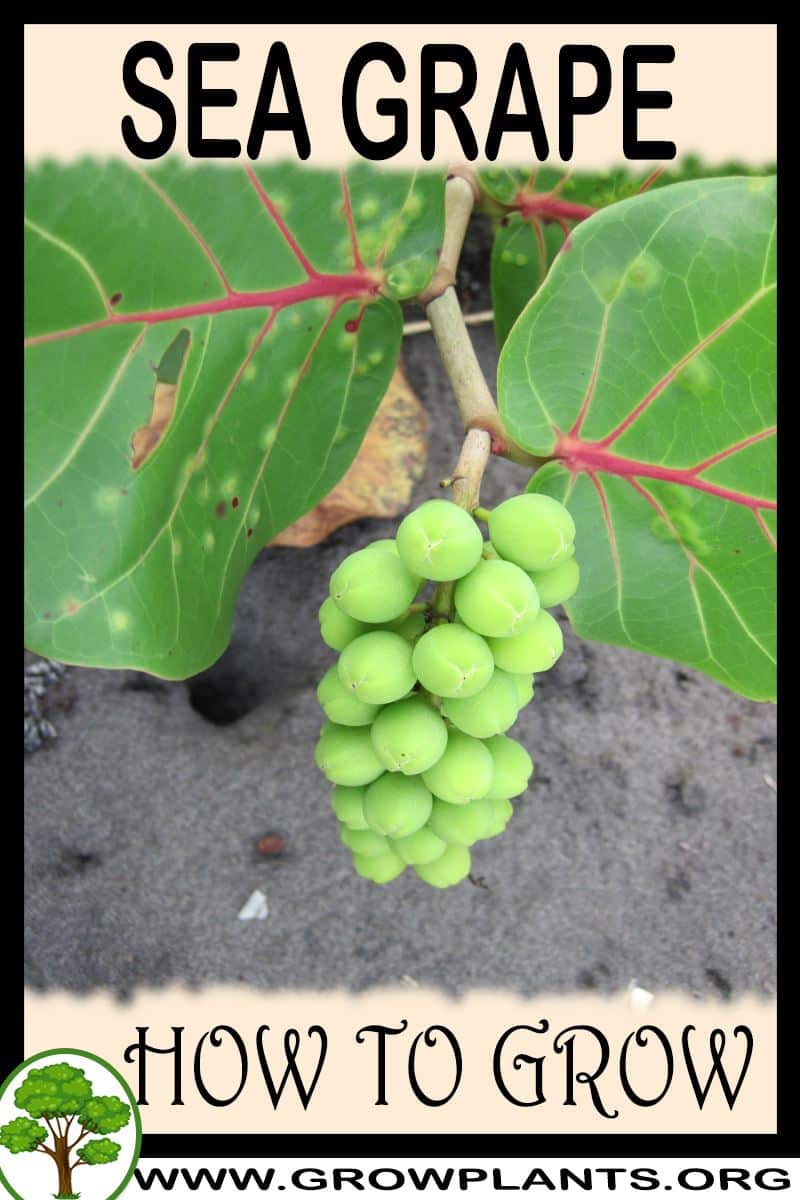
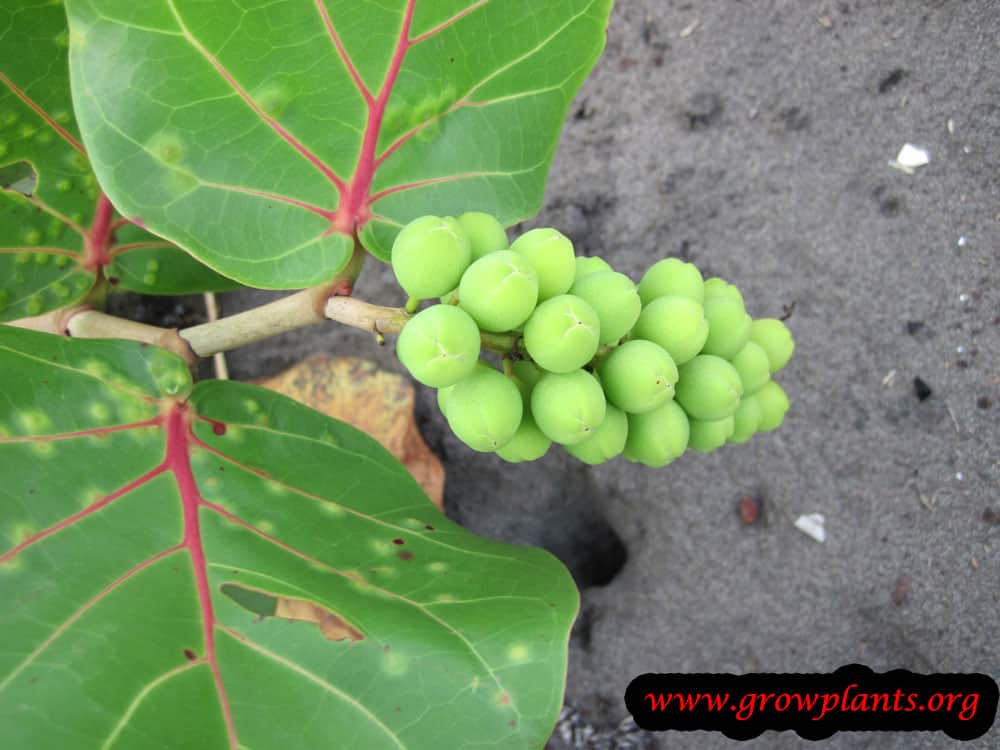
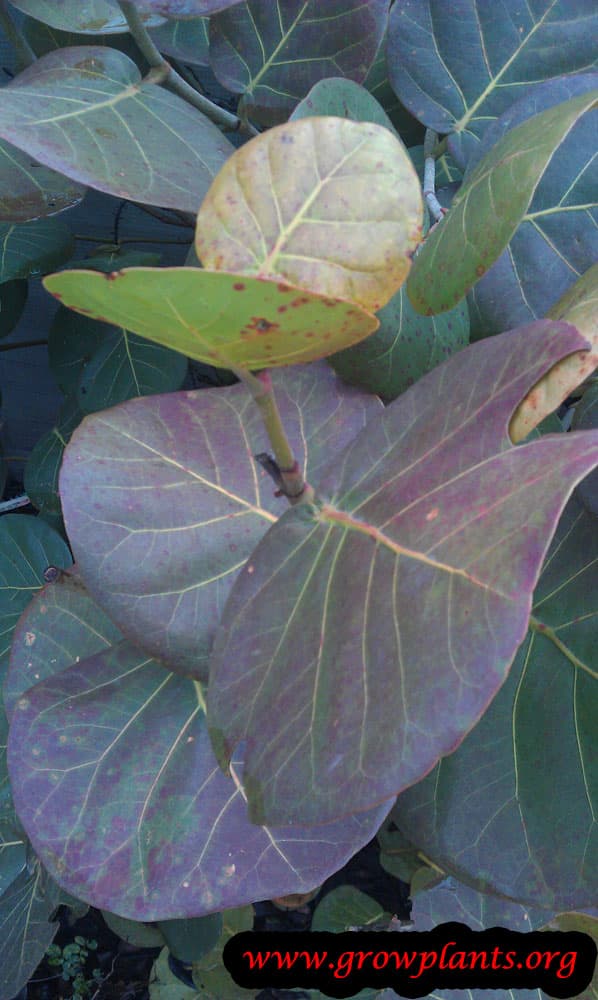
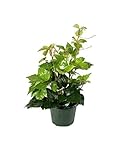
- Leaves & Foliage: Large round to heart-shaped leathery leaves, green ageing to red-orange, with prominent veins
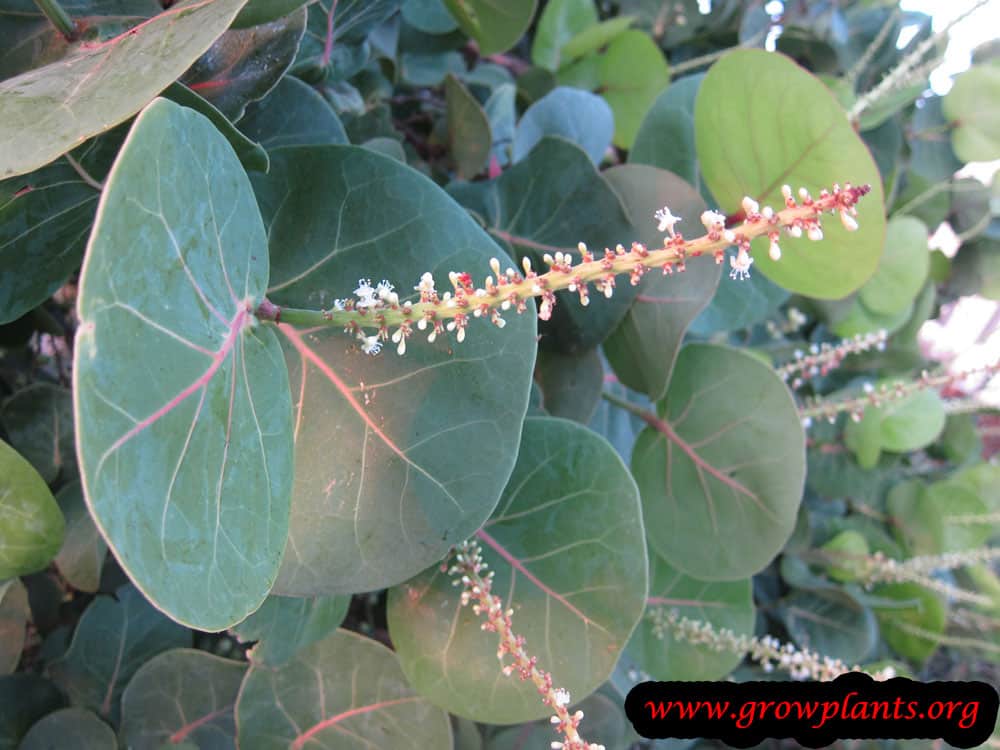
- Flower Characteristics: Small white flowers in clusters; plants are male or female (dioecious), so both are needed for fruit
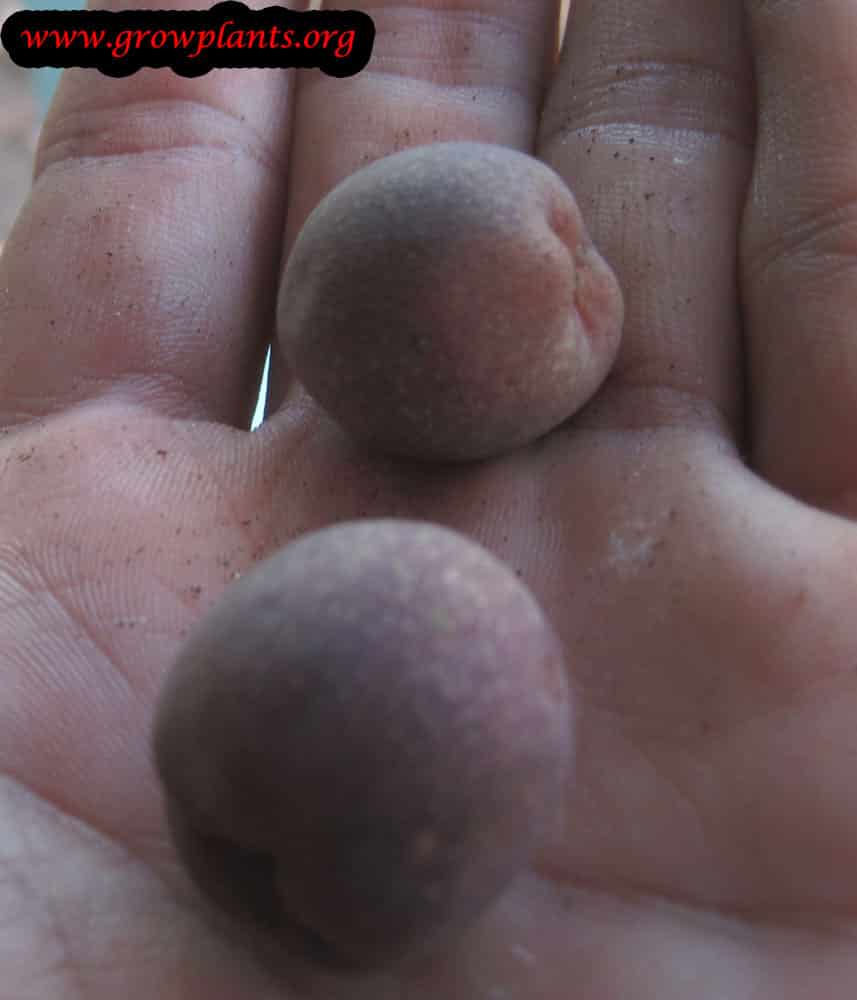
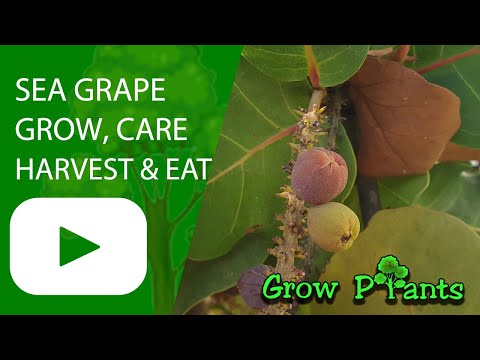
- Fruit Profile: Purple-black grape-like fruit in hanging clusters, eaten fresh
Primary Uses & Landscape Value
- Edible Uses: Fruit eaten raw or made into juice, jam and wine
- Functional & Ornamental Roles: Salt-tolerant coastal ornamental, hedge, shade tree and bonsai subject; can be grown indoors with enough light
Care Guide: Planting, Soil & Watering
Overview: Sea grape is a fast-to-moderate coastal evergreen (hardy to about zone 10+) that thrives in full sun and tolerates salt, wind and drought. It wants well-draining, sandy soil and moderate watering, and can be grown as a shrub, tree, hedge or bonsai.
Quick Care Requirements
| Requirement | Ideal Condition |
|---|---|
| Planting Season | Year-round in the tropics; in spring in cooler areas |
| Growth Rate | Fast (Moderate in less-than-ideal conditions) |
| Soil Type | Sandy, free-draining |
| Water Need | Moderate to High with good drainage |
Planting & Establishment
- Best Planting Season: Plant year-round in tropical climates; in cooler areas plant in spring.
- How to Plant:
- Hole Preparation: Dig a hole as deep as the root ball plus an extra 20–40%, and loosen the root ball slightly before planting.
- Soil Amendments: Mix organic matter, humus and dried leaves into the backfill soil.
- Planting Depth: Set the tree so the root collar sits at soil level; firm gently — enough to stay stable but not compacted — then mulch.
- Growth Speed & Expectations: Fast in ideal coastal conditions and slower otherwise, ranging 1–10 m (3–30 ft); stake young plants so they stay upright.
Soil, Watering & Drainage Care
- Soil Mix & Drainage Needs: Sandy, sharply draining soil suits it best; in containers (25–50 L / 6.5–13 gal) use potting mix or peat with perlite and good drainage.
- Watering Schedule & Technique:
- Young / Newly Planted: Water newly planted trees daily (preferably in the morning) for the first two weeks, then taper off.
- Established: Water established plants moderately to generously, always with good drainage — they are highly salt- and drought-tolerant once rooted.
- Seasonal Adjustments: More during hot, dry spells; less in cool or wet weather.
Climate, Light & Hardiness
Sea grape grows in tropical, Mediterranean, and subtropical climates (or indoors as a houseplant) in full sun to full shade with adequate light, and is best known as a tough beachfront species with excellent wind and salt-spray tolerance. Cold tolerance is limited, so outdoor culture is reliable only from about zone 10 upward.
Quick Climate Specifications
| Climate Zones | Tropical, Mediterranean, Subtropical (or indoor as a houseplant) |
|---|---|
| USDA Hardiness Zones | 10+ |
| Approx. Survival Minimum | approximately −1°C (30°F) at the zone 10 boundary, briefly, for an established plant |
| Frost Tolerance | Low |
| Light Conditions | Full Sun / Half Shade / Full Shade with adequate light |
| Wind Tolerance | High |
| Salt / Coastal Tolerance | High |
Sunlight & Light Exposure
Optimal Light Setup
Full sun gives the densest, most compact growth; the species also tolerates half shade and even fairly deep shade with some light.
Direct Sun Requirement
Not strict – this is a flexible, adaptable species across a wide light range.
Best Exposure / Orientation
Any warm, sheltered-to-exposed site works; it is one of the few species here well suited to fully open, wind- and salt-exposed coastal positions.
Temperature Extremes & Hardiness
USDA Hardiness & Regional Limits
Reliable outdoors from about zone 10 upward; colder areas can grow it as a container or indoor plant.
Cold Damage & Winter Protection
Becomes semi-deciduous in cooler parts of its range as a response to cold; site in the warmest available spot near its hardiness limit.
Frost Sensitivity
Low frost tolerance; not for regions with regular freezes.
Extreme Heat Tolerance
Excellent – a classic beachfront species adapted to intense tropical sun and heat.
Wind, Humidity & Microclimate
Humidity Preferences
Adaptable; naturally found in humid coastal-tropical air but not demanding about it.
Wind Tolerance
Very high – sea grape is a signature dune and beachfront species specifically valued for standing up to strong onshore winds.
Coastal / Salt Tolerance
Very high – among the most salt-spray-tolerant species commonly grown, which is why it is planted right on beaches and dunes.
Microclimate Recommendations
Excellent choice for exposed coastal gardens; elsewhere, any warm, sheltered, sunny-to-shaded site works well.
Growing in Pots, Balconies & Indoors
Sea grape (Coccoloba uvifera) is a 1-10 m (3-30 ft) coastal plant, and the grower confirms it can be grown indoors as a houseplant – given enough light and a well-drained, airy mix. Adaptable and salt-tough, it also makes a fine patio container plant or bonsai, and he gives a detailed potting method (see the Grower’s Tip).
Quick Details
- Container Size: 25-50 L (6.5-13 gal), can go larger; also grows small as a bonsai
- Indoor Suitability: Yes – can be grown indoors with enough light and airy, well-drained soil
- Best Spot: Full sun to full shade with light; very adaptable
- Soil & Drainage: Aerated, organic-rich mix that drains freely
- Watering in Pots: Keep the mix lightly moist – pots dry faster than open ground; water once the surface starts to dry.
Indoors & On the Windowsill
- A real houseplant: Yes – the grower grows it indoors. Give it enough light and a well-drained, ventilated mix, and it adapts well to indoor life.
- Light indoors: Remarkably flexible – it takes full sun through to shade with light – but a bright spot keeps it fullest and healthiest.
- Keep it shaped: Prune and pot-limit it to keep this potentially large plant houseplant-sized; it also trains well as a bonsai.
On a Balcony or Patio
- Light & toughness: A superb balcony plant – it shrugs off sun, wind and salt spray. Pots still dry faster than open ground, so check moisture, but it tolerates dry spells well.
- Overwintering: Frost-tender, so in cold areas keep it potted and move it to a bright indoor spot for winter.
Choosing the Pot, Soil & Long-Term Care
- Pot & drainage: Use good drainage; the grower suggests a saucer for this one. Mix can be potting mix or peat soil with perlite – keep it airy and free-draining.
- Potting mix: Well-aerated, organic-rich mix – peat or coir with perlite and a little organic matter; it must drain freely.
- Feeding: Potted plants use up their food faster because nutrients leach out with each watering, so feed a little more often than plants in open ground.
- Repotting: Switch to a bigger pot when the root ball outgrows it (best in the cool season); once at final size, refresh the soil every few years, cutting some roots and pruning the plant when you do.
Grower’s Container Tip
- Pot up generously, prune when you repot: Start in a container at least 70-90% bigger than the plant and use a working size of at least 25-50 L (6.5-13 gal) – or grow it small as a bonsai. Move up a pot when the roots outgrow the current one, ideally in the cool season. Once at the desired size, refresh the soil every few years, cutting some roots and pruning the top as you do; a saucer under the pot is fine.
Fertilizing & Feeding
A tough, adaptable coastal plant grown as a shrub, small tree, or vine for its fruit, foliage, and form – it is naturally low-demand, so light, balanced feeding is generally enough whether grown outdoors, in a container, or indoors.
Quick Fertilizing Specs
| Feeding Level | light |
|---|---|
| young_feeding | light, balanced feeding to support establishment and early framework growth |
| mature_feeding | light, balanced feeding through the growing season |
| Main Nutrient Priority | balanced feeding; this adaptable species rarely needs a strong nitrogen push |
| Best Feeding Period | spring through the active growing season |
| Organic Options | mulch and organic matter worked in at planting |
| Micronutrients | a complete fertilizer for fruiting shrubs and trees generally supplies routine trace elements |
| Soil pH | adaptable to a wide range of well-drained soils, including coastal, sandy sites |
| Reduce/Stop Feeding | ease off feeding on indoor or container plants during slower, lower-light growth periods |
Feeding by Growth Stage
Newly planted
Establish a newly planted Sea grape with minimal stress.
| Nutrient direction | Keep feeding light and balanced while roots establish; mulch and organic matter matter more than fertilizer at this stage. |
|---|---|
| Timing | Once new growth appears after planting. |
| Frequency | A single light feeding is enough for the first growing season. |
| Fertilizer types | A diluted, balanced fertilizer for young shrubs and trees, Mulch and organic matter around the root zone |
| Precautions | Keep fertilizer away from the base of a newly planted specimen to avoid root scorch. |
Young plant, building growth
Build a strong framework whether trained as a shrub, small tree, or vine.
| Nutrient direction | Keep feeding light and balanced; this species is naturally tough and adaptable and does not need heavy nitrogen to grow well. |
|---|---|
| Timing | Through the active growing season. |
| Frequency | A light feeding or two through the growing season is generally sufficient. |
| Fertilizer types | A balanced fertilizer for young shrubs and trees, applied lightly |
| Routine trace nutrients | iron, manganese |
| Precautions | Prune to establish the desired form – tree, shrub, or trellised vine – rather than relying on feeding to shape growth. |
Established, approaching bearing age
Move an established plant toward reliable flowering and fruit set.
| Nutrient direction | Continue light, balanced feeding as the plant matures, keeping nitrogen moderate as it shifts toward flowering. |
|---|---|
| Timing | Spring into the main growing season. |
| Frequency | A light feeding or two spread across the active season. |
| Fertilizer types | A balanced complete fertilizer for fruiting shrubs and trees |
| Routine trace nutrients | iron, manganese |
| Precautions | Because male and female flowers grow on separate plants, reliable fruiting depends on having both nearby – feeding alone won’t produce fruit clusters without adequate pollination. |
Mature, bearing plant
Support flowering and grape-like fruit cluster development on a mature plant.
| Nutrient direction | Keep feeding light and balanced through bloom and fruit development, matching this species’ naturally light appetite. |
|---|---|
| Timing | From the spring growth flush through fruit development. |
| Frequency | Light feeding through the growing season is enough for this low-demand species. |
| Fertilizer types | A balanced complete fertilizer, applied lightly |
| Routine trace nutrients | iron, manganese |
| Precautions | For container or indoor-grown plants, ease back on feeding whenever growth slows in lower light. |
Nutrient Deficiency Signs & Corrections
Pale, undersized leaves and slower growth than expected for this typically tough, adaptable species.
| Possible causes | Low soil nitrogen, Nutrient leaching from sandy, coastal, or fast-draining soil, Low light slowing growth in indoor or container plants, Root-bound container limiting uptake |
|---|---|
| Appears first on | Older leaves and overall reduced vigor |
| What to check | Growth rate compared with prior seasons, Light exposure for container or indoor plants, Time since the plant was last fed |
| Possible correction | Apply a balanced fertilizer for actively growing shrubs and trees, adjusting lightly upward if the plant is otherwise healthy but visibly slow. |
Yellowing between the veins of new leaves while veins stay green.
| Possible causes | High soil pH limiting iron availability, Poorly drained or waterlogged soil, Root disturbance limiting uptake, Low soil iron |
|---|---|
| Appears first on | Newest growth |
| What to check | Soil drainage around the root zone, Soil pH relative to neighboring healthy plants, Any recent repotting or root disturbance |
| Possible correction | Correct drainage and soil conditions first; apply a chelated iron product per its label if chlorosis persists. |
Scorched leaf margins on older leaves and fruit clusters that develop unevenly.
| Possible causes | Low soil potassium, Sandy, coastal soil with poor nutrient retention, Insufficient pollination reducing overall fruit set and masking nutrient issues, Root stress limiting uptake |
|---|---|
| Appears first on | Older leaf margins |
| What to check | Whether both male and female plants are present nearby for pollination, Soil texture and drainage, Fruit cluster fill compared with prior seasons |
| Possible correction | Shift toward a potassium-leaning feed during fruit development if scorch and poor fruit fill appear together, after confirming pollination is not the limiting factor. |
Pruning, Training & Seasonal Maintenance
Sea grape tolerates hard pruning very well, but the right approach depends on which of its three common forms is being grown — clipped hedge, single or multi-trunk tree, or trained vine. The safest, most effective window is autumn to winter, after the spring–summer fruit crop finishes and before the next flowering flush. Because this is a fast-growing plant that can reach 1–10m, size-control pruning is also standard practice simply to keep the fruit clusters within reach for picking.
Quick Pruning & Maintenance Specs
| Pruning Tolerance | High |
| Primary Pruning Window | Autumn–Winter (after fruit harvest, before spring flowering) |
| Secondary Maintenance Window | Light shaping during the growing season on hedge-trained plants |
| Typical Frequency | 1x/year (tree or vine form); 2–3x/year shearing (hedge form) |
| Main Objective | Form-dependent structure (tree/hedge/vine) plus size control for easy fruit access |
| Young Plant Priority | Establish the chosen form early |
| Mature Plant Priority | Maintain size and shape; remove dead wood |
| Best Tool Type | Bypass secateurs/loppers (tree or vine); hedge shears only if clipped as a hedge |
| Avoid Heavy Pruning During | Spring–summer flowering and fruit set |
Pruning by Plant Age & Size
Newly Established
Remove only damaged or broken growth from transplanting; don’t force a form until the plant is actively establishing new growth.
Young / Formative
- As a tree: select and retain the strongest leader(s), removing competing low branches to build a clean trunk.
- As a shrub/hedge: head back (top) the main trunk while young to force lateral branching into a dense, multi-stemmed form — directly reflects the plant’s own guidance.
- As a vine: tie and trellis the leading shoots to a support, cutting back any growth that strays from the trellis line.
Mature / Established
Maintain the established form; keep the canopy at a height and spread that keeps the fruit clusters reachable; renewal-shear hedges periodically to hold density.
Seasonal Pruning Schedule
Post-Harvest / Dormant (Autumn–Winter)
Objective: shape and control size after the spring–summer crop is picked. Remove: dead, crossing, and storm-damaged wood, plus any growth that has strayed from the chosen form. Don’t remove: all new terminal growth on plants grown for flower/fruit, since bloom appears on new growth produced after this cut. Expected response: a vigorous new flush, given this species’ fast growth rate, which carries the next bloom.
Flowering & Fruiting Wood
Sea grape is dioecious (separate male and female plants) and flowers on new growth produced after each pruning or growth flush. Pruning in the autumn–winter window removes only last season’s wood, letting the plant push a fresh flush that carries the spring–summer bloom — this timing does not sacrifice the coming crop. Because fruiting depends on a nearby male plant for pollination, a male branch grafted onto a female plant for pollination purposes should never be mistaken for an unwanted sucker.
Structural Pruning & Training
Branch selection follows the tree/shrub/vine choice above. Height and spread control is a genuine, explicit priority for this species — it is routinely kept small specifically to keep the fruit within reach. Canopy thinning is not generally needed; a denser habit is normal and desirable for hedge or screen use.
Special Growth to Remove
- Dead and storm-damaged wood, at any time.
- On a mixed-sex planting, do not remove a grafted male pollinator branch on a female fruiting plant — it is functional, not unwanted growth.
- On vine-trained plants, growth that has wandered away from the trellis line.
Container & Small-Space Pruning
Sea grape is regularly grown in containers and as bonsai. When repotting into fresh soil (recommended every few years, best done in winter), root pruning and canopy pruning are normally done together to rebalance the plant — this is standard practice for the species, not a separate alarming step. Bonsai-trained specimens need more frequent pinching and clipping than an in-ground tree to hold a small, dense form.
Tools
- bypass_secateurs — dead-wood and design cuts, all forms.
- loppers — thicker branches on tree-form specimens.
- hedge_shears — only if maintained as a clipped hedge.
- soft_ties_stakes — training vine growth onto a trellis.
Tool Hygiene & Disease Risk
Routine — clean, sharp tools are sufficient. Aphids are the recorded pest pressure for this species, not a tool-transmitted disease.
Cut Placement & Technique
Use heading cuts deliberately when topping a young trunk to force branching on shrub-form plants. Use thinning cuts (removing a whole branch at its origin, just outside the branch collar) for dead or crossing wood on tree-form specimens. On vine form, cut wayward shoots back to a point along the trellis rather than leaving long stubs.
Heavy Pruning & Rejuvenation
Well tolerated. This fast-growing, resilient plant responds to hard cutting-back with vigorous new growth — exactly why it can be kept small for fruit access or maintained as a tightly clipped hedge. Expect a full flush of new growth within one growing season, with flowering and fruit resuming once the new wood matures.
Post-Pruning Care
Water regularly during the two weeks after any pruning that coincides with new planting or repotting, matching this plant’s own establishment routine. Don’t add extra fertilizer specifically to force regrowth — the species is already fast-growing on its own. Watch new soft growth for the aphids noted as this plant’s main pest.
Common Pruning Mistakes
- Letting a hedge-trained plant grow untrimmed until it reverts toward its larger natural size.
- Pruning a fruiting specimen hard right before the spring–summer bloom and losing the season’s crop.
- Removing a grafted male pollinator branch by mistake on a female fruiting plant.
When NOT to Prune
Avoid heavy structural cuts during spring–summer flowering and fruit set, and avoid hard-pruning a newly planted or newly potted specimen before it has re-established.
Recommended Tools (by task)
- Dead-wood and design cuts, any form: precision_snips or bypass_secateurs — the routine small-diameter cuts this plant’s own care calls for.
- Branch removal on tree-form or older multi-stemmed specimens: loppers — reaches the thicker wood this fast-growing species produces.
- Formal hedge shaping (hedge-trained plants only): hedge_shears — this species is commonly maintained as a dense clipped hedge and tolerates shearing well.
- Training vine-form growth onto a trellis: soft_ties_stakes — needed to direct climbing growth along the support.
Pruning Troubleshooting
| Problem | Possible Cause | What to Check | Corrective Action |
| Female plant not fruiting | No male plant nearby for pollination | Presence of a male sea grape within pollinator range, or a grafted male branch | Plant or graft a male pollinator rather than pruning the female harder |
| Hedge losing density at the base | Shearing only the outer surface, never renewal-cutting | Bare, leggy lower stems under a green shell | Hard cut-back a portion of the hedge in the dormant window to force basal regrowth |
| Vigorous regrowth after heavy pruning | Fast natural growth rate responding to a hard cut | Timing of the cut relative to season | Expected response — shape once new growth hardens rather than repeating hard cuts |
Propagation Guide
Sea grape is dioecious (separate male and female plants), so most growers start it from stem cuttings, which the site describes in useful detail and which give a plant of known, predictable sex; seed is also possible, but the site’s own data shows germination can be extremely slow and erratic. Difficulty is best rated Moderate: cuttings need warmth and humidity control, while seed simply requires patience.
Quick Propagation Specs
| Best Propagation Method | Stem cuttings (predictable, and lets a grower choose the plant’s sex) |
| Alternative Methods | Seed |
| Propagation Difficulty | Moderate |
| Seed True-to-Type | Variable – the species is dioecious, so seedling sex cannot be predicted, and only female plants bear fruit |
| Vegetative True-to-Type | Yes, including the sex of the parent plant |
| Best Propagation Season | Cuttings: early spring, or whenever temperatures are at least about 26°C (79°F). Seed: spring is best, also possible in summer, and year-round in tropical climates; can be started indoors in late winter |
| Seed Germination Time | Highly variable – often around 1 month, but commonly 4–8 months, sometimes up to a year, and occasionally as long as 2 years |
| Seed Sowing Depth | 2–4 mm |
Growing from Seed
Seed Handling & Viability
Store seed in a dry, dark location until sowing.
Sowing Season
Spring is best, though sowing is also possible in summer and, in tropical climates, year-round; seed can be started indoors in late winter.
Sowing Depth & Orientation
Sow about 2–4 mm deep, either directly in the garden in a sunny, well-drained spot, or in pots, covering with soil (ideally vermiculite) in a hole a bit larger than the seed. Where seed is plentiful, the site’s own approach is to sow generously and select the best resulting seedlings rather than rely on a single seed.
Germination Conditions
Moist soil, high humidity and hot weather – a greenhouse improves results.
Germination Time
Highly variable: often around 1 month, but commonly 4–8 months, sometimes up to a year, and occasionally as long as 2 years. This wide, slow range is consistent with sea grape’s general reputation for uneven germination.
Seedling Care
Full sun, consistently moist soil, regular watering and higher humidity support seedlings; keep an eye on pot-grown seedlings so the soil doesn’t stay waterlogged, since good drainage is also needed.
Stem Cuttings
Best Timing
Early spring, or whenever temperatures are at least about 26°C (79°F).
Rooting Setup
Moist, humid conditions in peat-based soil; a greenhouse or small ventilated plastic propagation box is highly recommended.
Rooting Hormone
The site’s method uses a root-growth hormone – beneficial for rooting success in this species.
Grafting & Budding
Why Grafting Is Used
Because sea grape is dioecious, a grower with room for only one plant can graft male and female wood onto the same tree so it can pollinate itself and set fruit, rather than needing two separate trees.
Bloom & Flower Guide
Quick Details
- Bloom Season: Spring to summer
- Flower Appearance: Small fragrant white flowers in long clusters (spikes)
- Edibility: The flower is not eaten; the plant is grown for its grape-like edible fruit
Detailed Blooming Overview
Sea grape is dioecious – male and female flowers grow on separate plants – so a female needs a male nearby to fruit. The small white flowers are carried in long, slender clusters that hang like tiny grapevines.
Flower Characteristics
- Small white flowers in long clusters; lightly fragrant.
- Male and female flowers on separate plants.
Bloom Care & Thinning
- Pollination: Mainly bees.
- Fruit set: Sparse fruiting usually points to too few male plants nearby to supply pollen.
Fruit & Uses
Sea grape is grown for its grape-like fruit, which forms in hanging clusters and is eaten fresh once fully coloured, or made into juice, jam and wine. The fruit is eaten raw, skin and all, around the single central seed, which is spat out rather than swallowed.
Quick Edible Specs
| Edible Parts | Fruit |
|---|---|
| Main Use(s) | Fresh eating, juice, jams/jelly, wine |
| Eaten Raw or Cooked | Raw; also cooked down for jam/jelly or fermented into wine |
| Preparation Required | Deseed (spit out the single pit); rinse before eating |
| Harvest Season | Spring to summer |
| Time to First Harvest | A few years after planting; only trees with both a male and female nearby will set fruit – see Pollination/Propagation |
| Storage | Best used fresh or processed soon after picking, as with other soft berry-type fruit |
| Safety/Toxicity Caveat | None specific – ripe fruit is a well-established food, just spit out the hard pit |
Fruit
The fruit grows in grape-like clusters and turns purple-black as it ripens, with a taste that resembles grapes. Fruit is picked by hand from the cluster once fully coloured and slightly soft; because sea grape is dioecious (separate male and female plants), only female plants near a male pollinator set the heavy fruit clusters worth harvesting. Beyond picking, no special handling is required.
Preparation, Uses & Safety
Ripe sea grapes are eaten out of hand fresh, with the single seed spat out, or processed into juice, jams/jelly and a home-made wine – all long-established, traditional uses in coastal regions where the plant grows. There are no toxicity concerns with the ripe fruit; the only caution is not swallowing the pit.
Pests, Diseases & Troubleshooting
Overview: Sea grape is a rugged, salt- and wind-tolerant coastal plant with few serious pests; its leathery leaves shrug off most trouble. Occasional scale, mealybug and a leaf-notching weevil appear, and a leaf-tying caterpillar can disfigure foliage, but healthy seaside specimens are among the toughest plants you can grow.
Quick Troubleshooting Overview
| Issue / Pest | Main Symptom | Primary Solution |
|---|---|---|
| Scale | Brown or waxy bumps on stems and leaf veins; honeydew | Scrape off, horticultural oil |
| Mealybugs | White cottony clusters on new growth | Insecticidal soap, oil |
| Leaf-notcher weevil | Notched leaf margins (adults); root damage (larvae) | Hand-pick adults at night, tidy mulch |
| Caterpillars | Chewed or tied/rolled leaves | Hand-pick, Bt |
| Aphids | Sticky new growth; distortion | Water jet, insecticidal soap |
| Leaf spot | Brown or black blotches on leaves | Improve airflow, rake fallen leaves |
Common Pests & Management
- Scale (Coccus / Aspidiotus spp.):
- Symptoms: Flat or waxy brown bumps along stems and leaf veins, with honeydew and sooty mold on heavy infestations.
- Prevention & Control: Scrape off light infestations and apply horticultural oil to smother, repeated; prune out badly encrusted growth; conserve natural predators.
- Mealybugs (Pseudococcus spp.):
- Symptoms: White cottony clusters on new growth and leaf undersides with honeydew and stunting.
- Prevention & Control: Spot-treat with alcohol, insecticidal soap or horticultural/neem oil; hose off and encourage predators.
- Leaf-notcher weevil (Diaprepes abbreviatus / Artipus floridanus):
- Symptoms: Adults chew characteristic notches from leaf margins at night; the root-feeding larvae are the more serious threat, weakening the plant.
- Prevention & Control: Hand-pick adults after dark, keep mulch and debris tidy to reduce shelter, and use beneficial nematodes for larvae in the soil.
- Aphids (Aphis spp.):
- Symptoms: Clusters on tender new shoots causing curling, honeydew and ants.
- Prevention & Control: Hose off, insecticidal soap on heavy colonies; conserve ladybirds and lacewings.
- Sea grape caterpillars (leaf-tying/rolling larvae):
- Symptoms: Leaves chewed, tied or rolled together by caterpillars sheltering inside, disfiguring foliage.
- Prevention & Control: Hand-pick and open rolled leaves to remove larvae; Bt on young caterpillars; tolerate minor cosmetic damage on this tough plant.
Diseases & Fungal Issues
- Leaf spot (Cercospora / Pestalotiopsis):
- Symptoms: Brown to black spots and blotches on the large leaves, mostly cosmetic on healthy plants.
- Treatment & Management: Rake up fallen leaves, improve airflow, avoid overhead watering; rarely needs fungicide.
- Sooty mold (secondary fungi on honeydew):
- Symptoms: Black film coating leaves wherever scale, mealybug or aphids have left honeydew.
- Treatment & Management: Control the sap-suckers, then wash or wipe off the residue.
- Root rot (Phytophthora / Pythium):
- Symptoms: Wilting and dieback only where soil is poorly drained or overwatered.
- Treatment & Management: Plant in well-drained (ideally sandy) soil; sea grape resents wet feet despite loving coastal conditions.
Growing Difficulties & Abiotic Problems
- Cold damage:
- Cause & Symptoms: Sea grape is tender and is damaged or killed by frost, blackening leaves and stems.
- Correction Strategy: Grow only in frost-free coastal/tropical conditions or protect/overwinter under cover in marginal climates.
- Micronutrient chlorosis:
- Cause & Symptoms: On alkaline, sandy coastal soils, iron and manganese lock up, yellowing new leaves between the veins.
- Correction Strategy: Apply chelated iron/manganese and use an acidifying palm/coastal feed; mulch to build organic matter.
- Salt & wind resilience:
- Cause & Symptoms: Unusually, salt spray and wind are strengths, not problems – this is a premier seaside plant.
- Correction Strategy: Site it confidently in exposed, salty coastal positions where most plants fail; little correction needed.
What Helps – Products & Tools
This tough coastal plant rarely needs much – good drainage, tidy mulch and the odd hand-pick handle most issues. When needed, horticultural oil and insecticidal soap manage scale and mealybug, Bt targets caterpillars, beneficial nematodes address weevil larvae, and chelated iron/manganese corrects chlorosis on alkaline sand.
Frequently Asked Questions
Are sea grapes edible?
Yes – ripe sea grapes are eaten out of hand fresh, with the single seed spat out, or processed into juice, jams/jelly and a home-made wine. The fruit grows in grape-like clusters and turns purple-black as it ripens, with a taste that resembles grapes, and there are no toxicity concerns with the ripe fruit; the only caution is not swallowing the pit.
What is a sea grape plant?
Sea grape is a salt-tolerant coastal evergreen grown as a windbreak, hedge or bonsai, and for its hanging clusters of grape-like purple fruit.
Is a sea grape a tree, a shrub, or a vine?
It can be any of the three – sea grape is a versatile evergreen that can be grown as a spreading shrub, a single-trunk tree or a trained vine, reaching about 1 to 10 m depending on how it is trained, with a dense leathery canopy.
What do sea grape leaves look like?
Sea grape has large, round to heart-shaped leathery leaves with prominent veins; they start out green and age to red-orange.
Why isn’t my sea grape plant producing fruit?
Sea grape is dioecious – male and female flowers grow on separate plants – so a female needs a male nearby to fruit. Sparse fruiting usually points to too few male plants nearby to supply pollen.