

Plant Profile & Key Characteristics
Overview: Isabella grape (Vitis x Labruscana) is a vigorous woody deciduous vine reaching 5-20 m, grown for its sweet purple fruit and edible leaves. This long-lived perennial also provides summer shade and screening.
Quick Specifications
| Specification | Attribute |
|---|---|
| Plant Type / Life Cycle | Perennial |
| Foliage Type | Deciduous |
| Mature Size | 5-20 m (15-60 ft) climbing |
| Growth Rate | Fast |
| Root System | Deep, woody and spreading |
| Toxicity | Non-toxic; fruit and leaves edible |
| Hardiness | USDA zones 6-11a |
Growth Form & Structure
- Height & Spread: 5-20 m (15-60 ft) as a vigorous vine on a trellis or pergola; can also be grown in a large container with regular root and cane pruning.
- Growth Habit & Form: Woody deciduous climbing vine that clings by tendrils and needs sturdy support.
- Lifespan & Maturity: Long-lived perennial vine; typically begins bearing fruit within about 2-3 years.
Anatomy & Physical Features
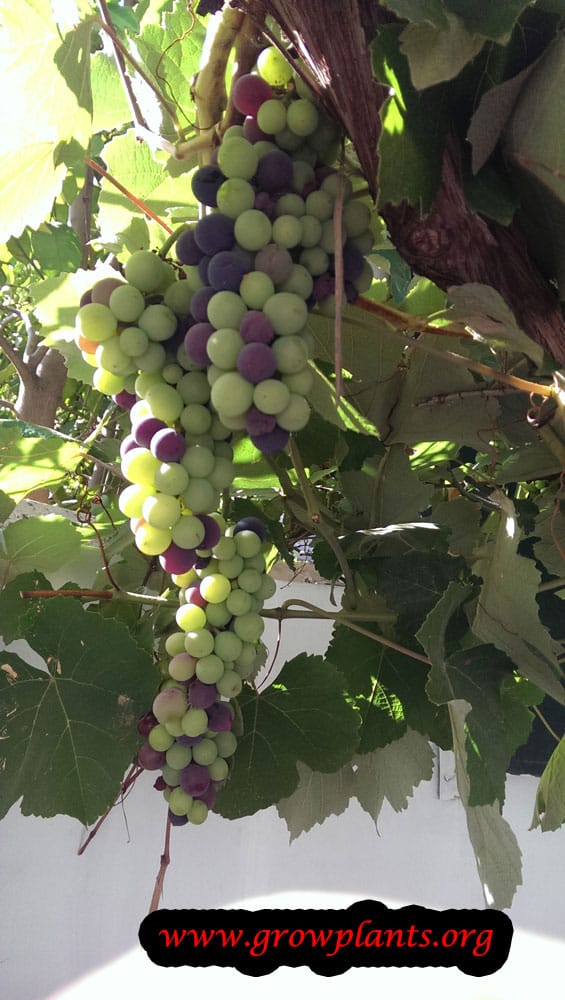
- Leaves & Foliage: Green leaves 6-18 cm with 3-5 lobes and serrated edges; young leaves are edible.
- Flower Characteristics: Small green flowers borne in clusters.
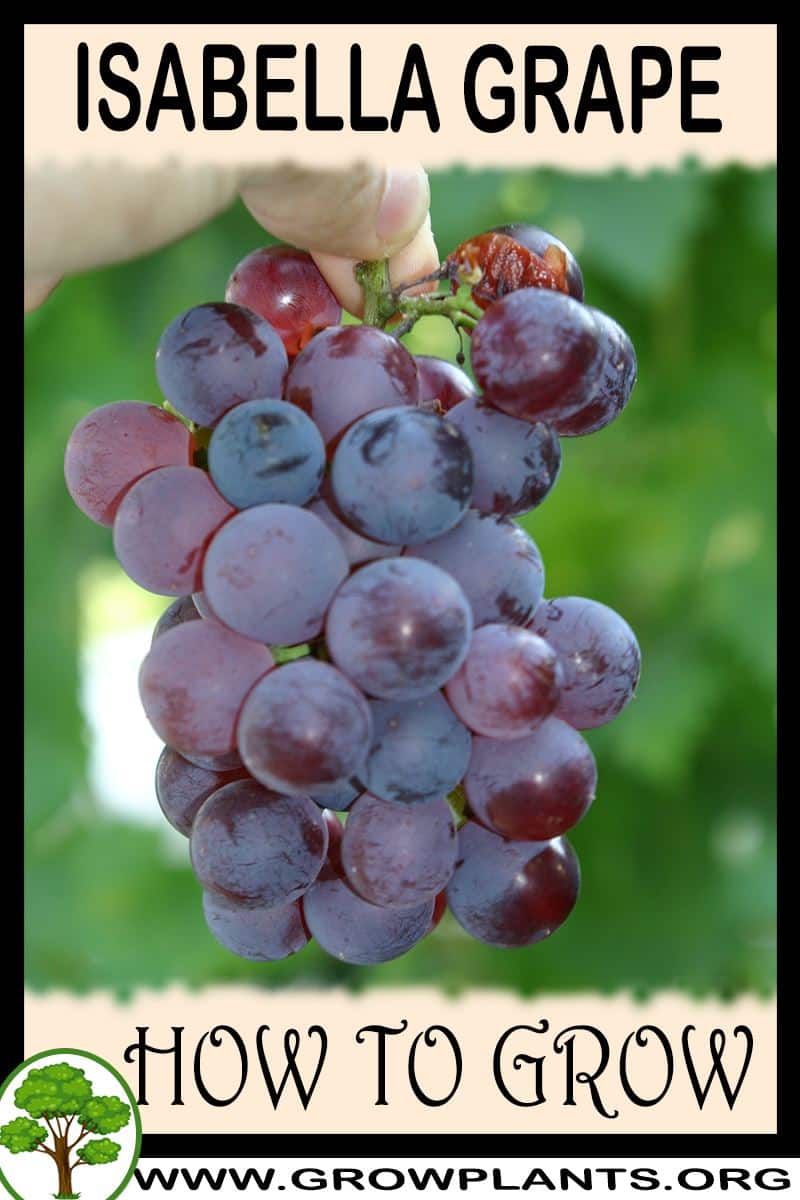
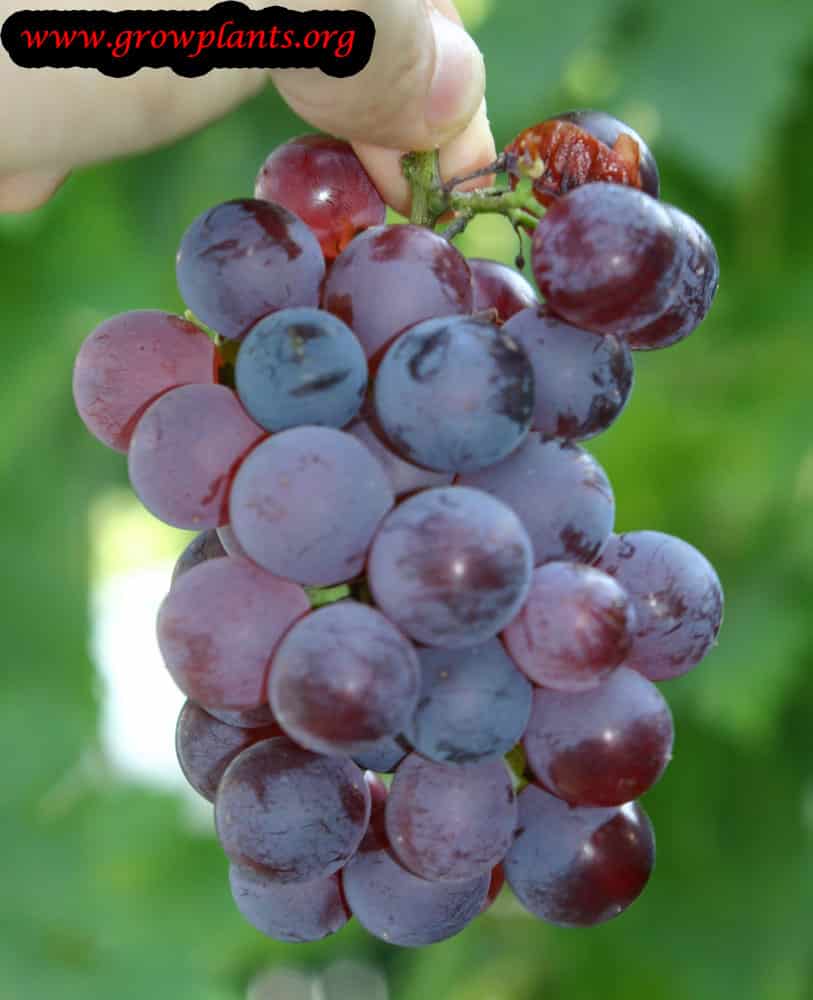
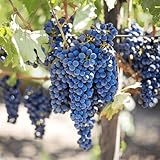
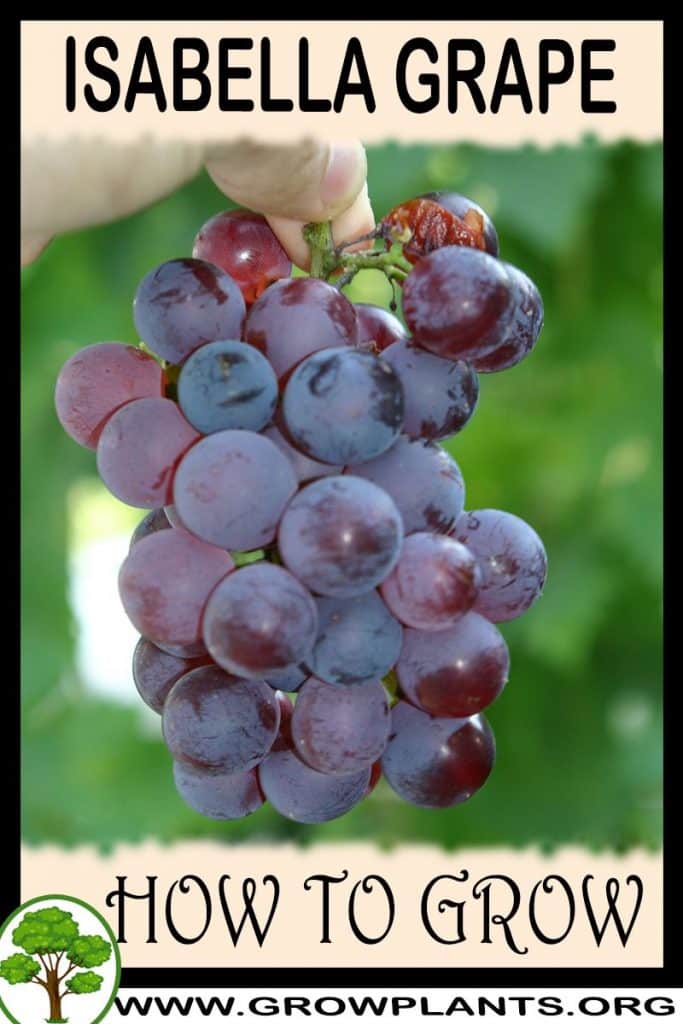
- Fruit Profile: Slip-skin purple grape with purple-green flesh; sweet for fresh eating and also used green or purple for juice.
Primary Uses & Landscape Value
- Edible Uses: Grapes eaten fresh or used for juice, wine and cakes; young leaves are stuffed and cooked (vine leaves).
- Functional & Ornamental Roles: Fruiting vine, summer shade over pergolas and arbours, informal hedge or screen, and ornamental.
Care Guide: Planting, Soil & Watering
Overview: Isabella grape is a vigorous deciduous grapevine that grows best in full sun (tolerating light shade) on deep, well-drained soil with a sturdy trellis or arbour to climb. It appreciates regular water but, once established, is fairly drought-tolerant, so let it grow strongly through the warm season and prune it hard once a year.
Quick Care Requirements
| Requirement | Ideal Condition |
|---|---|
| Planting Season | In the dormant-to-warm season (winter through summer), hardiness zones 6–11a |
| Growth Rate | Fast |
| Soil Type | Deep, well-drained soil; tolerates a range of soils |
| Water Need | Moderate — likes water but tolerates drought once established |
Planting & Establishment
- Best Planting Season: Plant from winter through spring into summer; dormant, bare-root planting in late winter to early spring establishes especially well.
- How to Plant:
- Hole Preparation: Dig a generous hole wider than the root ball and install a strong trellis, wires or arbour at planting so the vigorous canes have durable support.
- Soil Amendments: Mix compost or well-rotted organic matter into the backfill to feed the vine and improve drainage.
- Planting Depth: Set the vine at the depth it grew previously, root collar at soil level; firm and water in well.
- Growth Speed & Expectations: Fast and vigorous, climbing 5–20 m and needing a hard annual prune to stay productive and in bounds.
Soil, Watering & Drainage Care
- Soil Mix & Drainage Needs: Deep, free-draining soil is ideal; grapes dislike waterlogged ground, so ensure good drainage to keep the roots healthy.
- Watering Schedule & Technique:
- Young / Newly Planted: Water regularly to keep the root zone moist as the young vine develops its deep roots.
- Established: Water deeply but less often once established; the vine tolerates dry spells, though steady moisture improves fruiting.
- Seasonal Adjustments: Water more through the hot growing and fruiting season; reduce in autumn and withhold over winter dormancy.
Climate, Light & Hardiness
Isabella grape is a deciduous vine adapted to Mediterranean, desert, subtropical, and temperate climates, with USDA hardiness spanning zone 6 through 11a. It grows best in full sun, though it also tolerates half shade.
Quick Climate Specifications
| Climate Zones | Mediterranean, desert, subtropics, temperate |
|---|---|
| USDA Hardiness Zones | 6–11a |
| Frost Tolerance | High |
| Light Conditions | Full Sun (preferred); tolerates Half Shade |
Sunlight & Light Exposure
Grows best in full sun, though it adapts reasonably well to half shade.
Temperature Extremes & Hardiness
USDA Hardiness & Regional Limits
Hardy from zone 6 through 11a, covering cold–winter temperate climates through warm subtropical and desert regions.
Cold Damage & Winter Protection
As a deciduous vine it goes fully dormant for winter; the vigorous growth habit means winter pruning is used to manage cold–season dieback and shape next year's fruiting wood.
Chilling Requirement
As a temperate deciduous fruiting vine (a Vitis labrusca–type hybrid), it generally benefits from a period of winter chill for even dormancy break and fruiting.
Wind, Humidity & Microclimate
Rainfall & Seasonal Moisture
Its adaptability across desert, Mediterranean, subtropical, and temperate zones indicates tolerance of varied seasonal moisture patterns, from drier climates to more humid ones.
Growing in Pots, Balconies & Indoors
Isabella grape is a vigorous fruiting vine, marked by the grower as not a houseplant but suitable for containers. In a large pot on a sunny patio or balcony it will crop, kept in check by annual pruning to a fixed framework.
Quick Details
- Container Size: A large pot for a vigorous vine
- Indoor Suitability: Not a houseplant – too large and light-hungry
- Best Spot: Full sun; tolerates part shade with a lighter crop
- Soil & Drainage: Deep, fertile, free-draining mix
- Watering in Pots: Likes water but is fairly drought-tolerant once established
Indoors & On the Windowsill
- Not a houseplant: Marked No – a large vine needing full sun and space to climb.
- Windowsill: Not practical for fruiting; too vigorous for a sill.
On a Balcony or Patio
- Light & support: Full sun and a strong trellis; secure the heavy pot against wind.
- Watering & heat: Water well in growth; containers dry fast in reflected wall heat, though the vine tolerates some drought.
- Overwintering: Shelter potted roots in hard frost; feed more than a ground vine as pots leach nutrients.
Choosing the Pot, Soil & Long-Term Care
- Pot & drainage: A large, heavy-based pot with strong drainage holes; skip a standing-water saucer to avoid root rot. Terracotta breathes and dries fast, while glazed or plastic holds moisture longer.
- Potting mix: A well-aerated, organic-rich mix – peat or coir blended with perlite or vermiculite for free drainage.
- Feeding: Potted plants run their soil down fast as nutrients leach out, so feed more often than plants in open ground during active growth.
- Repotting: Refresh the mix or pot up about every two years; on established plants, lightly prune the root ball and top growth to keep them balanced.
Grower’s Container Tip
- Container & pruning routine: Every few years, once the root ball fills the pot, either move up a size or root-prune and cut the branches back. Decide the trunk height and prune to that same framework each year in the cold season. No special fertiliser is needed – the grower drops a few of the inedible fruits back onto the soil to return nutrients.
Fertilizing & Feeding
An unusually vigorous American-hybrid grape that establishes quickly with only light-to-moderate feeding; because it already grows so aggressively, restraint on nitrogen matters more here than with most fruiting vines.
Quick Fertilizing Specs
| Feeding Level | Moderate |
|---|---|
| young_feeding | A newly planted vine, typically grown from its own rootstock rather than grafted, needs only a modest nitrogen-forward feed to establish, since this variety is naturally fast-growing. |
| mature_feeding | An established, cropping vine does well on a balanced-to-potassium feed; because it grows so vigorously on its own, it rarely needs heavy nitrogen once established. |
| Main Nutrient Priority | Keep nitrogen restrained given this variety’s naturally aggressive growth habit; potassium becomes the priority once the vine is carrying a crop, supporting fruit fill and ripening. |
| Best Feeding Period | Feed in spring as growth resumes, easing back once fruit is ripening so late growth does not compete with the crop. |
| Organic Options | Compost or aged manure worked into the root zone in early spring is often enough on its own for this vigorous grower. |
| Micronutrients | A complete vine or fruiting-plant fertilizer that includes iron and manganese helps prevent pale new growth in high-pH soils. |
| Soil pH | Tolerates a wide range of well-drained soils; strongly alkaline soil is a frequent trigger for iron chlorosis in grapevines generally. |
| Reduce/Stop Feeding | Ease off nitrogen as fruit begins ripening, and reduce feeding overall once the vine goes dormant after leaf drop. |
Feeding by Growth Stage
Establishment
Help a newly planted, own-rooted vine build a strong trunk and root system before it is trained onto its trellis.
| Nutrient direction | A modest, balanced-to-nitrogen feed; this variety typically needs less encouragement to establish than most grapes |
|---|---|
| Timing | The first growing season or two after planting, while the trunk and main canes are being trained. |
| Frequency | Light, occasional feeding is generally sufficient given how readily this variety establishes and grows. |
| Fertilizer types | A balanced or lightly nitrogen-forward fertilizer suited to young grapevines, Compost or aged manure worked into the planting area |
| Routine trace nutrients | iron, manganese |
| Precautions | Avoid heavy nitrogen feeding during establishment; this variety already grows aggressively and excess vigor makes early training and trellising harder to manage. |
Vegetative Growth
Support healthy canopy development without adding fuel to a variety that already grows unusually fast.
| Nutrient direction | A restrained, balanced feed rather than a strong nitrogen push |
|---|---|
| Timing | Spring into early summer while shoots are extending. |
| Frequency | Light feeding is typically enough; overly generous feeding tends to produce excess canopy that needs extra pruning and thinning. |
| Fertilizer types | A balanced complete fertilizer applied lightly in spring, Established plantings on fertile soil may need no supplemental feeding at this stage |
| Routine trace nutrients | iron, manganese, zinc |
| Precautions | Dense, vigorous canopy growth shades developing clusters and increases fungal disease pressure, so match feeding to the vine’s already strong natural growth rather than adding to it. |
Fruiting
Support even fruit fill and ripening across each cluster on mature, bearing vines.
| Nutrient direction | A balanced feed shifting toward potassium as clusters develop and ripen |
|---|---|
| Timing | From fruit set through harvest on mature, cropping vines. |
| Frequency | Moderate feeding through fruit development, reduced sharply as ripening begins. |
| Fertilizer types | A balanced fruiting-plant fertilizer with a potassium lean, A potassium-supplemented feed for vines carrying a heavy crop |
| Routine trace nutrients | iron, manganese, zinc |
| Precautions | This variety is prone to uneven ripening within a bunch; heavy late-season nitrogen tends to make that unevenness worse rather than better. |
Nutrient Deficiency Signs & Corrections
New leaves emerge pale yellow with the veins remaining distinctly green.
| Possible causes | Alkaline or high-pH soil limiting iron availability to the roots, Waterlogged or poorly aerated soil restricting root function, An iron shortfall in the feeding program |
|---|---|
| Appears first on | Newest growth at the shoot tips first |
| What to check | Test or estimate the soil pH around the root zone, Check drainage and recent watering history, Confirm the fertilizer being used supplies iron |
| Possible correction | Work to lower soil pH toward the vine’s preferred range and apply a chelated iron product per its label if new growth stays pale. |
Berries within the same cluster ripen at noticeably different rates.
| Possible causes | A nutrient imbalance, particularly excess late-season nitrogen relative to potassium, Dense canopy shading part of the cluster unevenly, A trait common to this variety even under otherwise good care |
|---|---|
| Appears first on | Individual clusters, unevenly across the berries |
| What to check | Review whether feeding has skewed toward nitrogen late in the season, Assess canopy density and shading around the clusters, Compare against the variety’s known ripening pattern before assuming a nutrient cause |
| Possible correction | Shift late-season feeding toward potassium and away from nitrogen, and thin the canopy for more even light exposure across each cluster. |
Leaf margins scorch or turn brown, most noticeable on older leaves during fruit ripening.
| Possible causes | Insufficient potassium relative to the vine’s crop load, Sandy or fast-draining soil that readily leaches potassium, Excess nitrogen crowding out potassium uptake |
|---|---|
| Appears first on | Older leaf margins first |
| What to check | Review whether potassium has been included in recent feeding, Assess soil type and how readily it drains and leaches nutrients, Compare the balance of nitrogen versus potassium in the fertilizer used |
| Possible correction | Shift toward a more potassium-forward feed as fruit develops and correct any nitrogen-heavy imbalance. |
Pruning, Training & Seasonal Maintenance
Isabella grape is a vigorous vine that tolerates – and needs – strong annual pruning; left unpruned it grows into an unmanageable tangle that fruits poorly and unevenly. The safest and most effective window is the dormant season (autumn into winter), when the framework is cut back hard to a permanent trellis structure and only the strongest canes are kept. Because fruit forms on current-season shoots that grow from buds on the previous year’s canes, this dormant selection directly sets both the size and evenness of the next crop; the vine’s own tendency for a bunch to ripen unevenly is managed partly through cluster thinning and canopy/leaf management rather than through pruning timing alone.
Quick Pruning & Maintenance Specs
| Pruning Tolerance | High – an annual strong cutback is standard and necessary for this vigorous vine |
| Primary Pruning Window | Dormant season, autumn to winter |
| Secondary Maintenance Window | Spring/summer – leaf trimming near clusters, cluster/shoot thinning |
| Typical Frequency | One strong annual dormant pruning, plus in-season canopy touch-ups |
| Main Objective | Renew fruiting wood, remove the mass of thin/weak growth, and keep the permanent trellis framework productive |
| Young Plant Priority | Establish a single trunk and permanent arms on the trellis before allowing it to fruit heavily |
| Mature Plant Priority | Cut back to the main framework each winter, keeping only the strongest canes and removing the rest |
| Best Tool Type | Bypass secateurs and loppers for canes; a saw only for an old, thickened trunk |
| Avoid Heavy Pruning During | Active flowering/fruit set, and very late in dormancy right before bud break |
Pruning by Plant Age & Size
Newly Established
Focus on training a single strong trunk up to the trellis or arbor wire; remove only damaged growth rather than fruiting canes, since the framework isn’t ready to carry a crop yet.
Young / Formative
Train onto a trellis, arbor, or pergola as a cane- or cordon-based vine: one trunk to the support, then permanent arms from which each year’s fruiting canes are selected – the vine is explicitly used for trellising, hedging, and summer shade in addition to fruit, which reinforces training it onto a fixed structure rather than letting it sprawl.
Mature / Established
Each dormant season, cut back hard: retain only the biggest, best-placed canes on the permanent framework and remove the mass of thin, weak growth the vine throws out over a season. This strong annual renewal is what keeps a mature Isabella grape productive rather than congested.
Seasonal Pruning Schedule
| Dormant / Winter | Main structural pruning: cut back to the permanent framework, keep only strong canes, remove thin/weak wood |
| Ongoing Sanitary | Remove dead or damaged wood as noticed |
| Summer Canopy Management | Trim leaves growing directly around the developing clusters to improve airflow, light, and pest access for cleanup; thin some bunches, especially in the vine’s first fruiting years, since clusters otherwise ripen unevenly |
Flowering & Fruiting Wood
Fruit is produced on current-season shoots arising from buds on the previous year’s canes, so the dormant cutback directly determines next season’s crop: keeping too much old, thin wood spreads the vine’s energy thin and worsens the known problem of clusters ripening unevenly, while a hard, selective cutback to strong canes concentrates growth into fewer, better-developed fruiting shoots.
Structural Pruning & Training
- Maintain the permanent trunk and arms on the trellis; avoid re-cutting these once established.
- Each winter, keep only the biggest, healthiest canes and remove the rest — this vine’s own guidance is essentially a cane-renewal system, not light thinning.
- Manage canopy density in season by pulling leaves that shade the fruit clusters directly, without stripping the whole canopy.
Special Growth to Remove
- The mass of thin, weak canes produced each season – removed at dormant pruning, keeping only the strongest.
- Leaves growing immediately around fruit clusters, trimmed in season to reduce pest harborage and improve ripening conditions.
- Spent flower/fruit clusters after harvest, and any bunches thinned early in the season on young vines.
Container & Small-Space Pruning
Where grown in a large container, size is controlled by both root and top pruning: when roots fill the pot, either size up the container or cut back the root ball along with a matched reduction of the canopy; decide on and maintain a fixed trunk height, cutting back to that same point every winter rather than letting the vine gain height each year.
Tools
- Bypass secateurs – the bulk of annual cane selection and removal.
- Loppers – thicker canes and dense growth.
- Pruning saw – an old, thickened trunk needing renewal.
- Soft ties/stakes – training the trunk and retained canes onto the trellis.
Tool Hygiene & Disease Risk
Routine: clean, sharp tools are sufficient for general pruning. Given known pest pressure (ants, aphids) often associated with sap and fruit, keep cuts clean to avoid creating extra wound sites, though this is a sanitation habit rather than a call for between-cut disinfection.
Cut Placement & Technique
Cut canes back to their point of origin on the permanent arm or to a strong bud; avoid leaving long dead stubs. When trimming leaves near clusters, remove individual leaves rather than whole shoots so the fruiting cane itself isn’t weakened.
Heavy Pruning & Rejuvenation
Well tolerated and, for this vine, expected every year — an annual strong cutback to the main framework is the normal regime, not an occasional rejuvenation measure. A neglected, overgrown vine can also be cut back hard to its permanent arms to restart productive cane growth.
Post-Pruning Care
No special feeding push is needed after the winter cutback. In containers, keep the soil consistently moist while the reduced root/canopy balance re-establishes after a root-ball trim.
Common Pruning Mistakes
- Leaving too much thin, weak wood at the winter cutback instead of committing to a strong renewal prune.
- Skipping in-season leaf trimming around clusters, worsening uneven ripening and disease/pest pressure on the fruit.
- Letting a container-grown vine’s trunk height creep up each year instead of holding it to a fixed height at the annual cutback.
When NOT to Prune
Avoid heavy cutting during active flowering and fruit set, and avoid pruning very late in dormancy right before bud break.
Recommended Tools (by task)
- bypass_secateurs – the primary tool for annual cane selection, removal, and in-season leaf trimming near clusters.
- loppers – thicker canes and dense seasonal growth at the winter cutback.
- soft_ties_stakes – training the trunk and retained canes onto the trellis or arbor.
Pruning Troubleshooting
| Problem | Possible Cause | What to Check | Corrective Action |
| Clusters ripening unevenly within the same bunch | Vine carrying too much old/thin wood, spreading energy across too many shoots | Proportion of strong vs. weak canes retained at winter pruning | Prune harder at dormancy, keeping only the strongest canes; thin bunches in early fruiting years |
| Dense, tangled canopy over fruit | No in-season leaf trimming around clusters | Leaf cover directly around developing bunches | Trim leaves next to the clusters in season for airflow and light |
| Weak or declining growth after repotting (container vines) | Root ball trimmed without a matching canopy reduction | Root-to-canopy balance after root pruning | Match canopy cutback to root reduction and maintain a fixed trunk height |
Propagation Guide
Isabella grape is propagated from stem cuttings, which the site’s own data confirms is easier than seed and ensures the fruit stays true to the parent vine, since grape seedlings do not reproduce true-to-type. Propagation is easy: per the site, cuttings can simply be planted directly in the ground and kept moist, with no special treatment needed, and can begin producing leaves and roots within about 1–3 weeks when started at the beginning of spring.
Quick Propagation Specs
| Best Propagation Method | Stem cuttings |
| Alternative Methods | Seed (not recommended for fruit quality) |
| Propagation Difficulty | Easy |
| Seed True-to-Type | No – seedlings vary; cuttings are used to keep fruit quality consistent |
| Vegetative True-to-Type | Yes |
| Best Propagation Season | Winter to spring (preferred); summer or autumn possible but with reduced rooting success |
| Cutting Rooting Time | About 1–3 weeks, from the start of spring |
Growing from Seed
Seed is a listed but secondary option; seedlings do not reliably reproduce the parent vine’s fruit quality, so cuttings are preferred. Where used, sow cleaned seed from ripe fruit and expect slower, less predictable results than from cuttings.
Stem Cuttings
Cutting Type
Stem cuttings, per the site’s own vegetative-reproduction method for this plant.
Best Timing
Winter to spring is the preferred window; summer and autumn cuttings are possible but root less reliably under the right conditions.
Cutting Preparation
Take stem sections with a few buds/nodes.
Rooting Setup
Per the site’s own guidance, no special rooting setup is needed – simply plant the cutting directly in the ground and water it, keeping the soil consistently moist.
Rooting Hormone
Not necessary – the site’s direct-in-ground method roots without one.
Rooting Time
Roots and leaves can begin developing within about 1–3 weeks when cuttings are started at the beginning of spring.
Bloom & Flower Guide
Quick Details
- Bloom Season: Late spring into early summer
- Time to First Bloom: Usually in its second or third year
- Flower Appearance: Small green flowers in clusters, each the start of a future bunch
- Edibility: The flowers are not eaten — this grape is grown for its fruit and leaves
Detailed Blooming Overview
Isabella is a hardy, vigorous grape whose small green flowers appear in late spring to early summer. As with other grapes, the flowering cluster is simply the bunch-to-be, and a good set of flowers points to a good crop later on.
Flower Characteristics
- Small green flowers borne in clusters that develop into bunches.
Bloom Care & Thinning
- Pollination and set: Like other grapes it is largely self-pollinating with help from the wind, so pollinators are not essential.
- Thinning the bloom: Thinning some clusters in the first few years helps the young vine establish before it carries a full crop.
Bloom Health & Protection
- Powdery mildew and botrytis at flowering: These can infect the blossoms in wet weather; good airflow and, if needed, a sulphur-based fungicide help keep the bloom clean.
Fruit & Uses
Isabella grape is grown for both its sweet purple grapes and its young leaves, which are traditionally cooked and used as wrappers for stuffed vine-leaf dishes. The ripe berries are eaten raw or pressed into juice or wine, while the leaves must be young and cooked before eating.
Quick Edible Specs
| Edible Parts | Fruit (grapes); young leaves |
|---|---|
| Main Use(s) | Fruit: culinary – fresh eating, juice, wine, cakes. Leaves: culinary – cooked/stuffed vine leaves |
| Eaten Raw or Cooked | Fruit: raw (also pressed/fermented). Leaves: cooked only |
| Preparation Required | Fruit: none. Leaves: cook (typically blanched, then rolled/stuffed and simmered) – only take young, fully-expanded leaves |
| Harvest Season | Fruit: Summer / Autumn. Leaves: Spring / Summer |
| Time to First Harvest | Fruit: takes several years of vine growth before first crop (see Propagation) |
| Storage | Not specified in source data |
| Safety/Toxicity Caveat | None known; mature leaves simply become too fibrous to eat palatably, this is a texture issue rather than a safety one |
Fruit
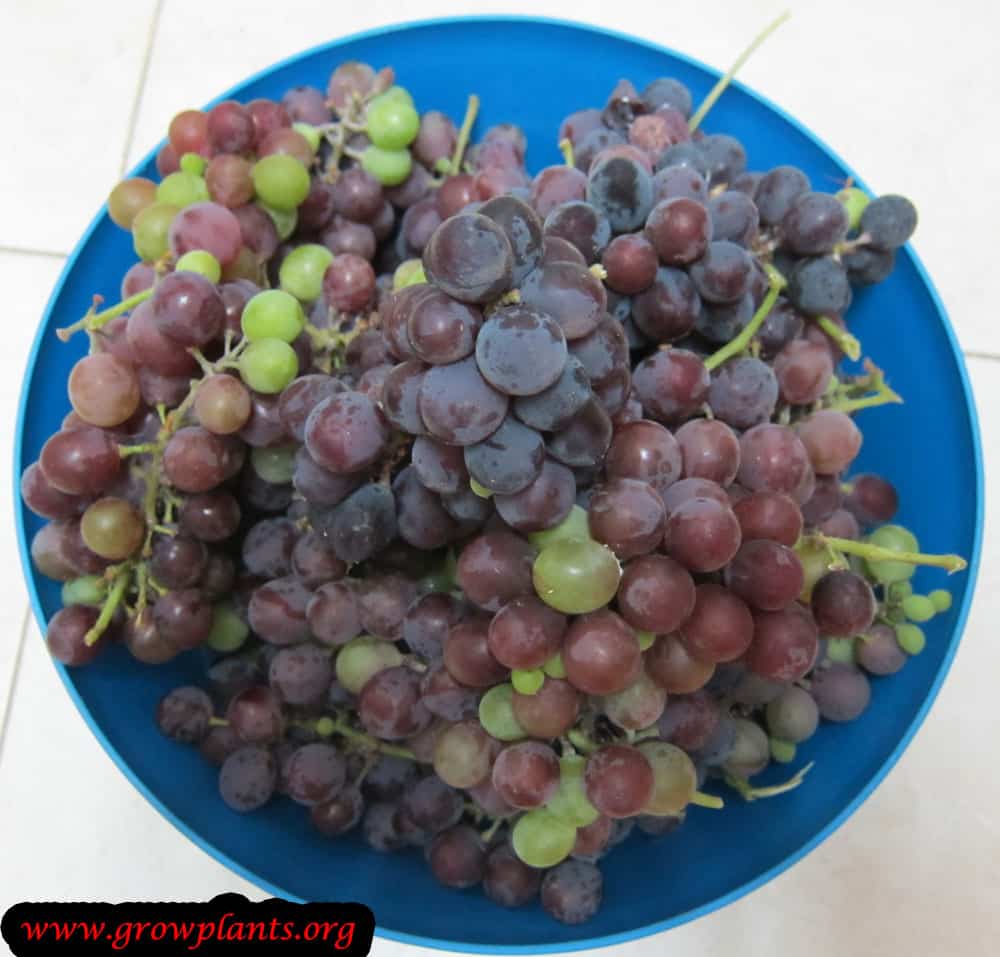
Berries have a purple rind with purple-green flesh; fully purple-colored grapes are sweet and ready to eat out of hand, while still-green berries are firmer and more commonly used for juice rather than fresh eating. Ripening within a single bunch is uneven, so harvest is usually spread over several pickings rather than one pass, in summer into autumn. Birds are a common pest on ripening fruit. Leaves growing right next to the fruit clusters are often thinned during the season to improve fruit exposure and reduce pest pressure on the grapes (see Pruning/Care). Uses for the harvested fruit include fresh eating, juice, wine, and baking into cakes.
Leaves & Greens
Only young, fully-grown leaves are harvested for eating – once leaves mature they turn too fibrous to use well. Leaf harvest falls in spring and summer. Traditionally used as “vine leaves” for stuffed-leaf dishes (grape-leaf dolma), the leaves are cooked (typically blanched, then filled/rolled and simmered) rather than eaten raw. Because leaf-thinning near fruit clusters is also done for the fruit’s benefit, light leaf harvesting can pull double duty – but taking too many leaves from the vine can reduce its ability to ripen its grape crop, so leaf picking should stay light where a good fruit harvest is also wanted.
Harvesting
Grapes ripen unevenly within a bunch, so picking is usually done over more than one round through summer/autumn; first fruiting is several years after planting (see Propagation). Leaves should be picked young, before they toughen, in spring/summer.
Preparation, Uses & Safety
Ripe grapes need no preparation and are eaten fresh, juiced, fermented into wine, or baked into cakes. Leaves must always be cooked, never eaten raw – the classic preparation is blanching them briefly, then using them as wrappers for a rice or meat filling. No specific toxicity is noted for either part; the only caution is that over-mature leaves are unpleasantly fibrous rather than unsafe.
Pests, Diseases & Troubleshooting
Overview: ‘Isabella’ is a vigorous American fox grape (Vitis labrusca type) that is considerably tougher than European wine grapes – more tolerant of phylloxera and of the mildews and rots that plague vinifera – but it still faces the standard grape pests and fungal diseases in humid climates. An open, well-pruned canopy with good airflow and sunlight, plus canopy sanitation, prevents most disease with minimal spraying.
Quick Troubleshooting Overview
| Issue / Pest | Main Symptom | Primary Solution |
|---|---|---|
| Powdery mildew | White powdery bloom on leaves, shoots and berries | Open canopy/airflow; sulphur (labrusca fairly resistant) |
| Downy mildew | Yellow ‘oil-spots’ above, white down beneath leaves | Airflow; avoid wet foliage; copper in wet weather |
| Black rot | Tan leaf spots then mummified, shrivelled black berries | Remove mummies; open canopy; protect from bloom on |
| Grape berry moth | Webbed, holed berries with frass; premature rot | Pheromone traps to time; sanitation; Bt at egg-hatch |
| Japanese beetle | Leaves skeletonised to lace | Hand-pick into soapy water; net; conserve enemies |
| Birds & wasps | Ripening berries pecked and eaten | Netting; harvest promptly; remove damaged fruit |
Common Pests & Management
- Grape phylloxera (Daktulosphaira vitifoliae):
- Symptoms: Small yellow galls on the leaf undersides (leaf form) and, more seriously in vinifera, root-feeding that kills roots; American labrusca types like ‘Isabella’ are naturally tolerant and rarely damaged at the root.
- Prevention & Control: On tolerant American grapes little action is needed – the vine coexists with it. Where the leaf-galling form is heavy on young vines, remove galled leaves; the root form is not a practical threat on labrusca-rooted vines.
- Grape berry moth (Paralobesia viteana):
- Symptoms: Larvae web together and bore into flower clusters and ripening berries, leaving frass and entry holes; damaged berries rot and drop, and infestations concentrate at cluster edges.
- Prevention & Control: Hang pheromone traps to detect flights and time control, and practise sanitation by removing infested and dropped berries. Bacillus thuringiensis at egg-hatch (guided by traps) controls larvae while sparing beneficials.
- Leafhoppers (Erythroneura spp.):
- Symptoms: Adults and nymphs on leaf undersides cause fine white stippling and yellowing; heavy feeding browns and drops leaves, and some species can vector disease.
- Prevention & Control: Tolerate light populations, which rarely need action, and conserve their parasitic wasps and predators. Remove basal leaves and weeds for airflow; insecticidal soap or a targeted spray is warranted only under heavy pressure.
- Japanese beetle (Popillia japonica):
- Symptoms: Adults skeletonise the leaves, chewing the tissue between the veins into a lacy network and clustering on the upper canopy in early summer.
- Prevention & Control: Hand-pick beetles into soapy water in the cool of the morning (they drop when disturbed), net high-value vines, and avoid lure traps that attract more beetles than they catch. Healthy vines tolerate moderate leaf loss.
- Grape mealybug (Pseudococcus maritimus):
- Symptoms: White cottony masses under the bark, in leaf axils and on clusters, with sticky honeydew and sooty mould fouling the fruit; they can also spread grapevine viruses.
- Prevention & Control: Conserve natural enemies, remove loose old bark where they shelter, and disrupt tending ants. A dormant or light summer horticultural oil and targeted soap reduce colonies on the vine and clusters.
- Two-spotted spider mite (Tetranychus urticae):
- Symptoms: Fine pale stippling and bronzing of leaves in hot, dry, dusty conditions, with webbing on the undersides in bad cases and early leaf loss.
- Prevention & Control: Avoid drought and dust stress, hose down foliage, and conserve predatory mites. A light summer oil is used only if bronzing becomes severe.
Diseases & Fungal Issues
- Powdery mildew (Erysiphe (Uncinula) necator):
- Symptoms: A white-to-grey powdery bloom on leaves, shoots and berries; infected berries crack and fail to ripen. American labrusca grapes such as ‘Isabella’ are markedly more resistant than European vinifera.
- Treatment & Management: Prune and position shoots for an open, airy, sunlit canopy, which greatly limits infection. On this resistant type, sulphur or potassium bicarbonate at first sign is usually all that is needed, if anything.
- Downy mildew (Plasmopara viticola):
- Symptoms: Pale yellow, oily-looking ‘oil-spot’ patches on the upper leaf surface with a white downy mould beneath in warm wet weather; shoots and young berries can be blighted.
- Treatment & Management: Improve airflow and drainage, avoid overhead watering, and remove infected leaves and mummified fruit. A copper fungicide protects new growth during prolonged wet, warm spells; open canopies suffer far less.
- Black rot (Guignardia bidwellii):
- Symptoms: Small tan leaf spots with dark borders and tiny black dots, and – most damagingly – infected berries that shrivel into hard, black, mummified fruit that carry the disease over winter.
- Treatment & Management: Remove and destroy mummified berries and infected canes (the key sanitation step), open the canopy, and protect susceptible tissue from bloom through early fruit development with an approved fungicide where pressure is high.
- Botrytis bunch rot (Botrytis cinerea):
- Symptoms: Grey fuzzy mould rots tight or split clusters in cool, wet, humid conditions near harvest, spreading berry-to-berry through the bunch.
- Treatment & Management: Open the fruiting zone by removing basal leaves for airflow and light, avoid dense clusters and berry splitting, and harvest promptly. Good canopy management usually controls it without spraying.
- Pierce’s disease (Xylella fastidiosa):
- Symptoms: In warm regions this bacterium, spread by sharpshooter leafhoppers, causes scorched leaf margins, uneven cane maturity and progressive vine decline and death over a few seasons.
- Treatment & Management: There is no cure – manage sharpshooter vectors, remove confirmed infected vines, and in high-risk areas grow tolerant types. Labrusca grapes vary in tolerance; site and vector control are the main tools.
Growing Difficulties & Abiotic Problems
- Uneven ripening / sunburn:
- Cause & Symptoms: Dense shaded canopies ripen unevenly, and clusters suddenly exposed to hot sun (e.g. after heavy leaf-pulling) can sunscald and shrivel.
- Correction Strategy: Manage the canopy for dappled light on the fruit, remove basal leaves gradually rather than all at once, and keep vines evenly watered through ripening.
- Winter cold & spring frost:
- Cause & Symptoms: Hard winter cold can injure buds and canes, and late spring frosts damage new shoots and reduce the crop.
- Correction Strategy: ‘Isabella’ is fairly cold-hardy, but site vines in a sheltered spot away from frost pockets, and choose training/pruning suited to the local winter.
- Overvigour:
- Cause & Symptoms: On rich soils or with heavy feeding the vine grows rampantly leafy at the expense of fruit and creates a dense, disease-prone canopy.
- Correction Strategy: Avoid over-feeding, prune and thin annually for balance, and train on a system that keeps the canopy open and the crop exposed to air and light.
What Helps – Products & Tools
Because ‘Isabella’ is a disease-tolerant American grape, a light hand suffices: sulphur or potassium bicarbonate for powdery mildew, copper for downy mildew and black rot in wet weather, pheromone traps and Bacillus thuringiensis for berry moth, a dormant/summer horticultural oil for mealybug and mite, and bird netting for the ripening crop. Canopy pruning and mummy sanitation are the most effective ‘tools’ of all.