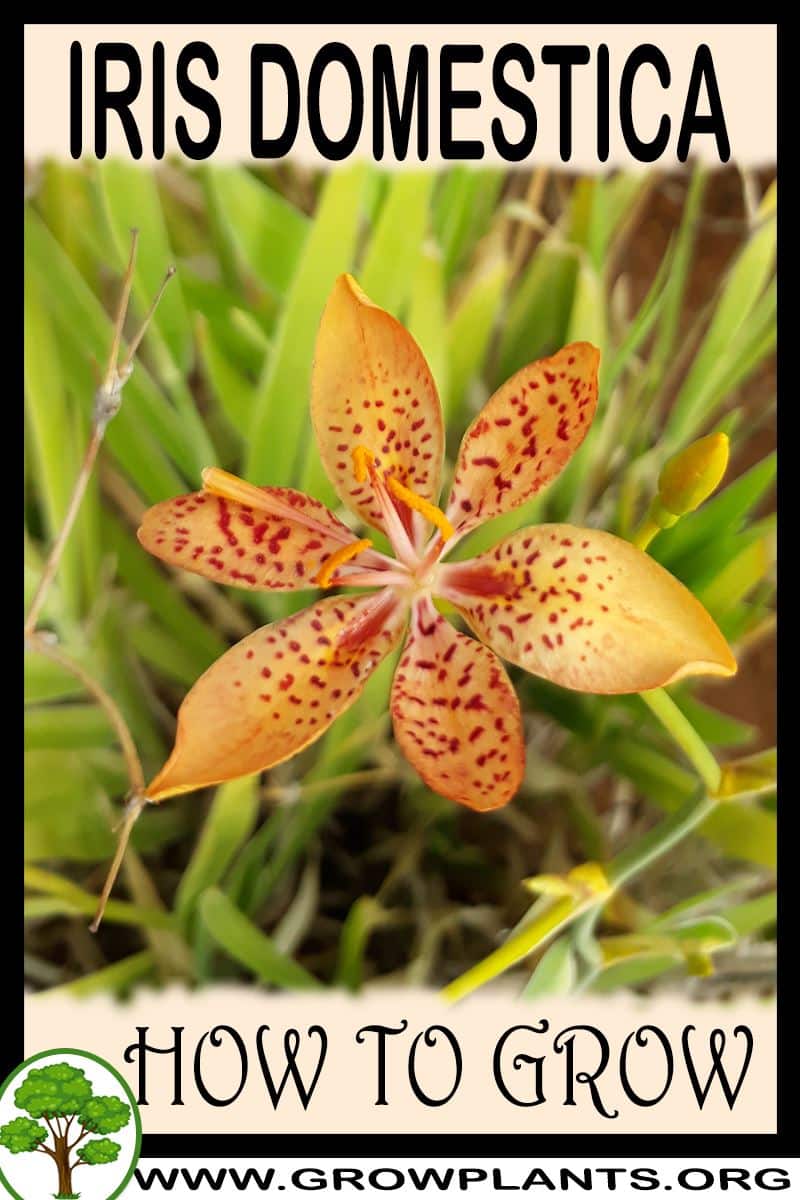


Plant Profile & Key Characteristics
Overview: Iris domestica (leopard / blackberry lily) is a rhizomatous perennial geophyte 60-90 cm tall, grown as an ornamental for its spotted flowers and for the blackberry-like seed clusters that follow. It is largely evergreen in mild climates.
Quick Specifications
| Specification | Attribute |
|---|---|
| Plant Type / Life Cycle | Perennial geophyte |
| Foliage Type | Evergreen to semi-evergreen |
| Mature Size | 60-90 cm (24-36 in) |
| Growth Rate | Moderate |
| Root System | Rhizomatous |
| Toxicity | Toxic if ingested – rhizomes and seeds contain irritant compounds; keep from pets |
| Hardiness | USDA zone 5-10 |
Growth Form & Structure
- Height & Spread: 60-90 cm (24-36 in) in ground; also grows in planters and containers.
- Growth Habit & Form: Upright fans of sword-shaped leaves with branching flower stems; can be aggressive.
- Lifespan & Maturity: Perennial; self-seeds readily from its ornamental seed clusters.
Anatomy & Physical Features
- Leaves & Foliage: Green, narrow, sword-shaped leaves in linked fans.
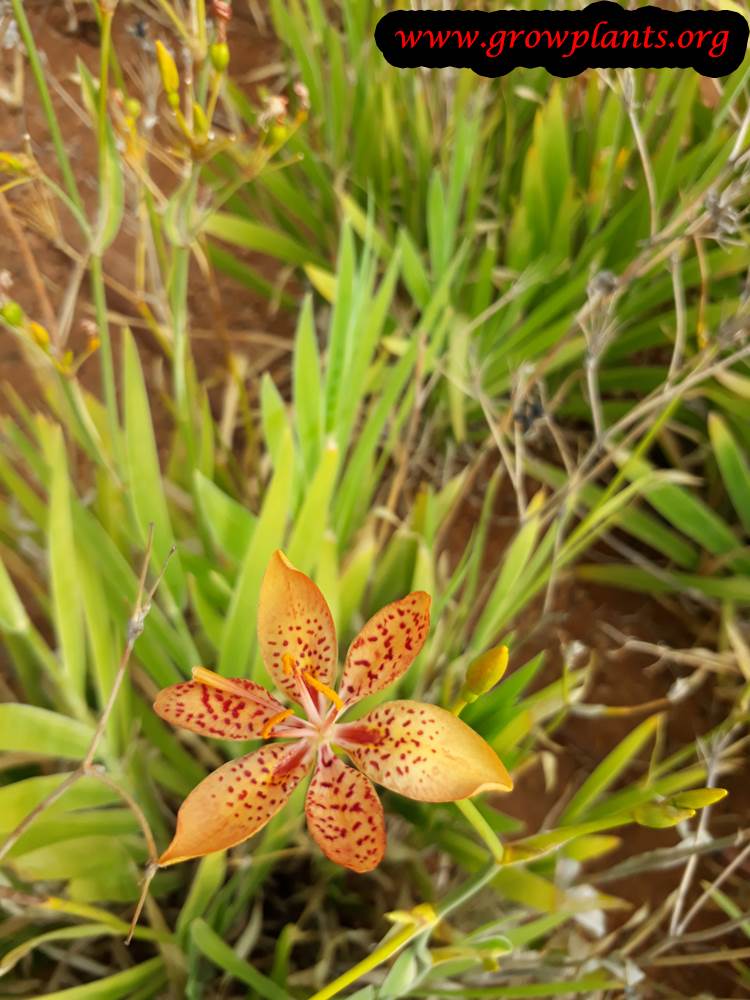
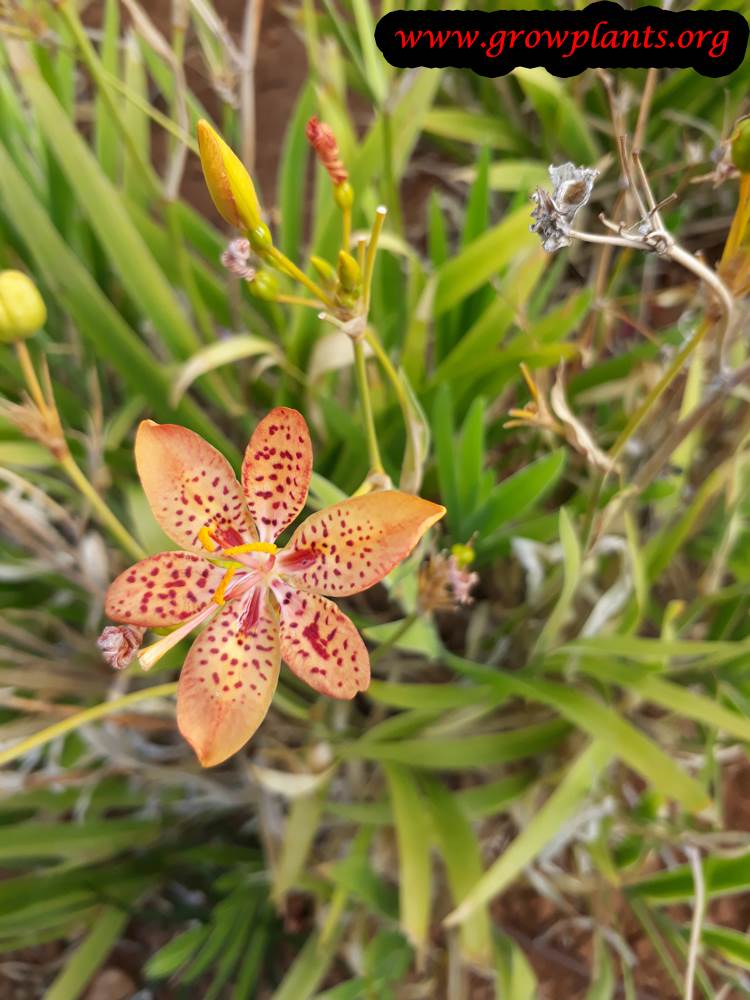
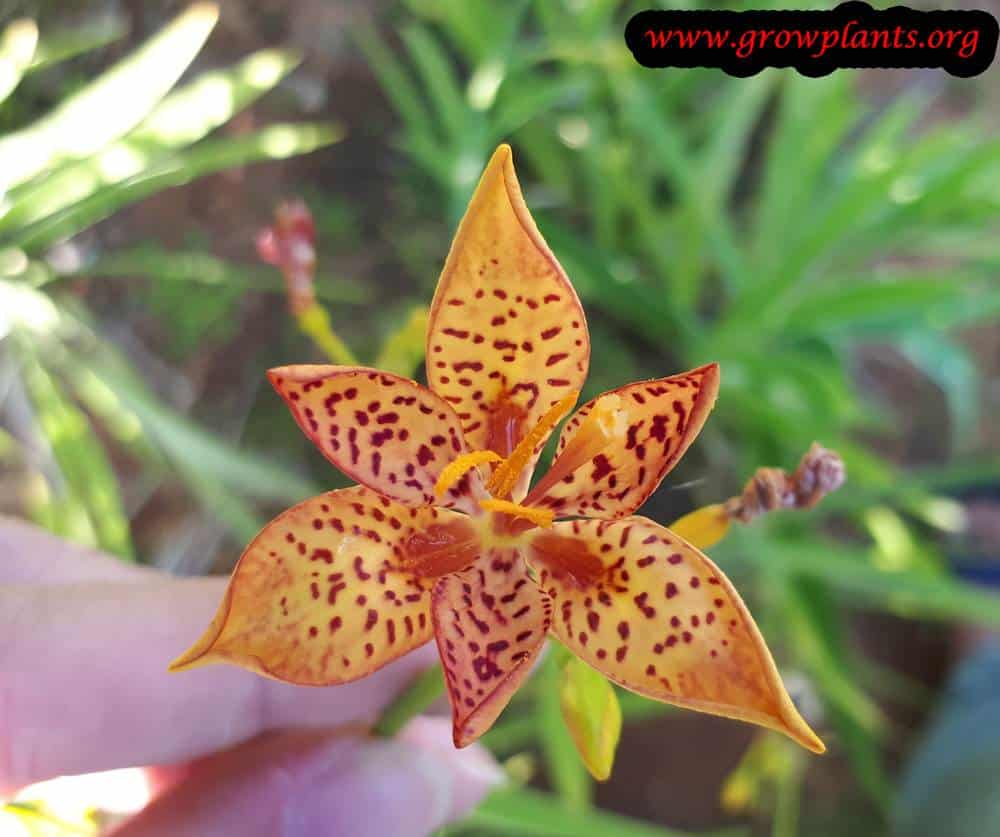
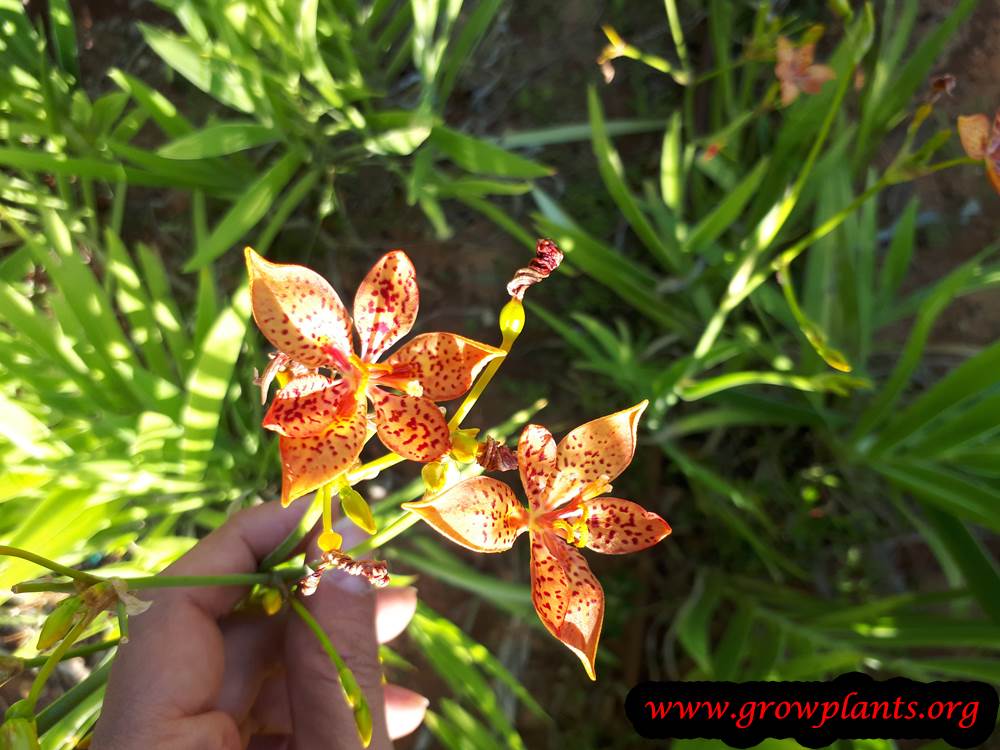
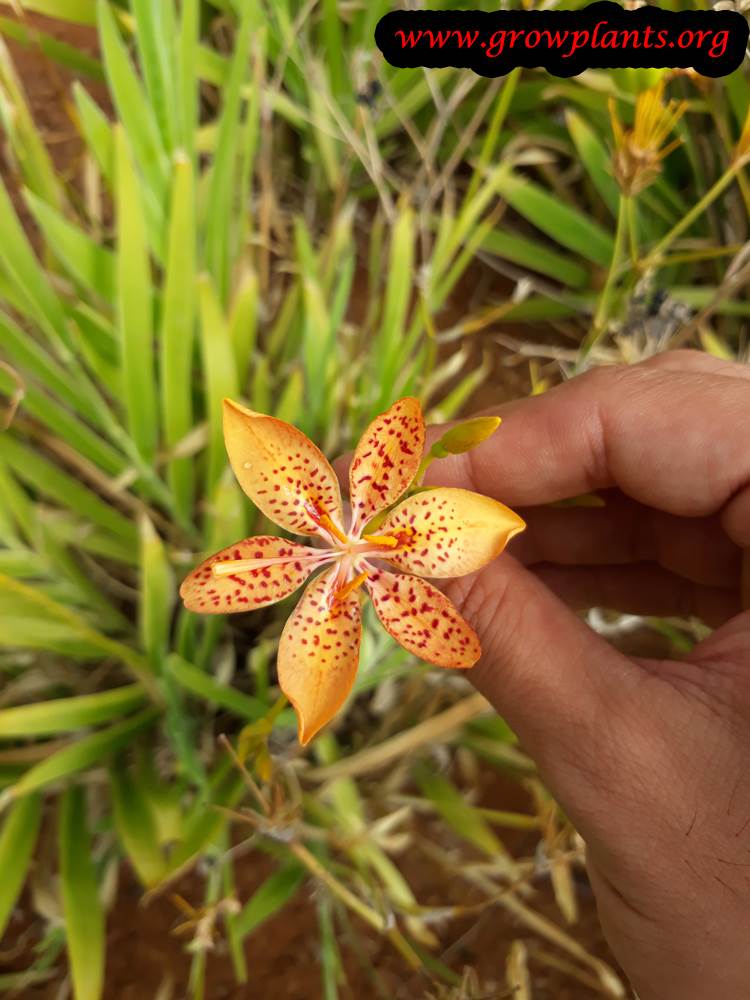
- Flower Characteristics: Six-petalled orange or yellow flowers spotted with darker dots (full detail in the Bloom guide).
- Fruit Profile: Seed pods split to reveal shiny black seed clusters resembling a blackberry – decorative and not edible.
Primary Uses & Landscape Value
- Functional & Ornamental Roles: Ornamental for borders; flowers and the striking black seed heads are both used in cut and dried arrangements.
Care Guide: Planting, Soil & Watering
Overview: The blackberry lily grows in full sun to part shade in well-drained soil that is never left soggy. It is an easy, clumping iris relative that flowers in warm weather and self-sows readily.
Quick Care Requirements
| Requirement | Ideal Condition |
|---|---|
| Planting Season | In spring through autumn |
| Growth Rate | Moderate |
| Soil Type | Well-draining; not soggy |
| Water Need | Moderate; let the surface dry between waterings |
Planting & Establishment
- Best Planting Season: Plant from spring through autumn during the growing season.
- How to Plant:
- Hole Preparation: Dig a hole a little wider than the root ball in well-drained soil.
- Soil Amendments: Work in some compost or organic matter, and add grit if the ground holds water.
- Planting Depth: Set the crown at soil level and firm gently, keeping it from sitting wet.
- Growth Speed & Expectations: A moderate grower forming clumps 60-90 cm tall; it can self-seed freely and become aggressive.
Soil, Watering & Drainage Care
- Soil Mix & Drainage Needs: Good drainage matters most, since it dislikes constantly wet soil; a free-draining potting mix suits container plants.
- Watering Schedule & Technique:
- Young / Newly Planted: Keep evenly moist while establishing.
- Established: Water moderately, letting the top few centimetres dry before watering again.
- Seasonal Adjustments: More in summer heat, less in winter.
Climate, Light & Hardiness
Iris domestica (leopard lily / blackberry lily) is an evergreen geophyte of Mediterranean, subtropical and temperate climates that grows in full sun to half shade with well-drained soil that isn't kept too wet. Its USDA zone 5–10 range gives it solid winter cold tolerance.
Quick Climate Specifications
| Climate Zones | Mediterranean, Subtropical, Temperate |
|---|---|
| USDA Hardiness Zones | 5–10 |
| Frost Tolerance | Moderate–High |
| Light Conditions | Full Sun / Half Shade |
Sunlight & Light Exposure
Optimal Light Setup
Full sun to half shade both suit this species well.
Direct Sun Requirement
Not mandatory - it performs well with either strong direct sun or partial shade through the day.
Shade & Heat Management
Half shade is a comfortable option in the hottest part of its subtropical range.
Best Exposure / Orientation
An open border position, sunny to lightly shaded, suits this upright, sword-leaved perennial.
Temperature Extremes & Hardiness
USDA Hardiness & Regional Limits
Hardy outdoors across USDA zones 5–10, spanning genuinely cold temperate winters through to mild Mediterranean and subtropical ones.
Cold Damage & Winter Protection
Established plants within its zone range generally need no extra winter protection.
Frost Sensitivity
Good frost tolerance across most of its listed hardiness range, reflecting its zone-5 rating.
Extreme Heat Tolerance
Also handles the warmer end of its range (subtropical summers) without difficulty.
Wind, Humidity & Microclimate
Rainfall & Seasonal Moisture
Wants soil that drains well and is not kept too wet; adaptable across the different rainfall patterns of its listed climate zones as long as drainage is good.
Microclimate Recommendations
Avoid low, poorly drained spots where water collects; otherwise this species is easygoing across its hardiness range.
Growing in Pots, Balconies & Indoors
Iris domestica (blackberry lily / leopard lily) is a clumping iris relative of 60-90 cm (24-36 in). The grower does not rate it as a houseplant but confirms it for growing in pots or containers, where its watering and dormancy are easy to control.
Quick Details
- Container Size: 15-25 L (4-6 gal)
- Indoor Suitability: Not a houseplant
- Best Spot: Full sun
- Soil & Drainage: Sharply drained, gritty loam-based mix
- Watering in Pots: Average – keep evenly moist in growth, then much drier through dormancy after the foliage dies back; never waterlogged.
Indoors & On the Windowsill
- Not a houseplant: The grower does not grow it indoors – irises need a real seasonal rhythm and strong outdoor light that rooms cannot supply, so they belong on a balcony, patio or in the garden.
- On the windowsill: A windowsill will not give it the light or the cool dormancy it needs; keep it outside in a container instead.
- Dormancy, not overwintering: Rather than needing indoor warmth, it wants a proper rest – after the leaves die back keep the pot cooler and much drier through the dormant season.
- Safety: Irises are toxic if eaten (especially the rhizomes and bulbs) and the sap can irritate skin – site them away from where children or pets might dig or chew.
On a Balcony or Patio
- Light & wind: Give it the brightest spot the balcony offers; shelter exposed plants from strong wind and stake any tall or top-heavy growth. Walls and paving reflect heat, so pots dry quickly – check moisture often in warm weather.
- Practicalities: A filled pot is heavy once watered, so make sure the balcony can take the weight and stand it where drainage runoff will not be a nuisance.
Choosing the Pot, Soil & Long-Term Care
- Pot & drainage: 15-25 L (4-6 gal) with strong drainage holes; skip a standing water saucer so the roots never sit wet. Terracotta breathes and dries fast, while glazed or plastic pots hold moisture longer.
- Potting mix: A free-draining, gritty loam-based mix; sharp drainage matters more than richness.
- Watering: Average – keep evenly moist in growth, then much drier through dormancy after the foliage dies back; never waterlogged.
- Feeding: Potted plants exhaust their soil faster because nutrients leach out with every watering – feed lightly but regularly through the growing season.
- Repotting: Refresh the mix or pot up about every couple of years, teasing out and lightly trimming the roots of established plants.
Fertilizing & Feeding
A light to moderate feeder: this easy-growing evergreen plant needs only balanced feeding through leaf growth and its autumn bloom, with feeding stopped during its quiet rest period.
Quick Fertilizing Specs
| Feeding Level | Light to moderate feeder |
|---|---|
| Main Nutrient Priority | Balanced feeding through leaf growth and bloom |
| Best Feeding Period | Spring through the autumn bloom period |
| Reduce/Stop Feeding | Stop feeding during the quiet period after flowering finishes |
| Organic Options | Compost or organic matter worked into well-drained soil |
| Soil pH | Tolerates a wide range in well-drained soil that is not kept too wet |
Feeding by Growth Stage
Spring into summer leaf growth
Support fresh sword-shaped foliage build-up ahead of the autumn bloom.
| Nutrient direction | A balanced feeding, with organic matter worked in, supports steady leaf growth without encouraging overly soft, floppy foliage. |
|---|---|
| Timing | Through spring and summer as new growth develops. |
| Frequency | An occasional light feeding through this period is usually enough for this easy-growing plant. |
| Fertilizer types | A balanced complete fertilizer, Compost or organic matter worked into well-drained soil |
| Precautions | Keep feeding moderate; this plant can already spread aggressively, and heavy feeding only adds to that vigor. |
Autumn into winter bloom
Sustain the plant through its orange and yellow flower display.
| Nutrient direction | Continue balanced feeding; adequate overall nutrition supports flowering better than any single nutrient. |
|---|---|
| Timing | During the autumn into winter bloom period. |
| Frequency | Feeding needs stay light through bloom for an established planting. |
| Fertilizer types | A balanced complete fertilizer |
| Precautions | Avoid heavy feeding during bloom, which can push leafy growth at the expense of flowers. |
Quiet period after bloom
Let the plant rest with minimal disturbance once flowering finishes.
| Nutrient direction | None – withhold fertilizer during this quiet period after flowering. |
|---|---|
| Timing | After flowering finishes, through the coolest part of the year. |
| Frequency | No feeding at this stage; resume light feeding as active growth resumes. |
| Fertilizer types | No feeding at this stage; hold off fertilizing until active growth resumes. |
| Precautions | Withhold fertilizer now; feeding during this quiet period wastes nutrients and can worsen this plant’s tendency to spread aggressively. |
Nutrient Deficiency Signs & Corrections
Older leaves pale or yellow and overall growth slows.
| Possible causes | low soil nitrogen, poor organic matter in the planting soil, nitrogen leaching from wet soil |
|---|---|
| Appears first on | older, lower leaves |
| What to check | feeding history, soil organic matter, recent rainfall or watering |
| Possible correction | Apply a balanced fertilizer with adequate nitrogen and build soil organic matter. |
Flowering is reduced or flower stems look weak despite healthy foliage.
| Possible causes | low soil potassium, nitrogen-heavy feeding that crowds out other nutrients, sandy soil that leaches nutrients |
|---|---|
| Appears first on | flower stems and buds |
| What to check | fertilizer balance used, soil texture, clump crowding |
| Possible correction | Switch to a balanced fertilizer rather than a nitrogen-heavy one and avoid overcrowded plantings. |
Leaf tips brown or roots look soft despite what seems like adequate care.
| Possible causes | fertilizer salt buildup, soil kept too wet for this plant’s preference, over-fertilizing beyond what this easy-care plant needs |
|---|---|
| Appears first on | leaf tips and the root zone |
| What to check | soil drainage and moisture, recent fertilizer amounts, planting depth |
| Possible correction | Improve drainage, avoid overly wet soil, and ease off feeding. |
Pruning, Training & Seasonal Maintenance
Iris domestica is an evergreen, clump-forming rhizomatous perennial – there is no woody framework, so pruning here means grooming leaf fans and managing spent flower stalks rather than structural cutting. Its most distinctive maintenance decision comes after flowering: spent stems split open to reveal glossy black, blackberry-like seed clusters (the source’s own “Blackberry lily” alternate name) that add real autumn–winter interest if left, but since the species is noted to self-seed aggressively, removing the stalks before pods split is the simple way to prevent unwanted spread. Damaged or frost-tattered leaf fans can be groomed away at almost any time.
Quick Pruning & Maintenance Specs
| Pruning Tolerance | Low–Moderate (foliage and flower-stalk grooming only, no structural cuts) |
| Primary Pruning Window | After flowering, to decide whether to deadhead or leave seed stalks |
| Secondary Maintenance Window | Late winter, to clean up any frost- or wind-tattered leaf fans before spring growth |
| Typical Frequency | Light, ongoing grooming plus one after-bloom decision point each year |
| Main Objective | Tidy foliage and control self-seeding if desired, while optionally keeping ornamental seedpods |
| Mature Plant Priority | Annual grooming of damaged fans; divide congested clumps every few years |
| Best Tool Type | Precision snips for leaves and stalks; a spade for periodic clump division |
| Avoid Heavy Pruning During | Active flowering, if the display is wanted |
Pruning by Plant Age & Size
Newly Established
Remove only damaged leaves in the first season; let the clump establish before any division.
Young / Formative
No structural training – the plant forms its own fan and clump from the rhizome.
Mature / Established
Annual grooming of dead or damaged fans, the after-bloom deadhead-or-leave decision, and division of overcrowded clumps roughly every three to four years once flowering starts to thin.
Seasonal Pruning Schedule
Post-Flowering
Objective: manage spent flower stalks. Remove: cut spent stalks at the base soon after petals fade if self-seeding is not wanted. Do not remove: leave stalks in place if the ornamental black seed clusters are wanted for autumn–winter interest (or for controlled self-sowing). Expected response: removing stalks channels the plant’s energy into the rhizome rather than seed production. Flowering impact: none, since flowering is already finished.
Dormant / Winter
Objective: sanitary cleanup. Remove: any frost-browned or tattered leaf fans, more likely near the colder end of its hardiness range. Do not remove: healthy green fans – this species is evergreen and does not die back the way deciduous irises do. Expected response: neater clump heading into spring regrowth.
Special Growth to Remove
Dead, damaged, or frost-browned leaf fans at any time. Spent flower stalks – either removed at the base promptly to limit self-sowing (the source notes this species can be aggressive), or left to mature into the ornamental seedpod display.
Container & Small-Space Pruning
Growing in a container naturally limits self-seeding compared with open ground, so leaving the ornamental seed stalks is lower-risk and often more attractive in a pot; remove them once fully spent and unsightly.
Tools
Precision snips for leaf and flower-stalk grooming; a garden spade for lifting and dividing the rhizome clump.
Tool Hygiene & Disease Risk
Routine – clean, sharp tools are sufficient; no significant tool-transmitted disease risk noted for this species.
Cut Placement & Technique
Cut spent flower stalks near the base above the leaf fan; remove damaged leaves at their base without tearing into the rhizome. When dividing, cut rhizome sections so each piece keeps healthy roots and a fan attached.
Heavy Pruning & Rejuvenation
Not a top-growth rejuvenation in the woody sense; clump vigor is renewed by periodic division rather than by cutting back foliage hard.
Post-Pruning Care
After division, replant promptly at the same depth and water in; expect reduced flowering for a season while divisions re-establish.
Common Pruning Mistakes
Letting every seed cluster mature and shatter if volunteer seedlings throughout the bed aren’t wanted; cutting healthy green fans hard “for tidiness,” which just reduces the plant’s leaf area unnecessarily; dividing or disturbing the clump outside the recommended post-bloom window.
When NOT to Prune
Avoid removing flower stalks mid-bloom if the display is wanted, and avoid heavy clump disturbance while flowering is underway.
Recommended Tools (by task)
- Spent-stalk and dead-leaf grooming: precision_snips – controlled cuts at the base without damaging the fan or rhizome.
- Periodic rhizome clump division: garden_spade – needed to lift and separate an established clump every few years.
Propagation Guide
Iris domestica is propagated most practically by division of the rhizome. Seed is also a biological propagation method, but it is slower and is not the preferred way to preserve a selected garden form.
Quick Propagation Specs
| Underground Organ | Rhizome |
| Best Vegetative Method | Rhizome division |
| Seed | Possible |
Rhizome Division
Lift or expose an established clump when the plant can be divided without severe heat or drought stress. Separate healthy rhizome sections that carry viable growth points and roots, discard damaged or diseased tissue, and replant promptly in suitable soil at the normal depth for the plant.
Growing from Seed
Use mature seed when seed propagation is desired. Seed-grown plants take longer to reach flowering size and may vary from selected garden forms.
Aftercare
Water newly divided plants enough to settle the soil and support new root growth, while avoiding prolonged waterlogging.
Bloom & Flower Guide
Quick Details
- Bloom Season: Late summer into autumn
- Flower Appearance: Star-like flowers of six segments, orange to yellow, freckled with darker red-brown spots
- Edibility: Not edible – like other irises, the plant is toxic if eaten
Detailed Blooming Overview
Known as the blackberry or leopard lily, this iris opens flat, six-segmented flowers in orange to yellow, generously freckled with dark spots – the “leopard” markings that give it one of its names. Each flower lasts about a day, but the plant opens many in succession over its season. The blooms are handsome but not for eating.
Flower Characteristics
- Six spreading segments in orange to yellow, spotted with red-brown.
- Individual flowers short-lived (roughly a day), produced in succession.
Bloom Care & Thinning
- Keep it flowering: Removing spent blooms keeps the plant tidy as fresh flowers open.
- Safety: The plant is toxic if ingested – site it away from where pets might graze.
Pests, Diseases & Troubleshooting
Overview: Beardless and crested irises are grown from spreading rhizomes and generally suffer fewer problems than bearded types, though slugs and snails relish their soft foliage and flowers, and the rhizomes can still rot in wet, airless conditions. Leaf spot, rust and sap-feeders round out the short list; culture and sanitation handle nearly all of it.
Quick Troubleshooting Overview
| Issue / Pest | Main Symptom | Primary Solution |
|---|---|---|
| Slugs & snails | Ragged holes and slime on leaves and flowers | Iron-phosphate bait, traps, tidy debris |
| Bacterial soft rot | Soft, smelly rhizome | Cut out rot, improve drainage and airflow |
| Iris leaf spot | Brown spots with yellow halos | Remove old leaves, airflow, copper fungicide |
| Iris rust | Orange pustules on foliage | Remove leaves, spacing, sulfur/copper |
| Aphids / thrips | Distorted buds, streaked flowers, honeydew | Insecticidal soap, remove weeds |
| Iris borer | Streaked leaves, rotting rhizome (regional) | Autumn sanitation, cut out grubs |
Common Pests & Management
- Slugs and snails (Gastropoda):
- Symptoms: Ragged holes chewed in the soft leaves and, especially, the flowers, with silvery slime trails; worst at night and in damp, shaded, evergreen clumps.
- Prevention & Control: Keep the crown open and clear of decaying leaves, hand-pick after dark, and set beer or shelter traps. Iron-phosphate bait and copper barriers protect emerging growth reliably.
- Aphids (Aphis / Macrosiphum spp.):
- Symptoms: Soft insects clustering on new growth and buds, causing distortion and honeydew and spreading iris mosaic virus.
- Prevention & Control: Rinse off with water and encourage natural predators. Insecticidal soap or neem clears colonies; controlling aphids also limits virus spread.
- Iris thrips (Frankliniella spp.):
- Symptoms: Tiny insects tucked into leaf sheaths and buds causing silvery streaking and distorted, browned tissue in hot dry weather.
- Prevention & Control: Clear old sheaths and weeds, hose plants, and use blue sticky traps. Insecticidal soap or spinosad, worked into the sheaths, controls infestations.
- Iris borer (Macronoctua onusta):
- Symptoms: Where present (mainly cooler North American gardens), larvae streak the leaves and tunnel into rhizomes, causing collapse and soft rot; less severe on crested and evergreen types than on bearded iris.
- Prevention & Control: Cut down and destroy old foliage in autumn to remove overwintering eggs, squash streaked leaf tissue in spring, and dig out any grubs found in rhizomes.
Diseases & Fungal Issues
- Bacterial soft rot (Pectobacterium (Erwinia) carotovorum):
- Symptoms: Soft, smelly, slimy breakdown of the rhizome following injury or waterlogging; fans yellow and lift away easily.
- Treatment & Management: Cut back to firm tissue with a sanitized blade, let the wound dry, and improve drainage and airflow. Avoid burying the rhizomes too deeply and divide congested, airless clumps.
- Iris leaf spot (Didymellina macrospora):
- Symptoms: Brown spots with yellow or water-soaked halos that merge and brown the leaf tips in warm, wet weather.
- Treatment & Management: Remove spotted and old leaves, thin clumps for airflow, and avoid overhead watering. Copper or mancozeb-type fungicide protects new foliage under heavy pressure.
- Iris rust (Puccinia iridis):
- Symptoms: Orange powdery pustules with surrounding yellowing on the leaves; severe infection dries the foliage.
- Treatment & Management: Remove affected leaves and debris and improve spacing. Sulfur or copper fungicide checks recurring rust.
Growing Difficulties & Abiotic Problems
- Rhizome rot in wet, airless clumps:
- Cause & Symptoms: Dense, undivided clumps in heavy or constantly wet soil rot at the rhizome and thin out in the center.
- Correction Strategy: Grow in moist but well-drained soil (or, for water/bog species, suitable wet conditions), divide congested clumps after flowering, and keep the crowns from being smothered by debris.
- No bloom / sparse flowering:
- Cause & Symptoms: Too much shade, overcrowding or excess nitrogen give leaves at the expense of flowers.
- Correction Strategy: Give plenty of light, divide crowded clumps, and avoid high-nitrogen feeding; a low-nitrogen bloom fertilizer encourages flowering.
- Leaf tip browning / stress:
- Cause & Symptoms: Drought, salt buildup or poor drainage brown the leaf tips and weaken the clump.
- Correction Strategy: Water consistently in dry spells, flush accumulated salts, and improve drainage; site the plant to suit its moisture preference.
What Helps – Products & Tools
Useful tools are a sharp sanitized knife for cutting out borers and rot, slug traps/iron-phosphate bait and copper barriers, insecticidal soap or horticultural oil for aphids and thrips, and – for foliar disease – a copper or mancozeb-type fungicide; systemic insecticide is a last resort for borer where cultural control fails. Bulbous types benefit from a fungicide bulb dip before storage. Always follow the label and protect pollinators.