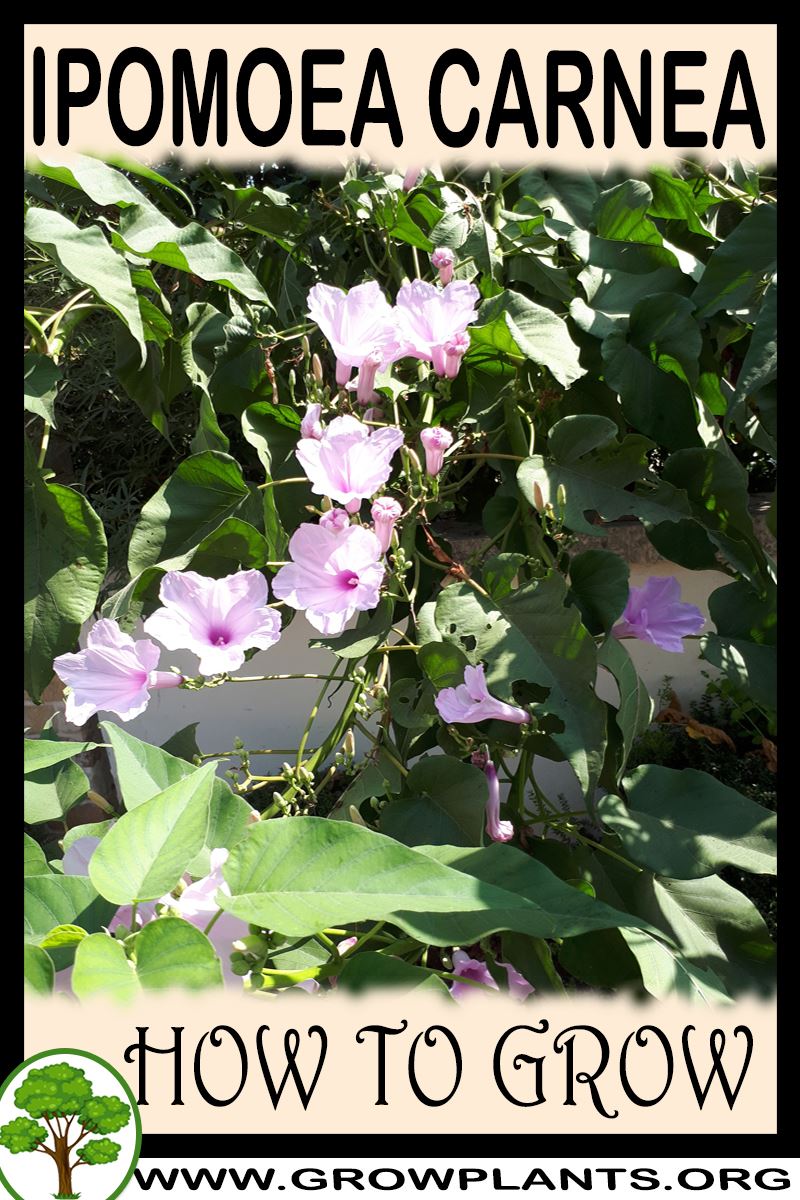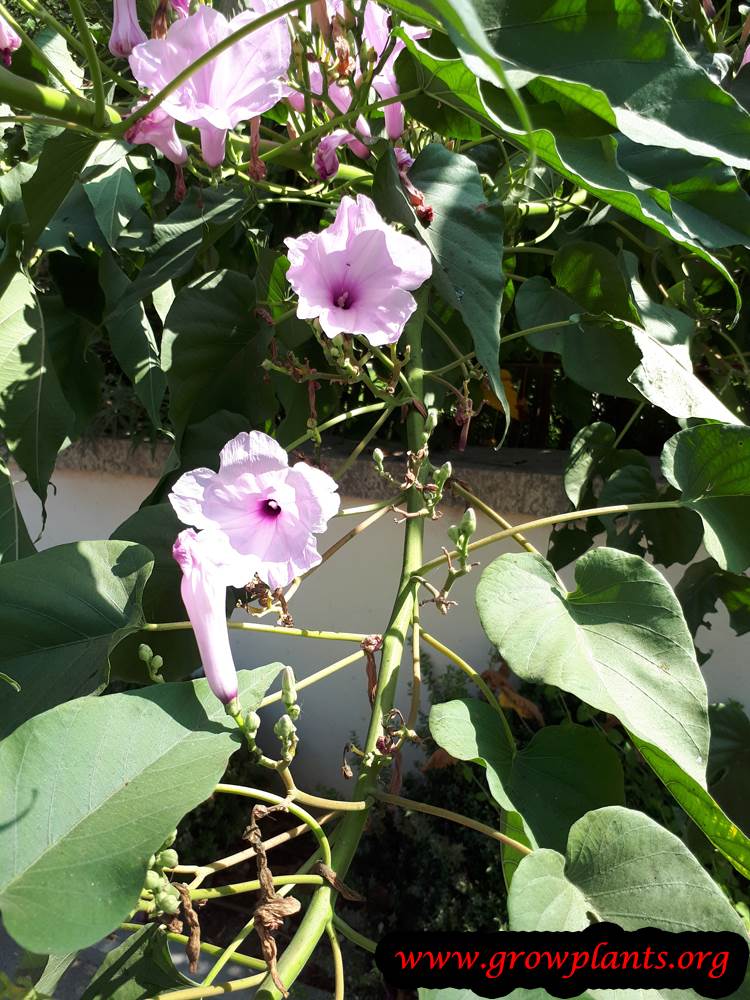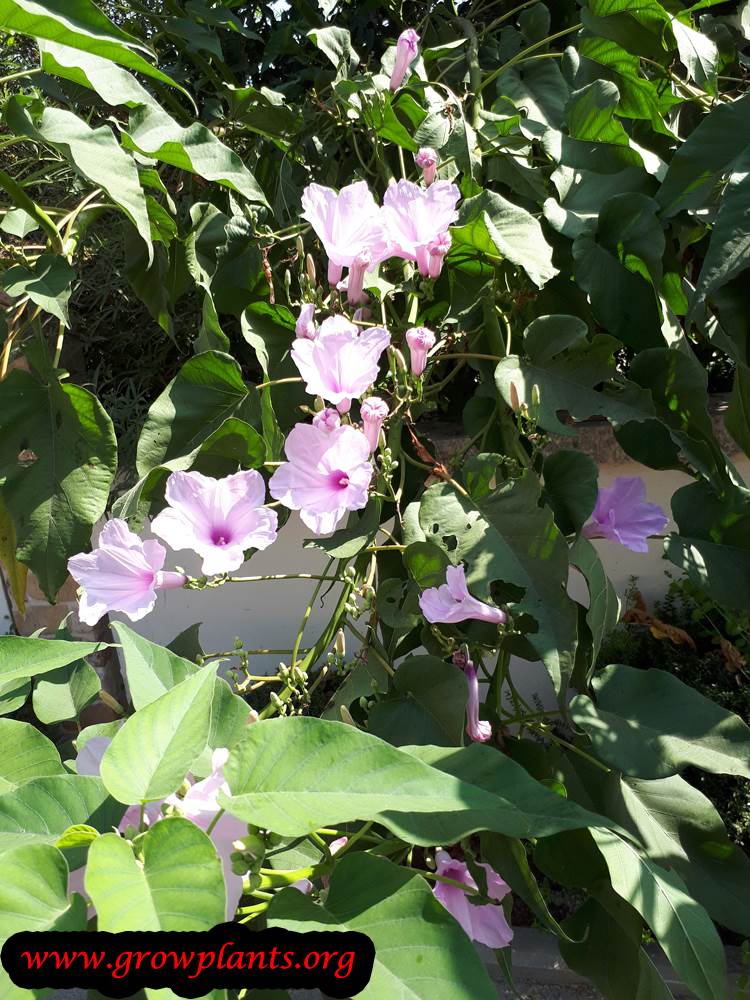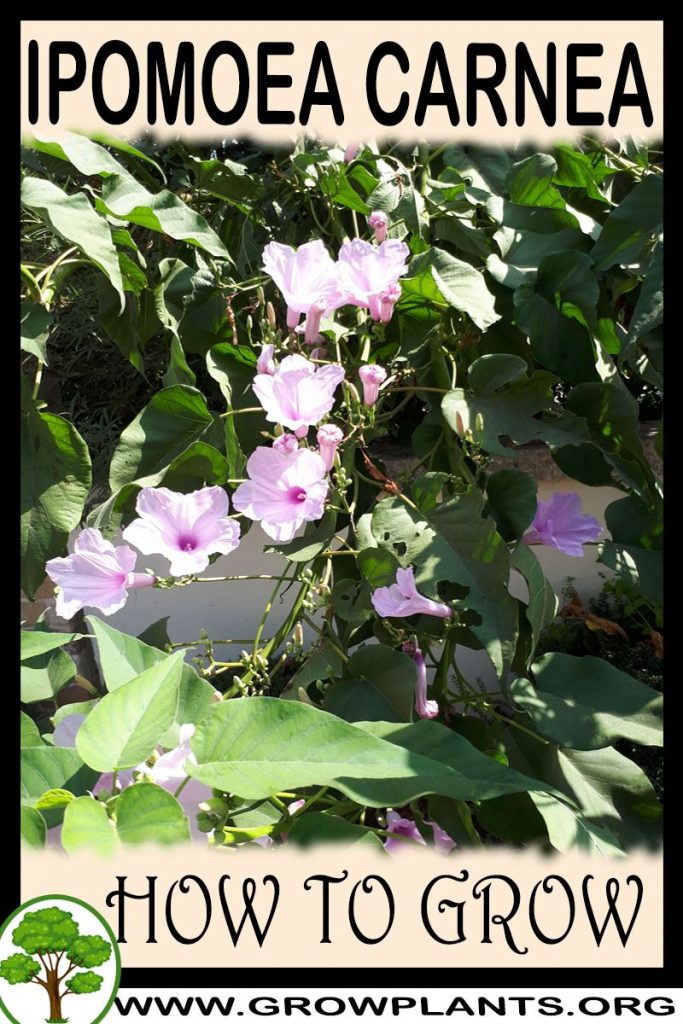
Plant Profile & Key Characteristics
Also known as: Ipomea cornea
Overview: A shrubby morning glory forming a fast-growing woody vine or bush of 2-5 m (6-15 ft), grown as an ornamental for its pink-to-white funnel flowers. Notably toxic to livestock.
Quick Specifications
| Specification | Attribute |
|---|---|
| Plant Type / Life Cycle | Perennial (evergreen) grown as an annual in cold climates |
| Foliage Type | Evergreen where frost-free; herbaceous annual elsewhere |
| Mature Size | 2-5 m (6-15 ft) |
| Growth Rate | Fast |
| Root System | Fibrous |
| Toxicity | Toxic – contains swainsonine; poisonous to livestock |
| Hardiness | USDA zone 10+ as perennial; zone 6+ grown as an annual |
Growth Form & Structure
- Height & Spread: Reaches 2-5 m (6-15 ft) as a scrambling shrub/vine; grows in containers (10-30 L / 2.5-8 gal) with support.
- Growth Habit & Form: Fast, semi-woody shrubby vine; aggressive and self-seeding.
- Lifespan & Maturity: Reaches flowering size in a single season.
Anatomy & Physical Features
- Leaves & Foliage: Green, heart-shaped (to deltoid) leaves.
- Flower Characteristics: Round, funnel-shaped flowers 3-7 cm across in pink to white (see the Bloom guide).
Primary Uses & Landscape Value
- Functional & Ornamental Roles: Ornamental climber for trellises, fences and pergolas; also used as a fast groundcover or informal screen. Grows in large containers.
Care Guide: Planting, Soil & Watering
Overview: A vigorous herbaceous vine that thrives in full sun to part shade in warm, frost-free conditions. It grows best in rich, moist, well-ventilated soil with good drainage and appreciates steady moisture through the growing season.
Quick Care Requirements
| Requirement | Ideal Condition |
|---|---|
| Planting Season | Spring after last frost (as annual); year-round in zone 12+ |
| Growth Rate | Fast |
| Soil Type | Rich, moist, well-ventilated soil with good drainage |
| Water Need | Moderate to High – keep the soil evenly moist |
Planting & Establishment
- Best Planting Season: Plant in spring after the last frost as an annual; where hardy, spring in zone 10a, spring to summer in 10b, spring to autumn in 11, and year-round in zone 12+.
- How to Plant:
- Hole Preparation: Dig the hole about 50% wider than the root ball so the roots can spread into loosened soil.
- Soil Amendments: Mix the excavated soil with organic matter, humus and dead leaves before backfilling to enrich and lighten it.
- Planting Depth: Set the plant so the root collar sits level with the surrounding soil; firm gently but firmly so it will not topple, and install a trellis or support at planting time.
- Growth Speed & Expectations: In optimal conditions this is a fast grower that can cover a support in a single warm season.
Soil, Watering & Drainage Care
- Soil Mix & Drainage Needs: Rich, moist but well-ventilated soil with good drainage; in containers (10–30 L) use free-draining mix with ample holes.
- Watering Schedule & Technique:
- Young / Newly Planted: Water twice on the first day of planting, then daily for the first two weeks while the roots establish.
- Established: Once established, water regularly to keep the soil evenly moist; morning glories dislike drying out completely. It appreciates generous moisture but dislikes waterlogging.
- Seasonal Adjustments: Give more water in summer heat and taper off in cooler weather or winter dormancy.
Climate, Light & Hardiness
Bush morning glory is a shrubby tropical to subtropical member of the genus, perennial in frost-free climates and grown as a warm-season annual where winters freeze, flowering in full sun to half shade. It thrives in warmth and humidity and has essentially no frost tolerance, so cold limits year-round outdoor culture outside roughly USDA zone 10.
Quick Climate Specifications
| Climate Zones | Tropical, Mediterranean, desert, subtropical, temperate |
|---|---|
| USDA Hardiness Zones | About 10+ as a perennial; about 6+ grown as a warm-season annual |
| Optimal Temp Range | Approximately 22–30 °C (72–86 °F) |
| Cold Damage Begins | At or near freezing |
| Approx. Survival Minimum | Top growth killed by frost; perennial only in essentially frost-free conditions (about zone 10+) |
| Frost Tolerance | None to Very Low |
| Light Conditions | Full sun to half shade |
| Wind Tolerance | Moderate |
Sunlight & Light Exposure
Optimal Light Setup
Full sun for the densest growth and most flowers; it tolerates half shade with reduced bloom.
Direct Sun Requirement
Best in full, direct sun.
Best Exposure / Orientation
An open, warm, sunny position suits its shrubby habit.
Temperature Extremes & Hardiness
USDA Hardiness & Regional Limits
Perennial in frost-free zones (about 10+); in zones 6–9 it grows as a warm-season annual killed each winter, so cold limits its year-round outdoor range.
Cold Damage & Winter Protection
Frost kills top growth; plants can be overwintered indoors and set out after the last frost.
Frost Sensitivity
High.
Extreme Heat Tolerance
Good; a warm-climate species comfortable in hot summers.
Frost-Free Growing Season
It needs a warm, frost-free stretch to grow and flower, germinating best in warm soil around 22–30 °C (72–86 °F).
Wind, Humidity & Microclimate
Humidity Preferences
Enjoys warm, humid air.
Wind Tolerance
Moderate; give tall stems some shelter or support.
Microclimate Recommendations
A warm, sheltered, sunny microclimate maximises growth and bloom.
Growing in Pots, Balconies & Indoors
Ipomoea carnea is a large, shrubby morning-glory relative reaching 2-5 m, which can be grown in a big tub with support. It is not a houseplant – it needs full outdoor sun and room – so grow it on a sunny balcony or patio. Note that this species is notably poisonous, so site it with care.
Quick Details
- Container Size: 10-30 L (2.5-8 gal) – bigger is better for this shrubby grower
- Indoor Suitability: Not indoors – a large, vigorous plant needing full outdoor light
- Best Spot: Full sun to part shade, with support
- Soil & Drainage: Well-ventilated, free-draining mix rich in organic matter
- Watering in Pots: Keep evenly moist – average to generous water; a pot dries fast
Indoors & On the Windowsill
- Houseplant limits: The grower marks it as not an indoor plant – it is large, vigorous and needs full sun.
- Windowsill growing: Not suitable; grow it outdoors with support.
- Safety: Ipomoea carnea is notably toxic – all parts are poisonous if eaten. Keep it well away from children and pets, and never grow it where livestock can reach it.
On a Balcony or Patio
- Light, support & wind: A sunny balcony or patio is where this climber shines – give it a trellis, railing or strings to climb and shelter it from strong wind, which shreds the soft growth. Reflected heat from walls dries the pot fast, so check moisture daily in warm weather. A drip irrigation kit with a timer can take over that watering check automatically.
- Practicalities: Make sure the filled pot and its support are stable and that drainage runoff can escape freely without pooling below.
Choosing the Pot, Soil & Long-Term Care
- Pot & drainage: Use a container of 10-30 L (2.5-8 gal) – bigger is better for these fast, hungry climbers. Keep the soil moist and make sure water drains out; it is better not to use a saucer under the pot.
- Potting mix: A well-ventilated mix with good drainage, rich in organic matter – a general potting mix, or peat soil with perlite or vermiculite.
- Feeding: Feed through the growing season; nutrients leach from pots faster than from open ground.
- Repotting (as a perennial): Every two years, switch the soil and prune back part of the roots and the top growth to keep it healthy.
Fertilizing & Feeding
Morning glory is an ornamental flowering vine fed mainly in spring; it wants balanced nutrition and rich, moist soil, but excess nitrogen gives rampant vine and fewer flowers.
Quick Fertilizing Specs
| Feeding Level | Moderate |
|---|---|
| Main Nutrient Priority | Balanced nutrition; keep nitrogen in check for better bloom. |
| Best Feeding Period | Mainly in spring as growth begins, easing through summer. |
| Organic Options | Compost, humus and organic matter mixed into the soil. |
| Micronutrients | Usually covered by a complete fertilizer and rich soil; correct iron only if new growth yellows. |
| Soil pH | Tolerates a wide range; near neutral, rich, moist, well-drained soil is ideal. |
| Reduce/Stop Feeding | Ease off feeding after the flush of growth and through winter rest. |
Feeding by Growth Stage
Spring growth flush
Support fresh shoots and leaves as the plant wakes up in spring.
| Nutrient direction | A balanced complete feed with adequate nitrogen fuels healthy new growth. |
|---|---|
| Timing | As new growth begins in spring. |
| Frequency | A light, regular feed as spring growth begins. |
| Fertilizer types | A balanced complete fertilizer, Compost or well-rotted organic matter |
| Precautions | Keep feeding moderate; overly rich soil softens growth. Avoid heavy nitrogen, which drives leaves at the expense of flowers. |
Flowering
Sustain flowering without pushing excess foliage.
| Nutrient direction | A balanced feed supports steady bloom; adequate nitrogen, not high phosphorus, drives flowering. |
|---|---|
| Timing | Through the flowering season. |
| Frequency | Light, regular feeding through the flowering period. |
| Fertilizer types | A balanced complete fertilizer |
| Precautions | High-phosphorus ‘bloom booster’ feeds are unnecessary; a balanced feed and full sun give better flowering. Avoid heavy nitrogen, which drives leaves at the expense of flowers. |
Dormancy or winter rest
Let the plant rest through cold or dormant months without forcing growth.
| Nutrient direction | None – withhold fertilizer while the plant is not actively growing |
|---|---|
| Timing | During dormancy or cool-season rest when growth has stopped |
| Frequency | No feeding at this stage |
| Fertilizer types | No feeding at this stage – resume only when active growth returns |
| Precautions | Do not fertilize until active growth resumes; feeding a resting plant risks salt buildup and root injury |
Nutrient Deficiency Signs & Corrections
Older, lower leaves fade to pale green or yellow overall and growth slows.
| Possible causes | Low soil nitrogen or thin organic matter, Nitrogen leached out by heavy watering or rain on light soils, Cold, waterlogged roots limiting uptake |
|---|---|
| Appears first on | older, lower leaves |
| What to check | soil organic matter and recent feeding, whether heavy rain or irrigation may have leached nutrients, overall plant vigor and colour |
| Possible correction | Topdress with compost or apply a balanced complete fertilizer at label strength; keep watering steady but not excessive so nutrients are not washed away. |
Youngest leaves yellow between the veins while the veins stay green.
| Possible causes | High or alkaline soil pH locking up iron, Cold or waterlogged soil slowing root uptake, Genuinely low available iron |
|---|---|
| Appears first on | newest leaves at the shoot tips |
| What to check | soil pH and drainage, whether the soil is cold or saturated, overall root health |
| Possible correction | Correct soil pH and improve drainage first; if the youngest growth stays chlorotic, apply a chelated iron product following its label. |
Lush leafy growth but few flowers.
| Possible causes | Too much nitrogen from over-feeding, Overly rich soil relative to light levels, Insufficient sunlight for the demand created by heavy feeding |
|---|---|
| Appears first on | new leafy shoots at the expense of buds |
| What to check | recent feeding rate and fertilizer type, light exposure, balance of leaf growth versus budding |
| Possible correction | Ease back on nitrogen and switch to a balanced feed; ensure full sun so the plant channels energy into flowering rather than foliage. |
Pruning, Training & Seasonal Maintenance
Bush morning glory is best treated as a fast-growing, soft-wooded shrub rather than a twining vine – it’s commonly grown as a hedge or informal screen in warm climates, and its cut behaviour follows that of a soft-stemmed shrub, not a herbaceous climber. It tolerates moderate-to-high pruning and responds well to shaping and renewal cuts, with the main objective being density and size control for hedge/screen use rather than guiding it onto a support.
Quick Pruning & Maintenance Specs
| Pruning Tolerance | Moderate–High |
| Primary Pruning Window | Late winter/early spring, before the main flush (mild-winter/frost-free areas), or after the main bloom period |
| Secondary Maintenance Window | Summer shaping if maintained as a hedge |
| Typical Frequency | 1–2 times per year for hedge maintenance; occasional renewal otherwise |
| Main Objective | Shape/density control for hedge or screen use; renew leggy growth |
| Young Plant Priority | Pinch the growing tip early to force low branching |
| Mature Plant Priority | Renew the oldest, leggiest stems; control height/spread |
| Best Tool Type | Bypass secateurs/loppers for the soft-woody stems |
| Avoid Heavy Pruning During | Peak flowering |
Pruning by Plant Age & Size
Newly Established
Pinch the leading shoot early to force low branching – this is important for a soft-wood shrub grown for hedge density; left unpinched it tends toward a single leggy stem instead of a bushy base.
Young / Formative
Open, multi-stem shrub training: select several main stems from low down rather than training a single leader up a support.
Mature / Established
Renewal pruning of the oldest, leggiest stems; ongoing height and spread control if kept as a hedge or screen.
Seasonal Pruning Schedule
Post-Flowering
Objective: tidy and renew after the bloom period. Remove: spent flower stems and the leggiest old growth. Do not remove: young, well-placed shoots forming the shrub’s framework. Expected response: fresh, denser branching. Flowering impact: minimal, since it follows the bloom period rather than pre-empting it.
Ongoing Sanitary
Remove dead or damaged stems at any time.
Structural Pruning & Training
Multi-stem branch selection rather than single-leader training; thinning genuinely helps light penetration and density in hedge use; renewal pruning of old leggy wood keeps the shrub full rather than bare at the base.
Special Growth to Remove
- Leggy, weak basal growth that isn’t contributing to hedge density
- Spent flower stems
Container & Small-Space Pruning
Possible while young, but this species grows to shrub/small-tree scale in warm climates, so long-term container culture requires regular size-control pruning well beyond what a true vine would need.
Tools
- Bypass secateurs – routine shaping of soft-woody stems
- Loppers – renewal cuts on older, thicker growth
- Hedge shears – genuinely appropriate here if maintained as a clipped hedge, since this species is actually used that way
Tool Hygiene & Disease Risk
Routine: clean, sharp tools suffice. Recorded pests (weevil, moth, whitefly, aphids) aren’t typically spread by pruning cuts.
Cut Placement & Technique
Use thinning cuts (removing a stem to its point of origin) for renewal work rather than shearing everywhere; if hedge-shearing the outer surface, follow up periodically with a thinning cut to stop the shrub becoming hollow and bare inside.
Heavy Pruning & Rejuvenation
Tolerated: as a fast-growing, soft-wooded shrub it can be cut back hard to renew a leggy or overgrown hedge, with vigorous regrowth expected within a season.
Post-Pruning Care
Water normally after a hard renewal cut; watch new growth for the same sap-feeding pests noted for this plant (aphids, whitefly).
Common Pruning Mistakes
- Treating it like a herbaceous twining vine and only guiding it onto a trellis instead of actively shaping and pinching it as a shrub, which produces a sparse, leggy, top-heavy plant instead of a dense hedge
- Shearing the surface repeatedly without ever thinning, leaving a hollow, bare-centred shrub
When NOT to Prune
Avoid heavy cutback during peak flowering; wait for the post-bloom window instead.
Recommended Tools (by task)
- Routine hedge/shrub shaping – bypass_secateurs: soft-woody stems need a clean cut, not a herbaceous snip
- Renewal cuts on older growth – loppers
- Formal hedge maintenance – hedge_shears: legitimate here since this species is genuinely grown as a clipped hedge, unlike the true twining Ipomoea vines
Propagation Guide
This shrubby morning glory roots exceptionally easily from stem cuttings — even fairly thick, woody pieces — so cuttings are the quickest and most dependable method. It can also be grown from its hard-coated seed. Cuttings reproduce a plant exactly; an Easy plant to increase.
Quick Propagation Specs
| Best Propagation Method | Stem cuttings (root very readily) |
| Alternative Methods | Seed; ground layering |
| Propagation Difficulty | Easy |
| Seed True-to-Type | Broadly uniform for the species |
| Vegetative True-to-Type | Yes — a cutting or layer reproduces the parent, including flower colour |
| Best Propagation Season | Spring to summer |
| Seed Germination Time | 2–7 weeks |
| Cutting Rooting Time | A few weeks under warm, humid conditions |
| Germination Temperature | 22–30°C (72–86°F) |
| Seed Sowing Depth | 1 cm (0.5 in) |
Growing from Seed
Seed Handling & Viability
Store seed in a dark, dry place until sowing.
Dormancy & Pre-Sowing Treatment
Morning glory seed has a hard coat; nicking it or soaking it in water overnight before sowing softens the coat and gives quicker, more even germination.
Sowing Season, Depth & Spacing
Sow in spring in most zones (and, in the warmest zones, from spring through autumn or year-round, avoiding the hottest days of summer). Sow about 1 cm (0.5 in) deep, spacing about 30×40 cm (12×16 in), or 4×4 cm (1.8×1.8 in) if pricking out seedlings to transplant. Sowing into peat with vermiculite — or adding vermiculite around the seed — helps hold moisture.
Germination Conditions & Time
Germinate at about 22–30°C (72–86°F) in moist soil with high humidity, ideally in a sunny spot. Emergence is spread over roughly 2–7 weeks, so germination can be staggered; soaking beforehand shortens the wait.
Seedling Care
Water seedlings regularly and never let them dry out.
Stem Cuttings
Best Timing
Take cuttings from spring to summer, when the vine is in active growth.
Rooting Setup
Root either in water — changing it every few days — or in moist soil kept constantly damp, keeping the cutting warm, around 25–30°C (77–86°F), with high humidity.
Rooting Hormone
Optional — the soft stems root readily on their own, though a rooting hormone can help.
Air & Ground Layering
Because these vines root easily along their stems, a length of stem can be bent down, covered with moist soil and left to root, then separated from the parent — a simple way to gain an extra plant identical to it.
Bloom & Flower Guide
Quick Details
- Bloom Season: Spring, summer and autumn
- Flower Appearance: Round, funnel-shaped flowers 3-7 cm, in pink to white
- Edibility: Not edible – this plant is toxic (it contains swainsonine)
Detailed Blooming Overview
Bush morning glory is a shrubby relative of the climbing morning glories, grown for its soft pink-to-white funnel flowers held over a long, warm season. It flowers freely and makes a fast, informal screen.
Flower Characteristics
- Funnel-shaped flowers 3-7 cm across, pink fading to white with a deeper throat.
- Carried in clusters over glossy heart-shaped leaves.
Bloom Care & Thinning
- Managing the bloom: Full sun and warmth keep it flowering; a hard prune after a flush keeps the shrub tidy and encourages fresh blooms.
- Pollination: Visited by bees and other insects.
Bloom Health & Protection
- Safety: All parts are toxic (swainsonine) and known to poison livestock – grow it strictly as an ornamental and keep it away from grazing animals and food use.
Pests, Diseases & Troubleshooting
Overview: Ornamental morning glories are fast, tough climbers that are rarely troubled seriously; their common visitors are chewing tortoise beetles and caterpillars plus sap-sucking aphids and whitefly, with rust and leaf spot the main diseases. Most ‘problems’ are really vigor — they self-seed and can become weedy — and poor flowering from excess nitrogen.
Quick Troubleshooting Overview
| Issue / Pest | Main Symptom | Primary Solution |
|---|---|---|
| Tortoise / flea beetles | Small round holes and pits in leaves | Tolerate light damage, hand-pick, neem if heavy |
| Caterpillars (leaf-rollers, hornworm) | Chewed, rolled, skeletonized leaves | Hand-pick, Bacillus thuringiensis |
| Aphids | Sticky curled new growth, sooty mold | Water jet, insecticidal soap |
| Whitefly | Clouds of white flies, honeydew, yellowing | Yellow sticky traps, soap/oil |
| Spider mites | Stippling and webbing in hot dry spells | Hose foliage, oil/soap |
| Rust / leaf spot | White or brown pustules/spots on leaves | Airflow, dry foliage, remove leaves |
Common Pests & Management
- Tortoise beetles & flea beetles (Charidotella / Cassidinae, Chaetocnema spp.):
- Symptoms: Golden or metallic tortoise beetles and tiny flea beetles chew small round holes and pits in the leaves; the classic ‘shot-hole’ look, mostly cosmetic on vigorous vines.
- Prevention & Control: Tolerate light feeding, hand-pick beetles, keep plants vigorous, and use neem or spinosad only if damage becomes heavy on young plants.
- Caterpillars (Sweet potato hornworm, leaf-rollers & webworms (Agrius, Spoladea, Bedellia)):
- Symptoms: Chewed, skeletonized, or rolled and webbed leaves and defoliated shoot tips from various moth larvae.
- Prevention & Control: Hand-pick and unroll leaves to remove larvae, encourage parasitic wasps and birds, and spray Bacillus thuringiensis (Bt) for significant infestations.
- Aphids (Aphis / Myzus spp.):
- Symptoms: Soft green or dark insects on shoot tips and leaf undersides causing sticky, curled, distorted growth and sooty mold; they can spread viruses.
- Prevention & Control: Blast with water, support ladybirds and lacewings, and use insecticidal soap or neem on stubborn colonies in the evening.
- Whitefly (Bemisia tabaci / Trialeurodes):
- Symptoms: Clouds of tiny white flies that lift off when disturbed, with honeydew, sooty mold, and yellowing; important virus vectors in warm climates.
- Prevention & Control: Hang yellow sticky traps, encourage natural enemies, and spray undersides with insecticidal soap or horticultural oil, repeating to break the cycle.
- Spider mites (Tetranychus urticae):
- Symptoms: Fine stippling, bronzing, and webbing under leaves in hot, dry, stressed conditions.
- Prevention & Control: Hose foliage, keep plants watered and unstressed, and treat undersides with insecticidal soap or a light horticultural oil.
Diseases & Fungal Issues
- White rust / rust (Albugo ipomoeae-panduratae, Coleosporium):
- Symptoms: Raised white blister-like pustules or orange-brown rust spots on leaf undersides with yellowing above, in humid conditions.
- Treatment & Management: Remove and destroy affected leaves, space and train for airflow, avoid overhead watering, and use a labelled fungicide only under heavy pressure.
- Fungal leaf spot & anthracnose (Cercospora, Colletotrichum):
- Symptoms: Brown, tan, or black spots and blotches on leaves, sometimes coalescing and causing early leaf drop in wet weather.
- Treatment & Management: Clear fallen litter, improve airflow, keep foliage dry, and apply copper only if spotting becomes severe.
- Stem & root rot / wilt (Fusarium, Rhizoctonia, Pythium):
- Symptoms: Wilting, yellowing, and a soft rotted stem base or roots in overwet, poorly drained soil.
- Treatment & Management: Grow in well-drained soil, avoid overwatering, and remove affected plants; give good drainage in containers.
- Viral mosaic (aphid/whitefly-borne):
- Symptoms: Mottled, mosaic, or distorted foliage and reduced vigor spread by sap-sucking vectors.
- Treatment & Management: There is no cure — remove symptomatic plants, control aphids and whitefly, and manage weed hosts.
Growing Difficulties & Abiotic Problems
- Aggressive, weedy self-seeding:
- Cause & Symptoms: The main real ‘problem’: vigorous growth and prolific self-seeding let morning glories climb over and smother neighbors and reappear as volunteers for years.
- Correction Strategy: Site where vigor is welcome, deadhead before seeds ripen to limit self-sowing, and pull volunteers early; grow on a strong support with room to run. I. carnea (bush morning glory) is a shrubby, toxic species that can spread aggressively near water.
- Poor flowering from excess nitrogen:
- Cause & Symptoms: Lush leafy vines with few flowers when soil is too rich or over-fed.
- Correction Strategy: Grow in lean-to-average soil in full sun, avoid nitrogen-rich feeding, and give plenty of light to shift the plant from leaf to bloom.
- Frost sensitivity:
- Cause & Symptoms: Blackening and collapse of these tender annual/tropical vines at first frost.
- Correction Strategy: Grow as a warm-season annual in cold climates; sow after frost and expect it to die back with the first hard freeze.
- Hard-coated seed & poor germination:
- Cause & Symptoms: Slow, erratic germination from the tough, water-resistant seed coat.
- Correction Strategy: Nick (scarify) and soak seeds before sowing to speed and even out germination.
What Helps — Products & Tools
Ornamental morning glories seldom need much beyond gentle tools: a water jet, insecticidal soap, and neem for aphids, whitefly, and mites, Bacillus thuringiensis for caterpillars, and yellow sticky traps for whitefly. Airflow and sanitation handle rust and leaf spot; copper is a last resort. The main ‘management tool’ is restraint — deadheading and pulling volunteers to curb their weedy vigor.