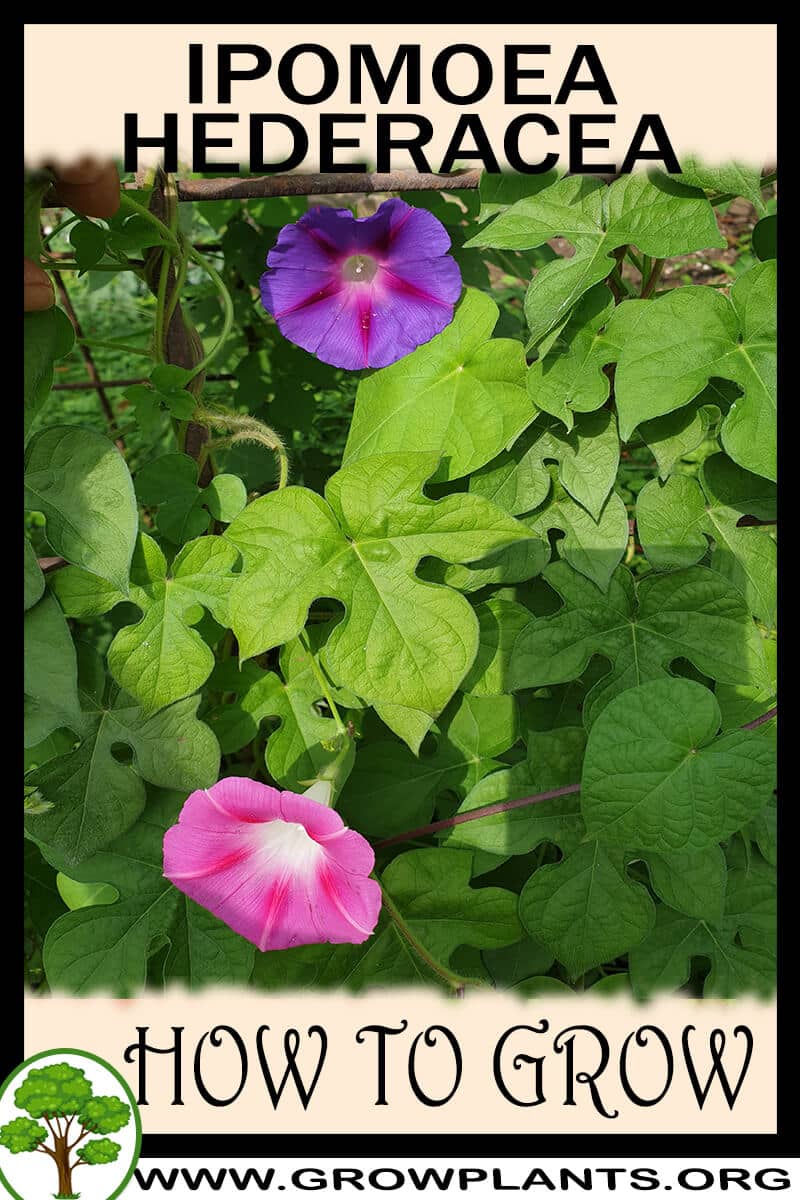
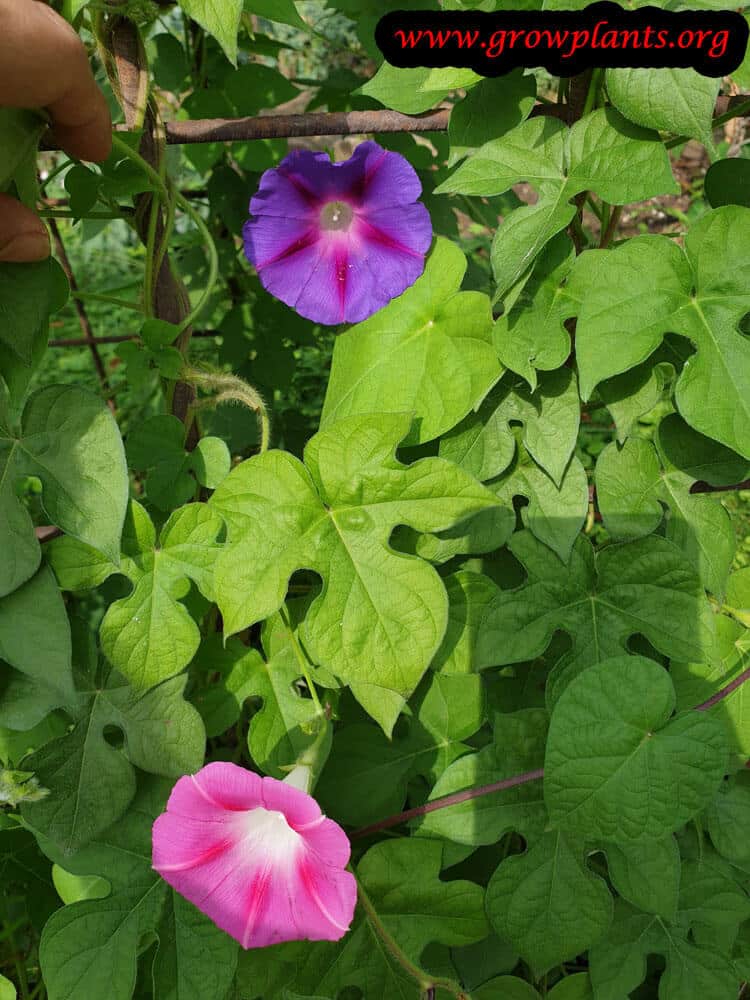
Plant Profile & Key Characteristics
Overview: Ipomoea hederacea (ivy-leaved morning glory) is a fast-growing herbaceous twining vine reaching 2-5 m, grown as an ornamental climber for its blue-to-purple flowers. It is perennial in frost-free zones and grown as an annual in colder climates.
Quick Specifications
| Specification | Attribute |
|---|---|
| Plant Type / Life Cycle | Perennial (evergreen); usually grown as annual |
| Foliage Type | Evergreen in frost-free zones; dies back with frost |
| Mature Size | 2-5 m (6-15 ft) long |
| Growth Rate | Fast |
| Root System | Fibrous |
| Toxicity | Ornamental only; morning-glory seeds contain toxic alkaloids and are not for consumption |
| Hardiness | USDA zone 10+ as perennial, 6+ as annual |
Growth Form & Structure
- Height & Spread: 2-5 m (6-15 ft) of climbing growth in ground; in a container use 10-30 L (2.5-8 gal), larger is better.
- Growth Habit & Form: Herbaceous twining climber with heart- to three-lobed leaves; trained up a trellis or fence.
- Lifespan & Maturity: Fast to cover a support in one season.
Anatomy & Physical Features
- Leaves & Foliage: Green, heart- to deltoid-shaped, often three-lobed leaves.
- Flower Characteristics: Round, funnel-shaped blue or purple flowers borne spring to autumn (full detail in the Bloom guide).
Primary Uses & Landscape Value
- Functional & Ornamental Roles: Ornamental climber, screen or hedge and groundcover; vigorous, self-seeds freely and can be invasive.
Care Guide: Planting, Soil & Watering
Overview: This fast morning-glory vine grows in full sun to part shade in warm, frost-free conditions, quickly climbing a trellis or sprawling as a groundcover. It prefers rich, consistently moist, well-draining soil and appreciates a support to twine up.
Quick Care Requirements
| Requirement | Ideal Condition |
|---|---|
| Planting Season | In spring after the last frost (year-round in frost-free zone 12+) |
| Growth Rate | Fast |
| Soil Type | Rich, moist, well-draining |
| Water Need | Moderate to high; keep the soil evenly moist |
Planting & Establishment
- Best Planting Season: Plant in spring after the last frost; in warm zones it can be set out from spring into summer, and year-round in frost-free zones, avoiding the hottest days of summer.
- How to Plant:
- Hole Preparation: Dig a hole about 50% wider than the root ball so the roots can spread into loosened soil.
- Soil Amendments: Mix organic matter, humus and dead leaves into the backfill to enrich and lighten the soil.
- Planting Depth: Set the plant at the same level it grew before, firm gently but securely, and add a support or trellis for the vines to twine up.
- Growth Speed & Expectations: Very fast; expect it to fill a trellis or cover ground quickly in warm weather, so site it where its vigorous, potentially invasive habit can be contained.
Soil, Watering & Drainage Care
- Soil Mix & Drainage Needs: Keep the soil well aerated and free-draining to avoid rot; in pots use a rich potting or peat mix with perlite or vermiculite and keep it evenly moist.
- Watering Schedule & Technique:
- Young / Newly Planted: Water twice on planting day, then daily for the first two weeks while the roots establish.
- Established: Water regularly to keep the soil evenly moist, letting the very surface dry slightly between waterings.
- Seasonal Adjustments: More in summer heat and dry spells; much less over the cool winter months.
Climate, Light & Hardiness
Ipomoea hederacea (ivy-leaved morning glory) is a fast, heat-loving vine adapted to tropical, Mediterranean, desert, subtropical, and temperate climates, growing best in full sun to half shade. It is frost-tender: it persists as a perennial only in essentially frost-free areas (roughly USDA zone 10 and warmer), while in colder climates - down to about zone 6 - it is grown as a fast-cycling summer annual killed by the first freeze.
Quick Climate Specifications
| Climate Zones | Tropical, Mediterranean, Desert, Subtropical, Temperate |
|---|---|
| USDA Hardiness Zones | 10+ as a perennial; grown as an annual from about zone 6 upward |
| Cold Damage Begins | Foliage and vines are damaged by the first light frost, near 0°C (32°F) |
| Approx. Survival Minimum | Roots may briefly persist just above freezing in the mildest, essentially frost-free part of its range; killed outright by hard frost |
| Frost Tolerance | Very Low |
| Light Conditions | Full Sun to Half Shade |
| Wind Tolerance | Moderate |
Sunlight & Light Exposure
Optimal Light Setup
Grow in full sun for the most vigorous vining growth and best flowering; half shade is tolerated but slows growth.
Direct Sun Requirement
Several hours of direct sun daily are genuinely beneficial for strong twining growth and flower production.
Shade & Heat Management
Well adapted to hot desert and subtropical summers; no special heat protection is needed given adequate water.
Best Exposure / Orientation
An open, sunny spot with a trellis, fence, or support for climbing suits this vigorous vine.
Temperature Extremes & Hardiness
USDA Hardiness & Regional Limits
True perennial persistence needs essentially frost-free conditions, roughly USDA zone 10 and warmer. From about zone 6 through the cooler part of its range, cold ends the plant’s life cycle each year, so it is grown as a fast, self-seeding warm-season annual rather than left to overwinter outdoors.
Cold Damage & Winter Protection
Frost blackens and kills the foliage and vines; where a plant is valued and winters are only briefly cold, it can be brought indoors or kept sheltered over winter and set out again after the last frost, though this is an overwintering technique rather than reliable outdoor hardiness.
Frost Sensitivity
Very frost-sensitive at every growth stage - even a light frost typically ends the season’s growth.
Extreme Heat Tolerance
Excellent; it thrives through hot tropical, desert, and subtropical summers.
Frost-Free Growing Season
Where commonly grown as an annual outside its perennial range, a long, warm, frost-free stretch from spring planting to autumn frost is what allows it to establish, vine, and flower fully each year.
Wind, Humidity & Microclimate
Humidity Preferences
Tolerates a wide humidity range, from humid tropical air to drier desert and Mediterranean conditions, given adequate soil moisture.
Wind Tolerance
Moderate; being trellised or otherwise supported helps the twining stems withstand wind better than when left to sprawl.
Rainfall & Seasonal Moisture
Adapts to varied rainfall regimes across its broad climate range but grows most vigorously with reliable moisture through the warm growing season.
Microclimate Recommendations
A warm, sunny, sheltered spot with something to climb suits it well; in marginal climates, a south-facing wall extends the effective warm season. Container-grown plants can be moved to frost-free shelter over winter, but note their smaller root zone also heats and cools faster than open ground.
Growing in Pots, Balconies & Indoors
Ipomoea hederacea is a fast, twining morning-glory vine that grows well in a large container but is not a houseplant – it needs full sun and a support to climb. Given a big pot and a trellis it covers a balcony or patio screen quickly.
Quick Details
- Container Size: 10-30 L (2.5-8 gal), and bigger is better for this vigorous 2-5 m vine (grower’s value)
- Indoor Suitability: Not a houseplant – it needs full sun and room to climb
- Best Spot: Full sun to half shade, outdoors, with a trellis or strings to twine up
- Soil & Drainage: Well-ventilated, free-draining mix rich in organic matter (grower’s spec)
- Watering in Pots: Average to generous water – keep the mix moist so water runs from the drainage holes
Indoors & On the Windowsill
- Houseplant limits: The grower does not rate it as a houseplant – it is a sun-loving climber that quickly outgrows any indoor spot and flowers poorly without strong light.
- Overwintering: It is usually grown as a tender annual and resown each warm season rather than kept indoors over winter.
- Safety: The seeds are toxic if eaten – keep them away from children and pets.
On a Balcony or Patio
- Light & support: Give it full sun and a sturdy trellis, railing or strings to climb; it twines fast and needs the support in place from the start.
- Practicalities: A leafy vine in a pot drinks heavily and dries fast in sun and wind – check moisture daily in summer. A drip irrigation kit with a timer can take over that watering check automatically.
Choosing the Pot, Soil & Long-Term Care
- Pot & drainage: A 10-30 L pot with strong drainage holes; the grower advises against a standing-water tray beneath it. Terracotta breathes and dries faster; glazed or plastic holds moisture longer.
- Potting mix: Well-ventilated, free-draining, organic-rich mix – potting mix or peat with perlite or vermiculite (grower’s spec).
- Feeding: Potted plants run through their soil faster as nutrients leach away with each watering, so feed a little more often than plants in open ground. Go easy on nitrogen, which drives leaf at the expense of flowers.
- Repotting (if kept as a perennial): Where it persists, the grower changes the soil every two years and prunes back part of the roots and top growth.
Growing this plant in a greenhouse
A greenhouse can give ipomoea hederacea frost protection and cold protection.
Greenhouse at a glance
| Greenhouse suitability | Conditional - depends on your climate |
|---|---|
| Main benefits | frost protection, cold protection |
| Season extension | earlier spring & later autumn |
| Outdoor protection advisable below | about 5°C |
| Maintain greenhouse minimum | around 5°C for active growth |
| Suitable types | unheated greenhouse, polycarbonate greenhouse, lean-to |
| Heating | Heating is optional - useful mainly for winter growing in cold areas. |
Related greenhouse guides
- Greenhouses: How to Choose the Right Greenhouse
- Best Lean-To Greenhouses
- Polycarbonate Greenhouses: What to Look for Before Buying
Fertilizing & Feeding
A light feeder: this fast, aggressive vine flowers best on lean to moderately rich soil, so a modest feeding at planting and in spring is usually all it needs.
Quick Fertilizing Specs
| Feeding Level | Light feeder |
|---|---|
| Main Nutrient Priority | Balanced feeding, kept light, to support twining growth and bloom without fueling excess vigor |
| Best Feeding Period | At planting and again as spring growth resumes |
| Organic Options | Organic matter and humus worked into the planting hole |
| Reduce/Stop Feeding | Little to no feeding is usually needed once the vine is established and climbing well |
| Micronutrients | Rarely an issue in enriched garden soil; correct only a diagnosed deficiency |
| Soil pH | Tolerates a fairly wide range in rich, moist, well-drained soil |
Feeding by Growth Stage
Establishment after planting
Help a young vine root in and begin climbing its support.
| Nutrient direction | Organic matter worked into the planting hole, plus a light balanced fertilizer, supports early root and shoot growth. |
|---|---|
| Timing | At planting and through the first weeks as the vine begins to climb. |
| Frequency | A light feeding at planting is usually enough to get the vine established. |
| Fertilizer types | A balanced complete fertilizer, applied sparingly, Organic matter and humus worked into the soil |
| Precautions | Provide a trellis or support early; feeding does not substitute for the structure this twining vine needs. |
Active climbing growth and bloom
Support the vine’s fast climbing habit and its blue or purple round flowers through the growing season.
| Nutrient direction | This stage rarely needs feeding; established vines typically bloom well on existing soil fertility. |
|---|---|
| Timing | Through the spring-to-autumn growing and bloom season. |
| Frequency | Minimal feeding is typical; add a light balanced feeding only if growth or bloom looks weak. |
| Fertilizer types | A balanced complete fertilizer only if growth appears weak or sparse |
| Precautions | This vine is known to grow aggressively; rich feeding tends to push more foliage rather than more flowers and can worsen its spreading tendency. |
Cold-season rest
Let an overwintered vine rest through the cold season without pushing tender new growth.
| Nutrient direction | None – withhold fertilizer while the vine is resting in cool conditions or held indoors over winter. |
|---|---|
| Timing | Autumn into winter, for vines kept from year to year rather than grown as annuals. |
| Frequency | No feeding at this stage. |
| Fertilizer types | No feeding at this stage; do not fertilize until active growth resumes after the last frost. |
| Precautions | Do not fertilize during this rest period; feeding now can push weak, frost-tender growth. |
Nutrient Deficiency Signs & Corrections
Older, lower leaves fade to pale green or yellow and vine growth slows noticeably.
| Possible causes | low available soil nitrogen, nitrogen leaching from watering or rain, root competition in a crowded bed |
|---|---|
| Appears first on | older, lower leaves |
| What to check | recent feeding history, soil organic matter, crowding from nearby plants |
| Possible correction | Apply a light balanced fertilizer and enrich the soil with organic matter. |
New leaves near the growing tips yellow while the veins stay green.
| Possible causes | high soil pH limiting iron availability, waterlogged or compacted soil, root stress from poor drainage |
|---|---|
| Appears first on | newest leaves at the vine tips |
| What to check | soil pH, drainage and compaction, recent watering |
| Possible correction | Improve drainage first, then apply a chelated iron product per its label if pH cannot be adjusted. |
Leaf margins brown or scorch, especially on container-grown vines, despite adequate watering.
| Possible causes | fertilizer salt buildup in a confined root zone, under-watering that concentrates salts, excessive or too-frequent feeding |
|---|---|
| Appears first on | leaf margins and tips |
| What to check | recent fertilizer amounts, watering consistency, container drainage, if grown in a pot |
| Possible correction | Ease off feeding and water thoroughly to flush accumulated salts, then resume with lighter feeding. |
Pruning, Training & Seasonal Maintenance
Ivy-leaved Morning Glory is a fast, twining herbaceous vine usually grown as an annual, in which case frost kills it back completely each year and no formal pruning is needed. In zone 10+, where it can persist as a tender perennial, it benefits from a hard cutback after its main bloom flush or in early winter to control its naturally aggressive, self-seeding spread on its support.
Quick Pruning & Maintenance Specs
| Pruning Tolerance | High (in perennial-zone plants) |
| Primary Pruning Window | After the main bloom flush, or early Winter (perennial zones only) |
| Secondary Maintenance Window | Through the growing season for tip-pinching/training |
| Typical Frequency | Annual-grown: none needed. Perennial-grown: one major cutback per year plus ongoing training |
| Main Objective | Contain aggressive twining spread, shape onto support, remove dead growth |
| Young Plant Priority | Pinch young tips to force branching and fuller trellis coverage |
| Mature Plant Priority | Seasonal cutback and thinning of tangled growth (perennial zones) |
| Best Tool Type | Precision snips/bypass secateurs; soft ties for training |
| Avoid Heavy Pruning During | Active summer bloom flush, which removes flowering shoots |
Pruning by Plant Age & Size
Newly Established
Remove only weak or damaged growth at planting, and direct young twining shoots onto their support.
Young / Formative
Trellising: guide twining stems onto a support and pinch growing tips periodically to force side-branching for fuller coverage – no cutting is required for training itself.
Mature / Established (perennial zones only)
After-bloom or early-winter cutback to control size and vigor; remove tangled, congested growth.
Seasonal Pruning Schedule
Applies only where grown as a perennial (zone 10+); annual-grown plants need no seasonal pruning.
Ongoing Sanitary
Objective: control spread and tidiness. Remove: dead/damaged stems and any growth encroaching on structures or neighboring plants. Do not remove: actively flowering shoots without reason. Response: contains this aggressive, self-seeding vine.
Post-Flowering/Early Winter
Objective: rejuvenate and limit self-seeding. Remove: cut back hard to control size. Do not remove: all foliage if some winter interest or frost protection for the crown is wanted in marginal areas. Response: vigorous regrowth the following season.
Structural Pruning & Training
Train onto a trellis or support by guiding the twining stems (no cutting needed for this); thin congested twining growth so it doesn’t smother itself or nearby plants; control height/spread with a hard cutback where grown as a perennial.
Special Growth to Remove
- Dead or weak stems, at planting and through the season
- Excess self-sown seedlings – this species is noted as aggressive/invasive, so unwanted seedlings should be removed
- Spent flower stems, if seed set is unwanted
Container & Small-Space Pruning
In containers kept as perennials, root-prune and refresh part of the soil every two years (per its care needs), pinching more frequently to keep it in scale on a compact trellis rather than letting it sprawl.
Tools
- Precision snips – pinching and light trims
- Bypass secateurs – thicker base stems on perennial specimens
- Soft ties/stakes – training onto the trellis
Tool Hygiene & Disease Risk
Routine – clean, sharp tools are sufficient. Its main pest pressure (weevil, moth, whitefly, aphids) is not tool-vectored.
Cut Placement & Technique
Pinch just above a leaf node to force branching; cut back to a strong bud for the post-bloom/winter cutback; guide, rather than force, twining stems onto supports.
Heavy Pruning & Rejuvenation
Tolerates hard cutback well in perennial zones given its fast growth – cut back by half or more after the main bloom flush or in early winter to rejuvenate and control size. Not applicable to annual-grown plants, which simply die at frost.
Post-Pruning Care
Water normally; no extra feeding is needed right after a hard cutback. Re-tie or guide new regrowth back onto its support as it resumes twining.
Common Pruning Mistakes
- Letting it go unchecked in perennial zones, where its aggressive, self-seeding habit overwhelms supports
- Pruning hard during peak summer bloom, sacrificing the flower display unnecessarily
When NOT to Prune
Avoid a major cutback during the height of summer bloom. On annual-grown plants, there is no need to prune declining autumn growth – simply remove the whole plant at frost.
Recommended Tools (by task)
- Precision snips – pinching tips and light seasonal trims
- Bypass secateurs – post-bloom/winter cutback on established perennial-zone vines
- Soft ties/stakes – training the twining stems onto trellis/support
Propagation Guide
Per the site’s own experience, stem cuttings root a little more easily and reliably than seed for Ipomoea hederacea, though direct seed sowing is also easy and is a fully practical option; simple layering (bending a trailing stem down and covering part of it with soil) works too since this vine roots readily at the nodes. As a true species vine, seed-grown plants come true-to-type. Overall this is an easy plant to propagate by any of these methods.
Quick Propagation Specs
| Best Propagation Method | Stem cuttings (slightly easier than seed per site experience) |
| Alternative Methods | Direct seed sowing; simple/ground layering of trailing stems |
| Propagation Difficulty | Easy |
| Seed True-to-Type | Yes (true species vine) |
| Vegetative True-to-Type | Yes |
| Best Propagation Season | Spring to summer |
| Seed Germination Time | 2–7 weeks |
| Cutting Rooting Time | Not stated precisely by the site; typically a few weeks under the warm, humid conditions described below |
| Germination Temperature | 22–30°C (72–86°F) for seed; 25–30°C (77–86°F) for cutting rooting |
| Seed Sowing Depth | 1cm (0.5 inch) |
Growing from Seed
Seed Handling & Viability
Store saved seed in a dark, dry place until sowing time.
Sowing Season
Sow in spring as an annual, or as a perennial in hardiness zone 10a (spring); spring to summer in zone 10b; spring to autumn in zones 11b–12a; all year in zone 12b and warmer. Planting in summer is possible but should be avoided during the hottest summer days.
Sowing Depth & Orientation
Sow at a depth of about 1cm (0.5 inch). It is best to sow into peat soil with vermiculite; even when sowing directly in the ground, dig a slightly larger hole and surround the seed with vermiculite.
Germination Conditions
Needs high humidity and consistently moist soil, ideally in a sunny location, with a temperature of roughly 22–30°C (72–86°F).
Germination Time
Typically 2–7 weeks.
Seedling Care
Water regularly and do not let the soil dry out. Final planting spacing is about 30x40cm (12x16in); if starting seedlings in trays before transplanting, use a closer nursery/cell spacing of about 4x4cm (1.8×1.8in) prior to moving them to their final spacing.
Stem Cuttings
Cutting Type
Stem cuttings from the vine.
Best Timing
Spring to summer.
Rooting Setup
Root either in water (switching the water every few days) or directly in moist soil, at a temperature of about 25–30°C (77–86°F) with high humidity.
Rooting Hormone
Optional – root growth hormone can be used but is not strictly necessary.
Air & Ground Layering
A trailing stem can be bent over and partly covered with soil where it touches the ground; kept moist through the spring-to-summer growing season, the covered node roots in, after which it can be severed from the parent vine and transplanted as a new, independent plant.
Bloom & Flower Guide
Quick Details
- Bloom Season: Spring through autumn
- Flower Appearance: Round, funnel-shaped flowers in blue or purple
- Edibility: Not edible – the seeds are toxic; grown as an ornamental only
Detailed Blooming Overview
Ivy-leaf morning glory (Ipomoea hederacea) is a twining annual vine grown for its bright, trumpet-shaped flowers. Like other morning glories, the blooms open in the morning and close again by the heat of the afternoon, so the display is fresh each day through the growing season.
Flower Characteristics
- Round, funnel- to trumpet-shaped flowers in blue or purple.
- Each flower is short-lived, opening in the morning and closing by midday.
Bloom Care & Thinning
- Support: Give the vine a trellis or netting to climb so the flowers are shown off along the stems.
- Self-seeding: It sets seed freely and can spread on its own – remove spent flowers before seed forms if you want to limit it.
- Safety: The seeds are toxic if eaten; enjoy the flowers for looks only and keep seed away from children and pets.
Pests, Diseases & Troubleshooting
Overview: Morning glories and their sweet-potato relatives are fast, lush growers whose soft leaves and vines attract sap-feeders and leaf-chewers; most trouble is cosmetic and best handled culturally with airflow, hand-removal of caterpillars and beetles, and support for natural predators before any spray is considered.
Quick Troubleshooting Overview
| Issue / Pest | Main Symptom | Primary Solution |
|---|---|---|
| Whitefly / aphids | Sticky honeydew, sooty mold, curled shoot tips | Blast with water, insecticidal soap, encourage lacewings/ladybirds |
| Tortoise beetles / caterpillars | Round or ragged holes chewed in leaves | Hand-pick, row cover on young plants, Bt for caterpillars |
| Spider mites | Fine stippling and webbing in hot, dry spells | Raise humidity, hose foliage, horticultural oil |
| White rust / leaf spot | White pustules or brown spots on foliage | Improve airflow, remove infected leaves, avoid wet foliage |
| All leaves, few flowers | Rampant growth but little bloom | Cut back nitrogen, give full sun, ease off water |
Common Pests & Management
- Whiteflies (Bemisia tabaci):
- Symptoms: Tiny white moth-like insects that lift in a cloud when foliage is disturbed; nymphs on leaf undersides suck sap, leaving sticky honeydew, sooty mold and weak, yellowing growth.
- Prevention & Control: Inspect leaf undersides regularly, hang yellow sticky traps, and rinse foliage. Support parasitic wasps and ladybirds; if needed spray insecticidal soap or a light horticultural oil in the evening, covering undersides.
- Aphids (Aphis / Myzus persicae):
- Symptoms: Clusters of soft green, black or peach insects on shoot tips and buds; distorted new growth, honeydew and sooty mold, and possible virus transmission.
- Prevention & Control: Knock them off with a firm water jet, pinch badly infested tips, and encourage ladybirds and hoverflies. Use insecticidal soap or neem for stubborn colonies; avoid excess nitrogen that fuels soft, aphid-prone growth.
- Golden tortoise beetle (Charidotella sexpunctata):
- Symptoms: Small metallic gold or orange ‘ladybird-like’ beetles and their spiny larvae chew neat round holes through the leaves; a classic morning-glory feeder.
- Prevention & Control: Hand-pick adults and larvae into soapy water and clear nearby wild morning glory that harbors them. Row cover protects young plants; neem deters light infestations. Established vines usually outgrow the damage.
- Morning-glory / sweetpotato hornworm (Agrius cingulata):
- Symptoms: Large green or brown caterpillars with a tail ‘horn’ strip foliage quickly and leave dark droppings below; heavy feeding can defoliate shoots overnight.
- Prevention & Control: Scout at dawn and dusk and hand-pick; the size makes removal easy. Bacillus thuringiensis (Bt) targets young larvae; leave any bearing white parasitic-wasp cocoons in place as they are already controlled.
- Two-spotted spider mite (Tetranychus urticae):
- Symptoms: Fine pale stippling on upper leaf surfaces and delicate webbing beneath in hot, dry, dusty conditions; leaves bronze and dry out.
- Prevention & Control: Raise humidity and hose down foliage regularly to break the cycle. Predatory mites give strong control; horticultural oil or insecticidal soap knock back heavy populations – miticides are rarely warranted.
Diseases & Fungal Issues
- White rust (Albugo ipomoeae-panduratae):
- Symptoms: Chalky-white, blister-like pustules on leaf undersides with yellow blotches above; common in warm, humid, wet weather and a frequent problem on morning glory and water spinach.
- Treatment & Management: Space plants and trellis for airflow, water at the base to keep foliage dry, and remove infected leaves promptly. Copper-based fungicide protects new growth in persistent wet spells.
- Rust (Coleosporium ipomoeae):
- Symptoms: Yellow-orange powdery pustules scattered on leaf undersides; heavy infection yellows and drops leaves.
- Treatment & Management: Remove and bin affected foliage, avoid overhead watering, and improve spacing. A sulfur or copper fungicide checks spread when pressure is high.
- Fusarium wilt & stem rot (Fusarium spp.):
- Symptoms: Yellowing, wilting and one-sided vine collapse; cut stems show brown internal streaking, and stem bases may rot at the soil line.
- Treatment & Management: There is no cure once a plant is infected – remove it. Rotate crops, plant in well-drained soil, use clean stock, and avoid wounding stems at the base.
- Leaf spots (Cercospora / Alternaria spp.):
- Symptoms: Brown to tan spots, sometimes with yellow halos, that merge and cause premature leaf drop in wet weather.
- Treatment & Management: Remove fallen and infected leaves, water at the base, and improve airflow. Copper fungicide protects healthy foliage when spotting is spreading.
Growing Difficulties & Abiotic Problems
- All leaves, few flowers:
- Cause & Symptoms: Excess nitrogen, too much shade or over-rich soil drive lush vine growth at the expense of bloom; a very common morning-glory complaint.
- Correction Strategy: Grow in full sun, stop feeding nitrogen, and let the plant experience slightly lean, drier conditions to trigger flowering. Ornamental foliage types (e.g. sweet-potato vine) are grown for leaves and need not flower.
- Root / tuber rot from waterlogging:
- Cause & Symptoms: Heavy, poorly drained or constantly soggy soil suffocates roots and rots tubers, causing sudden wilting and collapse.
- Correction Strategy: Plant in free-draining soil or raised beds, water deeply but let the surface dry between waterings, and avoid low spots that pool.
- Cold and frost damage:
- Cause & Symptoms: These are frost-tender warm-season plants; even a light frost blackens foliage and kills annual types, and perennial roots suffer in cold, wet ground.
- Correction Strategy: Plant only after frost risk passes and soil is warm. In marginal climates lift and store tubers, or grow as an annual and resow each season.
What Helps – Products & Tools
The workhorses here are insecticidal soap and neem or light horticultural oil for aphids, whitefly and mites; yellow sticky traps for monitoring; Bacillus thuringiensis (Bt) for hornworms and caterpillars; diatomaceous earth or spinosad for beetles; and copper or sulfur fungicide for rust and white rust. Always follow the label, spray oils in the evening to protect pollinators, and lean on cultural fixes first.