


Plant Profile & Key Characteristics
Overview: A small evergreen perennial forming a low rosette just 5-40 cm (2-16 in) across, grown almost entirely as a flowering houseplant. It is a compact, long-blooming ornamental prized for near year-round colour indoors.
Quick Specifications
| Specification | Attribute |
|---|---|
| Plant Type / Life Cycle | Evergreen herbaceous perennial |
| Foliage Type | Evergreen |
| Mature Size | 5-40 cm (2-16 in) across |
| Growth Rate | Slow to moderate |
| Root System | Fine, shallow, fibrous roots |
| Toxicity | Non-toxic — safe around cats and dogs |
| Hardiness | Tropical; USDA zone 13+ (grown as a houseplant) |
Growth Form & Structure
- Height & Spread: A tidy rosette 5-40 cm (2-16 in) wide; almost always grown in a small pot indoors, where it stays naturally compact.
- Growth Habit & Form: Stemless, clump-forming rosette of leaves hugging the soil, with flower stalks rising just above the foliage.
- Lifespan & Maturity: A long-lived perennial that, given warmth and humidity, flowers for most of the year.
Anatomy & Physical Features
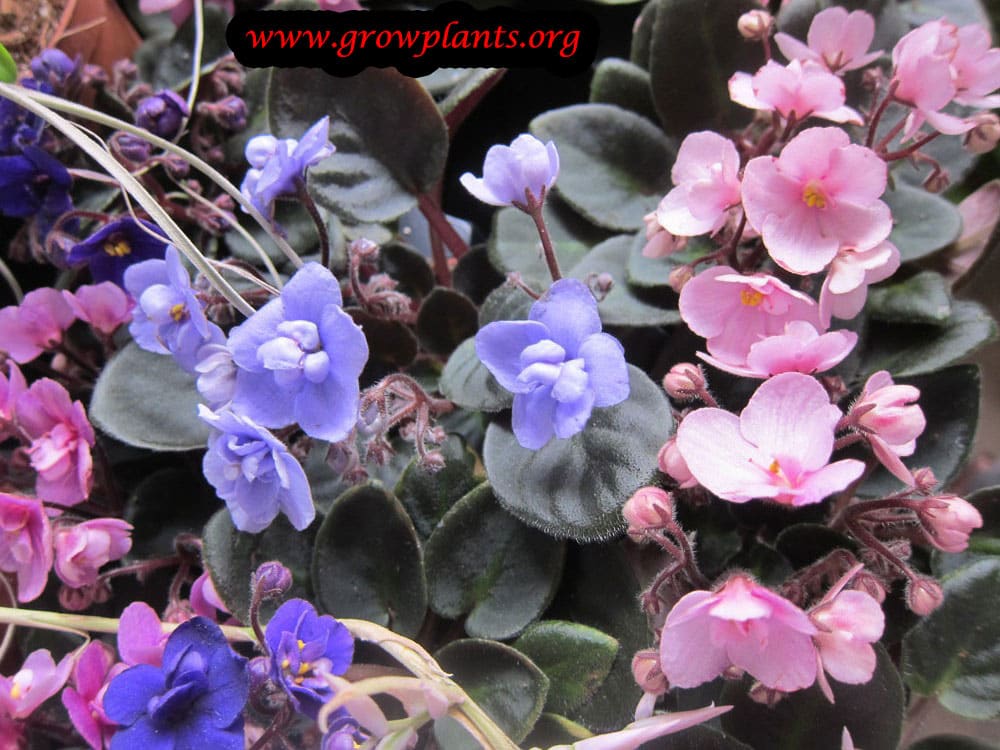
- Leaves & Foliage: Green, softly hairy, oval to rounded leaves arranged in a symmetrical ground-hugging rosette.
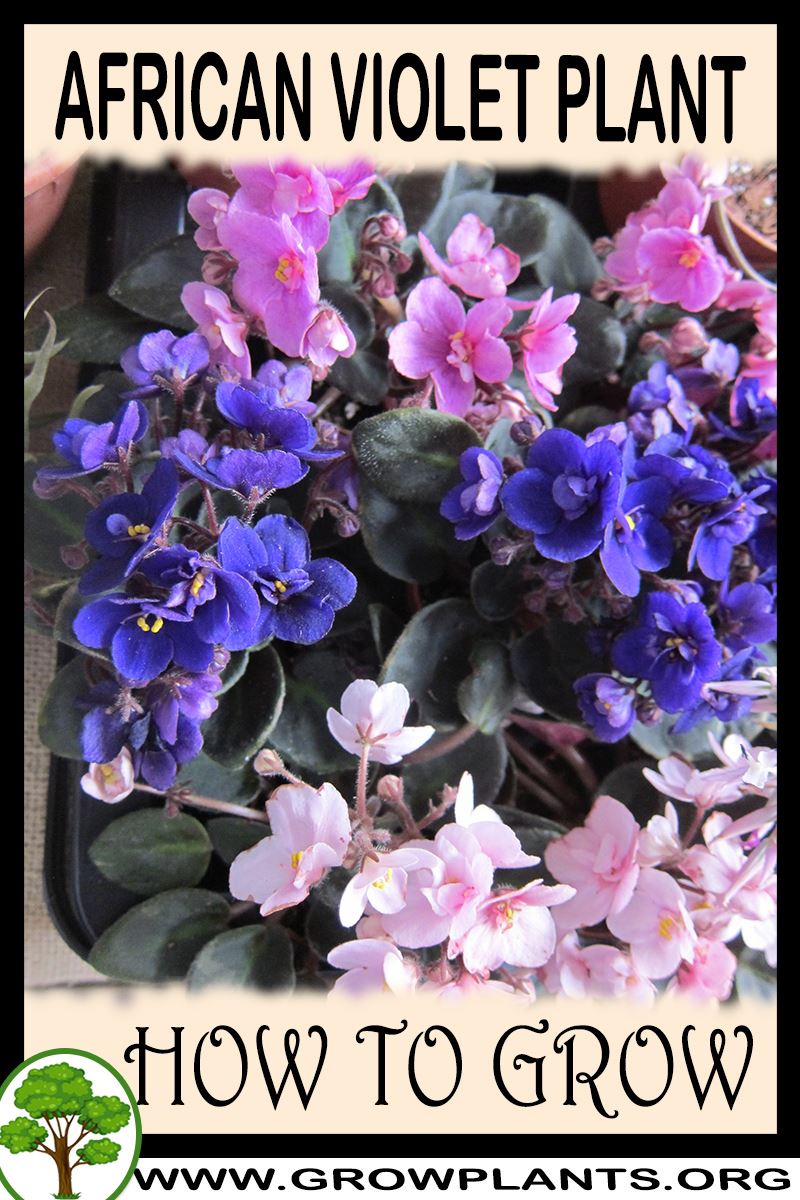
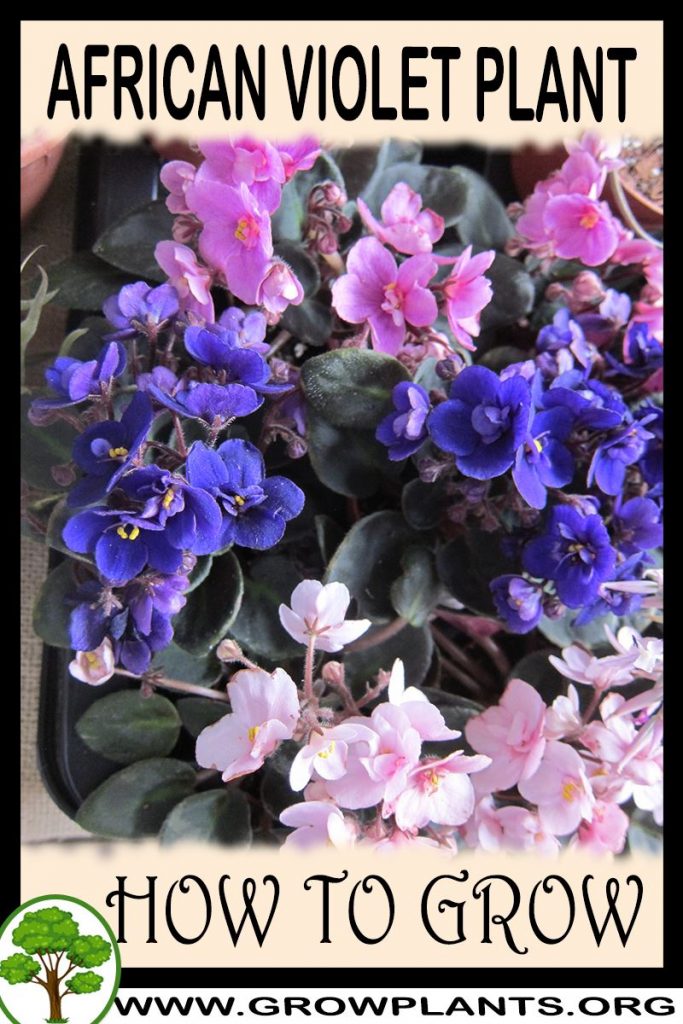
- Flower Characteristics: Clusters of five-petalled flowers in blue, pink, red, white or purple (often bicoloured) with a yellow eye, carried on short stems.
Primary Uses & Landscape Value
- Functional & Ornamental Roles: A classic flowering houseplant for windowsills and indoor displays, valued for compact size, tolerance of low light and long, repeat blooming.
Care Guide: Planting, Soil & Watering
Overview: African violet (Saintpaulia) is a compact, evergreen houseplant grown for its velvety leaves and near constant blooms, kept indoors in bright, indirect light in most climates (outdoors only in tropical zone 13+). It wants a light, well-draining, slightly acidic potting mix kept lightly moist, and dislikes cold, soggy soil and water splashed on its leaves and crown.
Quick Care Requirements
| Requirement | Ideal Condition |
|---|---|
| Planting Season | Any time indoors; repot into fresh mix during active growth |
| Growth Rate | Moderate |
| Soil Type | Light, porous, well-draining potting mix (peat with perlite/vermiculite) |
| Soil pH | Slightly acidic (about 6.0-6.5) |
| Water Need | Moderate; keep lightly moist, never soggy |
Planting & Establishment
- Best Planting Season: Being an indoor plant, it can be potted or repotted at any time of year, though it settles fastest when repotted during active growth in the warmer months.
- How to Plant:
- Hole Preparation: Choose a small, shallow pot only a little larger than the root ball – African violets bloom best slightly pot-bound – and ensure it has drainage holes.
- Soil Amendments: Use a light, porous mix such as a dedicated African-violet blend or peat with perlite and vermiculite, so the roots get air and the mix never packs down and stays wet.
- Planting Depth: Set the plant with the crown right at the soil surface, never buried, so the leaf rosette sits just above the mix and the crown cannot rot.
- Growth Speed & Expectations: A moderate grower forming a low rosette; with good light it stays compact and flowers repeatedly through the year rather than making large size.
Soil, Watering & Drainage Care
- Soil Mix & Drainage Needs: Aeration and drainage are everything – use a fluffy, free-draining mix and a pot that drains, so the roots stay damp but never waterlogged. Refresh the mix periodically as it breaks down and compacts.
- Watering Schedule & Technique:
- Young / Newly Planted: Water a newly potted plant lightly to settle the mix, keeping it just moist while new roots form; avoid saturating the crown.
- Established: Keep the mix evenly, lightly moist – water from below or at the soil edge with room-temperature water, keeping it off the leaves and crown to prevent spotting and rot.
- Seasonal Adjustments: Water a little more in warm, bright spells and less in cool, dim conditions, always letting the surface just begin to dry before watering again.
Climate, Light & Hardiness
African violet is a tender tropical grown almost everywhere as an indoor flowering houseplant, thriving in warm, stable room temperatures and bright, filtered light with no direct sun. It has essentially no cold tolerance - it is chilled well above freezing and resents draughts and sudden temperature swings, so outdoors it belongs only in frost-free tropical climates.
Quick Climate Specifications
| Climate Zones | Tropical; grown as a houseplant in most regions |
| USDA Hardiness Zones | Zone 13+ (site data) - essentially frost-free tropics only outdoors; grown indoors everywhere cooler |
| Optimal Temp Range | approximately 18–24 °C (65–75 °F); comfortable across 15–26 °C (60–80 °F) |
| Cold Damage Begins | growth slows below about 15 °C (60 °F); chilling injury below roughly 13 °C (55 °F) |
| Approx. Survival Minimum | keep above about 10 °C (50 °F) |
| Frost Tolerance | None |
| Light Conditions | Bright, indirect light (no direct midday sun) |
Sunlight & Light Exposure
Optimal Light Setup
Bright, indirect light keeps the rosette compact and free-flowering - an east- or north-facing window, or a spot set just back from a brighter one, is ideal, and it also grows well under a fluorescent or LED grow light.
Shade & Heat Management
Direct midday sun scorches the soft, hairy leaves and bleaches their colour, so filter or diffuse strong light. Too little light has the opposite effect - lush leaves but few flowers.
Temperature Extremes & Hardiness
Indoor Comfort & Limits
It is happiest in ordinary warm room conditions, roughly 18–24 °C (65–75 °F), and comfortable across about 15–26 °C (60–80 °F). Growth slows as temperatures fall below about 15 °C (60 °F), chilling injury sets in below roughly 13 °C (55 °F), and it should always be kept above about 10 °C (50 °F).
Cold Damage & Draughts
It is very sensitive to cold and to abrupt temperature change: avoid cold draughts, unheated rooms and contact with cold winter window glass, all of which chill and mark the foliage. Cold water on the leaves can also cause pale spotting, so protect it from cold shocks of every kind.
Frost Sensitivity
There is no frost tolerance whatsoever - even a light frost is fatal, which is exactly why it is kept indoors outside the frost-free tropics.
Wind, Humidity & Microclimate
Humidity Preferences
Reflecting its humid tropical origins, it prefers moderate to fairly high humidity, around 40–60%, and is very sensitive to dry air near heaters and air-conditioning.
Dry-Air Tolerance
Dry indoor air is poorly tolerated - standing the pot on a humidity tray or grouping it with other plants raises local moisture, though the leaves themselves should be kept dry.
Microclimate Recommendations
A warm, brightly lit, draught-free spot with steady temperature and moderate humidity is the ideal microclimate; chilly windowsills, cold draughts and dry heater air are its main enemies.
Growing in Pots, Balconies & Indoors
African violet (Saintpaulias) is a classic, compact houseplant – the grower grows it indoors and in pots, and it is one of the easiest flowering plants for a bright windowsill. It stays small (about 5-40 cm / 2-16 in) and, in a warm, humid spot, flowers for much of the year.
Quick Details
- Container Size: Small and snug – a shallow pot only a little wider than the rosette; it flowers best when slightly pot-bound.
- Indoor Suitability: An excellent houseplant in bright, indirect light (no direct midday sun).
- Best Spot: A warm room, roughly 15-26 C (60-80 F), with high humidity and bright but filtered light – an east or north window is ideal.
- Soil & Drainage: Light, aerated mix (peat or coir with perlite); free-draining and never soggy.
- Watering in Pots: Keep evenly moist with room-temperature water; do not overwater.
Indoors & On the Windowsill
- A star houseplant: Give it bright, filtered light – direct sun scorches the leaves, while too little light stops it flowering. An east or north sill is perfect.
- Warmth & humidity: Keep it above 15 C (60 F), ideally 15-26 C (60-80 F), with high humidity – standing the pot on a tray of damp pebbles helps.
- Watering care: Water at the soil with room-temperature water and avoid wetting the leaves, which can mark them; let the surface just dry between waterings and never leave the pot waterlogged.
On a Balcony or Patio
- Sheltered shade only: It can spend warm spells outdoors in bright shade, sheltered from direct sun, wind and cold – but bring it back inside well before temperatures fall below about 15 C (60 F).
Choosing the Pot, Soil & Long-Term Care
- Pot & drainage: A small pot with drainage holes; empty the saucer so it never stands in water.
- Potting mix: A light, airy mix – a dedicated African violet mix, or peat/coir with perlite.
- Feeding: Feed lightly and regularly through the growing season with a bloom-type feed, as nutrients leach quickly from the small volume of mix.
- Repotting: Refresh the mix and move up a size only when it becomes crowded – these plants flower best kept slightly snug.
Growing this plant in a greenhouse
A greenhouse can give african violet plant frost protection and cold protection.
Greenhouse at a glance
| Greenhouse suitability | Conditional - depends on your climate |
|---|---|
| Main benefits | frost protection, cold protection |
| Season extension | earlier spring & later autumn |
| Outdoor protection advisable below | about 15°C |
| Maintain greenhouse minimum | around 15°C for active growth |
| Suitable types | heated greenhouse, polycarbonate greenhouse |
| Heating | Heating is recommended in cold climates for continuous growth. |
Related greenhouse guides
- Greenhouses: How to Choose the Right Greenhouse
- Best Greenhouse Heaters
- Greenhouse Climate Control: Temperature, Ventilation and Humidity
- Polycarbonate Greenhouses: What to Look for Before Buying
Fertilizing & Feeding
A light feeder that does best with dilute balanced fertilizer during active growth and bloom, easing off as the plant slows for winter.
Quick Fertilizing Specs
| Feeding Level | Light |
|---|---|
| Main Nutrient Priority | Balanced nutrition with adequate nitrogen; no high-phosphorus bloom boosters |
| Best Feeding Period | Through the active growing and blooming season |
| Organic Options | Compost, well-rotted manure, or a balanced organic fertilizer |
| Soil pH | Slightly acidic to near neutral |
| Reduce/Stop Feeding | Reduce and stop feeding during the low-light winter slowdown |
Feeding by Growth Stage
Spring growth flush
Support strong new leaves and stems as the plant breaks into active growth.
| Nutrient direction | A balanced complete fertilizer with adequate nitrogen to fuel foliage and stems. |
|---|---|
| Timing | As new growth begins in spring. |
| Frequency | Feed steadily through the active growth period, easing back as blooming approaches. |
| Fertilizer types | Balanced complete garden fertilizer, Slow-release granular fertilizer, Compost or other organic matter worked into the soil |
| Precautions | Avoid heavy nitrogen, which can push soft leafy growth at the expense of flowers. |
Blooming period
Sustain flowering with steady, balanced nutrition without forcing excess foliage.
| Nutrient direction | A balanced complete fertilizer; adequate nitrogen alongside potassium supports continued bloom, and high-phosphorus bloom boosters are not needed. |
|---|---|
| Timing | Through the flowering season. |
| Frequency | Keep feeding light and steady while the plant is in bloom. |
| Fertilizer types | Balanced complete fertilizer, Liquid feed for garden and container plants |
| Precautions | Skip high-phosphorus bloom formulas; they do not increase flowering and can build up in the soil. |
Repeat and extended bloom
Keep a long- or repeat-blooming plant fed steadily so flowering continues over an extended season.
| Nutrient direction | Light, steady balanced feeding to replace nutrients drawn down by continuous flowering. |
|---|---|
| Timing | Across the extended blooming period. |
| Frequency | Feed lightly and consistently while flowering continues. |
| Fertilizer types | Balanced liquid fertilizer, Slow-release granular fertilizer |
| Precautions | Avoid overfeeding; excess nitrogen favors leaves over flowers. |
Low-light winter slowdown
Let an indoor plant coast through the darker, cooler months when growth naturally slows.
| Nutrient direction | None – withhold fertilizer while growth is slow in low light. |
|---|---|
| Timing | Through the low-light winter months. |
| Frequency | No feeding at this stage. |
| Fertilizer types | No feeding at this stage; do not fertilize until active growth and blooming resume. |
| Precautions | Do not fertilize a plant that is not actively growing; resume once new growth appears. |
Nutrient Deficiency Signs & Corrections
Older, lower leaves turn pale green to yellow and overall growth slows.
| Possible causes | Low soil nitrogen or infrequent feeding, Nitrogen leached out by heavy watering or from sandy soil, Cold soil early in the season limiting uptake |
|---|---|
| Appears first on | Older, lower leaves |
| What to check | Recent feeding history, Soil drainage and watering habits, Soil temperature in early spring |
| Possible correction | Apply a balanced complete fertilizer at its labeled rate and make sure the soil is warm and evenly moist. |
New leaves yellow between the veins while the veins themselves stay green.
| Possible causes | High soil pH reducing iron availability, Poor drainage or waterlogged roots, Genuinely low iron in the soil |
|---|---|
| Appears first on | Youngest leaves |
| What to check | Soil pH, Drainage and root health, Signs of overwatering |
| Possible correction | Correct soil pH and improve drainage; apply a chelated iron product per its label if the problem persists. |
Leaf edges and tips brown and scorch, sometimes with a whitish crust on the soil surface.
| Possible causes | Over-application of fertilizer and salt buildup, Insufficient leaching, especially in containers, Underwatering that concentrates salts in the root zone |
|---|---|
| Appears first on | Leaf tips and margins |
| What to check | Recent fertilizer amounts, Salt crust on the soil or pot rim, Whether watering wets the whole root zone |
| Possible correction | Cut back on feeding and leach the root zone thoroughly with plain water to flush out the excess salts. |
The plant makes lush leafy growth but produces few flowers.
| Possible causes | Excess nitrogen from over-feeding, Too much shade or insufficient light, An immature or heavily pruned plant |
|---|---|
| Appears first on | Whole plant, where vegetative growth dominates |
| What to check | Nitrogen inputs and fertilizer type, Light exposure, Plant maturity and recent pruning |
| Possible correction | Ease off nitrogen, switch to a balanced fertilizer, and make sure the plant gets enough light. |
Pruning, Training & Seasonal Maintenance
African violet (Saintpaulia) is a small rosette houseplant, so it has no pruning in the woody sense — upkeep is grooming a single, symmetrical crown of leaves. The useful tasks are removing spent flower stalks and tired outer leaves, pulling off side crowns (suckers) so the plant channels energy into blooming rather than splitting, and, over time, re-setting the plant lower when its bare “neck” elongates. Done regularly, this keeps a compact rosette that flowers almost continuously indoors.
Quick Pruning & Maintenance Specs
| Pruning Tolerance | Low — grooming only, no cutting-back |
| Primary Maintenance Window | Year-round, whenever leaves or flowers are spent |
| Typical Frequency | A little and often |
| Main Objective | Keep one tidy crown and steady bloom |
| Young Plant Priority | Remove side crowns early to build one strong rosette |
| Mature Plant Priority | Deadhead, strip old outer leaves, re-set an elongated neck |
| Best Tool Type | Precision snips (or a clean fingernail pinch) |
| Avoid Removing | Healthy inner leaves and developing flower stalks |
Pruning by Plant Age & Size
Newly Established
Leave a young plant to build its rosette; remove only leaves damaged in handling. If it is a single-crown type, rub out any side shoots early so it does not divide.
Young / Formative
No structural training exists. The only “shaping” is keeping the plant to one crown by removing suckers, and turning the pot periodically so the rosette grows evenly toward the light rather than lopsided.
Mature / Established
Regularly deadhead finished flower stalks and remove the oldest, flattest outer leaves as they yellow. When the plant develops a bare, palm-tree-like neck below the leaves, refresh it: either bury the neck deeper at the next repot or behead and re-root the rosette so the crown sits at soil level again.
Structural Pruning & Training
There is none — no stems to select or shorten. The plant is managed by grooming leaves and flowers and by keeping it to a single crown.
Special Growth to Remove
Side crowns and suckers are the key thing to remove on standard single-crown violets: left in place they split the plant and reduce flowering. Also remove spent flower stalks at the base and any leaf that is broken, spotted or badly aged. Retain all healthy inner foliage — the young central leaves carry the flowers.
Container & Small-Space Pruning
This is a container plant by nature and is kept deliberately small. Match a shallow pot to the rosette (violets bloom best slightly pot-bound), remove suckers to stay single-crowned, and reset the neck at repotting. If the rosette outgrows a balanced look, it is refreshed by re-rooting the crown rather than cut back.
Cut Placement & Technique
Snip flower stalks and leaf stalks cleanly at the base, close to the main stem, without leaving stubs that rot. Suckers can be gently pinched or cut out where they emerge between the leaf axils. Keep water and cut debris off the crown, which is prone to rot.
Post-Pruning Care
No feeding is triggered by grooming. Keep the plant warm (above about 15°C), in bright indirect light, with careful watering that never sits on the crown — this species is very sensitive to cold and to wet leaves, so clean cuts and dry foliage matter more than any aftercare.
Common Pruning Mistakes
- Leaving suckers to form multiple crowns, which crowds the plant and cuts flowering.
- Removing healthy inner leaves — these carry the blooms; only the old outer ring should go.
- Leaving leaf-stalk stubs that rot back into the crown.
- Ignoring the elongating neck until the plant is unstable, instead of re-setting it at repotting.
When NOT to Prune
Avoid stripping leaves in cold conditions or right after repotting, when the plant is already stressed. Do not remove more than the old outer leaves at once — a violet needs its rosette intact to keep blooming.
Recommended Tools (by task)
- precision_snips — the only tool needed: deadheading, removing old outer leaves, and taking out side suckers cleanly at the base.
Propagation Guide
African violets are propagated most easily from leaf-petiole cuttings, which sprout new plantlets at the base; most cultivars come true this way. The exceptions are chimera (pinwheel and striped) forms, which do not reproduce their pattern from a leaf and must instead be grown on from suckers or division — overall an Easy plant to propagate.
Quick Propagation Specs
| Best Propagation Method | Leaf-petiole cuttings |
| Alternative Methods | Division / removal of offsets (suckers) |
| Propagation Difficulty | Easy |
| Seed True-to-Type | Variable — seed is rarely used and does not keep a named form |
| Vegetative True-to-Type | Yes for most cultivars; chimera (pinwheel/striped) forms must be grown from suckers, not leaves |
| Best Propagation Season | Any time indoors, in warmth |
| Cutting Rooting Time | Roots in a few weeks; plantlets appear somewhat later |
| Germination Temperature | Warm room conditions, about 18–24°C (65–75°F) |
Leaf & Root Cuttings
Cutting Preparation
Choose a healthy mature leaf and cut it with about 3–4 cm (1–1.5 in) of leaf stalk (petiole).
Rooting Setup
Root the petiole in water or, better, insert it at a slight angle into a light, moist mix; keep it warm (about 18–24°C / 65–75°F) and humid, and avoid waterlogging the crown.
Rooting & Plantlets
Roots form within a few weeks, and clusters of small plantlets push up from the base of the petiole somewhat later. Separate these plantlets and pot them individually once they can be handled.
Variegation & Chimera Note
Ordinary variegated leaves usually reproduce from a leaf cutting, but chimera (pinwheel/striped) flower patterns do not — to keep those, propagate from suckers or by division instead.
Division, Offsets, Pups & Suckers
Plants that form multiple crowns or side rosettes (suckers) can be divided; detach an offset with some roots and pot it up. This is the required method for keeping chimera cultivars true.
Bloom & Edible Flower Guide
Quick Details
- Bloom Season: Most of the year – near-continuous indoors with good light
- Time to First Bloom: From a leaf cutting, usually several months; established plants rebloom almost constantly
- Flower Appearance: Five-petalled flowers with a yellow eye, in blue, pink, red, white or purple, often bicoloured, in clusters above the rosette
- Edibility: Edible – the flowers are non-toxic and are often crystallised to decorate cakes and desserts
Detailed Blooming Overview
African violets are loved as houseplants precisely because they bloom for so much of the year. Small clusters of velvety flowers rise on short stalks just above the rosette of rounded, softly hairy leaves, and with steady warmth and bright, indirect light a healthy plant is rarely without flowers.
Flower Characteristics
- Five petals with a bright yellow central eye; colours span blue, pink, red, white and purple, often more than one shade on a bloom.
- Flowers are carried in small clusters on stems above the leaves.
- Edible and non-toxic – frequently candied or crystallised as a decoration.
Bloom Care & Thinning
- Keeping it in bloom: Give bright, indirect light and steady warmth, and feed with a bloom-type fertiliser during active growth.
- Watering: Avoid splashing the flowers and leaves – water from below or at the soil to prevent spotting.
- Tidying: Pinch off spent blooms to encourage the next flush.
Bloom Health & Protection
- Thrips: These feed on pollen and petals and can streak the flowers; removing affected blooms and treating with insecticidal soap or neem helps break the cycle.
- Botrytis (grey mould): Damp, still air can spot the flowers with grey mould; better airflow and prompt removal of faded blooms keep it away.
Pests, Diseases & Troubleshooting
Overview: African violets are prized but fussy: their most damaging problem is the microscopic cyclamen mite that deforms the crown, closely followed by crown and root rot from overwatering or water in the crown. Sap-sucking pests are secondary. Grow them in bright indirect light, water carefully from below, and keep new plants in quarantine.
Quick Troubleshooting Overview
| Issue / Pest | Main Symptom | Primary Solution |
|---|---|---|
| Cyclamen mites | Stunted, greyish, distorted crown and flowers | Isolate/discard; strict hygiene between plants |
| Mealybugs | White cottony tufts in axils and roots | Surgical spirit dab; insecticidal soap; fresh mix |
| Crown / root rot | Soft, mushy, collapsing centre | Bottom-water; never wet the crown; free-draining mix |
| Powdery mildew | White powder on leaves and flowers | Improve airflow; bicarbonate or houseplant fungicide |
| Ring spot | Yellow/brown rings from cold water or sun | Tepid water to the soil; keep off the foliage |
Common Pests & Management
- Cyclamen mites (Phytonemus pallidus):
- Symptoms: Microscopic mites that attack the growing centre; new leaves become stunted, thickened, brittle, greyish and hairy, flowers are distorted or fail to open, and the crown puckers. Damage is easily mistaken for a virus and is the most serious pest of these plants.
- Prevention & Control: Isolate and usually discard badly infested plants, as the mites are invisible and hard to eradicate; keep new plants separate for weeks before mixing them in. Wash hands and tools between plants, avoid overcrowding, and use a labelled miticide only on valuable specimens.
- Mealybugs (Pseudococcus / Planococcus spp.):
- Symptoms: White cottony tufts in leaf axils, on flower stalks and – with root mealybugs – on the roots and inside the pot; sticky honeydew, stunting and slow decline follow.
- Prevention & Control: Dab visible colonies with a cotton bud dipped in surgical spirit; isolate the plant; for root mealybugs, discard the soil and wash the roots or start afresh from a clean leaf cutting. Repeat insecticidal soap or a systemic houseplant treatment as needed.
- Aphids (Myzus persicae):
- Symptoms: Soft green or black insects clustered on flower stalks, buds and new leaves, with sticky honeydew, distorted blooms and sooty mould; they can also spread viruses.
- Prevention & Control: Wipe or rinse off small colonies (protect the crown from prolonged wetting); isolate the plant; treat with insecticidal soap, taking care with the soft, hairy leaves. Remove badly infested flower stalks.
- Thrips (Frankliniella occidentalis):
- Symptoms: Streaked, distorted petals and spilled pollen on the flowers, silvery flecking on leaves, and fast-moving slender insects; they shorten bloom life and spread viruses.
- Prevention & Control: Remove affected flowers to break the cycle; use blue sticky traps to monitor; isolate new plants. Spray insecticidal soap or spinosad, treating repeatedly as thrips are hard to clear.
- Fungus gnats (Bradysia spp.):
- Symptoms: Small dark flies running over the soil surface and pots; their larvae feed in constantly moist, peaty compost and can damage fine roots and young cuttings.
- Prevention & Control: Let the surface dry between waterings and avoid overwatering; use yellow sticky traps and a Bt (israelensis) or nematode soil drench; a layer of grit on the surface deters egg-laying.
Diseases & Fungal Issues
- Crown & root rot (Pythium / Phytophthora / Rhizoctonia):
- Symptoms: The crown turns soft, brown and mushy and the plant collapses – usually from overwatering, water sitting in the crown, cold water, or burying the crown too deep. The single commonest killer of these plants.
- Treatment & Management: Water from below or carefully at the soil edge, never into the crown; use a light, free-draining mix and a pot that is not too big; keep the crown at soil level. Remove rotted plants; a healthy leaf can be re-rooted to start over.
- Powdery mildew (Oidium / Golovinomyces spp.):
- Symptoms: White powdery patches on leaves, stems and flowers in still, humid, crowded conditions; blooms are spoilt and growth weakens.
- Treatment & Management: Improve air circulation and space plants out; avoid wetting the foliage and reduce humidity around the leaves; remove affected parts. A labelled houseplant fungicide or potassium-bicarbonate spray clears stubborn cases.
- Botrytis (grey mould) (Botrytis cinerea):
- Symptoms: Fuzzy grey mould on faded flowers and damaged or crowded leaves in cool, damp, still air, rotting the tissue it colonises.
- Treatment & Management: Remove spent blooms and dead leaves promptly, improve ventilation, and avoid leaving water on the foliage. Reduce humidity; a biofungicide helps under persistent pressure.
- Downy mildew (Peronospora spp.):
- Symptoms: Pale, mottled patches on the upper leaf surface with greyish fuzzy growth beneath, mainly a problem on Streptocarpus in cool, damp, humid conditions.
- Treatment & Management: Increase airflow and reduce humidity and leaf wetness; remove affected leaves; isolate new plants. Space plants generously and, if needed, use a labelled fungicide.
Growing Difficulties & Abiotic Problems
- Ring spot & leaf marking from cold water:
- Cause & Symptoms: Pale yellow or brown rings and blotches appear where cold water or direct sun has touched the hairy leaves – a physiological injury, not a disease.
- Correction Strategy: Water with tepid water applied to the soil, not the foliage; avoid splashing leaves and keep plants out of harsh direct sun and cold draughts.
- No flowers / poor bloom:
- Cause & Symptoms: Too little light, the wrong temperature, over-feeding with nitrogen, or a pot that is too large keeps plants leafy but flowerless.
- Correction Strategy: Give bright, indirect light (a bit more for Streptocarpus), steady warmth, and a balanced or high-potassium feed; keep plants slightly pot-bound to encourage blooming.
- Overwatering & poor drainage:
- Cause & Symptoms: Constantly soggy, airless compost suffocates the fine roots, yellowing leaves and inviting crown rot and fungus gnats.
- Correction Strategy: Use a light, airy mix, water only when the surface begins to dry, and never let the pot stand in water; wick- or bottom-watering suits these plants well.
- Leaf scorch & edge browning:
- Cause & Symptoms: Direct hot sun, dry air, fertiliser salt build-up or low humidity browns and crisps the delicate leaf edges.
- Correction Strategy: Move to bright but filtered light, raise humidity modestly, flush the pot occasionally to clear salts, and feed at a dilute rate.
What Helps – Products & Tools
These delicate, hairy-leaved plants are best treated gently: use insecticidal soap and light horticultural oil for aphids, thrips and mealybugs (test on a leaf first), surgical spirit on a cotton bud for mealybug spots, and yellow/blue sticky traps plus a Bt or nematode drench for fungus gnats. Cyclamen mites usually mean discarding the plant. For disease, airflow, careful bottom-watering and a potassium-bicarbonate or houseplant fungicide handle mildew and botrytis.
Frequently Asked Questions
How do you care for an African violet?
African violets like bright, indirect light indoors and are hardy outdoors only in frost-free tropical zone 13+. Grow them in a light, well-draining, slightly acidic potting mix kept lightly moist, and keep them away from cold, soggy soil and water on the leaves and crown.
What size pot does an African violet need?
Use a small, shallow pot only a little wider than the plant’s rosette – African violets flower best when kept slightly pot-bound – and make sure it has drainage holes.
How do you propagate African violets?
The easiest way is from leaf-petiole cuttings: take a healthy leaf with about 3-4 cm (1-1.5 in) of stalk, root it, and new plantlets will sprout at the base of the petiole – roots form within a few weeks, with plantlets appearing somewhat later. Chimera (pinwheel/striped) forms don’t come true from a leaf cutting and must instead be grown from suckers or division.
Are African violets toxic to cats and dogs?
No – African violets are non-toxic, so they are safe to keep around cats and dogs.
Why won’t my African violet flower?
Poor blooming is usually caused by too little light, the wrong temperature, over-feeding with nitrogen, or too large a pot, which keeps the plant leafy but flowerless. Give it bright, indirect light, steady warmth, and a balanced or high-potassium feed, and keep it slightly pot-bound to encourage blooming.