Plant Profile & Key Characteristics
Overview: A caudex-forming, evergreen tuberous succulent 20-60 cm (8-24 in) high, clothed in dense silvery-white woolly leaves and bearing red-orange tubular flowers. Grown as an ornamental, drought-tolerant curiosity and houseplant.
Quick Specifications
| Specification | Attribute |
|---|---|
| Plant Type / Life Cycle | Herbaceous perennial (tuberous / caudiciform geophyte, succulent) |
| Foliage Type | Evergreen |
| Mature Size | 20-60 cm (8-24 in) |
| Growth Rate | Slow |
| Root System | Tuberous – grows from a swollen surface tuber (caudex) |
| Toxicity | Non-toxic – Sinningia (a Gloxinia relative) is not listed as toxic to cats or dogs |
| Hardiness | USDA zones 9-11 (grown indoors elsewhere) |
Growth Form & Structure
- Height & Spread: 20-60 cm (8-24 in) tall, well suited to pots where its caudex can be displayed.
- Growth Habit & Form: Succulent geophyte with a woody surface tuber (caudex) from which woolly-leaved shoots emerge.
- Lifespan & Maturity: A long-lived caudex plant valued by collectors; rests and re-sprouts from the tuber.
Anatomy & Physical Features
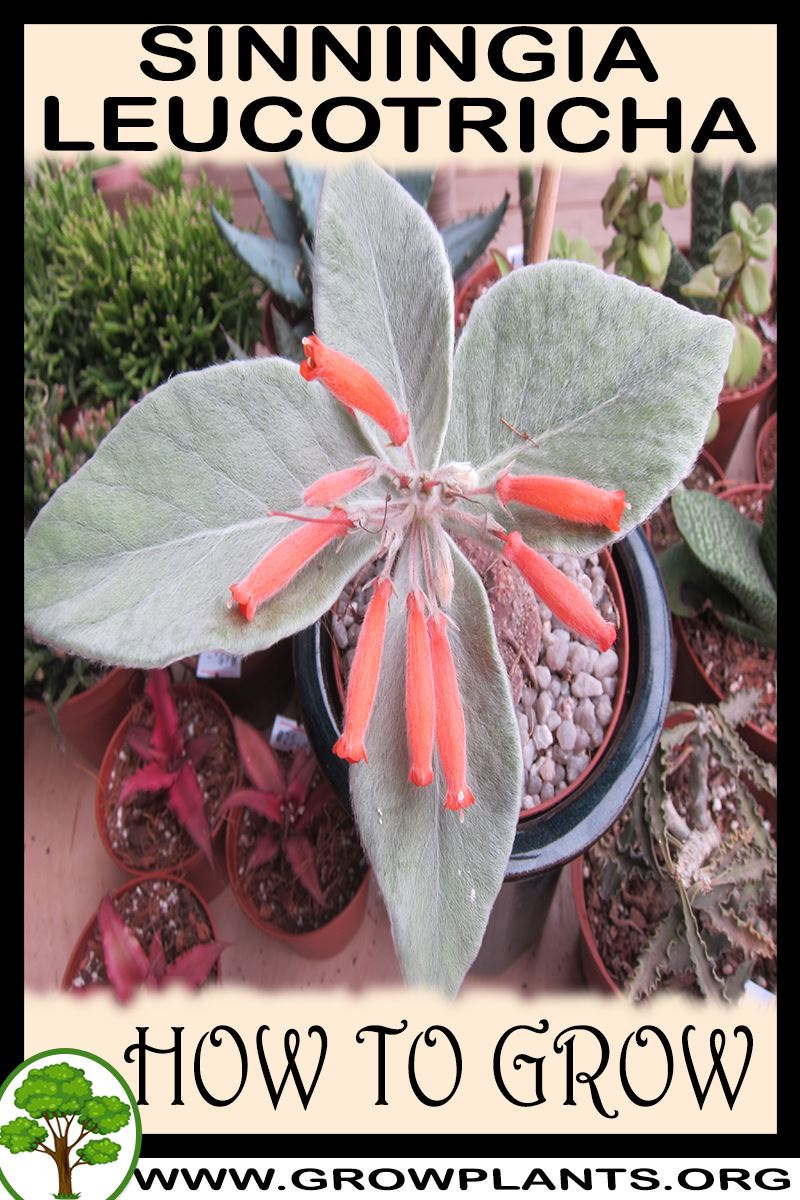
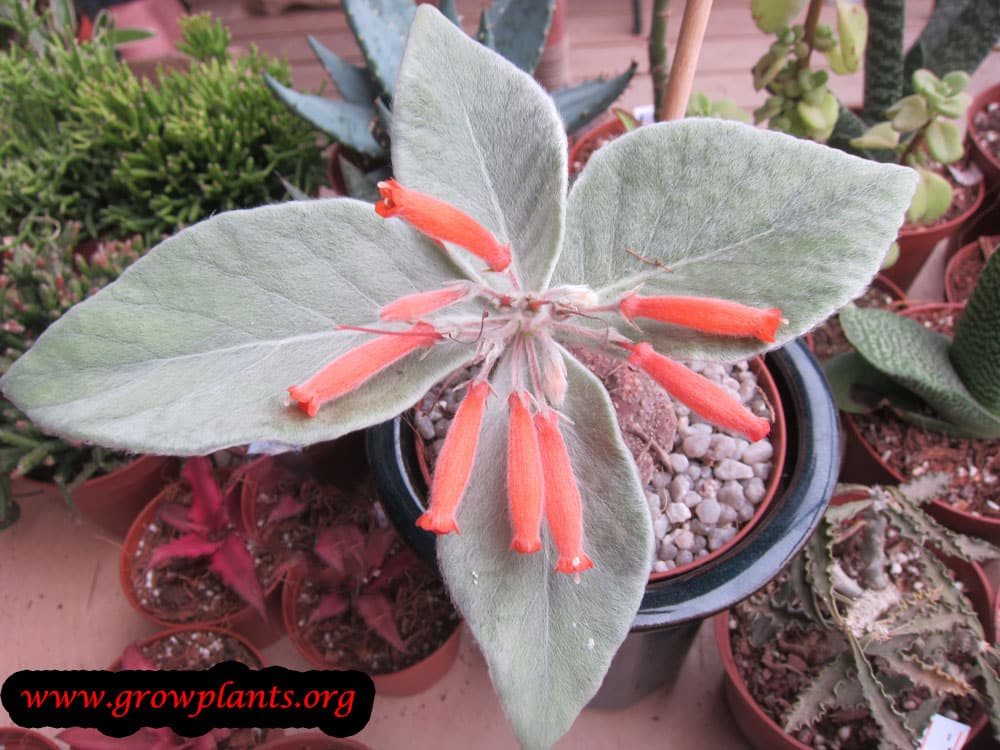
- Leaves & Foliage: Elliptic to deltoid leaves densely covered in silvery-white hairs, giving a felted, edelweiss-like look.
- Flower Characteristics: Red-orange, cone-shaped tubular flowers in clusters above the leaves.
Primary Uses & Landscape Value
- Functional & Ornamental Roles: An ornamental, drought-tolerant houseplant, a caudex/collector’s succulent and a container specimen.
Care Guide: Planting, Soil & Watering
Overview: Sinningia leucotricha (Brazilian Edelweiss) is a caudex-forming, drought-tolerant plant that grows best in bright, indirect light with well-drained soil. Its swollen caudex stores water, so it needs only light watering and sharp drainage to avoid rot.
Quick Care Requirements
| Requirement | Ideal Condition |
|---|---|
| Planting Season | In spring or summer during active growth |
| Growth Rate | Slow |
| Soil Type | Well-drained, gritty soil |
| Water Need | Low — let the soil dry between waterings |
Planting & Establishment
- Best Planting Season: Plant in spring or summer as growth resumes; it is suited to zones 9–11, so protect it from frost and grow it indoors where winters are cold.
- How to Plant:
- Hole Preparation: Make a hole slightly wider than the root ball in free-draining soil or a gritty potting mix.
- Soil Amendments: Mix perlite, grit or coarse sand into the medium to sharpen drainage; a lean, open mix suits the water-storing caudex.
- Planting Depth: Set the plant with the top of the caudex at or just above the soil surface — keeping the caudex partly exposed helps prevent rot.
- Growth Speed & Expectations: Slow growth; the woody caudex enlarges over years and sends up silvery-hairy shoots with red-orange flowers in the warm season.
Soil, Watering & Drainage Care
- Soil Mix & Drainage Needs: Use a gritty, free-draining succulent mix; in pots ensure excess water escapes freely, as the caudex and roots rot in soggy soil.
- Watering Schedule & Technique:
- Young / Newly Planted: Water lightly after planting to settle the roots, then let the soil dry before watering again.
- Established: Water sparingly during active growth once the soil has dried; the caudex tides it over dry spells.
- Seasonal Adjustments: Give a little more in warm active growth and keep it nearly dry during winter dormancy, when the top may die back.
Climate, Light & Hardiness
Sinningia leucotricha (Brazilian Edelweiss) is a tuberous, succulent-like geophyte for Mediterranean, desert and subtropical climates, also grown as a houseplant, in half to full shade. It stores water in a caudex and is drought-tolerant but frost-tender, so it separates high heat and dry-air tolerance from a genuine lack of frost hardiness.
Quick Climate Specifications
| Climate Zones | Mediterranean, desert, subtropical; grown as a houseplant elsewhere |
|---|---|
| USDA Hardiness Zones | Approximately 9–11 |
| Optimal Temp Range | Warm growing conditions during active growth |
| Cold Damage Begins | Damaged by more than light frost; foliage suffers as temperatures near freezing |
| Approx. Survival Minimum | The caudex may briefly tolerate a touch of light frost, but hard or prolonged freezing is damaging; keep essentially frost-free |
| Frost Tolerance | Very Low |
| Light Conditions | Half shade to full shade |
Sunlight & Light Exposure
Optimal Light Setup
Prefers half to full shade with bright, indirect light; the silvery, hairy leaves take some gentle sun but scorch in fierce, direct heat.
Shade & Heat Management
Protect from harsh midday sun in hot climates; bright shade keeps the felted foliage in good condition.
Best Exposure / Orientation
A lightly-shaded, warm, well-ventilated position - or a bright interior spot out of direct sun - suits it well.
Temperature Extremes & Hardiness
USDA Hardiness & Regional Limits
Suited to roughly USDA zones 9–11. It tolerates warm, dry conditions but not real frost, so outdoor culture is limited to essentially frost-free areas; elsewhere it is grown in containers and sheltered over winter.
Cold Damage & Winter Protection
More than light frost damages the plant. During its dry dormancy the caudex rests and should be kept cool but frost-free.
Frost Sensitivity
Frost-sensitive: light frost may be shrugged off briefly by the caudex, but freezing spells cause real harm.
Extreme Heat Tolerance
Tolerates considerable heat, particularly the dry heat of its native habitat - heat tolerance is a real strength, quite separate from its lack of frost hardiness.
Wind, Humidity & Microclimate
Humidity Preferences
Adapted to relatively low humidity; the felted leaves suit drier air and it does not need the humidity that thin-leaved tropicals demand.
Dry-Air Tolerance
Good - the water-storing caudex and hairy foliage make it well suited to dry-air conditions, a clear contrast with frost tolerance.
Microclimate Recommendations
A warm, bright-shaded, airy, frost-free niche - sharply drained and protected from winter wet-cold - keeps it healthy.
Growing in Pots, Balconies & Indoors
The grower confirms this Brazilian edelweiss makes a houseplant, and it is a lovely one – a silvery, felted tuberous succulent that enjoys the bright, dry warmth of a windowsill. Its drought tolerance makes it forgiving in a pot indoors.
Quick Details
- Container Size: A shallow 2-5 L pot, wide rather than deep, to sit the tuber (caudex) at the surface
- Indoor Suitability: Good – a bright, warm windowsill houseplant
- Best Spot: Bright light with some gentle sun; it takes part shade
- Soil & Drainage: Gritty, very free-draining succulent mix
- Watering in Pots: Water sparingly and let the mix dry between waterings; it stores water and hates being wet
Indoors & On the Windowsill
- A good houseplant: Give it a bright, warm spot; it copes with lower light than many succulents but colours and flowers best in good light. A ready-made cactus and succulent soil mix provides that structure without mixing it yourself.
- Dry rest: It naturally rests when cool or dark – ease off watering then and let the caudex sit almost dry until new growth appears.
- Windowsill: A sunny sill is ideal; keep water off the felted leaves and never leave it standing wet.
On a Balcony or Patio
- Light & shelter: Outdoors it enjoys a warm, bright spot in the frost-free season; being drought-tolerant it shrugs off dry pots, but shelter it from cold, wet weather.
- Overwintering: It cannot take more than light frost – bring it in and keep it dry and cool over winter.
Choosing the Pot, Soil & Long-Term Care
- Pot & drainage: A shallow 2-5 L pot with generous drainage holes; skip a standing water saucer to avoid root rot; terracotta breathes and dries faster, while glazed or plastic holds moisture longer.
- Potting mix: A gritty, fast-draining succulent or cactus mix with added perlite or coarse sand.
- Feeding: Feed lightly during active growth only; a little goes a long way in a small pot.
- Repotting: Refresh the gritty mix and check the tuber every couple of years, keeping the caudex proud of the soil.
Fertilizing & Feeding
A very light feeder: succulents need only occasional, dilute feeding in active growth and none during dormancy. Overfeeding does more harm than underfeeding.
Quick Fertilizing Specs
| Feeding Level | Light |
|---|---|
| Main Nutrient Priority | Low-nitrogen, sparing feeding |
| Best Feeding Period | Spring and summer active growth |
| Organic Options | Diluted balanced feeds in a lean, gritty mix |
| Soil pH | Prefers a near-neutral, fast-draining mix |
| Reduce/Stop Feeding | Stop feeding through winter dormancy |
| Micronutrients | Rarely needed; a complete fertilizer supplies traces |
Feeding by Growth Stage
Active growth
Support modest growth and flowering during the warm season without forcing soft growth.
| Nutrient direction | A dilute, low-nitrogen fertilizer; succulents need very little feeding. |
|---|---|
| Timing | Spring and summer during active growth. |
| Frequency | Feed sparingly through the growing season. |
| Fertilizer types | A low-nitrogen or balanced fertilizer used sparingly, A cactus and succulent fertilizer |
| Precautions | Overfeeding causes weak, stretched growth; keep feeding minimal. |
Dormant rest
Let the plant and its caudex rest during dormancy.
| Nutrient direction | None – withhold fertilizer while the plant is dormant. |
|---|---|
| Timing | Autumn and winter dormancy. |
| Frequency | No feeding during dormancy. |
| Fertilizer types | No feeding during dormancy – withhold fertilizer and keep the plant dry until growth resumes. |
| Precautions | Do not fertilize the dormant plant. |
Nutrient Deficiency Signs & Corrections
Weak, stretched, etiolated growth that flops or splits.
| Possible causes | Excess nitrogen from overfeeding, Too much fertilizer overall, Too little light compounding soft growth |
|---|---|
| Appears first on | New growth at the crown. |
| What to check | Feeding rate, Light levels |
| Possible correction | Reduce feeding and increase light so growth firms up. |
Brown, scorched leaf tips and damaged roots.
| Possible causes | Fertilizer-salt buildup in a lean mix, Poor drainage, Underwatering that concentrates salts |
|---|---|
| Appears first on | Leaf tips and root ends. |
| What to check | Feeding rate, Drainage and salt crust |
| Possible correction | Leach the mix with thorough watering and cut back the feeding rate. |
Pale color and stalled growth during the growing season.
| Possible causes | Long-exhausted potting mix, Root-bound plant, Extended period without any feeding |
|---|---|
| Appears first on | Older leaves and overall color. |
| What to check | Time since last repot, Whether roots fill the pot |
| Possible correction | Give a light, dilute feed during active growth and refresh the mix. |
Pruning, Training & Seasonal Maintenance
Brazilian edelweiss is a caudex-forming, silvery-furred tuberous gesneriad grown as a drought-tolerant curiosity for its swollen woody caudex and its clusters of red-orange tubular flowers, and like other caudex geophytes it wants almost no pruning. It grows soft, felted shoots from the top of the caudex, flowers, and then dies back for a semi-dormant rest. The only maintenance is grooming — removing spent flower clusters and the dead, faded furry leaves — and the prized caudex itself is never cut. It is a slow grower that does not tolerate structural or hard pruning, so the whole approach is minimal and conservative.
Quick Pruning & Maintenance Specs
| Pruning Tolerance | Low — groom only; the caudex must never be cut |
| Primary Maintenance Window | Any time a dead leaf or spent flower appears (facts note year-round) |
| Typical Frequency | Occasional — only as flowers fade and shoots die back |
| Main Objective | Keep the plant tidy; protect the caudex; allow a clean dormancy |
| Young Plant Priority | None beyond removing damaged growth — let the caudex develop |
| Mature Plant Priority | Remove spent flowers and dead furry leaves as shoots die back |
| Best Tool Type | Precision snips (a clean, sterile blade near the fleshy crown) |
| Avoid Heavy Pruning During | Always — it does not tolerate hard or structural cutting |
Pruning by Plant Age & Size
Newly Established
A young plant or sprouting caudex needs nothing but removal of a damaged leaf. Let the caudex swell and the felted shoots develop; there is no pinching or shaping to do.
Young / Formative
No training system applies. The plant’s character is its caudex and low, silvery shoots; it is not branched or trained. Growers displaying the caudex simply pot it high so the swollen base shows, rather than pruning for form.
Mature / Established
On an established plant, groom only: snip off spent flower clusters, and remove the soft furry shoots and leaves as they naturally yellow and die back toward dormancy. Leave the caudex entirely alone.
Special Growth to Remove
Remove faded flower clusters and the dead, felted leaves and shoots as they wither. Because the plant flowers on soft current-season shoots from the caudex rather than on persistent wood, there is no flowering-wood timing to manage — you simply tidy spent growth. There are no suckers or runners, and the woody caudex is a permanent feature to be preserved, never pruned.
Container & Small-Space Pruning
This is a container and caudex-display plant, and its care is grooming plus a dry rest: remove dead shoots as they die back, then keep the caudex cool, bright and nearly dry through dormancy until it resprouts. It needs no size control — it is naturally small and slow — and its main container risk is rot from overwatering the fleshy base, not overgrowth.
Tools
Precision snips are sufficient for the soft shoots and flower stalks. Because the tissue near the caudex is fleshy and can rot if bruised, a clean, sharp, sterile blade is preferable to tearing or pinching close to the crown. Nothing heavier is ever appropriate.
Tool Hygiene & Disease Risk
Hygiene is Routine but with care around the fleshy crown: use a clean, sharp (ideally sterile) blade so cuts near the caudex do not become rot entry points. The plant’s pests are slugs, snails and aphids rather than a blade-borne disease, but wet, bruised tissue on a caudex plant is the real hazard, so clean cuts and dry conditions matter more than disinfecting between cuts.
Cut Placement & Technique
Cut spent flower stalks and dying shoots cleanly, leaving no crushed stub against the caudex. Never cut into the caudex itself. If a shoot dies back, remove it back to firm tissue only, and keep the crown dry afterwards so the wound seals rather than rots.
Heavy Pruning & Rejuvenation
Brazilian edelweiss does not tolerate heavy or rejuvenation pruning. There is no woody canopy to renew, and cutting into the caudex or hard-cutting the plant risks rot and loss. Renewal is natural: the caudex rests and resprouts fresh shoots each season. Do not attempt to force new growth by cutting the plant back.
Post-Pruning Care
After grooming, keep the plant on the dry side — this is a drought-tolerant caudex plant that resents wet tissue at the crown. Do not feed into dormancy; simply keep the rested caudex cool and nearly dry, resuming light watering only when new shoots emerge.
Common Pruning Mistakes
- Cutting or damaging the caudex — the plant’s whole point — which invites rot.
- Removing soft shoots while they are still green and feeding the caudex, rather than waiting for natural dieback.
- Grooming and then overwatering the fleshy crown, causing rot at the cuts.
- Attempting to hard-prune it for shape, which it does not tolerate.
When NOT to Prune
Do not cut healthy green shoots that are still feeding the caudex, and never cut into the caudex. Avoid any cutting when the plant is wet or entering dormancy beyond removing clearly dead tissue.
Recommended Tools (by task)
- precision_snips — for removing spent flowers and dead furry shoots cleanly.
- grafting_knife — a clean, sterile blade for a tidy cut near the fleshy crown when a shoot must be removed close to the caudex.
Propagation Guide
Brazilian edelweiss is a caudex-forming gesneriad most often raised from its very fine seed; stem cuttings also root and can, in time, build their own swollen base. Its single caudex is not usually divided, so seed and cuttings are the practical routes. The fine seed makes it moderate rather than hard.
Quick Propagation Specs
| Best Propagation Method | Seed |
| Alternative Methods | Stem cuttings; separation of extra growth points where present |
| Propagation Difficulty | Moderate (very fine seed) |
| Seed True-to-Type | Mostly uniform for the species |
| Vegetative True-to-Type | Yes |
| Best Propagation Season | Spring to summer |
| Germination Temperature | Warm, about 21–24°C (70–75°F) |
| Seed Sowing Depth | Surface-sown; not covered (light required) |
Growing from Seed
Seed Handling & Sowing
The seed is dust-fine; sow it on the surface of a moist, gritty, free-draining mix and leave it uncovered, as light aids germination.
Germination Conditions
Keep warm at about 21–24°C (70–75°F) and humid with bright indirect light; expect slow, staggered emergence, then grow the seedlings on carefully to avoid rot in the free-draining mix.
Stem Cuttings
A firm stem cutting taken in the warm season roots in a free-draining, barely-moist mix under warmth and bright indirect light; over time such a cutting can develop its own caudex. Rooting hormone is optional, and the succulent tissue must be kept on the dry side to prevent rotting.
Division, Offsets, Pups & Suckers
A plant that has formed more than one growth point can occasionally be split, keeping roots and a bud on each piece; a solitary caudex is best left intact and propagated by seed or cuttings instead.
Bloom & Flower Guide
Quick Details
- Bloom Season: Spring and summer, typically as new growth emerges from the caudex
- Time to First Bloom: Once the tuberous caudex is mature and in active growth
- Flower Appearance: Tubular, cone-shaped red-orange flowers in clusters at the tips of the shoots
- Edibility: Ornamental only
Detailed Blooming Overview
Brazilian edelweiss is a caudex-forming relative of gloxinia, prized for its silvery, white-felted leaves. In spring and summer, fresh shoots push from the tuber and open clusters of tubular red-orange flowers at their tips, glowing against the silver foliage. Like other Sinningias it rests through the dormant season.
Flower Characteristics
- Tubular, cone-shaped flowers in red-orange.
- Carried in clusters at the tips of the new shoots, above the silvery leaves.
Bloom Care & Thinning
- Watering into bloom: Start watering as the caudex breaks dormancy to bring on the flowering shoots.
- Deadheading: Remove spent flowers to keep the plant tidy.
- After flowering: Ease off water and let the caudex rest before the next cycle.
Pests, Diseases & Troubleshooting
Overview: Sinningias are tender, tuberous gesneriads with soft, hairy foliage that is very attractive to tiny sap-sucking pests and prone to botrytis and tuber rot in cool, damp, still conditions. Warmth, gentle airflow, careful watering and scrupulous hygiene prevent most trouble.
Quick Troubleshooting Overview
| Issue / Pest | Main Symptom | Primary Solution |
|---|---|---|
| Thrips | Silvery streaks, distorted buds; can spread virus | Sticky traps; remove buds; insecticidal soap |
| Aphids | Clusters on soft tips & buds; honeydew | Rinse/wipe; insecticidal soap |
| Cyclamen & spider mites | Distorted, stunted new growth; stippling | Isolate; miticide/oil; discard if severe |
| Mealybugs / whitefly | Cottony tufts or white flies; honeydew | Alcohol swab / sticky traps; insecticidal soap |
| Botrytis (grey mould) | Fuzzy grey mould on leaves/flowers | Airflow; remove debris; avoid wet foliage |
| Tuber / crown rot | Soft, brown, collapsing base; sour soil | Ease off water; drainage; dust cut tuber |
Common Pests & Management
- Thrips (Frankliniella / Thrips spp.):
- Symptoms: Tiny slender insects causing silvery streaking and stippling on leaves, distorted or aborted flower buds with brown-flecked petals, and black specks of excrement; critically, they transmit tospoviruses (INSV/TSWV) that can destroy a plant.
- Prevention & Control: Monitor with blue or yellow sticky traps, remove infested buds and flowers, and treat with insecticidal soap, spinosad or neem, repeating to catch the fast life cycle. Isolate new plants and immediately discard any showing virus symptoms, as there is no cure.
- Aphids (Myzus persicae and others):
- Symptoms: Green, pink or black clusters on the soft new growth and flower buds, sucking sap, distorting growth, leaving honeydew, and spreading viruses.
- Prevention & Control: Wipe off or gently rinse small colonies (taking care with the brittle, hairy leaves), and use insecticidal soap for heavier numbers. Keep plants unstressed, avoid over-feeding, and isolate infested plants.
- Cyclamen & spider mites (Phytonemus pallidus / Tetranychus urticae):
- Symptoms: Cyclamen mites are microscopic and cause severely distorted, stunted, hardened new growth and deformed flowers at the crown; spider mites cause fine stippling and webbing in hot, dry air. Both are easily spread on hands and tools.
- Prevention & Control: Isolate affected plants immediately. Badly infested plants with cyclamen mite are often best discarded to protect a collection; otherwise treat with a suitable miticide or horticultural oil, and improve humidity for spider mites. Wash hands and tools between plants.
- Mealybugs & whitefly (Pseudococcus spp. / Trialeurodes vaporariorum):
- Symptoms: White cottony tufts in leaf axils and on the tuber (mealybug) or clouds of tiny white flies on leaf undersides (whitefly), both sucking sap and producing honeydew and sooty mould on the soft foliage.
- Prevention & Control: Spot-treat mealybugs with alcohol on a cotton bud and hang sticky traps for whitefly, following with insecticidal soap or neem to the undersides and repeating to catch crawlers. Check the tuber and roots at repotting for hidden mealybug.
Diseases & Fungal Issues
- Botrytis (grey mould) (Botrytis cinerea):
- Symptoms: Fuzzy grey-brown mould on leaves, stems and especially the soft flowers, with water-soaked collapse in cool, damp, still, or overcrowded conditions; fallen petals and dead leaves left on the plant are common infection sites.
- Treatment & Management: Increase airflow and warmth, avoid wetting the foliage and flowers, and remove spent blooms and dead leaves promptly (good hygiene is key). Space plants, water in the morning at the soil level, and use a copper or biological fungicide only if sanitation is not enough.
- Powdery mildew (Erysiphales):
- Symptoms: White powdery patches on the leaves and stems in crowded, humid, still conditions with poor light, distorting growth and disfiguring the plant.
- Treatment & Management: Improve airflow and light, thin congested growth, and avoid overcrowding. Remove affected leaves; a sulphur, potassium-bicarbonate or biological fungicide checks it, though better ventilation usually resolves it.
- Tuber & crown rot (Pythium / Phytophthora / Rhizoctonia / Fusarium spp.):
- Symptoms: Soft, brown, mushy decay of the crown and tuber with collapse of the plant and a sour, wet mix; caused by overwatering, water sitting in the crown, cold wet conditions, or infected, reused soil.
- Treatment & Management: Water carefully at the soil surface (never into the crown), use a free-draining, sterile mix, and keep dormant tubers barely moist and cool. Remove rotten tissue, dust cut surfaces of a salvaged tuber with sulphur or cinnamon, and repot into fresh mix.
Growing Difficulties & Abiotic Problems
- Cold-water leaf spotting:
- Cause & Symptoms: Pale, ringed or bleached spots appear where cold water or strong sun has hit the hairy leaves; the fine hairs hold water droplets that scald or chill the tissue.
- Correction Strategy: Water at the soil level with tepid water, avoid splashing the foliage, and keep the plant out of hot direct sun. Damaged leaves can be removed; new growth will be unmarked.
- Overwatering & crown rot:
- Cause & Symptoms: Yellowing, wilting despite wet soil, and a soft crown signal too much water or water lodged in the growing point — the commonest way these tubers are lost.
- Correction Strategy: Use a light, free-draining mix, water when the surface begins to dry, keep water out of the crown, and reduce watering sharply as the plant enters dormancy. Ensure the pot drains freely.
- Dormancy confusion:
- Cause & Symptoms: After flowering the top growth naturally yellows and dies back as the tuber goes dormant; this is mistaken for disease and the plant is often overwatered and rotted at this point.
- Correction Strategy: Recognise the natural rest: let the foliage die down, store the tuber cool and nearly dry, and resume watering only when new shoots appear. Do not keep a dormant tuber wet.
What Helps – Products & Tools
For these soft-leaved gesneriads use gentle tools: blue/yellow sticky traps and spinosad or insecticidal soap for thrips, insecticidal soap and neem for aphids, whitefly and mealybugs, alcohol swabs for spot-treating mealybugs, and a suitable miticide or horticultural oil for mites. Botrytis and mildew are met first with airflow and hygiene, backed by a copper or biological fungicide, and cut tubers are dusted with sulphur or cinnamon. Warmth, careful watering and a sterile free-draining mix are the real safeguards.